Home › Crypto Regulation › Kyrgyzstan
Bitcoin & Cryptocurrency Regulation in Kyrgyzstan
Quick answer — Kyrgyzstan, 2026
- Legal: Legal to own, trade and mine, not legal tender
- Tax: No dedicated personal crypto tax, mining taxed on electricity used
- Buying: Via financial-market-licensed VASPs, some global exchanges
Kyrgyzstan has become one of Central Asia's most active jurisdictions for digital assets. Cryptocurrency is legal and regulated under a dedicated framework, the Law "On Virtual Assets," which created licensing rules for exchanges, brokers, custodians and miners. Buying, holding, trading and mining crypto are permitted for residents and visitors who use licensed providers, and the government has gone further than most countries by allowing state-backed mining, building a national cryptocurrency reserve and supporting locally issued stablecoins. Cryptocurrencies are not legal tender, but a separate central bank digital currency, the digital som, has been given legal-tender status in law.
This page explains in plain terms how Bitcoin and other crypto-assets are treated in Kyrgyzstan as of 2026: who the regulators are, what the law says, how taxation and anti-money-laundering rules work, the practical steps for buying and using crypto, and the risks to weigh. The rules here have changed several times and continue to evolve, so treat this as a starting point and confirm the current position with the official regulator before acting. This is general information as of 2026 and is not legal, tax or financial advice; verify any specifics with the named official regulator, the Service for Regulation and Supervision of the Financial Market.
On this page: Legal status · Who regulates it · Taxes · How to buy · Mining
Is Bitcoin and crypto legal in Kyrgyzstan?
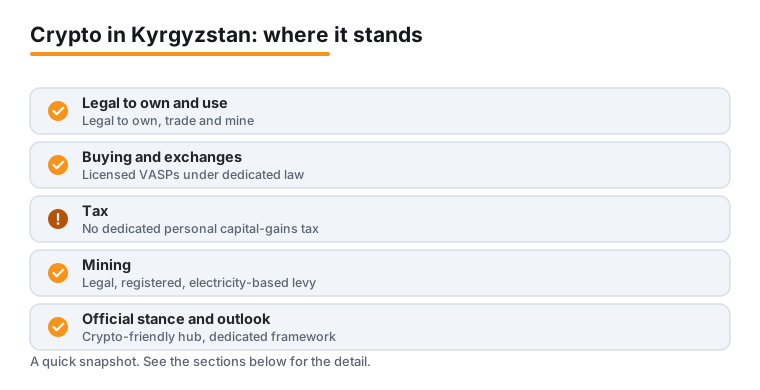
Yes. Buying, holding, selling and mining cryptocurrency are legal in Kyrgyzstan. The country does not treat Bitcoin or other cryptocurrencies as legal tender, but it has explicitly recognized them in law and regulates the businesses that handle them. In Kyrgyz legal texts these assets are referred to as "virtual assets" or "tokens."
The important distinction is between using crypto and providing crypto services. Individuals can generally own and trade crypto. Businesses that exchange, broker, transfer, issue, store or manage virtual assets on behalf of others must be licensed as Virtual Asset Service Providers (VASPs). Operating such a business without authorization is not permitted.
Because crypto is not an official means of payment, merchants are not required to accept it and prices are quoted in Kyrgyz som. Note that a separate, state-issued digital currency, the "digital som" (a central bank digital currency issued by the National Bank), will become legal tender under Constitutional Law No. 74 of 16 April 2025, which adds a new Chapter 4-1 to the Constitutional Law On the National Bank but does not enter into force until 1 January 2027; the Ministry of Justice legal database still records that law as not in force, and the implementing Law No. 88 of 29 April 2025 also takes effect on 1 January 2027, so through 2026 nobody is obliged to accept a digital som. That is distinct from decentralized cryptocurrencies like Bitcoin. For a broader primer, see our guide to crypto regulation.
Who regulates crypto in Kyrgyzstan?
The primary supervisor for cryptocurrency and virtual assets is the Service for Regulation and Supervision of the Financial Market under the Ministry of Economy and Commerce of the Kyrgyz Republic (often called the Financial Market Regulatory and Supervisory Service). It licenses VASPs, maintains the relevant registers and oversees the sector. Its official website is fsa.gov.kg, which publishes a dedicated "Virtual Assets" section with news, regulatory documents and draft acts.
The National Bank of the Kyrgyz Republic is responsible for monetary policy, the banking and payment system, and the digital som. Under the 2025 constitutional law, the National Bank holds the exclusive right to issue the digital som and to set the rules for its circulation. Anti-money-laundering supervision is handled by Kyrgyzstan's state financial-intelligence body within the national AML/CFT system, which is monitored under international standards through the Eurasian Group (EAG) and the Financial Action Task Force (FATF).
The picture changed with the amendments to the Law "On Virtual Assets" that the President signed on 20 January 2026. Law No. 3 of 19 January 2026 rewrote Articles 10 and 11 of the Law On Virtual Assets and split oversight into two bodies. Article 10 covers an authorised body for policy implementation and regulation, designated by the President. Article 11 covers a separate authorised body for supervision and control, designated by the Cabinet of Ministers. Presidential Decree No. 186 of 28 May 2026 filled the first slot by creating the National Agency for Virtual Assets and Blockchain Technologies under the President (NAVA), and ordered the financial market service to hand over within one month its virtual asset permits, digital registers and the Unified State Register of Virtual Asset Issuances. Cabinet Resolution No. 516 of 30 July 2026, in force from 9 June 2026, filled the second slot with the Service for Regulation and Supervision of the Financial Market and struck virtual asset regulation and licensing from its statute. NAVA now issues licences, registers virtual asset issues and publishes the registers at nava.gov.kg. The financial market service now carries out licence control and inspections, monitors AML and targeted financial sanctions compliance, watches mining pools, and publishes an annual report on the state of the market.
Alongside this, President Sadyr Zhaparov created a National Council for the Development of Virtual Assets and Blockchain Technologies under the President by a decree signed on 3 May 2025. The Council coordinates state policy, works on adapting national law to international standards and supports investment; its secretariat operates as a state institution under the President. Binance founder Changpeng Zhao was named a presidential advisor on virtual assets and added to the Council. Because authority has been moving between bodies, always confirm a provider's status directly with the financial-market service before depositing funds, since not every "exchanger" advertising in Kyrgyzstan is actually licensed.
Key laws and frameworks
The cornerstone is the Law "On Virtual Assets", which came into force in 2022 and established the legal categories, licensing requirements and supervisory powers for the sector. It has been amended more than once. That set of amendments became Law of the Kyrgyz Republic No. 3 of 19 January 2026. It was adopted by the Jogorku Kenesh on 24 December 2025, published in the official gazette Erkin-Too No. 4 (3764) on 23 January 2026, and entered into force ten days after publication, in early February 2026. The Cabinet of Ministers was given two months to bring its own acts into line.
The latest amendments introduced or clarified several concepts:
- Stablecoins received a clearer legal definition, alongside the "real-world asset (RWA) token," meaning a token backed by a tangible asset.
- State cryptocurrency mining was formally permitted, allowing the government and state-controlled entities to mine.
- A state cryptocurrency reserve was created as a national holding of digital assets.
- A regulatory sandbox framework was added, allowing the President to authorize pilot regulation within a defined territory to test innovative virtual-asset services.
Separately, a constitutional law on the digital som, approved by parliament in March 2025 and signed by the President in April 2025, granted the central bank digital currency legal-tender status and authorized a National Bank pilot. Because these rules are recent and have been amended repeatedly, always check the current version of the law on the official sources before relying on any specific provision.
Licensing and registration of exchanges (VASPs)
Any business that exchanges, brokers, transfers, issues or stores virtual assets for others must obtain a license from the financial-market regulator. The law defines distinct service types, including crypto exchange operators, exchange (trading) operators, brokers, transfer services and custody. Licenses are personal and non-transferable to third parties.
Key features of the regime:
- Fast review: the statutory review period for a VASP application is set at no more than one month, short by international standards.
- High capital for exchanges: Presidential Decree No. 112 of 13 March 2026 set the minimum charter capital of a virtual asset trading operator, that is a crypto exchange, at 300,000,000 som from 1 July 2026, about 3.4 million US dollars at the National Bank rate of 87.45 som to the dollar, and required existing exchanges to reach that level by the same date. The capital is to be used to provide liquidity in virtual assets. The 10 billion som figure reported earlier was the rule in paragraph 48 of the 2022 crypto exchange regulation, and Cabinet Resolution No. 516 of 30 July 2026 repealed that paragraph, so it no longer applies. Virtual asset exchange operators, the smaller exchangers, must hold not less than 400,000 calculation indices in cash as at the date of application, under paragraph 28 of the regulation approved by Cabinet Resolution No. 514 of 16 September 2022, and may not form that capital from credit, pledged or other borrowed funds.
- Mining registration: private miners, whether individual entrepreneurs or companies, must register and be certified before operating.
- Growing register: the number of licensed firms has risen into the hundreds. NAVA publishes the registers itself. As at August 2026 they list 15 virtual asset trading operators (crypto exchanges), 180 virtual asset exchange operators and 7 registered miners, and NAVA's own market indicators put the number of virtual asset service providers at 200 plus. The same indicators show turnover through providers of 2,735,062.50 million som, that is about 2.7 trillion som or roughly 31 billion US dollars at the National Bank rate of 87.45 som to the dollar, across 2.12 million transactions and 6 virtual asset issues. NAVA states that the register section is still under development and that entries may be incomplete or temporarily out of date.
For a general explainer on how exchange licensing works worldwide, see our crypto regulation guide.
Crypto and Bitcoin tax in Kyrgyzstan
Kyrgyzstan's crypto tax treatment differs sharply depending on whether you are an individual investor, a licensed service provider or a miner. The principles below are accurate as of 2026, but tax law is exactly the area where rates and details change, so verify with the State Tax Service or a qualified local adviser. For background, see our guide to crypto taxes.
- Individual investors: There is no standalone crypto tax act, but the Tax Code is explicit. Article 189 part 1 point 18 puts the excess of proceeds over acquisition cost on a disposal of virtual assets into aggregate annual income, and Article 197 part 1 sets personal income tax at 10 percent, so a gain on selling crypto for som or foreign currency is taxed at 10 percent. Article 4 part 1 point 35 defines a disposal as an exchange of a virtual asset for national or foreign currency and states that exchanging one virtual asset for another is not a disposal, so crypto to crypto trades do not themselves trigger income. Article 189 part 1 point 3 taxes the value of an asset received free of charge, including a virtual asset. Treat the absence of a specific crypto tax as "unsettled," not "exempt."
- Mining: mining is taxed under Chapter 60 of the Tax Code, Articles 436 to 442. Article 438 sets the base as the amounts charged for electricity consumed in mining including VAT and sales tax, or, where the miner uses its own electricity, the volume consumed multiplied by the tariff set for mining electricity. Article 439 sets the rate at 10 percent. Article 436 part 2 makes this tax a substitute for profit tax, VAT on taxable supplies and sales tax. Article 440 makes the tax period one calendar month, and Article 442 requires the mining tax report and the payment by the 20th of the following month. This special regime has effectively replaced certain other taxes for miners and captures revenue at the energy-input stage rather than on mined coins directly.
- Licensed service providers (VASPs): sales tax applies at 5 percent under Article 368 part 3, charged on proceeds minus acquisition cost under Article 366 part 6, and is payable by domestic organisations, foreign organisations operating through a permanent establishment and individual entrepreneurs under Article 363, not by private individuals. VAT does not apply, because Article 257 part 2 states that the disposal of a virtual asset is not an object of VAT. A business on the simplified single tax regime pays 8 percent of the difference between acquisition and disposal value under Article 423 part 19.
The Tax Code does not set a tax free allowance or a de minimis threshold for virtual asset gains, and it does not distinguish occasional from frequent trading, so a single sale into som or foreign currency is in principle within Article 189 part 1 point 18. Keep records and seek professional advice for anything material. This is general information, not tax advice.
AML and KYC rules
Licensed VASPs operate under know-your-customer (KYC) and anti-money-laundering / counter-terrorist-financing (AML/CFT) obligations. Expect to provide identification when you open an account, fund it or withdraw, and expect additional checks on larger transactions.
A "travel rule" style requirement applies: providers must collect and share customer details such as names, account numbers and identification for transfers above a defined threshold, widely reported at 85,000 KGS (roughly the equivalent of about USD 1,000). Do not expect anonymity at scale.
Kyrgyzstan's AML/CFT system is supervised by its national financial-intelligence body and is assessed against the FATF 40 Recommendations through the Eurasian Group (EAG). The country has been subject to enhanced monitoring and ongoing reporting on its progress, and as a fast-growing crypto corridor it attracts attention from international compliance and sanctions watchers. In early 2026 the European Union signaled scrutiny of Kyrgyzstan over alleged use of crypto channels connected to Russia, which is a reason to expect continued tightening of compliance rules.
Buying and using crypto in practice
The cleanest way to buy and sell crypto in Kyrgyzstan is through a licensed VASP. A typical path:
- Choose a licensed provider. Confirm with the financial-market regulator that the platform is authorized. Domestic providers make Kyrgyz som deposits and withdrawals easier; established global exchanges may also serve Kyrgyz users.
- Complete identity verification. Have a valid ID ready; expect KYC at sign-up and extra checks above the reporting threshold.
- Deposit funds. Fund the account with som through supported banking methods, or with another crypto-asset you already hold.
- Place your order. Buy Bitcoin, or a stablecoin first if you prefer a pegged asset. Review the spread and fees before confirming.
- Withdraw to a wallet you control. Move long-term holdings to a personal wallet, ideally hardware, and back up your recovery phrase offline. Self-custody removes exchange counterparty risk but makes you fully responsible for security.
- Keep records of every transaction for tax and compliance.
Bitcoin ATMs are scarce in Kyrgyzstan; any that operate tend to be in Bishkek with availability that can change, and spreads are usually wide. Crypto is also increasingly used for cross-border remittances, an important part of the economy; locally supported stablecoins such as a dollar-pegged USDKG and a som-pegged KGST are positioned for settlement and transfers, though all cross-border transfers remain subject to AML/KYC. Avoid sending money to unverified individuals or platforms promising guaranteed returns; those are classic fraud patterns.
Mining in Kyrgyzstan
Mining is legal, regulated and economically significant. Kyrgyzstan's mountainous geography and hydropower potential have historically attracted miners seeking lower-cost electricity, and the government has chosen to formalize the activity rather than ban it.
- Energy-based taxation: mining is taxed mainly through a charge tied to electricity consumption, reported at about 10 percent of the electricity cost. This raises revenue and discourages uncontrolled load on a grid that can be strained, especially in colder months when hydropower output falls.
- Registration and certification: private miners, whether individuals or companies, must register and be certified before operating.
- State participation: following the 2025 to 2026 amendments, the state and state-controlled entities may themselves mine, with proceeds intended to support the national crypto reserve and domestic blockchain initiatives.
If you intend to mine at scale, treat electricity supply, grid rules and the mining levy as the central planning factors, and confirm current licensing requirements with the regulator and energy authorities.
Recent developments (2025 to 2026)
Kyrgyzstan moved quickly across 2025 and into 2026:
- Digital som (CBDC): the presidential office announced on 17 April 2025 a constitutional law granting the digital som legal-tender status and authorizing a National Bank pilot. The National Bank has described the project as a priority with a focus on transaction traceability and fund security. Testing was expected to begin in 2025, with wider rollout reported for the second half of 2026 and broader public use in 2027; a final decision on full launch is not expected before late 2026.
- Escrow accounts for crypto deals: the National Bank amended its rules on bank accounts to let commercial banks open escrow accounts for transactions involving virtual assets, letting a bank hold funds with a third party until a deal completes. This is aimed at reducing counterparty risk in crypto trades.
- National Council and CZ advisory role: a presidential decree of 3 May 2025 created the National Council for the Development of Virtual Assets and Blockchain Technologies, and Binance founder Changpeng Zhao was named a presidential advisor and Council member.
- National stablecoins: a gold-backed, dollar-pegged stablecoin (USDKG) tied to Ministry of Finance reserves, and a som-pegged stablecoin (KGST) launched on BNB Chain, were introduced as part of the country's digital-asset strategy.
- State crypto reserve: Kyrgyzstan announced a national cryptocurrency reserve, reported to include BNB, alongside cooperation with industry partners on education and infrastructure.
- Law amendments: the Jogorku Kenesh adopted further amendments to the Law "On Virtual Assets" on 24 December 2025, signed by the President on 20 January 2026, adding definitions for stablecoins, RWA tokens, state mining and the state reserve, plus a presidential regulatory sandbox.
- External scrutiny: in early 2026 the EU signaled possible sanctions scrutiny over alleged Russia-linked crypto flows, which could affect banking access and compliance expectations.
Because the framework is young and changing, today's position may not hold next year.
Consumer risks and protection
Kyrgyzstan has deliberately positioned itself as a crypto-friendly hub, which brings opportunity but also specific risks for users:
- Regulatory change: the framework is new and has been amended more than once. Rules on licensing, capital, reporting and taxation can shift.
- Counterparty and concentration risk: rapid growth in licensed firms and large reported volumes can mask uneven quality. Stick to providers you can verify and avoid concentrating funds you cannot afford to lose.
- Market risk: crypto prices are volatile and assets can lose value quickly. Stablecoins reduce volatility but introduce issuer and peg risks.
- Energy constraints on mining: grid pressure and seasonal hydropower variability create real risk for miners, including possible tariff or policy changes.
- External scrutiny: as a fast-growing cross-border corridor, the jurisdiction draws attention from sanctions and compliance watchers, which can affect banking access.
Practical protection: use licensed channels, verify a provider with the regulator before depositing, secure self-custodied holdings, keep good records, and confirm the current legal and tax position with official Kyrgyz sources before significant decisions. For larger peer-to-peer deals, ask whether a bank escrow account is available, since the National Bank now allows banks to hold crypto-deal funds with a third party until completion. Crypto holdings are not covered by deposit-insurance schemes.
Official sources and how to verify
Crypto rules in Kyrgyzstan change frequently, so always confirm the current position with primary sources rather than third-party summaries:
- Financial-market regulator (VASP licensing and virtual assets): Service for Regulation and Supervision of the Financial Market (fsa.gov.kg), which publishes a dedicated virtual-assets section, registers and draft acts.
- Central bank (monetary policy and the digital som): National Bank of the Kyrgyz Republic (nbkr.kg).
- Legislation: the consolidated text of laws, including the Law "On Virtual Assets," can be checked through Kyrgyzstan's centralized legal database at cbd.minjust.gov.kg (Ministry of Justice).
- Taxation: confirm crypto and mining tax treatment with the State Tax Service of the Kyrgyz Republic or a licensed local tax adviser.
To verify that an exchange is licensed, check the regulator's official register or contact it directly rather than relying on the platform's own claims. You can also browse our broader country regulation hub for context on how other jurisdictions compare. This article is general information as of 2026 and is not legal, tax or financial advice; for your situation, verify with the Service for Regulation and Supervision of the Financial Market or a qualified professional.
What changed in 2026: a new regulator
Three acts adopted since the page was last reviewed have reshaped the sector, and all three are on the Ministry of Justice legal database.
- Law No. 3 of 19 January 2026 amended the Law On Virtual Assets. It split oversight in two. Article 10 now covers an authorised body for policy implementation and regulation, designated by the President. Article 11 covers a separate authorised body for supervision and control, designated by the Cabinet of Ministers. The same law defined stablecoins, real world asset (RWA) tokens, state mining and a state cryptocurrency reserve, added a regulatory sandbox in Articles 9-1 and 9-2, and moved the power to set minimum capital from the Cabinet to the President. It was adopted by parliament on 24 December 2025, published on 23 January 2026 and took effect ten days later. See the text of Law No. 3.
- Presidential Decree No. 186 of 28 May 2026 created the National Agency for Virtual Assets and Blockchain Technologies under the President (NAVA) as the Article 10 body, and ordered the financial market service to transfer within one month its virtual asset permits, digital registers and the Unified State Register of Virtual Asset Issuances. Read the decree and the statute of NAVA.
- Cabinet Resolution No. 516 of 30 July 2026 named the Service for Regulation and Supervision of the Financial Market as the Article 11 supervision body, struck virtual asset regulation and licensing from its statute, and gave it licence control, risk based supervision, AML and targeted financial sanctions monitoring, blockchain analytics, mining pool monitoring and an annual published market report. It applies from 9 June 2026. See Resolution No. 516.
The practical consequence for a reader: NAVA licenses and registers, the financial market service inspects. To check whether a platform is authorised, use NAVA's public registers. NAVA states that this section is still under development and that register entries may be incomplete or temporarily out of date, so treat a missing entry as a reason to ask rather than proof either way.
What is coming next: the draft presidential decree of 31 July 2026
Law No. 3 delegated most of the detail to the President and left it unwritten. On 31 July 2026 NAVA published the missing layer as a package of draft acts for public consultation: a single draft presidential decree with an explanatory note and seven annexes.
- Annex 1, Regulation on stablecoins.
- Annex 2, Regulation on RWA tokens.
- Annex 3, Regulation on crypto exchangers, meaning virtual asset exchange operators.
- Annex 4, Regulation on crypto exchanges, meaning virtual asset trading operators.
- Annex 5, Regulation on enforcement measures.
- Annex 6, Regulation on the special regulatory regime, meaning the sandbox.
- Annex 7, Procedure for registration and issue of mining certificates.
NAVA says the drafts improve state regulation of the virtual asset market, including a risk based approach, corporate governance requirements, financial soundness of market participants, protection of the rights of users and investors, and compliance with international standards and AML and CFT legislation. Comments go through the unified public consultation portal koomtalkuu.gov.kg or through NAVA. The announcement states no closing date for comments, and no adoption date has been published. The drafts are listed on NAVA's draft acts page, which shows no dates against them.
Until this decree is signed, there is no procedure for issuing a stablecoin or an RWA token in Kyrgyzstan and no operating rulebook for the sandbox, even though the law authorising all three has been in force since February 2026.
Capital and licensing thresholds now in force
The capital figure on this page has been overtaken. These are the numbers in the current acts.
| Requirement | Amount | Source and date |
|---|---|---|
| Minimum charter capital, virtual asset trading operator (crypto exchange) | 300,000,000 som, about 3.4 million US dollars at the National Bank rate of 87.45 som to the dollar | Presidential Decree No. 112 of 13 March 2026, applies from 1 July 2026; existing exchanges had to comply by that date |
| Minimum charter capital, virtual asset exchange operator (exchanger) | Not less than 400,000 calculation indices, in cash, as at the date of application | Cabinet Resolution No. 514 of 16 September 2022, Annex 3 paragraph 28; credit, pledged or other borrowed funds may not be used |
| Licence application review period | No more than one month | Law On Virtual Assets, Article 30 part 2 |
| Licence term and transferability | Unlimited term, personal, not transferable to third parties | Law On Virtual Assets, Article 30 part 4 |
| Server location | The provider's platform must run on servers located in Kyrgyzstan | Law On Virtual Assets, Article 29 part 2 point 1 |
The 10 billion som figure previously reported for crypto exchanges was real. It sat in paragraph 48 of the 2022 crypto exchange regulation, as amended by Cabinet Resolution No. 117 of 6 March 2025. Law No. 3 moved the power to set this figure from the Cabinet to the President, Decree No. 112 then set it at 300,000,000 som, and Resolution No. 516 repealed paragraph 48 outright. The effect is a sharp reduction in the entry threshold for a licensed crypto exchange, not an increase. Decree No. 112 also states that the capital is to be used to provide liquidity in virtual assets.
What the Tax Code actually says about crypto
Kyrgyzstan has no standalone crypto tax act, but the Tax Code of 18 January 2022 No. 3 addresses virtual assets directly in several places. The starting point is the definition in Article 4 part 1 point 35: a disposal of a virtual asset means exchanging it for national or foreign currency, and exchanging one virtual asset for another is expressly not a disposal.
| Who or what | Treatment | Article |
|---|---|---|
| Individual selling crypto for som or foreign currency | The excess of proceeds over acquisition cost is included in aggregate annual income and taxed at the 10 percent personal income tax rate | Article 189 part 1 point 18, with Article 197 part 1 |
| Individual swapping one crypto for another | Not a disposal, so no income arises on the swap itself | Article 4 part 1 point 35 |
| Crypto received free of charge | The value of a gratuitously received asset, including a virtual asset, is income | Article 189 part 1 point 3 |
| VAT on a crypto sale | The disposal of a virtual asset is not an object of VAT | Article 257 part 2 |
| Sales tax on virtual asset disposals | 5 percent, charged on proceeds minus acquisition cost, payable by domestic organisations, foreign organisations operating through a permanent establishment and individual entrepreneurs, not by private individuals | Article 368 part 3, base under Article 366 part 6, payers under Article 363 |
| Business on the simplified single tax regime disposing of virtual assets | 8 percent of the difference between acquisition and disposal value | Article 423 part 19 |
| Mining | 10 percent of the amounts charged for electricity consumed in mining, including VAT and sales tax; where own electricity is used, volume consumed multiplied by the tariff set for mining. This replaces profit tax, VAT on taxable supplies and sales tax | Chapter 60, Articles 436 to 439 |
| Mining filing and payment | Monthly tax period; the mining tax report and the payment are both due by the 20th of the month after the reporting month | Articles 440 and 442 |
Miners carrying on other activities must keep separate records, and mining costs cannot be deducted against income from other activities (Article 436 part 5). None of this is tax advice. Confirm your own position with the State Tax Service or a licensed adviser.
The digital som is not legal tender yet
Two acts give the digital som its legal footing, and neither is in force yet.
- Constitutional Law No. 74 of 16 April 2025 inserts a new Chapter 4-1 into the Constitutional Law On the National Bank. Article 22-1 defines the digital som as the national currency in digital form and legal tender on the territory of Kyrgyzstan, Article 22-2 gives the National Bank the exclusive right to issue it and makes it an unconditional obligation of the National Bank backed by all its assets, and the National Bank is the platform operator. Its Article 2 states that it enters into force on 1 January 2027, and the Ministry of Justice database records its status as not in force with an entry date of 1 January 2027.
- Law No. 88 of 29 April 2025 is the implementing package. It adds digital soms to the objects of civil rights in the Civil Code, allows payments in digital soms, adds digital soms and digital tyiyns to the Budget Code, lets banks open digital wallets and distribute digital soms, defines the digital som platform and settlement finality including two stage finality for offline payments, and adds Article 303-1 to the Code of Offences penalising refusal to accept the digital som with a fine of 30 calculation indices for individuals and 130 for legal entities. Its Article 8 sets entry into force at 1 January 2027.
So through 2026 nobody in Kyrgyzstan is obliged to accept a digital som, and the fine for refusing one cannot be applied. Both laws were adopted by the Jogorku Kenesh on 20 March 2025 and neither has been amended since.
Using an unlicensed platform is a rule for the user, not only the platform
Most country guides say only that operating without a licence is prohibited. Kyrgyzstan goes further. Paragraph 27 of the Regulation on virtual asset exchange operators, Annex 3 to Cabinet Resolution No. 514 of 16 September 2022, contains two prohibitions aimed at the transaction itself:
- Transactions inside Kyrgyzstan in virtual assets that have not passed state registration of issue with the authorised state body are prohibited, except for foreign virtual assets listed with a licensed virtual asset trading operator and issued and traded on foreign crypto exchanges.
- Resident individuals and legal entities are prohibited from carrying out virtual asset operations through unlicensed virtual asset exchange operators.
The same regulation requires exchange operators to use cashless settlement only when buying and selling virtual assets (paragraph 25), and requires applicants to hold client funds in a bank account separate from the account used for the firm's own business activity.
This regulation is one of the acts NAVA proposes to replace, through Annex 3 of the draft decree published on 31 July 2026, so the wording may change. Until it does, a Kyrgyz resident who uses an unlicensed exchanger is on the wrong side of a rule that binds the resident directly.
Frequently asked questions
Is cryptocurrency legal in Kyrgyzstan in 2026?
Yes. Owning, trading and mining crypto are legal under the Law "On Virtual Assets," though cryptocurrencies are not legal tender. A separate state digital currency, the digital som, was granted legal-tender status by a 2025 constitutional law. Businesses that exchange, broker, transfer, issue or store crypto for others must hold a Virtual Asset Service Provider (VASP) license from the financial-market regulator.
Who regulates crypto in Kyrgyzstan?
The main supervisor is the Service for Regulation and Supervision of the Financial Market under the Ministry of Economy and Commerce (fsa.gov.kg), which licenses VASPs and oversees virtual assets. The National Bank of the Kyrgyz Republic handles monetary policy and the digital som, and a national financial-intelligence body oversees anti-money-laundering compliance.
Do I have to pay tax on crypto in Kyrgyzstan?
It depends. As of 2026 Kyrgyzstan has not introduced a dedicated personal capital-gains tax targeting crypto trading, but general income and property rules can still apply depending on your situation. Mining is taxed mainly through an electricity-based levy reported at about 10 percent of the electricity cost, and licensed service providers face business taxes. Because details and rates change, verify with the State Tax Service or a qualified adviser. This is not tax advice.
What were the December 2025 to January 2026 changes to the law?
The Jogorku Kenesh adopted amendments to the Law "On Virtual Assets" on 24 December 2025, which President Zhaparov signed on 20 January 2026. They added clearer definitions for stablecoins, real-world asset (RWA) tokens, state cryptocurrency mining and a state cryptocurrency reserve, required private miners to register and be certified, and created a presidential regulatory sandbox for testing new services. Confirm the current consolidated text on the official legal database before relying on specifics.
What is the safest way to buy Bitcoin in Kyrgyzstan?
Use a provider you can confirm is licensed by the financial-market regulator, complete the required identity verification, buy through the platform, and move long-term holdings to a personal wallet you control. Expect reporting on transfers above roughly 85,000 KGS (about USD 1,000). Keep transaction records, and avoid unverified platforms or anyone promising guaranteed returns.
Can I mine cryptocurrency legally in Kyrgyzstan?
Yes. Mining is legal and regulated. Private miners, whether individuals or companies, must register and be certified before operating, and the state itself may now mine following the 2025 to 2026 amendments. Mining is taxed primarily through a levy on electricity consumed (reported at about 10 percent), and electricity supply plus grid rules are the main practical constraints.
Did the 2026 law change who regulates crypto in Kyrgyzstan?
To an extent. The amendments the President signed on 20 January 2026 place overall policy for issuing and circulating virtual assets at the level of the President's office, which is to set the procedures for launching and managing tokens. In practice the Service for Regulation and Supervision of the Financial Market continued to issue and supervise VASP licenses, and was still authorizing new exchange operators as of February 2026. A National Council for the Development of Virtual Assets and Blockchain Technologies, created by decree in May 2025, coordinates state policy. Because authority has been shifting, confirm the current position with official Kyrgyz sources.
How many licensed crypto exchanges are there in Kyrgyzstan?
The register has grown quickly. Reporting cited 201 virtual-asset exchange operators and 13 virtual-asset trading operators as of 12 February 2026, up from about 186 exchange operators in mid-2025. A licensed count does not guarantee quality, so verify any specific provider with the financial-market service before depositing funds.
Can a bank hold my crypto payment in escrow in Kyrgyzstan?
The National Bank amended its account rules to let commercial banks open escrow accounts for transactions involving virtual assets, so a bank can hold funds with a third party until a deal completes. This is meant to reduce counterparty risk in crypto deals. Availability depends on the individual bank, so ask your bank whether it offers the service.
Who regulates crypto in Kyrgyzstan as of August 2026?
Two bodies. The National Agency for Virtual Assets and Blockchain Technologies under the President (NAVA), created by Presidential Decree No. 186 of 28 May 2026, sets policy, issues and revokes licences, registers virtual asset issues, runs the regulatory sandbox and publishes the registers at nava.gov.kg. The Service for Regulation and Supervision of the Financial Market under the Ministry of Economy and Commerce, designated by Cabinet Resolution No. 516 of 30 July 2026 with effect from 9 June 2026, carries out supervision and control: licence control, inspections, AML and sanctions monitoring, mining pool monitoring and an annual public market report. Before June 2026 the financial market service did both jobs.
How do I check whether a crypto platform is licensed in Kyrgyzstan?
Use NAVA's registers at nava.gov.kg/registries. There are three: virtual asset trading operators (crypto exchanges), virtual asset exchange operators (exchangers) and miners. As at August 2026 they list 15, 180 and 7 entries respectively. NAVA states the section is still under development and entries may be incomplete or temporarily out of date, so a missing entry is a reason to ask NAVA rather than proof that a firm is unlicensed.
Is it illegal for me as a Kyrgyz resident to use an unlicensed exchanger?
Paragraph 27 of the Regulation on virtual asset exchange operators, Annex 3 to Cabinet Resolution No. 514 of 16 September 2022, prohibits resident individuals and legal entities from carrying out virtual asset operations through unlicensed virtual asset exchange operators. It also prohibits transactions inside Kyrgyzstan in virtual assets that have not passed state registration of issue, except foreign virtual assets listed with a licensed trading operator and issued and traded on foreign crypto exchanges. So the rule binds the user directly, not only the platform. NAVA has proposed replacing this regulation, so the wording may change.
Do I pay tax when I sell crypto in Kyrgyzstan?
Yes, if you sell into som or a foreign currency. Article 189 part 1 point 18 of the Tax Code includes the excess of proceeds over acquisition cost in aggregate annual income, and Article 197 part 1 sets personal income tax at 10 percent. There is no tax free allowance or de minimis threshold for virtual asset gains in the Code.
Do crypto to crypto swaps trigger tax?
No. Article 4 part 1 point 35 of the Tax Code defines a disposal of a virtual asset as an exchange for national or foreign currency, and states expressly that exchanging one virtual asset for another is not a disposal. So the swap itself does not create income.
Is the digital som legal tender now?
No. Constitutional Law No. 74 of 16 April 2025 defines the digital som as legal tender, but Article 2 of that law sets entry into force at 1 January 2027, and the Ministry of Justice database still records the law as not in force. The implementing Law No. 88 of 29 April 2025 also takes effect on 1 January 2027. The offence of refusing to accept a digital som, and the fine attached to it, cannot be applied before then.
How much capital does a crypto exchange need in Kyrgyzstan?
300,000,000 som, about 3.4 million US dollars at the National Bank rate of 87.45 som to the dollar, under Presidential Decree No. 112 of 13 March 2026. It applies from 1 July 2026, and existing crypto exchanges had to top up by that date. This replaced a 10 billion som floor, which Cabinet Resolution No. 516 of 30 July 2026 repealed, so the entry threshold fell sharply.
Can I issue a stablecoin or an RWA token in Kyrgyzstan?
Not yet in practice. Law No. 3 of 19 January 2026 defined stablecoins and RWA tokens and delegated the issuance, backing and circulation procedures to the President. Those procedures do not exist yet. NAVA published draft regulations for both on 31 July 2026 for public consultation, with no stated closing date and no published adoption date. Until the decree is signed there is no procedure to follow.
How is mining taxed?
Under Chapter 60 of the Tax Code. The base is the amount charged for electricity consumed in mining including VAT and sales tax, or, where the miner uses its own electricity, the volume consumed multiplied by the tariff set for mining. The rate is 10 percent. This replaces profit tax, VAT on taxable supplies and sales tax. The tax period is one calendar month, and both the report and the payment are due by the 20th of the following month. Miners must also register and hold a certificate, which is issued for an unlimited term.
Facts reviewed: 13 August 2026. Page updated: 13 August 2026.