Home › Crypto Regulation › Uzbekistan
Bitcoin & Cryptocurrency Regulation in Uzbekistan
Quick answer — Uzbekistan, 2026
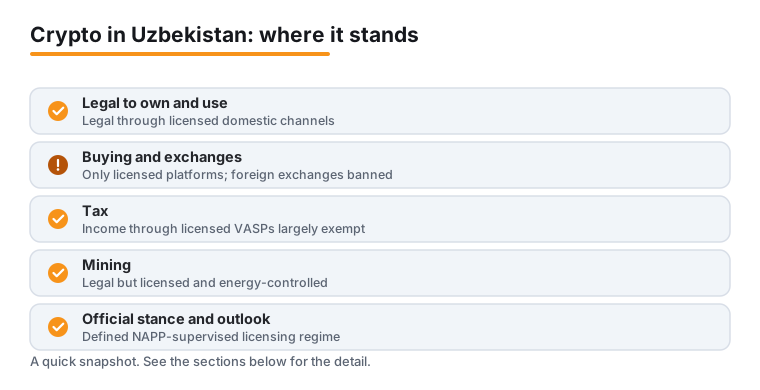
- Legal: Legal to own, trade and mine, not legal tender; only licensed domestic platforms permitted
- Tax: Income and gains through licensed VASPs generally exempt toward 2028, but under review
- Buying: Only via NAPP licensed local platforms with KYC; unlicensed foreign exchanges prohibited
Uzbekistan has moved from treating cryptocurrency as a legal grey area to building one of Central Asia's most defined regulatory regimes. Buying, selling, holding and mining crypto-assets are legal, but they must happen inside a licensed, state-supervised framework rather than on the open global market. The country pairs a notably investor-friendly tax stance with strict rules on which platforms residents may use, and it is actively widening its rulebook to cover stablecoins, tokenized securities and large-scale mining.
The sector is overseen mainly by the National Agency for Prospective Projects (NAPP), with the Central Bank of the Republic of Uzbekistan involved on payment and anti-money-laundering questions. This guide is general information as of 2026 and is not legal, tax or financial advice; because the rules change quickly, always verify the current position with NAPP and a qualified local adviser before acting. For wider context see our overview of crypto regulation.
On this page: Legal status · Who regulates it · Taxes · How to buy · Mining
Legal status of Bitcoin and crypto
Owning, buying, selling, trading and mining Bitcoin and other crypto-assets is legal in Uzbekistan, provided activity runs through the country's licensed channels. Crypto is treated as a regulated class of digital asset rather than as banned property, and a dedicated agency licenses the businesses that serve the market.
Legal does not mean unrestricted. Two points are central:
- Crypto is not legal tender. Bitcoin is not official money or a mandatory means of payment. Prices, wages and taxes are denominated in Uzbekistani som (UZS).
- Only licensed domestic platforms are permitted. Residents are required to transact through providers licensed inside Uzbekistan, and using unlicensed foreign exchanges is prohibited.
The foundational legalisation dates to Presidential Resolution PP-3832 of 3 July 2018 ("On measures to develop the digital economy and the sphere of crypto-assets turnover"), which authorised activities such as mining, exchange, storage and emission of crypto-assets and laid the groundwork for the current licensing system.
The regulator: National Agency for Prospective Projects (NAPP)
The primary regulator is the National Agency for Prospective Projects of the Republic of Uzbekistan (NAPP). NAPP is the state body responsible for regulation, licensing and permitting in the sphere of crypto-asset turnover, and it licenses and supervises Virtual Asset Service Providers (VASPs), writes the market rules, maintains the registries of licensed providers and permitted crypto-assets, and operates a regulatory sandbox for new blockchain products.
On payment-related questions such as stablecoins and on anti-money-laundering supervision, NAPP works alongside the Central Bank of the Republic of Uzbekistan, whose Financial Monitoring Department supervises compliance with the country's AML/CFT law. Enforcement against illicit use can also involve the General Prosecutor's Office, the Ministry of Internal Affairs and the State Security Service.
You can verify NAPP's mandate and its registries on its official site: National Agency for Prospective Projects (napp.uz), and the Central Bank at Central Bank of the Republic of Uzbekistan (cbu.uz).
Key laws and frameworks
Uzbekistan does not follow an external regime such as the EU's MiCA; it has its own domestic framework built around presidential acts and NAPP regulations rather than a single comprehensive crypto code. The main building blocks reported in official and legal sources are:
- Presidential Resolution PP-3832 (3 July 2018) on developing the digital economy and crypto-asset turnover, which legalised the sector and provided early tax relief. The text is published on the national legal database: lex.uz (PP-3832).
- NAPP licensing and registration rules for crypto-asset service providers, which set the categories of VASP and the conditions to operate.
- AML/CFT legislation (the law on countering the legalisation of criminal proceeds and terrorist financing) supervised by the Central Bank's Financial Monitoring Department.
The framework is expanding. Authorities have introduced or signalled rules for stablecoins as a payment instrument and for tokenized securities such as bonds and shares. Because secondary rules and licence conditions are updated frequently, treat NAPP's official publications as the authoritative source.
Licensing and registration of exchanges (VASPs)
To serve Uzbek users legally, a crypto business must hold a NAPP licence. NAPP recognises several categories of VASP, commonly described as crypto exchanges, crypto "shops" (over-the-counter sellers), crypto depositories or custodians, and mining pools.
Reported licensing conditions include establishing a resident legal entity in Uzbekistan (typically an LLC or joint-stock company) with disclosure of shareholders, directors and beneficial owners, and meeting a substantial minimum statutory capital requirement held in an Uzbek bank account. Industry and legal sources put the minimum statutory capital for a crypto exchange at 30,000 minimum monthly wages (reported at roughly 300,000 US dollars as of 2025), with lower thresholds for other VASP categories such as crypto shops and depositories. State licensing fees are significant and were updated by the authorities in late 2024. Uznex was the first regulated exchange to operate in the country, and NAPP publishes the current list of authorised platforms.
These thresholds and fees change, so anyone planning to apply should confirm the exact current capital, fee and documentation requirements directly with NAPP and a qualified local adviser before relying on any figure.
Taxation of crypto
Uzbekistan has been unusually generous on crypto taxation as a deliberate policy to grow the digital-asset economy. Income and gains from crypto transactions carried out through licensed VASPs have generally not been subject to taxation, and such activity has typically been excluded from the taxable base for both individuals and legal entities. Reporting indicates this favourable treatment, including profit-tax and VAT relief for licensed providers, is intended to run toward 1 January 2028. Mining operators inside the dedicated Besqala Mining Valley in Karakalpakstan are, according to the establishing decree, exempt from tax on mining income until 1 January 2035, in exchange for a monthly fee of 1 percent of mining income paid to the zone's directorate.
Two important caveats apply:
- The position is under review. Government planning documents have tasked NAPP and the Ministry of Finance with designing a phased model that could introduce taxes over time. Any specific rates or start dates discussed publicly are proposals, not settled law.
- The exemption is conditional. The benign treatment is tied to transacting through licensed providers; activity outside that channel may not qualify and may carry separate legal exposure.
This is general information, not tax advice. Confirm your obligations with the State Tax Committee, NAPP and a qualified Uzbek tax professional, and see our general explainer on crypto taxes.
AML and KYC rules
Licensed VASPs must run anti-money-laundering (AML) and know-your-customer (KYC) programmes broadly aligned with international (FATF) expectations. In practice this means verifying customer identity before trading or withdrawal, conducting customer due diligence, monitoring transactions, flagging suspicious activity and reporting to the authorities.
Compliance with the underlying AML/CFT law is supervised by the Central Bank's Financial Monitoring Department, working with NAPP and law-enforcement bodies. Reporting indicates licensed providers are also required to retain KYC profiles, blockchain logs and order records for several years and to submit periodic transaction reporting; anonymous or hidden crypto activity is prohibited. Breaches of data-retention or AML obligations can lead to licence suspension and financial penalties.
Buying and using crypto in practice
The defining rule of Uzbekistan's market is that residents may buy and sell crypto only through locally licensed VASPs; using unlicensed foreign exchanges is prohibited and has drawn enforcement action. Practical points for users:
- Use a licensed platform. Check NAPP's list of authorised exchanges before depositing funds; this is what keeps activity legal and, historically, tax-favoured.
- Expect identity verification. Licensed exchanges apply KYC, so you must verify your identity to trade or withdraw.
- On and off ramps run through licensed providers. Converting between som and crypto is intended to happen on regulated venues, not informal kiosks; a well-established network of public Bitcoin ATMs does not exist.
- Foreign platforms carry risk. Beyond breaching the rules, offshore services can expose users to penalties and offer no domestic recourse if something goes wrong.
Because the authorised-provider list and platform availability change, verify a service's current licence status with NAPP before using it.
Mining
Bitcoin mining is legal but formally licensed and increasingly structured around energy rules and state-defined zones. NAPP licenses mining activity, and the country issued its first formal private mining permit (to a domestic company reported as NexaGrid) in early 2026, marking a shift from tolerated activity to permitted, supervised operations. The NexaGrid permit was granted in January 2026, with the company planning facilities in the Bukhara region.
Uzbekistan has also set up a dedicated mining zone. A presidential decree signed by President Shavkat Mirziyoyev established the Besqala Mining Valley in the Republic of Karakalpakstan, run through a directorate under the Karakalpakstan Council of Ministers. Reporting on the decree indicates that income from crypto mining inside the zone is exempt from taxation until 1 January 2035, that resident firms must hold a NAPP licence, and that operators pay a monthly fee of 1 percent of mining income to the zone's directorate. The decree also revised earlier power rules: instead of the 2023 requirement to run only on solar energy, resident mining companies are given access to the national grid, with additional supply planned from hydrogen power. Proceeds from selling mined crypto must be transferred to bank accounts held in Uzbekistan regardless of where the sale takes place.
Energy is the central issue. Rules push operators toward planned, metered grid use and renewable sources: companies are encouraged to use their own solar generation, a separate meter must be installed for grid connections, and grid access can carry higher tariffs. Miners must report their activity to NAPP, and hidden mining or minting of anonymous assets is prohibited. Crypto mined in Uzbekistan is generally expected to be sold through licensed domestic exchanges.
Independent or home miners should not assume any large-scale or zone-specific tax perks apply to them, as those attach to qualifying entities under specific conditions. Confirm licensing, registration and electricity-tariff requirements with NAPP and the relevant energy authorities, as exact figures change.
Recent developments (2025-2026)
The framework has moved quickly into 2026. The most notable recent developments reported in official and industry sources are:
- Stablecoins and tokenized assets. Authorities announced recognition of stablecoins as a payment method and a controlled testing regime, reported to begin on 1 January 2026 and administered jointly by NAPP and the Central Bank, alongside plans to allow tokenized stocks and bonds on licensed platforms.
- First private mining permit. NAPP granted the country's first private crypto-mining permit in January 2026 to a domestic company (NexaGrid) planning facilities in the Bukhara region.
- Besqala Mining Valley. A presidential decree established a dedicated mining zone in Karakalpakstan, with reported tax exemption on mining income until 1 January 2035, a NAPP licence requirement, a 1 percent monthly fee on mining income, grid access and planned hydrogen power in place of the earlier solar-only rule.
- Tighter mining rules. New requirements emphasise sustainability, metering and accountability for mining operators.
- Tax review under way. The near-zero tax treatment for licensed activity (reported to run toward 2028) is under formal review, with a phased tax model proposed for development.
Because these items are evolving and some details are reported by third parties rather than published in final law, confirm the current status with NAPP before relying on any specific date or rate.
Consumer risks and protection
Operating inside the licensed system gives Uzbek users more clarity than many neighbouring markets, but real risks remain:
- Market and security risk. Crypto is volatile, total loss is possible, and custody and fraud risks apply as everywhere. Treat any "guaranteed return" pitch as a red flag and only commit funds you can afford to lose.
- Using unlicensed platforms. Offshore or unlicensed services are prohibited, can attract penalties, and offer no local recourse if funds are lost.
- Tax change. The current favourable treatment is under review and could change, so do not assume today's position is permanent.
- Fast-moving rules. Licence conditions, approved-platform lists and mining and energy requirements are updated regularly.
Practical protection: use licensed providers, complete KYC, enable two-factor authentication, consider a hardware wallet for longer-term holdings, keep good transaction records, and watch for official updates from NAPP.
Official sources and how to verify
Crypto rules in Uzbekistan change quickly, so always confirm the current position against primary official sources rather than secondary summaries. The most authoritative starting points are:
- National Agency for Prospective Projects (napp.uz) for VASP licensing, registries of authorised exchanges and permitted assets, mining permits and market rules.
- Central Bank of the Republic of Uzbekistan (cbu.uz) for AML/CFT supervision and payment-related matters such as stablecoins.
- lex.uz, the national legal database, for the underlying acts including Presidential Resolution PP-3832.
This guide is general information as of 2026 and is not legal, tax or financial advice; verify your situation with NAPP and a qualified Uzbek adviser before acting. You can also browse our wider country regulation guides for comparison.
Frequently asked questions
Is cryptocurrency legal in Uzbekistan?
Yes. Holding, buying, selling, trading and mining crypto are legal when done through Uzbekistan's licensed framework. Crypto is regulated as a digital asset, not banned, but it is not legal tender and residents must use licensed domestic platforms rather than unlicensed foreign exchanges.
Who regulates crypto in Uzbekistan?
The National Agency for Prospective Projects (NAPP) is the primary regulator. It licenses and supervises crypto exchanges, over-the-counter sellers, custodians and mining pools, maintains the official registries and runs a sandbox. On payments and AML matters such as stablecoins, NAPP works with the Central Bank of the Republic of Uzbekistan. You can verify both at napp.uz and cbu.uz.
Do I have to pay tax on crypto in Uzbekistan?
Historically, crypto income and gains earned through licensed VASPs have generally been exempt from taxation as a policy to grow the digital economy, with relief reported to run toward 2028. However, this position is under official review and a phased tax model has been proposed, so treatment could change. We do not state specific rates here; confirm with the State Tax Committee, NAPP and a qualified local tax adviser.
Can I use Binance or other foreign exchanges in Uzbekistan?
No. The rules require residents to use locally licensed platforms, and using unlicensed foreign exchanges is prohibited and has drawn enforcement action. Check NAPP's list of authorised providers and use a licensed venue to keep your activity legal and avoid penalties.
Is Bitcoin mining allowed in Uzbekistan?
Yes, but it is licensed and increasingly organised around energy rules. NAPP licenses mining, the first private permit was issued in early 2026, miners must report to NAPP, and operators are pushed toward solar power and metered grid use. Hidden or anonymous mining is prohibited. Confirm licensing and electricity-tariff requirements with NAPP before mining.
What is the Besqala Mining Valley in Uzbekistan?
Besqala Mining Valley is a dedicated crypto-mining zone in the Republic of Karakalpakstan, set up by a presidential decree and run through a directorate under the Karakalpakstan Council of Ministers. According to reporting on the decree, mining income inside the zone is exempt from tax until 1 January 2035, resident firms must hold a NAPP licence, and operators pay a monthly fee of 1 percent of mining income. Sale proceeds from mined crypto must be transferred to bank accounts held in Uzbekistan. Confirm eligibility and the current terms with NAPP before relying on any figure.
Are stablecoins legal in Uzbekistan?
Authorities announced recognition of stablecoins as a payment method under a controlled testing regime reported to begin on 1 January 2026, administered jointly by NAPP and the Central Bank, alongside plans to allow tokenized stocks and bonds on licensed platforms. Because some details are reported by third parties rather than published in final law, confirm the current status with NAPP and the Central Bank before relying on it.
How do I verify the current crypto rules in Uzbekistan?
Check primary official sources rather than secondary summaries: the National Agency for Prospective Projects (napp.uz) for licensing and registries, the Central Bank of the Republic of Uzbekistan (cbu.uz) for AML and payment matters, and the national legal database lex.uz for the underlying acts such as Presidential Resolution PP-3832. This guide is general information as of 2026, not legal advice, so confirm your situation with NAPP and a qualified local adviser.
Facts reviewed: 30 June 2026. Page updated: 3 August 2026.