Home › Crypto Regulation › Russia
Bitcoin & Cryptocurrency Regulation in Russia
Quick answer — Russia, 2026
- Legal: Legal property to own and trade, banned as domestic payment
- Tax: Gains taxed as income, broadly 13 to 15 percent
- Buying: Limited legal routes, sanctions restrict international platforms
Russia runs one of the world's most distinctive cryptocurrency regimes. It legally recognises digital currency as a form of property that can be owned, bought, sold, inherited and mined, yet it bans using crypto to pay for everyday goods and services inside the country, where the ruble is the only legal tender. The framework rests on Federal Law No. 259-FZ of 31 July 2020 ("On Digital Financial Assets and Digital Currency"), with major additions from 2024 to 2026: mining was legalised, dedicated crypto taxes took effect on 1 January 2025, an experimental regime opened crypto to cross-border trade, and in December 2025 the Bank of Russia published proposals to formalise regulated crypto trading for investors.
This page explains where Russian crypto rules stand as of 2026: legal status, the regulators, the key laws, exchange and registration rules, tax, anti-money-laundering duties, buying and using crypto in practice, mining, recent developments, consumer risks, and how to verify everything against official sources. It is general information as of 2026 and is NOT legal, tax or financial advice; Russian rules change quickly and several measures are still draft, so confirm anything that affects you with the Bank of Russia or a qualified Russian professional before acting. For wider context see our guide to crypto regulation and our regulation hub.
On this page: Legal status · Who regulates it · Taxes · How to buy · Mining
Is Bitcoin and crypto legal in Russia?
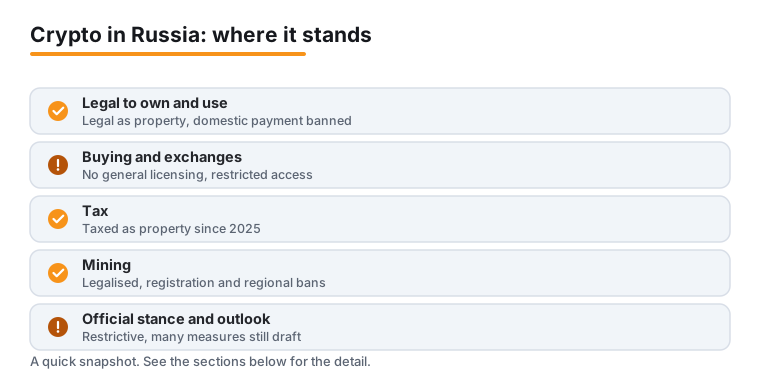
Owning, holding and trading Bitcoin and other cryptocurrencies is legal in Russia. Under Federal Law No. 259-FZ, digital currency is treated as a type of property rather than as money, so it can be bought, sold, held as an investment and inherited. What it cannot be is a means of everyday payment.
The 2020 law established that the ruble is the only legal tender and that digital currency must not be used to pay for goods, works or services supplied inside Russia. That domestic payment ban remains in force in 2026. The one major carve-out arrived through 2024 and 2025, when legislation and an experimental legal regime permitted businesses to use crypto in international trade and cross-border settlements under central-bank oversight, partly as a response to sanctions affecting conventional banking channels.
In short: holding and investing is allowed; paying a Russian shop or service provider in Bitcoin is not; and cross-border use is permitted only within tightly defined, supervised arrangements. Always verify the current limits before relying on any of these mechanisms.
Who regulates crypto in Russia?
Russian crypto policy is shared across several authorities, with the central bank in the lead.
- Bank of Russia (the Central Bank of the Russian Federation) is the primary regulator. It is cautious toward private crypto, maintains the official register of digital-financial-asset operators, oversees the cross-border trade regime, runs the digital ruble project, and in December 2025 published its proposals for regulating crypto trading. Its official site is cbr.ru.
- Federal Tax Service (FNS) administers crypto taxation and operates the registry that miners must join.
- Rosfinmonitoring (Federal Financial Monitoring Service) handles anti-money-laundering and counter-terrorist-financing supervision and analyses reported transaction data.
- Ministry of Finance has often taken a more permissive line than the central bank and helps shape mining and cross-border-trade legislation.
Because authority is split and many measures are still draft, the practical rule on any point can differ from the headline; check the current status with the Bank of Russia before relying on it.
Key laws and frameworks
The legal stack has grown quickly since 2020.
- Federal Law No. 259-FZ (31 July 2020), "On Digital Financial Assets and Digital Currency" is the foundation: it defines digital financial assets (DFAs) and digital currency, makes the ruble the sole legal tender, and bans crypto as domestic payment.
- Mining legislation effective 1 November 2024 explicitly legalised cryptocurrency mining and created the registration and reporting regime described below.
- Cross-border trade measures (2024 to 2025) permitted, on an experimental basis under the Bank of Russia, the use of digital currency in foreign-trade settlements.
- Federal Law No. 418-FZ (signed 29 November 2024, effective 1 January 2025) amended the Tax Code to set out how individuals, businesses and miners are taxed on crypto, treating digital currency as property for tax purposes.
- Bank of Russia proposals (published 23 December 2025) would classify crypto and stablecoins as tradeable currency assets, set investor categories and limits, and formalise platform conduct rules.
See the regulator's own explainer on digital financial assets and their operators at the Bank of Russia DFA page. Note that DFAs (regulated digital rights issued on permitted Russian platforms) are a separate category from "digital currency" such as Bitcoin.
Licensing and registration of exchanges and operators
Russia does not yet operate a general crypto-exchange licensing regime equivalent to the EU's MiCA. Instead, two things exist side by side. First, a formal regime for digital financial assets (DFAs): only Russian legal entities entered in the Bank of Russia's official register may run DFA information systems or DFA exchange operations, subject to capital, governance and operational requirements. Second, ordinary cryptocurrency (Bitcoin and similar) has been traded largely outside any dedicated domestic licensing framework, supplemented by narrow state-supervised channels such as the cross-border trade regime and a state-run platform launched in 2025 for highly qualified investors.
The Bank of Russia's December 2025 proposals would change this: existing licensed exchanges, brokers and trustees could offer crypto under their current licences, while specialised requirements would apply to crypto depositories and exchange offices. That is no longer a proposal. The framework bill, No. 1194918-8 "On Digital Currency and Digital Rights", passed the State Duma on 21 July 2026 and the Federation Council on 24 July 2026. Its main provisions take effect on 1 September 2026 and existing platforms have until 1 July 2027 to obtain licences and comply. As of 3 August 2026 no source reports the law as signed and published, so it has no federal law number yet, and the separate bills creating administrative and criminal liability for unlicensed intermediaries were still before the State Duma. These provisions are proposals, not yet enacted law, so confirm the current status before assuming any platform is licensed.
Crypto and Bitcoin tax in Russia
Crypto is taxed because it is classified as property, with dedicated rules in force since 1 January 2025 covering individuals, businesses and mining.
- Individuals pay personal income tax on gains from selling or otherwise disposing of digital currency. Crypto income falls in the same tax base as income from securities and similar investments, broadly at 13 percent, rising to 15 percent on the portion of total annual income above 2.4 million rubles. Non-residents are taxed at a higher flat rate of 30 percent on Russian crypto income under Federal Law No. 418-FZ.
- Companies are subject to corporate profit tax on crypto-related profits, generally at the 25 percent corporate rate that applies from 2025.
- Mining income is recognised for tax, typically based on the market value of coins when received, with reporting duties for miners and infrastructure operators.
- VAT does not apply to the mining or sale of digital currency itself.
- Reporting: a general duty for residents to report digital currency transactions to the Federal Tax Service is created by the companion law adopted alongside the main crypto law on 21 July 2026, and is set to take effect 270 days after that law is officially published. Miners already report separately: registered miners must file the volume mined and the wallet addresses used by the 20th day of the month following receipt, and mining infrastructure operators file quarterly by the 25th.
Rates, thresholds and deadlines can change, and treatment differs depending on whether you act as an individual, a registered entrepreneur or a company. Confirm your exact position with the Federal Tax Service or a qualified Russian tax adviser, and see our general crypto tax guide for background.
AML, KYC and monitoring
Anti-money-laundering (AML) and counter-terrorist-financing (CFT) duties sit with Rosfinmonitoring alongside the Bank of Russia. The core expectation is that intermediaries identify their customers (KYC), keep records and report relevant or suspicious activity. In the cross-border trade regime, authorised digital-asset service providers are expected to run KYC checks and report transactions to the central bank and Rosfinmonitoring, on lines comparable to banks.
The Bank of Russia's December 2025 proposals reinforce this direction: anonymity-focused (privacy) cryptocurrencies that conceal transaction data would remain prohibited, and residents who buy crypto abroad and bring it onto Russian platforms would have to report it to the tax authority. In practice, enforcement has been uneven, and authorities have flagged the continued use of no-KYC services to move funds. Treat any platform that lets you trade large sums with no identity checks as high risk both legally and from a fraud standpoint.
Buying and using crypto in practice
There is no outright ban on Russians buying crypto, but the legal route is being narrowed and formalised. Historically residents used global exchanges, peer-to-peer marketplaces and over-the-counter deals. Since 2022, sanctions have complicated this: many international platforms restricted or closed access for Russian users, and card funding via Visa and Mastercard from Russian banks is largely unavailable.
Those limits are now in the adopted law and apply from 1 September 2026. Non-qualified investors may buy only the most liquid cryptocurrencies from a Bank of Russia list, after passing a test, up to 300,000 rubles a year through each intermediary. Qualified investors face no volume cap and no restriction on which cryptocurrencies, but must also pass testing. Purchases must go through a licensed intermediary: a crypto exchanger, digital depository, broker, trust manager or trading organiser, while qualified investors could trade without volume caps after a knowledge assessment. Remember that domestic spending in crypto is still banned, so even legally held coins cannot be used to pay Russian merchants. If you buy from inside Russia, use platforms that clearly state they serve Russian residents lawfully, complete identity verification, keep records of every transaction for tax, and treat peer-to-peer deals as carrying real fraud and counterparty risk. Confirm current eligibility before opening an account, as these categories are proposals and the access rules have been a moving target.
Bitcoin mining in Russia
Mining is the area where Russia has moved furthest toward an open, regulated industry, reflecting its abundant and relatively cheap energy. Federal Law No. 221-FZ of 8 August 2024, whose core mining provisions took effect on 1 November 2024, explicitly legalised cryptocurrency mining. It defines mining and mining pools, requires sole traders and Russian legal entities to join the Federal Tax Service register before mining, and gives the government power to ban mining in named regions.
- Companies and individual entrepreneurs that mine must register with the Federal Tax Service, join the official miners' registry, and report their output and the wallet addresses used.
- Private individuals may mine without registering only while electricity use stays at or below 6,000 kWh per month, a threshold confirmed on the Federal Tax Service's own mining page, which also states that applications to join the register are processed within 15 working days; above that, they must register like a business.
- Reporting of mined amounts is mandatory, and proceeds are taxable.
Mining is not allowed everywhere. To protect the grid, the government has imposed full bans in certain regions (reported to include the North Caucasus republics and some other territories) and seasonal restrictions in others such as parts of the Irkutsk Region, Buryatia and Zabaikalsky Krai, with regional measures running on a multi-year timeline. Enforcement has tightened, and authorities have discussed criminal penalties (including large fines and forced labour) for serious unregistered mining. Track both the federal rules and your specific region, and confirm current registration thresholds and local bans before investing in equipment.
Recent developments (2025 to 2026)
The pace of change has been rapid and top-down.
- 1 January 2025: dedicated crypto tax rules took effect for individuals, businesses and miners.
- 2025: an experimental legal regime allowed limited crypto trading for qualified investors, and a state-run platform for highly qualified investors began operating, alongside the cross-border foreign-trade pilot.
- 23 December 2025: the Bank of Russia published proposals to classify crypto and stablecoins as tradeable currency assets (still barred from domestic payment), set qualified and non-qualified investor categories and the 300,000-ruble annual cap for non-qualified buyers, keep privacy coins prohibited, and target completion of the legal framework by 1 July 2026 with intermediary liability from 1 July 2027.
- December 2025: VTB, Russia's second-largest bank by assets, said it plans to launch spot crypto trading for qualified investors, which would make it the first Russian bank to offer clients direct trading in major cryptocurrencies such as Bitcoin and Ether, targeting a launch in 2026. The Bank of Russia had earlier signalled it would allow banks to operate in the crypto sector for the first time. This is a stated plan, not a live retail service, so confirm availability before relying on it.
- Digital ruble: large-scale introduction of the state digital ruble starts on 1 September 2026 under Federal Law No. 248-FZ of 23 July 2025. From that date the largest banks must let customers open accounts, transfer and pay in digital rubles, and merchants with revenue above 120 million rubles must accept them. Universal licence banks and merchants above 30 million rubles follow from 1 September 2027, everyone else from 1 September 2028, and merchants below 5 million rubles a year are exempt. All banks must also be ready for the universal payment code by 1 September 2026 over the following years.
Many of these are proposals or staged rollouts rather than settled law, so headlines about what has been "approved" can run ahead of the rules actually in force.
The digital ruble (and how it differs from crypto)
The digital ruble is a central bank digital currency (CBDC) issued and controlled by the Bank of Russia. It is state money in digital form, not a decentralised cryptocurrency like Bitcoin, and it is a distinct project from the private-crypto rules above. According to the Bank of Russia, large-scale introduction begins on 1 September 2026, with banks and larger merchants required to support and accept it on a phased schedule, and the smallest businesses exempt.
For users this matters because Russia is building tightly controlled state digital money in parallel with restrictive rules on private crypto. The two should not be confused: holding Bitcoin gives you no rights in the digital ruble system, and using the digital ruble is not the same as legally spending cryptocurrency (which remains banned for domestic payment). See the official timeline on the Bank of Russia website.
Consumer risks and protection
Russian crypto holders face the usual market risks (price volatility, hacks, scams, lost keys) plus a layer of country-specific ones. Rules on who may trade, through which venues and under what limits have shifted repeatedly and remain partly in draft. Sanctions have cut access to many international platforms and to Visa and Mastercard rails, which can make it harder to convert in and out and harder to recover funds after fraud or a platform failure. The domestic payment ban limits real-world spending, and tax applies to realised gains.
To protect yourself: size positions to what you can afford to lose; prefer secure self-custody (ideally a hardware wallet with a safely stored recovery phrase) or reputable custodians; complete proper KYC rather than relying on anonymous services; keep meticulous records for tax; and treat any promise of guaranteed returns as a warning sign. Because consumer-protection mechanisms for private crypto are limited, verification and caution matter more here than in more open markets.
Official sources and how to verify
This page is general information as of 2026 and is NOT legal, tax or financial advice; verify anything that affects you with the Bank of Russia or a qualified Russian professional before acting. Go to primary sources:
- Bank of Russia (Central Bank of the Russian Federation) for the regulator's position, the digital ruble timeline and crypto-regulation proposals.
- Bank of Russia: Digital financial assets and their operators for the legal framework and the official register of approved DFA operators.
- The text of Federal Law No. 259-FZ of 31 July 2020 on Digital Financial Assets and Digital Currency, available via Russian official legal databases, for the foundational definitions and the domestic payment ban.
For tax specifics, consult the Federal Tax Service or a qualified adviser. For our own background material, see crypto regulation basics and the regulation hub. Because much of the 2025 to 2026 framework is still being finalised, always check whether a given rule is in force or merely proposed before you rely on it.
August 2026 update: Russia's crypto law has passed parliament
Since this page was last reviewed on 30 June 2026, the Bank of Russia's December 2025 concept has become adopted legislation. Bill No. 1194918-8, "On Digital Currency and Digital Rights", was introduced to the State Duma by the government in early April 2026, passed second and third readings on 21 July 2026 by 340 votes with five abstentions, and was approved by the Federation Council on 24 July 2026. The Bank of Russia confirmed on the day of the Duma vote that regulation of cryptocurrencies on the Russian market has been established, that the main provisions take effect on 1 September 2026, and that market participants have until 1 July 2027 to obtain licences and meet the new requirements.
One step still appears to be outstanding. No source we could locate as of 3 August 2026 reports that the law has been signed by the President and published in the official gazette, so it has no federal law number yet. Kommersant reported on 3 July 2026 that Federation Council approval and presidential signature were together expected to take about two weeks, so signature looks imminent rather than in doubt. This matters for one practical reason: the 270 day clock on the new tax reporting duty described below runs from official publication, not from the Duma vote.
The Bank of Russia published its first tranche of secondary legislation on 27 July 2026: draft rules for organised trading in digital currencies and digital rights, requirements for a new type of institution called a digital depository, and accounting and record-keeping standards. Digital depositories would need own funds of 50 million to 250 million rubles depending on what they do, with 250 million for those settling exchange trades, 100 million for those controlling crypto addresses or holding assets with foreign custodians, and 50 million for the rest, according to reporting on the drafts. A further draft on margin trading was opened for comment until 12 August 2026. All of this is still in consultation, which is why a live regulated Russian crypto venue is not expected to open the moment the law commences.
What the new law changes from 1 September 2026
These are the operative rules once the law commences, drawn from the Bank of Russia's announcement and the final reading summary published by ConsultantPlus.
| Area | Rule from 1 September 2026 |
|---|---|
| Domestic payment | Accepting digital currency or digital rights as a means of payment for goods, works, services or information is prohibited. |
| Non-qualified investors | May buy only the most liquid cryptocurrencies from a Bank of Russia list, after passing a test, up to 300,000 rubles a year through each intermediary. |
| Qualified investors | No cap on purchase volumes and no restriction on which cryptocurrencies, but testing is still required. |
| Exporters and importers | May use digital currency in cross-border settlements without volume limits. |
| Who may act as an intermediary | Crypto exchangers, digital depositories, brokers, trust managers and trading organisers. Interfax reports a minimum own-funds requirement of 15 million rubles for crypto exchangers, which must be Russian legal entities. |
| Which coins can be publicly traded | Interfax reports admission criteria of average capitalisation above 5 trillion rubles and average daily trading volume above 1 trillion rubles measured over two years. The Bank of Russia will publish the actual list. |
| Self-custody | Withdrawal to an external address not serviced by a Russian digital depository is allowed. For amounts above 100,000 rubles a cooling-off delay of at least 48 hours applies, so the customer can reconsider. The first reading version had allowed transfers only to licensed foreign exchanges or depositories; that was relaxed by amendment before adoption. |
| Licensing deadline | 1 July 2027. Existing platforms have until then to come into the regime. |
| Bank transfer blocking | From 1 July 2027 credit institutions must refuse residents' transfers, including cross-border card transfers, to persons suspected of unlicensed crypto exchange. |
Sources: Bank of Russia, 21 July 2026, ConsultantPlus summary of the final reading, 22 July 2026, Interfax, 24 July 2026, VBR on the adopted text, 22 July 2026 and Vedomosti on the second reading changes.
What is still in the pipeline, and when it moves
The main law is only one of several linked measures. Three are still in the State Duma, which means the penalties and the tax mechanics are not settled yet.
| Measure | Stage as of 3 August 2026 | Expected timing | What it would mean |
|---|---|---|---|
| Bill No. 1194918-8, On Digital Currency and Digital Rights | Passed both chambers, awaiting signature and publication | Main provisions 1 September 2026; transition to 1 July 2027 | The framework itself: licensing, investor categories, the 300,000 ruble retail cap and the payment ban |
| Bill No. 1194929-8, companion amendments | Passed third reading 21 July 2026, awaiting signature | Bank refusal duty from 1 July 2027; resident reporting duty 270 days after publication | Residents must report digital currency transactions to the tax authority; banks must block transfers to unlicensed exchangers |
| Bill No. 1222105-8, Tax Code amendments | In parliament, first reading passed, reported by Garant on 15 July 2026 | Not stated by any source found | Brokers and trust managers become tax agents withholding personal income tax on crypto; gains and losses can be netted within a tax period; digital depository and crypto exchanger services become VAT-exempt |
| Bill No. 1194944-8, new Article 15.29.1 of the Code of Administrative Offences | In parliament | Proposed 1 July 2027 | Fines of 30,000 to 50,000 rubles for officials and 700,000 to 1,000,000 rubles for companies that transact with non-qualified investors beyond the limits |
| Bill No. 1209607-8, new Article 171.7 of the Criminal Code | In parliament, first reading 8 July 2026 | Proposed 1 July 2027 | Criminal liability for organising crypto circulation without registration or a licence. Large scale 3.5 million rubles, especially large scale 13.5 million rubles. Up to four years imprisonment, up to seven where a group is involved or damage is large |
| Bank of Russia secondary regulations | Drafts in public consultation since 27 July 2026 | Margin trading draft open to 12 August 2026 | Capital, trading, custody and pricing rules that determine when a regulated venue can actually open |
| Stablecoin regulation | Announced only, no bill | Detailed discussion begins autumn 2026 | Rules on issuance, circulation and collateral, agreed in principle between the Duma financial market committee and the Bank of Russia |
Sources: ConsultantPlus, Pravo.ru on the criminal and administrative bills, 9 July 2026, Forbes on the first reading of the criminal bill, 8 July 2026, Pravo.ru on the tax bill, 30 April 2026, Garant on the tax bill first reading, 15 July 2026, Bank of Russia and Anatoly Aksakov on stablecoins.
Mining: Moscow and Moscow Region banned from 15 August 2026
Mining was legalised by Federal Law No. 221-FZ of 8 August 2024, whose core mining provisions took effect on 1 November 2024. That law defines mining and mining pools, requires sole traders and Russian legal entities to join the Federal Tax Service register before mining, lets ordinary citizens mine below a government-set electricity limit without registering, and gives the government power to ban mining in named regions.
The register is real and populated. The Federal Tax Service said on 20 February 2026 that more than 1,500 companies and sole traders had entered the miners register, and that about 4,000 individuals mine within the permitted limits without needing to register, for more than 5,500 legalised miners in total. The Federal Tax Service's own mining page confirms the 6,000 kWh per month threshold for individuals, that applications are processed within 15 working days, that miners must report the volume mined and the wallet addresses used by the 20th day of the month following receipt, and that mining infrastructure operators report quarterly by the 25th.
The map of where mining is allowed changed on 31 July 2026. A decree signed by Prime Minister Mikhail Mishustin bans mining in the city of Moscow, Moscow Region, and the Belovsky, Bolshesoldatsky, Glushkovsky, Korenevsky, Lgovsky, Rylsky, Sudzhansky and Khomutovsky districts of Kursk Region plus the urban district of Lgov, from 15 August 2026 to 31 December 2032. The ban covers participation in mining pools as well as mining on your own account, as Fontanka also reported. This sits on top of the earlier bans, which have applied since 1 January 2025 in Dagestan, Ingushetia, Kabardino-Balkaria, Karachay-Cherkessia, North Ossetia, Chechnya, the DPR, LPR, Zaporizhzhia and Kherson regions, and were extended from 1 April 2026 to parts of Buryatia, Zabaikalsky Krai and southern Irkutsk Region, according to a 1 August 2026 summary of the decrees. The stated policy aim is to push mining toward regions with surplus electricity.
Sanctions: the EU targeted Russian crypto rails on 23 July 2026
The Council of the EU adopted its 21st sanctions package on 23 July 2026, with 218 listings covering 48 individuals and 170 entities, the largest batch of individual listings in four years. For crypto specifically, the package extends the EU transaction ban to 14 crypto-related service platforms based in Georgia, Panama, the United Arab Emirates, the Marshall Islands, Kyrgyzstan and Belarus, including entities linked to the cross-border A7 network such as A7 Nigeria and A7 Africa, and for the first time creates the possibility of a full third-country ban on crypto-asset services, which would let the EU prohibit transactions with crypto providers in an entire jurisdiction. On the banking side it freezes the assets of 94 banks and major financial institutions and extends the transaction ban to 33 more Russian credit and financial institutions, according to analysis of the package. From 25 August 2026 the existing bar on Russian nationals and residents owning, controlling or sitting on the governing bodies of EU crypto-asset service providers extends to all providers regulated under MiCA.
For a reader in Russia the practical effect is unchanged in direction but stronger in degree: offshore platforms that previously served Russian users through third countries are now themselves exposed, and EU-facing counterparties have a further reason to decline Russian-linked flows. That is the backdrop against which the domestic licensed regime opens in September 2026.
Frequently asked questions
Is Bitcoin legal in Russia in 2026?
Yes. Owning, trading and mining cryptocurrency is legal, and digital currency is treated as property under Federal Law No. 259-FZ. However, it is not legal tender, and using it to pay for goods or services inside Russia is prohibited. A limited, supervised exception allows crypto in cross-border trade. Verify current rules with the Bank of Russia before relying on any of these uses.
Can I pay for things in Russia with cryptocurrency?
No. Russian law makes the ruble the only legal tender and bans using crypto to pay for goods, works or services supplied within the country. Crypto is meant to be held or traded as an asset, not spent domestically. This ban remains in force in 2026 even under the Bank of Russia's latest proposals.
Who regulates cryptocurrency in Russia?
The Bank of Russia (the Central Bank, cbr.ru) is the lead regulator, alongside the Federal Tax Service for tax and the miners' registry, and Rosfinmonitoring for anti-money-laundering supervision. The Ministry of Finance also helps shape mining and cross-border-trade rules. The Bank of Russia maintains the official register of digital-financial-asset operators.
Do I have to pay tax on crypto in Russia?
Yes. Because crypto is property, gains from disposals are taxable, with dedicated rules in force since 1 January 2025 for individuals, businesses and miners. Individuals are taxed broadly at 13 percent, rising to 15 percent on income above 2.4 million rubles a year; companies face corporate profit tax. Rates and thresholds change, so confirm your situation with the Federal Tax Service or a qualified Russian tax adviser.
Is crypto mining allowed in Russia?
Yes, mining was legalised by a law effective 1 November 2024. Companies and entrepreneurs must register with the Federal Tax Service and report output and wallet addresses, while small individual miners may operate below a set monthly electricity limit without registering. Mining is banned outright in a growing list of regions. Full bans have applied since 1 January 2025 in Dagestan, Ingushetia, Kabardino-Balkaria, Karachay-Cherkessia, North Ossetia, Chechnya, the DPR, LPR, Zaporizhzhia and Kherson regions, and were extended from 1 April 2026 to parts of Buryatia, Zabaikalsky Krai and southern Irkutsk Region. A decree signed by Prime Minister Mikhail Mishustin and published on 31 July 2026 adds the city of Moscow, Moscow Region, and eight districts of Kursk Region plus the urban district of Lgov, from 15 August 2026 to 31 December 2032. The bans cover participation in mining pools as well as mining on your own account, and unregistered large-scale mining can carry serious penalties, so verify the rules for your area.
What is the digital ruble, and is it the same as Bitcoin?
No. The digital ruble is a central bank digital currency issued and controlled by the Bank of Russia, not a decentralised cryptocurrency like Bitcoin. The Bank of Russia has set large-scale introduction from 1 September 2026, with acceptance obligations phased in for banks and larger businesses over the following years. It is state money in digital form, distinct from private crypto assets.
Can a Russian bank let me trade crypto in 2026?
It is starting to become possible. In December 2025 VTB, Russia's second-largest bank, said it plans to offer spot crypto trading for qualified investors, which would make it the first Russian bank to do so, with a launch targeted in 2026. Access is expected to be limited to qualified or high-net-worth investors at first. This is a stated plan rather than a confirmed live retail service, so check whether it has actually launched and whether you are eligible before relying on it.
How much crypto tax do non-residents pay in Russia?
Non-residents are taxed at a flat 30 percent on crypto income sourced in Russia, higher than the 13 to 15 percent range that applies to residents, under Federal Law No. 418-FZ effective 1 January 2025. Tax rules can change and depend on your exact status, so confirm your position with the Federal Tax Service or a qualified Russian tax adviser.
Has Russia's new crypto law been signed into force?
Not as far as we can establish, as of 3 August 2026. The law On Digital Currency and Digital Rights (bill No. 1194918-8) passed the State Duma on 21 July 2026 and the Federation Council on 24 July 2026, but no source we checked reports it as signed by the President and published in the official gazette. Until it is published it has no federal law number. Kommersant reported in early July that Federation Council approval and signature together were expected to take about two weeks, so signature appears imminent. The main provisions are set to take effect on 1 September 2026.
When can I legally buy crypto through a Russian broker or exchange?
The law allows it from 1 September 2026 through a licensed intermediary: a crypto exchanger, digital depository, broker, trust manager or trading organiser. In practice the venues will not be ready on day one. The Bank of Russia only published its first draft rules for organised trading and digital depositories on 27 July 2026 and they are still in public consultation, and platforms have until 1 July 2027 to obtain licences.
How much crypto can a non-qualified investor buy in Russia?
Up to 300,000 rubles a year through each intermediary, and only in the most liquid cryptocurrencies from a list the Bank of Russia will publish, after passing a test on the risks. Qualified investors have no volume cap and no restriction on which cryptocurrencies, but must also pass testing. Exporters and importers may use digital currency in cross-border settlements without volume limits.
Can I withdraw crypto to my own private wallet under the new law?
Yes. The adopted text allows withdrawal to an external address that is not serviced by a Russian digital depository, but for amounts above 100,000 rubles a cooling-off delay of at least 48 hours applies before the transfer completes, intended to give the customer time to reconsider if they are being defrauded. An earlier version of the bill would have allowed transfers only to licensed foreign exchanges or depositories, and that restriction was relaxed by amendment before adoption.
Will I have to declare my crypto to the Russian tax authority?
Yes, a general reporting duty is coming. The companion law adopted alongside the main crypto law on 21 July 2026 obliges residents to report their digital currency transactions to the tax authorities, and it is set to take effect 270 days after the law is officially published. Since publication had not been confirmed as of 3 August 2026, the start date is not yet fixed.
Can I still mine crypto in Moscow?
Not from 15 August 2026. A government decree signed by Prime Minister Mikhail Mishustin and published on 31 July 2026 bans crypto mining in the city of Moscow, Moscow Region, and eight districts of Kursk Region plus the urban district of Lgov, until 31 December 2032. The ban covers participation in mining pools as well as mining on your own account. Mining remains banned in the North Caucasus republics, the DPR, LPR, Zaporizhzhia and Kherson regions, and in parts of Buryatia, Zabaikalsky Krai and southern Irkutsk Region.
Will my bank block transfers to a crypto exchange?
From 1 July 2027, yes, if the recipient is unlicensed. The companion law requires credit institutions to refuse residents' transfers, including cross-border card transfers, in favour of persons suspected of exchanging crypto without being entered in the relevant register, and the Bank of Russia will circulate details of foreign payment services used for such transfers. Separate bills before the State Duma would add administrative fines of up to 1 million rubles for companies and criminal liability of up to seven years for organising crypto circulation without a licence, both proposed to start on 1 July 2027.
Facts reviewed: 5 August 2026. Page updated: 5 August 2026.