Home › Crypto Regulation › Turkmenistan
Bitcoin & Cryptocurrency Regulation in Turkmenistan
Quick answer — Turkmenistan, 2026
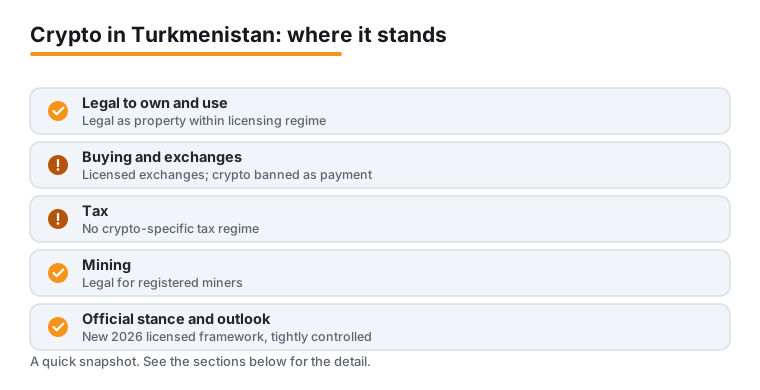
- Legal: Legal to own, mine and trade as property since 2026 law, but not legal tender or a payment method
- Tax: No published crypto specific tax regime; likely follows property and business income rules
- Buying: Via Central Bank licensed exchanges, but currency controls and internet limits constrain access
Turkmenistan spent most of the past decade with no formal rules for digital assets, leaving Bitcoin in a legal grey zone alongside some of the world's tightest currency and internet controls. That changed at the start of 2026. The Law of the Republic of Turkmenistan on Virtual Assets, signed by President Serdar Berdimuhamedov in late November 2025, entered into force on 1 January 2026. It gives the country its first dedicated framework for the issuance, circulation, storage and use of virtual assets. The law legalises licensed mining, trading and custody under the oversight of the Central Bank of Turkmenistan, while stopping well short of letting crypto function as money. This guide explains what the law does and does not allow, how it interacts with the country's strict exchange controls, and what it means for anyone in Turkmenistan thinking about mining, buying, holding or moving Bitcoin. For wider context, see our overview of crypto regulation and our country index at regulation by country.
This article is general information as of 2026 and is not legal, tax or financial advice. Turkmenistan's framework is new and detailed regulations are still developing, so always confirm the current position with the Central Bank of Turkmenistan or a qualified local professional before acting.
On this page: Legal status · Who regulates it · Taxes · How to buy · Mining
Is Bitcoin and crypto legal in Turkmenistan?
Yes, with important limits. Since 1 January 2026, owning, mining and trading virtual assets is legal in Turkmenistan when carried out within the new licensing regime. The Law on Virtual Assets recognises digital assets as objects of civil law that can be owned, held and traded as property.
What it does not do is make crypto money. The law states that virtual assets are not legal tender, not a currency and not securities. They cannot be used to pay for goods or services inside the country, and they cannot be used to pay salaries. The Turkmenistani manat remains the only legal means of payment.
So the practical position is straightforward: Bitcoin is a legal asset class you can hold and trade through licensed channels, but it is not a permitted payment method. Engaging in mining or exchange activity without the required licence or registration, or using crypto to settle everyday transactions, falls outside the law.
Who regulates crypto in Turkmenistan?
The single authority for digital assets is the Central Bank of Turkmenistan (Turkmenistanyn Merkezi Banky). Under the Law on Virtual Assets it is the authorised body responsible for regulating crypto mining, the issuance and primary placement of virtual assets, and the provision of virtual-asset services, including crypto-exchange operations.
In practice this means the Central Bank handles the licensing of exchanges and custodians, the registration of miners, and the supervision of anti-money-laundering and know-your-customer compliance across the sector. There is no separate, standalone crypto agency: oversight sits with the central bank rather than a dedicated markets regulator.
You can reach the regulator at its official website, Central Bank of Turkmenistan. Because the framework is new, this is the primary place to confirm current licensing procedures and any secondary regulations as they are published.
Key laws and frameworks
The cornerstone is the Law of the Republic of Turkmenistan on Virtual Assets, signed by the president in late November 2025 and effective from 1 January 2026. Its core features, as set out in official and legal reporting, include:
- Civil-law classification. Virtual assets are treated as objects of civil law, not as means of payment, currency or securities. The law expressly excludes securities, currencies, electronic money, bank deposits and gambling from its scope.
- Secured and unsecured assets. The law divides virtual assets into secured (asset-backed tokens) and unsecured assets such as Bitcoin that do not certify rights or obligations.
- A licensing and registration regime. Crypto exchanges and custodial services must be licensed, and mining activity must be registered, with the Central Bank.
- AML and KYC obligations. Licensed providers must apply client identification, transaction monitoring and record-keeping, and anonymous wallets and unidentifiable transactions are banned.
- Banking ring-fence. Ordinary credit institutions, other than licensed exchange operators, are barred from directly buying, selling or exchanging virtual assets, keeping traditional banking separate from retail crypto activity.
The stated policy goal is economic diversification: reducing reliance on natural-gas exports by attracting investment and encouraging digitalisation. Because the law is recent, secondary regulations, licence criteria and operational guidance are still being developed, so specific procedures may evolve through 2026.
Licensing and registration of exchanges and service providers
Under the new framework, crypto exchanges, custodial (storage) services and related trading platforms that operate in or target Turkmenistan must be licensed by the Central Bank and meet prudential and operational standards. Exchange operators must be licensed legal entities registered in Turkmenistan and must operate through specialised platforms. Both domestic and foreign companies may participate, with the notable exception of entities based in or associated with offshore jurisdictions, which are excluded: individuals and legal entities registered in offshore jurisdictions cannot establish exchanges, and founders holding offshore bank accounts are reported to be disqualified from obtaining a licence. There is also a naming restriction. Operators are barred from using words such as state, Turkmenistan, Turkmen or national, in any language, in company names, branding or symbols.
Licensed providers are expected to enforce full KYC and AML controls, with no anonymous accounts or transactions. Reporting on the law also describes cold-storage requirements, meaning a significant portion of client funds must be held offline to reduce cyber-risk. Separately, credit institutions other than licensed exchange operators cannot provide crypto buy, sell or exchange services, so banks are kept out of direct retail crypto dealing.
If you are considering operating or using a licensed venue, treat licence status as something to confirm directly with the regulator, since the application process and approved-operator lists are still being established during 2026.
Crypto and Bitcoin tax in Turkmenistan
Turkmenistan does not have a widely published, crypto-specific tax regime, and the 2026 Law on Virtual Assets has been reported primarily as a licensing and classification framework rather than a tax statute. Because digital assets are treated as objects of civil law and a form of property, any tax consequences would most likely flow from how existing rules on property, business income and licensed activity apply, rather than from a bespoke crypto tax.
We do not quote specific rates or thresholds here, because reliable, verified crypto tax figures for Turkmenistan are not available and guessing would be irresponsible. If you mine, trade or hold crypto in connection with Turkmenistan, treat the tax position as unsettled and seek confirmation from the State Tax Service or a qualified local tax adviser. For general background on how digital-asset taxation tends to work, see our guide to crypto taxes. This section is informational only and is not tax advice.
AML, KYC and anonymous transactions
Anti-money-laundering and counter-terrorist-financing compliance sits at the centre of the new law. Licensed exchanges and custodians must implement robust client identification (KYC), ongoing transaction monitoring and record-keeping, in line with Turkmenistan's broader commitment to international financial-monitoring standards.
The law explicitly bans anonymous wallets and unidentifiable crypto transactions, which effectively shuts unregistered or privacy-only platforms out of the formal market. Combined with the licensing regime, this means anyone using a compliant service should expect to provide identification and to have their activity monitored. Licensed providers must also comply with reporting obligations and protect client data and assets in line with the country's national-security and cybersecurity legislation.
For users, the practical takeaway is that legal crypto activity in Turkmenistan is non-anonymous by design. Any platform marketing fully anonymous accounts to Turkmen residents is operating outside the framework and should be treated with caution.
Buying and using crypto in practice
Under the new framework, exchanges and custodial services that serve Turkmenistan are expected to be licensed by the Central Bank and to enforce KYC and AML controls, with no anonymous accounts. In principle this opens the door to compliant, regulated trading. In practice, two structural obstacles loom large:
- Strict currency controls. Turkmenistan operates a tightly managed foreign-exchange system. The manat's official rate is pinned far stronger than the rate available unofficially, and access to hard currency for ordinary residents is limited. These controls make it difficult to move money in and out of crypto markets through normal banking channels.
- Internet restrictions. Connectivity is heavily restricted and monitored, and many international platforms are hard to reach. Even where trading is legal, the everyday ability to access an exchange can be constrained.
Remember too that crypto cannot legally be used to pay for goods, services or salaries: the manat is the only legal means of payment. So even lawfully acquired crypto is limited to holding and trading as property, not spending. There are also no Bitcoin ATMs known to be operating in the country, which is unsurprising given the cash-and-manat economy and tight oversight of financial infrastructure. Before using any platform, verify that it is permitted to serve Turkmen residents, that it applies proper KYC, and that your funding method is lawful under local currency-control rules.
Bitcoin mining in Turkmenistan
Mining is one of the clearest beneficiaries of the 2026 law. Both companies and individuals, and both residents and non-residents, may mine virtual assets provided they register with the Central Bank and meet technical, reporting and energy-use requirements. The law distinguishes between private mining conducted by individual entrepreneurs and industrial mining carried out by legal entities. Hidden or covert mining, defined as using someone else's computing resources without their knowledge or consent (cryptojacking), is prohibited across the country.
Turkmenistan's appeal as a mining location is its abundant, inexpensive energy, anchored by some of the world's largest natural-gas reserves and electricity output that has grown sharply over the past decade. The trade-offs are significant. The country's grid and energy mix are carbon-intensive, large-scale mining is energy-hungry, and operators face questions about heat management, power reliability and environmental impact. Heavy restrictions on internet access also complicate running connected mining hardware at scale.
For now, mining is best viewed as a tightly supervised, registration-dependent activity rather than an open opportunity. Prospective miners should confirm current registration requirements, energy arrangements and operational standards directly with the authorities before committing capital.
Advertising and consumer protection
The law pairs legalisation with notable consumer-protection guardrails, especially around marketing. Crypto-related advertising is tightly restricted: promotions must carry mandatory risk warnings about the potential total loss of capital, and there are restrictions on adverts that depict wealth, offer bonuses, or target minors. Promotional material must state that virtual assets are not state-backed and may lose value, and providers are prohibited from promising profitability or offering inducements to attract customers.
The banking ring-fence is also a protective measure. By barring ordinary credit institutions from directly offering crypto buy, sell and exchange services, the law tries to keep depositors' everyday banking separate from volatile digital-asset activity. Cold-storage requirements for client funds at licensed providers similarly aim to reduce the risk of theft or loss.
None of this removes the underlying risk of crypto itself. The protections are about honest marketing and operational safeguards, not a guarantee against losing money.
Recent developments and outlook
The 2026 law is a genuine shift: it moves Turkmenistan from having no crypto rules to a licensed, supervised framework, joining a regional trend among Central Asian states such as Kazakhstan, Uzbekistan and Kyrgyzstan to formalise digital-asset activity and attract investment. The Library of Congress published an official analysis of the law in February 2026, and reporting through the first half of 2026 has focused on whether foreign miners and exchanges will actually enter, given the offshore exclusions and the requirement to register a licensed legal entity inside the country. For miners, exchanges and custodians willing to operate under state oversight, it creates a legal pathway that did not exist before.
The outlook is nonetheless cautious. The framework is deliberately tight: crypto remains barred as a payment method, the manat is protected by strict currency controls, and internet access is heavily restricted, all of which limit everyday participation regardless of what the law permits. Much also depends on secondary regulations and on how licensing and registration are implemented in practice during 2026. As of this update, detailed licence criteria, fee schedules and the first lists of approved operators are still emerging, so the position should be re-checked with the Central Bank rather than assumed from earlier reporting.
Consumer risks
Crypto is risky everywhere, and Turkmenistan layers country-specific risks on top of normal market volatility. Bitcoin and other crypto assets can lose substantial value quickly, and this guide makes no price predictions and gives no investment advice. For people connected to Turkmenistan, key risks include:
- Regulatory newness. The framework only took effect in 2026 and its detailed rules are still settling, so the operating environment can shift.
- Liquidity and access. Currency controls and internet restrictions make it harder to enter and, crucially, to exit positions and realise value in manat.
- No payment utility. Crypto cannot legally be spent domestically, so its local usefulness is limited to holding and trading as property.
- Custody and security. Self-custody carries the risk of lost keys, while exchange custody carries counterparty risk, even with cold-storage rules in place.
- Scams and unlicensed platforms. Any service offering anonymous accounts or operating without a Central Bank licence is outside the law and a red flag.
Sensible risk management includes never investing more than you can afford to lose, dealing only through clearly lawful and licensed channels, favouring reputable custody such as a hardware wallet for funds you are not actively trading, and keeping up with regulatory developments. None of this guarantees a good outcome.
Official sources and how to verify
Because this is a fast-moving area, verify the current rules against primary and official sources rather than relying on summaries. The most useful starting points are:
- Central Bank of Turkmenistan, the authorised regulator for licensing, mining registration and AML/KYC supervision.
- Library of Congress, Global Legal Monitor, an official US government analysis of the Law on Virtual Assets and its key provisions.
- Government of Turkmenistan official portal, for state announcements on the law and economic policy.
If you need to act on anything in this guide, confirm the position with the Central Bank of Turkmenistan or a qualified local lawyer or tax adviser first. This article is general information as of 2026 and is not legal, tax or financial advice. For more on the wider topic, see our hub on crypto regulation.
Frequently asked questions
Is cryptocurrency legal in Turkmenistan in 2026?
Yes, within limits. The Law on Virtual Assets, in force since 1 January 2026, legalises owning, mining and trading crypto through a licensing and registration regime overseen by the Central Bank of Turkmenistan. However, crypto is classified as property and an object of civil law rather than money, and it cannot be used to pay for goods, services or salaries.
Who regulates crypto in Turkmenistan?
The Central Bank of Turkmenistan. It is the authorised body for licensing crypto exchanges and custodians, registering mining activity, and supervising KYC and anti-money-laundering compliance. There is no separate crypto agency. You can verify the current rules at the regulator's official site, cbt.tm.
Can I use Bitcoin to pay for things in Turkmenistan?
No. The law states that virtual assets are not legal tender, currency or securities, and they cannot be used as payment for goods, services or salaries. The Turkmenistani manat is the only legal means of payment, so crypto is limited to holding and trading as property.
Is Bitcoin mining allowed in Turkmenistan?
Yes, for registered operators. The 2026 law permits mining by companies and individuals, and by residents and non-residents, provided they register with the Central Bank and meet technical, reporting and energy-use rules. It distinguishes private from industrial mining and bans hidden mining, such as using someone else's computing resources without consent.
How is crypto taxed in Turkmenistan?
There is no widely published crypto-specific tax regime, and the 2026 law is mainly a licensing and classification framework. Any tax would likely follow existing property and business-income rules. Because verified figures are not available, confirm the current position with the State Tax Service or a qualified local adviser. This is not tax advice.
Can banks in Turkmenistan offer crypto services?
Generally no. Under the law, ordinary credit institutions, other than licensed exchange operators, are barred from directly buying, selling or exchanging virtual assets. This ring-fence keeps everyday banking separate from retail crypto activity. Crypto services must instead run through providers specifically licensed by the Central Bank.
Can a foreign company run a crypto exchange in Turkmenistan?
Only within limits. Exchange operators must be licensed legal entities registered in Turkmenistan and must trade through specialised platforms. Both domestic and foreign owners may participate, but entities registered in offshore jurisdictions are excluded, and founders holding offshore bank accounts are reported to be disqualified from a licence. Operators also cannot use words such as state, Turkmenistan, Turkmen or national in their name or branding.
Can crypto services advertise freely in Turkmenistan?
No. Advertising is tightly restricted. Promotions must carry mandatory risk warnings about the possible total loss of capital, must state that virtual assets are not state-backed and may lose value, and cannot depict wealth, offer bonuses or target minors. Providers are also prohibited from promising profitability or offering inducements to attract customers.
Facts reviewed: 30 June 2026. Page updated: 3 August 2026.