Home › Crypto Regulation › Tajikistan
Bitcoin & Cryptocurrency Regulation in Tajikistan
Quick answer — Tajikistan, 2026
- Legal: Recognised but restricted, not legal tender, payment and salary use banned
- Tax: No crypto-specific tax defined; general business tax may apply
- Buying: Via licensed sandbox exchange Bitcom.tj, or unsupervised international and P2P
Tajikistan has moved from a true legal grey zone toward a cautious, partly defined framework for cryptocurrency. The turning point was Presidential Decree No. 798 of 27 March 2024, which created the Agency for Innovation and Digital Technologies and a special regulatory regime (a sandbox) for innovation and digital assets. That decree recognises that crypto assets can legally exist in Tajikistan, but it also makes clear that using crypto as a means of payment, or receiving it as remuneration, is prohibited. The national currency, the somoni, remains the only legal tender.
Two further developments define the picture in 2026. First, in late 2025 parliament criminalised the illegal use of electricity to mine virtual assets, targeting power theft rather than mining as such. Second, in mid-2026 the first legal crypto exchange (Bitcom.tj) began operating as a resident of the IT Park in Dushanbe under the sandbox regime, giving residents a domestic, lawful way to buy and sell crypto for the first time. The National Bank of Tajikistan, meanwhile, continues to warn that virtual assets are not legal tender, are high risk, and are not covered by consumer protection.
This guide explains Tajikistan's current crypto legal status as of 2026, who oversees the sector, how exchanges, tax, AML, mining, and everyday use work, and where to verify the rules with the named official bodies. It is general information, not legal advice.
On this page: Legal status · Who regulates it · Taxes · How to buy · Mining
Is Bitcoin and crypto legal in Tajikistan?
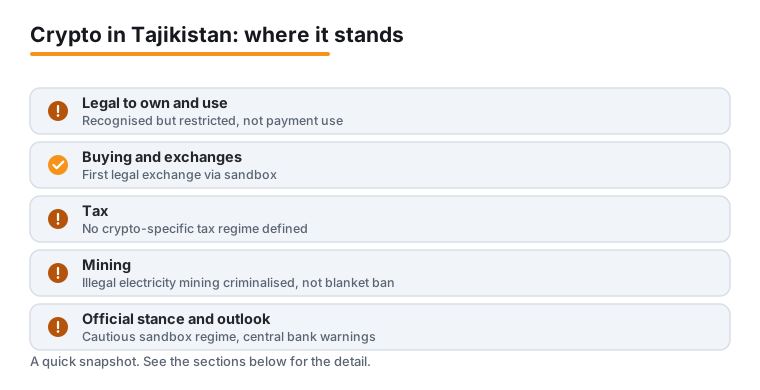
Owning and trading cryptocurrency in Tajikistan is not banned. Since Presidential Decree No. 798 of 27 March 2024, Tajik law formally acknowledges that crypto assets can exist and be circulated, and in 2026 the country gained its first legally operating crypto exchange. So crypto is best described as recognised but restricted, rather than either fully embraced or outlawed.
The key limits to understand are:
- Crypto is not legal tender. The Tajikistani somoni is the only official currency. The National Bank of Tajikistan has repeatedly stressed that financial transactions in the country should be carried out exclusively in the national currency, and that cryptocurrency is not recognised as a means of exchange, a store of value, or a unit of account.
- Payment and salary use is prohibited. Under the special-regime rules introduced by Decree No. 798, projects that promote crypto as a medium of payment are not allowed, and crypto cannot lawfully be used to pay for goods and services or to pay wages.
- Activity is channelled through a regulated regime. Lawful crypto businesses are expected to operate within the sandbox supervised by the Agency for Innovation and Digital Technologies, rather than freely outside any framework.
In short, you can lawfully hold, buy, and sell Bitcoin in Tajikistan, especially through a licensed venue, but you cannot use it as money. For background on how rules differ between countries, see our overview of crypto regulation.
Who regulates crypto in Tajikistan?
Two official bodies matter most.
- Agency for Innovation and Digital Technologies. Created and empowered by Presidential Decree No. 798 of 27 March 2024, this agency is responsible for the circulation of digital assets, including crypto assets, for running the special regulatory regime (sandbox), and for proposing further legislation. It is the body that authorises and supervises pilot projects such as the country's first legal exchange. Information on the agency is published via the government portal at egov.tj (Agency for Innovation and Digital Technologies).
- National Bank of Tajikistan (NBT). As the central bank and monetary authority, the NBT sets the tone on money and payments. It has stated that the circulation of virtual assets is not regulated by ordinary financial law, that crypto trading is not a licensed banking or financial activity, that no exchanges were registered with it as of 2025, and that it accepts no responsibility for losses from crypto use. Its site is nbt.tj (National Bank of Tajikistan).
The division of labour is important: the Agency is the gateway for lawful crypto businesses under the special regime, while the NBT guards the somoni and warns about risk. Because rules are still developing, treat any specific requirement as provisional and confirm it directly with the relevant body.
Key laws and frameworks
Tajikistan does not yet have a single, comprehensive crypto-asset statute. The framework is built from a presidential decree, criminal-law amendments, and central-bank guidance.
- Presidential Decree No. 798 (27 March 2024). Approves the regulations of the Agency for Innovation and Digital Technologies and the Special Regime Rules in the sphere of innovation and digital assets. It recognises crypto assets, allows pilot projects in a regulatory sandbox, and prohibits crypto as a means of payment or remuneration. Notably, it does not fully define terms such as crypto asset, mining, or blockchain, leaving gaps for future legislation.
- Criminal Code amendment (approved by parliament on 3 December 2025). Adds an offence covering the illegal use of electricity to produce virtual assets, with fines and prison terms (see the mining section below). It targets power theft connected to mining rather than mining in general.
- National Bank guidance (2025). Public statements clarifying that crypto is not legal tender, not a licensed financial activity, and high risk, with no NBT responsibility for losses.
- National digital-economy policy. Tajikistan has declared 2025 to 2030 the Years of Digital Economy and Innovation Development, signalling official support for digital-asset infrastructure within controlled limits.
Because the picture is assembled from several instruments and is still evolving, verify the current text and status of any rule with the named official sources before relying on it.
Licensing and registration of exchanges (VASPs)
The route to operating a crypto exchange or service in Tajikistan now runs through the special regulatory regime supervised by the Agency for Innovation and Digital Technologies, typically by becoming a resident of the country's IT Park and operating within the sandbox.
- A legal exchange now exists. In May 2026, Bitcom.tj began operating as the first legal crypto exchange in Tajikistan. It was launched by the company Service and Technology, which became a resident of the IT Park of Tajikistan in Dushanbe, and it processes transactions under the auspices of the Agency for Innovation and Digital Technologies and the National Bank of Tajikistan. It is described as serving both private and institutional participants, including commercial banks, with a Tajik and Russian-language interface and links to local payment systems.
- The NBT does not license crypto trading as such. The central bank has stated that crypto trading is not a licensed banking or financial activity and that, as of 2025, no exchanges were registered with it. Authorisation for lawful crypto venues comes through the Agency's special regime, not through an ordinary NBT financial licence.
- Outside the regime, you are unsupervised. International platforms and peer-to-peer trades remain accessible, but they sit outside Tajik supervision, so users carry the full counterparty, custody, and compliance risk.
If you intend to offer exchange-like services, assume you must engage with the Agency and the IT Park framework, and confirm the exact residency, sandbox, and reporting conditions with the Agency directly, as these rules are new and still being shaped.
Crypto and Bitcoin tax in Tajikistan
Tajikistan has not published a dedicated, crypto-specific tax code that clearly sets out how individual gains, mining income, or trading profits are taxed. This guide deliberately does not quote crypto tax rates or thresholds, because none have been reliably established for digital assets and inventing figures would be misleading.
In general terms:
- No special crypto tax is publicly defined for individuals. The absence of a tailored regime does not automatically mean activity is tax-free. General income and business-tax principles can apply depending on how the authorities characterise a transaction.
- Business activity may carry obligations. Running a crypto business, including a licensed exchange resident in the IT Park, brings standard business-tax, accounting, and reporting considerations into play, alongside any sandbox conditions.
- Uncertainty cuts both ways. An undefined position can change quickly, and unreported activity carries risk if rules are introduced or clarified.
Do not assume crypto is untaxed. Keep clear records of what you acquire, dispose of, or earn in crypto, and confirm your position with the tax authorities or a qualified Tajik adviser. For general concepts, see our guide to crypto taxes. This is not tax advice.
AML and KYC rules
Anti-money-laundering (AML) and know-your-customer (KYC) expectations are a central theme of Tajikistan's approach, and one reason the authorities prefer activity to run through a regulated venue.
- Stated rationale. The National Bank has repeatedly warned that crypto can be misused for money laundering, terrorist financing, and other crimes, and officials have framed a supervised, centralised exchange as a way to fight financial crime more effectively.
- International commitments. Tajikistan is a member of the Eurasian Group on Combating Money Laundering and Financing of Terrorism (EAG), a FATF-style regional body, and its AML/CFT system is assessed against FATF standards. You can review its status on the FATF Tajikistan country page. FATF standards expect crypto service providers to apply customer due diligence and report suspicious activity.
- What it means in practice. Expect identity verification at any lawful exchange, and be aware that informal or anonymous trades run counter to the direction of policy and may expose you to fraud with no recourse.
Treat KYC as the norm rather than the exception, and keep your own records of the source of funds and counterparties.
Buying and using crypto in practice
For the first time, residents of Tajikistan have a lawful domestic option for buying and selling crypto, alongside the international and peer-to-peer routes that were previously the only choice.
- Licensed domestic exchange. Bitcom.tj, run by the resident company Service and Technology and operating within the IT Park framework, lets residents buy and sell crypto within the Tajik legal framework, with identity verification and faster, supervised conversions. Using an authorised venue reduces, though it does not eliminate, the legal and counterparty risks of grey-market trading.
- International exchanges. Global platforms remain accessible online. They are not supervised by Tajik authorities, so users carry the full counterparty, custody, and compliance risk, and access can depend on each platform's own policies.
- Peer-to-peer (P2P) trading. Direct trades between individuals still occur, but they carry elevated fraud and dispute risk and sit outside any local protection.
Whatever route you use, remember that crypto cannot lawfully be used to pay for goods, services, or wages in Tajikistan. Convert to somoni for spending, use reputable platforms, enable strong security such as two-factor authentication, verify withdrawal addresses, and be wary of anyone promising guaranteed returns.
Bitcoin mining in Tajikistan
Mining is the area where enforcement has hardened most, but the law is narrower than a blanket ban. Tajikistan's substantial hydropower long made it attractive to miners, especially after some left other markets, which strained an already seasonal electricity supply.
- Illegal electricity use is now a crime. On 3 December 2025, parliament approved a Criminal Code amendment, reported as Article 253(2), creating an offence for the illegal use of electricity to produce virtual assets. Reported penalties are fines of roughly 15,000 to 37,000 somoni for individuals, and, for organised groups or particularly large-scale power theft, prison terms of up to five to eight years. Authorities have linked the measure to electricity theft and damage to state infrastructure. The country relies on hydropower for the great majority of its electricity, so supply tightens in colder months.
- The target is power theft, not mining as such. The offence centres on stealing or illegally using electricity for mining. It does not, by its terms, criminalise mining that is properly authorised and pays for power lawfully, though a general mining regime is still not fully defined.
- Energy is the real constraint. Even lawful mining competes with household and industrial demand, particularly in colder months, which is why the authorities are cautious. Marketing claims about green or efficient rigs do not change the legal position.
Treat mining as a regulated, capital-intensive activity, not a casual one. Obtain explicit legal clarity on permissions and a lawful, metered electricity arrangement before committing hardware.
Recent developments (2024 to 2026)
The pace of change has been notable for a small Central Asian economy.
- March 2024. Presidential Decree No. 798 establishes the Agency for Innovation and Digital Technologies and the special regime for innovation and digital assets, formally recognising crypto assets while barring crypto payments.
- May 2025. The National Bank publicly denies premature reports that a national crypto exchange had launched, and clarifies that crypto circulation is unregulated by ordinary financial law, that no exchanges were registered with it, and that crypto is not legal tender.
- December 2025. Parliament approves a Criminal Code amendment criminalising the illegal use of electricity for mining virtual assets.
- 2025 to 2030. Tajikistan declares these the Years of Digital Economy and Innovation Development, signalling policy support for digital-asset infrastructure within controlled limits.
- May 2026. Bitcom.tj launches as the first legal crypto exchange, run by the IT Park resident company Service and Technology and processing transactions under the auspices of the Agency and the National Bank.
- May to June 2026. A Council for the Development of the Digital Economy is established under the President by a decree adopted on 23 May 2026 (announced in early June). It is a permanent advisory body headed by the head of state, with the director of the Agency for Innovation and Digital Technologies serving as its secretary, signalling that digital-economy policy, including digital assets, is now coordinated at the highest level.
Because the framework is young and changing, revisit the official sources periodically rather than assuming today's rules are final.
National digital-economy governance
Crypto policy in Tajikistan sits inside a wider push to develop the digital economy, which helps explain why the authorities favour supervised, centralised activity over an open market.
- Years of Digital Economy and Innovation Development (2025 to 2030). Tajikistan has designated this period for building digital and innovation infrastructure, which frames the work of the Agency for Innovation and Digital Technologies and the IT Park.
- Council for the Development of the Digital Economy. Established under the President by a decree adopted on 23 May 2026 and announced in early June, it is a permanent advisory body headed by the head of state. The director of the Agency for Innovation and Digital Technologies serves as its secretary, and its tasks include setting priorities for state policy on the digital economy, linking the state and private sector, and supporting innovative projects.
- What this means for crypto. Digital assets are treated as one strand of a controlled, state-led digital agenda rather than a stand-alone market, so expect further rules to arrive through this governance structure over time.
Because this structure is new, confirm any specific requirement with the Agency and the National Bank rather than assuming a fixed position.
Consumer risks and protection
Even with a lawful exchange now available, crypto in Tajikistan carries significant risk, and the safety net is limited.
- No central-bank backstop. The National Bank has stated it is not responsible for losses connected to crypto use. There is no deposit-style guarantee for crypto holdings.
- Volatility and self-custody. Prices can fall sharply, and if you self-custody, losing your keys or recovery phrase means losing your funds. Only commit money you can afford to lose.
- Fraud and grey-market exposure. Using unsupervised international or P2P channels increases the risk of scams, platform failure, and disputes with no local recourse. Anonymous or informal trades also run against the AML direction of policy.
- Payment prohibition. Attempting to use crypto as money for goods, services, or wages conflicts with the special-regime rules.
Reduce risk by preferring an authorised venue, completing identity verification, using strong security, keeping records, and treating any too-good-to-be-true offer as a red flag.
Official sources and how to verify
Crypto rules in Tajikistan are new and still being shaped, so always confirm the current position with primary, official sources rather than secondary summaries.
- National Bank of Tajikistan for monetary policy, the status of the somoni, and central-bank warnings on virtual assets: nbt.tj.
- Agency for Innovation and Digital Technologies for the special regime, the sandbox, and authorisation of crypto businesses, via the government portal: egov.tj (Agency for Innovation and Digital Technologies).
- FATF Tajikistan country page for the AML/CFT assessment and EAG context: fatf-gafi.org.
For wider context, see our hub on crypto regulation by country and our explainer on how crypto regulation works. This article is general information as of 2026 and is not legal, tax, or financial advice; before acting, verify the current rules with the National Bank of Tajikistan, the Agency for Innovation and Digital Technologies, and a qualified local professional.
Frequently asked questions
Is cryptocurrency legal in Tajikistan in 2026?
Yes, in a limited sense. Owning, buying, and selling crypto is not banned, and since Presidential Decree No. 798 of 27 March 2024 Tajik law recognises that crypto assets can exist and circulate. In mid-2026 the first legal exchange began operating under a regulatory sandbox. However, crypto is not legal tender and cannot lawfully be used to pay for goods, services, or wages, and the somoni remains the only official currency. This is general information, not legal advice.
Who regulates crypto in Tajikistan?
Two bodies. The Agency for Innovation and Digital Technologies, created by Decree No. 798, runs the special regulatory regime for digital assets and authorises lawful crypto businesses. The National Bank of Tajikistan oversees money and payments and has warned that virtual assets are not legal tender, are not a licensed financial activity, and are high risk, with no central-bank responsibility for losses. Verify with nbt.tj and the Agency via egov.tj.
Can I legally buy and sell crypto in Tajikistan now?
Yes. As of mid-2026 a licensed domestic exchange, Bitcom.tj, operates within the IT Park sandbox and lets residents buy and sell crypto under Tajik law, with identity verification. International exchanges and peer-to-peer trades are also accessible but are not supervised by Tajik authorities, so they carry full counterparty and security risk. You cannot lawfully use crypto as a means of payment.
Is Bitcoin mining allowed in Tajikistan?
Mining itself is not flatly banned, but on 3 December 2025 parliament criminalised the illegal use of electricity to produce virtual assets, with fines and possible prison terms for power theft and organised activity. The measure targets stolen or unauthorised electricity rather than mining as such. Given strained, seasonal power supply and an incomplete mining regime, obtain explicit legal clarity and a lawful, metered electricity arrangement before mining.
Can I use Bitcoin to pay for things or receive my salary in crypto?
No. Under the special-regime rules introduced by Decree No. 798, projects promoting crypto as a means of payment are prohibited, and crypto cannot lawfully be used to pay for goods and services or to pay wages. The somoni is the only legal tender. If you hold crypto, convert it to somoni for spending.
How is crypto taxed in Tajikistan?
There is no clearly published, crypto-specific tax regime for individuals, so this guide does not quote rates. That does not mean activity is automatically tax-free, since general income and business-tax principles can apply, especially for commercial activity such as a licensed exchange. Keep detailed records and confirm your position with the tax authorities or a qualified Tajik adviser. This is not tax advice.
What is Bitcom.tj and who runs it?
Bitcom.tj is described as the first legal crypto exchange in Tajikistan, launched in May 2026. It is run by the company Service and Technology, which became a resident of the IT Park of Tajikistan in Dushanbe, and it processes transactions under the auspices of the Agency for Innovation and Digital Technologies and the National Bank of Tajikistan. It is reported to serve both private and institutional participants, including commercial banks, with a Tajik and Russian-language interface. Confirm current terms and status directly before relying on any specific detail.
What penalties apply to illegal crypto mining in Tajikistan?
A Criminal Code amendment approved on 3 December 2025, reported as Article 253(2), penalises the illegal use of electricity to produce virtual assets. Reported fines for individuals are roughly 15,000 to 37,000 somoni, while organised groups or particularly large-scale power theft can face prison terms of up to five to eight years. The offence targets stolen or unauthorised electricity rather than mining as such, and a full mining regime is still not defined.
Facts reviewed: 30 June 2026. Page updated: 3 August 2026.