Home › Crypto Regulation › Cyprus
Bitcoin & Cryptocurrency Regulation in Cyprus
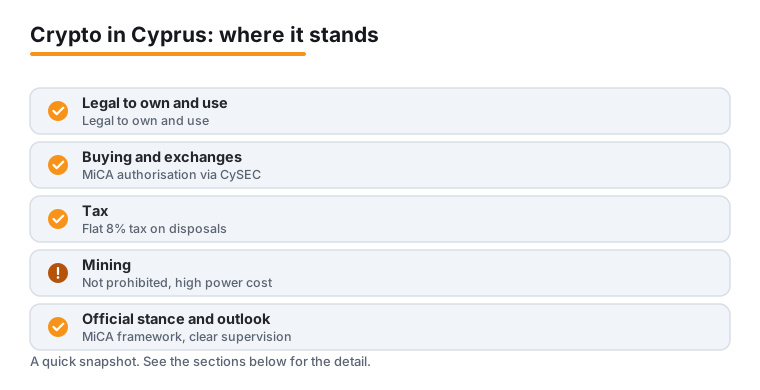
Quick answer — Cyprus, 2026
- Legal: Legal to own and trade, not legal tender, CASPs licensed under MiCA
- Tax: Flat 8 percent tax on disposal gains from 2026, mining taxed separately
- Buying: Via MiCA-authorised or EU exchanges after KYC, euro SEPA on-ramps
Cyprus is an EU and eurozone member, so its rules for cryptocurrency are shaped first by EU law and then by national supervision. Owning and trading Bitcoin and other crypto-assets is legal, and as of 2026 the sector is governed by the EU's Markets in Crypto-Assets Regulation (MiCA), enforced locally by the Cyprus Securities and Exchange Commission (CySEC). Cyprus has also moved its crypto businesses off the older national registration regime and onto the MiCA authorisation framework, with a hard transition deadline in mid-2026, and it introduced a dedicated crypto tax provision that took effect on 1 January 2026.
This guide explains where Bitcoin and other cryptocurrencies stand legally in Cyprus, who regulates the sector, how crypto is taxed, and the practical rules around licensing, buying, mining and consumer protection. It is written for residents, expats and visitors who want an accurate, plain-language picture. Crypto law in Cyprus is evolving quickly, so every figure and rule below should be confirmed against the official sources named at the end before you rely on it. For broader background see our guide to crypto regulation and our overview of crypto taxes.
This article is general information as of 2026 and is not legal, tax or financial advice. Verify the current position with CySEC, the Central Bank of Cyprus and the Cyprus Tax Department, and consult a qualified Cyprus-licensed professional before acting.
On this page: Legal status · Who regulates it · Taxes · How to buy · Mining
Is Bitcoin and crypto legal in Cyprus?
Yes. Buying, holding, selling and using Bitcoin and other cryptocurrencies is legal in Cyprus. There is no law banning private individuals from owning or trading crypto-assets, and Cyprus has not attempted to prohibit cryptocurrencies.
It is important to separate legal from legal tender. Crypto is legal to use, but it is not official money. The euro is the only legal tender in Cyprus, and no merchant is obliged to accept Bitcoin. Some businesses accept crypto voluntarily, but that is a commercial choice, not a right. The Central Bank of Cyprus has repeatedly stressed that virtual currencies are not legal tender and carry no state guarantee.
The activity that is regulated is the provision of crypto services to others, such as running an exchange, custody wallet or brokerage. Those businesses must be authorised. Personal use sits outside that licensing net, although it still carries tax and anti-money-laundering obligations when you interact with regulated providers.
Who regulates crypto in Cyprus?
The Cyprus Securities and Exchange Commission (CySEC) is the competent authority for crypto-asset services in Cyprus. It is both the MiCA authorisation authority for Crypto-Asset Service Providers (CASPs) and the anti-money-laundering and counter-terrorist-financing supervisor for crypto activity carried out in or from Cyprus. CySEC maintains the register of authorised firms and supervises their conduct.
The Central Bank of Cyprus (CBC) is the monetary authority. It does not license retail crypto exchanges, but it issues public warnings about crypto risks, oversees payment and banking matters, and has a role in matters touching on stablecoins and monetary stability under the EU framework.
At EU level, the European Securities and Markets Authority (ESMA) and the European Banking Authority develop the technical standards that sit under MiCA. The single most reliable thing a consumer can do is to check a provider's status directly on the official CySEC register rather than relying on the firm's own marketing. See CySEC and the Central Bank of Cyprus.
Key laws and frameworks
Cyprus regulation now operates on two layers: the EU rulebook and national supervision.
MiCA: the EU framework
The EU's Markets in Crypto-Assets Regulation, Regulation (EU) 2023/1114 (MiCA), applies directly across all member states, including Cyprus. It creates a single authorisation regime for CASPs such as exchanges, custodians and brokers, sets specific rules for issuers of asset-referenced tokens and e-money tokens (stablecoins), and imposes disclosure requirements for token offerings. A firm authorised under MiCA in one EU state can passport its services across the bloc. You can read about it on the ESMA MiCA page.
National AML law
Before MiCA, crypto businesses registered under Cyprus's national regime. That regime was built on the Prevention and Suppression of Money Laundering Activities Law, Law 188(I)/2007, as amended (notably by Law 13(I)/2021, transposing the EU's 5th Anti-Money-Laundering Directive, and Law 98(I)/2023). Under that law CySEC issued a CASP registration directive in 2021. This national registration framework is being phased out in favour of MiCA authorisation during 2026.
Licensing and registration of exchanges (MiCA transition)
Any business providing crypto-asset services in or from Cyprus must be authorised. The framework is now MiCA, replacing the older national CASP registration.
The 2026 transition deadline
CySEC confirmed that crypto firms that were operating under Cyprus's national rules had to apply for MiCA authorisation by 27 February 2026. The transitional window is reported to cover providers that were already registered with CySEC before 30 December 2024. Firms that applied in time may continue providing services under the prior national regime only until their application is decided, or until the transitional regime ends on 1 July 2026, whichever comes first. Providers that did not apply must submit a wind-down plan, because providing crypto-asset services from a Cyprus base will not be permitted after the transitional period.
This is the single most important regulatory development for anyone using a Cyprus-based platform in 2026. Confirm that any provider you use has applied for or obtained MiCA authorisation, and verify it on the CySEC register rather than taking the firm's word for it.
What authorisation involves
MiCA authorisation requires fit-and-proper management, minimum capital and own-funds requirements scaled to the services offered, and robust governance, custody and AML controls. The detailed thresholds are set in MiCA and CySEC's implementing rules, so prospective applicants should take Cyprus-licensed legal advice.
Crypto and Bitcoin tax in Cyprus
For most of the past decade Cyprus had no specific crypto tax legislation. Gains were assessed under general income-tax principles, and because Cyprus does not levy capital-gains tax on most non-property assets (capital-gains tax is generally confined to gains from immovable property located in Cyprus), the treatment of crypto was often ambiguous.
This changed with the 2026 tax reform. Multiple professional and legal summaries report that Cyprus inserted a dedicated crypto provision into the Income Tax Law (commonly cited as Article 20E), introducing a flat 8% tax on profits from the disposal of crypto-assets, effective 1 January 2026, applying to both individuals and companies subject to Cyprus income tax. Reported summaries state the measure was approved by Parliament on 22 December 2025 and published in the Official Gazette on 31 December 2025, and that the law ties the definition of crypto-asset to the EU MiCA framework so tax and regulation use the same concepts. Reported features include: disposal covers selling crypto for fiat, crypto-to-crypto exchanges, using crypto to pay for goods or services, and gifts or transfers without consideration; taxable profit is generally proceeds minus acquisition cost and directly related expenses; the 8% gains are reported as ring-fenced from the progressive income-tax base; and crypto obtained through mining is excluded from the 8% regime and taxed under general income-tax rules.
The reform also sets a strict loss rule. According to those summaries, a loss from disposing of crypto-assets can be set off only against gains from other crypto-asset disposals of the same taxpayer, and only within the same tax year. Crypto losses cannot be carried forward to later years and cannot be used to reduce salary, business or other non-crypto income. In practice this means a trader who wants to net a loss against a gain has to realise both in the same calendar year.
Because the precise statutory text, definitions and any reliefs can be interpreted differently and may be refined, The rate, scope and effective date are settled. What could not be found in public records is a dedicated Cyprus Tax Department circular interpreting Article 20E, so edge cases such as staking rewards, DeFi positions and NFTs are worth putting to a Cyprus tax adviser. The rate is 8 per cent, the legal basis is Article 20E of the Income Tax Law, and it applies from 1 January 2026, so the 2026 tax year is the first one affected and the first returns using it are filed in 2027. Regardless of the headline rate, you must keep detailed records of every acquisition and disposal (dates, euro values, fees and counterparties) and self-assess and declare crypto income. See our general crypto tax guide for context.
AML and KYC rules
Anti-money-laundering (AML) and Know-Your-Customer (KYC) obligations are central to crypto in Cyprus and apply at the level of regulated providers, not individual holders.
- CASPs are obliged entities. Authorised and registered crypto firms must perform customer due diligence, verify identity, monitor transactions, and report suspicious activity to the authorities. CySEC supervises this under the national AML law (Law 188(I)/2007 as amended) and under MiCA.
- Identity checks are mandatory. Expect to provide government ID and often proof of address before you can trade, withdraw, or use a crypto ATM above modest limits. Anonymous high-value accounts are not permitted at regulated venues.
- The travel rule applies. The EU's transfer-of-funds rules require that sender and recipient information accompanies many crypto transfers between regulated providers, mirroring the standards for traditional wires.
These obligations are now a permanent feature of using regulated crypto services in Cyprus and across the EU.
Buying and using crypto in practice
Residents can buy crypto through international exchanges that serve EU customers and through providers authorised to operate in Cyprus. Practical points to keep in mind:
- Use authorised providers. Favour platforms that are MiCA-authorised or that applied within the transition window. This gives clearer consumer protections and lower counterparty risk. Verify status with CySEC.
- Expect KYC. Identity verification is required before you can trade or withdraw at regulated venues.
- Funding is straightforward. Cyprus is in the eurozone and the SEPA area, so euro bank transfers and cards are the usual on-ramps. There are no general capital or foreign-exchange controls today (the emergency controls imposed during the 2013 banking crisis were fully lifted in 2015).
- Banks vary. Some Cypriot banks are cautious about crypto-related transfers and may query or delay them. Using a well-known regulated exchange and being able to explain your source of funds reduces friction.
- Bitcoin ATMs. A small number of Bitcoin ATMs have operated in cities such as Nicosia, Limassol and Paphos. They allow cash purchases (and sometimes sales) but charge high fees and apply KYC above modest thresholds. Availability changes, so check a live locator first.
For larger amounts a regulated exchange is almost always cheaper and safer than an ATM, and you should never keep more on an exchange than you need for active trading.
Bitcoin mining in Cyprus
Bitcoin mining is not prohibited in Cyprus, but it is not a natural fit for the island. The dominant constraint is electricity: Cyprus has historically had some of the highest power prices in the EU, and proof-of-work mining is extremely energy-intensive. A hot Mediterranean climate adds cooling costs, so large-scale mining is rarely competitive against operations in regions with cheap or renewable power.
On the regulatory side, mining itself is not licensed in the way that running an exchange is. For tax, reported summaries of the 2026 reform indicate that crypto obtained through mining is excluded from the flat 8% disposal regime and is instead taxed under general income-tax rules, so mining rewards are taxable. Those summaries put the general rates at 15% corporate income tax for companies and progressive personal rates up to 35% for individuals, rather than the flat 8% that applies to ordinary disposals. Anyone mining commercially should also consider business registration, electricity-tariff terms and EU energy-efficiency expectations, and should confirm the tax treatment with the Cyprus Tax Department.
Recent developments (2025-2026)
Two developments dominate the current picture:
- MiCA transition. CySEC set 27 February 2026 as the deadline for existing crypto firms to apply for MiCA authorisation, with the national transitional regime ending on 1 July 2026. After that point, only firms holding a CySEC-issued MiCA authorisation may provide crypto-asset services from Cyprus. That point has now passed. CySEC stated that any continuation of activities beyond 1 July 2026 is conditional on obtaining the relevant MiCA authorisation, and firms that did not apply by 27 February 2026 were required to submit a wind-down plan.
- Dedicated crypto tax. Cyprus introduced a flat 8% tax on profits from disposing of crypto-assets, reported as approved by Parliament on 22 December 2025, published in the Official Gazette on 31 December 2025, and effective from 1 January 2026. It is the first time crypto has had its own provision in the Income Tax Law. Crypto losses are reported as usable only against crypto gains in the same year with no carry-forward, and mining income is reported as taxed separately under general rules (about 15% for companies and up to 35% for individuals).
The Central Bank of Cyprus has also continued to issue investor-caution statements. In a notice dated 7 February 2025 it urged caution on crypto-asset investments, pointing to extreme volatility, speculation, fraud and the lack of regulatory protection, and it reiterated that Cypriot financial institutions do not invest in cryptocurrencies. Separately, in October 2025 CySEC relayed an EU-level alert to consumers about the risks of crypto-assets and the weak safeguards around them. The overall direction of travel is toward more structure: clearer authorisation, clearer tax, and clearer obligations, alongside ongoing official warnings about risk.
Consumer risks and protection
Key risks. Crypto is a high-volatility, high-risk asset class that can lose value rapidly. It is not covered by deposit-guarantee or investor-compensation schemes the way bank deposits are. Common dangers include scams, fake exchanges and impersonation fraud, loss of funds through mismanaged private keys, and regulatory or tax change. Because Cyprus's crypto rules are mid-transition in 2026, a provider you use today could be required to wind down if it fails to obtain MiCA authorisation.
What protection exists. MiCA brings conduct, disclosure, custody and governance standards that improve provider accountability, and CySEC supervises authorised firms. The Central Bank of Cyprus has publicly urged caution on crypto investments, noting the risk of substantial losses and fraud and the lack of guarantees for unregulated activity. Practical protection is largely in your hands: use clearly authorised firms, treat any allocation as money you can afford to lose, diversify, avoid leverage and any scheme promising guaranteed returns, and secure your own keys for anything beyond small active-trading amounts.
Official sources and how to verify
Because crypto rules in Cyprus are changing quickly, verify the current position with the primary authorities rather than relying on summaries (including this one):
- Regulator and provider register: Cyprus Securities and Exchange Commission (CySEC), including its CASP register. Check that any platform you use is authorised before depositing funds.
- Monetary authority and risk warnings: Central Bank of Cyprus.
- EU framework: the ESMA MiCA page for the EU-wide rulebook.
- Tax: the Cyprus Tax Department for the current treatment of crypto gains, mining and reporting.
For more general background, see our crypto regulation guide and our country regulation hub. This article is general information as of 2026 and is not legal, tax or financial advice; always confirm with the named official regulators and a qualified Cyprus-licensed professional before acting.
What is changing: Cyprus crypto status in August 2026
The MiCA transitional window in Cyprus is closed. In a press release dated 23 December 2025, the Cyprus Securities and Exchange Commission set 27 February 2026 as the deadline for existing crypto-asset service providers to apply for authorisation under MiCA. It clarified that providers operating under the national framework could continue only until their application was approved or rejected, or until the end of the transitional period on 1 July 2026, whichever came first. Firms that did not apply by the deadline were required to submit a wind-down plan. CySEC stated plainly that any continuation of activities beyond 1 July 2026 is conditional on obtaining the relevant MiCA authorisation. That position follows its announcement of 17 October 2024 and Circular No. 674.
On 10 July 2026 the regulator issued a public warning about unauthorised crypto-asset services, reminding clients that all crypto-asset services must comply with MiCA following the end of the transitional period. The notice said clients of unauthorised providers do not benefit from MiCA safeguards, including protections for client assets, told them to check the official ESMA register, and encouraged anyone whose provider lacks authorisation to act promptly by moving crypto-assets to an authorised provider where one is identified, or to a self-hosted wallet (Cyprus Mail, 10 July 2026).
How many firms actually made it through? There is no official Cyprus figure in the public domain, so the honest answer is roughly two dozen. Two independent trackers of ESMA's interim MiCA register, both synced on 3 August 2026, put Cyprus at 25 and 24 authorisations, against a total of roughly 320 across the EU and EEA. Brands appearing under Cyprus on the first of those trackers include eToro, Revolut, Trading 212, capital.com and NAGA X. For context on the pace, ESMA's first post-transition register update, reported on 4 July 2026, added 37 newly authorised providers and put the EU total at 280 at that point (Crowdfund Insider). Neither tracker is an official source, and they disagree by one on Cyprus, so treat these as indicative rather than exact.
Before depositing money with any platform that markets itself as Cyprus-regulated, do these three checks:
- Look the firm up on ESMA's interim MiCA register, which includes a dataset of authorised crypto-asset service providers and is published at weekly intervals from ESMA's MiCA page. Check the exact legal entity name, not the brand, because a familiar brand often trades through a differently named licensed company.
- Cross-check on CySEC's own site, which lists MiCAR CASPs and former MiCAR CASPs separately (CySEC MiCA overview). A firm appearing only under former CASPs has lost its permission.
- Treat a pending application as not authorised. CySEC's stated position is that continuing beyond 1 July 2026 depends on holding the authorisation itself, and a pending application does not automatically extend a firm's right to operate (Cyprus Insider).
On tax, nothing has changed since 1 January 2026. The 8 per cent flat rate under Article 20E of the Income Tax Law still stands and 2026 is the first tax year it covers, so the first Cyprus returns applying it fall due in 2027.
Cyprus crypto legislation: adopted and in progress
Cyprus does not legislate on crypto mainly through its own parliament. Most of what governs crypto here is directly applicable EU law that CySEC enforces, with two important exceptions where the Cyprus House of Representatives had to act: the 8 per cent tax and the DAC8 reporting law. Here is the picture and the timing.
| Measure | Stage | What it does | When it bites |
|---|---|---|---|
| Regulation (EU) 2023/1114 (MiCA) | In force | Authorisation and conduct rules for crypto-asset service providers and issuers. CySEC is the designated national competent authority for CASPs in Cyprus. | Applies from 30 December 2024, with the asset-referenced and e-money token titles applying since 30 June 2024. Cyprus transitional regime ended 1 July 2026. |
| Article 20E, Income Tax Law | In force | Flat 8 per cent tax on profits from disposing of crypto-assets, for individuals and companies alike. Losses ring-fenced to crypto gains in the same year. | Approved by the House of Representatives 22 December 2025, gazetted 31 December 2025, effective 1 January 2026. First returns filed in 2027. |
| Law 38(I)/2026 (DAC8 transposition) | In force | Obliges reporting crypto-asset service providers to collect and report user identity, tax residence, balances by asset type and transaction data to the Tax Department. | Gazetted 27 March 2026. DAC8 rules apply from 1 January 2026. First Cyprus report due 30 June 2027. |
| Regulation (EU) 2023/1113 (travel rule) | In force | Originator and beneficiary information must accompany crypto transfers. | Already applies. CySEC confirmed in December 2025 that CASPs on the national register remained bound by it during the transition. |
| Regulation (EU) 2024/1624 (AMLR) with the AMLA Regulation | Adopted, not yet applicable | A single directly applicable EU anti-money-laundering rulebook whose recitals state that crypto-asset service providers should be covered. Sets up an EU AML Authority seated in Frankfurt. | Published in the Official Journal 19 June 2024 and not yet applicable. Check the Regulation itself for the application date before relying on any timing. |
| Digital euro Regulation | In negotiation | Would create central bank digital money for the euro area alongside cash. | Parliament mandate adopted 9 July 2026. Trilogues expected to begin by end of July 2026, target agreement end of 2026. ECB pilot planned for the second half of 2027, potential first issuance during 2029. |
| Market Integration and Supervision Package | Commission proposal | Would place all crypto-asset service providers under direct ESMA supervision. Two regulations and one directive amending 19 pieces of EU legislation. | Published 4 December 2025. Negotiations expected to continue until at least 2027. No application date fixed. |
Sources for the table: CySEC press release of 23 December 2025, EUR-Lex summary of MiCA, Cyprus Mail on the 22 December 2025 tax vote, KPMG on the 31 December 2025 gazette date, Law 38(I)/2026, European Commission on DAC8, Regulation (EU) 2024/1624, European Commission on the AML package, Banca d'Italia on the 9 July 2026 Parliament vote, ECB digital euro pilot and Baker McKenzie on the December 2025 package.
No separate Cyprus bill on crypto trading, mining or holding could be identified in public records as sitting before the House of Representatives at the time of writing. The pipeline that matters for Cyprus holders is the EU pipeline in the table above.
From 2027 your Cyprus exchange reports your account to the tax office
The change most Cyprus holders have not registered is Law 38(I)/2026, which amends the Administrative Cooperation in the Field of Taxation Law 205(I)/2012 and was published in the Official Gazette of the Republic of Cyprus on 27 March 2026. It transposes Council Directive (EU) 2023/2226, known as DAC8, which extends EU tax transparency to crypto-asset transactions.
Who has to report: a reporting crypto-asset service provider is either an entity licensed in Cyprus under MiCA, or a crypto-asset operator with a Cyprus nexus through tax residence, incorporation in Cyprus, place of effective management in Cyprus or usual place of business in Cyprus.
What gets reported: for each reportable user, identification details including name, address, tax identification number and tax residence, controlling persons where relevant, aggregate fair market values by asset type, transaction counts and transfer information (summary of Law 38(I)/2026).
When: DAC8 rules apply from 1 January 2026, and the European Commission states that first reporting falls due within nine months after the end of the first fiscal year covered, that is between 1 January and 30 September 2027 (European Commission on DAC8). Within that window, the Cyprus deadline reported for providers to file with the Tax Department is 30 June 2027 for calendar year 2026, with automatic exchange with other EU tax authorities by 30 September 2027. Penalties are reported at up to 5,000 euro for due diligence failures and up to 10,000 euro for record-keeping or filing breaches.
What it means in practice: the 8 per cent Article 20E charge stops being purely self-declared. From the 2026 tax year the Tax Department receives platform-level data it can compare against your return, and the same flow works in reverse if you are a Cyprus resident holding on a platform elsewhere in the EU. Keep an exportable transaction history for 2026 onwards, including crypto-to-crypto swaps, because each of those is a disposal under Article 20E even though no euro ever reached your bank account.
Frequently asked questions
Is cryptocurrency legal in Cyprus?
Yes. Buying, holding, selling and using cryptocurrency is legal in Cyprus. It is not legal tender (only the euro is) and no business is required to accept it. Companies that provide crypto services to others must be authorised under the EU's MiCA regulation and supervised by CySEC.
Who regulates crypto in Cyprus?
The Cyprus Securities and Exchange Commission (CySEC) is the competent authority for crypto-asset service providers and the AML/CFT supervisor for crypto activity carried out in or from Cyprus. The Central Bank of Cyprus is the monetary authority and issues crypto risk warnings. You can verify a provider's authorisation on the CySEC register.
How is crypto taxed in Cyprus in 2026?
Cyprus introduced a dedicated crypto provision in its Income Tax Law, reported as a flat 8% tax on profits from disposing of crypto-assets, effective from 1 January 2026, for individuals and companies. Disposal includes selling for fiat, crypto-to-crypto swaps, paying with crypto, and gifts. Mining income is reported as taxed separately under general rules (about 15% for companies and progressive rates up to 35% for individuals). Crypto losses are reported as usable only against crypto gains in the same tax year, with no carry-forward. Confirm the exact current rules with the Cyprus Tax Department and keep detailed records of all transactions.
Can I offset crypto losses against other income in Cyprus?
Reported summaries of the 2026 reform say no. A loss from disposing of crypto-assets can be set off only against gains from other crypto-asset disposals of the same taxpayer, and only within the same tax year. Crypto losses cannot be carried forward to future years and cannot reduce salary, business or other income. This means traders who want to net a loss against a gain generally have to realise both in the same calendar year. Confirm the current treatment with the Cyprus Tax Department.
How do residents in Cyprus buy Bitcoin?
Most residents buy through international exchanges that serve EU customers or through providers authorised to operate in Cyprus. Cyprus is in the eurozone and the SEPA area, so euro bank transfers and cards are the usual funding methods, and there are no general capital or foreign-exchange controls today. Expect identity verification (KYC) at any regulated venue, and check the provider's status on the CySEC register before depositing. A small number of Bitcoin ATMs have operated in cities such as Nicosia, Limassol and Paphos, but they charge high fees and still apply KYC above modest limits.
What is the MiCA deadline for crypto firms in Cyprus?
CySEC required crypto-asset service providers operating in Cyprus to apply for MiCA authorisation by 27 February 2026, with the national transitional regime ending on 1 July 2026. Firms that did not apply must wind down, and after 1 July 2026 only CySEC-authorised firms may provide crypto-asset services from Cyprus. Confirm that any platform you use has applied or been authorised.
Do I need to do identity verification (KYC) to use crypto in Cyprus?
Yes, at regulated providers. EU and Cyprus AML rules require crypto-asset service providers to verify your identity (ID and often proof of address) before you can trade, withdraw, or use a Bitcoin ATM above modest limits. The EU travel rule also means sender and recipient information accompanies many transfers between regulated providers.
Is my crypto protected if a Cyprus exchange fails?
Not in the way bank deposits are. Crypto is not covered by deposit-guarantee or investor-compensation schemes, and the Central Bank of Cyprus has warned there is no state guarantee for virtual currencies. MiCA improves provider standards and accountability, but you still bear market and counterparty risk, so use clearly authorised firms and secure your own keys for larger holdings.
Is crypto legal in Cyprus in August 2026?
Yes. Buying, holding, trading and spending crypto is legal in Cyprus. It is not legal tender, the euro is, and no merchant has to accept it. What changed on 1 July 2026 is who may sell you the service: the CySEC transitional period ended on that date, and the regulator has stated that any continuation of crypto-asset services beyond it is conditional on obtaining a MiCA authorisation.
Do I pay Cyprus tax when I swap one crypto for another?
Yes. Under Article 20E of the Income Tax Law, in force since 1 January 2026, exchanging one crypto-asset for another is a disposal and the profit is taxed at a flat 8 per cent, even though no euro reached your bank account. Selling for fiat, using crypto to pay for goods or services, and donations or transfers without consideration are also disposals.
Can I carry a crypto loss forward in Cyprus?
No. A loss on a crypto disposal can only be set against gains from other crypto disposals within the same tax year. There is no carrying forward of crypto losses and no offset against other income such as salary, rent or dividends.
Will my exchange tell the Cyprus tax office what I hold?
From the 2026 tax year, yes. Law 38(I)/2026, published in the Official Gazette on 27 March 2026, transposes the EU DAC8 directive. Reporting crypto-asset service providers must file user identity, tax residence, aggregate values by asset type and transaction data with the Cyprus Tax Department, with the Cyprus filing deadline reported as 30 June 2027 for calendar year 2026 and exchange with other EU tax authorities by 30 September 2027. The European Commission puts the EU-wide first reporting window between 1 January and 30 September 2027.
How many crypto firms are actually licensed in Cyprus?
Around two dozen, though there is no official Cyprus headline figure in the public domain. Two independent trackers of ESMA's interim MiCA register, both synced on 3 August 2026, showed 25 and 24 authorised crypto-asset service providers in Cyprus, out of roughly 320 across the EU and EEA. Brands listed under Cyprus include eToro, Revolut, Trading 212, capital.com and NAGA X. Check the exact legal entity name on the ESMA register rather than relying on the brand, because these are unofficial trackers and they disagree by one.
My platform applied for a MiCA licence but has not been approved. Can it still serve me?
Not on the strength of the application alone. CySEC's stated position is that any continuation of crypto-asset services beyond 1 July 2026 is conditional on obtaining the relevant MiCA authorisation, and a pending application does not automatically extend a firm's right to operate. If your provider is not on the ESMA register, the regulator's advice from 10 July 2026 is to move your crypto-assets to an authorised provider where one is identified, or to a self-hosted wallet.
Is mining taxed at 8 per cent in Cyprus?
No. Crypto obtained through mining is excluded from the Article 20E regime and taxed under general income tax rules instead. After the December 2025 tax reform that means the corporate tax rate of 15 per cent for a company, up from 12.5 per cent, or personal income tax rates for an individual, where the tax-free threshold rose from 19,500 to 22,000 euro.
Is the digital euro replacing crypto in Cyprus?
No, and it does not exist yet. The digital euro would be central bank money, not a crypto-asset, and would sit alongside cash rather than replace Bitcoin or stablecoins. The European Parliament adopted its negotiating position on 9 July 2026 by 416 votes to 169 with 22 abstentions, and negotiations with the Council were expected to begin by the end of July 2026. The ECB has selected 36 payment service providers for a pilot planned to start in the second half of 2027 and run for 12 months, and aims to be ready for a potential first issuance during 2029 assuming the Regulation is adopted in 2026.
Facts reviewed: 3 August 2026. Page updated: 12 August 2026.