Home › Crypto Regulation › San Marino
Bitcoin & Cryptocurrency Regulation in San Marino
Quick answer — San Marino, 2026
- Legal: Legal to own and use, not legal tender; DLT framework in force since October 2024
- Tax: Taxed under domestic IGR system by analogy; some regulated-token income exempted
- Buying: Mostly via international EU-serving exchanges in euros with KYC
San Marino is one of the world's smallest and oldest republics, a microstate of roughly 34,000 people enclaved within Italy. Despite its size, it has positioned itself as an early mover on blockchain and distributed-ledger technology (DLT), and as of 2 October 2024 it has a dedicated, in-force legal framework for crypto-assets. This page explains the current state of San Marino crypto regulation as of 2026: whether Bitcoin and other cryptocurrencies are legal, who supervises the sector, the key laws, how exchanges and service providers are authorised, taxation, AML and KYC rules, buying and using crypto in practice, mining, recent developments, consumer risks, and how to verify everything against official sources.
San Marino is not a member of the European Union or the European Economic Area, though it uses the euro under a monetary agreement with the EU. Its crypto rulebook does not apply the EU's Markets in Crypto-Assets Regulation (MiCA) directly; instead, the Central Bank of San Marino built its own crypto-asset regulation using EU Regulation 2023/1114 (MiCAR) as the reference benchmark. Because the rules are recent and detail can change, this article is general information as of 2026 and is not legal, tax, or financial advice. Always verify your specific situation with the Central Bank of the Republic of San Marino or a qualified local professional. For broader context see our guide to crypto regulation and the wider regulation hub.
On this page: Legal status · Who regulates it · Taxes · How to buy · Mining
Is Bitcoin and crypto legal in San Marino?
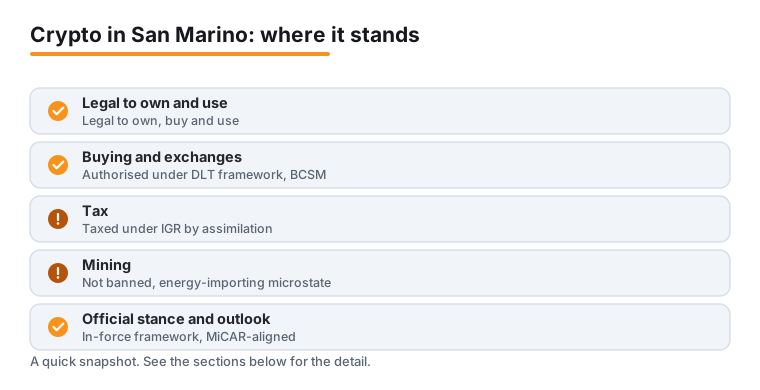
Yes. Owning, buying, selling, and using Bitcoin and other cryptocurrencies is legal in San Marino. There is no prohibition on individuals holding digital assets, and the republic has gone further than many jurisdictions by enacting a specific, in-force legal framework for crypto-assets and distributed-ledger technologies rather than leaving the sector unregulated.
Legal does not mean legal tender. The euro is San Marino's official currency, and no business is obliged to accept Bitcoin as payment. Crypto is best understood as a permitted asset and technology that operates within a defined regulatory perimeter: lawful to hold and trade for individuals, but subject to authorisation, registration, and compliance obligations when offered as a business activity or service.
In short, individuals enjoy broad freedom to use crypto, while companies that issue tokens or provide crypto-asset services must operate inside the framework supervised by the Central Bank of San Marino and San Marino Innovation, as described below.
Who regulates crypto in San Marino?
Crypto supervision in San Marino is split between two bodies according to the type of token involved:
- Central Bank of the Republic of San Marino (BCSM) is the competent authority for Type A tokens, i.e. crypto-assets. This category covers cryptocurrencies (such as Bitcoin), electronic-money tokens, and crypto-assets linked to other assets in tokenised form. BCSM is also San Marino's supervisory authority for the banking, financial, and insurance sectors. Where an operator deals in both Type A and Type B tokens, BCSM is the lead authority.
- San Marino Innovation (the Institute for Innovation) is the competent authority for Type B tokens, such as utility tokens, non-fungible tokens (NFTs), and other DLT documents that fall outside the crypto-asset perimeter. It also maintains the register of DLT operators.
Anti-money-laundering supervision is carried out by the Agenzia di Informazione Finanziaria (AIF), the Financial Intelligence Agency, which is established within the Central Bank and operates with autonomy under Law No. 92 of 17 June 2008. You can confirm the regulator and consult its provisions on the Central Bank of San Marino website.
Key crypto laws and the DLT framework
San Marino's crypto rulebook rests on primary legislation and implementing regulations rather than a single act:
- Legge 15 settembre 2023 n. 132 and the delegated decrees that followed established the framework for technologies based on distributed ledgers.
- Decreto Delegato 29 agosto 2024 n. 138 ratified the earlier delegated decrees and set the structure under which the two supervisory regulations were issued.
- Two implementing Regulations entered into force on 2 October 2024: one issued by the Central Bank of San Marino for Type A crypto-assets (its crypto-assets Regulation, identified as No. 2024-03), and one issued by San Marino Innovation for Type B tokens.
The Central Bank explicitly developed its crypto-assets regulation using EU Regulation 2023/1114 (MiCAR) as the reference parameter, so the San Marino rules are closely informed by EU standards even though San Marino is outside the EU and EEA and MiCA does not apply automatically. The framework defines token categories, sets authorisation and white-paper rules, and creates a registration and supervision regime. Because this area is evolving, treat the above as general orientation and confirm current requirements via the BCSM laws and regulations pages.
Licensing and registration for exchanges and service providers
Anyone providing crypto-asset services from within San Marino, such as running an exchange, custody, or token-issuance business, operates inside the DLT framework and must meet authorisation and registration requirements:
- Authorisation. The provision of crypto-asset services and the issuance, offering, or admission to trading of Type A crypto-assets is reserved for authorised crypto-asset firms and financial entities supervised by the Central Bank. Operators must satisfy capital, organisational, and governance requirements, plus integrity and professionalism standards for key functions.
- Registration. DLT operators must be entered in the register of DLT operators maintained by San Marino Innovation.
- Corporate form. Sammarinese operators are generally expected to be incorporated as companies under San Marino company law.
- White papers. Public offerings of crypto-assets typically require a white paper subject to notification to, or authorisation by, the Central Bank, depending on the token type.
- Foreign operators. Foreign DLT operators wishing to provide services in San Marino must seek authorisation from the competent authority for the relevant token type and may be required to establish a local presence.
Because San Marino is not in the EU, a San Marino authorisation does not provide EU MiCA passporting rights. A business serving EU customers may separately need MiCA authorisation within the EU. Verify the exact licensing steps with the Central Bank and San Marino Innovation before launching.
How the DLT operator register works
The register of DLT operators kept by San Marino Innovation is the central gate for anyone doing token business from the republic. It is divided into sections, separating issuers of non-crypto-asset tokens, issuers of crypto-assets, and service providers, so an operator is entered under the category that matches its activity.
A few practical points reported from the framework:
- Blockchain Entity recognition. A party wishing to issue usage or investment tokens must first obtain a specific recognition as a Blockchain Entity from the Institute before it can operate.
- Corporate form. Sammarinese operators are generally expected to be incorporated as joint-stock companies, with consultants a limited exception.
- Asset segregation. Client tokens and funds must be kept separate from the operator's own assets, and an operator may not use client assets without written consent.
- Application handling. Registration applications are reviewed on a defined timeline, with a practice fee set by directive rather than fixed in the decree itself.
These are administrative specifics that can be revised, so confirm the current sections, fees, and timelines directly with San Marino Innovation and the Central Bank before applying.
Crypto and Bitcoin tax in San Marino
San Marino taxes income and gains under its own domestic tax system, with general income tax known as the Imposta Generale sui Redditi (IGR). Crypto is brought within that system rather than being tax-free by default, but the framework uses an assimilation approach in which different tokens are treated by analogy to existing categories:
- Usage tokens have been treated by analogy to foreign currencies.
- Investment tokens have been assimilated to shares or debt securities.
- An IGR exemption has applied to certain income realised through token transactions regulated under the DLT framework, a feature designed to attract blockchain business.
Because public secondary sources differ on the exact rates, holding rules, and the precise scope of any exemption, and because treatment has been refined as the framework matured, this guide deliberately does not quote specific percentages or thresholds. As general principles, disposals can be taxable, crypto received as income (for example from mining, staking, or being paid in crypto) is generally valued at the time of receipt, and businesses face accounting and tax obligations on the value of transactions. Keep dated records of acquisitions, disposals, valuations, and fees. Confirm the current treatment with the San Marino tax authorities or a qualified local professional before filing, and see our general crypto tax guide for context. This section is not tax advice.
AML and KYC rules
Crypto activity in San Marino is firmly within the anti-money-laundering and counter-terrorist-financing (AML/CFT) perimeter. The Agenzia di Informazione Finanziaria (AIF), established within the Central Bank under Law No. 92 of 17 June 2008, identifies and assesses money-laundering and terrorist-financing risks and supervises obliged parties.
Under the DLT framework, crypto-asset service providers are treated as designated financial parties for AML purposes, while token issuers carry obligations as designated non-financial parties. In practice this means:
- Customer due diligence (KYC). Service providers must identify and verify customers and the source of funds, and monitor transactions on an ongoing basis.
- Reporting. Suspicious transactions must be reported to the AIF.
- Record-keeping. Providers must retain transaction and identification records.
- Penalties. Breaches can attract administrative fines under the AML framework, and, in serious or systemic cases, substantially higher penalties that can be scaled to the economic benefit derived from the violation. Confirm the current amounts directly with the AIF.
For individuals, this is why reputable platforms ask you to verify your identity before you can trade. You can read the agency's guidance on the Agenzia di Informazione Finanziaria website.
Buying and using crypto in practice
There is no general ban on residents buying, selling, or using cryptocurrency in San Marino. Because the domestic market is small, most people access crypto through international exchanges and brokers rather than a dedicated local platform, funding accounts in euros via SEPA bank transfer or card where the provider supports it.
Practical pointers for buyers:
- Prefer platforms with a clear regulatory standing and a track record of serving European customers; many EU-licensed exchanges accept San Marino residents.
- Compare the all-in cost, not just the headline fee. Spreads, deposit and withdrawal charges, and exchange rates all matter.
- Expect to complete identity verification under AML rules; this is standard, not unique to San Marino.
- For meaningful amounts, consider moving coins to a wallet you control, ideally a hardware wallet, and store your recovery phrase offline.
- Using a platform regulated elsewhere does not exempt you from San Marino tax or reporting obligations on your gains.
Crypto ATMs are common in nearby Italian cities but are not a guaranteed feature of a territory as small as San Marino; if you rely on one, confirm its availability, limits, and fees in advance, as they typically cost more than online exchanges. Crypto and stablecoins are also sometimes used for fast cross-border transfers, though they carry network fees, conversion spreads, and volatility, and the recipient still needs a way to cash out into local currency.
Bitcoin mining in San Marino
Bitcoin mining is not specifically prohibited in San Marino, but the republic is a very small, densely settled, energy-importing territory. It has no domestic fossil-fuel resources and relies heavily on electricity supplied through Italy, so large-scale, energy-intensive proof-of-work mining is unlikely to be economical at industrial scale within its borders.
For most residents, mining is therefore a small-scale or hobby activity at best, and its viability depends almost entirely on electricity costs and hardware efficiency. Anyone considering it should weigh the price of power, the heat and noise of equipment, and the tax treatment of mined coins, which are generally treated as income valued at the time received.
San Marino's public positioning emphasises high technology and innovation rather than heavy mining, and like much of Europe the policy direction favours energy-efficient approaches. If you intend to mine commercially, check current electricity tariffs, any permitting or business-registration requirements, and the tax position before investing in hardware.
Recent developments (2024 to 2026)
The defining recent development is that San Marino's crypto framework moved from aspiration to enforcement. After years of blockchain initiatives dating back to 2015 and early decrees in 2019, the republic passed Legge n. 132 in September 2023, ratified the structure through Decreto Delegato n. 138 in August 2024, and brought two implementing Regulations into force on 2 October 2024, one from the Central Bank for crypto-assets and one from San Marino Innovation for Type B tokens.
Against the same backdrop, the EU's MiCA regime reached full effect, with most EU member states requiring crypto-asset service providers to be authorised by mid-2026. San Marino, sitting just outside the EU, has chosen close alignment with MiCAR rather than adoption, which keeps its framework familiar to European operators while preserving domestic control. Expect continued refinement of the rules; check official sources for the latest position rather than relying on secondary summaries.
Consumer risks and protection
The main risks for crypto users in San Marino mirror those elsewhere, with a few local nuances:
- Market volatility. Crypto prices can swing dramatically in short periods, and products marketed as high-yield can carry hidden risk.
- Fraud and scams. Online financial fraud is a growing problem, including investment scams that lure victims with promises of guaranteed crypto returns. Be wary of unsolicited offers and impersonation schemes.
- Platform and custody risk. Much local activity runs through foreign exchanges; choose carefully and consider self-custody for larger balances.
- Regulatory change. The framework is recent and may be refined; tax treatment in particular can change, so verify current rules before acting.
- Cross-border complexity. Serving or transacting with EU customers may engage EU rules such as MiCA in addition to San Marino law.
On the protective side, San Marino has chosen to regulate rather than ban crypto, with authorisation, AML supervision, and disclosure rules that did not exist before October 2024. None of this guarantees you cannot lose money. Only commit funds you can afford to lose, use authorised or well-regulated providers, keep good records, and treat crypto as a high-risk part of a diversified plan.
Official sources and how to verify
Crypto rules in San Marino are evolving, so always check the primary sources before acting. The most authoritative references are:
- Central Bank of the Republic of San Marino (BCSM), the competent authority for crypto-assets and the supervisor of the financial sector. Its provisions, including the crypto-assets Regulation, are published at bcsm.sm regulations and general information at bcsm.sm.
- Agenzia di Informazione Finanziaria (AIF), the Financial Intelligence Agency responsible for AML/CFT, at aif.sm.
- San Marino Innovation, the authority for Type B tokens and the DLT operator register, at sanmarinoinnovation.com.
This page is general information as of 2026 and is not legal, tax, or financial advice; readers should verify their specific situation with the Central Bank of the Republic of San Marino or a qualified local professional before acting. For wider context, see our crypto regulation guide and the regulation hub.
Frequently asked questions
Is cryptocurrency legal in San Marino?
Yes. Buying, holding, selling, and using cryptocurrency is legal for individuals in San Marino, and since 2 October 2024 the republic has an in-force legal framework for crypto-assets. Crypto is not legal tender, however; the euro is the official currency and no one is obliged to accept Bitcoin as payment.
Who regulates crypto in San Marino?
The Central Bank of the Republic of San Marino (BCSM) is the competent authority for crypto-assets (Type A tokens, including cryptocurrencies and e-money tokens) and the supervisor of the financial sector. San Marino Innovation regulates Type B tokens such as utility tokens and NFTs and keeps the DLT operator register, and the Agenzia di Informazione Finanziaria (AIF) handles anti-money-laundering supervision.
What laws govern crypto in San Marino?
The framework rests on Legge 15 settembre 2023 n. 132 and Decreto Delegato 29 agosto 2024 n. 138, under which two implementing Regulations entered into force on 2 October 2024: a Central Bank regulation for crypto-assets and a San Marino Innovation regulation for Type B tokens. The Central Bank developed its crypto-assets regulation using EU Regulation 2023/1114 (MiCAR) as the reference benchmark.
Does San Marino follow the EU's MiCA regulation?
Not directly. San Marino is outside the EU and EEA, so MiCA does not apply automatically. Instead, the Central Bank built its own crypto-assets regulation using EU Regulation 2023/1114 (MiCAR) as a reference, so the rules are closely aligned with EU standards. A San Marino authorisation does not provide EU passporting; businesses serving EU customers may still need MiCA authorisation within the EU.
How is crypto taxed in San Marino?
Crypto is brought within San Marino's domestic tax system (general income tax, IGR) rather than being tax-free by default, using an assimilation approach in which usage tokens are treated like foreign currencies and investment tokens like shares or debt securities, with an exemption that has applied to certain regulated token income. Because public sources differ on exact rates and thresholds, confirm the current treatment with the San Marino tax authorities or a qualified professional before filing. This is not tax advice.
Do crypto exchanges need a licence in San Marino?
Yes. Providing crypto-asset services or issuing crypto-assets from within San Marino is reserved for entities authorised by the Central Bank, which must also be entered in the DLT operator register kept by San Marino Innovation and meet capital, governance, and AML requirements. A San Marino authorisation does not confer EU MiCA passporting rights, so a provider serving EU customers may need separate EU authorisation.
Can I buy Bitcoin in San Marino?
Yes. There is no ban on residents buying, holding, or selling crypto. Because the domestic market is small, most people use international exchanges and brokers that serve European customers, funding accounts in euros by SEPA transfer or card and completing standard identity checks under AML rules. Using a platform regulated elsewhere does not remove your San Marino tax and reporting obligations on any gains.
What is a Blockchain Entity in San Marino?
Under the DLT framework, a party that wants to issue usage or investment tokens must first obtain a specific recognition as a Blockchain Entity from San Marino Innovation before it can operate, and it must be entered in the relevant section of the DLT operator register. This recognition sits alongside the Central Bank authorisation required for crypto-asset services. Confirm the current steps and fees with San Marino Innovation before applying.
Is there a tax break for token business in San Marino?
The framework was designed to be attractive to blockchain business, and an IGR exemption has applied to certain income realised through token transactions regulated under the DLT rules, with usage tokens treated by analogy to foreign currencies and investment tokens to shares or debt securities. The exact scope has been refined as the framework matured, so confirm the current treatment with the San Marino tax authorities or a qualified local professional before relying on it. This is not tax advice.
Facts reviewed: 30 June 2026. Page updated: 3 August 2026.