Home › Crypto Regulation › Gibraltar
Bitcoin and Cryptocurrency Regulation in Gibraltar
Quick answer — Gibraltar, 2026
- Legal: Legal to own and use, not legal tender
- Tax: No capital gains tax or VAT; income or corporation tax can apply
- Buying: Via GFSC-authorised DLT providers or well-regulated international exchanges
Gibraltar is a British Overseas Territory at the southern tip of the Iberian Peninsula with its own government, courts and financial-services regulator. It was one of the first jurisdictions in the world to build a purpose-made regulatory regime for blockchain businesses: its Distributed Ledger Technology (DLT) framework took effect on 1 January 2018. Rather than banning crypto or leaving it unregulated, Gibraltar chose to license firms that store or transmit value for others, supervising them through the Gibraltar Financial Services Commission. This, combined with a low-tax environment and no capital gains tax, has made the territory a notable home for digital-asset companies.
This page explains the current legal status of Bitcoin and other cryptocurrencies in Gibraltar, who regulates the sector, how digital-asset businesses are licensed and taxed, and what individuals and businesses should know in practice. This is general information as of 2026 and is NOT legal, tax, or financial advice. Crypto laws change quickly, so verify any specific point with the Gibraltar Financial Services Commission or a qualified local professional before acting. For background, see our overview of crypto regulation.
On this page: Legal status · Who regulates it · Taxes · How to buy · Mining
Is Bitcoin and crypto legal in Gibraltar?
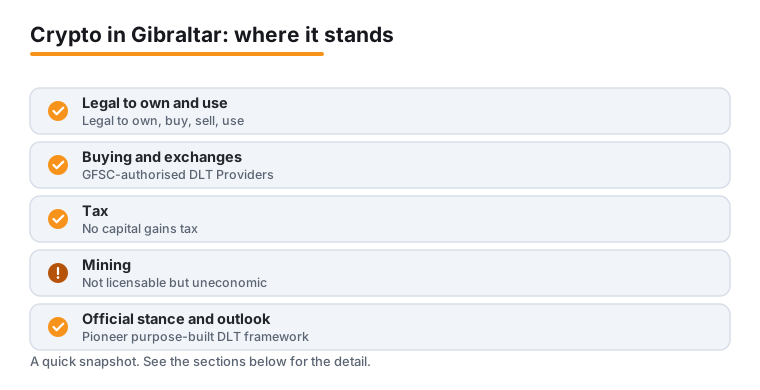
Yes. Owning, buying, selling and using Bitcoin and other cryptocurrencies is legal in Gibraltar. There is no prohibition on individuals holding digital assets, and the territory has deliberately positioned itself as a regulated home for crypto and fintech firms rather than banning the sector.
Legal does not mean unregulated, and it does not mean official money. Bitcoin is not legal tender in Gibraltar. The territory uses the Gibraltar pound, which is issued locally and pegged at par to the British pound sterling. Cryptocurrencies are treated as assets, not as currency, and any business that uses distributed ledger technology to store or transmit value belonging to others must be authorised by the Gibraltar Financial Services Commission as a DLT Provider.
For an ordinary resident or visitor, the practical takeaway is straightforward: you can legally use crypto, but you should expect the platforms you use to ask for identity verification and to operate under authorisation.
Who regulates crypto in Gibraltar?
The principal regulator for digital assets is the Gibraltar Financial Services Commission (GFSC). The GFSC authorises and supervises firms that carry on DLT activities in or from Gibraltar, applies fit-and-proper standards, and enforces conduct, consumer-protection and systems-and-controls requirements. Any firm that uses distributed ledger technology for storing or transmitting value belonging to others, by way of business in or from Gibraltar, must be authorised by the GFSC as a DLT Provider.
Other authorities play supporting roles. HM Government of Gibraltar sets policy and legislation, the Income Tax Office administers tax, and the Gibraltar Financial Intelligence Unit (GFIU) receives suspicious-activity reports under the anti-money-laundering regime. Gibraltar Finance, part of the government, promotes the jurisdiction and publishes background on the DLT framework.
You can confirm the regulator and its published guidance directly at the Gibraltar Financial Services Commission and read the government's overview of the framework at Gibraltar Finance.
Key laws and frameworks
The cornerstone of crypto regulation in Gibraltar is the Financial Services Act 2019 together with the subsidiary regulations made under that Act, originally titled the Financial Services (Distributed Ledger Technology Providers) Regulations 2020 and since renamed the Financial Services (DLT Providers and VAA Providers) Regulations 2020 to reflect supervision of both DLT Providers and Virtual Asset Arrangement (VAA) Providers. The underlying DLT regulatory framework first came into force on 1 January 2018 and was widely described as the world's first purpose-built regime for businesses using blockchain or DLT.
A defining feature is that the regime is principles-based rather than a long list of prescriptive rules. DLT Providers must comply with ten core regulatory principles set by the GFSC, which include conducting business with honesty and integrity, paying due regard to the interests and needs of customers, maintaining adequate financial and other resources, managing risk and protecting client assets, having effective systems and controls, and protecting against financial crime. A tenth principle on market integrity was added to require providers to maintain or enhance the integrity of the markets in which they participate, addressing issues such as market manipulation and insider dealing.
The 2020 Regulations have since been broadened to capture additional virtual-asset activity. The regime covers both DLT Providers and Virtual Asset Arrangement (VAA) Providers. VAA Provider's business is the regulated activity in paragraph 139A of Schedule 2 to the Financial Services Act 2019, inserted by LN 2025/254 with effect from 27 October 2025: exchanging, or making arrangements with a view to the exchange of, virtual assets for money, money for virtual assets, or one virtual asset for another. Since 23 July 2026, paragraph 142A excludes from that activity anything carried on in the course of the business for which they are authorised by collective investment schemes within the meaning of Part 18, pension funds, or the depositaries and managers of those entities. Because the detail is technical and has been amended, businesses in particular should take local legal advice rather than rely on summaries. See our general guide to crypto regulation for wider context.
Licensing and registration of exchanges and VASPs
Under the Financial Services Act 2019 and the DLT Providers Regulations, any firm that, by way of business in or from Gibraltar, uses DLT to store or transmit value belonging to others must be authorised by the GFSC as a DLT Provider. In practice this typically captures cryptocurrency exchanges, custodians and wallet providers that hold or move clients' assets.
The application is rigorous and assesses not only documentation but the firm's actual governance, client protection and operational resilience against the ten principles. Applicants must demonstrate fit-and-proper management, adequate resources, robust systems and controls, and effective financial-crime defences. The GFSC assesses DLT Provider applications through a staged authorisation process, and the time taken depends on the complexity of the business and the quality of the submission, so applicants should plan for a substantial review period and confirm current timelines with the GFSC.
Authorisation involves fees. Reported figures suggest application and supervisory costs can run into the tens of thousands of euros depending on the licensable activities, but you should confirm current fee schedules directly with the GFSC rather than rely on third-party estimates. Before depositing funds with any platform, check that it is genuinely authorised; the GFSC publishes information about regulated firms and warnings about unauthorised ones on its website.
VASP registration and the consumer-duty standard
That lighter registration route has been closed. The Financial Services (Regulated Activities) (Amendment) Regulations 2025 (LN 2025/254), in force on 27 October 2025, omitted regulation 4(1)(d) of the Proceeds of Crime Act 2015 (Relevant Financial Business) (Registration) Regulations 2021, and instead made providing virtual asset arrangements a regulated activity requiring full GFSC Part 7 permission. Firms already registered on the old basis had to inform the GFSC in writing within 14 days and apply for permission within six months of the appointed day, that is by 27 April 2026, and could continue trading while their application was determined. One registration category does remain, in regulation 4(1)(c): an undertaking that receives, on its own account or on behalf of another, proceeds in any form from the sale of tokenised digital assets involving the use of DLT, and is not subject to supervision by a relevant supervisory authority, must still be entered on the GFSC register.
In 2024 Gibraltar also introduced the Financial Services (Core Principles and Consumer Duty) Regulations 2024. These set out core principles and a consumer-duty standard for regulated financial services in Gibraltar. The precise scope of the consumer-duty standard is defined in the regulations and has been the subject of ongoing clarification, so a firm should confirm how it applies to its own activities. In broad terms, the direction of travel reinforces the expectation that authorised firms treat customers fairly, communicate clearly, and act in customers' interests, alongside the ten DLT principles. Because the boundaries between DLT Provider authorisation and VASP registration are technical and have been amended, a firm should confirm which route applies to it with the GFSC or a local adviser rather than assume.
Crypto and Bitcoin tax in Gibraltar
Gibraltar is a well-known low-tax jurisdiction. It does not levy capital gains tax, and it has no value-added tax (VAT), no wealth tax and no dividend or withholding tax of the kind seen in many countries. As a result, an individual generally does not face a specific Gibraltar capital gains charge simply for selling cryptocurrency at a profit.
That headline should not be mistaken for crypto being entirely tax-free. Several points matter:
- Gibraltar does levy income tax and corporation tax. There is no crypto-specific tax legislation, so general tax principles apply. Whether crypto activity is taxable income often turns on the traditional badges of trade test: if buying and selling crypto amounts to carrying on a trade, profits can be taxable as income; if it does not, a disposal is more likely to be treated as a non-taxable capital gain.
- The standard rate of corporation tax rose to 15 percent from 1 July 2024 (from 12.5 percent), and applies to companies on profits accrued in or derived from Gibraltar. Crypto businesses operating in or from Gibraltar are subject to this in the normal way.
- If you are tax-resident in another country, your home jurisdiction may tax your crypto gains or income regardless of Gibraltar's rules.
This section is informational only and not tax advice. We deliberately avoid quoting personal-tax bands or thresholds, as these change and should be checked against official sources. Confirm your position with the Gibraltar Income Tax Office or a qualified adviser. For general background, see our guide to crypto taxes.
AML, KYC and the Travel Rule
Anti-money-laundering and counter-terrorist-financing (AML/CFT) obligations apply to authorised DLT and virtual-asset firms. The core statute is the Proceeds of Crime Act 2015 (POCA) and its supporting regulations, alongside GFSC guidance. Firms must apply customer due diligence and KYC procedures, assess and manage money-laundering and terrorist-financing risk, monitor activity, and report suspicious transactions to the Gibraltar Financial Intelligence Unit. Gibraltar has aligned its rules with international standards, including the Financial Action Task Force (FATF) recommendations.
Gibraltar implements the FATF Travel Rule for crypto-asset transfers through the Funds (Transfer) Regulations 2026 (LN 2026/134), which came into operation on 15 July 2026 and, by regulation 47, revoked the earlier Proceeds of Crime Act 2015 (Transfer of Virtual Assets) Regulations 2021. This requires firms to collect and pass on identifying information about the originator and beneficiary of certain transfers. Since 15 July 2026 there is no minimum threshold. Regulation 16 of the Funds (Transfer) Regulations 2026 requires full originator and beneficiary information on every transfer of virtual assets between service providers, verified beforehand against a reliable and independent source, and regulation 16(8) provides that a provider must not allow the initiation of, or execute, a transfer before ensuring full compliance. The EUR 1,000 figure now applies only to self-hosted wallets: under regulation 16(5), for a transfer exceeding the sterling equivalent of EUR 1,000 to a self-hosted address, the provider must take adequate measures to assess whether that address is owned or controlled by the originator. Separately, section 19A of the Proceeds of Crime Act 2015, inserted with effect from the same date, requires firms to risk-assess self-hosted address transfers in both directions.
For users, the practical effect is that any compliant platform serving Gibraltar will require full identity verification when you open an account, fund it, or withdraw, and may ask about the source of funds and the destination of larger transfers.
Buying and using crypto in practice
Residents and visitors can buy crypto through international exchanges and through firms authorised locally. Any platform that uses DLT to hold or move clients' assets by way of business in or from Gibraltar is expected to hold DLT Provider authorisation from the GFSC.
A typical path looks like this, and is a general guide rather than an endorsement of any provider:
- Choose a platform. Prefer a reputable exchange that is transparent about its regulatory status, ideally authorised by the GFSC or in another well-regulated jurisdiction.
- Create and verify your account. Expect to provide identity documents and proof of address to satisfy KYC requirements.
- Fund your account. Deposit pounds or euros by the methods the platform supports; Gibraltar uses the Gibraltar pound at par with sterling.
- Place your order after reviewing fees and the exchange rate.
- Secure your holdings. For anything beyond small amounts, consider moving funds to a wallet you control, such as a hardware wallet, and keep your recovery phrase offline and private.
Be alert to scams: unrealistic returns, pressure to act quickly, and unsolicited investment managers are common red flags. Using an authorised platform offers more protection than dealing with an unregulated one, but it does not remove market risk.
Bitcoin ATMs in Gibraltar
Gibraltar is a small territory of around 30,000 people, and the number of cryptocurrency ATMs is correspondingly limited; the territory installed its first Bitcoin ATM in 2017. There is no separate ATM-specific crypto statute. Instead, whether a crypto ATM is a regulated activity depends on the general DLT framework: an operator that uses distributed ledger technology to store or transmit value belonging to others, by way of business, can fall within the scope of DLT Provider authorisation.
If you use a crypto ATM in Gibraltar, expect identity-verification steps for larger amounts as part of AML compliance, and check the fees and exchange rate carefully, since machine rates and spreads are often less favourable than online exchanges. Availability can change, so do not assume a machine seen previously is still operating.
Bitcoin mining in Gibraltar
There is no specific Gibraltar law that bans cryptocurrency mining, and the DLT framework is focused chiefly on storing and transmitting value for others rather than on mining as an activity. As a result, mining is generally not a licensable activity in its own right. That said, the way a mining operation is structured should still be analysed: if a miner exercises meaningful control over a network or protocol, or effectively stores or transmits value belonging to third parties, licensing questions could arise.
The bigger constraint is practical. Gibraltar is a small, densely built territory with limited land and relatively high electricity costs, and it is not a notable destination for large-scale, energy-intensive mining. Anyone considering mining should model electricity costs carefully and check local rules on power supply, business licensing, planning and the import of equipment.
Recent developments (2024 to 2026)
Two strands of change stand out in this period. First, tax transparency for crypto: in January 2025 (press release 15/2025) HM Government of Gibraltar confirmed that the territory is among the jurisdictions committed to the OECD Crypto-Asset Reporting Framework (CARF), which extends the automatic exchange of tax information to crypto-assets. Gibraltar is listed by the OECD among the jurisdictions committed to begin exchanges by 2027. In line with that first wave, crypto firms in participating jurisdictions are expected to start collecting the required customer information from 1 January 2026, with the first automatic exchange of that data taking place in 2027. Reporting obligations for crypto businesses are therefore being phased in rather than being fully in force earlier.
Second, refinement of the DLT regime: the standard corporation-tax rate rose to 15 percent from 1 July 2024, and Gibraltar introduced the Financial Services (Core Principles and Consumer Duty) Regulations 2024, which came into effect in 2024 and set out core principles and a consumer-duty standard for regulated financial services in Gibraltar. The DLT Providers Regulations have been amended repeatedly and the changes are now dated and in force rather than anticipated. LN 2025/040 recast the authorisation application requirements from 1 April 2025; LN 2025/254 renamed the Regulations as the Financial Services (DLT Providers and VAA Providers) Regulations 2020 and extended them to VAA Providers from 27 October 2025; LN 2026/053 added regulation 5A, requiring 30 days notice to the GFSC before any dividend or capital distribution, from 26 March 2026; and LN 2026/231 extended the core principles in the Financial Services (Core Principles and Consumer Duty) Regulations 2024 to VAA Providers from 23 July 2026. Because the framework is technical and still evolving, the most reliable way to track changes is to monitor GFSC and government publications directly rather than relying on secondary summaries.
Consumer risks and protection
Gibraltar offers a comparatively developed regulatory environment for digital assets, but real risks remain that users should weigh:
- Market volatility. Crypto prices can move sharply, and losses can be significant and rapid.
- Platform and counterparty risk. Even authorised firms can fail. Use platforms that segregate client assets and are genuinely authorised, and check the GFSC's registers and warnings.
- Regulatory change. The DLT framework has been amended more than once and continues to be refined, and CARF tax-reporting obligations are on the way.
- Limited compensation. Holding crypto is not the same as holding bank deposits; do not assume crypto balances are covered by any depositor-protection scheme.
- Scams and fraud. Pseudonymous, irreversible transactions are attractive to fraudsters, so be sceptical of unsolicited offers and guaranteed returns.
Authorisation by the GFSC offers more protection than dealing with an unregulated platform, but no regulation removes the underlying market risk. Apply the same caution you would anywhere: verify, diversify, secure your keys, and confirm anything legal or tax-related with official sources. This page is informational only and is not legal, tax, or financial advice.
Official sources and how to verify
Crypto rules evolve, so always confirm specific points with primary, official sources rather than third-party summaries. The most authoritative references for Gibraltar are:
- Gibraltar Financial Services Commission (GFSC), the regulator that authorises and supervises DLT and virtual-asset firms.
- Gibraltar Laws portal: Financial Services (DLT Providers and VAA Providers) Regulations 2020, the text of the core subsidiary legislation made under the Financial Services Act 2019.
- Gibraltar Income Tax Office for income tax, corporation tax and tax administration.
- Gibraltar Finance: Distributed Ledger Technology for the government's overview of the framework.
To verify whether a specific platform is permitted to serve you, check the GFSC's published information on regulated firms and its warnings about unauthorised firms. This is general information as of 2026 and is not legal advice; for your particular situation, confirm with the named regulator or a qualified Gibraltar professional. You can also browse our wider regulation hub for other jurisdictions.
What changed in Gibraltar between October 2025 and August 2026
Gibraltar did not leave the 2018 DLT framework untouched. Nine separate instruments changed the position for crypto firms and holders between October 2025 and July 2026, and all of them are already in force. No crypto bill is currently awaiting passage: the published bills list shows no digital-asset bill later than the Protected Cell Companies (Amendment) Bill 2026 of 29 April 2026, and the eight bills published after it deal with appropriation, the courts, legal services, health protection, investigatory powers, education, species protection and light electric transporters. The most recent sitting shown on the Parliament meetings list is 17 July 2026, at which no crypto measure was taken.
| Instrument | In force | Effect |
|---|---|---|
| Financial Services (Regulated Activities) (Amendment) Regulations 2025, LN 2025/254 | 27 October 2025 | Exchanging virtual assets becomes a licensable regulated activity; the Proceeds of Crime registration route in regulation 4(1)(d) is deleted |
| International Co-operation (Improvement of International Tax Compliance) (Amendment) Regulations 2026, LN 2026/032 | 29 January 2026, new CRS schedule deemed in force from 1 January 2026 | Updated Common Reporting Standard brings e-money tokens and central bank digital currencies into automatic tax reporting |
| Property (Digital Assets etc) Act 2026, Act No. 2026-09 | 23 March 2026 | A digital thing can be the object of personal property rights |
| Financial Services (E-Money Firms and DLT Providers etc.) (Amendment) Regulations 2026, LN 2026/053 | 26 March 2026 | Licensed DLT and VAA Providers must clear dividends and capital distributions with the GFSC first |
| Prediction Market Regulations 2026, LN 2026/176 | 13 July 2026 | New prediction market authorisation, with express permission to use stablecoins and other digital asset payments |
| Funds (Transfer) Regulations 2026, LN 2026/134 | 15 July 2026 | New crypto Travel Rule with no minimum threshold; revokes the 2021 Transfer of Virtual Assets Regulations |
| Proceeds of Crime (Amendment) Regulations 2026, LN 2026/147 | 15 July 2026 | New Proceeds of Crime Act sections 19A and 19B on self-hosted address transfers and virtual asset correspondent relationships |
| Financial Services (Miscellaneous Amendments) Regulations 2026, LN 2026/231 | 23 July 2026 | Fund and pension exclusion moved from paragraph 139B to a reworded paragraph 142A; consumer duty core principles extended to VAA Providers |
| Protected Cell Companies (Amendment) Act 2026, Act No. 2026-20 | 30 July 2026 | Experienced investor funds may issue cell shares as tokens on a DLT share register |
Crypto is now legally property in Gibraltar
Until 2026 it was arguable in Gibraltar, as it had been in England, that a crypto-token could not be owned as property at all, because the common law recognised only two categories of personal property: things in possession, such as a physical object, and things in action, such as a debt. A crypto-token is neither.
The Property (Digital Assets etc) Act 2026 (Act No. 2026-09) settles the point. Section 3 provides that a thing, including a thing that is digital or electronic in nature, is not prevented from being the object of personal property rights merely because it is neither a thing in possession nor a thing in action. The Bill was published on 18 December 2025, passed by Parliament on 18 March 2026, and assented and published on 23 March 2026, which under section 2 is also the day it came into operation.
Moving the Bill, the Minister for Justice, Trade and Industry, Nigel Feetham KC MP, said it is based on the United Kingdom Bill of the same name, which became a UK Act on 2 December 2025, and that its purpose is to clarify that certain digital assets such as crypto-tokens can be recognised as property. He described the term digital assets as very broad, capturing digital files, digital records, domain names, cryptocurrency and non-fungible tokens, and said the Bill deliberately does not state which digital assets fall within any further category of personal property or how the law will treat them, leaving that to be developed by the courts (speaking note dated 18 March 2026, press release 187/2026).
Practical consequences for holders and businesses:
- Stolen or misappropriated crypto can be pursued as property, including through tracing and proprietary claims, without a preliminary argument about whether it is property at all.
- Client crypto held by a Gibraltar exchange or custodian can more clearly be held on trust and kept out of the firm's estate if it fails.
- Crypto can be given as security, and passes on death, as property.
- The Act creates no tax charge, no new licence, and no reporting obligation.
Who needs a GFSC licence now: DLT Providers and VAA Providers
Gibraltar's licensing perimeter widened on 27 October 2025. Two distinct regulated activities now sit in Schedule 2 to the Financial Services Act 2019:
- Paragraph 139, providing distributed ledger technology services. The original 2018 trigger, which reads in full: using DLT for storage or transmission of value belonging to another is a specified kind of activity. DLT is defined in paragraph 138(2) as a database system in which information is recorded and consensually shared and synchronised across a network of multiple nodes and all copies of the database are regarded as equally authentic. This captures exchanges, custodians and wallet providers that hold or move client assets.
- Paragraph 139A, providing virtual asset arrangements. Added by the Financial Services (Regulated Activities) (Amendment) Regulations 2025 (LN 2025/254). A person provides virtual asset arrangements if, by way of business, it exchanges or makes arrangements with a view to the exchange of virtual assets for money, money for virtual assets, or one virtual asset for another.
The exclusion for funds and pension schemes has moved. LN 2025/254 originally put it in paragraph 139B, but that paragraph was omitted on 23 July 2026 by the Financial Services (Miscellaneous Amendments) Regulations 2026 (LN 2026/231) and replaced by a new paragraph 142A. The wording changed with it: paragraph 142A excludes from paragraph 139A any activity carried on in the course of the business for which they are authorised by collective investment schemes within the meaning of Part 18, pension funds, or the depositaries and managers of those entities, where paragraph 139B had excluded any dealing on own account by the same bodies.
Both routes require Part 7 permission from the GFSC and both are held to the same ten regulatory principles in the Schedule to the Financial Services (DLT Providers and VAA Providers) Regulations 2020: honesty and integrity; due regard to customers' interests and fair, clear and not misleading communication; adequate financial and non-financial resources; effective management and due skill, care and diligence; protection of customer assets and money; effective corporate governance; high systems and security standards; financial crime systems; resilience and orderly and solvent wind down; and market integrity.
Regulation 8 caps the administrative penalty for breach of those principles at the higher of twice any benefit derived from the contravention, or 1,000,000 pounds or 5 per cent of total annual turnover for a legal person, and 250,000 pounds for an individual. Regulation 9(2) requires the GFSC Register to include a list of VAA Providers as well as a list of DLT Providers, so a Gibraltar swap service should now be findable there as a VAA Provider rather than only as a registered business. Since 26 March 2026, regulation 5A also requires a licensed provider to give the GFSC at least 30 days notice before declaring any dividend or capital distribution, including capital repayments on a loan from a parent, and the GFSC may object. Since 23 July 2026, regulation 6A of the Financial Services (Core Principles and Consumer Duty) Regulations 2024 applies the core principles to VAA Providers as well as DLT Providers, with the 2020 regulatory principles prevailing in any conflict.
The term virtual asset is defined in section 7(1) of the Proceeds of Crime Act 2015 as a digital representation of value that can be digitally traded, or transferred, and can be used for payment or investment purposes, but not including digital representations of fiat currencies or of financial instruments specified in paragraph 46 of Schedule 2 to the Financial Services Act 2019.
The Travel Rule changed on 15 July 2026
The Funds (Transfer) Regulations 2026 (LN 2026/134) came into operation on 15 July 2026 and, by regulation 47, revoked both the Proceeds of Crime Act 2015 (Transfer of Virtual Assets) Regulations 2021 and Regulation (EU) 2015/847 as it formed part of Gibraltar law. Part 3 governs transfers of virtual assets. The key points for users:
- No minimum threshold. Regulation 16 requires originator and beneficiary information on transfers of virtual assets with no de minimis figure, and regulation 16(8) provides that the provider must not allow the initiation of, or execute, any transfer before ensuring full compliance with the regulation.
- What must travel. The originator's name, distributed ledger address and virtual asset account number, and the originator's address including country, official personal document number and customer identification number, or alternatively date and place of birth; plus the beneficiary's name, ledger address and account number.
- Verification first. Regulation 16(6) requires the provider to verify the accuracy of the originator information on the basis of documents, data or information from a reliable and independent source before transferring.
- Self-hosted wallets. The 1,000 euro figure survives only here. Under regulation 16(5), for a transfer exceeding the sterling equivalent of 1,000 euro to a self-hosted address, the provider must take adequate measures to assess whether that address is owned or controlled by the originator. Expect signed-message or similar proof of wallet ownership.
- Crypto ATMs are covered. Regulation 4(1)(b) applies the rules to transfers of virtual assets executed by means of virtual asset ATMs.
- Stablecoins count. Regulation 4(8) requires e-money tokens that purport to maintain a stable value by reference to a fiat currency to be treated as virtual assets.
- Purely private transfers are out of scope. Regulation 4(7)(b) excludes person-to-person transfers of virtual assets carried out without the involvement of a virtual asset service provider.
Penalties under regulation 30 run to the higher of twice the benefit derived or the sterling equivalent of 1,000,000 euro, rising to 5,000,000 euro or 10 per cent of total annual turnover for a credit or financial institution, alongside suspension or withdrawal of authorisation for up to 18 months and prohibitions on individuals exercising managerial functions.
A second instrument commenced the same day and is easy to miss. The Proceeds of Crime (Amendment) Regulations 2026 (LN 2026/147), gazetted on 3 July 2026, inserted section 19A into the Proceeds of Crime Act 2015, requiring a virtual asset service provider to identify and assess the money laundering, terrorist financing and proliferation financing risk of transfers directed to or originating from a self-hosted address, and to apply mitigating measures commensurate with that risk. Those measures may include risk-based identification and verification of the originator, beneficiary or beneficial owner, requiring additional information on the origin and destination of the assets, or enhanced ongoing monitoring. The same instrument inserted section 19B, which adds due diligence requirements for virtual asset correspondent relationships with entities outside Gibraltar, including senior management approval before a new relationship is established.
Tokenised fund shares and stablecoin payments in prediction markets
Two 2026 measures show where Gibraltar is taking the framework next, and both are now in force.
Tokenised fund shares. The Protected Cell Companies (Amendment) Act 2026 (Act No. 2026-20) received assent on 6 July 2026, was gazetted on 9 July 2026 and was commenced on 30 July 2026 by Notice of Commencement LN 2026/294. It inserts a new Part 1A, headed Tokenised Shares, into the Protected Cell Companies Act 2001. It applies only to protected cell companies which are, or will be, experienced investor funds authorised by the GFSC under Part 18 of the Financial Services Act 2019. Such a company may, with GFSC consent and where its articles permit, issue cell shares as share tokens, and if it does so all shares in that cell must be issued in that form. A share token is a valid share certificate for Companies Act 2014 purposes; the register of members must be kept on a DLT share register; tokens may sit in a shareholder's own allow-listed wallet or, with GFSC consent, in a custodial wallet held by the fund administrator or a licensed DLT provider; and where a smart contract effects a transfer, its execution constitutes delivery of a proper instrument of transfer and the transferor's cryptographic signature is as valid as a handwritten signature. Section 18C requires disclosure of the distributed ledger technology used, the cybersecurity risks and how they are mitigated, the custody and transfer arrangements, and the procedures on technology failure. Announcing the Bill, the Government said funds must obtain prior GFSC approval before tokenised shares can be issued and that strict requirements apply to investor eligibility, cybersecurity, custody arrangements and risk disclosure (press release 301/2026, 29 April 2026). This route is confined to experienced investor funds and is not open to ordinary retail investors.
Prediction markets. The Prediction Market Regulations 2026 (LN 2026/176), made under sections 34 and 159 of the Gambling Act 2025, came into operation on 13 July 2026 and create a dedicated prediction market authorisation with contract approval, market integrity, client money, financial resources and wind-down requirements. Regulation 22 states that nothing in the Regulations is to be taken to prevent an authorised operator using digital asset payments, including stablecoins, for funding participants' accounts, providing collateral, settling transactions or making payments to or withdrawals by participants, and that using such a payment does not of itself affect the legal character of a prediction market contract or cause the operator or a participant to be treated as carrying on any other regulated activity solely by reason of that payment. Regulation 21 keeps operators subject to the Proceeds of Crime Act 2015 and the Sanctions Act 2019, and regulation 23 requires such substantive presence in Gibraltar as the Authority considers necessary for effective supervision.
Does MiCA or any EU crypto law apply in Gibraltar?
No. Gibraltar is not in the European Union and the 2026 treaty arrangements do not change that for financial services. The Treaty on Gibraltar and the European Union Act 2026 (Act No. 2026-11) received assent on 1 April 2026, when sections 1 to 10, 13 to 15 and 17 to 26 came into force, with further provisions commenced on 25 June 2026 by LN 2026/129 and all remaining provisions on 15 July 2026 by LN 2026/148. Its 113 pages cover circulation of persons and Schengen border control, economy and trade level playing field rules with chapters on state aid control and on taxation and labour and social standards, arrangements on customs, indirect taxation and trade related issues including a transaction tax on goods and excise duty, aviation, frontier workers and civil nuclear cooperation. A full-text search of the Act returns no occurrence of the words virtual asset, crypto, token, distributed ledger or financial services.
What this means in practice:
- The EU Markets in Crypto-Assets Regulation does not apply in Gibraltar, and there is no Gibraltar MiCA transition or grandfathering deadline to track.
- A GFSC authorisation as a DLT Provider or VAA Provider is not a MiCA licence and carries no passport into the European Economic Area.
- Gibraltar's crypto Travel Rule comes from the Funds (Transfer) Regulations 2026, made under domestic law, not from the EU transfer of funds regulation, which those Regulations expressly revoked as it formed part of Gibraltar law.
- One qualification on the anti-money-laundering side. The treaty Act inserted section 184ZB into the Proceeds of Crime Act 2015 with effect from 25 June 2026, and section 184ZC now allows the Government to make anti-money-laundering regulations corresponding to EU legislative acts specified in Annex 17 to the treaty. So while EU crypto market rules do not apply, the treaty does supply a standing power to align Gibraltar AML rules with listed EU acts.
Separately on tax, in May 2026 the Government welcomed publication by Spain's Ministry of Finance of a draft Ministerial Order removing Gibraltar from Spain's list of non-cooperative jurisdictions, a designation dating from Royal Decree 1080/1991. The draft went to a seven working day consultation that opened on 22 May 2026 and closed on 1 June 2026, and the Order would take effect the day after publication in Spain's Boletin Oficial del Estado (press release 394/2026). Final publication is a Spanish act, not a Gibraltarian one, and should be checked separately.
Crypto and tax reporting: what actually took effect on 1 January 2026
Gibraltar still has no capital gains tax and no crypto-specific tax legislation, so a disposal of crypto by an individual generally falls outside any Gibraltar charge unless the activity amounts to a trade under the badges of trade. What changed is reporting, not the charge.
The International Co-operation (Improvement of International Tax Compliance) (Amendment) Regulations 2026 (LN 2026/032) were made on 29 January 2026 and, by regulation 3(22), replaced Schedule 4 to the 2016 Regulations with the amended OECD Common Reporting Standard. That replacement Schedule is deemed to have come into operation on 1 January 2026. The practical effects:
- Under paragraph A(5)(b) of the new Schedule 4, an entity that holds Specified Electronic Money Products or Central Bank Digital Currencies for the benefit of customers is a Depository Institution for CRS purposes, so those balances become reportable financial accounts.
- Under paragraph A(6)(a)(iii), an entity primarily conducting the business of investing, administering or managing Financial Assets or money or Relevant Crypto-Assets on behalf of other persons falls within the Investment Entity definition and so can become a Reporting Financial Institution.
- The Commissioner of Income Tax appointed under section 2 of the Income Tax Act 2010 is named as the Competent Authority.
- Section I paragraph G is a coordination rule: gross proceeds from the sale or redemption of a Financial Asset need not be reported under the CRS to the extent they are reported by the institution under the Crypto-Asset Reporting Framework.
On CARF itself, be precise about what is verifiable. That coordination rule is the only mention of the Crypto-Asset Reporting Framework in the consolidated 2016 Regulations, which as at August 2026 have four Schedules and no CARF schedule, and a title search of the Laws of Gibraltar returns no Gibraltar CARF regulations. So Gibraltar has updated its CRS with effect from 1 January 2026 to catch stablecoin and central bank digital currency balances, but domestic CARF reporting rules for crypto exchanges do not appear in the Laws of Gibraltar database. Anyone relying on a specific CARF start date for Gibraltar should confirm it with the Income Tax Office rather than assume it from OECD commitment lists.
Frequently asked questions
Is Bitcoin legal in Gibraltar?
Yes. Holding, buying, selling and using cryptocurrency is legal in Gibraltar. However, Bitcoin is not legal tender; Gibraltar uses the Gibraltar pound, pegged at par to the British pound. Crypto is treated as an asset rather than as money, and any firm that uses distributed ledger technology to store or transmit value belonging to others, by way of business in or from Gibraltar, must be authorised by the Gibraltar Financial Services Commission as a DLT Provider.
Who regulates cryptocurrency in Gibraltar?
The Gibraltar Financial Services Commission (GFSC) is the principal regulator. It authorises and supervises DLT Providers and virtual-asset firms under the Financial Services Act 2019 and the Financial Services (Distributed Ledger Technology Providers) Regulations 2020. HM Government of Gibraltar sets policy, the Income Tax Office administers tax, and the Gibraltar Financial Intelligence Unit receives suspicious-activity reports under the anti-money-laundering regime.
What is Gibraltar's DLT framework?
Gibraltar's Distributed Ledger Technology framework took effect on 1 January 2018 and was one of the first purpose-built crypto regimes in the world. Firms that store or transmit value for others using DLT must be authorised as DLT Providers and comply with ten core regulatory principles, including honesty and integrity, customer protection, adequate resources, sound systems and controls, financial-crime prevention and market integrity. It operates under the Financial Services Act 2019 and the DLT Providers Regulations 2020, which have since been amended.
Do I pay tax on crypto profits in Gibraltar?
Gibraltar has no capital gains tax and no VAT, so an individual generally does not face a specific Gibraltar capital gains charge simply for selling crypto at a profit. There is no crypto-specific tax law, so general principles apply: under the badges of trade test, profits from activity that amounts to a trade can be taxable as income, while one-off disposals are more likely treated as non-taxable capital gains. Corporation tax (15 percent since 1 July 2024) applies to companies. If you are tax-resident elsewhere, your home country may still tax you. This is not tax advice; confirm with the Income Tax Office or a qualified adviser.
Do crypto exchanges need a licence in Gibraltar?
Yes. Any firm that, by way of business in or from Gibraltar, uses distributed ledger technology to store or transmit value belonging to others must be authorised by the GFSC as a DLT Provider. This typically captures exchanges, custodians and wallet providers. Applicants must meet fit-and-proper standards, demonstrate adequate resources, systems and controls and financial-crime defences against the ten principles, and pay fees. The GFSC assesses applications through a staged authorisation process, and timelines depend on the complexity and quality of the submission.
Will Gibraltar report my crypto to tax authorities?
It is moving in that direction. In January 2025 the Gibraltar government confirmed it is among the jurisdictions committed to the OECD Crypto-Asset Reporting Framework (CARF), which extends the automatic exchange of tax information to crypto-assets. The government has indicated that information exchange under CARF is expected to begin around 2027 or 2028. Existing anti-money-laundering rules, including KYC and the Travel Rule for transfers at or above EUR 1,000, already require firms to collect identifying information. Under CARF, crypto firms in first-wave jurisdictions are expected to start collecting the required data from 1 January 2026, with the first exchange in 2027. Check the official sources for the current position.
What is the difference between a DLT Provider and a VASP registration in Gibraltar?
DLT Provider authorisation is the full regime under the Financial Services Act 2019 for firms that use distributed ledger technology to store or transmit value belonging to others, such as exchanges and custodians. Separately, under the Proceeds of Crime Act 2015 (Relevant Financial Business) (Registration) Regulations 2021, a person who sells virtual assets by way of business from Gibraltar and is not supervised under another regime must register with the GFSC as a virtual-asset-service provider. The registration route exists chiefly so anti-money-laundering supervision reaches firms outside the full DLT framework. The boundaries are technical and have been amended, so a firm should confirm which applies with the GFSC.
What corporation tax rate applies to crypto firms in Gibraltar?
The standard corporation-tax rate is 15 percent, having risen from 12.5 percent with effect from 1 July 2024. It applies to companies on profits accrued in or derived from Gibraltar, and licensed crypto firms operating in or from Gibraltar are subject to it in the normal way. Gibraltar has no capital gains tax and no VAT. This is general information, not tax advice; confirm your position with the Gibraltar Income Tax Office or a qualified adviser.
Do I have to give my details for every crypto withdrawal from a Gibraltar exchange?
Yes, if the withdrawal goes to another service provider. Since 15 July 2026 the Funds (Transfer) Regulations 2026 have no minimum threshold, so regulation 16 requires the originator and beneficiary information on every transfer of virtual assets, verified before the transfer, and regulation 16(8) bars the firm from executing the transfer until it has fully complied. The old EUR 1,000 threshold now applies only to self-hosted wallets: above the sterling equivalent of EUR 1,000 to a self-hosted address, the firm must take adequate measures to assess whether you own or control that address.
Is a crypto-token legally property in Gibraltar?
Yes. The Property (Digital Assets etc) Act 2026, in operation since 23 March 2026, provides in section 3 that a thing, including a thing that is digital or electronic in nature, is not prevented from being the object of personal property rights merely because it is neither a thing in possession nor a thing in action. The Act deliberately leaves it to the courts to decide which digital assets qualify and how they are treated. It creates no tax charge and no new licence.
Does a Gibraltar crypto licence let a firm passport into the EU under MiCA?
No. Gibraltar is not in the EU and the Treaty on Gibraltar and the European Union Act 2026 does not extend EU financial services law to Gibraltar. A full-text search of that Act returns no mention of financial services, virtual assets, crypto-assets or distributed ledger technology. A GFSC authorisation as a DLT Provider or VAA Provider is not a MiCA licence and carries no European Economic Area passport.
Does a firm that only swaps one coin for another need a GFSC licence in Gibraltar?
Yes, since 27 October 2025. Paragraph 139A of Schedule 2 to the Financial Services Act 2019 makes providing virtual asset arrangements a regulated activity, which covers exchanging, or making arrangements with a view to exchanging, virtual assets for money, money for virtual assets, or one virtual asset for another. That requires Part 7 permission as a VAA Provider. Firms previously on the lighter Proceeds of Crime Act registration route had to apply for permission by 27 April 2026.
Can a Gibraltar fund issue its shares as tokens?
Only in a narrow case. Since 30 July 2026, Part 1A of the Protected Cell Companies Act 2001 allows a protected cell company that is an experienced investor fund authorised by the GFSC to issue cell shares as share tokens, with prior GFSC consent, keeping its register of members on a DLT share register. It is not open to ordinary retail investors.
Has Gibraltar brought in CARF reporting for crypto exchanges?
Not visibly in legislation as at August 2026. Gibraltar updated its Common Reporting Standard from 1 January 2026, which brings stablecoin and central bank digital currency balances held for customers into scope, and the new Schedule 4 refers to the Crypto-Asset Reporting Framework only in a coordination rule about gross proceeds. The consolidated 2016 Regulations contain no CARF schedule and no separate Gibraltar CARF regulations appear in the Laws of Gibraltar database. Confirm any specific start date with the Income Tax Office.
Facts reviewed: 13 August 2026. Page updated: 13 August 2026.