Home › Crypto Regulation › Puerto Rico
Bitcoin and Cryptocurrency Regulation in Puerto Rico
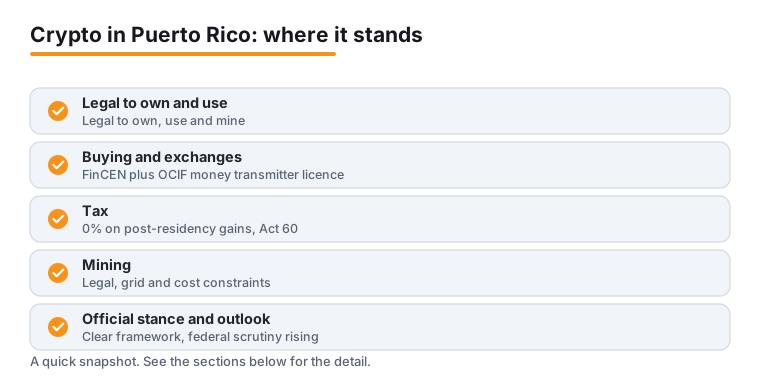
Quick answer — Puerto Rico, 2026
- Legal: Legal to own, use and mine, not legal tender, treated as property
- Tax: Zero percent local rate on post-move gains under Act 60 decree, strict residency
- Buying: Via FinCEN-registered and OCIF-licensed exchanges, brokerages and ATMs
Puerto Rico is a Caribbean archipelago and an unincorporated territory of the United States, and that dual status is the single most important thing to understand about its crypto rules. Owning, buying, selling and mining Bitcoin and other cryptocurrencies is legal in Puerto Rico. Because it is US territory, the major federal frameworks apply here, including the Bank Secrecy Act enforced by FinCEN, the federal securities and commodities laws, and federal criminal law. Layered on top of that, Puerto Rico has its own financial regulator and its own money transmission statute, plus a distinctive set of local tax incentives that have made the island famous among crypto investors.
This guide explains where Puerto Rico crypto regulation stands as of 2026: the legal status of crypto, the local and federal regulators, the key laws and frameworks, how money transmitters and exchanges are licensed, the unusual tax picture under Act 60, anti-money-laundering rules, how to buy and use crypto in practice, Bitcoin ATMs, mining, recent developments, consumer risks, and how to verify everything against official sources. This is general information as of 2026 and is not legal, tax or financial advice; because the rules are evolving and the tax position is heavily fact-dependent, always confirm specifics with the named official regulator or a licensed professional before acting. See our broader crypto regulation overview for global context.
On this page: Legal status · Who regulates it · Taxes · How to buy · Mining
Is Bitcoin and crypto legal in Puerto Rico?
Yes. Buying, holding, selling, transferring and mining cryptocurrency is legal in Puerto Rico. There is no local or federal ban on owning or using digital assets. Bitcoin is not legal tender; the US dollar is the official currency of the territory, and crypto is treated as property rather than money for most legal and tax purposes.
What is regulated is the business activity around crypto rather than personal ownership. Companies that exchange, transmit or custody digital assets for customers must register and obtain licenses, both under US federal rules and under Puerto Rico's own money transmission law. Individuals carry tax and reporting obligations that depend heavily on whether they qualify as bona fide residents of Puerto Rico.
Because Puerto Rico is a US territory rather than an independent country, it does not have its own securities regulator equivalent to a national authority for crypto tokens; federal agencies such as the Securities and Exchange Commission and the Commodity Futures Trading Commission reach conduct in the territory. At the same time, Puerto Rico keeps significant local authority over financial institutions and over its own tax system, which is what makes its crypto landscape distinctive.
Who regulates crypto in Puerto Rico?
There is no single dedicated crypto regulator. Oversight is shared between Puerto Rico's local financial regulator and several US federal agencies:
- Office of the Commissioner of Financial Institutions (OCIF / Oficina del Comisionado de Instituciones Financieras): the principal local regulator, attached to the Puerto Rico Department of Treasury. OCIF licenses and supervises money transmitters, banks, international financial entities and other financial businesses operating in the territory, and it has taken enforcement action against crypto firms operating without proper licensing. Official site: ocif.pr.gov.
- Financial Crimes Enforcement Network (FinCEN): the US Treasury bureau that administers the Bank Secrecy Act. Crypto exchanges, custodial wallet providers and kiosk operators in Puerto Rico are generally treated as money services businesses and must register federally. Official site: fincen.gov.
- Internal Revenue Service (IRS): sets the federal tax treatment of digital assets and enforces the rules that determine whether income is sourced to Puerto Rico or the United States.
- Puerto Rico Department of Treasury (Departamento de Hacienda) and the Department of Economic Development and Commerce (DDEC): administer local taxes and the Act 60 incentive decrees.
- SEC and CFTC: federal market regulators whose authority over securities-like tokens and crypto derivatives extends to the territory.
Because authority is split between local and federal bodies, a crypto business in Puerto Rico can answer to OCIF, FinCEN and one or more federal market regulators at the same time.
Key laws and frameworks
Puerto Rico does not have a single consolidated crypto code. The framework combines US federal law that applies in the territory with Puerto Rico's own money transmission and tax statutes. The most important pieces are:
- Puerto Rico money transmission law: money transmitting businesses are regulated under Puerto Rico law and supervised by OCIF, with licensing handled through the Nationwide Multistate Licensing System (NMLS). The relevant provisions are codified in the Laws of Puerto Rico governing money services businesses and money transmitting (Title 10), and they require licensing for businesses that receive money or its equivalent for transmission. Crypto exchanges, transmitters and kiosk operators serving Puerto Rico generally fall within this regime.
- US Bank Secrecy Act and FinCEN guidance: FinCEN's longstanding interpretive guidance (FIN-2013-G001) treats administrators and exchangers of convertible virtual currency as money transmitters, which applies in Puerto Rico as in the rest of the US.
- Act 60 of 2019 (the Puerto Rico Incentives Code): consolidated earlier incentive laws, including the former Act 20 of 2012 (export services) and Act 22 of 2012 (individual investors). It is the vehicle for the tax benefits that draw crypto investors and businesses to the island.
- US federal tax rules on residency and sourcing: Internal Revenue Code Sections 933, 937 and 865, together with Treasury regulations, determine when income, including digital asset gains, is treated as Puerto Rico sourced and therefore outside the US federal tax base.
Parts of this picture, especially the federal tax treatment of crypto gains claimed as Puerto Rico sourced, are under active scrutiny and possible legislative change, so treat any single characterization with caution and rely on official sources for the current status. For how rules are evolving worldwide, see our crypto regulation guide.
Licensing and registration for exchanges and VASPs
Crypto exchanges and virtual asset service providers operating in or into Puerto Rico generally face obligations at both the federal and territorial levels.
At the federal level, a business that exchanges or transmits convertible virtual currency typically qualifies as a money services business and must register with FinCEN, usually within 180 days of being established, and then maintain a written anti-money-laundering program, perform customer identification, monitor transactions, keep records and file suspicious activity reports.
At the territorial level, the same business generally needs a Puerto Rico money transmitter license from OCIF, applied for through the NMLS. Public reporting indicates that licensing has historically involved substantial requirements such as minimum net worth, minimum liquid assets and a surety bond, along with a compliance program and audited financials; exact thresholds are set by OCIF and have been revised over time, so confirm the current figures directly with the regulator. Major platforms have obtained Puerto Rico money transmitter licenses in order to serve the territory. Federal FinCEN registration does not by itself satisfy the local licensing requirement; a business generally needs both.
Puerto Rico also has a separate banking-style route for crypto custody through its International Financial Entity (IFE) regime, which OCIF licenses and supervises. IFEs can offer services aimed at non-resident clients, including digital asset custody. FV Bank International, an OCIF-licensed IFE (license IFE-063), launched a regulated digital asset custody service in 2022 covering assets such as Bitcoin, Ether and certain stablecoins alongside US dollar deposits. The IFE framework was tightened by Act 44 of 2024, which raised capital and compliance standards for these entities.
How crypto is taxed in Puerto Rico
Taxation is where Puerto Rico is genuinely different, and also where the most caution is required. The headline is that bona fide residents of Puerto Rico who hold a valid Act 60 Individual Resident Investor decree (the former Act 22 benefit) can qualify for a 0% local tax rate on certain capital gains. Note an important 2026 change: under recent amendments (reported as Act 38), the 0% rate applies to decrees secured by applications filed on or before December 31, 2026, while investors applying afterward face a 4% preferential rate instead, with the program extended through 2055; existing decree holders generally keep their current terms. See the recent developments section below. But the detail matters enormously.
- The benefit is for gains that accrue after you become a bona fide resident. Under the general sourcing rule in Internal Revenue Code Section 865, gain on the sale of personal property, including digital assets, is generally sourced to the seller's tax home at the time of sale, so post-move appreciation realized while a bona fide resident can be Puerto Rico sourced and excluded from US federal tax under Section 933.
- Pre-move gains stay taxable in the US. Appreciation that built up before you established Puerto Rico residency generally remains US sourced. Treasury regulations apply a 10-year lookback rule to certain property owned before the move, so gains can remain US taxable even after relocating.
- Residency is strict. Bona fide residency under Sections 933 and 937 requires meeting a physical presence test (commonly framed around being present in Puerto Rico at least 183 days in the year), having your tax home in Puerto Rico, and having a closer connection to Puerto Rico than to the US or a foreign country.
- Mining, staking and trading income. Whether such income qualifies as Puerto Rico sourced depends on the same residency and sourcing rules and is exactly the area drawing federal attention.
The IRS has publicly increased scrutiny of taxpayers claiming Puerto Rico sourcing for crypto and other gains, and has pursued enforcement where it views the claims as improper. This is a complex, fact-specific area where mistakes are costly, so anyone considering it should consult a qualified Puerto Rico and US tax professional. For a plain-language primer on crypto taxation generally, see our crypto taxes guide. This is not tax advice.
AML and KYC rules
Anti-money-laundering and know-your-customer obligations in Puerto Rico flow primarily from the US Bank Secrecy Act, administered by FinCEN, and apply alongside OCIF's supervision of locally licensed money transmitters.
Crypto businesses that qualify as money services businesses must implement a written AML program. Typical elements include KYC procedures to verify customer identity, ongoing transaction monitoring, screening against sanctions lists maintained by the US Treasury's Office of Foreign Assets Control, record-keeping (commonly for at least five years), and filing of suspicious activity reports and currency transaction reports where thresholds are met. OCIF, as the local licensing authority, expects licensees to maintain compliance programs consistent with these federal requirements.
For everyday users, the practical effect is that compliant platforms serving Puerto Rico will ask you to verify your identity before you can trade or withdraw, and may request additional information for larger or unusual transactions. Operating an unlicensed money transmission or exchange business in Puerto Rico can expose a person to enforcement by OCIF and to federal criminal liability for unlicensed money transmitting.
Buying and using crypto in practice
Buying Bitcoin and other crypto in Puerto Rico is straightforward and legal, and because the territory uses the US dollar and US payment rails, the practical experience resembles the mainland US. Whichever route you choose, expect to verify your identity, because compliant providers must follow KYC and AML rules.
- Centralized exchanges: the most common option. Platforms that serve US customers generally serve Puerto Rico residents and let you fund an account by bank transfer or card and buy crypto. Look for a provider registered with FinCEN as a money services business and licensed to transmit money in Puerto Rico.
- Brokerages and crypto ETPs: if you prefer not to hold coins directly, regulated US spot Bitcoin and other crypto exchange-traded products can generally be bought through a standard brokerage account, giving price exposure without managing wallets or keys.
- Bitcoin ATMs (crypto kiosks): available in some retail locations for cash purchases. Operators are regulated as money transmitters; fees and spreads are typically higher than on exchanges.
- Peer-to-peer: direct trades between individuals are possible but carry higher counterparty and fraud risk; use reputable platforms with escrow and never send funds to a stranger on a promise.
Practical tips: confirm the platform's FinCEN registration and Puerto Rico licensing before depositing; decide between leaving assets on a platform (convenient, but you rely on it) and self-custody (you control the keys but are solely responsible for them); enable a unique password and app-based two-factor authentication rather than SMS where possible; and keep detailed records of every purchase, sale and transfer, which matters all the more given Puerto Rico's residency-based tax rules.
Bitcoin ATMs in Puerto Rico
Bitcoin ATMs, also called crypto kiosks or Bitcoin teller machines, operate in Puerto Rico, and several operators have installed machines across the island over the years. They let users buy (and sometimes sell) crypto with cash, usually for higher fees than online exchanges.
Operating a Bitcoin ATM in Puerto Rico is a regulated money transmission activity. OCIF made this explicit in Circular Letter CIF-CC-2021-3 (2021), which confirmed that operators of Bitcoin teller machines and convertible-virtual-currency kiosks must be licensed as money services businesses. Operators generally must register with FinCEN as a money services business and obtain a Puerto Rico money transmitter license from OCIF, and they must run AML and KYC programs, including identifying customers. OCIF has demonstrated that it will enforce these rules: it ordered Athena Bitcoin to cease cryptocurrency operations in the territory until it obtained proper money services business licensing.
For users, the cautions mirror the mainland US. Kiosk fees and spreads are often steep, and fraudsters frequently direct scam victims to send cash through Bitcoin ATMs precisely because the transfers are fast and hard to reverse. Treat any request to pay a bill, fine, official or unexpected contact via a Bitcoin ATM as a likely scam.
Bitcoin mining in Puerto Rico
Bitcoin mining is legal in Puerto Rico. There is no local ban on running mining hardware. The practical constraints are economic and infrastructural rather than prohibitive, and they center on electricity and the territory's grid.
Puerto Rico's power grid has historically faced reliability challenges and electricity costs that are high relative to the cheapest mainland mining locations, which can make large-scale mining less attractive than in places with abundant low-cost power. Anyone planning a sizable operation should investigate local utility rates and capacity, permitting and zoning, and the resilience of their power supply.
On the tax side, mining and staking income is subject to the same residency and sourcing analysis described in the tax section above. Commercial mining conducted through a Puerto Rico entity may potentially benefit from local incentives under Act 60, while income that is not properly Puerto Rico sourced remains within the US federal tax base. Because the federal sourcing treatment of crypto activity is exactly what regulators are scrutinizing, miners should confirm the current rules and consult a professional before relying on any particular tax outcome.
Recent developments (2025-2026)
The most consequential recent developments concern the tax treatment of crypto investors who relocate to Puerto Rico, an area under intensifying federal scrutiny and possible legislative change:
- Proposed federal legislation: on April 21, 2025, Rep. Nydia M. Velazquez introduced the Fair Taxation of Digital Assets in Puerto Rico Act of 2025 (H.R. 2982), which would amend the income-sourcing rules (Internal Revenue Code Section 865) so that digital asset income earned by Puerto Rico residents is subject to US federal income tax, aimed at closing what supporters describe as a loophole. As a minority-party bill it faced an uncertain path, and as of the time of writing it had not become law; check Congress for current status.
- IRS enforcement focus: the IRS has signaled and pursued increased examination of taxpayers claiming Puerto Rico sourcing for capital gains, including crypto, scrutinizing whether residency and sourcing requirements are genuinely met. The IRS Large Business and International division opened a dedicated compliance campaign in 2021 targeting taxpayers claiming Puerto Rico's resident investor incentive (the former Act 22, now folded into Act 60), and practitioners report that examinations of Act 60 claimants, including crypto investors and fund managers, intensified through 2025 and into 2026, often centered on the pre-move appreciation issue. Federal scrutiny has been reflected in matters such as IRS Chief Counsel guidance and litigation over residency and sourcing claims.
- GAO report (December 2025): the US Government Accountability Office published GAO-26-107225 on December 12, 2025, finding that around 2,200 people received the Puerto Rico resident investor incentive in 2021 and that the associated drop in federal tax revenue could reach hundreds of millions of dollars per year. It concluded the IRS should improve its oversight and data-sharing with Puerto Rico, which points to continued and possibly heavier enforcement ahead.
- Major Act 60 overhaul (Act 38-2026): Puerto Rico enacted legislation (reported as Act 38 of 2026, amending the Incentives Code, Act 60 of 2019) that extends the Individual Resident Investor program through December 31, 2055 but replaces the headline 0% rate with a 4% preferential rate on interest, dividends and certain post-residency capital gains for investors who file decree applications after December 31, 2026. Applications filed on or before December 31, 2026 can still secure the 0% rate (generally through 2035), and existing decree holders keep the terms of their current decrees, though some may elect into the new framework. The change was signed by the Governor and reported as pending final endorsement by the federal Financial Oversight and Management Board; new applicants also face tighter eligibility, such as a multi-year prior-non-residency requirement. Confirm the current status and your specific position with the Department of Economic Development and Commerce and a qualified tax professional.
- Licensing supervision: OCIF has continued to supervise money transmitters and to update its expectations for licensees, including on areas such as compliance and cybersecurity.
Because so much remains in motion, treat any single article, including this one, as a starting point and confirm current status with official sources before acting.
Consumer risks and protection
The most pervasive risk in any crypto market is volatility: prices can move sharply and quickly. Crypto holdings are not bank deposits and are generally not insured; there is no FDIC or SIPC protection for crypto held on an exchange or in a wallet. Some custodians carry private insurance for specific losses such as certain hacks, but coverage and exclusions vary and never extend to ordinary market losses, so assume nothing. Self-custody adds the risk of losing access if keys or recovery phrases are lost, while keeping funds on a platform adds counterparty and custody risk.
Fraud is widespread. Common schemes include fraudulent token offerings, Ponzi and guaranteed-return programs, social-media and romance scams that steer victims to fake platforms, phishing sites that mimic real companies, SIM-swap attacks that hijack a phone number to intercept verification codes, and scams that pressure victims to send cash through Bitcoin ATMs. In Puerto Rico, an additional and very specific risk is tax: relying on aggressive interpretations of the Act 60 and residency rules without genuinely meeting them can lead to costly IRS assessments and penalties. Federal authorities, including the SEC, CFTC, DOJ and FTC, pursue crypto fraud, and OCIF can act against unlicensed operators. Victims can report incidents to OCIF, to the FBI's IC3 or to federal regulators, but recovery is often difficult. The best protection is prevention: be skeptical of guaranteed returns, verify platforms independently, get qualified tax advice before relying on residency benefits, and never share private keys or seed phrases.
Official sources and how to verify
Because Puerto Rico's crypto rules combine local and US federal law and are changing, always confirm details against primary official sources rather than secondary summaries. Useful starting points include:
- Office of the Commissioner of Financial Institutions (OCIF, ocif.pr.gov) for money transmitter licensing and local financial supervision.
- FinCEN (fincen.gov) for federal money-services-business registration and AML rules that apply in the territory.
- IRS Publication 570 (irs.gov) for the tax rules on bona fide residents of US territories, including Puerto Rico sourcing.
- Congress.gov (H.R. 2982) for the text and status of the proposed Fair Taxation of Digital Assets in Puerto Rico Act.
- US Government Accountability Office (GAO-26-107225) for the December 2025 report on IRS oversight of taxpayers claiming Puerto Rico federal tax exemptions.
- Puerto Rico Department of Economic Development and Commerce (DDEC, desarrollo.pr.gov) for the Act 60 incentives code and decree administration.
For comparisons with other jurisdictions, browse our country regulation hub. This article is general information as of 2026 and is not legal, tax or financial advice; verify specifics with the named official regulators, such as OCIF, or a licensed professional before making decisions.
Frequently asked questions
Is cryptocurrency legal in Puerto Rico?
Yes. Buying, holding, selling and mining cryptocurrency is legal in Puerto Rico. Crypto is not legal tender (the US dollar is the official currency), and it is treated as property rather than money. The regulated activities are exchanging, transmitting and custodying crypto for others, plus your own tax obligations. This is general information as of 2026, not legal advice.
Who regulates crypto in Puerto Rico?
Oversight is shared between local and federal bodies. Puerto Rico's Office of the Commissioner of Financial Institutions (OCIF) licenses and supervises money transmitters in the territory, while US federal agencies apply too: FinCEN enforces anti-money-laundering rules, the IRS governs taxation, and the SEC and CFTC reach securities-like tokens and derivatives. Verify with OCIF at ocif.pr.gov.
Is Puerto Rico really a 0% crypto tax haven?
Only in a narrow, fact-specific way. Bona fide residents with a valid Act 60 investor decree can qualify for 0% local tax on capital gains that accrue after they become residents. Gains that built up before the move generally remain US taxable, residency tests are strict, and the IRS is actively scrutinizing crypto sourcing claims. Get qualified Puerto Rico and US tax advice before relying on this. This is not tax advice.
Do crypto exchanges need a license in Puerto Rico?
Generally yes. A business that exchanges or transmits crypto usually must register with FinCEN as a money services business and also obtain a Puerto Rico money transmitter license from OCIF, applied for through the NMLS. It must maintain an AML and KYC program. Federal registration alone does not satisfy the local license; a business generally needs both.
Are Bitcoin ATMs legal in Puerto Rico?
Yes, and several operate in the territory, but operating one is regulated money transmission. Operators generally must register with FinCEN and hold a Puerto Rico money transmitter license from OCIF, and must verify customers. OCIF has ordered an operator to stop until it was properly licensed. Fees are often high, and scammers frequently misuse Bitcoin ATMs, so be cautious.
What residency is required for Puerto Rico crypto tax benefits?
You must become a bona fide resident under US tax rules (Internal Revenue Code Sections 933 and 937), which generally means meeting a physical presence test (commonly being in Puerto Rico at least 183 days a year), having your tax home there, and having a closer connection to Puerto Rico than to the US. An Act 60 decree is also typically needed for the investor benefit. Confirm details with a tax professional and IRS Publication 570.
Does the Puerto Rico 0% crypto tax rate still apply in 2026?
For now, but the window is closing for new applicants. Under Act 38 of 2026, which amended the Act 60 Individual Resident Investor program, the 0% rate on qualifying capital gains applies to decrees secured by applications filed on or before December 31, 2026. Applications filed on or after January 1, 2027 instead face a 4% preferential rate, and the program was extended through 2055. Existing decree holders generally keep their current terms. Confirm your position with the DDEC and a qualified tax professional. This is not tax advice.
Is the IRS auditing Puerto Rico crypto investors?
Federal scrutiny has increased. The IRS opened a dedicated compliance campaign in 2021 targeting taxpayers claiming Puerto Rico's resident investor incentive (the former Act 22), and a December 2025 US Government Accountability Office report (GAO-26-107225) urged the IRS to improve oversight of taxpayers claiming Puerto Rico federal tax exemptions. Practitioners report that audits of Act 60 claimants, including crypto investors, have intensified, frequently focused on whether gains that built up before the move are being improperly treated as Puerto Rico sourced. Keep thorough records and get professional advice. This is not tax advice.
Facts reviewed: 30 June 2026. Page updated: 3 August 2026.