Home › Crypto Regulation › Haiti
Bitcoin & Cryptocurrency Regulation in Haiti
Quick answer — Haiti, 2026
- Legal: Not banned but unregulated, not legal tender
- Tax: No crypto-specific tax; general income rules may apply
- Buying: Via international platforms and P2P; no licensed local exchange
Haiti sits in an unusual position on the crypto map. The country has not passed a dedicated cryptocurrency law, has not declared Bitcoin legal tender, and has not banned digital assets outright. The result is a legal grey zone: owning or trading crypto is not prohibited, but it is also not formally licensed, supervised or protected. The only legal tender is the Haitian gourde (HTG), issued by the central bank, the Banque de la République d'Haïti (BRH).
What makes Haiti different from most countries in this situation is the enormous role of remittances. Money sent home by the Haitian diaspora is one of the largest sources of foreign currency in the economy, equivalent to a very large share of GDP. That, combined with a fragile banking system, periods of high inflation, severe political and security instability, and Haiti's placement on the Financial Action Task Force (FATF) list of jurisdictions under increased monitoring, shapes how digital assets are viewed and used here. This page explains the current legal status, who regulates financial activity, and the practical realities around tax, exchanges, AML rules, mining and remittances. Haiti's crypto situation is poorly documented in formal law and can change, so treat this as a general overview as of 2026. It is informational only and is not legal, tax or financial advice. Verify anything important with the BRH and a qualified Haitian professional before acting.
On this page: Legal status · Who regulates it · Taxes · How to buy · Mining
Is Bitcoin and crypto legal in Haiti?
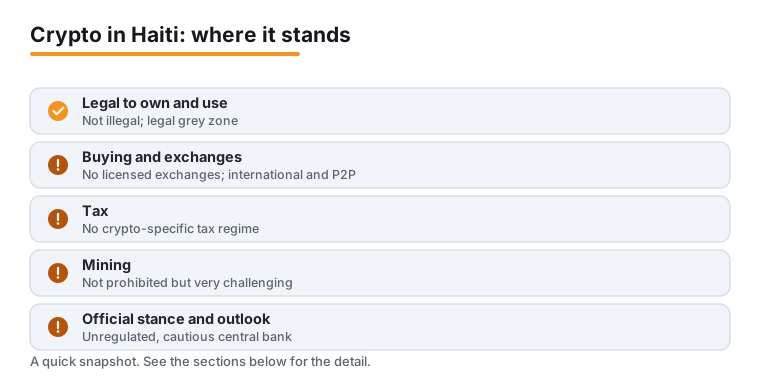
In short: crypto is not illegal in Haiti, but it is also not officially recognised. There is no statute that bans buying, holding or trading Bitcoin and other digital assets, and there is no law that makes them legal tender. Only the Haitian gourde is legal tender for settling debts. This means you can lawfully own crypto, but you cannot expect a shop, employer or government office to be required to accept it.
It is worth correcting a misconception that circulates in templated articles. Haiti has not followed El Salvador in adopting Bitcoin as official currency, and it has not passed a comprehensive Bitcoin law. Headlines suggesting Haiti is a forward-thinking pioneer with a clear digital-asset framework overstate the reality. The accurate description is a country that has so far left private crypto largely unaddressed in law, while the central bank has explored a state-issued digital currency of its own.
The practical consequence of this silence is that crypto activity happens without a safety net. There is no licensing regime for exchanges, no investor-protection scheme and no formal complaints process aimed at crypto. That is very different from an outright ban, but it places more responsibility on the individual. For background on how this compares with other countries, see our overview of crypto regulation. Before assuming anything about your specific situation, confirm the current position with official BRH notices and qualified local counsel.
Who regulates crypto in Haiti?
There is no dedicated crypto regulator and no crypto-specific licensing body in Haiti. Oversight of money and finance is shared among a small number of institutions, and digital assets fall under their general mandates rather than any purpose-built crypto rules.
- Banque de la République d'Haïti (BRH) is the central bank and the primary financial authority. It issues the gourde, sets monetary policy, and supervises banks and money-transfer (remittance) businesses. The BRH has not created a crypto licensing regime, and it has historically signalled caution toward private cryptocurrencies while studying a digital version of the gourde of its own.
- The Ministry of Economy and Finance (Ministère de l'Économie et des Finances) is responsible for broader fiscal and economic policy, including the tax framework that could in principle reach crypto-related income.
- The Unité Centrale de Renseignements Financiers (UCREF) is Haiti's financial intelligence unit, responsible for receiving and analysing suspicious-transaction reports under the anti-money-laundering framework.
Because there is no authorisation regime, there are no formally licensed virtual-asset service providers (VASPs) operating under a Haitian crypto law. The BRH is the institution to watch for any official notice or change. Confirm the current status through its channels before relying on any of this; see the official-sources section below.
Crypto laws and frameworks in Haiti
Haiti does not have a purpose-built crypto framework with licensing, disclosure and consumer-protection rules. Digital assets instead sit within the country's general financial, banking and anti-money-laundering laws, plus whatever guidance the central bank chooses to issue.
The most relevant existing pieces are:
- Monetary law establishing the gourde as Haiti's currency and the BRH as its issuer and supervisor of the banking system. Crypto is not recognised as currency under this framework.
- The anti-money-laundering and counter-terrorist-financing (AML/CFT) law, now the decree of 30 April 2023, published in Le Moniteur, special issue number 12, of 4 May 2023, which expressly repealed the laws of 21 February 2001, 11 November 2013 and 28 September 2016 and imposes customer-identification and suspicious-transaction obligations on the eleven categories of financial institution listed in its article 4. Virtual asset service providers are not one of them.
- Central bank guidance. The BRH published a public document on Bitcoin in 2018 cautioning that such assets are not issued or guaranteed by the central bank and carry significant risk. It has not since enacted a detailed crypto rulebook.
No comprehensive crypto statute has been enacted, and as of August 2026 no crypto bill, draft decree or public consultation has been published by the BRH, the Ministry of Economy and Finance or the financial intelligence unit UCREF. Because Haiti has no sitting legislature, any change would arrive either as an executive decree published in Le Moniteur, or as a BRH circular using article 4, point 11 of the decree of 30 April 2023, which lets the central bank designate new categories of covered financial institution without a new statute.
Licensing and registration of crypto exchanges
There is no licensed domestic crypto exchange operating under a Haitian regulatory regime, because no such regime exists. Haiti has not established a registration or licensing process for virtual-asset service providers, so there is no official register of approved crypto platforms and no Haitian licence for an exchange to obtain.
In practice, Haitians who buy crypto generally do so through international platforms accessed online, or through peer-to-peer (P2P) arrangements where individuals trade directly, often settling the local leg in gourdes or US dollars by cash or bank transfer. Several frictions shape how this works:
- Banking and card access. Limited access to international payment cards and a fragile banking system can make funding a foreign exchange account difficult.
- Platform availability. Some global exchanges restrict or limit users in Haiti, so availability and identity-verification (KYC) requirements vary and change over time.
- Counterparty risk on P2P. Direct trades have little recourse if the other party defrauds you, because there is no crypto regulator to complain to.
- Foreign-exchange rules. Haiti manages foreign-currency activity through the BRH, and moving value across borders interacts with those rules.
The honest summary is that using an exchange in Haiti is possible but informal, with no domestic licensing and limited protection. Treat any platform's availability in Haiti as something to verify rather than assume.
Crypto and Bitcoin tax in Haiti
Haiti does not operate a clear, published tax regime built specifically for cryptocurrency. There is no official guidance that defines how capital gains, trading profits, mining income or crypto received as payment should be reported, and there is no crypto-specific rate or allowance to cite.
That absence should not be read as tax-free. General tax principles still exist in Haiti. Income earned by residents and profits made by businesses can be subject to taxation under the ordinary rules administered through the Ministry of Economy and Finance and its tax administration. In practice, crypto used in a business, or converted into gourdes as income, could fall within existing income or business-tax obligations even though no rule names crypto directly.
No official source defines a crypto-specific rate, so the figures that matter are the general ones. Personal income tax in Haiti still runs on the scale set by the decree of 29 September 2005: five bands with rates of 0, 10, 15, 25 and 30 percent, the zero-rate band ending at 60,000 gourdes of annual income. A February 2019 opinion from the Director General of the tax administration extended that zero-rate band to 150,000 gourdes for salaried workers in the export assembly and export manufacturing sector only. The Ministry of Economy and Finance has validated a replacement scale and plans to bring it into force on 1 October 2026 by writing it into the Code général des impôts. If your situation involves Haitian tax residency, business income or sizeable gains, do not assume any particular treatment. Keep your own records of purchases, sales and transfers, read our general guide to crypto taxes, and get advice from a qualified Haitian tax professional. This section is informational only and is not tax advice.
AML, KYC and the FATF grey list
Anti-money-laundering rules are the part of Haiti's framework most likely to touch crypto in practice. Haiti's AML/CFT law, amended in 2016, requires banks, money-transfer businesses and other financial institutions to identify their customers (KYC), keep records, and report suspicious transactions to the financial intelligence unit, UCREF. Crypto activity that touches the formal banking or remittance system can attract scrutiny here even though crypto itself is not separately licensed.
Two points are important for 2026:
- FATF increased monitoring. Haiti has been on the FATF list of jurisdictions under increased monitoring (commonly called the grey list) since June 2021 and was still on it after the plenary of 17 to 19 June 2026, which added Bosnia and Herzegovina and Iraq and removed only Algeria and Namibia. Haiti has at points deferred its reporting to the FATF, so the published action-plan text may not reflect its very latest position. FATF statements have noted continued progress, including steps toward risk-based AML/CFT supervision, while flagging that all action-plan deadlines have expired and work remains. This status tends to make banks and exchanges apply extra caution to Haiti-linked flows.
- Tighter identity rules on mobile money. Under BRH Circular 121, electronic-payment providers must fully identify their customers, and since 2 March 2026 Circular BRH/IF/2026/129-1 has fixed the point at which simplified checks stop: an individual can be handled under simplified due diligence only up to 15,000 gourdes of cash deposits and withdrawals a month, and an informal micro business only up to 50,000 gourdes a month. Users of the mobile-money service MonCash were required to register a valid ID (such as a voter card, driver's licence or passport) with a selfie by 1 July 2024; accounts not identified by then had transactions limited. This signals the direction of travel: more identity verification, not less.
The takeaway is that even though crypto is unregulated, the general AML/KYC system is active and tightening. Expect identity checks on any regulated on-ramp, and confirm current obligations with the BRH.
What the FATF action plan asks of Haiti
Haiti's place on the FATF grey list comes with a specific action plan agreed with the FATF and the Caribbean Financial Action Task Force (CFATF). The plan is not crypto-specific, but it shapes the wider AML environment that any regulated crypto on-ramp has to work within. As set out in FATF statements through February 2026, the main items ask Haiti to:
- complete its money-laundering and terrorist-financing risk assessment and share the findings;
- apply risk-based AML/CFT supervision to designated non-financial businesses and professions (DNFBPs) judged higher risk;
- keep basic and beneficial-ownership information available and up to date;
- show that authorities are identifying, investigating and prosecuting money-laundering in line with the country's risk profile;
- increase the tracing and recovery of criminal proceeds;
- fix technical gaps in its targeted-financial-sanctions regime;
- monitor non-profit organisations vulnerable to abuse without discouraging legitimate activity.
The FATF has recognised continued progress, but has also noted that the action-plan deadlines have expired and work remains, in part because of Haiti's security and political situation. For crypto users, the practical read-through is that identity and source-of-funds checks on any regulated financial channel are more likely to tighten than loosen. Confirm current requirements with the BRH and the FATF country page linked below.
Buying and using crypto in practice
Because crypto in Haiti is unregulated rather than banned, buying and holding is possible, but there is no domestic licensed on-ramp and no local safety net. The responsible approach is a general checklist adapted to Haiti's constraints:
- Choose a reputable platform. Prefer an exchange that is well established and regulated in its home jurisdiction and that accepts users in Haiti. Expect identity verification (KYC).
- Understand funding options. Check which deposit methods actually work from Haiti, as card and bank access can be limited, and be aware of fees and exchange rates.
- Be careful with peer-to-peer. If trading P2P, use escrow features where available, deal only with reputable counterparties, and never release funds first to an unknown party.
- Secure your holdings. Use a reputable wallet, enable strong authentication, and back up your recovery phrase offline. Self-custody means full control and full responsibility.
- Watch for scams. Ignore guaranteed-return schemes, fake support accounts and pressure tactics, which are common wherever oversight is weak.
Using crypto to pay for goods is not formally supported either: merchants are under no obligation to accept it, and prices remain quoted in gourdes or US dollars. None of this is a recommendation to buy. Confirm the current legal and foreign-exchange position first.
Sending remittances with crypto
Remittances are the strongest reason crypto is discussed in Haiti at all. Transfers from the diaspora, mainly in the United States, Canada, France, Chile and the Dominican Republic, are one of the largest sources of foreign currency in the economy and a lifeline for millions of families. The BRH and other sources have put diaspora remittances at roughly a fifth of Haiti's GDP in recent years, which is why lower-cost transfer methods draw so much interest. Traditional money-transfer services can charge meaningful fees and depend on agent networks and a banking system under strain.
This is the genuine kernel of truth behind the Bitcoin-as-remittance framing. In principle, Bitcoin and US-dollar stablecoins can move value across borders quickly, at any hour, without a correspondent bank, and sometimes at lower cost than conventional channels. But the realities temper the marketing:
- The last-mile problem. The recipient still has to convert crypto into usable gourdes or dollars, often through informal P2P channels, which adds cost, friction and risk.
- Volatility. Holding value in Bitcoin between send and cash-out exposes it to price swings; dollar-pegged stablecoins reduce this but carry their own risks.
- Access and literacy. Both sender and receiver need a phone, internet, a wallet and the knowledge to use them safely.
- Irreversibility. Crypto transactions cannot be reversed if sent to the wrong place or to a scammer.
So while crypto can technically route remittances into Haiti and may cut fees for some users, it has not replaced established services or reshaped the country's transfer laws. It is one option among several, with real trade-offs.
Bitcoin mining in Haiti
Bitcoin mining is not specifically prohibited in Haiti, but nor is it supported by any framework, and the practical barriers are significant. The single biggest obstacle is electricity. Haiti's grid is among the least reliable in the region, with limited generation capacity, frequent outages and many households and businesses depending on generators. Mining is energy-intensive and needs cheap, stable power to be viable, which is exactly what is hard to obtain here.
Other constraints reinforce the point:
- Hardware and capital. Importing specialised mining equipment is expensive and logistically difficult, and financing is constrained.
- Cost of power. Relying on fuel-based generators to run miners is usually uneconomic compared with regions that have cheap grid or renewable power.
- Stability and security. Political and security conditions add operational risk to any capital-heavy, fixed installation.
Some commentary points to Haiti's solar and renewable potential as a theoretical opportunity. That potential is real in the abstract, but it is not the same as an existing, profitable mining industry. For now, mining in Haiti should be regarded as legally unaddressed and practically very challenging for most residents. This is not a recommendation to mine.
Recent developments and the digital gourde
The most concrete official activity in Haiti's digital-money story is not about private crypto at all, but about a possible central bank digital currency (CBDC). Since 2019 the BRH has explored issuing a digital version of the gourde, sometimes referred to in local coverage by the working name Bitkòb (unveiled in March 2021) or simply the gourde digitale. The BRH has run public engagement around the project and has framed it as a way to improve domestic payments and financial inclusion that would complement rather than replace physical banknotes. Independent CBDC trackers continue to list Haiti's digital gourde as in development rather than launched.
Important caveats apply. The most recent BRH notice on the project published on the central bank's site is dated 17 May 2022 and signed by then Governor Jean Baden Dubois. It states that no technology provider had been chosen for the central bank digital currency project, that the BRH was working on launching an international tender to select a technology solution firm, and that the BRH is the only authority competent to give information on the phases of the project. There is still no publicly circulating central bank digital currency, and no launch date has been confirmed. A digital gourde, if launched, would be state-issued central bank money, not a decentralised cryptocurrency like Bitcoin, and would not change the unregulated status of private crypto.
On the AML side, tighter identity enforcement on mobile money took effect under BRH Circular 121, with a MonCash customer-identification deadline of 1 July 2024, reflecting Haiti's ongoing work to address FATF concerns. Haiti remained on the FATF grey list in the FATF statement of February 2026, having deferred some reporting, with the FATF noting continued progress but expired action-plan deadlines. Beyond these AML steps, no comprehensive private-crypto framework has been enacted. Because this is an evolving area, do not rely on any single article, including this one, as the final word.
Consumer risks and protection
The defining feature of Haiti's crypto landscape is the absence of rules rather than the presence of a ban, and most consumer risk flows from that gap.
- No local protection. There is no Haitian crypto regulator, no deposit insurance and no dispute process if a platform fails or you are defrauded.
- Fraud and irreversibility. Informal P2P deals offer little recourse, and crypto transfers cannot be reversed once sent.
- Volatility. Bitcoin's price can swing sharply; dollar-pegged stablecoins are steadier but carry issuer and de-peg risk.
- Custody risk. Lost keys, phishing and scams are irreversible and entirely on the holder when self-custodying.
- Infrastructure and security. Unreliable electricity, internet and banking, plus broader instability, add practical risk to anything crypto-related.
Because there is no official safety net, the burden of protection falls on the individual. The BRH's 2018 caution that such assets are not guaranteed by the central bank still captures the spirit of the official stance. Only consider amounts you can afford to lose, verify platforms independently, and treat guaranteed-return offers as scams. This is informational only and is not investment advice.
Official sources and how to verify
Because Haiti's crypto position is under-documented and evolving, verify the current rules directly with official sources rather than relying on summaries. The key references are:
- Banque de la République d'Haïti (BRH) - the central bank, for monetary policy, banking and remittance supervision, and any official notice on crypto or the digital gourde.
- BRH information document on Bitcoin (2018) - the central bank's published caution on Bitcoin and related risks.
- FATF country page for Haiti - for Haiti's increased-monitoring (grey-list) status and AML/CFT action-plan updates.
For wider context on this site, see our hub on crypto regulation by country and our explainer on how crypto regulation works. This page is general information as of 2026 and is not legal, tax or financial advice; you should verify your specific situation with the BRH and a qualified Haitian professional before acting.
What changed between February and August 2026
Nothing crypto-specific changed in Haitian law in that window, but several things moved around it.
- Two Banque de la République d'Haïti circulars signed on 6 February 2026 took effect on 2 March 2026. Circular BRH/IF/2026/129-1 replaced circular 129 of 31 March 2025 and now sets the anti-money-laundering programme every supervised financial institution must run. Circular BRH/IF/2026/131 replaced circular 109-1 of 10 May 2019 and sets minimum standards for financial consumer protection, including complaints handling and redress. Neither reaches crypto platforms.
- Circular 131 also requires institutions to identify, without delay, domestic and international transfers left unclaimed for a continuous period of at least one year, and to hand those funds to the BRH within 90 days of the circular taking effect, while preserving the beneficiary's permanent right to claim them.
- On 22 June 2026 the BRH issued a notice to financial institutions, signed by Governor Ronald Gabriel, naming Iran, North Korea and Myanmar as the FATF high-risk jurisdictions as at 19 June 2026 and requiring enhanced screening, source of funds checks, and restriction, suspension or termination of a relationship where the risk cannot be mitigated.
- The FATF plenary of 17 to 19 June 2026 added Bosnia and Herzegovina and Iraq to the list of jurisdictions under increased monitoring and removed Algeria and Namibia. Haiti was not among the removals.
- Haiti's financial intelligence unit UCREF has published the country's national money laundering and terrorist financing risk assessment, dated December 2025 and running to 141 pages, prepared as a self-assessment using the World Bank risk assessment tool.
The law that actually applies, and why it stops short of exchanges
Haiti does have a current, named anti-money-laundering instrument, and it is not the 2016 amendment. The decree of 30 April 2023, published in Le Moniteur, special issue number 12, of 4 May 2023, expressly repealed the law of 21 February 2001, the law of 11 November 2013 and the law of 28 September 2016 that amended it.
What matters for crypto is who the decree reaches. Article 4 lists eleven categories of covered financial institution: banks, investment promotion companies, credit card companies, development finance companies, leasing companies, microfinance institutions, savings and credit cooperatives, money transfer houses, bureaux de change, insurance companies with their agents and brokers, and a residual category. Article 5 adds casinos, lotteries, borlette operators and other gaming establishments, real estate companies, dealers in precious stones, metals, antiques and artworks, lawyers, notaries, other independent legal professionals and accountants, and trust and company service providers. Virtual asset service providers appear in neither list.
Two things follow. First, a crypto exchange has no category to register in, which is the legal reason there is no Haitian licence for one to hold. Second, the route to changing that already exists and does not need a new statute: article 4, point 11 lets the BRH designate a further category of company as a covered financial institution in light of how economic and financial activity evolves. The BRH has not used it for digital assets.
The decree also sets amounts that bite outside banking. Casinos, lotteries, borlette operators and other gaming establishments are covered once a client carries out a financial transaction of 50,000 gourdes or more, and dealers in precious stones, metals, antiques and artworks once a cash transaction with a client reaches 2,500,000 gourdes. Circular BRH/IF/2026/129-1, in force since 2 March 2026, applies to broadly the same universe plus electronic payment service providers and other entities designated by the BRH, again with no crypto category.
What is coming, and roughly when
Haiti has no sitting legislature, and the government says so in its own law. The decree of 30 April 2023 recites in its preamble that legislative power is for the moment inoperative and that the executive therefore has to legislate by decree on matters of public interest. That is the practical answer to how crypto would ever be regulated here: not by a bill, but by an executive decree published in Le Moniteur, or by a BRH circular using the designation power in article 4 of that decree. Neither has been used for digital assets, and no crypto bill, draft decree or public consultation has been published by the BRH, the Ministry of Economy and Finance or UCREF.
The timetable for a parliament returning is now public. Under the electoral decree of 2 June 2026 and the calendar published on 28 July 2026:
- Voter registration runs to 13 October 2026 and candidate registration from 20 August to 2 October 2026, with campaigning for the first round opening on 5 October 2026.
- The first round of legislative and presidential elections, together with a constitutional referendum, is set for 13 December 2026, with preliminary results on 19 December 2026.
- The second round of legislative, presidential and local elections is set for 21 February 2027, with final legislative and presidential results due on 7 March 2027.
So a parliament able to debate a crypto statute is not expected before 2027, and the referendum could reshape the constitutional framework first. Anything sooner has to come by decree or circular.
One fiscal change is already scheduled and does reach crypto by default. The Ministry of Economy and Finance published a paper dated July 2026 recording that its Tax Policy Committee reworked the personal income tax scale, that the Minister validated the option labelled scenario 3d in May 2026, and that the new scale is planned to enter into force on 1 October 2026 by being written into the Code général des impôts. No enacting decree had been published as of August 2026, so this is a stated plan rather than a commencement in law. Because crypto has no separate regime, that is the scale that would reach a resident's crypto income.
Reporting thresholds a crypto cash-out can actually trigger
Crypto itself is unregulated, but the moment proceeds move through a bank, a transfer house or a bureau de change, fixed reporting amounts apply. They come from BRH circular 95-5, signed on 16 April 2025, which replaced circular 95-4 and took effect on signature. The institution files the report with UCREF; the customer does not file anything, but the customer's amount is what triggers it.
| Institution | Transaction covered | Reporting threshold |
|---|---|---|
| Banks | Cash transaction, funds transfer or electronic transfer | 1,320,000 gourdes |
| Money transfer houses | Any funds transfer | 132,000 gourdes |
| Bureaux de change | Cash transaction | 1,132,000 gourdes |
| Bureaux de change | Transaction by bank transfer | 350,000 gourdes |
| Savings and credit cooperatives | Cash transaction | 1,132,000 gourdes |
| Microfinance companies | Cash transaction | 1,132,000 gourdes |
Each threshold is expressed in gourdes or the foreign currency equivalent. At the BRH reference rate of 130.4786 gourdes to the US dollar quoted on 13 August 2026, the transfer house threshold of 132,000 gourdes is roughly 1,010 US dollars, which is why remittance-sized transactions are the ones most likely to be reported.
Penalties fall on the institution, not the customer: 500,000 gourdes a day for failing to complete a report, 350,000 gourdes a day for late transmission and 750,000 gourdes a day for not transmitting a duly completed form. Separately, circular 129-1 caps simplified checks at electronic payment providers such as mobile money services at 15,000 gourdes of cash deposits and withdrawals a month for an individual and 50,000 gourdes a month for an informal micro business. Above those levels full identification applies.
Frequently asked questions
Is cryptocurrency legal in Haiti in 2026?
Crypto is not banned in Haiti, but it is also not officially regulated or recognised as legal tender; only the Haitian gourde is. You can lawfully own and trade digital assets, but there is no licensing regime for exchanges and no consumer-protection scheme aimed at crypto. Treat it as a legal grey zone and verify the current position with the central bank, the Banque de la République d'Haïti (BRH).
Who regulates crypto in Haiti?
There is no dedicated crypto regulator. The Banque de la République d'Haïti (BRH) is the central bank and oversees the gourde, banks and money-transfer businesses; the Ministry of Economy and Finance handles fiscal and tax policy; and the financial intelligence unit, UCREF, receives suspicious-transaction reports under the anti-money-laundering law. None of them currently licenses crypto exchanges under a specific crypto statute.
Has Haiti adopted Bitcoin as legal tender like El Salvador?
No. Haiti has not adopted Bitcoin as official currency and has not passed a comprehensive Bitcoin law. The gourde remains the only legal tender. Separately, the BRH has explored a state-issued central bank digital currency (a digital gourde), but as of 2026 that project is still in a research or concept stage and is not the same as recognising Bitcoin.
Are there crypto-specific taxes in Haiti?
Haiti has no published crypto-specific tax regime, but that does not make crypto tax-free. General income and business-tax rules administered through the Ministry of Economy and Finance can still apply to residents and businesses. There is no crypto-specific rate, but the default is the personal income tax scale from the decree of 29 September 2005: five bands with rates of 0, 10, 15, 25 and 30 percent, the zero-rate band ending at 60,000 gourdes a year. The Ministry of Economy and Finance validated a replacement scale in May 2026 and plans to bring it into force on 1 October 2026. Keep records and consult a qualified Haitian tax professional. This is informational only and not tax advice.
Do AML and KYC rules apply to crypto in Haiti?
Haiti's anti-money-laundering law (amended in 2016) requires banks and money-transfer businesses to identify customers and report suspicious transactions to UCREF, and these rules can reach crypto activity that touches the formal financial system. Haiti has also been on the FATF grey list (jurisdictions under increased monitoring) since 2021, and the BRH has pushed tighter identity checks on mobile-money accounts (a MonCash ID deadline of 1 July 2024 under Circular 121), so expect KYC on any regulated on-ramp.
Can I use Bitcoin to send remittances to family in Haiti?
Technically yes. Bitcoin and dollar-pegged stablecoins can move value across borders quickly and sometimes more cheaply than traditional services, which matters because remittances are vital to Haiti's economy. The catch is the last-mile problem: the recipient still has to convert crypto into usable gourdes or dollars through informal channels, with added fees, volatility and fraud risk. It is one option among several, not a guaranteed upgrade, and foreign-exchange rules still apply.
Is Haiti still on the FATF grey list in 2026?
Yes. Haiti has been on the FATF list of jurisdictions under increased monitoring (the grey list) since June 2021 and was still on it in the FATF statement of February 2026. Haiti has at times deferred its reporting, so the published text may lag its latest position. The FATF has noted continued progress on the action plan while flagging that deadlines have expired and work remains. This is not crypto-specific, but it keeps AML and identity checks tight on any regulated financial channel.
Has Haiti launched the digital gourde (Bitkòb) yet?
Not as a circulating currency. The BRH unveiled the Bitkòb working name in March 2021 and has explored a central bank digital version of the gourde since around 2019, aimed at improving domestic payments and financial inclusion. As of 2026 independent CBDC trackers still list it as in development, with no publicly circulating digital gourde and no confirmed launch date. A digital gourde would be state-issued central bank money, not a decentralised cryptocurrency, and would not change the unregulated status of private crypto.
What ID do I need for a MonCash account in Haiti?
Under BRH Circular 121, electronic-payment providers must fully identify their customers. For MonCash this means registering a valid identity document, such as a voter card, driver's licence or passport, along with a selfie. The identification deadline was 1 July 2024, and accounts that were not identified had their transactions limited. This is part of Haiti's wider AML tightening rather than a crypto rule, but it affects the mobile-money rails people often use to move local funds. Confirm current requirements with your provider and the BRH.
Has Haiti passed a crypto law in 2026?
No. As of August 2026 there is no crypto-specific law, decree, circular or published consultation in Haiti. The instrument that governs money laundering is the decree of 30 April 2023, published in Le Moniteur special issue number 12 of 4 May 2023, and the eleven categories of covered financial institution in its article 4 do not include virtual asset service providers. Two BRH circulars did take effect on 2 March 2026, one on anti-money-laundering programmes and one on financial consumer protection, but neither covers crypto platforms.
When could Haiti realistically regulate crypto?
Not through parliament before 2027. Haiti has no sitting legislature, and the decree of 30 April 2023 states in its own preamble that legislative power is for the moment inoperative and that the executive must therefore legislate by decree. The electoral calendar published on 28 July 2026 sets the first round of legislative and presidential elections plus a constitutional referendum for 13 December 2026, a second round for 21 February 2027 and final legislative and presidential results for 7 March 2027. Before then, any rule would have to arrive as an executive decree in Le Moniteur, or as a BRH circular using article 4 of the 2023 decree to designate a new category of covered institution.
What tax rate would apply to crypto profits in Haiti?
There is no crypto rate. Personal income tax runs on the scale set by the decree of 29 September 2005, which has five bands with rates of 0, 10, 15, 25 and 30 percent and a zero-rate band ending at 60,000 gourdes of annual income. The Ministry of Economy and Finance validated a replacement scale in May 2026 and its July 2026 paper says the new scale is planned to enter into force on 1 October 2026 by being written into the general tax code, though no enacting decree had been published as of August 2026. None of the reform document mentions digital assets, so any treatment of crypto gains falls to the ordinary income and business tax rules. Take advice from a qualified Haitian tax professional.
Will a large crypto cash-out get reported in Haiti?
It can be, depending on the channel and the amount. Under BRH circular 95-5 of 16 April 2025, banks file a transaction report with UCREF for any cash transaction, funds transfer or electronic transfer of 1,320,000 gourdes or more, money transfer houses from 132,000 gourdes, bureaux de change from 1,132,000 gourdes in cash or 350,000 gourdes by bank transfer, and cooperatives and microfinance companies from 1,132,000 gourdes in cash. The rule is about the amount and the channel, not about crypto, and the institution rather than the customer files the report.
Facts reviewed: 13 August 2026. Page updated: 13 August 2026.