Home › Crypto Regulation › Saint Vincent and the Grenadines
Bitcoin & Cryptocurrency Regulation in Saint Vincent and the Grenadines
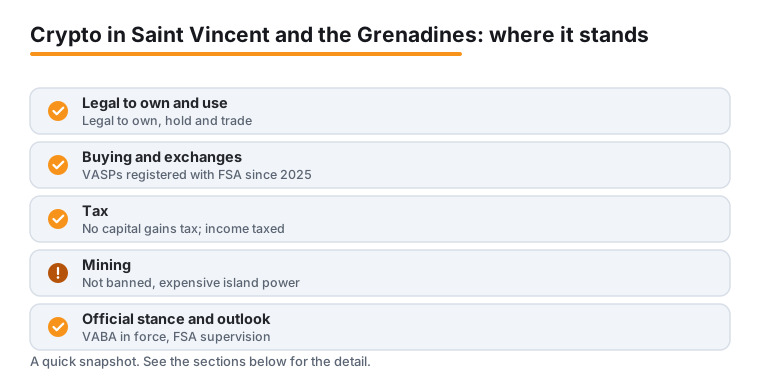
Quick answer — Saint Vincent and the Grenadines, 2026
- Legal: Legal to own and use, not legal tender; VASPs must register with FSA since May 2025
- Tax: No crypto-specific tax and no capital gains tax; income tax can apply to crypto income
- Buying: Via international exchanges or P2P with KYC; no reliable local ATMs
Saint Vincent and the Grenadines (SVG) is a small Eastern Caribbean nation that has long been used as a base for international financial-services companies, including many that offer online trading and crypto services. For individuals, owning, holding and trading Bitcoin and other cryptoassets is legal: there is no law that prohibits residents or visitors from buying or using crypto. At the same time, no cryptocurrency is legal tender. The national currency is the Eastern Caribbean dollar (XCD/EC$), issued by the Eastern Caribbean Central Bank (ECCB) and pegged to the US dollar.
The most important recent change concerns crypto businesses. For years SVG was marketed offshore as a place to incorporate quickly and offer exchange or wallet services with little oversight. That era has ended. The Virtual Asset Business Act (enacted in 2022) came into force on 31 May 2025, and the St. Vincent and the Grenadines Financial Services Authority (FSA) now registers and supervises virtual asset service providers (VASPs). Companies can no longer lawfully provide regulated virtual asset services in or from SVG without FSA authorisation. This page explains the current legal status, the regulators, the new framework, taxation, AML/KYC rules, and the practical realities of using crypto in SVG as of 2026.
This page is general information as of 2026 and is NOT legal, tax or financial advice. Crypto rules in SVG are evolving; verify your situation with the St. Vincent and the Grenadines Financial Services Authority and a qualified local professional before acting.
On this page: Legal status · Who regulates it · Taxes · How to buy · Mining
Is Bitcoin and crypto legal in Saint Vincent and the Grenadines?
Yes. No law in Saint Vincent and the Grenadines makes it illegal for individuals to buy, hold, sell or use Bitcoin and other cryptocurrencies. Residents can legally own crypto, trade on international platforms and accept it from willing counterparties. A small number of tech-aware merchants and freelancers handle crypto for cross-border payments, but everyday acceptance in shops remains rare.
Two ideas are often confused, so it helps to separate them:
- Legal to use. Individuals face no prohibition on owning or transacting in crypto.
- Not legal tender. No business is obliged to accept Bitcoin, and crypto is not official money. The only legal tender is the Eastern Caribbean dollar (XCD), issued by the ECCB and shared across the Eastern Caribbean Currency Union.
The ECCB previously ran a central bank digital currency pilot called DCash across several member states, including SVG. DCash was a digital form of the EC dollar, not a cryptocurrency, and that pilot was discontinued in January 2024. The ECCB later explored a DCash 2.0 project but on 13 February 2026 its Monetary Council approved suspending that development in favour of a regional Fast Payment System. Any future digital EC dollar would be issued and controlled by the central bank, which is conceptually very different from decentralised assets like Bitcoin.
The sharpest legal distinction in SVG is between using crypto as an individual and running a crypto business. The latter is now a regulated, licensable activity, as explained below. For broader context, see our guide to crypto regulation.
Who regulates crypto in Saint Vincent and the Grenadines?
Several bodies share responsibility, each with a distinct role:
- St. Vincent and the Grenadines Financial Services Authority (FSA) is the integrated regulator for the international and non-bank financial sector. Since 31 May 2025 the FSA registers and supervises virtual asset service providers under the Virtual Asset Business Act, handling licensing, ongoing compliance and enforcement. See the FSA's Virtual Asset Businesses page.
- Eastern Caribbean Central Bank (ECCB) issues the EC dollar and oversees the monetary system and commercial banks across the Eastern Caribbean Currency Union. See the ECCB.
- Financial Intelligence Unit (FIU) collects and analyses suspicious-transaction reports and publishes public advisories warning about forex and crypto scams. See the SVG Financial Intelligence Unit.
- Inland Revenue Department administers domestic taxation.
For crypto businesses, the FSA is now the central authority. For individuals worried about scams, the FIU's advisories are the most relevant official guidance.
Key laws and frameworks
SVG's crypto framework is built around dedicated virtual-asset legislation working alongside the country's anti-money-laundering laws.
The Virtual Asset Business Act (VABA)
The Virtual Asset Business Act was enacted in 2022 and came into force on 31 May 2025, with an amendment passed on 28 April 2025 that set the commencement date and clarified certain provisions. It establishes a comprehensive registration and supervision regime for virtual asset businesses operating in or from SVG, aligned with the standards of the Financial Action Task Force (FATF). Before this commencement date, SVG had no specific crypto law and the FIU repeatedly advised that no forex or crypto licences were being issued; the VABA changed that by creating a formal authorisation pathway and bringing VASPs under supervision.
AML/CFT laws
Registered virtual asset businesses must also comply with the Anti-Money Laundering and Countering the Financing of Terrorism (Amendment) Regulations and the related Proceeds of Crime framework. These impose customer due diligence, record-keeping, suspicious-transaction reporting and the FATF Travel Rule.
Important nuance for SVG companies
SVG remains widely used to incorporate trading entities. A standard SVG Business Company or LLC may legally act as a trading company, but offering regulated virtual asset services requires FSA registration under the VABA. Separately, SVG does not issue a forex licence; firms offering retail forex must hold authorisation in another recognised jurisdiction. Because exact statute titles, commencement details and the scope of licensable activities are refined over time, operators should rely on the current text and guidance published by the FSA rather than secondary summaries.
Licensing and registration of crypto exchanges (VASPs)
Under the Virtual Asset Business Act, only Business Companies (BCs) and Limited Liability Companies (LLCs) incorporated in SVG may register as VASPs. Registration is required for firms that perform any of these regulated activities:
- Exchange between virtual assets and fiat currency;
- Exchange between one or more forms of virtual assets;
- Transfer of virtual assets;
- Safekeeping or administration (custody) of virtual assets;
- Participating in or providing financial services related to the issue or sale of virtual assets.
Pure technology providers, private individuals making personal transfers, and businesses that use crypto only internally are generally outside scope.
What the FSA requires
According to the FSA's published guidance, applicants must typically provide a multi-year business plan with financial projections, audited financial statements (for existing companies), due-diligence and fit-and-proper assessments for directors and beneficial owners, and policies covering AML/CFT, risk management, IT and cybersecurity, and consumer protection. Foreign-owned entities must appoint a principal representative resident in SVG.
Fees, capital and deposits
The FSA's stated figures include an application fee of EC$4,000, a registration fee and annual renewal fee of EC$12,000 each, minimum paid-up capital of EC$300,000 (with an ongoing maintenance figure), a statutory deposit of the greater of about USD/EC$100,000 or 25 percent of client obligations, and professional indemnity insurance of at least USD 1 million. The FSA aims to process complete applications in roughly 90 days. Fee and capital figures can change, so confirm the official requirements directly with the FSA before relying on them.
Transition deadline
The commencement date was set by an amendment passed on 28 April 2025, which confirmed the Act came into force on 31 May 2025. Existing entities engaged in virtual asset activities had to submit a registration application to the FSA within 30 days of commencement, that is, by 31 July 2025. The FSA has stated that entities failing to apply within the prescribed period are subject to administrative striking off. The takeaway for users: an SVG address does not mean a platform is licensed. Always check the firm's actual FSA authorisation.
Crypto taxation in Saint Vincent and the Grenadines
SVG has no dedicated crypto tax code, and the country is often described as having a favourable tax environment. Notably, SVG does not levy a capital gains tax, so the increase in value of cryptoassets held as a personal investment is generally not taxed as a capital gain. International Business Companies structured for offshore income can also achieve low or zero tax on foreign-source income.
That does not make crypto entirely tax-free. SVG does impose personal income tax: residents are taxed on worldwide income, and non-residents on income sourced in (or repatriated to) the country. Personal income tax is charged through a Pay As You Earn system on a progressive scale; the top personal and corporate income tax rate is 28 percent, and recent budgets have raised the standard tax-free deduction. So crypto received as employment income, business income or trading profits can still fall within income tax depending on the facts. How any given gain or transaction is treated depends on whether it is personal investment, business activity, or income, and on the general income and corporate tax rules. Where crypto trading takes on the character of a professional business rather than personal investment, profits may be reclassified as taxable income rather than exempt capital gains.
Because the rules are general rather than crypto-specific, do not assume a particular rate or exemption applies to you. Confirm your obligations with the Inland Revenue Department and a qualified local tax adviser, especially if you trade actively, are paid in crypto, run a crypto company, or are tax-resident in another country whose rules may also apply. See our general crypto taxes guide. Nothing here is tax advice.
AML, KYC and the Travel Rule
Anti-money-laundering compliance is central to SVG's new framework. Registered virtual asset businesses must comply with the country's AML/CFT regulations and the supervisory expectations of the FSA, alongside the reporting role of the Financial Intelligence Unit.
In practice, a licensed VASP in SVG is expected to:
- Apply customer due diligence (KYC), verifying customer identity and beneficial ownership;
- Screen against sanctions and politically-exposed-persons lists;
- Monitor transactions and file suspicious-transaction reports with the FIU;
- Keep records and submit periodic compliance reports (the FSA requires quarterly and annual AML/CFT reporting and audited statements);
- Comply with the FATF Travel Rule, which requires sharing originator and beneficiary information (names, account numbers, identification details and addresses) for qualifying transfers.
For individuals, the practical effect is that reputable on-ramps and off-ramps will ask for identity verification. This is normal and offers more protection than informal peer-to-peer deals.
Buying and using crypto in practice
Because SVG is a small market, most buying and selling happens through international platforms rather than a local exchange. Typical options include:
- Global centralised exchanges. Many large international exchanges accept users from SVG and support card or bank-transfer funding. Availability and supported payment methods change, so confirm a platform currently serves SVG residents before signing up.
- Peer-to-peer (P2P) marketplaces. These match buyers and sellers directly and can support local payment methods. Use escrow-protected trades, deal only with well-reviewed counterparties, and stay alert to scams.
- Brokers and OTC desks. For larger amounts, over-the-counter services may offer better pricing, though minimums are usually higher.
Practical pointers: complete identity verification (reputable platforms require it and it protects you); watch the EC-dollar-to-US-dollar and US-dollar-to-crypto conversions, since fees can stack at each step; move long-term holdings to a wallet you control rather than leaving them on an exchange; and keep records of purchases and disposals in case they matter for tax.
Remittances
Like much of the Caribbean, SVG has a sizeable diaspora and relies on remittances. Crypto, and especially dollar-pegged stablecoins, can move value across borders quickly and sometimes cheaply. The trade-offs are volatility (Bitcoin can swing before cash-out), the cash-out step (the recipient still needs an exchange or trusted P2P counterparty to convert to EC dollars), variable network and provider fees, and compliance (licensed services apply KYC but offer more protection than informal deals). No SVG law prohibits receiving a remittance in crypto, but converting it touches the regulated on/off-ramp layer.
Bitcoin ATMs
There is no reliable evidence of a meaningful network of Bitcoin ATMs in SVG. Crypto ATMs are sparse across the smaller Eastern Caribbean islands, so plan around online exchanges or P2P rather than local machines. If a machine is advertised locally, verify the operator and fees first.
Bitcoin mining in Saint Vincent and the Grenadines
There is no specific law in SVG that bans or licenses cryptocurrency mining for individuals, so home or hobby mining is not, by itself, prohibited. In practice, however, mining at any meaningful scale is constrained by economics rather than regulation.
- Electricity cost and supply. SVG relies heavily on imported fuel for power, and Caribbean island electricity tariffs are typically high by global standards. Proof-of-work mining is energy-intensive, which makes profitability difficult when power is expensive.
- Climate and hardware. A hot, humid tropical environment increases cooling demands and wear on mining hardware, adding cost.
- Scale and compliance. A small personal rig is a private matter, but commercial mining can bring in business-licensing, import, tax and energy considerations. If mining becomes a service offered to others (for example pooled or hosted mining), it may also intersect with the FSA's virtual-asset rules.
Anyone considering more than incidental mining should check local electricity terms, import duties on equipment and any business-registration requirements, and seek professional guidance.
Recent developments (2025-2026)
The headline development is the commencement of the Virtual Asset Business Act on 31 May 2025, which ended SVG's long-standing reputation as an unregulated place to offer crypto services and put VASPs under FSA registration and supervision. An amendment on 28 April 2025 confirmed that commencement date. Existing operators had to submit a registration application by 31 July 2025 (within 30 days of commencement) or face administrative striking off, and the FSA has signalled it will pursue unlicensed operators.
On the central-bank side, the ECCB discontinued its DCash pilot in January 2024. It subsequently explored a DCash 2.0 successor, but at the 112th meeting of its Monetary Council on 13 February 2026 the ECCB approved suspending DCash 2.0 development to prioritise a regional Fast Payment System and participation in the CARICOM payments pilot. This affects the EC dollar and digital-currency strategy, not the legality of private crypto.
The FIU continues to publish advisories warning the public about fraudulent forex and crypto investment schemes. Note that earlier FIU advisories stating that no forex or crypto licences are issued in SVG predate the VABA's commencement; for virtual asset businesses, the FSA registration regime is now the authoritative position. Expect continued alignment with FATF standards and clearer supervision of crypto businesses, while individual use remains legal.
Consumer risks and protection
SVG offers a permissive environment for individuals and an increasingly formal one for businesses, but several risks deserve attention:
- Offshore-firm caution. Many entities advertise SVG addresses. An SVG company does not, on its own, mean a platform is licensed or supervised. Check the FSA's position and the firm's actual authorisation under the VABA.
- Scams. The FIU specifically warns about high-yield, low-risk forex and crypto pitches, unsolicited offers, and pyramid or Ponzi schemes. Be sceptical of guaranteed returns.
- No deposit protection. Crypto holdings are not covered by deposit-protection schemes, and recovery after fraud, hacks or exchange failure is limited. Self-custody and careful platform selection matter.
- Market volatility. Prices can move sharply; never invest money you cannot afford to lose.
- Cross-border tax exposure. If you are tax-resident elsewhere, your home country's rules may apply to your crypto regardless of SVG's treatment.
For the latest and most reliable information, consult the FSA, the ECCB and the FIU rather than promotional websites.
Official sources and how to verify
Crypto rules in SVG are evolving, so always confirm the current position with official sources before acting. The most authoritative are:
- St. Vincent and the Grenadines Financial Services Authority (FSA) for VASP registration, licensing and supervision: fsasvg.com and its Virtual Asset Businesses guidance.
- Eastern Caribbean Central Bank (ECCB) for the EC dollar, monetary policy and digital-currency strategy: eccb-centralbank.org.
- SVG Financial Intelligence Unit (FIU) for AML matters and public scam advisories: svgfiu.com.
- SVG legal and gazette portal for the text of laws and regulations: legal.gov.vc.
You can also browse our country-by-country crypto regulation hub for comparisons. This page is general information as of 2026 and is not legal advice; verify your situation with the St. Vincent and the Grenadines Financial Services Authority and a qualified local professional.
Frequently asked questions
Is Bitcoin legal in Saint Vincent and the Grenadines?
Yes. Individuals can legally own, buy, sell and use Bitcoin and other cryptocurrencies. However, no crypto is legal tender; the only official currency is the Eastern Caribbean dollar (XCD), issued by the Eastern Caribbean Central Bank.
Who regulates cryptocurrency in Saint Vincent and the Grenadines?
The St. Vincent and the Grenadines Financial Services Authority (FSA) registers and supervises virtual asset service providers under the Virtual Asset Business Act, which came into force on 31 May 2025. The Eastern Caribbean Central Bank oversees the monetary system and banks, and the Financial Intelligence Unit handles suspicious-transaction reporting and scam advisories. Crypto businesses now require FSA registration; the previously unregulated approach has ended.
Do I need a licence to run a crypto exchange in SVG?
Yes. Under the Virtual Asset Business Act, SVG-incorporated companies that exchange crypto for fiat or other crypto, transfer crypto, provide custody, or offer related financial services must register with the FSA. The FSA's stated requirements include fit-and-proper checks, AML and IT policies, a statutory deposit, paid-up capital, professional indemnity insurance, and annual fees. Confirm current figures and rules directly with the FSA.
Do I pay tax on crypto in Saint Vincent and the Grenadines?
SVG has no dedicated crypto tax and does not levy a capital gains tax, so gains on crypto held as a personal investment are generally not taxed as capital gains. However, SVG does have personal income tax, so crypto received as income or business or trading profit can still be taxable depending on the facts. Confirm your obligations with the Inland Revenue Department and a qualified tax adviser, especially if you are tax-resident in another country. This is not tax advice.
Is a company with a Saint Vincent and the Grenadines address a licensed crypto platform?
Not necessarily. Many firms advertise SVG addresses, but incorporation alone does not mean a platform is licensed or supervised. Since 31 May 2025 the Virtual Asset Business Act requires VASPs to register with the FSA, so check the firm's actual authorisation before trusting any operator.
Can I buy Bitcoin in Saint Vincent and the Grenadines, and are there crypto ATMs?
Yes. Most people buy through international exchanges or peer-to-peer marketplaces using card or bank transfer, after completing identity verification. There is no reliable evidence of a meaningful Bitcoin ATM network in SVG, so plan around online platforms rather than local machines.
When did SVG's crypto licensing regime start and what was the deadline?
The Virtual Asset Business Act came into force on 31 May 2025, with an amendment on 28 April 2025 setting that commencement date. Existing entities engaged in virtual asset activities had to submit a registration application to the FSA within 30 days, that is, by 31 July 2025, or face administrative striking off. Confirm current registration requirements directly with the FSA.
Is DCash still available in Saint Vincent and the Grenadines?
No. DCash, the ECCB's digital EC dollar pilot, was discontinued in January 2024. The central bank later explored a DCash 2.0 successor, but at its Monetary Council meeting on 13 February 2026 the ECCB approved suspending DCash 2.0 development to prioritise a regional Fast Payment System. DCash was a central bank digital currency, not a cryptocurrency, and its status does not affect the legality of privately held crypto.
Facts reviewed: 30 June 2026. Page updated: 3 August 2026.