Home › Crypto Regulation › Saint Kitts and Nevis
Bitcoin & Cryptocurrency Regulation in Saint Kitts and Nevis
Quick answer — Saint Kitts and Nevis, 2026
- Legal: Legal to own and trade, not legal tender; VASPs regulated under Virtual Asset Act
- Tax: No personal income or capital gains tax, so personal gains generally untaxed
- Buying: Mostly via international exchanges with KYC; local VASPs must register
Saint Kitts and Nevis is a twin-island federation in the Eastern Caribbean and the smallest sovereign state in the Americas. It is a member of the Eastern Caribbean Currency Union (ECCU) and the Organisation of Eastern Caribbean States (OECS), so its money is the Eastern Caribbean dollar (XCD), issued by the Eastern Caribbean Central Bank (ECCB) and pegged to the US dollar at a long-standing fixed rate. The federation moved early on digital assets: it enacted a dedicated virtual-asset law in 2020 and has since amended it repeatedly to keep pace with international standards, all while keeping the EC dollar firmly at the centre of everyday payments.
This guide explains the current state of Saint Kitts and Nevis crypto regulation as of 2026 in plain language: whether Bitcoin is legal, who supervises digital-asset businesses, how the licensing regime works, how tax generally applies, and what residents and visitors should know about buying, using and storing crypto. It is general information only and is not legal, tax or financial advice; crypto law and tax treatment change, so verify the specifics with the named official authorities, in particular the Financial Services Regulatory Commission, or a licensed local professional before acting. See also our wider crypto regulation guide and the country regulation index.
On this page: Legal status · Who regulates it · Taxes · How to buy · Mining
Is Bitcoin and crypto legal in Saint Kitts and Nevis?
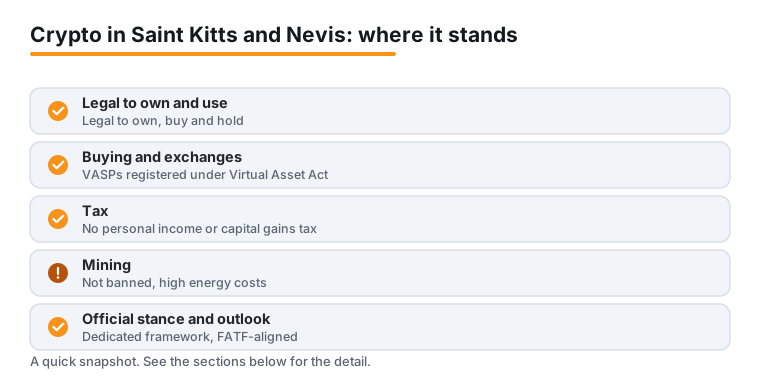
Yes. Owning, buying, selling and holding Bitcoin and other cryptocurrencies is legal in Saint Kitts and Nevis. There is no ban on private use of digital assets, and the federation has gone further than many small states by passing a specific framework that regulates businesses dealing in virtual assets rather than leaving the sector in a legal vacuum.
What crypto is not is legal tender. The only legal tender across the ECCU is the Eastern Caribbean dollar (XCD), issued by the Eastern Caribbean Central Bank. The ECCB has publicly stated that the EC dollar, including any digital form the bank itself issues, is the sole legal tender in the currency union. In practice a hotel, shop or service provider may choose to accept Bitcoin if it wishes, but nobody is obliged to take it the way they must accept EC dollars, so any crypto payment is a private commercial arrangement between the two parties. As of 2026 no cryptocurrency holds legal-tender status in the federation.
Who regulates crypto in Saint Kitts and Nevis?
Two authorities matter. Monetary policy and the currency itself sit with the Eastern Caribbean Central Bank (ECCB), the shared central bank for the eight ECCU members, which issues the EC dollar and has issued public advisories about the risks of cryptocurrencies.
Supervision of virtual-asset businesses sits with the Financial Services Regulatory Commission (FSRC). Because of the two-island structure, the Commission operates through a Saint Kitts branch and a separate Nevis branch, and Nevis in particular has a long-established reputation as an offshore financial and company-formation centre. The FSRC registers and supervises virtual asset service providers (VASPs), administers fit-and-proper checks, and works alongside the Financial Intelligence Unit (FIU) on anti-money-laundering matters. You can confirm the current law library, forms and registration details directly on the FSRC site at FSRC St. Kitts (fsrc.kn) and the Nevis branch at Nevis FSRC (nevisfsrc.com).
Key laws and frameworks
The cornerstone of Saint Kitts and Nevis crypto regulation is the Virtual Asset Act, 2020 (Act No. 1 of 2020), codified as Chapter 21.29 of the Revised Laws, one of the earliest dedicated digital-asset statutes in the Eastern Caribbean. The Act defines a virtual asset as a digital representation of value that can be digitally traded or transferred and used for payment or investment, excluding digital representations of fiat currency or securities. It has been amended several times, so anyone relying on it should always check the current consolidated version. The chain of legislation listed by the FSRC includes:
- Virtual Asset Act, 2020 (Act No. 1 of 2020), the founding statute (CAP. 21.29).
- Virtual Asset (Amendment) Act, 2021 (Act No. 8 of 2021) and the related SRO 47 of 2021 (Amendment of Schedule) Order.
- Virtual Asset (Forms) Regulations, No. 25 of 2022, setting out application and reporting forms.
- Virtual Asset (Amendment) Act, 2024, passed in the National Assembly on 10 May 2024 to tighten the regime in line with the latest Financial Action Task Force (FATF) standards ahead of a follow-up assessment.
You can read the original consolidated text on the official Law Commission portal: Virtual Asset Act CAP. 21.29 (lawcommission.gov.kn), and the government's own announcement of the 2024 amendment on the official information service: SKNIS (sknis.gov.kn). Because the regime keeps evolving, treat any summary as a starting point and confirm the live position with the FSRC.
Licensing and registration of exchanges and VASPs
Any entity that carries on "virtual asset business" in or from within the federation must register with the FSRC and is brought within an anti-money-laundering and counter-terrorist-financing (AML/CFT) framework. Activities that typically fall within the regime include:
- Operating a crypto exchange or trading platform.
- Transferring or exchanging virtual assets on behalf of others.
- Providing custodial or hosted wallet services.
- Issuing, offering or administering tokens, and providing related financial services.
Authorisation comes with obligations: fit-and-proper checks on owners and directors, appointment of a compliance officer, internal controls, ongoing reporting to the regulator and, since the 2024 amendment, tighter alignment with FATF travel-rule and customer-due-diligence expectations. These duties, and the fees attached, are aimed at firms rather than individuals. For someone simply buying crypto for their own account the framework mostly runs in the background; it becomes directly relevant if you plan to run a crypto business, raise money through a token, or provide services to others, in which case licensing, governance and reporting duties apply and professional legal advice is essential. Token offerings that behave like securities or collective investments can also engage other financial laws. Confirm the current application process and fees with the FSRC (fsrc.kn) before relying on any summary.
Crypto taxation in Saint Kitts and Nevis
Saint Kitts and Nevis is widely reported to have an unusually light personal-tax environment: it levies no personal income tax and no separate capital-gains tax on individuals, which generally means personal gains on crypto are not taxed locally. That favourable position is a large part of why the federation markets itself, including through its Citizenship-by-Investment programme, as crypto-friendly. In 2025 the Citizenship by Investment Unit began accepting cryptocurrency as a partial source of wealth for applicants, with extra due-diligence steps, though the citizenship contribution and fees themselves must still be paid in fiat rather than crypto.
Several caveats matter, however. Treatment can depend on whether your activity looks like personal investing or a business; companies, payroll, property and consumption taxes (such as VAT) still exist and can touch crypto-related operations; and dedicated crypto tax guidance from the local Inland Revenue authorities remains limited, which is why we avoid quoting specific rates here. Just as important, if you are tax-resident elsewhere you may still owe income, capital-gains or reporting obligations in that country regardless of the Saint Kitts and Nevis position. Keep full records of every transaction and confirm your own situation with the local tax authority or a qualified adviser. For background, see our general crypto taxes guide. None of this is tax advice.
AML, KYC and the FATF dimension
Anti-money-laundering compliance is the spine of the regime. Registered VASPs must run customer due diligence (KYC), monitor and report suspicious transactions, keep records, and cooperate with the Financial Intelligence Unit and the FSRC. The 2024 amendment was driven explicitly by the need to meet the latest Financial Action Task Force (FATF) standards ahead of a follow-up mutual-evaluation assessment, and the government has stressed that staying compliant helps the federation avoid FATF grey-listing or black-listing and protects its standing in the international financial system.
In day-to-day terms this means any compliant exchange or service operating in or from Saint Kitts and Nevis will ask for government ID, proof of address and, for larger activity, source-of-funds information. KYC is a legal requirement for compliant providers, not an optional step, and individuals should expect the same checks they would meet on any reputable international platform.
Buying and using crypto in practice
No rule stops individuals from buying crypto, and most residents reach the market through international platforms rather than a single large domestic exchange. A typical path looks like this:
- 1. Choose a platform. Pick a reputable global exchange that accepts users from Saint Kitts and Nevis, or a locally registered service where one exists. Compare fees, funding methods, security history and withdrawals; any service operating in or from the federation should be registered with the FSRC.
- 2. Create and verify your account. Expect KYC identity verification: government ID and proof of address are standard.
- 3. Fund the account. Add funds by card or bank transfer, typically in US or EC dollars depending on what the platform supports, and watch for conversion costs.
- 4. Buy. Place an order and note the fees and exchange rate, not just the headline price.
- 5. Secure your crypto. For anything beyond a small amount, consider moving funds to a wallet you control; a hardware wallet suits long-term holdings. Keep your recovery phrase offline and never share it.
Peer-to-peer trading is an alternative where exchange access is limited, but it carries more counterparty and fraud risk, so use escrow features and verify the other party. Do not assume there is a network of crypto ATMs: Saint Kitts and Nevis is a small market and, as of 2026, there is no evidence of an established Bitcoin-ATM network across the islands, with public tracking services typically listing few or no machines. Any kiosk that did operate would generally be expected to fall within the registration and AML requirements above and to charge higher fees than an online exchange. Whatever method you use, double-check wallet addresses before sending, because crypto transactions cannot be undone.
Bitcoin mining in Saint Kitts and Nevis
There is no specific law that bans Bitcoin mining, and equally no dedicated regime designed to attract it. The decisive factor is energy. Saint Kitts and Nevis is a small island system where grid electricity is relatively expensive compared with large mainland economies, which makes energy-hungry proof-of-work mining hard to run profitably at scale. The federation has pursued renewable ambitions, including geothermal potential on Nevis, so any future mining activity would realistically need to align with national energy policy, environmental rules and any licensing for power use. Practical points include:
- Electricity cost and supply: the single biggest driver of whether mining can break even.
- Environmental and planning rules: equipment, heat and noise can trigger local requirements.
- Business obligations: mining as a commercial activity carries normal registration and reporting duties.
- Hardware logistics: importing, powering and cooling specialised machines on a small island is non-trivial, and import duties may apply.
In short, small-scale or hobby mining is not prohibited, but the economics are challenging. Anyone planning a serious operation should speak to the relevant authorities about energy use and permits and model costs carefully before committing capital.
Recent developments (2024-2026)
The most concrete recent change is the Virtual Asset (Amendment) Act, 2024, passed on 10 May 2024 with bipartisan support to bring the framework into line with current FATF standards ahead of a November 2024 follow-up assessment. This continued a pattern of steady tightening from the original 2020 Act through the 2021 amendment and 2022 forms regulations.
At the regional level, the Eastern Caribbean digital-money picture is in transition. The ECCB wound down its DCash central-bank-digital-currency pilot in January 2024 after roughly 34 months. It had worked on a redesigned "DCash 2.0" effort, but at the 112th meeting of the ECCB Monetary Council on 13 February 2026 the Council suspended development of DCash 2.0 and chose instead to prioritise a regional Fast Payment System and participation in the CARICOM Payments and Settlement System pilot, so official digital-money plans now centre on faster movement of the existing EC dollar rather than a new digital currency. Separately, in 2025 the St. Kitts and Nevis Citizenship by Investment Unit updated its policy to accept cryptocurrency as a partial source of wealth for citizenship applicants, subject to extra due-diligence checks; crypto is not accepted for the actual payment, so the government contribution and fees must still be paid in fiat. Saint Kitts and Nevis has also drawn international attention through high-profile private blockchain proposals, including the "Destiny" Special Sustainability Zone pitched for Nevis by crypto investor Olivier Janssens, which as of 2026 remained a proposal awaiting federal government consideration rather than approved law. The likely direction of travel is gradual: clearer rules harmonised across the ECCU, continued AML/CFT tightening, and steady institutional progress on digital payments.
Consumer risks and protection
Consumer protection for retail crypto is far less developed than for bank deposits or regulated investments, so the practical risks fall on the user. Crypto is highly volatile and can lose value quickly; market access depends largely on international platforms whose availability can change; and there is limited local recourse if a platform fails or a transfer goes wrong. The ECCB has issued an advisory urging the public to be mindful of the risks of cryptocurrencies, and has warned about schemes that misuse its name or imply central-bank backing.
Sensible habits apply everywhere: invest only what you can afford to lose, avoid borrowing to buy crypto, use reputable and (where applicable) registered services, secure your own keys, and be deeply sceptical of anything promising guaranteed or unusually high returns or claiming "official" or "central-bank-backed" status. Verify any such claim independently with the regulator. You can read the central bank's own caution here: ECCB cryptocurrency risk advisory (eccb-centralbank.org). This is general information, not financial advice.
Official sources and how to verify
Because this is money-and-law content that changes, always confirm the current position with primary sources before acting. The authorities and documents that matter for Saint Kitts and Nevis are:
- Financial Services Regulatory Commission (FSRC), the regulator for virtual-asset businesses, with its virtual-asset law library at fsrc.kn and the Nevis branch at nevisfsrc.com.
- Eastern Caribbean Central Bank (ECCB), the issuer of the EC dollar and source of public crypto advisories, at eccb-centralbank.org.
- The Virtual Asset Act (CAP. 21.29) and amendments, via the official Law Commission portal at lawcommission.gov.kn.
- St. Kitts and Nevis Information Service (SKNIS), the official government news channel for legislative announcements, at sknis.gov.kn.
This guide is general information as of 2026 and is not legal advice; you should verify the current rules with the named official regulator, the Financial Services Regulatory Commission, or a licensed local professional before making decisions. For more background, see our crypto regulation overview.
Frequently asked questions
Is cryptocurrency legal in Saint Kitts and Nevis?
Yes. It is legal for individuals to own, buy, sell and hold Bitcoin and other cryptocurrencies. Crypto is not legal tender, though; the only legal tender in the Eastern Caribbean Currency Union is the Eastern Caribbean dollar, issued by the Eastern Caribbean Central Bank. Businesses that deal in virtual assets are regulated under the Virtual Asset Act, 2020 (CAP. 21.29) and its amendments and must register with the Financial Services Regulatory Commission.
Who regulates crypto in Saint Kitts and Nevis?
Two bodies. The Eastern Caribbean Central Bank (ECCB) handles the currency and monetary policy across the currency union and issues public crypto-risk advisories. Virtual-asset businesses are supervised by the Financial Services Regulatory Commission (FSRC), which operates through separate Saint Kitts and Nevis branches, under the Virtual Asset Act, 2020 and its amendments, with AML/CFT obligations applying to registered firms.
What laws govern crypto in Saint Kitts and Nevis?
The main statute is the Virtual Asset Act, 2020 (Act No. 1 of 2020), codified as CAP. 21.29. It has been amended by the Virtual Asset (Amendment) Act, 2021, supplemented by the Virtual Asset (Forms) Regulations, 2022, and tightened by the Virtual Asset (Amendment) Act, 2024, which was passed on 10 May 2024 to align the regime with the latest FATF anti-money-laundering standards. Always check the current consolidated version on the official Law Commission portal or the FSRC site.
Do I have to pay tax on crypto in Saint Kitts and Nevis?
Saint Kitts and Nevis is widely reported to levy no personal income tax and no separate capital-gains tax on individuals, which generally means personal crypto gains are not taxed locally. However, treatment can depend on whether your activity looks like investment or a business, other taxes such as VAT and corporate taxes still exist, and crypto-specific guidance is limited, so we avoid quoting rates here. If you are tax-resident elsewhere you may still owe tax there. Keep full records and confirm your position with the local tax authority or a qualified adviser. This is not tax advice.
Do crypto exchanges need a licence in Saint Kitts and Nevis?
Yes. Any business carrying on virtual asset business in or from the federation, including operating an exchange, transferring or exchanging assets for others, custody, or issuing tokens, must register with the Financial Services Regulatory Commission and meet AML/CFT, fit-and-proper, compliance-officer and reporting requirements. Individuals buying crypto for their own account are not licensed, but the platforms they use should be. Confirm the current process and fees directly with the FSRC.
Did Saint Kitts and Nevis adopt Bitcoin as legal tender?
No. The idea of exploring a cryptocurrency as legal tender attracted attention in the past, but it was never enacted. As of 2026 no cryptocurrency is legal tender in the federation; only the Eastern Caribbean dollar holds that status. Crypto remains legal to own and use as a private arrangement, just not as official money.
Can I use cryptocurrency for St. Kitts and Nevis citizenship by investment?
In 2025 the Citizenship by Investment Unit began accepting cryptocurrency as a partial source of wealth, meaning applicants can use crypto holdings to help prove where their money came from, subject to additional due-diligence checks and documentation. Crypto is not accepted for the actual payment, however: the government contribution and fees must still be paid in fiat currency. This is general information, not immigration or financial advice, so confirm the current rules with the Citizenship by Investment Unit or a licensed adviser.
Is the Eastern Caribbean DCash digital currency still running?
No. The ECCB closed its DCash pilot in January 2024 and had been developing a redesigned "DCash 2.0". At the 112th meeting of the ECCB Monetary Council on 13 February 2026 the Council suspended DCash 2.0 development and decided to prioritise a regional Fast Payment System and participation in the CARICOM Payments and Settlement System pilot instead. In short, the focus has shifted from a new digital currency to moving the existing EC dollar faster. DCash was a central-bank project and is separate from private cryptocurrencies such as Bitcoin.
Facts reviewed: 30 June 2026. Page updated: 3 August 2026.