Home › Crypto Regulation › Saint Lucia
Bitcoin & Cryptocurrency Regulation in Saint Lucia
Quick answer — Saint Lucia, 2026
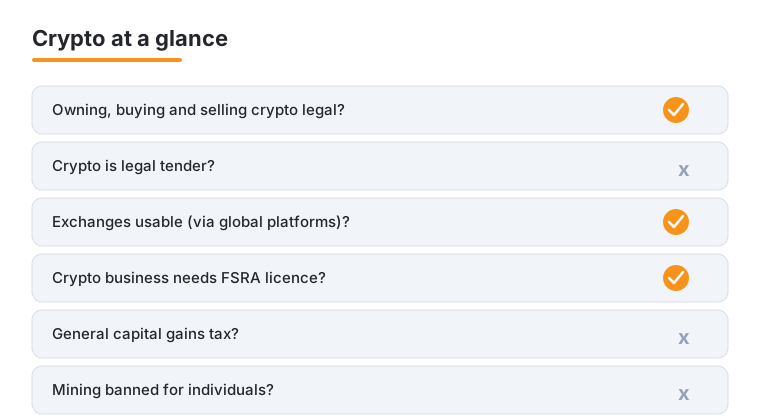
- Yes, owning, buying and selling crypto is legal for individuals; Bitcoin is not legal tender, so no merchant must accept it.
- No crypto-specific tax law: gains may fall outside tax (no general capital gains tax), but commercial trading, mining or staking can be taxable business income.
- Most residents buy via international exchanges with KYC; firms running a crypto business need an FSRA licence.
Saint Lucia is a small Eastern Caribbean island nation and a member of the Eastern Caribbean Currency Union (ECCU), which shares the Eastern Caribbean dollar (XCD) issued by the Eastern Caribbean Central Bank (ECCB). Cryptocurrencies such as Bitcoin are not banned in Saint Lucia, but they are not legal tender either: the EC dollar is the only currency that carries legal-tender status across the union. What has changed in recent years is that Saint Lucia moved from having essentially no crypto-specific rules to operating a dedicated licensing regime for businesses that handle virtual assets, supervised by the Financial Services Regulatory Authority (FSRA).
This page explains where Saint Lucia crypto regulation stands as of 2026: whether Bitcoin is legal, who the regulators are, the key laws and frameworks, how exchanges and other virtual-asset service providers (VASPs) are licensed, how tax may apply, AML/KYC expectations, and practical points about buying, using and mining crypto. This is general information as of 2026 and is not legal, tax or financial advice; rules change quickly, so verify the current position with Saint Lucia's Financial Services Regulatory Authority, the ECCB, the Inland Revenue Department or a qualified local professional before acting. For broader context see our overview of crypto regulation.
On this page: Legal status · Who regulates it · Taxes · How to buy · Mining
Is Bitcoin and crypto legal in Saint Lucia?
Yes. Owning, buying, selling and holding Bitcoin and other cryptocurrencies is legal for individuals in Saint Lucia, and there is no general ban on trading digital assets. What crypto is not is legal tender. Under ECCU rules the EC dollar is the sole legal currency, so no merchant is obliged to accept Bitcoin and crypto cannot be used to settle taxes or other official obligations. Acceptance by shops and service providers is voluntary and, in practice, limited.
The crucial distinction is between using crypto and running a crypto business. Individuals face few restrictions, but any company that operates an exchange, custody or wallet service, payment service or similar virtual-asset business in or from Saint Lucia must be licensed by the FSRA before operating. The Eastern Caribbean Central Bank has also published advisories warning that crypto assets are highly volatile, largely unregulated at the consumer level, and carry a real risk of total loss.
Who regulates crypto in Saint Lucia
Two bodies matter for crypto in Saint Lucia, with different roles:
- Financial Services Regulatory Authority (FSRA) is the national regulator that licenses and supervises virtual-asset businesses under Saint Lucia's virtual-asset legislation. It also regulates insurance, credit unions, international banking and insurance, mutual funds, money-services businesses and registered agents. The FSRA is the authority to consult for anything involving operating, licensing or compliance of a crypto business in or from Saint Lucia. See the Financial Services Regulatory Authority website.
- Eastern Caribbean Central Bank (ECCB) is the monetary authority for the eight-member currency union, of which Saint Lucia is a member. The ECCB issues and protects the EC dollar, oversees commercial banks, and has issued public advisories on the risks of cryptocurrencies. It does not license individual crypto firms, but its rules on legal tender and banking shape the environment. See the Eastern Caribbean Central Bank.
Tax matters are handled separately by Saint Lucia's Inland Revenue Department, and the Financial Intelligence Authority receives suspicious-transaction reports under anti-money-laundering rules.
Key laws and frameworks
Saint Lucia is not an EU member, so EU frameworks such as MiCA do not apply here. Its crypto rules are domestic. The core instruments are:
- Virtual Asset Business Act, Act No. 24 of 2022, the primary statute, which came into force in late 2022 and created a licensing and supervision framework for virtual-asset businesses;
- Virtual Asset Business (Amendment) Act, Act No. 1 of 2025, which amended the principal Act;
- Virtual Asset Business Regulations, No. 37 of 2025, which set out detailed operating, capital and compliance requirements.
The framework was designed in part to align Saint Lucia with international anti-money-laundering standards set by the Financial Action Task Force (FATF), including the Travel Rule for transfers between VASPs. Because the legislation has been amended and supplemented, always check the current consolidated text rather than relying on a summary. The official texts are published through the Saint Lucia Government laws portal and listed on the FSRA's virtual-asset legislation page.
Licensing and registration of exchanges and VASPs
Any entity carrying on virtual-asset business activities in or from Saint Lucia is expected to hold an FSRA licence before operating, and acting without authorisation can expose a business to civil and criminal penalties under the Act. The legislation broadly covers activities such as:
- Exchanging virtual assets for fiat currency, or one virtual asset for another;
- Transferring virtual assets, whether or not for value;
- Safekeeping, custody or administration of virtual assets or the instruments that control them;
- Payment services involving virtual assets;
- Participating in or providing financial services connected to the issue or sale of virtual assets, and related advisory services.
Public guidance from licensing advisers describes a licence structured around five classes of activity:
- Exchange - exchanging virtual assets for fiat, or one virtual asset for another;
- Custodial wallet - custody and administration of virtual assets and the keys that control them;
- Payment services - crypto payment gateways, remittance and payment processing;
- Advisory - investment advice, portfolio recommendations and consulting on virtual assets;
- Initial Virtual Asset Offering (IVAO) - conducting or facilitating token offerings.
Advisers commonly cite an application fee of about 5,000 US dollars per class and minimum capital that varies by class, in the region of roughly 100,000 to 250,000 US dollars (for example around 200,000 for a custodial wallet, 150,000 for payment services and 100,000 for advisory), together with annual licence fees, escrow or safeguarding of client assets, audited financial statements, fit-and-proper checks on principals, and periodic reporting to the FSRA. Advisers also describe a typical processing time of roughly four to five months. Exact classes, fees, capital and timelines change and are set by the FSRA, so confirm the current requirements directly with the regulator before relying on any figure. Operating without authorisation can lead to civil and criminal penalties, including possible imprisonment, under the Act. For individuals the takeaway is simple: the heavy compliance lands on businesses, not ordinary users, though any regulated platform will still verify your identity.
Crypto and Bitcoin tax in Saint Lucia
Saint Lucia does not have a tax regime written specifically for cryptocurrency, so general tax principles apply and the outcome depends on what you are doing.
Two features matter. First, Saint Lucia is widely noted as not levying a general capital gains tax, so in principle a one-off gain from selling an appreciated asset may fall outside the income-tax net. Second, income from a trade or business is taxable. If a person or company trades crypto frequently or commercially, profits could be treated as ordinary business income rather than a tax-free gain. Mining rewards, staking income and crypto received as payment can likewise be income when received, and Saint Lucia also operates a value-added tax with a standard rate of 12.5 percent on most goods and services.
Because the line between a casual investor and an active trader is a question of fact, and rules can change, this page deliberately states no specific rates or thresholds for crypto. Confirm your own position, including any income tax, VAT and reporting obligations, with Saint Lucia's Inland Revenue Department or a qualified local tax adviser. Keep clear records of every transaction (dates, amounts, EC-dollar values, counterparties); they are your best protection if asked to substantiate your position. See also our general guide to crypto taxes.
AML, KYC and compliance obligations
Anti-money-laundering and counter-terrorist-financing (AML/CFT) compliance sits at the centre of Saint Lucia's virtual-asset regime, reflecting FATF standards. Licensed VASPs are expected to operate a full compliance programme, which typically includes:
- Customer due diligence (KYC) and enhanced due diligence for higher-risk clients;
- Ongoing transaction monitoring and screening;
- Suspicious-transaction reporting to the Financial Intelligence Authority;
- Travel Rule compliance for transfers between VASPs;
- Record-keeping and data-protection measures.
For ordinary users, the practical effect is that any compliant platform serving Saint Lucia will ask you to verify your identity, may request proof of address and source of funds, and can pause or report transactions it finds suspicious. This is normal and not specific to Saint Lucia. The detailed obligations for businesses are set by the FSRA and the underlying regulations.
Buying and using crypto in practice
There is no well-known Saint Lucia-headquartered retail exchange, so most residents buy through international platforms. Whether a given global exchange serves Saint Lucia depends on that platform's own policies, not on a local prohibition, and availability can change without notice, so check the exchange's country list before signing up. Common routes include:
- International centralised exchanges that accept Saint Lucian customers, funded by card or bank transfer in EC or US dollars, with mandatory KYC;
- Peer-to-peer (P2P) marketplaces, where buyers and sellers settle directly; useful where card funding is limited, but higher-risk for fraud, so favour platforms with escrow and reputation systems;
- Brokerage or app-based services that support the region.
Some sources describe historical exchange restrictions affecting crypto accessibility here. In practice these have generally stemmed from banking and card-network friction, such as banks declining crypto-related card transactions or platforms not onboarding small-market customers, rather than a legal ban on buying. Expect identity checks and occasional payment declines. A business operating an exchange from Saint Lucia, as opposed to a resident using one, needs an FSRA licence. Whichever route you use, double-check addresses before sending, enable two-factor authentication, move larger holdings into a wallet you control, and stay alert to phishing and too-good-to-be-true schemes.
Bitcoin mining in Saint Lucia
No specific law bans cryptocurrency mining in Saint Lucia for individuals, but the economics are challenging. The island relies heavily on imported fuel for electricity and retail power costs are high by international standards. Bitcoin mining is energy-intensive and competitive, so high electricity prices make small-scale mining hard to run profitably compared with regions that have cheap or surplus power.
Saint Lucia and the wider region also emphasise renewable energy and emissions reduction. There is no dedicated crypto-mining energy code, but anyone contemplating a larger operation should consider general requirements around electricity supply agreements, business licensing, import duties on equipment, and environmental or planning rules for commercial energy use. Mining income could also be treated as business income for tax purposes. In short, hobby mining is not prohibited but rarely economic at island power rates, and a commercial operation would need to navigate ordinary business, energy and tax requirements. Confirm specifics with the relevant utility and authorities before committing capital.
Recent developments (2025 to 2026)
Saint Lucia has continued to refine its virtual-asset regime. In 2025 the framework was updated by the Virtual Asset Business (Amendment) Act, Act No. 1 of 2025, and the Virtual Asset Business Regulations, No. 37 of 2025, which added detailed operating and compliance requirements for licensees. Saint Lucia was among the first Eastern Caribbean jurisdictions to enact dedicated virtual-asset legislation, and industry advisers report a growing number of active FSRA licences under the regime.
At the currency-union level, the digital EC dollar has changed course. The ECCB ran its DCash central bank digital currency pilot from 2021 until the pilot concluded in early 2024, and later explored a redesigned DCash 2.0. At the 112th Meeting of the Monetary Council on 13 February 2026, the ECCB suspended development of DCash 2.0 and pivoted to a regional Fast Payment System (FPS) aimed at letting people send ordinary EC dollars instantly across the union using a phone number or QR code, alongside participation in the wider CARICOM Payments and Settlement System (CAPSS) work. The ECCB has reiterated that the EC dollar remains the sole legal tender in the ECCU and that it is not associated with any crypto token or stablecoin. The overall direction of travel is toward clearer rules for businesses and continued caution for consumers, not blanket prohibition.
Consumer risks and protection
Crypto carries the same core risks in Saint Lucia as everywhere else, and local protections are limited. Key considerations for residents:
- Volatility and total loss - prices can swing dramatically and can fall to zero; the ECCB has explicitly warned consumers about this;
- Scams and fraudulent platforms - fake exchanges, romance and investment scams, and phishing are common; be especially wary of guaranteed returns;
- Limited local recourse - if you use an offshore platform and something goes wrong, Saint Lucian authorities may have little ability to help;
- Custody risk - self-custody makes you solely responsible for securing keys, while exchange custody adds counterparty risk;
- Banking and tax friction - card declines can complicate buying and cashing out, and active trading could be taxed as business income.
A prudent approach is to deal only with reputable, compliant platforms, invest only what you can afford to lose, avoid borrowing to buy crypto, and keep good records. This is not investment advice and we make no price predictions.
Official sources and how to verify
Because crypto rules in Saint Lucia are evolving, always confirm the current position against primary sources rather than third-party summaries. The authoritative places to check are:
- Financial Services Regulatory Authority for VASP licensing, the virtual-asset legislation list and regulatory guidance: fsrastlucia.org;
- Eastern Caribbean Central Bank for legal-tender status, the EC dollar, fast-payment plans and consumer advisories on crypto: eccb-centralbank.org;
- Government of Saint Lucia laws portal for the official texts of the Virtual Asset Business Act and its amendments and regulations: npc.govt.lc;
- Inland Revenue Department for tax questions: irdstlucia.gov.lc.
This page is general information as of 2026 and is not legal, tax or financial advice; verify your specific situation with the Financial Services Regulatory Authority or a qualified local professional before acting. For more guides, see our regulation hub.
Frequently asked questions
Is Bitcoin legal in Saint Lucia?
Yes. Buying, holding and selling Bitcoin is legal for individuals, with no general ban on crypto. But Bitcoin is not legal tender, because the Eastern Caribbean dollar is the only legal currency across the currency union, so no business is obliged to accept it. Companies that operate crypto businesses such as exchanges or custody services must be licensed by the Financial Services Regulatory Authority (FSRA).
Who regulates cryptocurrency in Saint Lucia?
The Financial Services Regulatory Authority (FSRA) licenses and supervises virtual-asset businesses under the Virtual Asset Business Act, Act No. 24 of 2022, as amended by Act No. 1 of 2025 and supplemented by the Virtual Asset Business Regulations, No. 37 of 2025. The Eastern Caribbean Central Bank (ECCB) oversees the EC dollar and banking across the currency union and has issued advisories about crypto risks. Tax is handled by the Inland Revenue Department.
Do I have to pay tax on crypto in Saint Lucia?
Saint Lucia has no crypto-specific tax law, so general principles apply. The country is generally noted as not having a capital gains tax, which may put some one-off gains outside the income-tax net, but profits from frequent or commercial trading, mining or staking could be treated as taxable business income, and VAT may also be relevant. Because this depends on the facts and rules can change, confirm your position with the Inland Revenue Department or a qualified local adviser. This is not tax advice.
Does an exchange need a licence in Saint Lucia?
Yes. Any business that carries on virtual-asset activities in or from Saint Lucia, including running an exchange, providing custody or wallet services, transferring virtual assets or offering related payment and advisory services, is expected to hold an FSRA licence under the Virtual Asset Business Act. Operating without authorisation can lead to civil and criminal penalties. Licensees must meet capital, escrow, AML/KYC and reporting requirements. Confirm the current classes, fees and capital directly with the FSRA.
Did Saint Lucia adopt the EU MiCA crypto rules?
No. Saint Lucia is an independent Caribbean state and a member of the Eastern Caribbean Currency Union, not the European Union, so the EU Markets in Crypto-Assets Regulation (MiCA) does not apply. Saint Lucia's crypto rules are domestic, centred on the Virtual Asset Business Act of 2022 and its 2025 amendment and regulations, and are aligned with FATF anti-money-laundering standards rather than with EU law.
What happened to the ECCB digital currency DCash?
The ECCB ran a DCash central bank digital currency pilot from 2021 and later explored a redesigned DCash 2.0. At its Monetary Council meeting on 13 February 2026 the ECCB suspended development of DCash 2.0 and shifted focus to a regional Fast Payment System for sending ordinary EC dollars instantly. DCash was a central bank product, not a cryptocurrency, and the ECCB stresses that the EC dollar remains the sole legal tender and that it is not linked to any crypto token or stablecoin.
What licence classes exist for a crypto business in Saint Lucia?
Advisers describe five classes under the Virtual Asset Business Act, administered by the FSRA: exchange, custodial wallet, payment services, advisory, and initial virtual asset offering (IVAO). A licence is tied to the class or classes of activity a business carries on. Advisers commonly cite an application fee of about 5,000 US dollars per class and minimum capital that varies by class, roughly in the 100,000 to 250,000 US dollar range, plus annual fees and ongoing compliance. Because the FSRA sets and updates these terms, confirm the current classes, fees and capital directly with the regulator.
Is there VAT on crypto in Saint Lucia?
Saint Lucia operates a value-added tax with a standard rate of 12.5 percent on most goods and services. There is no crypto-specific tax law, so how VAT and income tax apply depends on the activity and the facts. Casual investment gains may fall outside tax because Saint Lucia is generally noted as not having a capital gains tax, while commercial trading, mining, staking or crypto received as payment can be treated as taxable business income. Confirm your own position with the Inland Revenue Department or a qualified local adviser. This is not tax advice.
Facts reviewed: 30 June 2026. Page updated: 3 August 2026.