Ethereum (ETH): Price, Wallets & How to Buy
Ethereum is the largest smart-contract platform in crypto and the home of its native asset, ETH (ether). Where Bitcoin was built primarily to move and store value, Ethereum was designed as a programmable settlement layer: a global computer that runs code, secures applications, and underpins much of decentralized finance (DeFi), stablecoins, and tokenization. This page explains what Ethereum is, how to buy and store ETH safely, how it differs from Bitcoin and from Ethereum Classic, and what actually drives ETH's price. It is informational and not financial advice.
What is Ethereum (ETH)?
Ethereum is a decentralized, open-source blockchain that launched in 2015, conceived by Vitalik Buterin and a group of co-founders. Its defining feature is the ability to run smart contracts: self-executing programs that carry out an agreement automatically when predefined conditions are met, without a trusted intermediary. ETH, the network's native cryptocurrency, is used to pay for the computation and storage these programs consume.
Because anyone can deploy code to it, Ethereum has become the base layer for a large ecosystem of applications: decentralized exchanges, lending markets, stablecoins, NFT marketplaces, identity tools, and games. Most of these are built using shared technical standards. The two best known are:
- ERC-20: the standard for fungible tokens, used by the majority of stablecoins and project tokens.
- ERC-721: the standard for non-fungible tokens (NFTs), which represent unique items such as collectibles or digital art.
Gas fees and how the network pays for itself
Every action on Ethereum, such as sending ETH, swapping tokens, or minting an NFT, requires computation, and that work is paid for in a fee commonly called gas, denominated in ETH. Fees rise when the network is busy and fall when it is quiet. Since the EIP-1559 upgrade in 2021, a portion of each fee (the base fee) is burned, permanently removing that ETH from circulation, while validators receive a separate tip.
Proof-of-stake and The Merge
In September 2022, Ethereum completed an upgrade known as The Merge, switching its consensus mechanism from energy-intensive proof-of-work (mining) to proof-of-stake. Instead of competing with specialized hardware, validators now lock up ETH as collateral to propose and confirm blocks, earning rewards and risking penalties if they misbehave. The change cut Ethereum's energy consumption by roughly 99.9% and made ETH a stakeable asset. By 2026, a substantial share of the total ETH supply, on the order of a third, is staked, typically earning low-single-digit annual yields.
Layer-2 rollups
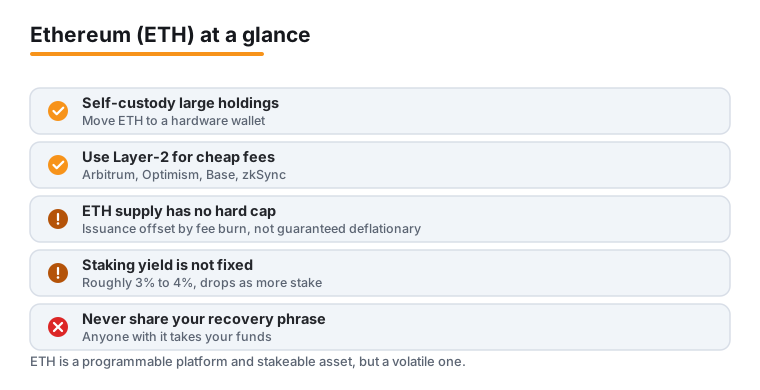
To handle more activity without congesting the main chain, Ethereum relies on Layer-2 (L2) rollups: separate networks that process transactions in bulk and post compressed proofs back to Ethereum for security. Popular examples include Arbitrum, Optimism, Base, and zkSync. Following the EIP-4844 ("proto-danksharding") upgrade, L2 fees fell dramatically, often to a fraction of a cent, and these networks now carry a large and growing share of everyday transactions. Ethereum's main chain increasingly acts as the secure settlement layer beneath them.
How to buy & store ETH
Buying ETH is straightforward, but the steps that matter most are verifying who you buy from and deciding where the coins ultimately live. The neutral process below applies to most reputable services; the specific platforms named are examples of categories, not endorsements.
Step 1: Choose a reputable exchange
Most people start with a centralized exchange that operates in their country and complies with local regulation. Look for a long operating history, clear fee disclosure, proof of reserves or audits, and strong security practices. Compare the total cost of a purchase (trading fee plus the spread) rather than the headline fee alone.
Step 2: Create an account and complete KYC
Regulated exchanges require identity verification (Know Your Customer, or KYC): typically your name, address, and a government ID. This is standard and helps protect against fraud. Enable two-factor authentication (2FA) using an authenticator app rather than SMS where possible.
Step 3: Fund the account and buy ETH
Deposit funds via bank transfer, debit or credit card, or a payment service such as PayPal where supported. Card and instant-buy options are convenient but usually carry higher fees than a bank transfer. Once funded, select ETH, enter the amount, review the fees, and confirm the order. You can buy a fraction of one ETH, so there is no need to purchase a whole coin.
Step 4: Decide where to store it
Leaving ETH on an exchange is convenient but means a third party controls the private keys, as the saying goes, "not your keys, not your coins." For meaningful amounts, consider moving ETH into a wallet you control:
- Hot wallets (software wallets and browser extensions) stay connected to the internet. They are convenient for everyday use and interacting with apps, but more exposed to malware and phishing.
- Cold / hardware wallets keep your private keys offline on a dedicated device. They are the more secure choice for longer-term holdings and larger balances.
Step 5: Withdraw to self-custody (optional but recommended)
To take custody, withdraw ETH from the exchange to your wallet's Ethereum address. Always send a small test amount first, double-check the address, and confirm you are on the correct network (for example, Ethereum mainnet versus a Layer-2). Whatever wallet you use, write down the recovery phrase, store it offline in more than one secure location, and never share it or type it into a website. Anyone with that phrase can take your funds.
Ethereum vs Bitcoin
Ethereum and Bitcoin are the two largest cryptocurrencies, but they were built for different purposes. Bitcoin is optimized to be sound, scarce digital money, often described as "digital gold." Ethereum is a general-purpose platform: ETH is money, but the network's main job is to run applications. The two are complementary as often as they are rivals.
| Feature | Bitcoin (BTC) | Ethereum (ETH) |
|---|---|---|
| Launched | 2009 | 2015 |
| Primary purpose | Store of value and payments | Programmable platform for apps and contracts |
| Consensus | Proof-of-work (mining) | Proof-of-stake (staking) since 2022 |
| Smart contracts | Limited scripting | Yes, fully programmable |
| Supply policy | Hard cap of 21 million BTC | No fixed cap; net issuance can be negative when fee burns exceed new issuance |
| Native unit use | Transfers and store of value | Pays gas fees; can be staked |
| Scaling approach | Lightning Network and similar | Layer-2 rollups (Arbitrum, Optimism, Base, zkSync) |
The most important conceptual difference is supply. Bitcoin's 21-million cap is fixed and central to its store-of-value thesis. Ethereum has no fixed supply ceiling; instead, issuance to validators is offset by the fee burn introduced in 2021. When network demand is high, the amount of ETH burned can exceed the amount issued, making ETH temporarily deflationary, though this is not guaranteed and varies with activity, especially as more usage moves to Layer-2s.
ETH price & outlook
ETH is a volatile asset, and its price can move sharply over short periods. Rather than forecasting numbers, it is more useful to understand the forces that push ETH up and down. The following is informational and not financial advice, so do your own research and never invest more than you can afford to lose.
What drives ETH's value
- Network usage and fee burn. When more people transact, swap, and build on Ethereum, more gas is paid and more ETH is burned, tightening supply. The growth of Layer-2 activity is a double-edged factor: it expands the ecosystem but moves some fees off the main chain, which can reduce mainnet burn.
- Staking dynamics. A large share of ETH is locked by validators earning a yield, which reduces freely circulating supply. Staking also reframes ETH as a productive, income-bearing asset rather than a purely speculative one.
- Institutional access and ETF flows. Spot Ether exchange-traded funds (ETFs) began trading in the United States in 2024, giving traditional investors regulated exposure to ETH. Inflows and outflows from these products, including newer staking-enabled variants, can be a meaningful source of demand.
- Macro conditions and regulation. Interest rates, inflation, liquidity, and the broader risk appetite affect all crypto. Regulatory decisions, such as how ETH and staking are classified and taxed, can move sentiment quickly.
- Correlation and narrative. ETH often trades in the same direction as Bitcoin and the wider market. News cycles, security incidents, and major protocol upgrades can amplify swings in either direction.
Why it is volatile
Crypto markets are smaller and trade around the clock with thinner liquidity than mature equity markets, so large buyers or sellers can move prices fast. ETH carries the usual crypto risks: sharp drawdowns, regulatory uncertainty, smart-contract bugs, and competition from other smart-contract chains. Historical patterns can offer context, but the past does not predict future prices, and no indicator reliably calls tops or bottoms. If you choose to invest, decisions such as how much to allocate and when to take profits should reflect your own financial situation, time horizon, and risk tolerance, ideally with advice from a qualified professional.
What changed in 2025-2026
Ethereum kept shipping upgrades through 2025 and into 2026. Two are worth knowing about if you last looked at the network a while ago.
Pectra (May 2025)
The Pectra upgrade went live in May 2025. Among other things it raised the maximum effective balance for a single validator from 32 ETH to 2,048 ETH, so large stakers can run fewer validators instead of hundreds, and it let everyday wallets behave more like smart accounts (paying fees in tokens other than ETH, batching actions, and adding recovery options). It also doubled the target number of data “blobs” per block to make room for Layer-2 traffic.
Fusaka (December 2025)
The upgrade that followed Pectra is Fusaka, which activated on December 3, 2025. Its headline feature is PeerDAS (peer data availability sampling): instead of every node downloading all rollup data, each node only checks a slice of it, so the network can carry far more Layer-2 data without forcing validators to buy bigger machines. Fusaka also:
- Cut Layer-2 fees further by expanding blob capacity. New “blob-parameter-only” (BPO) forks let the network raise the blob count between major upgrades, lifting the maximum to 15 blobs in December 2025 and 21 in January 2026.
- Fixed how blob fees are priced (EIP-7918) so the fee can no longer collapse to a meaningless fraction of a cent, which keeps validator rewards steadier and discourages spam.
- Raised the block gas limit toward 60 million, letting the main chain settle more transactions per block, while capping the gas any single transaction can use as a safety measure.
You can read the official summary on ethereum.org. None of this broke existing apps or changed how you hold ETH. For a refresher on how the network runs code, see Ethereum smart contracts, and for the wider picture of decentralized apps, DeFi. The next named upgrade, often called Glamsterdam, is expected later and is still being finalized at the time of writing.
Staking and ETFs in 2026
By 2026, two ways of getting ETH exposure that barely existed a few years ago have become common: staking the coin for a yield, and buying a regulated fund that holds it for you. This section is informational and not financial advice.
Staking yields in plain terms
When you stake ETH you help confirm transactions and earn a reward, a bit like interest. As of 2026 the base reward is roughly 2.7% to 3% a year, and validators who also collect tips and MEV can see around 3% to 4% all in. The rate is not fixed: it drops as more ETH gets staked, because the network shares a smaller reward across more validators. By 2026 about a third of all ETH (north of 30%) is staked, which is part of why yields have drifted down from earlier levels above 4%. You can stake by running your own validator, joining a pool, or using an exchange's staking service. Each option carries its own trade-offs around fees, lock-ups, and counterparty risk.
Spot ETH ETFs, and whether staking is included
Spot Ether exchange-traded funds (ETFs) have traded in the United States since 2024, letting people buy ETH exposure through a normal brokerage account without holding the coin themselves. The big change in 2025-2026 is staking inside the fund. After regulators cleared the way, issuers launched ETFs that stake part of their ETH and pass the rewards to shareholders. For example, BlackRock's staked product (ticker ETHB) launched in March 2026, stakes most of its holdings, and distributes the bulk of the staking rewards to investors each month. Not every ETF stakes, though: a plain spot fund (such as BlackRock's ETHA) only tracks the price and pays no yield. If yield matters to you, check the fund's name and documents to see whether staking is switched on, what share of rewards reaches you, and what the fee is. A fund also charges an annual fee and adds a layer between you and the asset, which is the trade-off for not managing keys yourself. If you would rather hold the coin directly, see the how to buy and sell crypto guide.
Is ETH a commodity or a security?
For years it was unclear in the United States whether ETH counted as a commodity (like gold or oil, mostly overseen by the CFTC) or a security (like a share, overseen by the SEC). That uncertainty hung over exchanges, funds, and stakers.
In 2026 that question got a much clearer answer. On March 17, 2026, the SEC and CFTC issued a joint interpretation treating ETH and several other large, sufficiently decentralized tokens as digital commodities, and stating that ordinary staking rewards are not securities. Removing that legal doubt is a big reason staking-enabled ETFs were able to launch. Congress has also been working on the CLARITY Act, which would write a similar three-bucket framework (digital commodities, investment-contract assets, and payment stablecoins) into federal law. As of mid-2026 that bill has advanced but is not yet final, so the agency guidance is what applies for now.
Two caveats. First, this is a US view; other countries classify and tax ETH differently, so check the rules where you live. Second, “commodity” status does not remove tax or reporting duties: staking rewards and gains are still generally taxable. See crypto taxes and the wider crypto regulation overview for context, and read the original agency releases before making decisions. Stablecoins, a big part of Ethereum's economy, sit under their own rules in the US, explained in stablecoins and the GENIUS Act.
Frequently asked questions
What is the difference between Ethereum and ETH?
Ethereum is the blockchain network and platform; ETH (ether) is its native cryptocurrency. People often say "Ethereum" loosely to mean the coin, but strictly speaking you buy, hold, and stake ETH, while Ethereum is the network that ETH powers.
Is Ethereum still mined?
No. Ethereum stopped using mining (proof-of-work) when it completed The Merge in September 2022 and switched to proof-of-stake. Instead of miners, validators now secure the network by staking ETH. This cut Ethereum's energy use by roughly 99.9%.
How is Ethereum different from Ethereum Classic?
They share a common origin but split in 2016 after a major hack of a project called The DAO. The main Ethereum chain reversed the hack's effects through a hard fork; a minority kept the original, unchanged chain on the principle that "code is law," and that chain became Ethereum Classic (ETC). Today they are separate networks with different communities, coins, and roadmaps. Ethereum uses proof-of-stake, while Ethereum Classic retains proof-of-work. ETH and ETC are not interchangeable.
Can I earn rewards by staking ETH?
Yes. Because Ethereum uses proof-of-stake, ETH can be staked to help secure the network in exchange for rewards, typically in the low single digits annually. You can run your own validator (which requires 32 ETH and technical setup), join a staking pool, or use a staking service. Staking carries risks, including penalties for validator faults and, in some arrangements, lock-up periods or counterparty risk.
Why are Ethereum gas fees sometimes high, and how can I pay less?
Gas fees rise when many people want to use the network at the same time, since block space is limited. The most common way to pay less is to transact on a Layer-2 rollup such as Arbitrum, Optimism, Base, or zkSync, where fees are typically a small fraction of mainnet costs. Transacting during quieter periods can also help when you do use the main chain.
What is the latest Ethereum upgrade after Pectra?
It is Fusaka, which went live on December 3, 2025, after Pectra in May 2025. Fusaka's main feature is PeerDAS, which lets nodes verify Layer-2 data by sampling slices of it instead of downloading everything. That made room for more blob data, which pushed Layer-2 fees lower (often well under one cent), steadied how blob fees are priced, and raised the block gas limit so the main chain settles more transactions. It did not change how you buy or hold ETH.
Do spot Ethereum ETFs pay staking rewards?
It depends on the fund. Plain spot ETH ETFs (available in the US since 2024) only track the price and pay no yield. Starting in 2025-2026, after regulators said ordinary staking rewards are not securities, issuers launched staking-enabled ETFs that stake part of their ETH and pass most of the rewards to shareholders, often as a monthly distribution. BlackRock's staked fund (ETHB) is one example. Before buying, check the fund's documents to confirm whether staking is on, how much of the reward you receive, and what fee it charges.
Last updated: 2026-06.