Home › Crypto Regulation › Mauritius
Bitcoin & Cryptocurrency Regulation in Mauritius
Quick answer — Mauritius, 2026
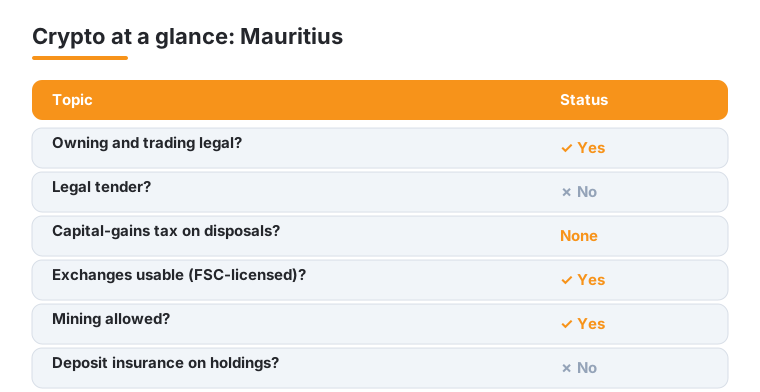
- Owning, buying and trading crypto is legal for individuals; it is not legal tender and holdings have no deposit protection.
- Gains on disposal are treated like exempt securities gains since 2024, but crypto run as a business is taxed as income.
- Residents buy via international exchanges, P2P, or FSC-licensed local providers after completing KYC.
Mauritius has positioned itself as one of Africa's most deliberate jurisdictions for digital assets. Rather than banning cryptocurrencies or ignoring them, the island built a dedicated licensing regime that brings virtual asset businesses under formal supervision while leaving individuals free to buy, hold and use crypto at their own risk. The centrepiece is the Virtual Asset and Initial Token Offering Services (VAITOS) Act 2021, in force since 7 February 2022, supervised by the Financial Services Commission. A notable 2024 change to the tax law also redefined virtual assets as a form of securities, with significant consequences for how gains are taxed. This guide explains the current state of Mauritius crypto regulation as of 2026: whether Bitcoin is legal, which authorities oversee the sector, the licensing rules for exchanges, how crypto is taxed, AML and KYC obligations, and the practical realities of using digital assets locally.
This is general information as of 2026 and is NOT legal, tax or financial advice. Crypto rules and tax treatment change frequently and depend on your circumstances. Always verify the current position with the Financial Services Commission (FSC), the Bank of Mauritius and the Mauritius Revenue Authority (MRA), and consult a qualified local professional before acting. See also our crypto regulation overview.
On this page: Legal status · Who regulates it · Taxes · How to buy · Mining
Is Bitcoin and crypto legal in Mauritius?
Yes. Buying, holding, selling and trading Bitcoin and other cryptocurrencies is legal in Mauritius. There is no prohibition on individuals owning digital assets, and businesses may operate in the sector provided they are licensed where the law requires it under the VAITOS Act.
It is important to separate being legal from being legal tender. Cryptocurrencies are not legal tender in Mauritius. The Bank of Mauritius has stated that crypto assets carry no legal-tender status, meaning no merchant or person is obliged to accept them as payment, and holdings are not covered by any statutory compensation or deposit-protection scheme. In practice you can use crypto freely, but you do so at your own risk and without the safeguards that apply to bank deposits. Note that the central bank's planned Digital Rupee (a central bank digital currency) is a separate matter and is not a crypto asset.
Mauritian authorities have repeatedly warned the public about fraudulent schemes marketed as cryptocurrencies, so the legality of the asset class does not imply endorsement of any particular product or platform. For broader context see our guide to crypto regulation.
Who regulates crypto in Mauritius?
Three official bodies are relevant, each with a distinct role:
- Financial Services Commission (FSC) is the integrated regulator for non-bank financial services and the primary authority for virtual assets. The FSC licenses and supervises Virtual Asset Service Providers (VASPs) and issuers of Initial Token Offerings (ITOs), issues the binding FSC Rules, publishes guidance, and maintains a public register of licensees.
- Bank of Mauritius (BoM) is the central bank, responsible for monetary policy, the rupee, the payment system, foreign-exchange matters and legal-tender questions. It has issued public notices cautioning against crypto risks and is developing the Digital Rupee.
- Mauritius Revenue Authority (MRA) administers taxation, including how crypto gains and crypto-related income are treated, and collects the annual Statement of Virtual Assets Transactions from VASPs.
For individual users, the key point is that supervision targets service providers, not personal holders. Using a licensed, FSC-registered platform gives you greater protection and recourse than dealing with an unregulated one. You can confirm whether a provider is licensed via the FSC's public register.
Key laws and regulatory framework
The cornerstone of Mauritius crypto regulation is the Virtual Asset and Initial Token Offering Services (VAITOS) Act 2021, which came into force on 7 February 2022. It was introduced in part to align Mauritius with the standards set by the Financial Action Task Force (FATF), in particular FATF Recommendation 15 on virtual assets and VASPs, and to provide a clear framework for businesses dealing in digital assets while guarding against money laundering and terrorism financing.
Under the VAITOS framework the FSC has issued a body of subsidiary FSC Rules and guidance covering matters such as custody of client assets, client disclosure, capital and financial requirements, cybersecurity and AML/CFT. Alongside the VAITOS Act, the wider AML/CFT regime (including the Financial Intelligence and Anti-Money Laundering Act) applies to virtual asset activity. The Finance (Miscellaneous Provisions) Act 2024 then amended the Income Tax Act to bring virtual assets within the tax definition of securities, which is covered in the taxation section below.
Because licensing categories, capital thresholds and rules are technical and are updated over time, anyone running or planning a crypto business should review the current FSC Rules and guidance directly rather than relying on summaries.
Licensing and registration of exchanges and VASPs
Businesses that provide virtual asset services in or from Mauritius must be licensed by the FSC under the VAITOS Act. Reporting indicates the regime is structured around five VASP licence classes covering broker-dealer, wallet services, custody, advisory and marketplace/exchange activities, each with its own conditions. An exchange that matches buyers and sellers, for example, falls under the marketplace/exchange category.
Typical requirements reported for applicants include:
- Local company and substance: incorporating a Mauritian company with genuine mind-and-management on the island, including resident directors, a compliance officer and a money laundering reporting officer (MLRO).
- Fit-and-proper checks: directors, officers and beneficial owners must satisfy the FSC's fit-and-proper criteria.
- Minimum capital: capital requirements are tiered by licence class, reported in the region of MUR 2 million to MUR 6.5 million depending on the activity, alongside ongoing liquidity expectations.
- AML/CFT systems: customer due diligence, transaction monitoring and suspicious-transaction reporting.
- Operational controls: client-asset protection, IT and cybersecurity arrangements (including periodic cybersecurity audits) and business-continuity planning.
For stablecoin issuers specifically, FSC guidance indicates that fiat-referenced stablecoins must be fully backed by a 1:1 reserve held in segregated bank accounts in Mauritius, with the reserve attested quarterly by an independent auditor. This sits on issuers rather than ordinary users.
FSC fees changed on 1 July 2026. The Financial Services (Consolidated Licensing and Fees) (Amendment) Rules 2026, Government Notice No. 119 of 2026, were gazetted on 30 June 2026 and are effective from that date, restructuring both regulatory processing fees, which the FSC says had remained unchanged since the principal rules were made in 2008, and annual licence fees, last reviewed seven years back in 2019. The revision is not uniform: the FSC states that several fees were reduced, including those for VCC Funds, Asset Management and Representative of Investment Dealer licences, while some remained unchanged. The FSC has extended the due date for payment of annual licence fees to 30 September 2026. Confirm the current fee schedule, capital requirements and application forms directly with the FSC before applying.
Crypto and Bitcoin tax in Mauritius
Mauritius is widely regarded as tax-friendly, and a 2024 change strengthened this reputation for digital assets. The Finance (Miscellaneous Provisions) Act 2024 amended the Income Tax Act so that the definition of securities now includes virtual assets and virtual tokens. Because gains on the disposal of securities are exempt from tax in Mauritius, gains on the disposal of virtual assets are treated in the same way. Reporting indicates this exemption took effect from 1 July 2024.
Two important qualifications remain. First, Mauritius has no general capital gains tax for individuals, and the exemption applies to disposal gains that are genuinely capital in nature. Second, where crypto activity amounts to a trade or business rather than investment, the profits can be treated as income and fall within the income tax system; companies are likewise subject to corporate income tax on their profits. The boundary between exempt disposal gains and taxable business income is fact-specific.
For licensed virtual asset businesses, the Finance Act 2025 extended the 80% partial exemption regime to qualifying income of FSC-licensed VASPs from the exchange, transfer, safekeeping and administration of virtual assets, subject to meeting substance requirements. Reporting indicates this takes effect for years of assessment starting on or after 1 July 2026 and reduces the effective corporate tax rate on that income to about 3%, from the standard 15%. The substance conditions are to be set by regulation, so VASPs should confirm the current detail with the MRA and a tax adviser.
Separately, VASPs and ITO issuers must file an annual Statement of Virtual Assets Transactions with the MRA, reporting customers whose transactions exceed set thresholds (reported as MUR 250,000 individually or MUR 2 million in aggregate for individuals, and higher figures for non-individuals). This is a reporting obligation on providers, not a tax on users.
Because rates, definitions, exemptions and reporting rules can change, this guide does not state personal tax rates for your situation. Confirm the current position with the MRA and a qualified tax adviser, and keep thorough records of dates, amounts, counterparties and rupee values. See our crypto taxes guide for general principles. This is general information, not tax advice.
AML, KYC and consumer protection rules
The most visible rules for ordinary users come from the anti-money-laundering and counter-terrorism-financing (AML/CFT) regime rather than from any restriction on crypto itself. Licensed VASPs must implement customer due diligence, verify identity, monitor transactions and report suspicious activity, consistent with the VAITOS Act and FATF Recommendation 15.
What you will encounter in practice:
- Identity verification (KYC): licensed platforms must verify who you are. Expect to provide proof of identity and address before you can deposit, trade or withdraw.
- Source-of-funds checks: larger or unusual transactions may trigger questions about where the money came from.
- Travel-rule style obligations: the FSC published no virtual-asset-specific circular letter or communique during 2025 or 2026, and no circular of any kind is listed for March 2025, so transaction-monitoring and cross-border reporting duties on VASPs should be taken from the Financial Intelligence and Anti-Money Laundering Act and the FSC licence conditions rather than from a dated virtual asset circular. The change now proposed sits in the Budget 2026-2027, which would amend FIAMLA to clarify the power of the FSC to impose administrative sanctions on financial institutions under its purview for non-compliance with AML/CFT requirements. That amendment is announced and awaits the Finance Bill 2026 or the Economic and Financial Measures (Miscellaneous Provisions) Bill 2026, neither of which had been introduced as at 4 August 2026.
On consumer protection, the FSC's guidance urges the public to transact only with FSC-licensed VASPs and registered ITO issuers, and to check the FSC register before sending funds. Because crypto is not legal tender and holdings are not covered by deposit insurance, the strongest protection available to a user is to stick to licensed providers and verify them independently. The clearest published signal on unlicensed promotion is the Budget 2026-2027 announcement that the VAITOS Act will be amended to prohibit unlicensed persons from soliciting investors in Mauritius for virtual asset transactions or initial token offerings, with a view to protecting investors from unregulated or abusive practices. That amendment is announced rather than enacted, and it awaits the Finance Bill 2026 or the Economic and Financial Measures (Miscellaneous Provisions) Bill 2026, neither of which had been introduced in Parliament as at 4 August 2026. Anyone offering staking or similar services to Mauritian residents should confirm the licensing position with the FSC directly.
How Mauritius fits FATF and international standards
Mauritius built its virtual asset rules against the backdrop of an international review of its anti-money-laundering system. In February 2020 the Financial Action Task Force (FATF) placed Mauritius on its list of jurisdictions under increased monitoring, commonly called the grey list, and the country was also added to the European Union's list of high-risk third countries. Mauritius then carried out an action plan to strengthen its AML/CFT framework.
At its October 2021 plenary the FATF removed Mauritius from the grey list, and the European Commission removed Mauritius from its high-risk list with effect from early January 2022. Reporting at the time noted that Mauritius met 39 of the 40 FATF recommendations as compliant or largely compliant, with the virtual asset area being the outstanding item. The VAITOS Act and the FSC rules for VASPs are part of the response to that gap, aligning the country with FATF Recommendation 15 on virtual assets and VASPs. For a user, the practical takeaway is that the KYC and source-of-funds checks you meet on a licensed platform are a direct product of these international standards.
Buying and using crypto in practice
Residents and visitors can buy crypto through international exchanges that accept Mauritian customers, through peer-to-peer (P2P) marketplaces, and through locally licensed VASPs. No law prevents an individual from purchasing crypto for their own account.
A straightforward, security-first approach:
- Choose a platform. Favour a reputable exchange that accepts Mauritian users or an FSC-licensed local provider. Check funding methods, fees and whether it handles rupees.
- Verify your account. Complete KYC with identity and address documents; this is mandatory on compliant platforms.
- Secure it. Enable two-factor authentication, use a strong unique password and turn on withdrawal protections such as address whitelisting.
- Fund and buy. Deposit via supported methods, mindful of your bank's policies on crypto-related card payments and transfers, since the Bank of Mauritius oversees foreign-exchange matters. Start small until you are comfortable, and review fees before confirming.
- Consider self-custody. For larger long-term holdings, a hardware wallet with an offline-stored recovery phrase removes reliance on a platform's solvency. Never share your private keys or recovery phrase.
- Keep records. Save confirmations and statements for tax and compliance.
Crypto is sometimes promoted for cheaper, faster remittances. It can settle quickly, but volatility, on- and off-ramp conversion fees, and KYC checks on both ends can offset the savings, so compare the all-in cost against established remittance services for your corridor.
Bitcoin ATMs and on-ramps
Bitcoin ATMs (BTMs) are physical kiosks that let users buy, and sometimes sell, crypto with cash or card. Globally they cluster in dense urban markets with clear operator licensing, and availability in smaller markets like Mauritius tends to be limited and to change over time as private operators install and remove machines.
If you are looking for a BTM on the island, check a live crypto-ATM locator immediately before travelling, since listings can quickly become outdated. Where a machine does operate, expect identity verification for larger amounts and fees that are typically higher than those of online exchanges, reflecting the convenience of instant cash access. Any BTM operator that provides virtual asset services in or from Mauritius would itself be expected to hold the appropriate FSC licence.
For most users, a regulated online exchange or licensed local provider offers better rates and liquidity than an ATM. Treat any ATM transaction as you would handling cash: confirm the operator is legitimate, understand the spread and fees before confirming, and keep your receipt.
Bitcoin mining in Mauritius
There is no specific prohibition on cryptocurrency mining for individuals in Mauritius, but the economics are challenging. Mining is energy-intensive, and profitability depends almost entirely on electricity cost relative to cooling demands and hardware prices.
Practical factors weigh against domestic mining here:
- Electricity cost and supply: mining only makes sense where power is cheap and reliable. Assess tariffs and whether large continuous loads are permitted under your connection agreement.
- Climate and cooling: a warm, humid tropical climate raises cooling requirements and running costs.
- Renewables: pairing mining with clean energy is discussed globally and Mauritius has broader clean-energy ambitions, but commercial viability depends on project-specific costs and any applicable energy rules.
- Tax and registration: income from mining could be treated as taxable business income, and commercial-scale activity may engage other business-registration or regulatory requirements. Verify obligations before scaling up.
For most people, buying crypto on an exchange is far more practical than mining it domestically.
Recent developments (2024-2026)
Mauritius continues to refine its framework rather than reverse course. Notable recent developments include:
- Tax treatment of virtual assets (2024): the Finance (Miscellaneous Provisions) Act 2024 redefined securities to include virtual assets and virtual tokens, extending the existing exemption on disposal gains to crypto, reported as effective from 1 July 2024.
- Enhanced AML/CFT for VASPs (2025): reporting indicates strengthened obligations applied from March 2025, including mandatory transaction monitoring, reporting of larger cross-border transfers, tighter beneficial-ownership disclosure and periodic cybersecurity audits.
- FATF and EU standing: although this predates the tax changes, it is the backdrop for the current AML rules. Mauritius was removed from the FATF grey list at the October 2021 plenary and from the EU high-risk list in early January 2022, after strengthening its AML/CFT framework, of which the VAITOS regime for VASPs forms part.
- The Digital Rupee (CBDC): the Bank of Mauritius has been developing a retail central bank digital currency, the Digital Rupee, with IMF technical assistance, an earlier public consultation and a pilot phase that began in 2024. The Digital Rupee is not a crypto asset; it would be central bank money and, once issued, legal tender, in contrast to cryptocurrencies which have no legal-tender status.
- Tax incentive for licensed VASPs (Finance Act 2025): the Finance Act 2025, following the 2025-2026 National Budget, extended the 80% partial exemption regime to qualifying income of FSC-licensed VASPs from the exchange, transfer, safekeeping and administration of virtual assets, subject to substance requirements. Reporting indicates this applies for years of assessment commencing on or after 1 July 2026 and brings the effective corporate tax rate on that income to about 3%, down from the standard 15%.
Because dates and the exact scope of these measures evolve, treat the official regulator and central bank pages as the authority and verify the current position before acting.
Consumer risks and how to protect yourself
The principal risks of using crypto in Mauritius mirror those everywhere: market volatility, the absence of any statutory protection for holdings, security threats such as hacking and phishing, and the prevalence of scams ranging from fake investment schemes to fraudulent tokens. Because crypto is not legal tender and is not covered by deposit insurance, recourse when things go wrong is limited and losses generally fall on the user.
Sensible safeguards:
- Use FSC-licensed or well-established platforms, and check the FSC public register before sending funds.
- Be sceptical of anything promising guaranteed or outsized returns; this is the hallmark of a scam.
- Only commit money you can afford to lose, and secure assets with strong authentication and, for larger holdings, self-custody.
- Keep records of every transaction for tax and compliance.
If you are weighing crypto as an investment, remember that suitability depends on your goals and risk tolerance, not on geography. This guide makes no price predictions and does not advise whether to invest. Consider speaking with a licensed financial adviser. This is not financial advice.
Official sources and how to verify
Crypto rules and tax treatment change, so always confirm the current position with the official authorities rather than third-party summaries. The primary official sources for Mauritius are:
- Financial Services Commission (FSC) for the VAITOS Act, FSC Rules and guidance, licensing criteria and the public register of licensed VASPs and ITO issuers. The register of licensees is available on the FSC register of licensees page, which you can use to confirm that a provider is licensed before sending funds.
- Bank of Mauritius for legal-tender, currency and foreign-exchange matters, public notices on cryptocurrencies, and the Digital Rupee.
- Mauritius Revenue Authority (MRA) for taxation of crypto gains and income and the Statement of Virtual Assets Transactions.
You can read the legislation itself in the VAITOS Act 2021 (FSC PDF). For more on this site, see our crypto regulation hub and the main regulation directory.
This article is general information as of 2026 and does not constitute legal, tax or financial advice. Verify the current rules with the FSC, the Bank of Mauritius and the MRA, and consult a qualified local professional before making decisions.
What is changing: Mauritius crypto rules as at August 2026
The legal position has not changed since this page was last reviewed. The Virtual Asset and Initial Token Offering Services Act 2021 remains the law in force, buying and holding crypto remains legal, and the Financial Services Commission still licenses Virtual Asset Service Providers under its FinTech category, alongside peer-to-peer lending, investment-based crowdfunding, payment intermediary services and robotic and artificial intelligence enabled advisory services (FSC, licensed activities).
What has moved is the pipeline. The National Budget 2026-2027, delivered on 19 June 2026, announced a cluster of crypto measures: two amendments to the VAITOS Act, a framework for stablecoins and tokenisation of real-world assets, an Open Banking Framework covering banks and VASPs, and a data collection power for the Mauritius Revenue Authority under the OECD Crypto-Asset Reporting Framework. None of it is law. The Annex to the Budget Speech states that these amendments are to be included in the Finance Bill 2026 and the Economic and Financial Measures (Miscellaneous Provisions) Bill 2026, and neither Bill appeared on the National Assembly bills list as at the sitting of 4 August 2026, where 2026 bills ran to No. XIV (National Assembly, Bills).
One change has actually taken effect, and it is a cost change rather than a rule change. The Financial Services (Consolidated Licensing and Fees) (Amendment) Rules 2026, Government Notice No. 119 of 2026, were gazetted on 30 June 2026 and are effective as from 1 July 2026. They restructure FSC processing fees and annual licence fees. The FSC states that regulatory processing fees had remained unchanged since the principal rules were made in 2008 and that annual licence fees were last reviewed seven years back in 2019, and it has extended the due date for payment of annual licence fees to 30 September 2026 (FSC Circular Letter CL20260701, 1 July 2026). The revision does not move in one direction: the FSC says several fees were reduced, naming VCC Funds, Asset Management and Representative of Investment Dealer licences, while some remained unchanged (FSC communique, 10 July 2026). Check the current schedule rather than assuming.
One thing the FSC has not done is issue any virtual-asset-specific circular letter or communique during 2025 or 2026. If you are looking for new crypto rules from the regulator this year, there are none. The activity is all at budget and legislative level.
Budget 2026-2027: what is coming for crypto, and when
Every measure below was announced on 19 June 2026, either in the Budget Speech or in its Annex. The Annex states that the legislative amendments it explains are to be included in the Finance Bill 2026 and the Economic and Financial Measures (Miscellaneous Provisions) Bill 2026. Neither Bill had been introduced in Parliament as at 4 August 2026. Read the stage column as the government's stated intention, not as a commencement date.
| Measure | What it would do | Stage as at August 2026 |
|---|---|---|
| VAITOS Act, senior executive residence (Annex item 74(a)) | Clarifies that a senior executive of a VASP must satisfy both the requirements of being a resident in Mauritius and holding a senior management position | Announced, awaiting a budget bill |
| VAITOS Act, solicitation ban (Annex item 74(b)) | Prohibits unlicensed persons from soliciting investors in Mauritius for virtual asset transactions or initial token offerings | Announced, awaiting a budget bill |
| Stablecoins and tokenisation (Speech para 61) | Clear rules for the issuance of and investment in stablecoins, and the tokenisation of real-world assets | Announced only, no draft or consultation published |
| CARF reporting power for the MRA (Annex 9.2.3(d)) | Allows the MRA to collect information from Reporting Crypto-Asset Service Providers for automatic exchange with foreign tax authorities | Announced, awaiting a budget bill |
| Financial Services Act (Annex item 42) | Establishes the National Fintech Governance Committee and a conservatorship framework empowering the FSC to appoint a conservator over licensees facing financial or operational difficulties | Announced, awaiting a budget bill |
| FIAMLA (Annex item 40(a)) | Clarifies the power of the FSC to impose administrative sanctions on financial institutions under its purview, including VASPs, for AML/CFT non-compliance | Announced, awaiting a budget bill |
| Open Banking Framework (Speech para 61) | Secure sharing of customer financial data between licensed banks, virtual asset service providers and authorised fintech providers | Announced only, no date given |
| Banking legislation overhaul (Speech paras 62 to 63) | A new Bank of Mauritius Bill, a new Banking Bill and an appropriate Resolution Regime, replacing laws dating from 2004 | Announced, introduction promised before the end of 2026 |
Sources: Budget Speech 2026-2027 and Annex to the Budget Speech 2026-2027.
On international reporting, the sequence matters. Mauritius signed the OECD Multilateral Competent Authority Agreement on automatic exchange of information under the Crypto-Asset Reporting Framework on 12 December 2025, appearing as entry 39 on the OECD signatory list (OECD, status as of 3 March 2026). That list shows jurisdiction and signature date only, with no first-exchange date. That is the international half. The domestic half, meaning CARF regulations plus the MRA collection power, is not yet in place: domestic CARF regulations have not been published, while separately the MRA announced on 22 May 2026 that CRS 2.0 came into effect on 1 January 2026, under which entities managing relevant crypto-assets are classified as investment entities (KPMG, 15 June 2026). No Mauritius crypto platform is reporting your account under CARF today. That is the change to watch.
A wider deadline sits behind all of this. The Budget Speech states that the immediate priority is to consolidate the reputation of Mauritius as a trusted International Financial Centre and to ensure full readiness for the 2027 Mutual Evaluation by ESAAMLG, the regional FATF-style body. That evaluation, and the AML/CFT tightening it drives, is a stated reason the VAITOS and FIAMLA amendments are on the table.
Crypto tax rates in Mauritius: the numbers that actually apply
Mauritius has no crypto-specific tax and no crypto-specific rate. What decides your bill is whether the activity is investment or trade. As set out above, gains on the disposal of virtual assets follow the exempt treatment given to securities. Where crypto activity amounts to a trade or business rather than investment, the profit is ordinary income and is taxed at the ordinary rates.
Those ordinary personal rates are being changed. In the Budget Speech of 19 June 2026 the Minister announced a new tax band: the 20 percent tax rate will be applicable on the portion of chargeable income exceeding Rs 1 million up to Rs 12 million, and any chargeable income in excess of Rs 12 million will be taxed at the rate of 35 percent, with that band replacing the fair share contribution for individuals (Budget Speech 2026-2027, paragraph 280). The speech gives no commencement date, the Annex does not restate the personal bands, and the change requires a budget bill, so confirm the year of assessment with the MRA before relying on it.
The practical read for a crypto holder:
- Buy and hold, then sell: unaffected by the budget, because the disposal exemption is unchanged.
- Frequent trading treated as a trade: the profit is ordinary income, and the announced top marginal rate is 35 percent above Rs 12 million of chargeable income.
- Trading through a company: taxed under the corporate regime, not the personal bands. The Budget 2026-2027 annex makes no change to any crypto-specific corporate rate. The only 3 percent corporate rate it names is the existing reduced rate on profits derived from exports of goods, and the sole 2026 change to that rate is to exclude profits from exports of live animals.
Nothing in the Budget 2026-2027 documents creates a crypto-specific tax, rate, allowance or filing form, and the MRA has published no crypto-specific guidance in its latest news listing (MRA, latest news). If your position is material, get it characterised as investment or trade in writing before you file.
Frequently asked questions
Is cryptocurrency legal in Mauritius?
Yes. Buying, holding and trading crypto is legal for individuals, and businesses can operate under an FSC licence through the VAITOS Act. However, cryptocurrencies are not legal tender, so no one is obliged to accept them as payment, and holdings are not covered by deposit protection or statutory compensation. This is general information, not legal advice; verify with the FSC.
Who regulates crypto in Mauritius?
The Financial Services Commission (FSC) is the main regulator, licensing and supervising Virtual Asset Service Providers and token issuers under the Virtual Asset and Initial Token Offering Services (VAITOS) Act, in force since 7 February 2022. The Bank of Mauritius handles monetary, currency and legal-tender matters, and the Mauritius Revenue Authority (MRA) handles taxation.
Do I have to pay tax on crypto in Mauritius?
It depends on how your activity is characterised. The Finance (Miscellaneous Provisions) Act 2024 redefined securities to include virtual assets, so gains on the disposal of crypto are treated like exempt gains on securities (reported as effective 1 July 2024), and Mauritius has no general capital gains tax for individuals. But crypto activity that amounts to a trade or business may be taxed as income, and companies are taxed on profits. Confirm your position with the MRA and a qualified tax adviser. This is not tax advice.
Do crypto exchanges need a licence in Mauritius?
Yes. A business providing virtual asset services in or from Mauritius, including operating an exchange, must hold the relevant VASP licence from the FSC under the VAITOS Act. Reporting indicates the regime uses several licence classes covering broker-dealer, wallet, custody, advisory and marketplace/exchange activities, with local substance, fit-and-proper, capital and AML/CFT requirements. Check the FSC's public register to confirm a provider is licensed.
What KYC and AML rules apply when I buy crypto in Mauritius?
Licensed platforms must verify your identity (KYC) before you deposit, trade or withdraw, and may ask about your source of funds for larger transactions. Reporting indicates enhanced AML/CFT obligations applied to VASPs from March 2025, including stronger transaction monitoring and reporting of larger cross-border transfers. These rules sit on the service provider; individuals simply complete verification.
Is the Digital Rupee the same as cryptocurrency?
No. The Digital Rupee is a central bank digital currency being developed by the Bank of Mauritius, with an earlier public consultation and a pilot phase that began in 2024. It is central bank money, not a crypto asset, and once issued it would be legal tender, unlike cryptocurrencies such as Bitcoin which have no legal-tender status in Mauritius. Verify the latest status on the Bank of Mauritius website.
Is Mauritius on the FATF grey list?
No. Mauritius was placed on the FATF list of jurisdictions under increased monitoring, known as the grey list, in February 2020, and was removed at the FATF plenary in October 2021 after strengthening its anti-money-laundering framework. The European Union removed Mauritius from its high-risk list in early January 2022. The VAITOS Act and the FSC rules for virtual asset service providers are part of that stronger AML/CFT framework. Verify the current status with the FSC and the Bank of Mauritius.
How do I check if a crypto platform is licensed in Mauritius?
Use the FSC public register of licensees on the Financial Services Commission website, which lists licensed virtual asset service providers and registered token issuers. The FSC advises the public to transact only with licensed providers and to check the register before sending funds. Being licensed is not an endorsement of any product, and holdings are still not covered by deposit protection, so treat licensing as one safeguard among several.
Has Mauritius passed a new crypto law in 2026?
No. The Virtual Asset and Initial Token Offering Services Act 2021 is still the governing law. The Budget 2026-2027 of 19 June 2026 announced amendments to it, plus a stablecoin and tokenisation framework and a CARF reporting power for the tax authority, but the Annex to the Budget Speech states those amendments go into the Finance Bill 2026 and the Economic and Financial Measures (Miscellaneous Provisions) Bill 2026, and neither Bill had been introduced in the National Assembly as at the sitting of 4 August 2026. The only crypto-relevant instrument that has actually taken effect in 2026 is the FSC fee realignment under GN No. 119 of 2026, in force from 1 July 2026.
Will my Mauritius crypto account be reported to my home tax authority?
Not yet. Mauritius signed the OECD CARF Multilateral Competent Authority Agreement on 12 December 2025, appearing as entry 39 on the OECD signatory list, but domestic CARF regulations have not been published and the power for the Mauritius Revenue Authority to collect data from Reporting Crypto-Asset Service Providers is only a Budget 2026-2027 announcement awaiting a budget bill. Once both are in place, Mauritius-based exchanges, brokers and custodians will identify account holders and report to foreign tax authorities. Separately, the MRA announced on 22 May 2026 that CRS 2.0 came into effect on 1 January 2026, under which entities managing relevant crypto-assets are classified as investment entities.
What tax rate do I pay if I trade crypto as a business in Mauritius?
There is no crypto-specific rate. Trading profits are ordinary income. The Budget 2026-2027 announced that the 20 percent rate will apply on the portion of chargeable income exceeding Rs 1 million up to Rs 12 million, and that chargeable income in excess of Rs 12 million will be taxed at 35 percent, replacing the fair share contribution for individuals. The Budget Speech gives no commencement date and the change requires a budget bill, so confirm the applicable year of assessment with the MRA. Pure investment gains on disposal of virtual assets remain exempt.
Are the rules for exchanges operating in Mauritius about to get stricter?
Yes, on current government intention. The Budget 2026-2027 would amend the VAITOS Act so a senior executive of a VASP must satisfy both the requirement of being resident in Mauritius and the requirement of holding a senior management position, and would ban unlicensed persons from soliciting Mauritian investors for virtual asset transactions or token offerings. Separately, the Financial Services Act would be amended to establish a National Fintech Governance Committee and give the FSC a conservatorship power over licensees facing financial or operational difficulties, and FIAMLA would be amended to clarify the FSC power to impose administrative sanctions for AML/CFT failures. All of these are announced and await the Finance Bill 2026 or the Economic and Financial Measures (Miscellaneous Provisions) Bill 2026. The Budget Speech names readiness for the 2027 ESAAMLG mutual evaluation as an immediate priority.
Did the cost of an FSC licence change in 2026?
Yes. The Financial Services (Consolidated Licensing and Fees) (Amendment) Rules 2026, GN No. 119 of 2026, were gazetted on 30 June 2026 and are effective from 1 July 2026. The FSC says regulatory processing fees had been unchanged since the principal rules were made in 2008 and annual licence fees were last reviewed in 2019. Not every fee rose: the FSC states several were reduced, including those for VCC Funds, Asset Management and Representative of Investment Dealer licences, while some were unchanged. The due date for payment of annual licence fees has been extended to 30 September 2026.
Facts reviewed: 3 August 2026. Page updated: 3 August 2026.