Home › Crypto Regulation › Madagascar
Bitcoin & Cryptocurrency Regulation in Madagascar
Quick answer — Madagascar, 2026
- Legal: Not banned but not recognised, grey area, not legal tender
- Tax: No crypto-specific tax, general principles may apply
- Buying: No licensed local exchange, via international platforms and P2P
Madagascar has no dedicated cryptocurrency law. As of 2026, digital assets such as Bitcoin are neither formally recognised nor outright banned: they sit in a legal grey area where individuals buy, hold, and trade crypto in practice, mostly through international exchanges and peer-to-peer markets, while no local statute defines, licenses, or supervises the sector. The Central Bank of Madagascar, Banky Foiben'i Madagasikara (BFM), has warned the public about crypto risks but has not issued a binding framework, and it is instead piloting a digital version of the national currency, the eAriary. This page explains where crypto stands legally, who the relevant authorities are, how tax and anti-money-laundering rules apply, and the practical realities of buying and using crypto in Madagascar.
General information, not legal advice. This article is general information as of 2026 and is not legal, tax, or financial advice. Crypto rules and their enforcement can change. Always verify your situation with the named official regulator, Banky Foiben'i Madagasikara, the Malagasy tax administration, and a qualified local professional before acting. See also our overview of crypto regulation.
On this page: Legal status · Who regulates it · Taxes · How to buy · Mining
Legal status of Bitcoin and crypto in Madagascar
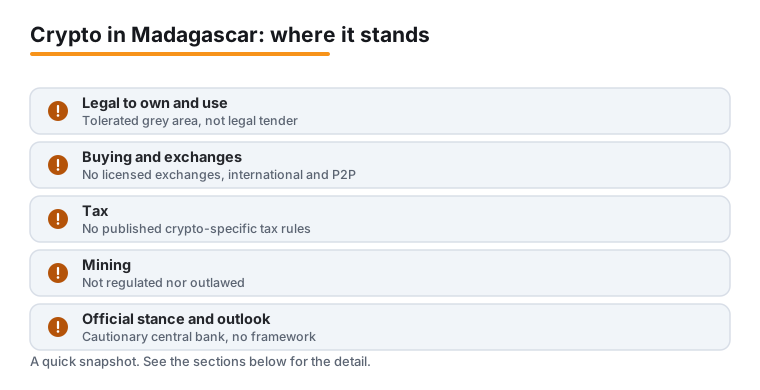
Owning and using Bitcoin is not a crime in Madagascar. No statute prohibits individuals from buying, holding, or transferring cryptocurrency, and people do so routinely. At the same time, no law formally recognises crypto, so digital assets are tolerated in practice rather than authorised by design. This is the same default that applies across much of francophone Africa, where dedicated crypto rules remain rare.
Two points matter most:
- Crypto is not legal tender. The only official currency is the Malagasy ariary (MGA), issued by the Central Bank of Madagascar. No merchant is obliged to accept Bitcoin, and crypto cannot be used to settle taxes or public debts.
- There is no local consumer-protection regime for crypto. Because exchanges and tokens are not licensed or supervised inside Madagascar, users who lose funds to fraud, hacks, or platform failure generally have no domestic regulator to turn to.
In short, holding Bitcoin is legal by default rather than by design. The direction of travel is now on the record. SAMIFIN's April 2026 national risk assessment recommends that Madagascar adopt an official position favouring a regulated approach rather than an outright prohibition, supported by a dedicated law, a licensing regime for exchanges and custodians, and a named supervisory authority. Nothing has been drafted or timetabled, so today's openness is provisional rather than permanent, and the likelier future is regulation rather than a ban.
The regulator: Banky Foiben'i Madagasikara (Central Bank)
The central authority for money and finance is the Central Bank of Madagascar, Banky Foiben'i Madagasikara (BFM). It manages monetary policy, issues the ariary, and oversees the stability of the banking system.
The BFM has published public communications on cryptocurrencies (an avis au public sur les cryptomonnaies / public notice on cryptocurrencies, alongside a report on the topic) warning of the risks involved, including sharp price volatility, fraud and scams, and the potential use of crypto in illicit transactions. Crucially, these communications stop short of banning crypto or creating a licensing regime. The BFM's stance is best read as cautionary rather than prohibitive.
The bank's public notice on cryptocurrencies was dated 5 October 2021. In it, the BFM stated that cryptocurrencies are neither issued nor regulated by the central bank or any other monetary authority, that they have no legal-tender status in Madagascar, and that unregulated exchange platforms bear no responsibility for user losses. It flagged the risks of money laundering and terrorist financing tied to the lack of transaction traceability, and the financial risk from crypto's volatility and speculative nature, and it advised the public to act with caution. No binding crypto framework has replaced that notice since. You can read the original at the BFM's avis au public sur les cryptomonnaies.
Rather than regulate private crypto, the BFM is developing its own digital money: the eAriary central bank digital currency (CBDC). You can review the bank's own communications on its official site, Banky Foiben'i Madagasikara.
Key laws and frameworks that apply
Madagascar has not enacted crypto-specific legislation. Instead, digital-asset activity is touched indirectly by existing monetary, financial, and anti-money-laundering rules. The most relevant pieces are:
- Anti-money-laundering and counter-terrorist-financing (AML/CFT) law. Law No. 2018-043 on the fight against money laundering and the financing of terrorism (LBC/FT) is the core framework, amended and supplemented by Law No. 2023-026 of 1 February 2024, which introduced the only recognition of a virtual asset in Malagasy law, and implemented by Decree No. 2024-1352. It is enforced by the country's financial intelligence unit, SAMIFIN.
- Monetary and foreign-exchange rules. The BFM's authority over the ariary and over cross-border currency flows means foreign-exchange controls can apply to moving money in and out of the country, including funds linked to crypto.
- General tax law. Ordinary rules on income, business profits, and capital gains may capture crypto activity depending on how it is characterised, even though no crypto-specific tax text exists.
Because the framework is built around general rules rather than dedicated crypto text, the absence of a specific rule is not the same as permission. Verify your specific situation with a local advisor. For a wider primer, see how crypto regulation works.
Licensing and registration of exchanges (VASPs)
There is no dedicated licensing or registration regime for crypto exchanges, brokers, or custodians operating from Madagascar. The country has not created a Virtual Asset Service Provider (VASP) authorisation scheme of the kind the Financial Action Task Force (FATF) recommends, and there are no locally licensed, domestically supervised crypto platforms.
In practice this means:
- Malagasy users rely on international platforms (such as Binance, which supports the ariary on its peer-to-peer market) and on peer-to-peer (P2P) marketplaces, each of which applies its own identity-verification and terms of service.
- There are no statutory rules forcing a local platform to perform Know Your Customer (KYC) checks, because there are effectively no locally registered platforms to regulate.
- Any business handling crypto in Madagascar would still be subject to general company-registration, tax, and AML obligations.
In April 2026 SAMIFIN published Madagascar's first national ML/TF risk assessment on virtual assets and VASPs. It records that no licensing, authorisation or prior approval mechanism is required to carry out virtual-asset activities, that no competent authority is designated to regulate and supervise VASPs, and that a crypto business may only register as an ordinary commercial company under Law No. 2003-036 with no fit and proper test. The same report recommends that Madagascar create a dedicated VA and VASP law, a licensing regime and a named supervisory authority. No bill has been published and no date has been set.
Crypto and Bitcoin tax in Madagascar
Madagascar does not publish crypto-specific tax rules. There is no official crypto tax rate, threshold, or reporting form set out specifically for digital assets, and no guidance that tells residents exactly how Bitcoin gains, trading profits, or mining income should be declared.
That absence does not make crypto income automatically tax-free. General Malagasy tax principles may apply depending on how an activity is characterised by the tax administration. As a guide to the general system, capital gains made by a company on the sale of assets and interests are treated as normal business income subject to corporate income tax, while for individuals the only capital gains charge set out in the published summary is 20 percent on gains from a series of purchases and re-sales of real estate property. For reference on the general rates that could be relevant by analogy, capital gains on the sale of shares deriving value from assets in Madagascar are subject to income tax at 20 percent, resident individuals are taxed on worldwide income, and a small business with annual turnover below MGA 400 million falls under a 5 percent synthetic tax on turnover. None of these is a crypto-specific rule, and how, or whether, these principles attach to a given crypto transaction is not settled by any crypto-specific text. General tax facts here follow the published Madagascar tax summary.
Given this uncertainty:
- Keep clear, dated records of every purchase, sale, transfer, and conversion to or from ariary, including amounts and counterparties where known.
- Do not assume any particular crypto rate or exemption applies; none has been published as crypto-specific.
- Consult a Malagasy tax professional or the tax administration before filing, especially if you trade actively, mine, or receive crypto as payment.
This section is informational only and is not tax advice. For background, see our guide to crypto taxes.
AML and KYC rules
Although there is no crypto-specific regime, anti-money-laundering and counter-terrorist-financing (AML/CFT) obligations are real and enforced. The framework rests on Law No. 2018-043 (LBC/FT), and the body responsible for receiving and analysing suspicious-transaction reports is SAMIFIN, Madagascar's Financial Intelligence Unit.
What this means for crypto users in practice:
- International platforms apply KYC. The major exchanges Malagasy users rely on require identity verification (ID documents, personal details) under their own AML programmes, regardless of the gap in local crypto law.
- General AML law still bites. Using crypto does not exempt anyone from rules on fraud, money laundering, and large or suspicious cross-border flows, which can attract scrutiny under existing law.
- Standards are being tightened. ESAAMLG assessors conducted Madagascar's third-round mutual evaluation on-site visit from 13 to 30 July 2026, and SAMIFIN expects the full evaluation to be completed in August 2027. Madagascar has moved from 13 to 29 of the 40 FATF Recommendations rated compliant or largely compliant since 2018, but ESAAMLG's twelfth enhanced follow-up report of April 2025 still rates Recommendation 15, the standard covering virtual assets, as non-compliant. That is the specific gap any future Malagasy VASP rules would be written to close.
You can review the AML authority's mandate and publications on the official site of SAMIFIN, and Madagascar's standing on the global standard-setter at the FATF Madagascar country page.
Buying and using crypto in practice
There are no locally regulated crypto exchanges based in Madagascar, so Malagasy users access crypto mainly in two ways:
- International exchanges. Global platforms such as Binance, which supports the ariary through its peer-to-peer market and local mobile-money methods, are commonly used for their liquidity, asset range, and mobile apps. They apply their own KYC and terms, which determine who can register and what limits apply.
- Peer-to-peer (P2P) trading. Buyers and sellers match directly, often settling in ariary through bank transfers or mobile money. P2P is popular where card funding is limited but carries higher counterparty risk.
Several local realities shape the experience: limited availability of international payment cards, foreign-exchange controls on moving ariary across borders, patchy internet outside cities, and the dominance of cash and mobile money. Mobile-money rails (MVola, Orange Money, Airtel Money) are frequently the practical on-ramp and off-ramp. Note that Madagascar has no meaningful Bitcoin ATM network; public trackers do not list operating machines, so converting between cash and crypto generally happens through P2P or an exchange off-ramp.
Whichever route you choose, prefer well-established platforms, complete identity verification honestly, move larger holdings to a wallet you control, and treat any offer that guarantees returns as a warning sign.
Crypto mining in Madagascar
Cryptocurrency mining is not specifically regulated or outlawed in Madagascar. As with trading, the absence of dedicated rules means mining sits in the same grey zone: not prohibited, but not formally licensed or encouraged either.
Anyone considering mining should weigh practical and legal factors rather than assume a clear green light:
- General business and tax obligations. A mining operation may be treated as a business, bringing it within ordinary registration and tax rules even though no crypto-specific mining law exists.
- Electricity supply and cost. Reliable, affordable power is the single biggest constraint. Grid coverage and stability vary considerably across the country, which makes large-scale mining hard to run economically.
- Import of equipment. Mining hardware must be imported, so standard customs and duty rules apply.
For most individuals, hobby-scale mining is more realistic than industrial operations. Confirm electricity and business obligations locally before investing in equipment.
Recent developments: the eAriary CBDC
The most significant recent development is not about private crypto but about official digital money. On 29 October 2025, technology provider eCurrency announced that it was preparing to begin the pilot phase of the eAriary, the central bank digital currency (CBDC) of the Central Bank of Madagascar (BFM), using eCurrency's DSC3 technology in partnership with PayLogic SA. The pilot itself comes later. The BFM's own eAriary page states that the pilot phase begins in August 2026, in selected areas and for targeted uses, and will run for ten months, after which a progressive national rollout may be considered depending on the results. The eAriary is designed as a digital version of the national currency that would operate alongside notes and coins, with the BFM remaining the sole issuer and private-sector entities (commercial banks, e-money providers, microfinance institutions, and fintechs) handling distribution to the public.
The stated goals are expanding financial inclusion and modernising the national payment system. A CBDC is fundamentally different from decentralised crypto-assets such as Bitcoin: it is issued and controlled by the central bank and represents official money, not a private token. The eAriary therefore does not change the legal status of Bitcoin, but it signals where Madagascar's official focus lies.
You can read the technology provider's announcement of the eAriary CBDC pilot launch, and watch for official confirmations on the BFM site. Treat this as an evolving area and verify current status with the central bank.
Consumer risks and protection
The defining feature of crypto in Madagascar is uncertainty. The same lack of regulation that makes Bitcoin easy to hold also means there is no safety net and little legal clarity. Because no domestic regulator licenses or supervises crypto platforms, there is no local body to compensate or assist users who are defrauded or who lose funds when a platform fails.
Key risks to keep front of mind:
- Fraud and scams, which thrive where oversight is thin and recourse is limited. Be especially wary of guaranteed-return schemes and unsolicited investment managers.
- Platform and custody risk if funds are left on exchanges that are not locally supervised.
- Volatility, since crypto prices can swing sharply, which is serious if you can only afford to risk essential savings.
- Off-ramp friction, because converting back to ariary reliably is not always easy.
- Regulatory change, as the authorities could introduce rules, reporting requirements, or restrictions with limited notice.
A common-sense approach is to treat crypto as high-risk, invest only what you can afford to lose, avoid leverage, never borrow to buy, and keep good records. This is not financial advice.
Official sources and how to verify
Because Madagascar's crypto position is evolving and built on general rather than dedicated rules, always confirm current requirements directly with the official bodies rather than relying on summaries alone. The authorities that matter are:
- Banky Foiben'i Madagasikara (Central Bank of Madagascar) for monetary policy, the ariary, public notices on cryptocurrencies, and the eAriary CBDC: www.banky-foibe.mg.
- SAMIFIN (Financial Intelligence Unit) for AML/CFT rules and suspicious-transaction reporting: www.samifin.gov.mg.
- FATF (Financial Action Task Force) for Madagascar's international AML standing and virtual-asset standards: FATF Madagascar page.
For tax questions, contact the Malagasy tax administration and a qualified local professional. This guide is general information as of 2026, not legal advice, and you should verify the details that affect you with the named official regulator before acting. You can also browse our country-by-country regulation hub.
What is changing: virtual-asset rules are now officially on the agenda
Since this page was last reviewed, the question in Madagascar has shifted from whether anyone in government is looking at crypto to which authority should supervise it and under what law. Nothing has been enacted. But there is now a published, official national position, and it is not a ban.
In April 2026 SAMIFIN released Madagascar's first ML/TF risk assessment report on virtual assets and VASPs. It was produced by a multisectoral technical working group that included the Banking and Financial Supervision Commission (CSBF), the Ministry of Finance, the Ministry of Justice, the Ministry of Economy and Finance, the Ministry of Public Security, INTERPOL, the Agency for the Recovery of Illicit Assets, banks, electronic money institutions, microfinance institutions, insurers, accountants, lawyers and members of the Madagascar Fintech Association. Using the World Bank's VA and VASP assessment tool, it rates both the overall and the residual money-laundering and terrorist-financing risk as HIGH for every channel it examined: peer-to-peer transfers, fiat to virtual asset conversion, virtual asset to fiat conversion and virtual asset to virtual asset conversion.
Its recommendations are the clearest signal of direction the country has produced. The report tells the authorities to define a clear national position favouring a regulated approach rather than an outright prohibition, on the reasoning that a ban would be difficult to enforce given the decentralised and cross-border nature of virtual assets; to establish a specific legal framework for virtual assets and VASPs; to introduce a licensing or authorisation regime with AML/CFT requirements; and to designate a competent authority to supervise the sector. No draft bill has been published, no ministry has claimed the file, and the Assemblee Nationale's register of legislative texts contains nothing on virtual assets.
| Item | Stage as of August 2026 | What it would mean in practice |
|---|---|---|
| Legal definition of a virtual asset | In force, via Law No. 2023-026 of 1 February 2024 | A definition exists in the AML law, but no obligation attaches to exchanges or custodians |
| National VA and VASP risk assessment | Published April 2026 by SAMIFIN | Officially classifies the sector as high risk and recommends regulation rather than prohibition |
| Dedicated VASP law and licensing regime | Recommended only. No bill, no reading, no date | Would require exchanges, brokers and custodians to be authorised and to run KYC under Malagasy law |
| Designated crypto supervisor | Not designated | Today no Malagasy authority licenses, inspects or sanctions a crypto platform |
| ESAAMLG mutual evaluation, third round | On-site visit 13 to 30 July 2026, process expected to complete August 2027 | The rating on virtual assets is the main external pressure for a VASP law |
That evaluation is the thing to watch. SAMIFIN confirms the on-site mission ran from 13 to 30 July 2026 as part of a round launched in November 2025, and states that the process should be completed in August 2027. Madagascar has moved from 13 to 29 of the 40 FATF Recommendations rated compliant or largely compliant since its 2018 evaluation, and SAMIFIN was admitted to the Egmont Group on 8 July 2026 at the Baku plenary. But in ESAAMLG's twelfth enhanced follow-up report of April 2025, the most recent one published, Recommendation 15, the FATF standard covering new technologies and virtual assets, is still rated non-compliant. Closing that specific gap is what a Malagasy VASP law would be written to do.
What the law actually covers today, and what it leaves open
There is no crypto-specific statute in Madagascar. Said once, that is the headline. What applies instead is specific enough to be worth knowing precisely.
- The AML chain is named and dated. Law No. 2018-043 of 13 February 2019 on the fight against money laundering and terrorist financing, as amended and supplemented by Law No. 2023-026 of 1 February 2024 and implemented by Decree No. 2024-1352, is the operative framework, enforced by SAMIFIN. The full register is published on SAMIFIN's laws, decrees and orders page.
- Virtual assets are defined, but nothing follows from the definition. Law No. 2023-026 recognises a virtual asset as a digital representation of value. SAMIFIN's April 2026 assessment states that this recognition remains general and does not translate into an operational regime, and that VASPs are not expressly recognised as reporting entities, so they are not subject to formal obligations on customer due diligence, identification of the origin of funds or diligence towards counterparties.
- There is no entry control at all. The same report records that no licensing, authorisation or prior approval mechanism is required to carry out virtual-asset activities, and that VASPs may only register as ordinary commercial companies under Law No. 2003-036, with no fit and proper test, no assessment of management competence and no prior review of the business model.
- No supervisor has been designated. The report states that no competent authority is currently designated to regulate and supervise VASPs, and lists the absence of sectoral guidelines among the structural gaps.
- Legal tender rests on a specific article. Article 9 of Law No. 2016-004 of 29 July 2016 on the statutes of the Central Bank gives the BFM the exclusive privilege of issuing notes and coins with legal tender status. That is the provision the BFM cited in its public notice of 5 October 2021, which also stated that providers carrying on investment, marketing or exchange activities in cryptocurrencies are not regulated under the legislation in force. The BFM has published no further crypto communique since, and a search of its own register of regulatory texts returns no instruction on virtual assets or cryptocurrencies.
The practical consequence is that the regulated choke point is the ariary leg of a transaction, not the crypto leg. Your bank and your mobile-money provider are supervised and run KYC. The exchange you trade on is not supervised in Madagascar and answers to its own home rules.
Crypto crime on the record in Madagascar, and who investigates it
The April 2026 assessment is the first time Malagasy authorities have put numbers to crypto-related offending, which matters for anyone deciding how much risk to take.
- Fraud is the best documented threat. Data from the Economic Police Directorate show a first case identified in 2024, followed by several in 2025. Recorded amounts range from MGA 9.8 million to MGA 45 million per case, mostly from fraudulent online investment platforms promising high returns and operating on Ponzi-type mechanisms, with flows directed to platforms abroad and growing use of USDT and Bitcoin. Cases have spread beyond the major urban centres, including Mahajanga and Toamasina.
- SAMIFIN had 19 suspicious transaction reports linked to the phenomenon, still under analysis at the time of the assessment.
- Undeclared cross-border payments are the other documented use. Investigative authorities reported value transferred via USDT or Bitcoin to foreign platforms, estimated at MGA 20 million in 2024 and MGA 150 million in 2025, used in part to settle goods imported from China outside formal import and foreign exchange control mechanisms. The report notes these transactions have not been given a definitive legal characterisation.
- No terrorist financing case involving virtual assets had been identified at the time of the report.
- Capacity is being built now. From 3 to 8 August 2026 SAMIFIN hosted a workshop on virtual-asset identification, tracing, investigation and recovery at its Centre Ilohay headquarters, funded by the United Nations Office on Drugs and Crime with an expert from Kenya, for BIANCO, the Agency for the Recovery of Illicit Assets, the National Gendarmerie, the National Police, INTERPOL, the Central Intelligence Service and the anti-corruption courts.
The report also notes that mobile money plays a pivotal role as a bridge between the cash economy and the informal sector, which is why on-ramps and off-ramps are the part of a Malagasy crypto transaction most likely to attract scrutiny. If you are defrauded, your route is the police and SAMIFIN, not a financial regulator, because no Malagasy regulator supervises the platform.
Frequently asked questions
Is Bitcoin legal in Madagascar?
Bitcoin is not banned, and individuals can legally own and trade it, but it is also not officially recognised or regulated. The Malagasy ariary remains the only legal tender, and there is no dedicated crypto law, which leaves digital assets in a legal grey area with no local consumer protection. This is general information as of 2026, not legal advice; verify with Banky Foiben'i Madagasikara.
Who regulates cryptocurrency in Madagascar?
There is no dedicated crypto regulator. The Central Bank of Madagascar, Banky Foiben'i Madagasikara (BFM), oversees money and the ariary and has warned the public about crypto risks without banning it. The Financial Intelligence Unit, SAMIFIN, enforces anti-money-laundering rules under Law No. 2018-043. You can verify directly at www.banky-foibe.mg and www.samifin.gov.mg.
Does Madagascar tax cryptocurrency?
There are no published crypto-specific tax rules and no official crypto rate or threshold. That does not make crypto income automatically tax-free, because general principles, such as treating capital gains as ordinary income, may apply depending on the activity. Keep detailed records and consult the tax administration or a local professional. This is not tax advice.
Do crypto exchanges need a licence in Madagascar?
No. Madagascar has not created a licensing or registration regime for crypto exchanges or Virtual Asset Service Providers (VASPs), so there are no locally licensed, domestically supervised platforms. Malagasy users rely on international exchanges and peer-to-peer markets, which apply their own KYC and terms. Any local crypto business would still face general company, tax, and AML obligations.
What is the eAriary and is it the same as Bitcoin?
The eAriary is a retail central bank digital currency (CBDC). The Central Bank of Madagascar states that its pilot phase begins in August 2026, in selected areas and for targeted uses, and will last ten months, following the October 2025 announcement that preparations with technology provider eCurrency and local partner PayLogic SA were under way. It is a digital version of the official national currency, issued and controlled by the central bank, which is fundamentally different from a decentralised, privately issued crypto-asset like Bitcoin. The eAriary does not change Bitcoin's legal status.
Is crypto mining allowed in Madagascar?
Mining is neither specifically regulated nor outlawed, so it sits in the same grey area as trading. Miners should still expect to meet general business, customs, and tax obligations, and the biggest practical hurdle is access to reliable, affordable electricity, which varies across the country. Confirm requirements locally before investing.
When did the Central Bank of Madagascar last address crypto directly?
The BFM's public notice on cryptocurrencies (avis au public sur les cryptomonnaies) was dated 5 October 2021. It stated that crypto is neither issued nor regulated by the central bank, has no legal-tender status, and that unregulated platforms bear no responsibility for user losses, and it warned about money-laundering, terrorist-financing, and volatility risks. No binding crypto framework has been issued since. Verify current notices at www.banky-foibe.mg.
How do people in Madagascar buy crypto and cash out to ariary?
With no locally licensed exchanges, Malagasy users rely on international platforms such as Binance, which supports the ariary on its peer-to-peer market, and on peer-to-peer trading, often settling in ariary through bank transfers or mobile money such as MVola, Orange Money, and Airtel Money. There is no meaningful Bitcoin ATM network, so converting cash and crypto usually happens through P2P or an exchange off-ramp. Foreign-exchange controls and limited access to international payment cards can add friction.
Is Madagascar about to regulate crypto exchanges?
Not yet, and no bill exists. In April 2026 the financial intelligence unit SAMIFIN published a national money-laundering and terrorist-financing risk assessment on virtual assets and VASPs. It recommends that Madagascar adopt a regulated approach rather than a ban, create a specific law for virtual assets and service providers, introduce a licensing or authorisation regime with AML/CFT requirements, and designate a competent supervisory authority. That is a recommendation in an official report, not a government commitment. The Assemblee Nationale's published register of legislative texts contains nothing on virtual assets, no ministry has announced a timetable, and until a text is adopted nothing binds exchanges operating from or into Madagascar.
Does any Malagasy law define what a virtual asset is?
Yes, one does. Law No. 2023-026 of 1 February 2024, which amends and supplements AML/CFT Law No. 2018-043 of 13 February 2019, recognises a virtual asset as a digital representation of value. SAMIFIN's April 2026 assessment states that this recognition remains general and does not translate into an operational regime for virtual asset service providers, which are not expressly recognised as reporting entities and are therefore not subject to formal customer due diligence obligations.
When does the eAriary pilot actually start?
The Central Bank of Madagascar states on its eAriary page that the pilot phase begins in August 2026, in selected areas and for targeted uses, and will run for ten months, with a progressive national rollout considered afterwards depending on the results. The October 2025 announcement by technology provider eCurrency was about preparing to begin the pilot, not the pilot itself. As of mid-August 2026 the central bank had not published a news item or communique confirming that the pilot had started. The eAriary will be distributed through banks, microfinance institutions and electronic money issuers rather than directly by the central bank.
Is the eAriary a cryptocurrency?
No, and the Central Bank says so directly. Its eAriary FAQ states that the eAriary does not rely on a public blockchain, that it is official money issued by the central bank unlike cryptocurrencies which are not recognised as legal currencies, that it is not speculative, and that its value is stable because it is backed by the ariary and has the same value as physical notes and coins. It is a retail central bank digital currency, and it does not change the legal position of Bitcoin.
Have there been crypto fraud cases in Madagascar?
Yes. According to the April 2026 national risk assessment, the Economic Police Directorate identified a first case in 2024 and several in 2025, with recorded amounts ranging from MGA 9.8 million to MGA 45 million per case, mainly from fraudulent online investment platforms promising high returns and operating on Ponzi-type mechanisms. Cases have appeared in Mahajanga and Toamasina as well as in the major urban centres. SAMIFIN had 19 related suspicious transaction reports under analysis. Because no Malagasy regulator supervises crypto platforms, recourse runs through the police and SAMIFIN rather than a financial regulator.
Facts reviewed: 13 August 2026. Page updated: 13 August 2026.