Home › Crypto Regulation › Somalia
Bitcoin & Cryptocurrency Regulation in Somalia
Quick answer — Somalia, 2026
- Legal: Not banned but unregulated, not legal tender; central bank warns against it
- Tax: No specific crypto tax regime; treat position as uncertain
- Buying: Mainly international exchanges and P2P, funded via mobile money
Somalia is one of the most remittance-dependent and mobile-money-saturated economies in the world, which makes it a natural environment for digital money of every kind, including cryptocurrency. Yet the country still has no dedicated law that defines, licenses, or bans Bitcoin and other crypto assets. The Central Bank of Somalia (CBS) is the country's monetary authority and bank regulator, and in 2025 it issued a public warning that virtual assets such as Bitcoin and stablecoins are not legal tender and that no licensed institution is authorised to deal in them. It has not, however, enacted a formal crypto framework. The result is a legal grey area: holding and using crypto is not outlawed, but it is also not regulated, supervised, or protected.
This page explains, in plain language, where things stand as of 2026: the legal status, who the regulators are, the laws that shape the wider financial sector, how exchange, tax and AML rules work in practice, mining, and the heavily discussed use of crypto for remittances. Because Somalia's rules are still evolving and enforcement is uneven across the Federal Government and the federal member states, treat everything here as general information only as of 2026. It is not legal, tax, or financial advice, and you should verify current requirements directly with the Central Bank of Somalia or a qualified local professional before acting.
On this page: Legal status · Who regulates it · Taxes · How to buy · Mining
Is Bitcoin and crypto legal in Somalia?
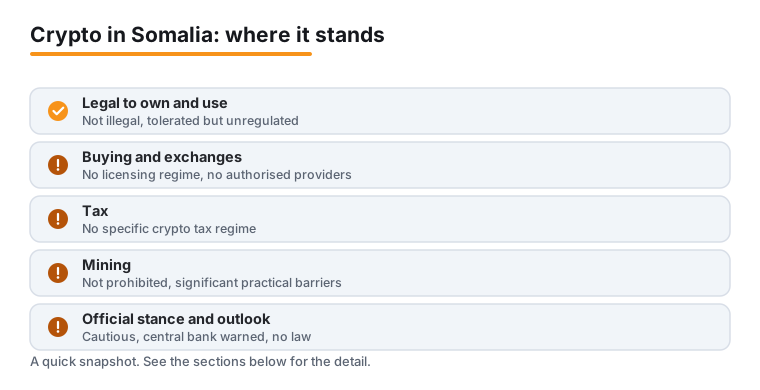
Bitcoin and other cryptocurrencies are not illegal to own or use in Somalia, but they are not recognised as legal tender. The only currency the state formally backs is the Somali shilling (SOS), although in everyday life the US dollar and dollar-denominated mobile money dominate transactions across much of the country.
There is no statute that specifically bans, taxes, or licenses crypto activity. At the same time, the Central Bank of Somalia has publicly cautioned the public against using virtual assets and stressed that there are no licensed institutions authorised to provide crypto services. In practical terms this means:
- Buying, holding, and transferring crypto between individuals is not prohibited.
- Crypto is not guaranteed, insured, or supervised by any Somali authority, so there is no formal consumer protection if a platform fails or funds are stolen.
- Using crypto for money laundering, terrorism financing, or sanctions evasion is illegal and can carry severe penalties under Somalia's anti-money-laundering and counter-terrorism-financing (AML/CFT) framework.
This tolerated-but-unregulated status is common across the Horn of Africa. It can change quickly, so anyone active in the market should watch for new guidance from the Central Bank. For broader context on how countries approach this, see our overview of crypto regulation.
The regulator: Central Bank of Somalia (CBS)
The lead authority on money and financial institutions in Somalia is the Central Bank of Somalia (CBS). It is responsible for monetary policy, issuing the Somali shilling, and licensing and supervising banks, remittance (money-transfer) businesses, mobile-money operators, microfinance institutions and takaful providers. Its official website is centralbank.gov.so, where it publishes its regulatory guidelines and licensing information.
The CBS has not created a crypto-specific licensing regime, and its website does not list any authorised virtual-asset service provider. Its main public intervention on the subject came in 2025, when it issued a warning advising the public to avoid trading virtual assets such as Bitcoin and stablecoins, on the grounds that they are not legal tender, are not backed by any guarantee, are highly volatile, lack licensed oversight in Somalia, and can be misused for criminal activity.
A second key body is the Financial Reporting Center (FRC), Somalia's financial intelligence unit, which receives suspicious-transaction reports and leads efforts against money laundering and terrorism financing. Its site is frc.gov.so. Note that the self-declared region of Somaliland operates its own central bank and rules, so requirements can differ there.
Key laws and frameworks
Somalia does not yet have a standalone digital-asset law. Instead, crypto sits against the backdrop of the laws that govern the formal financial sector, any of which could become the foundation for future crypto oversight:
- Central Bank of Somalia Act (Law No. 130 of 2012) re-established the central bank and gives it authority to license and supervise financial institutions and to oversee the national payment system.
- Anti-Money Laundering and Countering the Financing of Terrorism (AML/CFT) Act, 2016, administered through the Financial Reporting Center, sets reporting and compliance obligations for regulated entities. The text is published by the FRC at frc.gov.so/aml-cft-law.
- Mobile Money Regulations issued by the CBS brought the dominant mobile-money operators under formal supervision, the country's first major step in regulating digital finance.
- National Payment System reforms and an instant-payment switch have modernised how money moves between banks and mobile-money operators.
None of these specifically authorise or regulate crypto, but they show a regulator steadily building capacity. Because Somalia is a federal state, you should also be aware that the relationship between Federal Government and member-state authority over financial matters is still being worked out, which adds uncertainty for any new digital-asset rules.
Licensing and registration of exchanges and VASPs
There is currently no licensing or registration regime in Somalia specifically for crypto exchanges or virtual-asset service providers (VASPs). The Central Bank has not published an application process, a register of approved crypto firms, or a rulebook for the sector. In its 2025 warning it stated plainly that no licensed institution is authorised to provide virtual-asset services in the country.
As a result, most crypto activity happens through international platforms and peer-to-peer (P2P) trading rather than locally licensed venues. Some Somali banks and fintechs have nonetheless moved ahead of any explicit rules. Salaam Somali Bank added an in-app crypto-exchange feature in 2025 that lets customers buy and sell the stablecoin USDT (Tether), and it is listed as an accepted payment method for USDT trades on Binance's peer-to-peer marketplace. Fintech apps such as Taran App connect mobile-money balances to stablecoins and crypto wallets across Somalia and other Horn of Africa markets. Because these services operate without a dedicated legal framework, users should treat their legal treatment as unsettled, since it could be clarified, licensed, or restricted in future. If you operate or use such a service, monitor CBS guidance closely and assume that any future VASP regime would require strict identity and AML compliance.
Crypto and Bitcoin tax in Somalia
Somalia does not currently publish a specific tax regime for cryptocurrency. There is no widely confirmed crypto capital-gains tax, crypto VAT, or dedicated reporting form, largely because the asset class sits outside the formal legal framework and the country's general tax administration is still being rebuilt after decades of conflict.
The absence of clear rules is not the same as a guarantee that crypto is tax-free. General tax obligations, for example on business income or profits, can still apply depending on how authorities interpret your activity, and rules can differ between the Federal Government and the federal member states. Because nothing is settled, do not rely on any specific rate or threshold you may see quoted online.
Practical guidance:
- Keep clear records of your crypto purchases, sales, and transfers in case reporting is ever required.
- Do not assume gains are exempt; treat your tax position as uncertain until confirmed.
- Consult a qualified Somali tax professional or the relevant revenue authority for your situation.
This section is general information, not tax advice. For how crypto is taxed elsewhere, see our guide to crypto taxes.
AML, KYC and financial-crime rules
The clearest legal obligations touching crypto in Somalia come through the anti-money-laundering and counter-terrorism-financing (AML/CFT) framework rather than any crypto-specific statute. The AML/CFT Act of 2016 and the Financial Reporting Center (FRC), the country's financial intelligence unit, require regulated institutions to identify their customers (KYC), monitor transactions, and report suspicious activity.
For crypto users this has several practical effects:
- Reputable international exchanges and P2P platforms will almost always require identity verification before you can trade, partly to meet global AML/CFT standards.
- Banks and mobile-money operators that touch crypto-related funds are themselves subject to AML/CFT obligations, so large or unusual flows can attract scrutiny.
- Using crypto to launder money or finance terrorism is a serious criminal offence; keep your transactions transparent and well documented.
Somalia has faced real challenges in building out AML/CFT capacity, including limited formal identity documentation across the population, which has historically made full KYC difficult. The direction of travel, supported by the FRC and international partners, is toward stronger compliance over time.
Buying and using crypto in practice
Because there is no local licensing framework, most Somalis access crypto through international platforms and P2P trading rather than locally regulated venues. Common routes include:
- Global exchanges and P2P marketplaces, with trades often settled through mobile money or bank transfer in Somali shillings or US dollars.
- Bank and fintech apps, where Salaam Somali Bank has launched an in-app feature to buy and sell the stablecoin USDT, and apps such as Taran App bridge mobile-money balances to stablecoins and crypto wallets.
- Mobile money as the on-ramp. Services such as Hormuud's EVC Plus are near-universal and effectively dollarised, making them the most common way people fund a crypto purchase.
Practical points to keep in mind:
- There is no Somali deposit guarantee or formal complaints process if a platform fails or freezes funds, so favour reputable, well-established services.
- Expect identity verification (KYC) on most international platforms.
- P2P trades carry counterparty risk; use escrow features and verified traders, and never release funds before confirming receipt.
- There are no widely confirmed, publicly operating Bitcoin ATMs in Somalia, so the practical equivalent is a mobile-money-to-crypto on-ramp rather than a physical kiosk.
Sending remittances with crypto
Remittances are central to Somalia's economy, with diaspora transfers a major source of household income, and this is where crypto's appeal is strongest. Traditional international transfers can be slow and costly, and Somali money-transfer businesses have at times struggled to maintain correspondent-banking relationships. Bitcoin and, increasingly, dollar-pegged stablecoins such as USDT are used by some senders to move value quickly and at lower cost.
In practice a sender abroad buys crypto, transfers it to a recipient or a local intermediary, and the recipient converts it into cash or a mobile-money balance for everyday spending. Stablecoins are often preferred over Bitcoin here because they avoid Bitcoin's price swings during the transfer.
Benefits and trade-offs to weigh:
- Potential upsides: faster settlement, possibly lower fees, and access for people underserved by traditional banking.
- Risks: price volatility for non-stablecoins, exchange-rate and conversion costs at the last mile, internet-access requirements, and no formal recourse if something goes wrong.
- Compliance: large or unusual flows can attract AML/CFT scrutiny, so keep transfers transparent and well documented.
For most families, established mobile-money and money-transfer channels remain the default, with crypto acting as a complementary option rather than a wholesale replacement.
Bitcoin mining in Somalia
Bitcoin mining is not specifically prohibited in Somalia, but it is also not a meaningful industry there, and the practical barriers are significant. Mining is electricity-intensive and needs a stable, low-cost power supply, reliable internet, and cooling, none of which are easy to guarantee across much of the country.
The main constraints include:
- Electricity: power in many areas is supplied by private operators at relatively high cost and with variable reliability, which undermines mining profitability.
- Connectivity: broadband access is uneven outside major cities.
- Hardware import and security: sourcing and protecting specialised mining equipment is challenging.
There is no published mining-specific tax or licensing rule to comply with at present. For the vast majority of Somalis interested in crypto, buying or earning it is far more practical than mining it.
Recent developments (2025 to 2026)
The most notable regulatory event was the Central Bank of Somalia's 2025 public warning against virtual assets, reported in May 2025, which reaffirmed that crypto is not legal tender, is not backed by any guarantee, and is not offered by any licensed institution in Somalia. At the same time, the market has continued to develop ahead of formal rules:
- Salaam Somali Bank added an in-app crypto-exchange feature in 2025 that lets customers buy and sell the stablecoin USDT, becoming the first Somali bank to offer such a service.
- Fintech apps such as Taran App have expanded services that link mobile-money balances to stablecoins; in January 2026 Taran App reported receiving a grant from Base, the Ethereum layer-2 network backed by Coinbase, to support mobile-money to stablecoin transfers across the Horn of Africa.
- Stablecoin-based remittances have drawn growing attention as a faster, cheaper channel for diaspora transfers.
- The CBS has continued to modernise the formal financial sector through payment-system reform and the supervision of mobile-money operators, building the institutional capacity any future crypto framework would require.
Taken together, the trajectory points toward gradual formalisation rather than outright prohibition, but as of 2026 no dedicated crypto law or VASP licensing regime has been enacted. Because this is an evolving area, always confirm the latest position with the Central Bank before relying on it.
Consumer risks and protection
The defining feature of crypto in Somalia is the absence of a clear legal framework. That brings both freedom and exposure. Individuals can use crypto without navigating a licensing regime, but there is no supervision, no deposit protection, and no formal recourse when things go wrong.
Key risks to keep in mind:
- No regulatory protection: because crypto is unregulated, there is no Somali authority to turn to if a platform collapses, funds are stolen, or you are defrauded.
- Fraud and scams: unregulated markets attract bad actors, so be sceptical of guaranteed returns and unsolicited offers; losses are typically unrecoverable.
- Volatility and conversion costs: values can swing sharply, and cashing out depends on local liquidity.
- AML/CFT exposure: misuse of crypto for illicit purposes is a serious offence.
Because there is no local consumer-protection backstop, your own habits are your main line of defence: use reputable services, complete identity verification, enable two-factor authentication, beware of phishing, double-check wallet addresses, and only commit funds you can afford to lose. This is general information only and not financial advice.
Official sources and how to verify
Because Somalia's crypto position is unsettled and could change, always check primary sources rather than relying on summaries. The most authoritative places to verify the current rules are:
- Central Bank of Somalia (centralbank.gov.so) for monetary policy, licensing, supervision, and any public notices or regulatory guidelines on virtual assets.
- Financial Reporting Center (frc.gov.so), Somalia's financial intelligence unit, for AML/CFT obligations and the text of the AML/CFT Act 2016 at frc.gov.so/aml-cft-law.
For broader context, compare other jurisdictions through our country regulation hub and our explainer on how crypto regulation works. This page is general information as of 2026 and is not legal advice; for your specific situation, verify the current position with the Central Bank of Somalia or a qualified local professional before acting.
Frequently asked questions
Is cryptocurrency legal in Somalia?
Owning and using cryptocurrency is not illegal in Somalia, but it is not legal tender and is not regulated. The Central Bank of Somalia issued a public warning in 2025 that virtual assets such as Bitcoin and stablecoins carry serious risks and that no licensed institution is authorised to deal in them. Using crypto for money laundering or terrorism financing is a criminal offence. This is general information as of 2026, not legal advice; verify with the Central Bank of Somalia.
Who regulates crypto in Somalia?
There is no dedicated crypto regulator. The Central Bank of Somalia (centralbank.gov.so) is the monetary authority and financial-institution supervisor, and it has warned the public against virtual assets without creating a licensing regime for them. The Financial Reporting Center (frc.gov.so) is the financial intelligence unit responsible for anti-money-laundering enforcement. Somaliland operates its own central bank and rules.
Are crypto exchanges licensed in Somalia?
No. Somalia has no licensing or registration regime for crypto exchanges or virtual-asset service providers, and the Central Bank has stated that no licensed institution is authorised to provide such services. Most activity therefore happens through international exchanges and peer-to-peer trading, with some Somali banks and apps offering stablecoin features ahead of any formal rules. Treat the legal treatment as unsettled.
Does Somalia tax crypto gains?
Somalia does not publish a specific crypto tax regime, so there is no widely confirmed crypto capital-gains tax or dedicated reporting requirement. That does not guarantee crypto is tax-free, since general tax rules may apply depending on your activity and may differ between the Federal Government and member states. Keep records and consult a qualified Somali tax professional. This is not tax advice.
Can I send remittances to Somalia using Bitcoin or stablecoins?
Some senders use Bitcoin or dollar-pegged stablecoins such as USDT to transfer value to Somalia, often converting to cash or mobile money at the receiving end. Stablecoins are popular because they avoid price swings. Weigh conversion costs, internet requirements, AML/CFT scrutiny on large flows, and the lack of formal recourse, and keep transfers transparent and documented.
What are the main rules crypto users must follow in Somalia?
The clearest obligations come through the AML/CFT Act 2016, enforced via the Financial Reporting Center: regulated firms must verify customer identity (KYC) and report suspicious activity, so most platforms require ID verification. Crypto is not legal tender, has no consumer protection, and must not be used for money laundering or terrorism financing. Always confirm the current position with the Central Bank of Somalia.
Can I buy USDT or crypto through a Somali bank?
Salaam Somali Bank added an in-app crypto-exchange feature in 2025 that lets its customers buy and sell the stablecoin USDT (Tether), and it is listed as an accepted payment method for USDT trades on Binance's peer-to-peer marketplace. This happened ahead of any dedicated crypto law, and the Central Bank of Somalia has not licensed a virtual-asset service provider, so treat the legal treatment as unsettled. This is general information as of 2026, not financial advice.
How do Somalis usually buy crypto?
Because there is no local licensing framework, most people use international exchanges and peer-to-peer marketplaces, funding trades through mobile money such as Hormuud's EVC Plus or through bank transfer in shillings or US dollars. Some use Salaam Somali Bank's in-app USDT feature, or fintech apps such as Taran App that convert mobile-money balances to stablecoins. Expect identity verification on most platforms, and remember there is no Somali deposit guarantee if a service fails.
Facts reviewed: 30 June 2026. Page updated: 3 August 2026.