Home › Crypto Regulation › Mozambique
Bitcoin & Cryptocurrency Regulation in Mozambique
Quick answer — Mozambique, 2026
- Legal: Legal to own and trade, not legal tender; service providers must register
- Tax: No crypto-specific tax; general income tax rules may apply
- Buying: Via international exchanges, P2P and mobile money
Mozambique has moved from a regulatory vacuum toward a defined framework for businesses that handle crypto. As of 2026, there is still no law that recognises Bitcoin as money or that bans private individuals from buying, holding or trading it. However, since late 2023 the central bank, the Banco de Moçambique, has required any company that provides virtual-asset services to register before operating. This makes Mozambique one of the African jurisdictions that regulate crypto service providers under anti-money-laundering rules, even though it has not adopted a comprehensive standalone digital-asset code.
The metical (MZN), issued by the Banco de Moçambique, remains the only legal tender. Cryptocurrency is treated as a virtual asset, not as currency. For ordinary users, crypto activity still largely happens through peer-to-peer (P2P) trading, international exchanges and mobile-money rails. This guide explains the legal status, the regulator, the licensing rules for exchanges and other providers, how tax and anti-money-laundering obligations apply, and the practical risks of using crypto in Mozambique.
This is general information current as of 2026 and is not legal, tax or financial advice. Rules and enforcement change; always confirm your situation with the Banco de Moçambique, the Autoridade Tributária (tax authority) and a qualified local professional before acting. See also our broader crypto regulation guide.
On this page: Legal status · Who regulates it · Taxes · How to buy · Mining
Is Bitcoin and crypto legal in Mozambique?
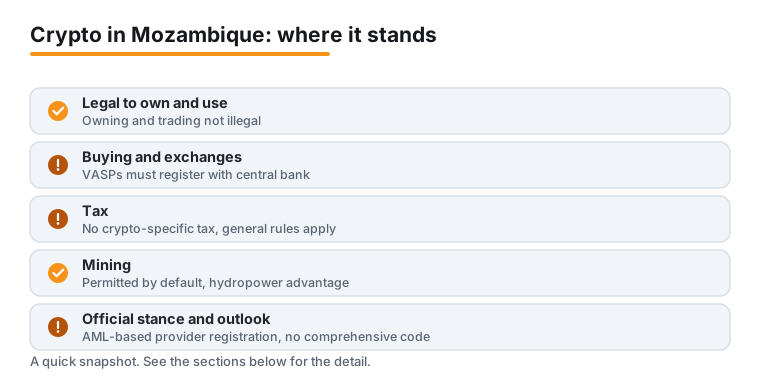
Owning and trading Bitcoin in Mozambique is not illegal for individuals. No statute criminalises buying, holding or selling cryptocurrency, and no law forces anyone to accept it. Two points are essential:
- Crypto is not legal tender. Only the metical (MZN), issued by the Banco de Moçambique, is legal currency. The central bank stated as far back as January 2018 that virtual currency such as Bitcoin has no legal standing and is not issued by the national monetary authority, so no merchant or institution is obliged to accept it.
- Businesses that provide crypto services ARE regulated. Since November 2023, any entity offering virtual-asset services in or into Mozambique must first register with the Banco de Moçambique. This is a genuine licensing-style requirement, not a grey area, and operating without it is an offence.
So the position is two-tier: personal use and ownership are permitted and unbanned, while commercial service provision is now subject to mandatory registration and anti-money-laundering oversight.
Who regulates crypto in Mozambique?
The lead authority is the Banco de Moçambique (the central bank). Under the anti-money-laundering framework it is responsible for regulating virtual-asset activity and for registering virtual-asset service providers (VASPs). Other bodies play supporting roles:
| Authority | Role relevant to crypto |
|---|---|
| Banco de Moçambique (central bank) | Issues the metical, oversees payments and foreign exchange, and registers and supervises virtual-asset service providers. It has repeatedly warned the public about crypto risks and fraud. |
| GIFiM (Gabinete de Informação Financeira de Moçambique) | The national financial intelligence unit that receives suspicious-transaction reports and coordinates anti-money-laundering and counter-terrorist-financing efforts. |
| Autoridade Tributária de Moçambique (tax authority) | Administers personal and corporate income tax that can apply to crypto gains and crypto-related business income. |
You can verify the central bank's role on the Banco de Moçambique AML/CFT supervision page and the financial intelligence unit at the GIFiM website.
Key laws and frameworks
Mozambique regulates crypto through its anti-money-laundering regime rather than through a dedicated crypto code. The main instruments are:
- Law 14/2023, of 28 August: the law on the prevention and combating of money laundering, terrorist financing and the financing of proliferation. It gives the Banco de Moçambique the mandate to regulate virtual-asset activity and to set the requirements for service providers.
- Aviso n.º 4/GBM/2023, of 14 September: the central-bank notice that approves the legal framework for registering virtual-asset service providers. It entered into force on 14 November 2023.
- Supporting regulations: including decrees and further central-bank notices that implement the anti-money-laundering law and define duties for reporting entities.
Mozambique is not in the European Union, so the EU's Markets in Crypto-Assets (MiCA) Regulation does not apply here. Its framework instead reflects the global standards of the Financial Action Task Force (FATF) and the regional body ESAAMLG. This area moved in 2026: Lei n.º 15/2026, de 2 de Julho replaced the payments regime that had run since 2008 and entered into force in August 2026, so treat any summary as a snapshot and confirm the current text of each instrument with the central bank.
Licensing and registration of exchanges and VASPs
This is the area where Mozambique has the clearest rules. Under Aviso n.º 4/GBM/2023, virtual-asset service providers must register with the Banco de Moçambique before operating. The framework covers entities that, alone or alongside other activities, carry out one or more of the following:
- Exchanging virtual assets for fiat currency or for other virtual assets;
- Transferring virtual assets;
- Custody or administration of virtual assets, or of instruments that allow control over them;
- Providing financial services connected to the offer or sale of a virtual asset;
- Any other activity involving virtual assets defined by the central bank.
Key features reported for the regime include:
- Foreign providers are also caught. A foreign VASP whose services can be subscribed to or accessed by people resident in Mozambique, or that has staff or management located there, is subject to prior authorisation from the central bank.
- Time limit to start. A registered provider must begin its activity within a set period after the favourable decision, or the registration can lapse.
- Penalties for non-compliance. Operating without the required registration is treated as an offence subject to fines. Under Law 14/2023, breaches are punishable by fines of 2,000,000 to 10,000,000 MZN for legal entities and 600,000 to 6,000,000 MZN for individuals. Published figures differ and none quote the statutory provision directly: JLA Advogados puts the fines for carrying on virtual-asset activities without registration at 2,000,000 to 10,000,000 meticais for legal entities and 600,000 to 6,000,000 meticais for individuals, with accessory measures available on top, while another Mozambican advisory gives a single range of 300,000 to 10,000,000 meticais. Confirm the current amounts and procedure directly with the central bank, as figures and rules can be updated.
If you are a business, check the official notice and the central bank's Normativos (regulations) archive before launching any crypto service, and seek local legal advice.
Crypto taxation in Mozambique
Mozambique has no crypto-specific tax law, but that does not mean crypto is tax-free. General tax principles apply, so gains and income connected to virtual assets can be taxable:
- Individuals may be taxed under Personal Income Tax (IRPS) where crypto activity amounts to a business or professional activity generating profit.
- Companies are subject to Corporate Income Tax (IRPC) on gains from crypto transactions, including exchanging crypto for fiat, for other crypto, or for goods and services.
- Mining, staking and similar activities are generally treated as economic activities producing taxable income under the same general rules, with no special crypto regime.
The wider tax code changed at the start of 2026. A package of laws all dated 29 December 2025 took effect on 1 January 2026 and brought digital goods and services into scope: Law 10/2025 amended the VAT code, Law 12/2025 amended the Corporate Income Tax code (IRPC), and Law 11/2025 amended the Personal Income Tax code (IRPS). Concrete provisions now in force include a 16% standard VAT on digital goods and services supplied to consumers in Mozambique, including by non-resident suppliers with no permanent establishment; a 10% withholding tax on income of non-residents from the transfer of digital goods or the provision of digital services; and autonomous taxation of corporate capital gains at 32%. The statute defines “digital goods” broadly as intangibles delivered or represented electronically that can be owned, transferred, licensed or controlled by digital means, a definition wide enough that it may capture virtual assets. The rules bite where the acquirer is domiciled or established in Mozambique regardless of where the supplier sits, and for a non-resident supplier the Mozambican acquirer accounts for the 16% VAT by self-assessment, or auto-liquidação. No published guidance applies this to crypto trading or exchange fees, so the point stays untested. Implementing regulations are still expected, and no source publishes a deadline for them: EY describes the withholding treatment of digital service supplies only as a matter expected to be regulated, and no implementing regulation covering digital goods and services could be found as of early August 2026. Because the position is unsettled and fact-specific, confirm your obligations with the Autoridade Tributária de Moçambique and a qualified tax adviser. For background, see our crypto taxes guide.
AML and KYC rules
Crypto in Mozambique sits squarely inside the anti-money-laundering (AML) and counter-terrorist-financing (CFT) framework established by Law 14/2023. Under this regime:
- Registered VASPs are reporting entities. Like banks and other financial institutions, they are expected to apply customer due diligence, identify and verify clients (KYC), keep records, and report suspicious transactions.
- GIFiM is the reporting hub. Suspicious-transaction reports and certain asset-freeze actions flow to the Gabinete de Informação Financeira de Moçambique, the financial intelligence unit.
- Banks scrutinise crypto flows. Even outside dedicated crypto firms, regulated banks apply AML controls, so transfers linked to exchanges may be questioned, delayed or limited.
For ordinary users, the practical effect is that any reputable platform you use will require identity verification, and large or unusual crypto-related bank movements may attract compliance checks. The framework is designed to align with FATF standards on virtual assets and VASPs.
Buying and using crypto in practice
For individuals, there is no ban on buying crypto, and no domestic retail platform is singled out for approval. Most users rely on:
- International exchanges that accept Mozambican users, subject to each platform's own KYC onboarding.
- Peer-to-peer (P2P) marketplaces, where buyers and sellers trade directly, often settling in metical via bank transfer or mobile money.
- Mobile-money rails, widely used in Mozambique, which frequently act as the on/off-ramp between local currency and crypto.
Practical points to keep in mind:
- Use registered or reputable providers. A provider serving Mozambican residents should be registered with or authorised by the central bank; an unregistered local operator may be acting unlawfully.
- Banking access can be inconsistent. Some banks flag or restrict crypto-linked transfers, so expect occasional friction at the fiat on/off-ramp.
- Foreign-exchange rules matter. Mozambique maintains currency controls, so moving value across borders to fund or cash out of crypto can engage those rules. Check current requirements before transacting at scale.
- Keep records. Save transaction details for your own accounting and any tax obligations.
Mining and energy
There is no law that specifically prohibits cryptocurrency mining in Mozambique, and none that grants it a special licence or incentive. Mining is therefore permitted by default but falls under general business, electricity, import and environmental rules rather than a tailored framework.
The country's distinctive factor is energy. Mozambique is a significant hydropower producer and exports electricity regionally, which in theory makes lower-cost, lower-carbon power attractive for energy-intensive mining. Caveats apply:
- Electricity access and reliability vary, and grid capacity is prioritised for domestic supply and exports.
- No dedicated mining policy exists, so tariffs, permits, equipment-import duties and environmental obligations are governed by general regulations.
- If mining is run as a business, income is taxable under the general corporate or personal income tax rules, and a commercial crypto-mining operation that also provides virtual-asset services could trigger the VASP registration requirement.
Anyone planning a commercial operation should clarify electricity terms, business registration, import rules and any registration duties with the relevant authorities and a local adviser before committing capital.
Recent developments
The most important recent change is the shift from warnings to actual regulation of providers:
- 2018: The Banco de Moçambique issued a public alert that Bitcoin has no legal standing, is not supervised by the central bank, and exposes users to fraud and money-laundering risks.
- 2023: Law 14/2023 modernised the anti-money-laundering regime and brought virtual assets within scope. The central bank then issued Aviso n.º 4/GBM/2023, creating a mandatory registration framework for virtual-asset service providers that took effect on 14 November 2023.
- 2025: The Banco de Moçambique rolled out the National Financial Inclusion Strategy 2025-2031 (ENIF) in August 2025, a plan built around inclusive digitalisation, consumer protection and responsible use of digital financial services. Later in 2025 the central bank opened the 7th edition of its Regulatory Sandbox, with applications due by 31 October 2025 and a participation period of about nine months starting in February 2026. The sandbox is a general fintech initiative aimed at expanding financial access, not a crypto-specific programme, but it is the channel through which the central bank tests new digital-finance solutions.
- 2026: Tax reforms enacted in late 2025 took effect on 1 January 2026: Law 10/2025 (VAT), Law 12/2025 (corporate income tax, IRPC) and Law 11/2025 (personal income tax, IRPS). They brought digital goods and services into the tax base, with a 16% VAT on digital supplies to consumers (including by non-resident providers), a 10% withholding tax on non-residents' digital-service income, and 32% autonomous taxation of corporate capital gains. The broad statutory definition of “digital goods” may capture virtual assets, so crypto-related digital-service income could fall in scope, though application to crypto is untested and implementing regulations are still pending.
Mozambique has not adopted a single comprehensive crypto law, and further guidance may follow. Watch the central bank's Normativos archive for new notices, and confirm any major decision against primary sources.
Financial inclusion and the fintech sandbox
Crypto sits within a wider push to expand digital finance in Mozambique. In August 2025 the Banco de Moçambique rolled out the National Financial Inclusion Strategy 2025-2031 (ENIF), which is organised around inclusive digitalisation, consumer protection, and responsible use and quality of financial services. Mobile money is central to this effort and is the main way many people move value, which also makes it the common on/off-ramp for crypto.
To test new digital-finance products under supervision, the central bank runs a Regulatory Sandbox. It opened the 7th edition in 2025, with applications due by 31 October 2025 and a participation period of about nine months starting in February 2026. The sandbox invites credit institutions, payment providers, fintechs and startups to trial innovative solutions in a controlled setting. Two points matter for crypto users:
- The sandbox is a general financial-inclusion initiative, not a crypto licensing route. Taking part in it does not by itself authorise a firm to provide virtual-asset services; that still requires registration under Aviso n.º 4/GBM/2023.
- It signals that the central bank is actively working on digital-finance rules, so further guidance affecting crypto-adjacent services could follow. Confirm any current programme details on the central bank's website.
You can read about the initiative on the Banco de Moçambique Regulatory Sandbox page.
Consumer risks and protection
Even with provider registration, crypto in Mozambique carries significant risk for users:
- No dedicated investor-protection scheme. Registration is mainly an anti-money-laundering and supervisory measure; it does not guarantee compensation if a platform fails or you are defrauded.
- Fraud and scams. The central bank has repeatedly warned about fake investment platforms and “guaranteed return” schemes, which have caused real losses. Treat unsolicited offers and impersonators with extreme caution.
- Volatility and self-custody errors. Crypto prices can move sharply, and holding assets yourself means full responsibility for your keys; lost keys or scams mean lost funds.
- Banking and FX friction. Converting between crypto and metical can be inconsistent and intersects with currency controls.
- Unregistered operators. A local provider that is not registered with the central bank may be operating illegally and offers no reliable recourse.
Protect yourself by using registered or well-established platforms, enabling strong security and two-factor authentication, keeping recovery phrases offline, and never investing more than you can afford to lose. This is not financial advice.
Official sources and how to verify
Because crypto rules in Mozambique are evolving, always confirm the current position with primary sources rather than third-party summaries. The most authoritative references are:
- Banco de Moçambique - AML/CFT supervision, which sets out the central bank's role over virtual-asset service providers and the relevant laws and notices.
- Banco de Moçambique - Normativos (regulations archive), where official notices such as Aviso n.º 4/GBM/2023 are published.
- GIFiM - Gabinete de Informação Financeira de Moçambique, the financial intelligence unit responsible for AML/CFT.
- Autoridade Tributária de Moçambique, for tax questions.
This guide is general information current as of 2026 and is not legal advice; readers should verify their specific situation with the Banco de Moçambique and a qualified local professional. For more, see our country regulation hub.
August 2026 status: the new payments law is now in force
The material change since this page was last reviewed is a payments law, not a crypto law. Lei n.º 15/2026, de 2 de Julho replaces the National Payments System regime that had been in place since 2008 and entered into force in August 2026, thirty days after publication.
- Blockchain gets legal standing, but only for securities accounts. The law recognises distributed ledger technology such as blockchain and allows securities accounts to be opened, maintained and settled through those platforms, with prior authorisation from the Banco de Moçambique (Forbes África Lusófona, Lusa). This is a securities settlement provision. It is not a general authorisation to run crypto payments.
- The central bank is named as the payments system authority, with power to license operators, regulate, inspect and supervise every component of the sector, and to create and regulate safe testing environments for innovation and financial inclusion, which puts the regulatory sandbox on a statutory footing.
- A new coordination body is created, the Comité de Coordenação do Sistema Nacional de Pagamentos (CCSNP), bringing together government, the central bank, operators, payment service providers, commercial banks and technology and communications entities.
- Operators have 180 days to adapt. The law sets a transitional period of 180 days for payment operators and participants to bring their systems into line.
- It does not license crypto. No published account of Law 15/2026 refers to criptoativos, activos virtuais or stablecoins. Virtual-asset service providers still register with the Banco de Moçambique under Law 14/2023 and Aviso n.º 4/GBM/2023, and no crypto-asset has been made legal tender or an approved means of payment.
The legislative trail is traceable. The Assembleia da República approved the bill by consensus and in general terms on 14 April 2026, President Daniel Chapo promulgated it on 13 June 2026, and it was published as Lei n.º 15/2026 on 2 July 2026. The drafting takes the SADC model payments legislation and IMF guidance as its reference points.
A second 2026 instrument matters for anyone moving money to buy crypto: Aviso n.º 1/GBM/2026, de 25 de Fevereiro created Mozambique's instant payment system, in force since 2 March 2026. Its participants are SIMO, credit institutions, payment service provider companies and other entities the central bank authorises. Crypto firms are not named participants.
Legislative pipeline: what is binding and what is missing
What is on the books, what is expected but not published, and where the dates come from.
| Instrument | Stage in August 2026 | What it means in practice | Timing |
|---|---|---|---|
| Lei n.º 15/2026, de 2 de Julho (National Payments System) | In force | Banco de Moçambique licenses and supervises payment operators; DLT recognised for opening, maintaining and settling securities accounts with prior authorisation; statutory sandbox; CCSNP created; no crypto licence | In force from August 2026; 180-day transition for operators and participants |
| Aviso n.º 1/GBM/2026, de 25 de Fevereiro (instant payments) | In force | Immediate availability of funds to the beneficiary across banks, payment providers and SIMO | In force since 2 March 2026 |
| Commission Delegated Regulation (EU) 2026/83 | In force | Removes Mozambique from the EU high-risk third country list, so EU banks and crypto firms no longer apply enhanced due diligence purely on nationality | Adopted 4 December 2025, published 9 January 2026, in force 29 January 2026 |
| Regulations on VAT for non-resident digital supplies | Expected, not published | Would settle how non-resident digital supplies are self-assessed and whether crypto trading and exchange fees sit inside the 16% VAT base | No timetable is stated in any published source located; EY describes it only as a matter expected to be regulated |
| AML sustainability strategy 2026 to 2030 | Approved by cabinet, reported 8 May 2026 | Five pillars including risk-based supervision of obligated entities and beneficial ownership transparency | Runs to 2030; steps taken since grey list exit must be demonstrated from September 2027 |
| A dedicated crypto or virtual-asset statute | Not tabled | Would be the first law to define crypto-assets, set conduct and custody rules, or create an exchange licence beyond AML registration | No bill before the Assembleia da República could be identified as of August 2026 |
On direction of travel rather than draft text: at an international roundtable in Dakar on 8 May 2026, Banco de Moçambique governor Rogério Zandamela said African monetary authorities arrived very late to crypto regulation, driven by international pressure rather than strategic foresight, and that his institution initially lacked the technical knowledge and resources to deal with digital assets (O Democrata). He announced no instrument and gave no timetable, so read this as supervisory intent, not a pipeline item.
Mozambique's AML standing after the grey list exit
This changes the practical experience of moving money in and out of Mozambique, and the page did not previously cover it.
- FATF removed Mozambique from the grey list at its October 2025 plenary, held in Paris from 22 to 24 October 2025, alongside Burkina Faso, Nigeria and South Africa. Mozambique had been listed since October 2022, and its action plan targeted international cooperation, use of financial intelligence, and the investigation, prosecution and sanctioning of money laundering offences (Basel Institute on Governance). Finance Minister Carla Loveira said the decision improves the country's image in domestic and international financial circles, and that the measures should become part of long-term governance practices rather than actions taken only to exit the list (Xinhua).
- The European Union followed. Commission Delegated Regulation (EU) 2026/83 of 4 December 2025 removed Burkina Faso, Mali, Mozambique, Nigeria, South Africa and Tanzania from the EU list of high-risk third countries, and added Bolivia and the British Virgin Islands. It was published in the Official Journal on 9 January 2026 and entered into force on the twentieth day following publication, that is 29 January 2026. The Commission's announcement of 4 December 2025 confirms the delisting.
- What it means for you. EU-regulated banks and crypto firms must apply enhanced due diligence to transactions involving listed countries. With Mozambique off the list, that automatic trigger is gone. Standard identity verification, source of funds checks and transaction monitoring still apply in full, and a platform can always apply stricter checks of its own.
- Domestic pressure has not eased. In May 2026 the cabinet approved a sustainability strategy for the AML and counter-terrorist-financing system covering 2026 to 2030, built around institutional coordination, risk-based supervision of obligated entities, beneficial ownership transparency, and strengthened investigation and asset recovery. Mozambique must begin demonstrating the steps it has taken since leaving the grey list by September 2027 (Lusa).
What the 2026 tax laws add beyond the headline rates
The rates are already covered above. These are the mechanics that decide who actually has to pay, all from the package dated 29 December 2025 and effective 1 January 2026 (KPMG).
- VAT bites on the buyer's location, not the seller's. Under Lei n.º 10/2025, digital goods and services are taxable in Mozambique whenever the acquirer is domiciled or established in the national territory, regardless of where the supplier is resident. Where the supplier is non-resident, the assessment, declaration and payment obligations shift to the Mozambican acquirer through self-assessment, or auto-liquidação. The named categories include software, applications and digital platforms, cloud computing, media, streaming and digital content, and digital financial services (RSM Moçambique).
- Tax residency no longer depends on a day count. Lei n.º 11/2025 removes physical presence of more than 180 days as a criterion for determining residency (DLA Piper Africa).
- Individual capital gains are progressive. The brackets run 10% up to 42,000 MZN, 15% to 168,000 MZN, 20% to 504,000 MZN, 25% to 1,512,000 MZN, and 32% above that. With no crypto-specific rule, an individual's disposal gain falls to be assessed on this scale.
- The 10% withholding also catches e-money agents. The same 10% final withholding that applies to non-residents' digital service income applies to commissions earned by electronic money agents.
- Refunds changed too. Decreto n.º 52/2025, de 29 de Dezembro replaced the old special VAT regime with a refund regime effective 29 January 2026, with tacit approval after 90 days and a normal refund period of 150 days.
- The default position for crypto. Because no specific legislation has been issued for the taxation of crypto-assets, general tax principles apply and a gain falls under corporate or personal income tax depending on who realises it, with losses from the last five years available for offset (CMS expert guide, last updated 12 June 2024, so it predates the 2026 package).
The open question is whether a crypto-asset or an exchange fee counts as a digital good or digital service for VAT. EY describes this as a matter expected to be regulated, without giving a date.
Frequently asked questions
Is cryptocurrency legal in Mozambique?
Yes, for individuals. There is no law banning the buying, holding or trading of crypto, but it is not legal tender; only the metical (MZN) is. Businesses are different: since November 2023, any virtual-asset service provider must register with the Banco de Moçambique before operating. This is general information as of 2026, not legal advice.
Who regulates crypto in Mozambique?
The Banco de Moçambique (central bank) is the lead regulator. Under Law 14/2023 and Aviso n.º 4/GBM/2023 it registers and supervises virtual-asset service providers. The financial intelligence unit GIFiM handles anti-money-laundering reporting, and the Autoridade Tributária handles tax. Verify on the central bank's official website.
Do crypto exchanges need a licence in Mozambique?
They must register. Under Aviso n.º 4/GBM/2023, in force since 14 November 2023, any entity providing virtual-asset services, including exchange, transfer, custody and related financial services, must register with the Banco de Moçambique before operating. Foreign providers serving Mozambican residents also need prior authorisation, and operating without registration is an offence subject to fines of 2,000,000 to 10,000,000 MZN for legal entities and 600,000 to 6,000,000 MZN for individuals under Law 14/2023.
Do I have to pay tax on crypto in Mozambique?
There is no crypto-specific tax, but general tax law applies, so crypto gains and crypto-related business income can be taxable under Personal Income Tax (IRPS) or Corporate Income Tax (IRPC). Reforms in force from 1 January 2026 (Law 10/2025 on VAT, Law 12/2025 on corporate income tax and Law 11/2025 on personal income tax) added a 16% VAT on digital goods and services, a 10% withholding tax on non-residents' digital-service income, and 32% autonomous taxation of corporate capital gains; the broad definition of “digital goods” may reach virtual assets, but application to crypto is untested. Confirm your obligations with the Autoridade Tributária and a tax professional.
Is Bitcoin mining allowed in Mozambique?
There is no law specifically prohibiting mining, so it is permitted by default, and the country's hydropower resources are sometimes cited as an advantage. There is no dedicated mining policy, so electricity, import and environmental rules fall under general regulations, mining income is taxable, and a mining business that also provides virtual-asset services may need to register as a VASP.
Is my crypto protected if a platform fails or I am scammed?
No. VASP registration is mainly an anti-money-laundering and supervisory measure, not a compensation guarantee. There is no dedicated investor-protection scheme for crypto, and the central bank has warned about fake investment platforms. Use registered or reputable providers, secure your own keys, and never invest more than you can afford to lose.
Is the metical (MZN) the only legal currency in Mozambique?
Yes. The metical, issued by the Banco de Moçambique, is the only legal tender. Cryptocurrency is treated as a virtual asset, not money, so no merchant or institution is obliged to accept it. The central bank stated as far back as 2018 that virtual currency such as Bitcoin has no legal standing and is not issued or supervised by the national monetary authority.
Does Mozambique have a crypto sandbox or a plan to legalise crypto?
Not specifically for crypto. The Banco de Moçambique runs a Regulatory Sandbox for fintech innovation, and it opened a 7th edition in 2025 (applications by 31 October 2025, running about nine months from February 2026) under the National Financial Inclusion Strategy 2025-2031. This is a general digital-finance initiative, not a crypto legalisation programme, and participation does not replace the mandatory VASP registration under Aviso n.º 4/GBM/2023. There is no announced plan to make crypto legal tender.
Did Mozambique pass a crypto law in 2026?
No. Mozambique passed a new payments law, not a crypto law. Lei n.º 15/2026, de 2 de Julho replaced the National Payments System regime in force since 2008 and took effect in August 2026. It gives distributed ledger technology such as blockchain legal recognition for opening, maintaining and settling securities accounts, subject to prior authorisation from the Banco de Moçambique, and it puts the regulatory sandbox on a statutory footing. It does not create a crypto exchange licence, does not define crypto-assets, and does not make any crypto-asset legal tender. No published account of the law mentions criptoativos or activos virtuais. Virtual-asset service providers still register under Law 14/2023 and Aviso n.º 4/GBM/2023.
What does Law 15/2026 mean for someone who just buys and holds crypto?
Directly, very little. It regulates payment operators and the infrastructure they run, not individuals. Its blockchain provision is confined to securities accounts, so it does not authorise crypto payments generally. What it does change is that the Banco de Moçambique now has explicit statutory power to license, inspect and supervise the whole payments sector, and can run regulatory sandboxes on a statutory basis. Buying, holding and selling crypto for your own account remains lawful and remains unregulated by any dedicated statute.
Is Mozambique still on the FATF grey list?
No. FATF removed Mozambique from its list of jurisdictions under increased monitoring at the plenary held in Paris from 22 to 24 October 2025, after three years on the list. The European Union followed with Commission Delegated Regulation (EU) 2026/83 of 4 December 2025, which removed Mozambique from the EU list of high-risk third countries; it was published in the Official Journal on 9 January 2026 and entered into force on 29 January 2026. In practice, EU banks and crypto firms no longer have to apply enhanced due diligence purely because a customer or counterparty is Mozambican. Mozambique must begin demonstrating the steps it has taken since the exit by September 2027.
When will Mozambique clarify the tax treatment of crypto?
There is no announced date, and no published source gives a deadline. The 2026 tax reform laws, all dated 29 December 2025 and effective 1 January 2026, brought digital goods and services into the 16% VAT base, and EY describes the treatment of digital service supplies as a matter expected to be regulated without stating when. No implementing regulation covering digital goods and services could be found as of early August 2026. Until one appears, whether a crypto-asset or an exchange fee counts as a digital good or digital service is unresolved, and gains fall under the general personal or corporate income tax rules by default.
How is a crypto gain taxed in Mozambique if there is no crypto tax law?
By the general rules. For a company, Lei n.º 12/2025 subjects capital gains to autonomous taxation at 32%. For an individual, Lei n.º 11/2025 taxes capital gains on a progressive scale: 10% up to 42,000 meticais, 15% to 168,000, 20% to 504,000, 25% to 1,512,000, and 32% above that. Lei n.º 11/2025 also removed the test of more than 180 days of physical presence for tax residency, so you can be treated as resident without meeting any day count. Losses from the last five years can generally be offset. None of this is crypto-specific, so confirm your position with the Autoridade Tributária and a qualified adviser.
What is the penalty for running a crypto exchange in Mozambique without registering?
Registration with the Banco de Moçambique under Aviso n.º 4/GBM/2023 has been mandatory since 14 November 2023, sixty days after its publication on 14 September 2023. Published figures for the fine differ and none quote the statutory text: JLA Advogados gives 2,000,000 to 10,000,000 meticais for legal entities and 600,000 to 6,000,000 meticais for individuals, with accessory measures on top, while another Mozambican advisory gives a single range of 300,000 to 10,000,000 meticais. Confirm current figures with the central bank before relying on them.
Facts reviewed: 3 August 2026. Page updated: 3 August 2026.