Home › Crypto Regulation › Seychelles
Bitcoin & Cryptocurrency Regulation in Seychelles
Quick answer — Seychelles, 2026
- Legal: Legal to own and trade, not legal tender, services need FSA licence
- Tax: No personal capital gains tax, business income can be taxed
- Buying: Via licensed exchanges after KYC, no ATM network
Seychelles is one of the most discussed offshore jurisdictions in the digital-asset world. Many global crypto exchanges and token projects are incorporated there, and in 2024 the country moved from a largely permissive stance to a formal licensing regime under the Virtual Asset Service Providers Act, 2024. This page explains the current legal status of Bitcoin and other cryptocurrencies in Seychelles, who regulates the sector, how tax generally works, and what residents, businesses, and visitors should know about buying, mining, and sending crypto. It reflects the position as of 2026 and is general information only, not legal, tax, or financial advice. Crypto rules in small jurisdictions change quickly, so always confirm the current position with the Seychelles Financial Services Authority (FSA) or a qualified local professional before acting. For wider context, see our guide to crypto regulation.
On this page: Legal status · Who regulates it · Taxes · How to buy · Mining
Is Bitcoin and crypto legal in Seychelles?
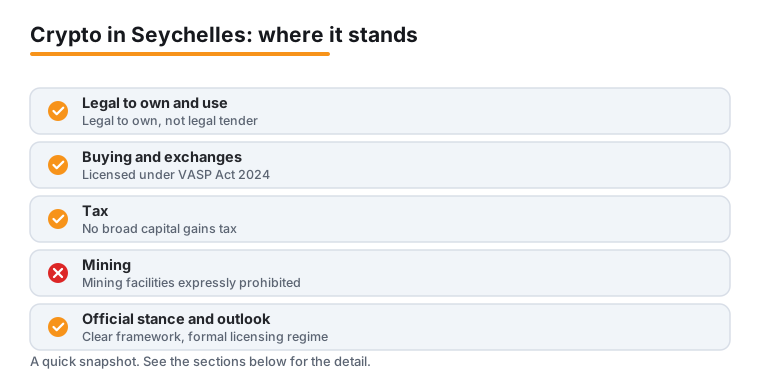
Yes. Owning, buying, selling, and trading Bitcoin and other cryptocurrencies is legal in Seychelles. There is no prohibition on individuals holding digital assets, and the country has actively positioned itself as a base for crypto businesses.
An important distinction applies, however: cryptocurrencies are not legal tender in Seychelles. The Seychellois rupee is the only official currency, and no business is obliged to accept Bitcoin as payment. The Central Bank of Seychelles has stated that virtual currencies are not legal tender and are not a payment instrument regulated by the central bank. Crypto is treated as a private digital asset rather than as money issued or backed by the state.
Since 2024, the more significant point is that providing crypto services, such as running an exchange, custodial wallet, brokerage, or virtual-asset investment business in or from Seychelles, now requires a licence from the FSA. Simply holding or personally using crypto does not, but operating a crypto business without authorisation is a criminal offence.
Who regulates crypto in Seychelles?
The main regulator for virtual-asset businesses is the Financial Services Authority (FSA) of Seychelles, the body that oversees the country's non-bank financial services sector. The FSA receives applications, issues licences, sets compliance codes and guidelines, and supervises and enforces the rules for virtual-asset firms operating in or from Seychelles. Its official website is fsaseychelles.sc, which publishes the VASP legal framework, application guidelines, and a public register of licensees.
A separate body, the Central Bank of Seychelles (CBS), is responsible for monetary policy, the rupee, and the regulation of banks and payment systems. The CBS does not license crypto businesses and has made clear that virtual currencies are not legal tender and are not a payment instrument it regulates. Anti-money-laundering supervision and the receipt of suspicious-transaction reports also involve the Financial Intelligence Unit. For broader background on how regulators approach digital assets, see our crypto regulation hub.
Key laws and frameworks
The central piece of legislation is the Virtual Asset Service Providers Act, 2024 (commonly called the VASP Act), which came into force on 1 September 2024. It introduced, for the first time in Seychelles, a dedicated framework requiring crypto businesses connected to the country to be licensed and supervised. Seychelles is not part of the European Union and is therefore not covered by the EU's MiCA regulation; its framework is purely domestic.
The Act is supported by a set of implementing regulations made in 2024, which the FSA lists in its legal framework, including:
- Virtual Asset Service Provider (Licensing and Ongoing Requirements) Regulations, 2024
- Virtual Asset Service Provider (Capital and other Financial Requirements) Regulations, 2024
- Virtual Asset Service Provider (Cyber Security Requirements) Regulations, 2024
- Virtual Asset Service Provider (Safekeeping and Management of Client's Assets) Regulations, 2024
- Virtual Asset Service Provider (Advertisements) Regulations, 2024
- Virtual Asset Service Provider (Registration of Initial Coin Offering and Non-Fungible Tokens) Regulations, 2024
Related amendments to the Anti-Money Laundering and Countering the Financing of Terrorism regulations were also made in 2024 to bring VASPs within the AML/CFT regime. The exact wording, fees, and conditions should always be checked against the official texts. The framework aligns with the Financial Action Task Force (FATF) Recommendation 15 on virtual assets.
Licensing and registration of exchanges and VASPs
Carrying on virtual-asset services in or from Seychelles is prohibited unless the person is licensed by the FSA. The Act sets out four broad categories of licensable activity:
- Virtual asset exchange services (trading platforms)
- Virtual asset wallet providers (custody of clients' keys or assets)
- Virtual asset broking
- Virtual asset investment providers (advisory or portfolio-type services)
Key features of the regime include:
- Eligibility. Only Seychelles companies, whether incorporated under the International Business Companies Act 2016 or the Companies Act 1972, may apply. Individuals (natural persons) are expressly ineligible to operate a VASP business.
- Local substance. Licensees must have a genuinely manned office in Seychelles, at least one resident director present in the country for 183 days or more in any 12-month period, and core decision-making, board, and management meetings held locally.
- Capital and fit-and-proper tests. Minimum paid-up capital is set by activity, reported by law firm summaries of the capital regulations as USD 100,000 for a virtual asset exchange, USD 75,000 for a wallet service provider, USD 50,000 for virtual asset broking and USD 25,000 for an investment provider, alongside background and fitness checks on directors and beneficial owners and a resident compliance officer. The FSA does not publish these thresholds in its VASP FAQs, referring applicants to Schedule 1 of the capital regulations instead.
- Record-keeping. Transaction and client records must be retained and accessible in Seychelles, with a minimum retention period reported at seven years.
Operating without a licence is a criminal offence; reported penalties include fines up to USD 350,000 and imprisonment of up to 15 years. ICO and NFT activities may face separate registration expectations. Always confirm the exact requirements in the FSA VASP legal framework.
Crypto and Bitcoin tax in Seychelles
Seychelles is widely regarded as a low-tax jurisdiction, and this extends to digital assets in several respects. For individuals, Seychelles does not generally levy a broad personal capital gains tax, and crypto transactions are not typically subject to value-added tax (VAT). In practice this means that, for many individuals, a gain from selling personally held Bitcoin is not taxed in the way it would be in higher-tax countries. Note that the line between a personal capital gain and a taxable trading or business activity is not always clearly defined, so caution is warranted.
The picture is more nuanced for businesses. Income genuinely sourced from a business carried on in Seychelles can fall within the country's business tax rules. Seychelles taxes on a territorial basis, so income sourced outside Seychelles is generally not taxed there, and Seychelles does not impose a separate capital gains tax. A Seychelles VASP must maintain an actual office in the country, a board of at least two directors with one resident in Seychelles, and qualified local staff handling client onboarding, complaint handling and management meetings in country. The Seychelles Revenue Commission publishes no concessionary business tax rate specific to virtual asset businesses; the flat 1.5 percent figure sometimes quoted is the presumptive tax rate that applies to small businesses with turnover below SCR 1 million, not a VASP concession. The published figures are these: companies pay business tax at 15 percent on the first SCR 1 million of taxable income and 25 percent above that, a small business with annual turnover below SCR 1 million pays presumptive tax at a flat 1.5 percent of turnover instead, and VAT is 15 percent with mandatory registration at SCR 2 million of taxable supplies.
Anyone with meaningful holdings or a crypto business should confirm their position with the Seychelles Revenue Commission or a qualified local adviser, and should also consider obligations in any other country where they are resident or a citizen. For general principles, see our guide to crypto taxes. This is not tax advice.
AML, KYC, and the travel rule
Anti-money-laundering and counter-terrorist-financing (AML/CFT) compliance is at the heart of the Seychelles VASP regime. Licensed providers are brought within the country's AML/CFT laws, which were amended in 2024 to cover virtual assets in line with FATF standards. In practice, a licensed VASP must:
- Verify customer identity (KYC) and carry out customer due diligence before providing services
- Appoint a resident compliance officer and maintain internal AML/CFT controls
- Monitor transactions and report suspicious activity to the Financial Intelligence Unit
- Comply with the FATF "travel rule", collecting, verifying, and securely transmitting originator and beneficiary information for transfers, and keeping records
For ordinary users, the practical effect is more identity checks and documentation when opening accounts on a Seychelles-licensed platform, and the understanding that transfers are not anonymous and that larger amounts may trigger reporting.
Buying and using crypto in practice
There is no law preventing a resident of Seychelles from buying cryptocurrency. Most people access the market through international exchanges, since several large global platforms are themselves incorporated in or licensed from Seychelles. The VASP Act primarily targets the providers of services rather than ordinary buyers.
Typical steps to acquire Bitcoin in Seychelles are much the same as elsewhere: choose a reputable, properly licensed exchange (whether under the Seychelles VASP regime or another well-regulated jurisdiction); complete identity verification (government ID and proof of address) to satisfy KYC; fund the account; place an order, starting small if new and checking fees and spreads; and, for meaningful amounts, move coins to a private or hardware wallet rather than leaving everything on an exchange. Use strong, unique passwords and two-factor authentication, and stay alert to phishing and "too good to be true" offers.
On Bitcoin ATMs: Seychelles is a small island nation, and there is no evidence of an established public crypto-ATM network. Travellers and residents should not assume a machine will be available; online exchanges, peer-to-peer arrangements, and brokers are the usual routes, and any commercial crypto-for-cash service operated from Seychelles would itself likely require FSA authorisation. Anyone moving large sums between rupees, foreign currency, and crypto should also be mindful of banking and foreign-exchange compliance overseen by the Central Bank of Seychelles. None of this is a recommendation to buy.
Bitcoin mining in Seychelles
Crypto mining is treated very differently from buying or holding. Under the VASP Act 2024, operating mining facilities in or from Seychelles is expressly prohibited, as is operating mixer or tumbler (coin-mixing or privacy-obfuscation) services. This is a deliberate policy choice intended to reduce financial-crime risk in the jurisdiction.
Beyond the legal prohibition on commercial mining facilities, Seychelles is not a natural mining hub in any case. As a tropical island economy it has a relatively small electricity grid and a high reliance on imported fuel, making power costly compared with regions that attract large-scale mining, and heat and humidity raise cooling costs. Specialised hardware shipped to the islands may also attract customs duties. For practically everyone in Seychelles, buying crypto on a licensed exchange is the realistic route; commercial mining is not a permitted activity.
Recent developments (2025 to 2026)
The relationship between the crypto industry and Seychelles changed materially through 2025 and into 2026. The transitional window that let existing operators regularise their position ended on 31 December 2024. From 2025, Seychelles became a straight licensing jurisdiction with no "wait-and-see" exemptions, grace periods, or legacy registration pathways.
Reported supervisory developments include the FSA introducing detailed "show and tell" sessions for transitional applicants, in which the regulator expects to see live, working systems and genuine local governance rather than a paper presence. The FSA has indicated that entities found operating after the deadline without a submitted application are in breach and may face enforcement, including company strike-off. The FSA Code of Corporate Governance took effect on 1 January 2026 and expressly applies to Virtual Asset Service Providers alongside other licensees, with the first annual disclosure form due by 31 December 2026 and non-compliance carrying criminal liability because the Code has the force of law under section 33 of the FSA Act. The overall direction is toward fewer purely nominal firms and more emphasis on real operations, substance, and AML/CFT compliance.
A concrete example of enforcement came in 2025. The FSA publicly identified MX Global Ltd, the Seychelles-registered entity behind the MEXC exchange, as carrying on virtual-asset services in or from Seychelles without the required licence, in breach of the VASP Act and the International Business Companies Act. No affiliated entity had submitted a licensing application after the transition period ended, and the FSA said it was initiating enforcement and referring the matter to the relevant authority. The FSA has also issued public caution notices warning that some firms falsely present themselves as Seychelles-licensed. These actions signal that the regulator is prepared to name and pursue unlicensed operators rather than tolerate a paper presence. For the latest, monitor the FSA's regulatory updates and the official regulator pages linked below, and our regulation overview.
Consumer risks and protection
Crypto remains high-risk for ordinary users, and Seychelles is no exception. The biggest day-to-day dangers are market volatility, platform failures or hacks, and fraud. Crypto assets can lose substantial value quickly, and unlike bank deposits they are not covered by a deposit-protection scheme.
The licensing regime improves oversight of firms that are genuinely Seychelles-regulated, but it does not guarantee returns or eliminate risk. Some entities falsely claim to be "Seychelles licensed"; you can and should check a firm against the FSA's public register before sending money. Other points to keep in mind:
- Regulatory change. Rules, fees, and licensing conditions are evolving; what is true today may shift within a year.
- De-risking pressure. Offshore crypto hubs can face heightened scrutiny from foreign regulators and banks, which can affect access to services.
- Verify before you trust. Treat unsolicited "investment" offers and guaranteed returns as red flags, and never invest money you cannot afford to lose.
Choosing a regulated provider, keeping good records, and doing your own research remain the best protections.
Official sources and how to verify
Because the rules are evolving, always confirm the current position against primary, official sources rather than third-party summaries. The most authoritative starting points are:
- Financial Services Authority (FSA) Seychelles, VASP Legal Framework, listing the VASP Act 2024 and its regulations, and the regulator's main site at fsaseychelles.sc, where you can also check the licensee register.
- FSA VASP FAQs and licence application guidelines, covering eligibility, prohibited activities, capital, and substance requirements.
- Central Bank of Seychelles, for the position on legal tender, payment systems, and foreign-exchange matters.
You can also consult the National Assembly of Seychelles for the gazetted texts of the 2024 regulations, and the Seychelles Revenue Commission for tax questions.
This article is general information as of 2026 and does not constitute legal, tax, or financial advice. Always verify the current position with the Seychelles Financial Services Authority, the relevant tax authority, or a qualified professional before making decisions.
What is changing: Seychelles crypto rules in August 2026
Nothing in the Seychelles statute book changed between June and August 2026. The Financial Services Authority, however, published four virtual asset notices during July 2026, and all four were warnings or wind-down actions rather than new rules.
- 5 July 2026. The FSA warned that DC Group Ltd, formerly DEEPCOIN Global Limited and incorporated on 1 July 2025, which operates the DEEPCOIN platform at deepcoin.com, holds no authorisation under the VASP Act. The Authority stated it has not received an application for DEEPCOIN (FSA warning, 5 July 2026).
- 15 July 2026. Public statement on Inside Invest Inc trading as BTCSquare (btcsquare.net), which the FSA says does not and has never had authorisation to operate under the Act. The FSA recorded that the legitimate platform has ceased operations and has no association with duplicated, cloned or impersonating websites (FSA statement, 15 July 2026).
- 23 July 2026. HDR Global Trading Limited (IBC No. 148707), trading as BitMEX, voluntarily elected to cease operations and withdraw the licence application it filed on 18 December 2024. Its authorisation ended on 23 July 2026 and it must complete an orderly winding down by 23 September 2026. The FSA told users to close all open positions and withdraw their funds as soon as reasonably practicable (FSA notice, 23 July 2026).
- 29 July 2026. Warning naming Hitechno Business Ltd, HiTech Digital Business Ltd and Hit Tech Solutions Development Ltd in connection with the HitBTC platform. The FSA recorded that Hit Tech Solutions Development Ltd was struck off and dissolved on 12 May 2023 and is no longer a legal entity, and that none of the named entities presently has any legal or operational nexus to Seychelles despite claims on third-party websites (FSA warning, 29 July 2026).
On the legislative side there is nothing pending. The National Assembly's published bill list for 2026 runs from Bill No. 1 (Seychelles Tourism Board Bill, 2026) to Bill No. 7 (Seychelles Culture the Arts and National Heritage Bill, 2026), plus one private member's bill on National Assembly administration, and contains no virtual asset item. The most recent crypto legislation remains the Virtual Asset Service Providers Bill, 2024, listed as Bill No. 12 of 2024 (National Assembly bills register). If you are waiting for a new Seychelles crypto law, the position as at August 2026 is that change comes through FSA circulars and guidance rather than parliament.
Stablecoins are treated differently from other crypto in Seychelles
On 20 May 2026 the FSA published a clarification that reverses the assumption most readers arrive with. Stablecoins are not classified as virtual assets under the VASP Act. The Authority's wording is that stablecoins, in their current form and usage within the domestic market, are not classified as virtual assets under the Act (FSA clarification, 20 May 2026).
Two things follow for practical purposes. First, stablecoin issuances fall outside VASP regulation, so issuing one is not by itself a licensable activity in Seychelles. Second, providing services in stablecoins still is. Exchange, broking, custody and investment advice in relation to stablecoins remain within scope depending on the scope of activities undertaken, because the VASP Act regulates services relating to virtual assets and not products (FSA introduction to VASP). A platform cannot use a stablecoin-only trading model to sidestep licensing.
The FSA paired the clarification with warnings on counterparty risk if the issuer becomes insolvent, lack of transparency over backing reserves, redemption delays or failures, exposure to foreign regulatory decisions, and cyber security and operational risk. Note the qualifier "in their current form and usage": the FSA has left itself room to reclassify if usage changes.
Which platforms actually hold Seychelles authorisation
The FSA register is the fastest way to check a platform, and as of August 2026 no entry on it shows a completed licence. Every firm on the FSA "Licensed VASPs" page carries the status "Assessment", meaning it submitted a complete application to the Authority and is now in the assessment stage following the transitional period that ended on 31 December 2024 (FSA register of VASPs).
Eight companies appear on that register, with the date shown in the register's "Date of Approval" column:
- MATCH2PAY LTD trading as MATCH2PAY, 12 May 2025
- Bequant Prime Limited trading as BEQUANT, 26 May 2025
- Bybit Technology Limited trading as BYBIT, 28 May 2025
- Etoro (Seychelles) Ltd, 10 July 2025
- Aux Cayes FinTech Co. Ltd trading as OKX, 18 July 2025
- Thecorio Ltd, 28 August 2025
- Stratos Tech Limited trading as Tradu, 14 October 2025
- BTG Technology Holdings Limited, 9 March 2026
Against that, DEEPCOIN, BTCSquare and HitBTC are all subject to 2026 FSA warnings, and BitMEX is winding down. A specialist compliance report of the FSA notice on the MEXC platform names the entity as MX Global Ltd (IBC No. 238047) and records unauthorised activity from 1 January 2025, with the FSA initiating enforcement and referring the matter to the relevant competent authority (reported FSA enforcement notice). The practical rule for a reader: if a platform is not on the FSA register, treat any claim that it is "Seychelles licensed" as unproven.
What it actually costs: capital, fees and tax figures
The FSA charges an annual licence fee made up of a base fee plus a fee for each activity the licensee undertakes. A firm offering two activities pays the base fee plus both activity fees.
| Licence category | Activity fee component | Annual fee for that activity alone (base SCR 75,000 included) |
|---|---|---|
| Virtual Asset Exchange | SCR 375,000 | SCR 450,000 |
| Wallet Service Provider | SCR 300,000 | SCR 375,000 |
| Virtual Asset Broking | SCR 150,000 | SCR 225,000 |
| Investment Provider | SCR 75,000 | SCR 150,000 |
The application fee is SCR 75,000 for a VASP licence and SCR 22,500 for an ICO or NFT registration. Annual renewal fees are payable on or before 1 January of every year after the licence is issued, and are pro-rated on a quarterly basis where approval falls outside the January to March window (FSA VASP FAQs). The FSA does not publish the capital thresholds in its FAQs, referring applicants instead to Schedule 1 of the capital regulations. Law firm summaries put minimum paid-up capital at USD 100,000 for an exchange, USD 75,000 for a wallet provider, USD 50,000 for broking and USD 25,000 for an investment provider, with reserve assets equal to 100 percent of client liabilities and, from the third year, capital of at least 2.5 percent of annual turnover (Charltons Quantum, Seychelles virtual assets regulation).
On tax, the Seychelles Revenue Commission publishes business tax for companies at 15 percent on the first SCR 1 million of taxable income and 25 percent above that. Sole traders and partnerships pay 0 percent on the first SCR 102,666, 15 percent from SCR 102,666.01 up to SCR 1 million, and 25 percent above SCR 1 million. A small business with annual turnover below SCR 1 million pays presumptive tax instead, at a flat 1.5 percent of annual business turnover. VAT is 15 percent, with mandatory registration at SCR 2 million of taxable supplies and voluntary registration available from SCR 100,000 since 1 January 2025 (Seychelles Revenue Commission, tax system). Seychelles levies no capital gains tax, which is why a personal disposal of Bitcoin normally falls outside the charge. The Revenue Commission publishes no concessionary rate specific to virtual asset businesses.
Frequently asked questions
Is cryptocurrency legal in Seychelles?
Yes. Buying, holding, and trading cryptocurrency is legal for individuals in Seychelles. However, crypto is not recognised as legal tender, and since the Virtual Asset Service Providers Act came into force on 1 September 2024, businesses providing crypto services in or from Seychelles must be licensed by the Financial Services Authority (FSA). Operating without a licence is a criminal offence.
Who regulates crypto in Seychelles?
The Financial Services Authority (FSA) of Seychelles is the main regulator for virtual-asset businesses. It administers the VASP Act 2024, licenses exchanges, wallet providers, brokers, and investment providers, and supervises AML/CFT compliance. The Central Bank of Seychelles handles monetary matters and has confirmed that crypto is not legal tender. You can verify firms on the FSA register at fsaseychelles.sc.
Do I have to pay tax on crypto in Seychelles?
Seychelles generally does not impose a broad personal capital gains tax, and crypto is not typically subject to VAT, which is one reason it is seen as low-tax. However, income from a crypto business or trading activity can fall under business tax, and your obligations also depend on where you are resident. Confirm your specific situation with the Seychelles Revenue Commission or a qualified tax adviser. This is not tax advice.
Can I run a crypto exchange or VASP from Seychelles?
Only with the proper authorisation. Under the VASP Act 2024, operating an exchange, custodial wallet, brokerage, or virtual-asset investment service in or from Seychelles requires an FSA licence, along with local substance (a manned office and a resident director), fit-and-proper directors, minimum capital, a resident compliance officer, and AML/CFT controls. Licences are issued only to Seychelles companies, not to individuals.
Is crypto mining allowed in Seychelles?
No, not commercially. The VASP Act 2024 expressly prohibits operating mining facilities, as well as mixer and tumbler services, in or from Seychelles. This is a deliberate policy to reduce financial-crime risk. High electricity costs and a small island grid would also make large-scale mining impractical even setting the prohibition aside.
Are there Bitcoin ATMs in Seychelles?
There is no evidence of an established public Bitcoin ATM network in Seychelles. Most people buy and sell crypto through online exchanges or broker services rather than physical machines. Any commercial crypto-for-cash service operated from Seychelles would itself likely need an FSA licence.
Has the Seychelles FSA taken action against any crypto platform?
Yes. In 2025 the FSA publicly identified MX Global Ltd, the Seychelles-registered entity behind the MEXC exchange, as providing virtual-asset services in or from Seychelles without the required licence, in breach of the VASP Act and the International Business Companies Act. No affiliated entity had applied for a licence after the transition period ended, and the FSA said it was pursuing enforcement. The regulator has also issued caution notices about firms that falsely claim to be Seychelles-licensed.
Is there capital gains tax on crypto in Seychelles?
Seychelles does not impose a separate capital gains tax, and it taxes on a territorial basis, so income sourced outside Seychelles is generally not taxed there. This is one reason it is regarded as low-tax for individuals holding crypto. Income from a crypto business carried on in Seychelles can still fall under business tax, and your obligations depend on where you are resident. Confirm your position with the Seychelles Revenue Commission or a qualified adviser. This is not tax advice.
Are stablecoins like USDT regulated in Seychelles?
Not as virtual assets. On 20 May 2026 the FSA clarified that stablecoins, in their current form and usage within the domestic market, are not classified as virtual assets under the VASP Act. Stablecoin issuances therefore fall outside VASP regulation. Providing services in relation to stablecoins, such as exchange, broking, custody or investment advice, still requires a VASP licence depending on the scope of activities undertaken. The FSA warned separately about counterparty risk, lack of transparency over backing reserves, redemption delays, exposure to foreign regulatory decisions, and cyber security risk.
Is BitMEX still operating in Seychelles?
No. On 23 July 2026 the FSA published a notice that HDR Global Trading Limited (IBC No. 148707), trading as BitMEX, had voluntarily elected to cease operations and withdraw the licence application it filed on 18 December 2024. Its authorisation ended on 23 July 2026 and it must complete an orderly winding down by 23 September 2026. The FSA advised users to close all open positions and withdraw their funds as soon as reasonably practicable.
How do I check whether a crypto exchange is really licensed in Seychelles?
Check the FSA register at fsaseychelles.sc/vasp/licensed-vasps. As of August 2026 no entry shows a completed licence; the eight entities on the register all carry the status Assessment, meaning they submitted a complete application and are in the assessment stage following the transitional period that ended 31 December 2024. They are MATCH2PAY, Bequant Prime, Bybit Technology, Etoro (Seychelles), Aux Cayes FinTech trading as OKX, Thecorio, Stratos Tech trading as Tradu, and BTG Technology Holdings. Anything not on that list should be treated as unauthorised.
Is a new crypto law going through the Seychelles parliament in 2026?
No. The National Assembly's published bill list for 2026 runs from Bill No. 1 to Bill No. 7 plus one private member's bill, and contains no virtual asset or cryptocurrency item. The most recent crypto legislation is the Virtual Asset Service Providers Bill, 2024, listed as Bill No. 12 of 2024, which became the VASP Act 2024. Change in Seychelles now comes from FSA circulars, guidance and codes rather than new statutes.
How much does a Seychelles crypto licence cost?
The application fee is SCR 75,000 for a VASP licence and SCR 22,500 for an ICO or NFT registration. The annual licence fee is a base fee of SCR 75,000 plus a fee for each activity: SCR 375,000 for a virtual asset exchange, SCR 300,000 for a wallet service provider, SCR 150,000 for broking and SCR 75,000 for an investment provider. So an exchange-only licensee pays SCR 450,000 a year. Annual fees are payable on or before 1 January each year after the licence is issued. Minimum paid-up capital is reported as USD 100,000 for an exchange, USD 75,000 for a wallet provider, USD 50,000 for broking and USD 25,000 for an investment provider, though the FSA does not publish these figures in its FAQs.
Which crypto platforms has the Seychelles FSA warned about in 2026?
Four notices were published in July 2026: DC Group Ltd, formerly DEEPCOIN Global Limited, operating DEEPCOIN on 5 July; Inside Invest Inc trading as BTCSquare on 15 July; the BitMEX wind-down notice on 23 July; and Hit Tech Solutions Development Ltd with two related entities in connection with HitBTC on 29 July. In each case the Authority stated the entity holds no authorisation under the VASP Act, or in BitMEX's case that its authorisation has ended.
Facts reviewed: 3 August 2026. Page updated: 3 August 2026.