Home › Crypto Regulation › Malawi
Bitcoin & Cryptocurrency Regulation in Malawi
Quick answer — Malawi, 2026
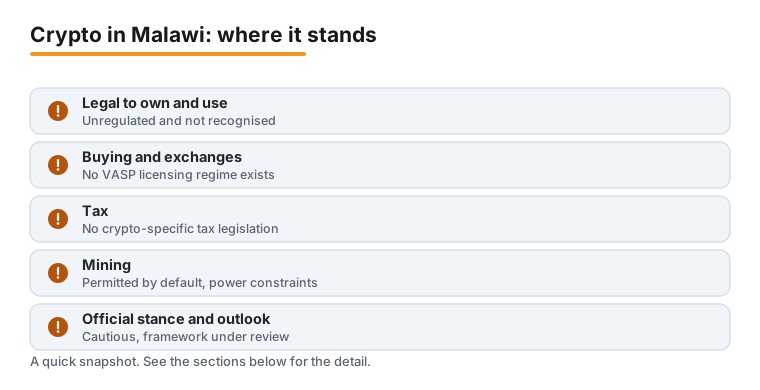
- Legal: Not banned but unregulated and not recognised, not legal tender
- Tax: No crypto-specific tax, income generally taxable under existing law
- Buying: No licensed local exchange, via offshore platforms and P2P
Malawi sits in the cautious-but-watching camp on cryptocurrency. The Reserve Bank of Malawi (RBM) has repeatedly stated that Bitcoin and other digital assets are not legal tender and are not regulated or endorsed, while stopping short of a clear, codified ban on individuals owning or trading them. The practical result is a legal grey area: as of 2026 Malawi has no dedicated virtual-assets statute, no licensing regime for exchanges, and no formal consumer-protection backstop, yet a growing number of Malawians buy, sell and receive crypto through peer-to-peer platforms and offshore exchanges. The clearest signal of where things are heading is the government's first Virtual Assets and Virtual Asset Service Providers Risk Assessment Report, published in June 2025 by the Financial Intelligence Authority, which recommends that Malawi urgently define a policy stance and build a proper legal framework. This page explains where Malawi stands on legality, the regulators, the law, exchanges, tax, AML/KYC, buying and using crypto, mining, recent developments and risk. See also our general guide to crypto regulation.
This article is general information as of 2026 and is not legal, tax or financial advice. Crypto rules in Malawi are unsettled and evolving. Always verify the current position with the Reserve Bank of Malawi and the Malawi Revenue Authority, and consult a qualified Malawian professional before acting.
On this page: Legal status · Who regulates it · Taxes · How to buy · Mining
Is Bitcoin and crypto legal in Malawi?
There is no Malawian law that makes simply holding or trading Bitcoin a criminal offence, but there is also no law that formally legalises or licenses crypto activity. The most accurate description of the position in August 2026 is unregulated but no longer unclaimed. Crypto is not legal tender, and no statute either licenses or bans it, but the Reserve Bank of Malawi has now formally taken ownership of the file in its National Payments System Vision and Strategy Framework 2026-2030, published 16 April 2026, and set itself a 2026 to 2028 window to draft and consult on the rules.
The Reserve Bank of Malawi has issued public cautions making clear that:
- Cryptocurrencies are not legal tender in Malawi and are not a substitute for the Malawi kwacha (MWK).
- The RBM does not regulate crypto and will not approve or recognise any inbound or outbound foreign investment in cryptocurrencies.
- Crypto businesses operating locally are not licensed by the Registrar of Financial Institutions, so disputes and scams are treated as criminal or law-enforcement matters rather than regulated financial-services complaints.
- Anyone using crypto does so at their own risk, with no central authority to turn to if funds are lost, stolen or frozen.
At the same time, the authorities are actively reviewing this stance. The June 2025 government risk assessment explicitly recommends that Malawi define a clear policy and build a legislative framework for virtual assets, so the legal status could change. Until formal legislation is passed, treat crypto as a high-risk, unsupervised activity.
Who regulates crypto in Malawi?
No single body has a dedicated crypto mandate yet. Oversight is shared among existing financial authorities, with the central bank as the most likely future regulator:
- Reserve Bank of Malawi (RBM): the central bank and monetary authority. It acts as the Registrar of Financial Institutions, oversees the payments system, currency and exchange-control matters, and has issued the main public statements on crypto. The risk assessment notes the RBM has begun receiving applications for formal VASP licensing, even though no licensing regime yet exists. Official site: Reserve Bank of Malawi (rbm.mw).
- Financial Intelligence Authority (FIA): Malawi's anti-money-laundering agency, established under the Financial Crimes Act, 2017. It led the 2025 virtual-assets risk assessment and is responsible for AML/CFT supervision. Official site: Financial Intelligence Authority (fia.gov.mw).
- Malawi Revenue Authority (MRA): the tax administration, relevant to any income or gains arising from crypto. Official site: Malawi Revenue Authority (mra.mw).
- Ministry of Finance and Economic Affairs: sat on the technical working group for the 2025 assessment and would lead any new legislation.
The Reserve Bank of Malawi has now named itself as the regulator. Section 4.4.3 of its National Payments System Vision and Strategy Framework 2026-2030, published 16 April 2026 and signed by Governor Dr George Partridge, commits the RBM to establish a proportionate, risk-based regulatory framework for virtual assets and VASPs aligned with FATF standards. The Financial Intelligence Authority continues to run AML supervision under the Financial Crimes Act No. 14 of 2017, which does not yet list VASPs as reporting institutions.
Key laws and frameworks
As of 2026 there is no comprehensive cryptocurrency or virtual-assets statute in Malawi and no dedicated licensing law for exchanges or wallet providers. Crypto is instead touched indirectly by existing legislation and by central-bank guidance:
- Financial Crimes Act, No. 14 of 2017: establishes the FIA and the AML/CFT regime; the framework into which any future crypto rules would have to fit.
- Financial Services Act and Banking Act: the prudential laws under which the RBM licenses and supervises banks and other financial institutions. Crypto firms are not licensed under these.
- Exchange-control rules: govern moving money in and out of Malawi and converting kwacha to foreign currency. Because crypto can move value across borders, regulators view it partly through this lens.
Malawi is a member of the Eastern and Southern Africa Anti-Money Laundering Group (ESAAMLG) and follows Financial Action Task Force (FATF) standards. The 2025 risk assessment was conducted specifically to meet FATF Recommendation 15 on new technologies, which requires countries to identify and mitigate virtual-asset risks. Note that Malawi is not in the EU, so the EU Markets in Crypto-Assets (MiCA) regulation does not apply here.
Licensing and registration of exchanges (VASPs)
There is no VASP licensing or registration regime in Malawi as of 2026. The 2025 government risk assessment confirmed that virtual asset service providers operate without licensing, oversight or enforcement, and described this regulatory and supervisory vacuum as a high-risk gap.
What the assessment found on the ground:
- At least one VASP had a physical presence in Malawi, operating as an unlicensed and unregistered business offering currency exchange and Bitcoin; for the year ending April 2025 it recorded over 84,000 customers and around USD 2.4 million in transaction volume.
- Around eleven firms were identified providing online wallet, exchange and investment services to Malawian users, several of them foreign-based platforms operating without local scrutiny.
- The RBM has reportedly begun receiving applications for formal VASP licensing, but there is currently no legal mechanism to grant such a licence.
For users this means a local crypto service is not supervised by the RBM, and standard safeguards such as custody audits, capital requirements and formal dispute resolution are not guaranteed. The RBM has now put dates against that work. Under the 2030 Framework it will review international best practices in 2025 to 2026, engage stakeholders in 2026 to 2027, and draft and consult on virtual asset regulations and a comprehensive legal framework across 2026 to 2028. As of August 2026 no draft has been published and nothing has been tabled in the National Assembly, so a working exchange licence cannot realistically exist before that drafting and consultation window closes in 2028.
Crypto and Bitcoin tax in Malawi
Malawi has no crypto-specific tax legislation and the Malawi Revenue Authority has published no crypto guidance, but the default is not a blank. Section 11 of the Taxation Act (Chapter 41:01) provides that a person's income includes any capital gain accruing from a source within or deemed to be within Malawi, and section 2 defines a capital gain as the excess of the amount realized on disposal of a capital asset over its adjusted basis. Malawi has no separate capital gains tax, so a gain on selling crypto falls into ordinary income tax rather than into a gap. That does not mean crypto is automatically tax-free: income and gains are generally taxable under Malawi's existing tax law, administered by the Malawi Revenue Authority, and crypto-related profits could fall within those general rules depending on the facts.
For context, Malawi's headline taxes include a top personal income tax rate and corporate income tax around 30 percent, and Malawi does not levy a standalone capital-gains tax, though gains on business assets can be brought into taxable business income. Because there is no published crypto tax framework, this page deliberately states no specific crypto rate. As general principles only, and subject to confirmation with a Malawian tax professional:
- Profits from selling or trading crypto fall into ordinary income under section 11 of the Taxation Act. For an individual that means the personal income tax rates in force since 31 December 2025: nil on the first K2,040,000 of annual taxable income and 30 percent on the excess. For a company it means 30 percent up to K5 billion of annual taxable income and 40 percent above that. The MRA publishes a separate PAYE scale for employment income which rises to 40 percent above K10,000,000 per month.
- Crypto received as payment for goods, services or work may be taxable at its kwacha value when received.
- Mining, staking or other rewards could also be treated as taxable.
- Keep dated records of purchases, sales, transfers and the kwacha value at each point.
The treatment of any specific transaction is uncertain under current law. Do not rely on this section as tax advice; confirm with the Malawi Revenue Authority or a qualified adviser. See also our general guide to crypto taxes.
AML and KYC rules
Malawi's anti-money-laundering and counter-terrorist-financing regime is set by the Financial Crimes Act, 2017, supervised by the FIA together with the RBM. Banks, mobile-money operators and other reporting institutions must perform customer due diligence (KYC), monitor transactions and file suspicious-transaction reports.
Crypto sits awkwardly inside this regime. Because VASPs are not licensed, they are not captured as reporting institutions under the Financial Crimes Act No. 14 of 2017, and the 2023 amendment did not add them. AML obligations therefore reach crypto only at the bank, mobile money or payment gateway edge. The June 2025 risk assessment rated the government's overall mitigation response as very low and stated that key fundamental elements, including the legal, regulatory and institutional frameworks, are non-existent. The 2025 risk assessment rated Malawi's overall money-laundering, terrorist-financing and proliferation-financing risk from virtual assets as high, driven by:
- Peer-to-peer transactions, custodial wallet services and cross-border platforms, which raise anonymity and traceability challenges.
- Unlicensed and foreign-based VASPs entering the market without oversight.
- Limited capacity among regulators and law-enforcement agencies to monitor and investigate crypto-related crime.
The assessment recommends bringing VASPs into the AML/CFT framework once enabling legislation exists. In practice today, reputable offshore platforms still apply their own KYC checks, and you should expect to verify your identity when using them.
Buying and using crypto in practice
With no licensed local exchanges, most Malawians use international platforms or peer-to-peer (P2P) marketplaces. A cautious approach looks like this:
- 1. Choose a method. The main options are P2P marketplaces (trading directly with other users via bank transfer or mobile money, with crypto held in escrow) and offshore or pan-African exchanges that accept Malawian customers.
- 2. Complete identity checks. Reputable platforms require KYC (ID and sometimes proof of address). Avoid services that ask for no verification, as these carry higher fraud and AML risk.
- 3. Fund and trade. Deposit kwacha via the supported method and buy your chosen asset. On P2P platforms, only confirm or release funds through the platform's escrow and dispute process.
- 4. Secure your holdings. Move significant amounts to a wallet you control, enable two-factor authentication, and never share private keys or recovery phrases.
Before sending money, check fees and exchange-rate spreads, verify the counterparty's reputation, and remember that Malawi's exchange-control rules may apply to cross-border funding. There is no local regulator to recover lost funds, so caution is essential. Physical Bitcoin ATMs are not an established part of Malawi's landscape, so do not assume a working machine is available.
Bitcoin mining in Malawi
No Malawian law specifically prohibits cryptocurrency mining, so mining is generally understood to be permitted by default rather than expressly authorised. The 2025 risk assessment noted that some organisations, academics and students were already engaged in mining, research and awareness activity. As with trading, the absence of a clear rule means miners operate without specific protection or recognition.
The bigger constraints in Malawi are practical rather than legal:
- Electricity supply: Malawi has historically faced power shortages and load-shedding, and mining is energy-intensive. Reliable, affordable electricity is the single largest hurdle.
- Hardware and import costs: mining equipment must usually be imported, adding cost and exchange-control considerations.
- Tax: any income from mining could be taxable under general MRA rules.
- Environmental footprint: the energy demands of mining raise environmental concerns; operators increasingly look to renewable or surplus power.
Anyone considering more than hobby-scale mining should verify the current legal and tax position locally and plan around Malawi's energy realities.
Recent developments (2025-2026)
The most significant recent step is the Virtual Assets and Virtual Asset Service Providers Risk Assessment Report, published in June 2025 by the Financial Intelligence Authority, with the RBM and Ministry of Finance and Economic Affairs. It was Malawi's first such assessment and was conducted to meet FATF Recommendation 15. Its headline findings and recommendations:
- Malawi faces a high overall ML/TF/PF risk from virtual assets, due to weak controls, no licensing and growing public use.
- The country should urgently define a clear policy stance on whether to allow or prohibit virtual assets and create the necessary legislation in line with international standards.
- It should strengthen institutional capacity, improve inter-agency and international cooperation, run public-awareness programmes, and develop procedures for investigating and seizing illicit virtual assets.
Earlier, RBM officials had publicly described Malawi as being on the borderline, neither saying yes nor no to crypto, and noted that an outright ban could push activity underground beyond AML oversight. The bank has consistently said it supports the underlying blockchain technology even while warning against crypto trading. Across the region, neighbours have moved to formal regulation, increasing pressure on Malawi to follow. Kenya enacted its Virtual Asset Service Providers Act, 2025, which received presidential assent on 15 October 2025 and came into force on 4 November 2025, placing licensing under the Central Bank of Kenya and the Capital Markets Authority (no VASP licences had been issued at the point the Act took effect). Nigeria has also moved toward formal oversight. A framework for Malawi, whether enabling or restrictive, is plausible in the coming years; watch official RBM and FIA channels for announcements.
Domestic pressure has been part of the picture. Bodies including the ICT Association of Malawi and the Economic Association of Malawi have urged the RBM to allow regulated crypto use rather than an outright ban, and RBM officials have publicly acknowledged the concern that a blanket prohibition could push users underground beyond anti-money-laundering oversight. The RBM has also indicated it is monitoring blockchain developments to judge whether regulatory intervention is needed, while continuing to caution that crypto is not legal tender.
Consumer risks and protection
The defining feature of crypto in Malawi is the absence of a safety net. Because crypto is unregulated and unrecognised, there is no compensation scheme, deposit guarantee or financial regulator to appeal to if something goes wrong.
Key risks
- No consumer protection: losses from hacks, scams or platform failure are generally unrecoverable; the RBM treats crypto scams as criminal matters for the police, not regulated complaints.
- Scam exposure: unregulated markets attract fraud, fake platforms and guaranteed-return schemes. The RBM's warnings followed real incidents in which Malawians lost significant sums.
- Volatility: prices can move sharply; only consider money you can afford to lose entirely.
- Regulatory and policy risk: the position is officially under review, so rules could tighten or formalise with limited notice.
- AML and exchange-control exposure: moving value across borders can intersect with Malawi's exchange-control and anti-money-laundering rules.
Protect yourself by using reputable platforms with strong security and proper KYC, enabling two-factor authentication, holding your own keys for larger amounts, keeping records, and ignoring social-media hype and unsolicited investment offers. This page does not give investment advice or price predictions.
Official sources and how to verify
Because Malawi's position is evolving, always confirm the current rules with the primary authorities rather than relying on third-party summaries. The key official sources are:
- Reserve Bank of Malawi for legal-tender status, exchange control, any future VASP licensing and public notices: rbm.mw.
- Financial Intelligence Authority for AML/CFT rules, the Financial Crimes Act and the June 2025 virtual-assets risk assessment: fia.gov.mw.
- Malawi Revenue Authority for tax obligations: mra.mw.
For wider context, compare other countries on our regulation hub. Remember that this article is general information as of 2026 and is not legal advice; verify your specific situation directly with the Reserve Bank of Malawi, the Malawi Revenue Authority and a qualified Malawian professional.
What is changing: the Reserve Bank's virtual assets timetable
The one thing that has genuinely moved since this page was last reviewed is that Malawi's central bank has stopped watching and started scheduling. On 16 April 2026 the Reserve Bank of Malawi published its National Payments System Vision and Strategy Framework 2026-2030, signed by Governor Dr George Partridge, who took office on 23 January 2026. Section 4.4.3 of that document is given over entirely to virtual assets and VASPs. It accepts that crypto is already interacting with the domestic payment and banking system, citing the June 2025 sectoral risk assessment, and it commits the RBM to establish a proportionate, risk-based regulatory framework for virtual assets and their service providers, aligned with Financial Action Task Force standards. It is the first time an organ of the Malawi government has committed in a published document to writing crypto rules, and the first time it has attached dates.
The framework sets out four dated actions:
| Action committed to in the 2030 Framework | Timeline stated in the document |
|---|---|
| Targeted review of international best practices for virtual asset regulation | 2025 to 2026 |
| Engage stakeholders to inform development of the regulatory approach | 2026 to 2027 |
| Draft and consult on virtual asset regulations and a comprehensive legal framework | 2026 to 2028 |
| Monitor market developments and international standards, and refine the framework | 2026 to 2030 |
Two adjacent workstreams in the same document matter for anyone tracking this. The RBM will run a comprehensive review of the Payment Systems Act, 2016 and its subsidiary regulations across 2026 to 2027, with revised legislation to be finalised and promulgated in 2027 to 2028. Separately, the RBM commits to launch a Financial Innovations Hub and Regulatory Sandbox, formally launched in 2026 to 2027 and rolled out to 2030, distinguishing a strict regulatory sandbox from a developmental sandbox in which an operator trades under minimum requirements and graduates to full licensing. A CBDC Proof of Concept is due to be published in 2026 to 2027.
What the framework does not do is equally important. It is a strategy, not a law. As of August 2026 there is no draft regulation, no consultation paper, no gazette notice, and nothing tabled in the National Assembly. No sandbox cohort has been admitted, so a crypto business cannot apply to test under RBM supervision today. Because drafting and consultation is itself scheduled to run to 2028, a working licence to operate a crypto exchange in Malawi cannot realistically exist before that window closes.
Crypto tax in Malawi: the rates that actually apply
There is no crypto-specific tax law in Malawi and the Malawi Revenue Authority has published no crypto guidance. That does not leave a blank. Section 11 of the Taxation Act (Chapter 41:01) provides that a person's income includes the total amount in cash or otherwise, including any capital gain, accruing from a source within or deemed to be within Malawi. Section 2 defines a capital gain as the excess of the amount realized on disposal of a capital asset over its adjusted basis. Malawi has no separate capital gains tax; gains are folded into income. So a gain on selling crypto falls into ordinary income tax by default.
The rates that gain meets were reset by the Taxation (Amendment) and Value Added Tax (Amendment) (No.2) Acts 2025, effective from 31 December 2025, following the 2025/26 Mid-Year Budget Review presented to Parliament on 21 November 2025. Per the Malawi Revenue Authority public notice:
- Personal income tax: nil on the first K2,040,000 of annual taxable income, 30 percent on the excess.
- PAYE on employment income, which the MRA publishes as a separate scale: nil to K170,000 per month, 30 percent from K170,000 to K1,570,000, 35 percent from K1,570,000 to K10,000,000, and 40 percent above K10,000,000 per month.
- Corporate income tax: 30 percent up to K5 billion of annual taxable income, 40 percent above K5 billion.
- VAT: adjusted to 17.5 percent.
- Minimum Alternative Tax: 0.5 percent of turnover for companies with turnover above K5 billion that have operated for a minimum of three years.
Two further measures bear on crypto users directly. A levy of 0.05 percent, payable by the sender, now applies to money transfers in excess of K100,000 through mobile money operators and to all money transfers through a bank's electronic system, so funding a peer-to-peer crypto purchase from a mobile wallet or bank app carries a small unavoidable cost. And the First Schedule exemption that spared gains on shares traded on the stock exchange and held twelve months or more was removed, so holding period no longer shelters a share gain. That removal applies to shares, not crypto.
The 2026/27 budget did not add a crypto tax. Its digital measure was the Value Added Tax (Amendment) Act 2026, reported as gazetted 14 April 2026 and effective 15 April 2026, which requires non-resident suppliers of digital services to register for VAT regardless of turnover and charge 17.5 percent on streaming, cloud computing, software subscriptions, online advertising and e-books. That measure does not name cryptocurrency, virtual assets or exchange services, and no Malawian authority has said it captures trading fees charged by offshore exchanges.
What actually applies while there is no crypto law
Saying there is no crypto law is true and it is where most explanations stop. Four things do apply.
- Anti-money laundering. The Financial Crimes Act No. 14 of 2017, amended in 2023 by a bill passed on 18 April 2023, establishes the Financial Intelligence Authority and lists the institutions that owe customer due diligence and reporting duties. VASPs are not on that list and the 2023 amendment did not add them; it defined funds to support terrorism financing criminalisation and criminalised financing travel for terrorist purposes or training. AML obligations therefore reach crypto only where a bank, mobile money issuer or payment gateway sits in the chain.
- Tax. Section 11 of the Taxation Act includes any capital gain in income, so crypto disposal gains are taxable at ordinary rates whether or not anyone has issued crypto guidance.
- Prudential and licensing law. Banks are licensed and supervised by the RBM acting as Registrar of Financial Institutions, and are governed by prudential regulations under the Financial Services Act and the Banking Act. None of these statutes creates a crypto licence, which is why the June 2025 assessment records that the RBM has been receiving applications for formal licensing of VASPs that it has no legal basis to grant.
- The general criminal law. This is the route that has actually been used. The June 2025 risk assessment records a Malawi Police Service case in which three suspects who defrauded victims of more than K130 million through a foreign-based VASP were to answer charges of operating a business as a financial institution without being registered or licensed, conspiracy to defraud, and fraud other than false pretence. Crypto fraud in Malawi is prosecuted as fraud and unlicensed financial business, not under any crypto statute.
The consequence is a specific and documented one, not a vague risk. The same assessment rated the government's overall mitigation response as very low, the weakest among the sectors assessed, and stated that key fundamental elements including the legal, regulatory and institutional frameworks are non-existent. It also found limited understanding of risks and lack of capacity by all the country's law enforcement agencies to investigate, trace, prosecute, seize and confiscate virtual assets. If funds are lost on an offshore platform, there is no Malawian licensing authority to complain to and, on the government's own assessment, limited capacity to trace them.
Where Malawi stands against its regional peers
Malawi belongs to the Eastern and Southern Africa Anti-Money Laundering Group, the FATF-style regional body. ESAAMLG's September 2025 follow-up study on virtual assets in the region is based on responses from 17 of the 21 ESAAMLG member countries, and places Malawi at the back of the field on hard numbers.
- Of the 17 jurisdictions that responded, 41 percent, or seven, use regulation to manage virtual asset risks: Botswana, Mauritius, Mozambique, Namibia, Seychelles, South Africa and Uganda. A further 35 percent, or six, are considering regulating the sector: Angola, Kenya, Lesotho, Madagascar, Rwanda and Zimbabwe. Ethiopia manages the risk through a total ban.
- Malawi is one of three jurisdictions, with Burundi and Eswatini, making 18 percent of respondents, that did not specify their approach to managing virtual asset risks.
- On FATF Recommendation 15, which covers new technologies including virtual assets, Malawi was rated Partially Compliant in its September 2019 mutual evaluation and was still Partially Compliant at its most recent follow-up report in April 2024.
That is the gap the RBM's 2026 to 2028 drafting window is meant to close. It also explains the direction of pressure: Malawi's obligation under Recommendation 15 is what prompted the June 2025 risk assessment in the first place, so continued inaction carries a regional evaluation cost rather than a purely domestic one.
Frequently asked questions
Is Bitcoin legal in Malawi?
There is no law that criminalises simply holding or trading Bitcoin, but there is also no law that formally legalises or licenses it. The Reserve Bank of Malawi has stated that crypto is not legal tender and is not regulated, leaving it in an unregulated grey area. Verify the current position with the RBM before acting.
Who regulates cryptocurrency in Malawi?
No single body has a dedicated crypto mandate yet. The Reserve Bank of Malawi is the central bank and the most likely future regulator, the Financial Intelligence Authority handles anti-money-laundering supervision, and the Malawi Revenue Authority handles tax. As of 2026 there is no crypto-specific licensing regime.
Do I need a licence to run a crypto exchange in Malawi?
There is currently no VASP licensing regime, so there is no licence available to apply for. The 2025 government risk assessment found exchanges operating without any licensing or oversight and recommended that Malawi create a legal framework. The Reserve Bank has reportedly started receiving licensing applications, but no mechanism yet exists to grant them.
Do I have to pay tax on crypto in Malawi?
Malawi has no crypto-specific tax law, but income and gains are generally taxable under existing rules administered by the Malawi Revenue Authority, and crypto profits could fall within them depending on the facts. No official crypto rates or thresholds are published, so confirm your obligations with the MRA or a qualified tax adviser.
What was the 2025 virtual-assets risk assessment?
In June 2025 Malawi's Financial Intelligence Authority, with the Reserve Bank of Malawi and the Ministry of Finance, published the country's first Virtual Assets and VASPs money-laundering risk assessment, meeting FATF Recommendation 15. It rated the overall risk as high and recommended that Malawi urgently define a policy stance and enact legislation to regulate virtual assets.
How can I buy Bitcoin in Malawi?
Because there are no licensed local exchanges, most people use peer-to-peer marketplaces or offshore platforms that accept Malawian users, funding with bank transfer or mobile money. Use platforms with proper identity checks, secure your own wallet, and remember there is no local regulator to help recover lost funds.
Is crypto mining legal in Malawi?
No Malawian law specifically bans cryptocurrency mining, so it is generally understood to be permitted by default rather than expressly authorised, and the 2025 government risk assessment noted some mining, research and awareness activity already taking place. The practical hurdles are electricity supply and load-shedding, the cost of importing hardware, and possible tax on any income. There is no dedicated mining licence or legal protection, so verify the current position locally before scaling up.
How does Malawi compare with its neighbours on crypto rules?
Malawi is behind several regional peers. As of 2026 it has no virtual-assets statute and no licensing regime, whereas Kenya enacted its Virtual Asset Service Providers Act, 2025, which came into force in November 2025 with the Central Bank of Kenya and Capital Markets Authority as regulators, and Nigeria has also moved toward formal oversight. Malawi's June 2025 risk assessment recommended it define a policy and legislate, so the gap may narrow, but nothing is enacted yet.
Has Malawi passed a crypto law yet?
No. As of 3 August 2026 Malawi has no crypto-specific statute, nothing has been tabled in Parliament, and no VASP licence has been issued because no licensing regime exists. What does exist is a published government commitment to write one: section 4.4.3 of the Reserve Bank of Malawi's National Payments System Vision and Strategy Framework 2026-2030, published 16 April 2026.
When will Malawi regulate crypto?
The Reserve Bank of Malawi's 2030 Framework sets four dated actions: review international best practices in 2025 to 2026, engage stakeholders in 2026 to 2027, draft and consult on virtual asset regulations and a comprehensive legal framework across 2026 to 2028, then monitor and refine to 2030. Because the drafting and consultation stage alone runs to 2028, an operative licensing regime before then is unlikely. No draft text has been published yet.
What tax do I pay on crypto gains in Malawi?
There is no crypto-specific tax and the Malawi Revenue Authority has issued no crypto guidance, but section 11 of the Taxation Act (Chapter 41:01) includes any capital gain in a person's income, so a disposal gain is taxed as ordinary income. Since 31 December 2025 the personal income tax rates are nil on the first K2,040,000 of annual taxable income and 30 percent above it, and the corporate rates are 30 percent up to K5 billion of annual taxable income and 40 percent above. Malawi has no separate capital gains tax.
Does the 0.05 percent transfer levy apply when I buy crypto?
It applies to the transfer, not to the crypto. Since 31 December 2025 a levy of 0.05 percent, payable by the sender, applies to money transfers in excess of K100,000 through mobile money operators and to all money transfers through a bank's electronic system. Because most Malawians fund peer-to-peer crypto purchases from a mobile wallet or bank app, the levy will normally be charged on that funding leg.
Does Malawi have a regulatory sandbox a crypto firm can join?
Not yet. The Reserve Bank of Malawi committed in its April 2026 strategy framework to establish a Financial Innovations Hub and Regulatory Sandbox, with formal launch scheduled for 2026 to 2027 and rollout to 2030. As of August 2026 no sandbox is open and no cohort has been admitted. The framework also does not say whether virtual asset firms will be eligible.
Is Malawi launching a digital kwacha?
The Reserve Bank of Malawi has committed to research and to publish a central bank digital currency Proof of Concept in 2026 to 2027, with technical and regulatory work on a possible pilot only in 2027 to 2030 and only if the Proof of Concept supports it. The framework is explicit that the aim is to determine the appropriate role, if any, of a CBDC. A digital kwacha would be central bank money, not a cryptocurrency, and would not change the legal status of Bitcoin or stablecoins.
Did the 2026/27 budget tax crypto?
No. The digital measure in Malawi's 2026/27 budget was the Value Added Tax (Amendment) Act 2026, reported as gazetted 14 April 2026 and effective 15 April 2026, which requires non-resident suppliers of digital services to register for VAT and charge 17.5 percent on streaming, cloud computing, software subscriptions, online advertising and e-books. Cryptocurrency, virtual assets and exchange services are not named in that measure.
How does Malawi compare with other countries in its region on VASP rules?
ESAAMLG's September 2025 follow-up study, based on responses from 17 of its 21 member countries, found that seven of those 17 regulate VASPs, namely Botswana, Mauritius, Mozambique, Namibia, Seychelles, South Africa and Uganda, and six more are considering it. Malawi was one of three jurisdictions, with Burundi and Eswatini, that did not specify an approach. Malawi was rated Partially Compliant on FATF Recommendation 15 in its September 2019 mutual evaluation and was still Partially Compliant at its April 2024 follow-up.
Facts reviewed: 5 August 2026. Page updated: 5 August 2026.