Home › Crypto Regulation › Yemen
Bitcoin & Cryptocurrency Regulation in Yemen
Quick answer — Yemen, 2026
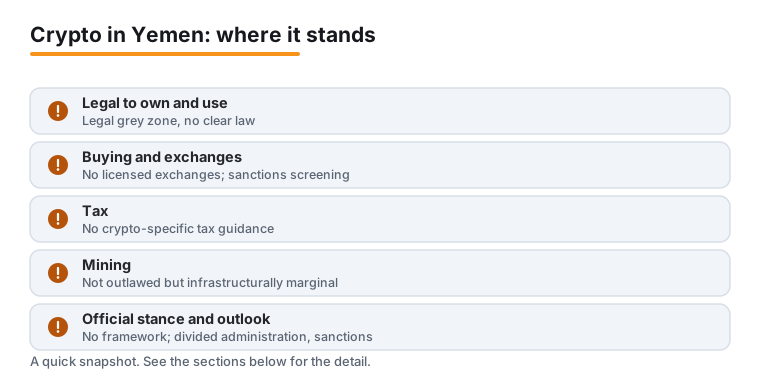
- Legal: Legal grey zone, no specific law or clear ban, not legal tender; governance is divided
- Tax: No crypto specific tax guidance; treatment undefined, not confirmed tax free
- Buying: No licensed exchanges, use P2P and international platforms; sanctions screening limits access
Yemen is one of the hardest countries in the world in which to state cryptocurrency rules with confidence, because there is no single functioning authority that has issued a clear legal framework for digital assets. Years of armed conflict have split the country between the internationally recognised government, which runs the Central Bank of Yemen from Aden (CBY-Aden), and the Houthi (Ansar Allah) authorities in Sana'a, who operate a parallel central bank. Against this backdrop there is no dedicated cryptocurrency or virtual-asset law, no licensing regime for exchanges, and no published tax guidance specific to Bitcoin or other tokens.
At the same time, the collapse of much of the formal banking system, a divided national currency, and tightening international sanctions have pushed some Yemenis toward dollar-pegged stablecoins and peer-to-peer transfers as practical tools for saving and moving value. This guide explains what is and is not known about crypto regulation in Yemen as of 2026, including legal status, the relevant authorities, key frameworks, exchange access, tax, anti-money-laundering rules, mining, recent developments, consumer risks, and how to verify the position against official sources. This is general information as of 2026 and is NOT legal, tax or financial advice; because Yemen's situation is unusually fluid and sanctions-sensitive, you should verify the current rules directly with the named official regulator and a qualified local professional before acting. For background, see our overviews of crypto regulation and regulation by country.
On this page: Legal status · Who regulates it · Taxes · How to buy · Mining
Legal status of Bitcoin and crypto in Yemen
There is no Yemeni statute that explicitly legalises cryptocurrency, and there is no clear, country-wide statutory ban either. In practical terms, Bitcoin and other digital assets sit in a legal grey zone: they are neither recognised as legal tender nor regulated as a licensed financial product. Ownership and peer-to-peer use are not generally prosecuted as crimes, but that absence of prohibition reflects a lack of legislation rather than a deliberate policy of permission.
Two factors complicate any simple "legal or illegal" answer. First, governance is divided: rules, warnings or enforcement actions issued by authorities in one part of the country may not apply, or may be contradicted, elsewhere. Second, the formal financial system has been disrupted by conflict and sanctions, so even where activity is not banned, the institutions that would normally supervise it often cannot. Treat any blanket claim that crypto is "fully legal" or "completely banned" in Yemen with caution, and confirm the position that applies to your location and circumstances. Independent trackers such as the Legality of cryptocurrency by country or territory reference generally describe Yemen as having no specific regulation rather than an outright ban.
The regulator: which authority governs crypto in Yemen?
Yemen does not have a dedicated digital-asset regulator or a virtual-asset service provider (VASP) authority. The body that would normally supervise money, banking and payments is the Central Bank of Yemen. Because of the conflict, however, there are effectively two competing central banks:
- Central Bank of Yemen in Aden (CBY-Aden) is the central bank of the internationally recognised government and is the institution recognised by the IMF and foreign correspondent banks. Its official site is english.cby-ye.com (Arabic: cby-ye.com).
- The Sana'a-based central bank is run by the Houthi (Ansar Allah) authorities and issues its own directives within the territory it controls.
Neither institution has published a dedicated cryptocurrency framework. CBY-Aden has, however, acted on the wider payments space: in June 2024 it issued a circular prohibiting dealings with unlicensed entities, electronic wallets and payment services, and it has suspended or revoked the licences of exchange and money-transfer companies as part of a drive to reassert financial oversight. These actions target unlicensed payment operators rather than cryptocurrency specifically, but they signal the regulator's stance against unauthorised money-movement channels. Always check which authority's rules apply where you are located.
Key laws and frameworks
Yemen has not enacted a comprehensive virtual-asset law, and no public authority has published a licensing framework for crypto exchanges, custodians or token issuers. As a result there are no clear domestic registration procedures, no crypto-specific anti-money-laundering (AML) obligations, and no consumer-protection rules tailored to digital assets.
The frameworks that do touch on crypto-related activity are indirect:
- CBY-Aden payments directives. The June 2024 circular from CBY-Aden prohibits banks, exchange companies and money-transfer institutions from dealing with unlicensed entities, wallets and electronic payment services, warning that such dealings risk fraud and the financing of illicit activity.
- General laws on banking, currency and fraud. Existing financial, currency and anti-fraud laws can in principle be applied to crypto-related conduct even though they were not written with digital assets in mind.
- International sanctions. The most consequential legal pressure on crypto in Yemen comes from outside the country, in particular sanctions administered by the US Treasury (covered below).
Because this area can change quickly, confirm the current position with official notices and qualified legal counsel before relying on any of the above.
Licensing and registration of exchanges and VASPs
There are no Yemen-licensed cryptocurrency exchanges and no domestic framework that authorises, registers or supervises crypto trading platforms or other virtual-asset service providers. There is therefore no licence for a crypto business to apply for, and equally no legal safe harbour confirming that a given crypto activity is permitted.
CBY-Aden does license and supervise traditional banks, exchange (money-changing) companies and electronic-payment providers, and during 2024 and 2025 it suspended or revoked licences of several exchange establishments and banned a number of unlicensed e-payment wallets as part of efforts to reinforce financial oversight. None of these licences extend to crypto trading. In practice, Yemenis who acquire crypto rely on peer-to-peer (P2P) trading and international platforms accessed online rather than any locally authorised venue. Treat any service claiming to be a "licensed Yemeni crypto exchange" with strong skepticism and verify its status directly with the central bank.
Crypto and Bitcoin tax in Yemen
Yemen has not published cryptocurrency-specific tax rules. There is no confirmed official guidance on how Bitcoin profits, trading gains, mining income or crypto received as payment should be classified or taxed, and no verified crypto tax rates or thresholds exist that we can responsibly cite. Anyone quoting a precise crypto tax rate for Yemen is almost certainly speculating.
In the absence of dedicated rules, the prudent assumption is that general tax principles could in theory apply to income or business activity, but enforcement capacity is limited and inconsistent across a divided, conflict-affected administration. This does not mean crypto activity is automatically tax-free; it means the treatment is undefined and uncertain. If you have a tax obligation connected to Yemen, do not rely on online generalisations: keep clear records of every transaction, consult a qualified Yemeni tax professional, and verify any requirement directly with the relevant authority. For a general primer, see our guide to crypto taxes. This section is informational only and is not tax advice.
AML, KYC and sanctions compliance
Yemen has general anti-money-laundering and counter-terrorist-financing concerns at the centre of how its financial system is policed, but there is no published crypto-specific AML or know-your-customer (KYC) rulebook. CBY-Aden's payments directives are framed largely around preventing fraud, money laundering and the financing of illicit activity through unlicensed channels, which is why it has banned unlicensed wallets and payment services.
The dominant AML and sanctions factor for crypto, however, is international. In 2025 the US Treasury's Office of Foreign Assets Control (OFAC) designated multiple cryptocurrency wallet addresses and individuals tied to Houthi financial and procurement networks, including wallets used to move the stablecoin USDT. See OFAC's announcement, Treasury Sanctions Houthi Network Procuring Weapons and Commodities from Russia (April 2025). The practical consequences are significant:
- US persons and US-regulated exchanges are barred from transacting with the listed wallets, and many international platforms apply equivalent screening.
- Compliant exchanges run KYC and sanctions checks that may restrict or block users associated with Yemen, regardless of local law.
- Transacting with sanctioned wallets, networks or persons can carry serious consequences even where Yemeni domestic law is silent.
Sanctions compliance is therefore the single most important legal consideration for anyone moving crypto in connection with Yemen.
Buying and using crypto in practice
With no Yemen-licensed exchanges and a damaged banking system, acquiring and using crypto in Yemen is largely informal. Yemenis typically rely on peer-to-peer trades, informal networks and international platforms accessed online, with dollar-pegged stablecoins such as USDT frequently preferred over volatile coins or the fragmented local currency. This use is not marginal: Chainalysis placed Yemen 16th out of 151 countries in its 2025 Global Crypto Adoption Index (published September 2025), reflecting how digital assets fill gaps left by a fractured banking system. Several constraints shape this:
- Banking and payment access. Limited card infrastructure and a disrupted banking sector make conventional fiat on-ramps difficult; many transactions settle through cash, hawala-style networks or stablecoin transfers.
- Sanctions and platform restrictions. International exchanges often geo-restrict or limit users associated with Yemen and must screen against sanctioned addresses, so access can be inconsistent or blocked entirely.
- Connectivity and power. Frequent power outages and unreliable internet, worsened by conflict, make consistent access difficult.
- Cash-out friction. Converting crypto back into usable local cash usually depends on informal P2P networks, which carry pricing and fraud risks.
Treat any platform claiming to "fully support" Yemen with skepticism, verify it independently, and remember that using offshore services does not remove your responsibility to avoid sanctioned counterparties. There is no evidence of a meaningful network of Bitcoin ATMs in Yemen, since machines depend on stable power, internet, banking relationships and a clear legal framework that the country currently lacks.
Bitcoin mining in Yemen
Yemen has no specific law authorising or prohibiting Bitcoin mining, leaving the activity in the same legal grey zone as other crypto use. There is no licensing regime, no published guidance on electricity use for mining, and no dedicated tax treatment of mining income.
Beyond the legal uncertainty, the practical barriers are severe:
- Electricity. Mining is energy-intensive, and Yemen's power supply is unreliable, costly and strained by conflict. Sustained, large-scale mining is difficult where the grid itself is fragile.
- Infrastructure and security. Importing and maintaining specialised hardware, securing facilities and keeping stable connectivity are all challenging in a conflict-affected environment.
- Economic viability. Profitability depends on equipment costs, electricity prices and volatile market values, all of which are unfavourable or unpredictable in Yemen.
In short, while mining is not specifically outlawed, the combination of legal ambiguity and infrastructure constraints makes it a marginal and risky undertaking.
Recent developments (2024 to 2026)
The most important recent developments around crypto in Yemen relate to payments oversight, the deepening monetary split, and international sanctions:
- June 2024 payments circular. CBY-Aden prohibited dealings with a list of unlicensed wallets and electronic payment services, and went on to suspend or revoke licences of several exchange establishments through 2024 and 2025 to reinforce financial oversight.
- OFAC crypto sanctions (2025). In April 2025 the US Treasury designated eight cryptocurrency wallets used by the Houthis and additional wallets linked to a senior Houthi financial facilitator, after the Houthis were re-designated as a Foreign Terrorist Organization earlier in 2025. The wallets transacted largely in USDT on the Tron network.
- Deepening monetary divide. Through 2025 the Houthi authorities issued new coins and banknotes, while CBY-Aden pursued reforms that strengthened the rial in government-held areas. The widening gap between the two monetary zones is part of why some Yemenis turn to stablecoins.
- Rising stablecoin and DeFi interest. Reporting during 2025 pointed to growing grassroots use of stablecoins and decentralised finance as banking restrictions and sanctions tightened. Yemen entered the top 20 of the Chainalysis 2025 Global Crypto Adoption Index at 16th place.
- Scale of Houthi-linked flows. Blockchain analytics firm TRM Labs reported in 2025 that the eight designated Houthi-linked addresses had moved more than 900 million US dollars in cryptocurrency, and that flows to and from high-risk, no-KYC and decentralised services rose sharply even as activity through centralised exchanges fell. This is why compliant platforms have tightened screening on Yemen-connected activity.
These developments are evolving and sanctions-sensitive; verify the latest position with the official sources listed below before acting.
Consumer risks and protection
Yemen presents an unusually high-risk environment for cryptocurrency, and there is essentially no local consumer protection or recourse if something goes wrong. The main risks include:
- No regulatory safety net. There is no authority to register a complaint with, no investor-protection scheme, and no licensed venue whose conduct is supervised.
- Sanctions exposure. International designations target wallets and persons linked to certain networks; inadvertently transacting with them can carry serious consequences.
- Fraud and scams. Phishing, fake exchanges, "guaranteed return" schemes and impersonation thrive where oversight is weak. If an offer seems too good to be true, it is.
- Volatility and loss. Bitcoin's price can swing sharply; stablecoins reduce but do not eliminate counterparty and de-pegging risk. Funds lost to hacks, fraud or platform failure are rarely recoverable.
- Infrastructure fragility. Unreliable power and internet can interrupt access at critical moments.
To reduce risk, never commit money you cannot afford to lose, prefer reputable non-custodial wallets with offline backups of recovery phrases, enable two-factor authentication, start with small test amounts, keep records, and verify every counterparty and platform independently. The burden of due diligence falls almost entirely on you.
Official sources and how to verify
Because the situation in Yemen is fluid and sanctions-sensitive, always confirm the current rules against primary sources rather than relying on third-party summaries. The most authoritative references are:
- Central Bank of Yemen (Aden): english.cby-ye.com, for circulars, licence actions and payments directives from the internationally recognised central bank, including its June 2024 circular on unlicensed wallets and payment services.
- US Department of the Treasury, OFAC: home.treasury.gov, for sanctions designations affecting crypto wallets and persons connected to Yemen.
- Comparative reference: the global legality-of-cryptocurrency tracker for context on how Yemen compares with other jurisdictions.
To verify your own position, check which authority controls the area you are in, search the central bank site for the latest circulars, screen any counterparty or platform against current OFAC sanctions lists, and consult a qualified Yemeni lawyer or tax adviser. You can also browse our country hub at crypto regulation by country. This guide is general information as of 2026 and is not legal, tax or financial advice; verify with the named official regulator before acting.
Frequently asked questions
Is cryptocurrency legal or banned in Yemen?
There is no clear, country-wide law that explicitly bans cryptocurrency in Yemen, and equally no law that legalises or regulates it. The result is a legal grey zone, complicated by a divided administration and by international sanctions targeting certain networks. Ownership and peer-to-peer use are not generally prosecuted, but there is no positive legal protection either. Because the position is uncertain and can change, verify the rules that apply to your situation with official sources before acting.
Who regulates cryptocurrency in Yemen?
No authority regulates crypto specifically. The body that would normally oversee money and payments is the Central Bank of Yemen, but the conflict has produced two competing central banks: the internationally recognised CBY-Aden (english.cby-ye.com) and a Houthi-run central bank in Sana'a. Neither has issued a dedicated crypto framework, though CBY-Aden has acted against unlicensed wallets and payment services.
Are there licensed crypto exchanges or Bitcoin ATMs in Yemen?
No. There is no domestic licensing regime for crypto exchanges or VASPs, and there is no evidence of a functioning Bitcoin ATM network. Most activity happens through peer-to-peer trades and international platforms accessed online, often using stablecoins. Access can be inconsistent because of sanctions screening, banking constraints and unreliable power and internet.
How is crypto taxed in Yemen?
Yemen has not published cryptocurrency-specific tax guidance, and there are no verified crypto tax rates or thresholds to cite. Treatment is undefined rather than confirmed to be tax-free. If you have a Yemen-related tax obligation, keep records and consult a qualified local tax professional. This is informational only and not tax advice.
Why are sanctions so important for crypto users connected to Yemen?
In 2025 the US Treasury's OFAC designated multiple crypto wallets and individuals tied to Houthi financial and procurement networks, including wallets moving USDT. US persons and US-regulated exchanges are barred from transacting with the listed wallets, and many international platforms apply equivalent screening. Dealing with sanctioned wallets or persons can carry serious legal consequences regardless of local law, which makes sanctions compliance the single most important consideration.
Do many people in Yemen actually use cryptocurrency?
Yes, relative to its size. Chainalysis ranked Yemen 16th out of 151 countries in its 2025 Global Crypto Adoption Index, noting that crypto helps fill gaps left by a fractured banking system. Use is concentrated in dollar-pegged stablecoins such as USDT and in peer-to-peer and decentralised-finance channels rather than any locally licensed exchange, because none exists. High adoption does not mean the activity is regulated or protected; it reflects practical demand in a conflict-affected economy.
Which stablecoin and network are most associated with crypto activity in Yemen?
Reporting and sanctions actions in 2025 point to Tether (USDT) on the Tron network as the combination most used in Yemen-connected flows. The eight wallets designated by OFAC in April 2025 were USDT-on-Tron addresses, and TRM Labs reported those addresses had moved more than 900 million US dollars. Ordinary residents also favour USDT for saving and transfers because it tracks the US dollar and settles quickly, but using it does not remove sanctions-screening or fraud risk.
How can I verify the current rules for crypto in Yemen?
Check primary sources rather than third-party summaries. Review circulars and licence actions on the Central Bank of Yemen (Aden) site at english.cby-ye.com, screen any counterparty or platform against current OFAC sanctions lists at home.treasury.gov, confirm which authority controls your area, and consult a qualified Yemeni lawyer or tax adviser. This guide is general information as of 2026 and is not legal advice.
Facts reviewed: 30 June 2026. Page updated: 3 August 2026.