Home › Crypto Regulation › Qatar
Bitcoin & Cryptocurrency Regulation in Qatar
Quick answer — Qatar, 2026
- Legal: Heavily restricted, not legal tender, banks barred, no licensed exchange
- Tax: No personal income or capital gains tax, no settled crypto business treatment
- Buying: No sanctioned route, banks block crypto, offshore or P2P is risky
Qatar holds one of the more restrictive positions on cryptocurrency in the Gulf. While neighbours such as the United Arab Emirates and Bahrain have built licensing regimes that welcome crypto exchanges and service providers, Qatar keeps decentralised cryptocurrencies like Bitcoin outside its regulated financial system. Licensed financial institutions are barred from handling them, and there is no framework under which a retail crypto exchange can be licensed to operate inside the country.
At the same time, Qatar is not anti-blockchain. In September 2024 the Qatar Financial Centre (QFC) launched its Digital Assets Framework, which provides a legal basis for tokenising real-world assets such as securities, sukuk, bonds and property. Crucially, that framework treats cryptocurrencies, stablecoins and central bank digital currencies as "excluded tokens" that fall outside the permitted regime. The result for 2026 is a market that is open to regulated tokenisation and blockchain experimentation but closed to mainstream crypto trading through official channels.
This page explains how Qatar treats Bitcoin and other crypto-assets: who the regulators are, what the law currently says, how tax works in a no-personal-income-tax economy, AML and KYC obligations, and the practical realities around buying crypto, mining and consumer protection. This is general information current as of 2026 and is not legal, tax or financial advice. Rules in this area change and depend on your circumstances, so verify the position with the Qatar Central Bank and the QFC Regulatory Authority and consult a qualified local adviser before acting. For broader context, see our overview of crypto regulation.
On this page: Legal status · Who regulates it · Taxes · How to buy · Mining
Legal status of Bitcoin and crypto in Qatar
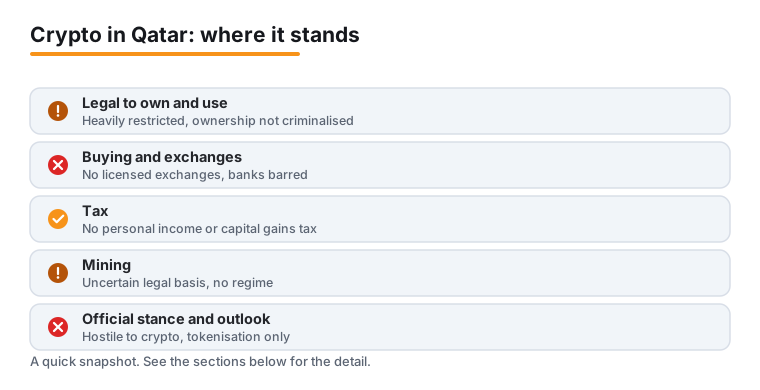
The position is best described as heavily restricted rather than openly legal. Qatar has not passed a law that makes an individual simply owning Bitcoin a criminal act, but it has closed off the regulated infrastructure that would let crypto operate openly, and it has prohibited the financial sector from facilitating it.
The foundational measure is Circular No. 6/2018, issued by the Qatar Central Bank (QCB) in February 2018, which prohibited banks and other licensed financial institutions in Qatar from dealing in Bitcoin and other virtual assets, from allowing customers to use their accounts to deal in them, and from processing money transfers connected to buying or selling them. That prohibition remains in force. In 2019 the QFC Regulatory Authority issued an alert confirming that virtual asset services were not permitted in or from the QFC, and it reaffirmed in 2024 that those restrictions still apply.
In everyday terms:
- Crypto is not legal tender. The Qatari riyal is the only official money, and no merchant is obliged to accept Bitcoin.
- There are no domestically licensed crypto exchanges serving retail customers.
- Banks will not knowingly process crypto-related transactions, and accounts linked to crypto activity can face scrutiny.
- Personal ownership of crypto held abroad or in self-custody is less explicitly addressed, but using local services to buy, sell or trade carries real legal and practical risk.
If you are in Qatar, the safest working assumption is that the regulated financial system is off-limits for cryptocurrencies. Always confirm the current position with the QCB and a qualified local adviser rather than relying on assumptions.
Who regulates crypto in Qatar
Several bodies share responsibility for the rules that affect crypto-assets.
- Qatar Central Bank (QCB) is the monetary authority responsible for banking, payments and financial stability. Its 2018 circular prohibiting financial institutions from dealing in virtual assets is the foundational restriction, and it leads on the national fintech strategy, digital payments and a central bank digital currency project.
- Qatar Financial Centre (QFC) and the QFC Regulatory Authority (QFCRA) govern the QFC, a special onshore jurisdiction with its own legal and regulatory regime. The QFCA issued the Digital Assets Framework and runs the Digital Assets Lab, while the QFCRA supervises firms and issues rules including the AML and CFT regime.
- Qatar Financial Information Unit (QFIU) is the national financial intelligence unit that receives and analyses suspicious transaction reports.
- National Anti-Money Laundering and Terrorism Financing Committee (NAMLC) coordinates AML and CFT policy across government bodies.
- General Tax Authority (GTA) administers corporate and other taxes.
Useful official references include the Qatar Central Bank and the QFC Regulatory Authority. Because interpretations evolve, treat the regulators' own publications as authoritative rather than secondary summaries.
Key laws and frameworks
Qatar's crypto rules sit across two regulatory worlds with a clear policy line dividing them.
The QCB prohibition (2018). Circular No. 6/2018 bars licensed financial institutions from dealing in virtual assets in any form. This is the restriction that keeps cryptocurrencies out of the regulated banking system.
The QFC Digital Assets Framework (2024). Launched on 1 September 2024, this comprises the Digital Asset Regulations 2024 and the Investment Token Rules 2024, alongside amendments to existing QFC rules. It establishes the legal basis for tokenisation, including legal recognition of property rights in tokens and their underlying assets, custody, transfer, exchange and smart contracts. It defines two categories of token:
- Permitted Tokens are digital representations of real rights or assets, such as tokenised securities, sukuk, bonds, commodities or property. These can be created and used within the QFC framework under supervision.
- Excluded Tokens are those that do not represent a right in underlying property, or that act as a substitute for currency or a means of payment. Article 9 of the Digital Asset Regulations makes the exclusion explicit, and the QFCRA has clarified that cryptocurrencies, stablecoins and central bank digital currencies fall squarely into this excluded category.
In short, Qatar has legalised tokenisation of traditional assets while keeping Bitcoin, Ether, stablecoins and similar instruments outside the regulated perimeter. The QFCRA explained the scope in its statement on excluded tokens. Because these instruments and their interpretation change, the authoritative sources are the QCB and QFCRA publications themselves.
Licensing and registration of exchanges and VASPs
There is no licensing route for a retail cryptocurrency exchange to operate inside Qatar. The QCB prohibition prevents financial institutions from facilitating crypto, and the QFCRA has confirmed that virtual asset services are not permitted in or from the QFC. Crypto firms therefore cannot register as licensed exchanges or virtual asset service providers in the way they can in some neighbouring Gulf jurisdictions.
What the QFC framework does allow is regulated activity around permitted tokens, that is, the tokenisation of real-world assets. Firms working on tokenised securities, deposits, real estate and similar instruments can engage with the QFC, and many do so through the QFC Digital Assets Lab, a supervised environment for developing and testing digital-asset products that opened in September 2024 with an initial cohort of 24 screened participants. The framework also introduced a licensing regime for token service providers dealing with permitted tokens inside the QFC. That route is open to tokenisation business models, not to cryptocurrency trading or exchange services.
The practical takeaway is that a business wanting to offer crypto exchange or brokerage services to the public in Qatar has no domestic licence to apply for. Any firm exploring digital-asset activity should engage the QFC and QFCRA directly to understand what is and is not permitted before committing resources.
Crypto and Bitcoin tax in Qatar
Qatar is a low-tax economy, and that shapes the crypto tax picture more than any specific crypto rule does.
For individuals, Qatar does not levy personal income tax on salaries, wages or personal investment income, and it does not impose a general capital gains tax on individuals. There is no specific personal crypto tax provision. In principle, an individual's crypto gains would not fall under a personal income or capital gains charge simply because no such charge exists. This is a consequence of the broader tax system, not an endorsement of crypto.
For businesses the position is different. Corporate income tax generally applies at a standard rate of 10 percent to profits attributable to foreign ownership, with higher rates for specific sectors such as oil and gas, while Qatari and other GCC nationals' shares of profits are typically exempt. QFC entities are taxed under the QFC's own regime. Qatar has also introduced a Domestic Minimum Top-Up Tax for in-scope large multinational groups for fiscal years starting on or after 1 January 2025.
A critical caveat: because crypto services cannot lawfully be provided through Qatar's regulated system, there is no settled, published tax treatment specifically for crypto trading businesses operating domestically. Tax depends on whether you are an individual or a business, on residency and on the nature of the activity, and the rules change. Confirm your position with the General Tax Authority and a qualified tax adviser. See also our general guide to crypto taxes. Nothing here is tax advice, and the absence of a personal tax is not a green light for any particular crypto activity.
AML and KYC rules
Qatar maintains a robust anti-money-laundering and counter-terrorist-financing regime aligned with Financial Action Task Force standards, and these rules are central to how the country approaches virtual assets.
The principal statute is Law No. 20 of 2019 on Combating Money Laundering and the Financing of Terrorism, which was amended by Decree Law No. 18 of 2025. The QCB issues AML and CFT instructions for banks and payment service providers, and the QFCRA maintains its own AML and CFT Rules that apply to all relevant persons operating in or from the QFC, in addition to State law. The Qatar Financial Information Unit (QFIU) receives suspicious transaction reports, and the National Anti-Money Laundering and Terrorism Financing Committee (NAMLC) coordinates policy.
For anyone moving funds, the practical implications are real. Financial institutions apply customer due diligence and know-your-customer checks, monitor transactions and report suspicious activity. Because crypto sits outside the regulated system and is associated with elevated illicit-finance risk, transactions connected to crypto can attract particular scrutiny, and source-of-funds questions are common for larger or unusual flows. Authorities continue to build capacity in this area as part of Qatar's wider AML and CFT programme. The official references are the QFCRA AML and CFT pages and the QFIU.
Buying and using crypto in practice
Because Qatar does not license domestic crypto exchanges and the QCB bars financial institutions from facilitating crypto, there is no straightforward, sanctioned way to buy Bitcoin inside the country through a regulated local platform. This is the single most important practical fact for anyone in Qatar.
Some residents access international exchanges or peer-to-peer arrangements, but doing so carries meaningful risks and limitations:
- Banking friction. Local banks are not permitted to knowingly process crypto transactions. Card payments and transfers to crypto platforms can be blocked, reversed or flagged, and associated accounts may face questions or restrictions.
- Legal and compliance risk. Using local services to buy or sell crypto runs against the QCB prohibition. Peer-to-peer trading can also expose users to fraud and to AML scrutiny.
- No local consumer protection. No Qatari regulator stands behind an offshore platform, so if something goes wrong there is little or no local recourse.
There is likewise no recognised network of sanctioned Bitcoin ATMs in Qatar, since a public riyal-to-crypto kiosk would clash with the QCB prohibition. On using crypto for remittances, despite Qatar's large expatriate workforce, the on and off ramps are precisely the restricted step: converting riyals to crypto and back through local banking rails is what the rules block, so crypto is not a reliable or sanctioned remittance workaround here. For most people, licensed money-transfer operators and banks remain the lawful channel. If you already hold crypto, practise strong self-custody hygiene, use a reputable hardware wallet for meaningful holdings, secure your recovery phrase offline, and keep clear records. Above all, verify the current legal position before taking any action.
Bitcoin mining in Qatar
Qatar has not established a dedicated legal framework that licenses or expressly authorises commercial Bitcoin mining. Against the backdrop of the QCB's restrictive stance on cryptocurrencies, mining sits in an uncertain area rather than a clearly permitted one, and there is no high-profile mining-licence regime of the kind some other countries operate.
Beyond the legal question, the practical economics are distinctive. Qatar has abundant and relatively low-cost energy thanks to its natural gas resources, which in theory is attractive for an energy-intensive activity like mining. But several factors weigh against it:
- Climate. The desert environment brings extreme heat for much of the year, sharply increasing cooling demand and the energy cost of running mining hardware.
- Water and environmental pressure. Freshwater is scarce and large-scale operations face sustainability scrutiny, pushing any serious operator toward efficiency and advanced cooling.
- Regulatory uncertainty. Without an explicit permitting regime and against the crypto prohibition, the legal basis for commercial mining is unclear.
Anyone contemplating mining in Qatar should treat it as a venture requiring direct confirmation from the relevant authorities on legality, electricity supply, business licensing and equipment import rules before committing capital. Cheap energy alone does not make it viable or permitted.
Recent developments (2025 to 2026)
Qatar's trajectory has been deliberate and bounded. The 2024 Digital Assets Framework showed real appetite for blockchain and tokenisation of regulated assets, and the momentum continued into 2025 and 2026.
- Tokenisation gains traction. The QFC Digital Assets Lab opened in September 2024 with an initial group of 24 participants that cleared a screening process, including firms such as Polygon and Partior, working on projects spanning trade finance, real-world asset tokenisation, carbon-credit tokenisation and supporting services. In May 2025 QFC leadership publicly linked future growth to tokenised property, arguing that tokenisation could support economic inclusion and unlock liquidity in Qatar's real-estate sector.
- AML law updated. Decree Law No. 18 of 2025 amended provisions of the 2019 AML and CFT law, and the QCB issued updated AML guidance for banks and payment service providers in 2025.
- Payments and fintech. The QCB advanced its national fintech strategy, launched a mobile payment initiative in 2025, and continued work on open banking and a wholesale central bank digital currency (CBDC). In June 2024 the QCB announced it had completed the infrastructure for its CBDC project and would begin a trial with local and international banks focused on two use cases: instant settlement of large interbank payments, and the purchase of digital securities settled with the CBDC. This wholesale CBDC is a state-controlled settlement tool and is separate from public cryptocurrencies, which remain excluded tokens.
Policymakers have repeatedly drawn a firm line, however: cryptocurrencies, stablecoins and CBDCs remain excluded tokens, and the priority appears to be a tightly governed digital-asset ecosystem rather than open access to decentralised crypto. The reasonable expectation for 2026 is continuity, with tokenisation developing inside the QFC framework while mainstream cryptocurrency trading stays outside the regulated perimeter. Because rules and interpretations can change, verify the current position directly with the QCB and the QFCRA.
Consumer risks and protection
For users connected to Qatar, the risks cluster into a few areas, and the local protections that exist in permissive jurisdictions are largely absent for cryptocurrencies.
- Regulatory and legal risk. The QCB prohibition and the lack of any licensing route mean crypto activity runs against the regulated system.
- Banking risk. Local institutions will not facilitate crypto and may restrict associated accounts.
- Market risk. Crypto prices are highly volatile and can fall sharply, and some tokens fail completely.
- Platform and counterparty risk. With no local regulated venue, users relying on offshore platforms take on jurisdictional and counterparty risk with little or no local recourse if a platform fails, freezes funds or is hacked.
- Fraud. The sector remains exposed to scams, fake investment schemes and phishing, and peer-to-peer dealing amplifies this.
Because there is no Qatari regulator standing behind crypto activity, there is no local compensation scheme or complaints route equivalent to those covering regulated financial products. Sensible principles hold everywhere: understand what you are buying, be deeply sceptical of guaranteed returns, never commit more than you can afford to lose, and consider how the local legal position affects your ability to transact and exit. This is general information, not a recommendation to buy or sell any asset.
Official sources and how to verify
Crypto rules in Qatar evolve and depend on your circumstances, so always confirm the current position with primary official sources rather than secondary summaries, including this page. The most relevant authorities are:
- Qatar Central Bank (QCB), the monetary authority responsible for the 2018 prohibition, payments and the national fintech strategy.
- QFC Regulatory Authority (QFCRA), which supervises the QFC and issued the Digital Assets Framework and the excluded-tokens clarification.
- Qatar Financial Centre (QFC), which runs the Digital Assets Lab and publishes the framework documents.
- General Tax Authority (GTA) for tax matters.
For broader background, see our pages on crypto regulation and country regulation guides. This article is general information current as of 2026 and is not legal, tax or financial advice. Before acting, verify the rules with the named official regulators and consult a qualified local adviser.
Frequently asked questions
Is cryptocurrency legal in Qatar?
Crypto is heavily restricted rather than openly legal. Qatar has not criminalised an individual simply owning Bitcoin, but the Qatar Central Bank has prohibited financial institutions from dealing in virtual assets since 2018 (Circular No. 6/2018), and there is no route to license a domestic crypto exchange. Crypto is not legal tender, and using local services to trade carries real legal and banking risk. Always confirm the current position with the QCB.
Who regulates crypto in Qatar?
Primarily the Qatar Central Bank (QCB), which oversees banking and issued the 2018 prohibition, and the QFC Regulatory Authority (QFCRA), which supervises the Qatar Financial Centre and issued the 2024 Digital Assets Framework. That framework permits tokenisation of real-world assets but classifies cryptocurrencies, stablecoins and CBDCs as excluded tokens outside the regulated regime. The QFIU and NAMLC handle AML and CFT.
Do I pay tax on crypto profits in Qatar?
Qatar has no personal income tax and no general capital gains tax on individuals, so there is no specific personal charge that would apply to an individual's crypto gains. Businesses face corporate tax (a 10 percent standard rate on foreign-attributable profits) and QFC rules, but there is no settled published tax treatment for crypto trading businesses domestically because such services cannot be lawfully provided through the regulated system. Confirm your position with the General Tax Authority. This is not tax advice.
Can I buy Bitcoin or use a crypto exchange in Qatar?
There is no officially sanctioned route. Qatar does not license domestic crypto exchanges or virtual asset service providers, banks will not facilitate crypto transactions, and there is no recognised Bitcoin ATM network. Some residents use offshore or peer-to-peer options, but these carry elevated fraud, banking and compliance risk with little local recourse. Verify the legal position before acting.
What is the QFC Digital Assets Framework, and does it allow crypto?
Launched on 1 September 2024, the QFC Digital Assets Framework (the Digital Asset Regulations 2024 and Investment Token Rules 2024) provides a legal basis for tokenising real-world assets such as securities, bonds, sukuk and property within the Qatar Financial Centre. It does not allow cryptocurrency trading. Article 9 of the regulations classes cryptocurrencies, stablecoins and CBDCs as excluded tokens that fall outside the permitted regime.
Is Bitcoin mining allowed in Qatar?
There is no dedicated framework licensing commercial Bitcoin mining, and against the backdrop of the crypto prohibition its legal basis is uncertain. Qatar has cheap energy, but extreme heat raises cooling costs and water is scarce. Anyone considering mining should confirm legality, electricity arrangements, business licensing and equipment import rules directly with Qatari authorities first.
Is Qatar launching its own digital currency?
Qatar is developing a wholesale central bank digital currency (CBDC), not a public retail coin. In June 2024 the Qatar Central Bank said it had completed the CBDC project infrastructure and would trial it with local and international banks for two use cases: instant settlement of large interbank payments and the settlement of digital securities. This is a state-controlled tool for banks and is separate from Bitcoin and other cryptocurrencies, which the QFC framework classes as excluded tokens. Confirm the current status with the QCB.
What can crypto businesses actually do in Qatar under the 2024 framework?
They can work on tokenising real-world assets, not on cryptocurrency trading. The QFC Digital Assets Framework and its Digital Assets Lab, which opened in September 2024 with 24 screened participants, support projects such as tokenised securities, sukuk, real estate, trade finance and carbon credits under supervision, with a licensing regime for token service providers dealing in permitted tokens. There is no domestic licence for a retail crypto exchange, brokerage or virtual asset service provider. Firms should engage the QFC and QFCRA directly before committing resources.
Facts reviewed: 30 June 2026. Page updated: 3 August 2026.