Home › Crypto Regulation › Macau
Bitcoin and Cryptocurrency Regulation in Macau
Quick answer — Macau, 2026
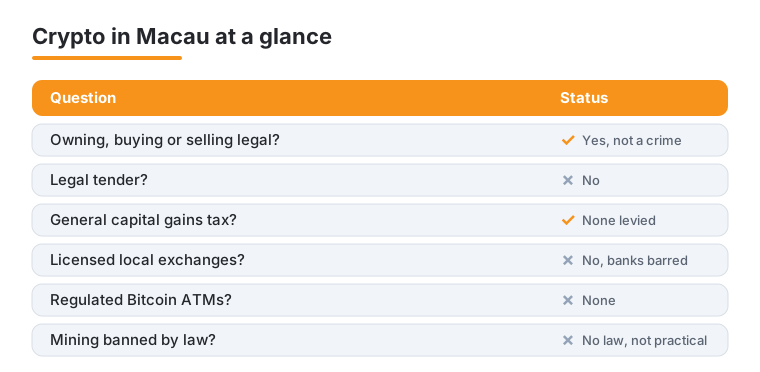
- Owning and trading: not illegal for individuals, but crypto is a virtual commodity, not legal tender, with no consumer protection.
- Tax: no general capital gains tax; business profits may face complementary tax up to 12%.
- Buying: hard. Banks and card issuers are barred from crypto transactions, so funding exchanges from a Macau account is difficult.
Macau (the Macao Special Administrative Region of the People's Republic of China) takes a restrictive, cautious approach to cryptocurrency. There is no dedicated virtual asset law and no licensing regime for crypto exchanges. The Monetary Authority of Macao (AMCM) treats cryptocurrencies such as Bitcoin as virtual commodities that are neither legal tender nor regulated financial instruments, and it has repeatedly warned the public about their risks. At the same time, Macau has been building its own central bank digital currency, the digital pataca (e-MOP), which was given legal-tender status by law in 2023. This page explains the legal status of crypto in Macau, who regulates it, the key laws, taxation, anti-money-laundering rules, and how to verify everything against official sources. It is general information as of 2026, not legal advice; always confirm your situation with the AMCM and a qualified Macau lawyer. For a broader overview, see our guide to crypto regulation.
On this page: Legal status · Who regulates it · Taxes · How to buy · Mining
Legal status of crypto in Macau
Owning, buying or selling cryptocurrency is not a criminal offence in Macau, but crypto enjoys no legal recognition and no consumer protection. The AMCM classifies cryptocurrencies as virtual commodities rather than currency or financial instruments. This means crypto is not legal tender, no merchant is obliged to accept it, and it falls outside the AMCM's regulated perimeter.
In practice, Macau has shut crypto out of the formal financial system. The AMCM has barred local banks and payment institutions from handling crypto-related transactions, and it has stated that operating a business that exchanges crypto to or from fiat money would breach the Financial System Act. Initial coin offerings (ICOs) and the issuance of crypto tokens to the public are effectively prohibited, mirroring the line taken in mainland China. In short, holding crypto privately is tolerated, but anything resembling a regulated crypto business is not permitted under the current framework.
The regulator: Monetary Authority of Macao (AMCM)
The main authority for money and financial services in Macau is the Monetary Authority of Macao, known by its Portuguese initials AMCM (Autoridade Monetaria de Macau). The AMCM supervises banks, payment institutions, insurers and the issuance of the pataca, and it advises the Macau SAR Government on monetary and financial policy.
Because the AMCM does not classify crypto as currency or as a financial instrument, it does not license or supervise crypto exchanges, custodians or token issuers. Instead, its role on crypto has been to issue public warnings, to instruct regulated financial institutions to stay away from crypto activity, and to develop the digital pataca. The gaming sector is overseen separately by the Gaming Inspection and Coordination Bureau (DICJ), which has its own prohibitions on virtual assets in casinos. You can reach the regulator through the official AMCM website at amcm.gov.mo.
Key laws and frameworks
Macau has no standalone crypto statute. The relevant rules sit inside its general financial and currency legislation:
- Financial System Act, Law no. 13/2023 - published in the Macau Official Gazette on 14 August 2023 and in force from 1 November 2023, replacing the 30-year-old Decree-Law no. 32/93/M. It defines what activities are reserved to licensed financial institutions; the AMCM has indicated that running a crypto-to-fiat exchange business would fall foul of this regime.
- Legal System for Currency Issuance (Currency Issuance Act), Law no. 10/2023 - the law that, together with the Financial System Act, gave the digital pataca (e-MOP) legal-tender status.
- AMCM public alerts - including the 2014 Notice on "Caution against Engagement in Bitcoin Transactions" and the standing "Alert to Risks of Virtual Commodities and Tokens" published on the AMCM website.
There is no Macau equivalent of the EU's MiCA, Hong Kong's VASP licensing regime, or Singapore's Payment Services Act. Anyone relying on these points should read the actual texts in the Macau Official Gazette (Boletim Oficial).
Licensing and registration of exchanges and VASPs
There is currently no licensing or registration framework for virtual asset service providers (VASPs) in Macau. The AMCM does not grant crypto exchange licences, custody licences or token-issuance approvals, because crypto sits outside the activities it regulates.
In practice this is more of a closed door than an open one. Since exchanging crypto to or from fiat as a business may breach the Financial System Act, a would-be operator cannot simply apply for permission, and unauthorised financial activity can attract enforcement. This contrasts sharply with neighbouring Hong Kong, which has built a dedicated VASP licensing regime. One caveat on future direction: a proposed overhaul of Macau's anti-money-laundering law is under sectoral consultation that would define VASPs and require authorisation before conducting virtual-asset business in Macau. That is a draft proposal, not enacted law, and no licensing pathway exists today, but it is the first formal sign of one being considered. If you are planning any crypto-related business activity touching Macau, treat the absence of a licence pathway as a serious legal obstacle and obtain professional advice before proceeding. See also our country-by-country regulation hub for how other jurisdictions compare.
Taxation of crypto in Macau
Macau has a simple, territorial and relatively low-tax system, and it has no dedicated cryptocurrency tax rules. Two features matter most for crypto holders:
- No general capital gains tax. Macau does not levy a separate capital gains tax, so gains from selling crypto held as a personal investment are not taxed, because capital gains are not taxable to individual recipients in Macau. PwC's Macau SAR tax summary states that capital gains and investment income are not taxable to individual recipients, the only exception being dividends received from local corporations.
- Complementary (profits) tax. Business profits sourced in Macau are subject to complementary tax at progressive rates up to 12%, with an exempt threshold on the first portion of taxable income. If crypto activity amounts to a trade or business carried on in Macau, those profits could fall within complementary tax.
Because the tax treatment of crypto specifically is undefined, the line between non-taxable investment gains and taxable business profits decides whether you pay anything at all. Business profits fall under complementary tax: the exemption amount for income subject to Profits Tax for the fiscal year 2025 is MOP 600,000, and taxable income above that is taxed at 12 percent, under the reliefs set by Law no. 13/2025, the Budget for the Fiscal Year 2026. Confirm your position with the Macau Financial Services Bureau (DSF) and a tax adviser. For general background, see our guide to crypto taxes.
AML and KYC requirements
Macau has a well-developed anti-money-laundering and counter-terrorist-financing (AML/CTF) regime, driven partly by its position as a major gaming hub and by the money-laundering risks the AMCM repeatedly cites when warning about crypto. Banks, payment institutions, casinos and other reporting entities must perform customer due diligence (KYC), monitor transactions and report suspicious activity to the authorities.
Because regulated institutions are instructed to avoid crypto, the practical effect is that the formal AML system filters crypto out rather than supervising crypto businesses directly. Banks may refuse or block transfers to crypto exchanges, and casinos are barred from virtual-asset transactions. There is no crypto-specific AML rulebook (such as a Travel Rule regime for VASPs) because there are no licensed VASPs to apply it to. Anyone moving significant value should expect close scrutiny from banks and a low tolerance for crypto-linked flows.
A proposed replacement for Macau's 2006 AML regime went to sectoral consultation and, if enacted, would establish legal definitions of virtual assets and virtual asset service providers for the first time in Macau law, require operators involved in virtual asset activities to obtain authorisation before conducting business, and extend monitoring to virtual asset accounts alongside bank, gaming and payment accounts, create a central register of beneficial ownership, and require covered entities to retain customer verification records for at least 15 years. It remains a draft under consultation rather than enacted law.
Buying and using crypto in practice
For an individual, holding crypto in a private self-custody wallet or on an overseas exchange is not illegal in Macau, but actually getting money in and out is the hard part. Local banks and card issuers are barred from facilitating crypto-related transactions, so you generally cannot fund an exchange account from a Macau bank account or buy crypto with a Macau-issued credit card.
Crypto is also not accepted as a means of payment for everyday goods and services, and it is specifically prohibited in casinos and gaming-related transactions. Reporting suggests that stablecoins such as USDT do circulate around the gaming ecosystem through informal and illegal money changers, but that is an underground market with no legal protection and significant legal risk. If you use any platform, treat it as fully outside Macau's regulatory and consumer-protection safety net.
Bitcoin ATMs in Macau
Macau does not host a recognised, regulated network of Bitcoin ATMs. Given that local financial institutions are barred from crypto-related transactions and there is no VASP licensing regime, there is no legal basis for operating cash-to-crypto kiosks as a licensed financial service. Travellers should not assume that crypto ATMs are available or lawful in Macau.
Any machine claiming to offer crypto-for-cash conversion in Macau would sit in a legal grey-to-prohibited zone and would carry elevated fraud and AML risk. If you need to convert crypto, do not rely on Macau infrastructure; and never use informal money changers, which operate outside the law. When in doubt, verify the legal position directly with the AMCM before acting.
Crypto mining in Macau
There is no specific Macau law that authorises or bans cryptocurrency mining, and Macau is not a meaningful mining location. As a small, densely populated SAR with limited land and relatively high electricity costs, it offers none of the conditions that attract large-scale mining operations.
Mining is also unattractive from a regulatory standpoint: with banks instructed to avoid crypto, monetising mined coins through the local financial system is effectively closed off, because AMCM has required banks and payment services institutions in Macao not to participate in or provide, directly or indirectly, any financial services that involve the use of virtual currencies or virtual commodities as the means of payment, and any commercial mining business could raise licensing, tax and AML questions. In effect, mining is neither encouraged nor practical in Macau. Mainland China's broad 2021 crackdown on mining further signals the policy direction in the wider Chinese context.
Recent developments (2024-2026)
The headline development in Macau is not private crypto but the digital pataca (e-MOP), Macau's central bank digital currency. Following the 2023 currency and financial-system reforms that gave it legal-tender status, the AMCM announced that the e-MOP prototype system was completed by the end of 2024, with sandbox and public testing to follow. By 2026 the e-MOP had moved into sandbox and whitelist transaction testing under a three-phase rollout, with Bank of China (Macau) designated as the first-phase operating entity. The AMCM has been broadening these trials to e-government, public transport and university campus scenarios, and is working toward an official launch targeted around 2027. The AMCM has said the e-MOP will carry the same legal status and value as banknotes and coins, and that it intends to connect the e-MOP with the mainland's e-CNY and Hong Kong's e-HKD to support payments across the Greater Bay Area.
That cross-border link became operational in June 2026, when the AMCM joined Project mBridge, the multi-CBDC cross-border bridge that also involves mainland China, Hong Kong, Thailand, the United Arab Emirates and Saudi Arabia. The platform went live for Macau on 2 June 2026 with 11 local banks authorised to take part, and the first cross-border trade-settlement and remittance transactions, including e-MOP transfers, were completed in the opening days.
On private crypto, the stance has remained restrictive into 2025-2026, with continued warnings and gaming-sector prohibitions rather than any active licensing regime. There is, however, a notable proposal in train: an overhaul of Macau's anti-money-laundering framework is under sectoral consultation that would replace the 2006 AML regime, align it with Financial Action Task Force (FATF) standards, create legal definitions for virtual assets and virtual asset service providers (VASPs), require operators to obtain authorisation before conducting virtual-asset business in Macau, and let authorities freeze virtual assets linked to crime. This is a draft under consultation, not enacted law, and no VASP licensing regime exists yet, but it signals the likely future direction. Treat any claim of a new crypto licence regime already in force in Macau with caution and verify it against the AMCM.
Cross-border payments and the Greater Bay Area
Macau's official direction on digital money is cross-border rather than private crypto. Through the digital pataca and Project mBridge, the AMCM is positioning Macau within the Greater Bay Area payment network that links Macau with mainland China, Hong Kong and Guangdong. Macau joined mBridge on 2 June 2026 as the sixth participating jurisdiction, alongside mainland China, Hong Kong, Thailand, the United Arab Emirates and Saudi Arabia.
On the first day of operation, three banks completed 23 cross-border transactions covering trade settlement and international remittances, with a combined value of about MOP 1.3 billion. These flows use central-bank digital currency and authorised commercial banks, not public cryptocurrencies. For an individual holding Bitcoin or a stablecoin, none of this creates a legal on-ramp; the mBridge and e-MOP systems are closed to bank participants and government-backed money, and private crypto remains outside the formal system.
Consumer risks
Crypto in Macau carries the usual risks plus some local ones. Because crypto is unregulated and sits outside the AMCM's perimeter, there is no investor compensation, no licensed local exchange to complain to, and no regulatory recourse if a platform fails or a scam occurs.
- Banking friction: transfers to crypto platforms may be blocked or reversed, and accounts can be frozen if crypto activity is suspected.
- Underground money changers: using informal or illegal exchangers (common around gaming) exposes you to fraud, theft and AML/criminal liability.
- Scams impersonating regulators: fraudsters may falsely claim AMCM approval; the AMCM itself publishes alerts about virtual-asset risks.
- Volatility and total-loss risk: as everywhere, crypto prices can fall sharply and assets can be lost permanently.
Assume that if something goes wrong with crypto in Macau, you are largely on your own.
Official sources and how to verify
Rules and statements can change, so always confirm against primary sources rather than relying on summaries. The most authoritative starting points are:
- Monetary Authority of Macao (AMCM) - the financial regulator, including its press releases and alerts on virtual commodities and tokens.
- Macau Official Gazette (Boletim Oficial) - where laws such as the Financial System Act (Law no. 13/2023) and the Currency Issuance Act (Law no. 10/2023) are published.
- Macao SAR Government Portal - official gateway to government departments, including the Financial Services Bureau (DSF) for tax matters.
This page is general information as of 2026 and is not legal advice; verify your specific situation directly with the AMCM and a qualified Macau lawyer or tax adviser before acting. For wider context, see our crypto regulation guide.
Macau in August 2026: what changed and what did not
Nothing in Macau law changed for crypto holders over the northern summer of 2026. There is still no crypto-specific statute, no licensing regime for exchanges, and no crypto tax. All of the movement is upstream of that, in a draft anti money laundering law that went to sectoral consultation at the start of June 2026 and has not yet reached the Legislative Assembly.
- 1 July 2026. AMCM told the Legislative Assembly, in a written reply to member Si Ka Lon, that the digital pataca (e-MOP) sandbox is being widened into public transport with the Transport Bureau, e-government services and university campuses. AMCM said the basic infrastructure and core system for the e-MOP were completed at the end of 2025 (Macau Daily Times, 1 July 2026).
- Sandbox stage, 2027 target. e-MOP transaction testing is being conducted through a whitelist of users, and the launch target remains 2027 (Macau Daily Times, 2 June 2026).
- 15 June 2026. The State Council appointed Ng Wai Han, until then head of the Gaming Inspection and Coordination Bureau (DICJ), as Secretary for Economy and Finance, the portfolio under which AMCM sits. The decision was taken on 10 June 2026 (Macao SAR Government Portal).
- 14 to 23 July 2026. The IMF ran its Article IV mission and issued its concluding statement on 29 July, projecting 3.3 percent growth for 2026 and noting that Macao's fiscal and external positions remain strong, with the financial system well capitalised and liquid. It announced no change of policy on virtual assets (Xinhua, 30 July 2026; Plataforma Media).
- Unchanged. AMCM's standing position is that virtual currencies are virtual commodities which are neither legal tenders nor financial instruments, and that all banks and payment services institutions in Macao must not participate in or provide, directly or indirectly, any financial services that involve the use of virtual currencies or virtual commodities as the means of payment (AMCM statement, 6 August 2018).
The draft anti money laundering law: what it would do to crypto, and how far along it is
This is the only live legislative pipeline in Macau that touches crypto. The 2026 Policy Address, published on 18 November 2025, committed the government to studying amendments to Law no. 2/2006, Prevention and Suppression of Money Laundering Crime, and Administrative Regulation no. 7/2006 on preventive measures, in response to the latest revision of international anti money laundering standards and changes in criminal patterns (2026 Policy Address). A draft that would replace the 2006 regime went to sectoral consultation at the start of June 2026.
| What is proposed | What it would mean in practice | Stage |
|---|---|---|
| Legal definitions of "virtual asset" and "virtual asset service provider" | First time either term would exist in Macau law. Today crypto has no statutory definition at all. | Consultation draft |
| Authorisation required before conducting virtual asset business | An exchange, broker or OTC desk serving Macau would need permission before doing business. Administrative penalties are graded minor, common and serious. | Consultation draft. Public reporting does not name which body would issue the authorisation. |
| Virtual assets classified as "goods or advantages derived from unlawful acts" when connected to criminal conduct | Brings crypto squarely inside the proceeds of crime machinery. | Consultation draft |
| Central register of beneficial ownership, plus a prohibition on anonymous accounts and shell banks | Companies and legal entities operating in Macau would have to record who ultimately controls them. | Consultation draft. This part and its sanctions are planned to take effect at a later stage than the rest. |
| Customer verification records retained for at least 15 years, with broader compliance obligations on banks, gaming operators and other covered organisations | A far longer paper trail on any account used to move crypto proceeds. | Consultation draft |
| Judges given authority to temporarily suspend financial operations where suspicious transactions are identified | Transfers could be halted while an investigation runs rather than after the fact. | Consultation draft |
Sources for the draft's contents: World Casino Directory, 1 June 2026, reporting the consultation document via Macau Business and Tribuna de Macau, and Surveillance Intelligence Asia, 4 June 2026, which describes it as the most significant rewrite of the territory's AML architecture in nearly two decades.
On timing, be precise about what is not known. No consultation closing date, no bill number and no date for introduction in the Legislative Assembly has been published, and neither report sets out the next procedural step or a timetable. A draft replacing a law would have to pass the Legislative Assembly to take effect, but no source states when that might happen, so treat any specific date you see elsewhere with suspicion.
The driver is external. Macau is a member of the Asia/Pacific Group on Money Laundering, which states that the Global 5th Round of mutual evaluations began in 2024, with APG-only evaluations commencing in 2026 (APG). The direction has been signalled for two years: in June 2024 the then Secretary for Economy and Finance, Lei Wai Nong, said the government would explore whether certain categories of virtual asset activity could be opened up where risk is controllable, and would draft or revise the relevant laws, regulations and supervisory guidelines (AASTOCKS via Yahoo Finance, 13 June 2024).
The rules that do apply to crypto in Macau right now
Macau has no crypto-specific law. That is worth saying once and then moving on, because a reader still needs to know which instruments actually bite. Every item below is a named law, regulation or notice that can be checked.
| Instrument | What it does to crypto | Concrete detail |
|---|---|---|
| Financial System Act, Law no. 13/2023 (in force 1 November 2023) | AMCM has declared that virtual assets are not legal tender, and the reported position is that exchanging crypto to or from fiat money would violate the Financial System Act. | Reported by Macao News. The Act's commencement date is confirmed by MdME. |
| AMCM notices of 20 September 2017 and 6 August 2018 | Banks and payment services institutions must not participate in or provide, directly or indirectly, any financial services that involve the use of virtual currencies or virtual commodities as the means of payment. | This is why a Macau card or bank transfer to an exchange fails. It is a regulatory instruction, not a bank preference (AMCM alert, 27 September 2017; AMCM statement, 6 August 2018). |
| Law no. 2/2006, Prevention and Suppression of Money Laundering Crime, and Administrative Regulation no. 7/2006 | The general AML regime. It imposes no crypto-specific duties, which is precisely the gap the 2026 consultation draft is written to close. | Law no. 2/2006 was published in the Official Gazette, series I, issue 14, on 3 April 2006 (Legislative Assembly record). |
| Law no. 20/2024, Law on Combating Illegal Gaming Crimes (in force 17 October 2024) | Carrying out an exchange of money for the purpose of gambling without legal authorisation is an offence, and exchange conducted within casinos or in affiliated and neighbouring facilities is treated as being for gaming. | Maximum penalty five years' imprisonment, plus a casino entry ban of between two and ten years, not including the period of imprisonment (IFLR). Enforcement is real: in February 2026 police shut down an operation run from a jewellery store inside a Cotai casino that had exchanged nearly HK$40 million, about US$5.1 million, for gamblers since April 2025 (Gambling News, 11 February 2026). |
| DICJ instructions to gaming operators | Explicit instructions prohibit any gaming-related transactions, services or activities involving virtual assets. | No Macau casino may accept crypto for gaming (Macao News). |
| Law no. 24/2024, the Tax Code, promulgated 30 December 2024, effective 1 January 2026 | Consolidates Macau tax law and introduces the territorial principle, transfer pricing and permanent establishment concepts. It creates no crypto tax and no capital gains tax. | Passed by the Legislative Assembly on 16 December 2024 (EY; PwC). |
| Complementary tax on business profits, reliefs set by Law no. 13/2025 (2026 Budget) | Applies if crypto activity is carried on as a business rather than held as a personal investment. | The exemption amount for income subject to Profits Tax for the fiscal year 2025 is MOP 600,000, and taxable income in excess of that is taxed at 12 percent. A 5 percent rate applies to corporate treasury centre income and to authorised investment fund activity (Financial Services Bureau; PwC). |
| No capital gains tax on individuals | A resident selling crypto held as a personal investment owes nothing on the gain. | PwC's Macau summary states that capital gains and investment income are not taxable to individual recipients, except for dividends received from local corporations. There are also no inheritance, estate, gift or net wealth taxes (PwC; PwC). |
| No capital markets framework for crypto assets | There is no regulatory framework in place regarding crypto assets or crypto infrastructure, and local financial institutions are barred from participating in transactions related to crypto assets. | Confirmed in a Macau capital markets comparative guide dated 17 September 2024 (Mondaq). |
Frequently asked questions
Is cryptocurrency legal in Macau?
Holding, buying and selling crypto privately is not a crime in Macau, but crypto is not legal tender and is not regulated by the Monetary Authority of Macao (AMCM), which treats it as a virtual commodity. Crypto businesses are effectively shut out: banks are barred from crypto transactions, ICOs are prohibited, and running a crypto-to-fiat exchange may breach the Financial System Act. There is no consumer protection if something goes wrong.
Who regulates crypto in Macau?
The main financial regulator is the Monetary Authority of Macao (AMCM, Autoridade Monetaria de Macau), reachable at amcm.gov.mo. However, because the AMCM does not classify crypto as currency or as a financial instrument, it does not license or supervise crypto exchanges or token issuers. Its role on crypto has been to issue warnings and to keep regulated institutions away from it. The gaming regulator, the DICJ, separately prohibits virtual assets in casinos.
Do I pay tax on crypto in Macau?
Macau has no dedicated crypto tax rules. It does not levy a general capital gains tax, so gains on crypto held as a personal investment are generally not taxed as capital gains. However, profits from a crypto trade or business carried on in Macau could fall within complementary (profits) tax, which runs at progressive rates up to 12%. Because the position is undefined, confirm with the Macau Financial Services Bureau (DSF) and a tax adviser.
Can I use a crypto exchange or Bitcoin ATM in Macau?
There are no licensed local crypto exchanges and no recognised, regulated Bitcoin ATM network in Macau. Local banks and card issuers are barred from facilitating crypto transactions, so funding an exchange from a Macau bank account is difficult. Crypto is also banned in casinos. Any informal money changer offering crypto conversion operates outside the law and carries serious fraud and legal risk.
What is the digital pataca (e-MOP)?
The e-MOP is Macau's official central bank digital currency, a digital version of the pataca issued under the AMCM's authority. It was given legal-tender status by Macau's 2023 currency and financial-system laws, meaning it is meant to have the same legal status and value as banknotes and coins. A prototype was completed by the end of 2024, and by 2026 the e-MOP had entered sandbox and whitelist testing, run initially by Bank of China (Macau), with an official launch targeted around 2027. In June 2026 Macau also joined Project mBridge, a multi-CBDC cross-border platform, completing its first cross-border e-MOP transactions. The e-MOP is a government-backed currency and is completely different from private cryptocurrencies such as Bitcoin.
Is Macau about to regulate crypto exchanges?
Not yet. As of 2026 there is no licensing regime for crypto exchanges or other virtual asset service providers (VASPs) in Macau, and running a crypto-to-fiat exchange business may breach the Financial System Act. However, a proposed overhaul of Macau's anti-money-laundering law is under sectoral consultation that would define VASPs, require authorisation before conducting virtual-asset business in Macau, and allow authorities to freeze crypto linked to crime. It is a draft proposal aligned with FATF standards, not enacted law, so verify the current position with the AMCM before relying on it.
How can I verify the current rules in Macau?
Check primary sources directly. Use the Monetary Authority of Macao website (amcm.gov.mo) for regulatory statements and alerts, the Macau Official Gazette (Boletim Oficial) for the actual texts of laws such as the Financial System Act (Law no. 13/2023), and the Macao SAR Government Portal (gov.mo) for tax and departmental information. This page is general information as of 2026, not legal advice, so verify your situation with the AMCM and a qualified Macau lawyer.
Can I pay with crypto at a Macau casino?
No. The gaming regulator, the Gaming Inspection and Coordination Bureau (DICJ), has issued explicit instructions prohibiting any gaming-related transaction, service or activity involving virtual assets, so casinos cannot accept crypto for chips or settlements. Reporting suggests stablecoins such as USDT and USDC still circulate around the gaming scene through illegal money changers who swap them for Hong Kong dollars, but that is an underground market with no legal protection and serious fraud and criminal risk.
Is Macau part of any cross-border digital currency network?
Yes, but for central-bank money, not private crypto. On 2 June 2026 Macau joined Project mBridge, a multi-CBDC cross-border platform whose members include mainland China, Hong Kong, Thailand, the United Arab Emirates and Saudi Arabia. On the first day, three banks completed 23 cross-border transactions worth about MOP 1.3 billion. mBridge and the digital pataca are closed to authorised banks and government-backed money and do not give individuals a legal way to move Bitcoin or other cryptocurrencies.
Has anything changed for crypto in Macau since mid 2026?
No. There is still no crypto-specific law, no exchange licensing regime and no crypto tax in Macau. The only live development is a draft replacement for the 2006 anti money laundering regime, which went to sectoral consultation at the start of June 2026 and has not been introduced in the Legislative Assembly.
What would the new anti money laundering law actually require of a crypto exchange?
Under the consultation draft reported in June 2026, operators involved in virtual asset activities would have to obtain authorisation before conducting business, with administrative penalties graded into minor, common and serious categories. The draft would also establish legal definitions of virtual asset and virtual asset service provider in Macau law for the first time. Public reporting does not name which body would grant the authorisation, and no bill number, consultation closing date or Legislative Assembly date has been published.
How much tax would I pay on crypto profits in Macau?
If you hold crypto as a personal investment, nothing. PwC's Macau summary states that capital gains and investment income are not taxable to individual recipients, the only exception being dividends from local corporations. If you trade crypto as a business, complementary tax applies: the exemption amount for income subject to Profits Tax for the fiscal year 2025 is MOP 600,000, and taxable income above that is taxed at 12 percent, under the reliefs set by Law no. 13/2025.
Why does my Macau bank card get declined by crypto exchanges?
Because AMCM has explicitly required all banks and payment services institutions in Macao not to participate in or provide, directly or indirectly, any financial services that involve the use of virtual currencies or virtual commodities as the means of payment. That instruction was reiterated in AMCM notices of 20 September 2017 and 6 August 2018 and has not been withdrawn. It is a regulatory requirement on the bank, not a bank policy you can appeal.
Is it a crime to swap stablecoins for cash near a Macau casino?
Unauthorised money exchange for gambling is a criminal offence. Law no. 20/2024, the Law on Combating Illegal Gaming Crimes, in force since 17 October 2024, sets a maximum penalty of five years' imprisonment for carrying out an exchange of money for the purpose of gambling without legal authorisation, plus a casino entry ban of between two and ten years on conviction, and exchange carried out within a casino or in affiliated and neighbouring facilities is treated as being for gaming. No published source confirms whether the word money in that provision extends to stablecoins, so treat crypto conversion near a casino floor as legally untested rather than clearly covered.
Does Macau have a new tax law that affects crypto?
Macau's new Tax Code, Law no. 24/2024, was passed by the Legislative Assembly on 16 December 2024, promulgated on 30 December 2024 and took effect on 1 January 2026. It consolidates Macau tax law and introduces the territorial principle, transfer pricing and permanent establishment rules, but it creates no crypto-specific tax and does not introduce a capital gains tax.
When will the digital pataca launch?
The target remains 2027. AMCM said the basic infrastructure and core system were completed at the end of 2025, and as of 1 July 2026 transaction testing is running through a whitelist of users and is being widened into public transport, e-government services and university campuses. The digital pataca is central bank money, not a cryptocurrency.
Facts reviewed: 3 August 2026. Page updated: 3 August 2026.
Related guides
More countries in the region
Practical guides