Home › Crypto Regulation › Saudi Arabia
Bitcoin & Cryptocurrency Regulation in Saudi Arabia
Quick answer — Saudi Arabia, 2026
- Legal: Restricted, not legal tender, no licensed local exchange
- Tax: No personal income tax, zakat and VAT may apply
- Buying: No licensed local exchanges, residents use foreign platforms
Saudi Arabia takes a cautious, restrictive stance on cryptocurrency. The Kingdom has not recognised Bitcoin or other cryptoassets as legal tender, has not licensed any domestic crypto exchange, and its financial authorities have repeatedly warned the public against trading virtual currencies. Banks and licensed financial institutions are not permitted to deal in cryptocurrencies without prior approval from the Saudi Central Bank (SAMA). At the same time, the Kingdom is investing heavily in blockchain, digital payments, a central bank digital currency (CBDC) and, as of late 2025, a planned framework for nationally regulated stablecoins under its Vision 2030 agenda.
This guide explains the practical reality of cryptocurrency regulation in Saudi Arabia as it stands in 2026: who regulates the space, whether Bitcoin is legal, how tax may apply, how people buy and use crypto, and what recent developments mean for the outlook. This is general information as of 2026 and is not legal, tax, or financial advice. Because the framework is evolving and parts of it are not codified in a single statute, always verify current requirements with the named official regulators (notably SAMA and the Capital Market Authority) and a qualified local adviser before acting. See our overview of crypto regulation for global context.
On this page: Legal status · Who regulates it · Taxes · How to buy · Mining
Is Bitcoin and crypto legal in Saudi Arabia?
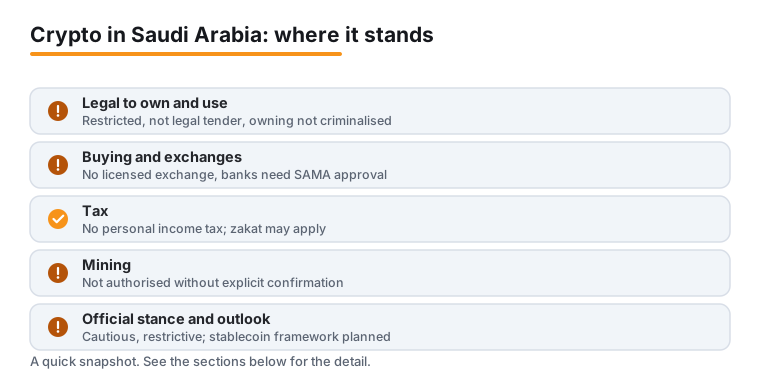
The legal status is best described as restricted rather than cleanly legal or outright banned for individuals. Cryptocurrencies are not recognised as legal tender, no cryptoasset is recognised as a regulated financial product, and there is no licensed domestic crypto exchange. A government standing committee that included SAMA has stated that virtual currencies are not recognised as official in the Kingdom and that no party is licensed to deal in them. The Ministry of Finance and SAMA have publicly warned the public against dealing or investing in virtual currencies, noting they sit outside the regulated financial system and carry high risk and links to fraud.
Crucially, banks and licensed financial institutions are prohibited from handling cryptocurrency transactions without SAMA's approval. There is, however, no specific law that makes it a criminal offence for an individual simply to own or trade crypto through external platforms. The practical result is a tightly cautious environment: residents who use crypto do so outside any sanctioned, supervised framework and without local consumer protection. Because the position is evolving, verify the current rules with official sources before acting.
Who regulates crypto: SAMA, CMA and others
Saudi Arabia does not have a single dedicated crypto regulator. Oversight is shared by the financial authorities that govern banking and capital markets:
- Saudi Central Bank (SAMA) supervises banks, payments and the monetary system. SAMA prohibits licensed banks and financial institutions from dealing in virtual currencies without its approval, and it has been developing CBDC initiatives.
- Capital Market Authority (CMA) regulates securities and capital markets. The CMA warns investors against unlicensed schemes and suspicious websites, and has taken enforcement action against unlicensed investment promotion, including via social media.
- Zakat, Tax and Customs Authority (ZATCA) administers zakat, corporate income tax, VAT and customs.
- The Anti-Money Laundering Permanent Committee and the Saudi Financial Intelligence Unit coordinate AML and counter-terrorist-financing measures.
For any digital-asset framework, SAMA and the CMA are the authorities to watch. Their planned joint work on regulated stablecoins (announced in late 2025) signals that future supervision of digital assets is likely to fall under these two bodies.
Key laws and frameworks
There is no single comprehensive cryptocurrency act in Saudi Arabia. Instead, the position is shaped by existing financial laws and official guidance:
- SAMA's powers over banks and payment services, used to restrict institutions from facilitating crypto without approval.
- The CMA's capital-markets mandate and its investor-warning and enforcement activity.
- The Anti-Money Laundering Law and its implementing regulations, aligned with Financial Action Task Force (FATF) standards, which impose KYC and reporting duties on regulated entities.
- The zakat, income tax and VAT rules administered by ZATCA.
Notably, Saudi Arabia is not part of any regional bloc with a unified crypto statute equivalent to the EU's Markets in Crypto-Assets (MiCA) regulation; it sets its own rules domestically. Through 2025 and into 2026, officials signalled work on a framework for nationally regulated stablecoins under SAMA and CMA oversight, but detailed rules on licensing, reserves and consumer protection had not been published at the time of writing. Treat any specific activity as carrying regulatory uncertainty until rules are formally issued.
Licensing and registration of exchanges and VASPs
As of 2026 there is no dedicated licensing regime for cryptocurrency exchanges or virtual asset service providers (VASPs) operating under Saudi law, and no crypto exchange is licensed to operate domestically. SAMA's authorised-institution lists and the CMA's licensed-entity lists do not include crypto exchanges as a recognised category. Operating an unlicensed financial or investment service can attract enforcement action: the CMA has penalised unlicensed investment activity, including promotion via messaging apps and social platforms.
In practice, residents who hold crypto typically use international or regional platforms regulated elsewhere, rather than a Saudi-licensed venue. If a future digital-asset or stablecoin framework is introduced, licensing and registration requirements are likely to sit with SAMA and the CMA. Until then, do not assume any platform is officially sanctioned in the Kingdom; check the regulators' official websites for who is and is not licensed. See our regulation hub for how other countries license exchanges.
Crypto and Bitcoin taxation
Saudi Arabia's tax system is structurally different from most Western countries, which shapes how crypto is treated. The Kingdom does not levy a personal income tax on individuals, so there is currently no specific personal capital-gains tax targeting ordinary individuals who sell crypto at a profit. That does not mean crypto is automatically tax-free in every situation. Other considerations administered by the Zakat, Tax and Customs Authority (ZATCA) can apply:
- Zakat is an Islamic wealth levy (commonly 2.5 percent of the zakat base) on Saudi and GCC-owned individuals and entities; qualifying crypto holdings may form part of the assessed wealth base depending on circumstances and scholarly interpretation.
- Corporate income tax of 20 percent generally applies to the profits attributable to foreign-owned companies; a crypto-related business may fall within this.
- VAT at the standard rate can apply to services such as exchange fees, even where the treatment of the underlying asset transfer is different.
Because digital-asset tax treatment is not codified in a dedicated statute and can change, do not rely on generic figures or assume gains are tax-free. Confirm your position with ZATCA or a qualified Saudi tax adviser. Read our general guide to crypto taxes for background, and treat this section as information, not tax advice.
AML and KYC requirements
Saudi Arabia maintains a robust anti-money-laundering (AML) and counter-terrorist-financing (CTF) regime aligned with FATF standards. The Anti-Money Laundering Law and its implementing regulations require regulated financial institutions to apply a risk-based approach: customer identification and verification (Know Your Customer, or KYC), enhanced due diligence for higher-risk clients, appointment of a compliance/reporting officer, transaction monitoring, and reporting of suspicious transactions.
The Anti-Money Laundering Permanent Committee (chaired by the Governor of SAMA and including the Ministry of Interior, Ministry of Justice and the CMA, among others) coordinates national policy, while the Saudi Financial Intelligence Unit collects and analyses suspicious-transaction reports. For anyone using crypto, the practical implication is that reputable platforms accepting Saudi customers will require full identity verification, and that flows in and out of the banking system are subject to monitoring. Anonymous, large-scale crypto activity is neither realistic nor advisable.
Buying and using crypto in practice
Because there is no licensed domestic exchange and banks need SAMA approval to handle crypto, buying and using cryptocurrency in Saudi Arabia involves real friction:
- Banking restrictions. Funding an account directly from a Saudi bank or card can be unreliable, and transfers may be delayed, blocked or reversed.
- KYC is standard. Reputable platforms require official ID and verification before you can trade meaningful amounts.
- No domestic backstop. If a platform fails or a transaction goes wrong, local recourse is limited, since these services are not licensed under a Saudi crypto framework.
- Use cases. Cross-border remittances are a frequently discussed use case given the Kingdom's large expatriate workforce, but on- and off-ramp friction and volatility reduce the practical benefits, and the activity carries the same regulatory uncertainty as other crypto use.
If you choose to proceed, prioritise well-established platforms with strong security and transparent fees, enable two-factor authentication, move larger holdings to a personal (ideally hardware) wallet, back up your recovery phrase offline, and never share it. Be cautious of any scheme promising guaranteed returns, which the CMA has repeatedly warned against. Bitcoin ATMs are effectively not part of the everyday landscape in the Kingdom.
Bitcoin mining
No dedicated law specifically authorises or licenses commercial Bitcoin mining as a regulated activity in Saudi Arabia, and the same regulatory caution that applies to trading applies here. The Kingdom does have attributes that make large-scale mining technically attractive, including abundant energy and major renewable-generation projects under Vision 2030, which in theory could support lower-carbon mining than fossil-heavy grids elsewhere.
In practice, several hurdles remain. Electricity tariffs, grid access and approvals for energy-intensive industrial loads are tightly managed, so cheap power being available does not mean mining is freely permitted. A mining enterprise would also engage business-licensing, customs, and AML rules, and any profits attributable to a foreign-owned business would fall within the corporate tax regime. Anyone exploring mining at meaningful scale should obtain legal advice and engage the relevant authorities rather than relying on energy availability; do not assume commercial mining is permitted without explicit confirmation.
Recent developments (2025 to 2026)
The most significant recent shift is around stablecoins and digital payments. In late 2025, a Saudi government minister publicly indicated the Kingdom is looking to launch nationally regulated stablecoins in partnership with the Capital Market Authority and the Saudi Central Bank, framed as part of Vision 2030's push to modernise the financial system and support faster, cheaper transactions. Global crypto exchanges publicly backed the Kingdom's stablecoin and digital-asset ambitions around the same period.
Important caveats apply: as of 2026 the stablecoin initiative remained at the policy-design stage, with detailed rules on licensing, reserve backing and consumer protection not yet published. SAMA has separately continued CBDC work; its cross-border experimentation includes Project Aber, an earlier joint proof of concept with the Central Bank of the UAE that tested a single, dual-issued wholesale digital currency for settlement between the two countries. Separately, the CMA has signalled work on a broader digital-asset and tokenisation framework, but as of 3 August 2026 no consultation has opened, no draft rulebook has been published, and the CMA press release archive records no digital asset or tokenisation framework. The CMA has also continued enforcement against unlicensed investment activity and consulted on capital-market structures that could, over time, accommodate token funds. As of 3 August 2026 no crypto rulebook has been issued. The operative instrument is still the Standing Committee statement of 12 August 2018, which cautions against trading in virtual currencies including Bitcoin and states that no parties or individuals are licensed for such practices by regulators in the Kingdom. Confirm the latest status directly with the official regulators.
Consumer risks and protection
The defining risk in Saudi Arabia is regulatory uncertainty combined with the absence of a local consumer-protection backstop. Because no crypto exchange is licensed domestically, residents who use external platforms have limited local recourse if a service fails, funds are frozen, or a transaction goes wrong. Banking restrictions add friction and the risk of blocked transfers, while crypto's inherent price volatility means you can lose a substantial portion or all of your capital.
Scams are a real and recurring danger. The CMA has repeatedly warned against suspicious websites and unlicensed schemes promising investment returns, and has penalised unlicensed promotion. Protect yourself by checking whether a person or firm is licensed via the regulators' official lists, ignoring offers that promise guaranteed or unrealistic returns, securing your accounts and wallets, and never sharing private keys or recovery phrases. For observant investors, the Shariah-compliance of specific assets and activities is a separate matter that may require scholarly guidance. Never invest more than you can afford to lose.
Official sources and how to verify
Because the rules are evolving and partly uncodified, always confirm the current position with primary official sources rather than third-party summaries. The key authorities and their official websites are:
- Saudi Central Bank (SAMA) for banking, payments and CBDC matters: sama.gov.sa
- Capital Market Authority (CMA) for securities, investor warnings and licensed-entity lists: cma.org.sa
- Zakat, Tax and Customs Authority (ZATCA) for zakat, tax and VAT: zatca.gov.sa
- Anti-Money Laundering Permanent Committee for AML/CTF policy: aml.gov.sa
To verify whether a platform or adviser is authorised, check SAMA's and the CMA's official licensed-entity lists. This article is general information as of 2026 and is not legal, tax, or financial advice; readers should verify current requirements with the named official regulators and seek qualified local advice before acting. For broader context, see our crypto regulation guide.
What Is Changing: Verified Status as of 3 August 2026
Saudi Arabia's crypto legal position did not change between 30 June 2026 and 3 August 2026. That is a checked statement, not an assumption. Here is what was checked and what each source showed.
- The Saudi Central Bank news archive, reviewed through its most recent item dated 30 July 2026, carries no virtual asset, crypto or stablecoin announcement. Its 2026 items cover open banking licences, debt-based crowdfunding licences, consumer microfinance licences, senior appointments, money exchange licence revocations and the IMF Article IV consultation.
- The Capital Market Authority press release archive carries no digital asset, virtual asset or stablecoin framework. Its 2026 items are the 2025 annual report published 14 July 2026, a graduate development programme intake, and the website domain change. The most recent framework approval recorded in the annual report is a robo-advisory framework approved in March 2026.
- The CMA FinTech Lab page limits experimentation to financial products and services related to securities activities. It names no digital asset licence category and does not mention crypto, virtual assets, tokenisation or security tokens.
- The SAMA Rulebook section on Anti-Money Laundering and Combating the Financing of Terrorism contains no virtual asset or virtual asset service provider obligations, and its definition of financial institution covers conventional banking and financial activities only.
- The IMF concluded its 2026 Article IV consultation with Saudi Arabia. The Ministry of Finance statement welcoming it, dated 3 June 2026, addresses growth, debt, reserves, the Public Investment Fund and banking sector resilience. It makes no reference to digital assets, crypto or stablecoins.
One practical correction: the Capital Market Authority launched its website under an updated domain, cma.gov.sa, on 6 May 2026. The Official Sources list on this page still shows cma.org.sa. Old links are not broken, since cma.org.sa issues a permanent redirect to the same path on the new domain, but the listed address should be updated.
The Named Instruments That Actually Apply
Saudi Arabia has no crypto-specific law. Said once: there is no statute that licenses, bans or defines cryptocurrency. What governs the space instead is a short list of named instruments, and a reader is better served knowing them than being told the position is unclear.
| Instrument | Date | What it actually does |
|---|---|---|
| Standing Committee statement on virtual currencies | 12 August 2018 | Issued by the Standing Committee for Awareness on Dealing in Unauthorized Securities Activities in the Foreign Exchange Market, formed by supreme decree and chaired by the CMA, with the Ministry of Interior, Ministry of Media, Ministry of Commerce and Investment and SAMA. It cautions against trading in forex and virtual currencies including Bitcoin, and states that no parties or individuals are licensed for such practices by regulators in the Kingdom. This is the operative instrument. It withholds authorisation; it does not criminalise individual ownership. |
| Ministry of Finance warning | 20 August 2019 | States virtual currencies are not recognised by legal entities in the Kingdom and fall outside its regulatory framework. Warns that any use of the Saudi name, national currency or emblem to market a virtual or digital currency will be subject to legal actions by the competent authorities, citing "Crypto Riyal" as an example. |
| Anti-Money Laundering Law, Royal Decree No. M/20 | 5/2/1439H, 25 October 2017 | The general AML statute: customer due diligence, ongoing monitoring, suspicious transaction reporting and record retention. It contains no virtual asset service provider category. This is the law that reaches crypto activity, and it reaches it indirectly, through the proceeds rather than the platform. |
| Amendment to the AML Law, Royal Decree No. D/223, approving Cabinet Decision No. 748 | Gazetted 17 April 2026, in force | Amends Articles 14, 15, 16 and 18 (removing explicit non-profit references), Article 28 (Hajj and Umrah re-entry for deported convicted persons), Article 50 (Implementing Regulations issued by the President of State Security), and adds Article 33(2), a power to confiscate a perpetrator's additional funds that are disproportionate to his lawful income, plus Article 49 on national risk-based AML policy. It introduces nothing on virtual assets. |
The 2026 amendment matters precisely because of what it omits. It is the Kingdom's most recent financial-crime legislation, it took effect the day after its publication in Umm Al-Qura issue 5155 on 17 April 2026, and it declined to create a licensing perimeter for crypto businesses. Anyone waiting for regulation to arrive through the AML route should read that as a negative signal. Sources: Royal Decree D/223 text and gazette reference, CMS legal update of 7 May 2026 for the article-by-article detail, and CMA and Ministry of Finance for the two warnings.
Tax: The Rates That Apply
The page currently gives no percentage figures. These are the rates in force, per PwC's Saudi Arabia tax summaries, last reviewed 29 July 2026.
| Charge | Rate | Who it applies to |
|---|---|---|
| Individual income tax | None | There is no individual income tax scheme in Saudi Arabia, and income tax is not imposed on an individual's earnings if derived only from employment. See the caveat below before assuming a trading gain is untaxed. |
| Corporate income tax | 20% of net adjusted profits | The share of a business attributable to non-Saudi and non-GCC ownership. Applies to trading or mining profits earned through a company. Oil and hydrocarbon production is taxed at 50% to 85% and is not relevant here. |
| Zakat | 2.5% of the Zakat base | The share attributable to Saudi and GCC ownership. The base is the net worth of the entity as calculated for Zakat purposes. |
| VAT | 15% | Standard rate since 1 July 2020, raised from the 5% that applied when the VAT Law took effect on 1 January 2018. Relevant to exchange and service fees rather than to a transfer of coins itself. |
| Real Estate Transaction Tax | 5% | Total real estate disposal value. Relevant because tokenised Saudi property title is the one live blockchain use case in the Kingdom. |
Two gaps worth stating plainly rather than smoothing over. First, PwC's summaries do not address capital gains for an individual holding cryptocurrency, and they note that non-employment income is taxed as an entity or permanent establishment. The absence of an individual income tax scheme is therefore not the same as a published confirmation that an individual's crypto trading gain is tax free, and this page should not claim otherwise. Second, ZATCA has issued no crypto-specific guidance that could be located, and Bloomberg Tax records that "current rules do not expressly address blockchain-based or tokenized ownership structures", recommending a private clarification request to ZATCA as the route to certainty (Bloomberg Tax, 23 December 2025). Rate sources: personal income, corporate income and Zakat, VAT and RETT.
The Pipeline: What Is Coming, and How Firm It Is
The honest summary of the pipeline is that one item is a completed transaction, one is ministerial intent with no timetable, and the recent legislation that could have created a crypto regime deliberately did not.
| Item | Stage | Timing |
|---|---|---|
| Real estate tokenisation under REGA and the Real Estate Registry | Executed, but not a framework. Ledger Insights reported on 20 November 2025 that Saudi Arabia completed its first tokenisation of a real estate title deed, traded between the National Housing Company and multiple investors, with regulatory oversight from the Real Estate General Authority and blockchain infrastructure operated by the national Real Estate Registry with SettleMint and Inspire for Solutions Development. | Already executed. No public REGA rulebook or technical tokenisation standard exists: REGA's English news index carries no tokenisation item at all as of 3 August 2026. |
| Nationally regulated stablecoins under SAMA and the CMA | Announced only. Housing Minister Majed al-Hogail said in November 2025 that the government aims to introduce stablecoins with the Capital Market Authority and the Central Bank. No draft rules, licensing categories, reserve requirements or consumer protection provisions exist. | The minister said "soon" and gave no date. No consultation paper has opened at either regulator since. |
| Amendment to the AML Law | In force. Royal Decree No. D/223 approving Cabinet Decision No. 748. Contains no virtual asset provisions. | Gazetted in Umm Al-Qura issue 5155 on 17 April 2026, effective the following day. |
| Crypto exchange licensing regime | Nothing announced, drafted or consulted on. | No timetable exists. |
Two distinctions are worth holding onto. First, tokenisation and cryptocurrency are being treated as separate things in Saudi Arabia: property title on a controlled registry has regulatory backing, while tradable cryptocurrency does not. Second, the stablecoin statement came from the housing minister in the context of property settlement, not from SAMA or the CMA, and neither regulator has confirmed a supervisory split in writing. Legal analysis describes the Kingdom's approach as substance over form, with a token that behaves like an investment or security falling within the CMA's perimeter and a product that functions more like money, payments or stored value raising concerns for SAMA, and notes that regulators remain cautious where such products would be offered to retail users (Legal 500 Saudi Arabia fintech guide). Separately, banks in Saudi Arabia are reported to be prohibited from engaging in cryptocurrency transactions without explicit SAMA approval (ICLG fintech chapter, 2025 edition).
Frequently asked questions
Is Bitcoin legal in Saudi Arabia?
Bitcoin is not recognised as legal tender and there is no licensed domestic crypto exchange. Authorities, including the Saudi Central Bank (SAMA) and the Ministry of Finance, have warned against dealing in virtual currencies, and banks are prohibited from handling crypto transactions without SAMA's approval. There is no specific law making individual ownership a criminal offence, so the status is best described as restricted rather than cleanly legal or outright banned. Verify the current rules with official sources before acting.
Who regulates cryptocurrency in Saudi Arabia?
There is no single dedicated crypto regulator. Oversight is shared mainly by the Saudi Central Bank (SAMA), which governs banking and payments, and the Capital Market Authority (CMA), which regulates securities and warns against unlicensed schemes. The Zakat, Tax and Customs Authority (ZATCA) handles tax, and the Anti-Money Laundering Permanent Committee coordinates AML policy. Any future digital-asset framework is expected to fall under SAMA and the CMA.
Do I have to pay tax on crypto profits in Saudi Arabia?
Saudi Arabia does not levy a personal income tax on individuals, so there is currently no specific personal capital-gains tax targeting ordinary crypto sales. However, zakat may apply to qualifying wealth for Saudi and GCC individuals and entities, a 20 percent corporate income tax can apply to foreign-owned businesses, and VAT can apply to services such as exchange fees. Digital-asset tax treatment is not codified in a dedicated statute and can change, so confirm your position with ZATCA or a qualified Saudi tax adviser. This is not tax advice.
Can I use my Saudi bank account to buy crypto?
It can be difficult. Banks and licensed financial institutions are prohibited from facilitating cryptocurrency transactions without SAMA's approval, so funding an exchange directly from a Saudi bank account or card may be unreliable, and transfers can be delayed, blocked or reversed. Many residents use international or regional platforms, but they should understand the banking friction, the lack of local consumer protection, and the regulatory uncertainty involved.
Is Saudi Arabia going to regulate crypto and stablecoins soon?
It appears to be moving in that direction. In late 2025, officials indicated the Kingdom is looking to launch nationally regulated stablecoins in partnership with the Capital Market Authority and the Saudi Central Bank, aligned with Vision 2030. As of 2026, however, the initiative remained at the policy-design stage, with detailed rules on licensing, reserves and consumer protection not yet published, and cryptoassets in general remained tightly regulated. Check SAMA's and the CMA's official websites for the latest status.
How can I check whether a crypto platform or adviser is licensed in Saudi Arabia?
Use the official regulators' websites. The Capital Market Authority (cma.org.sa) and the Saudi Central Bank (sama.gov.sa) publish lists of licensed and authorised entities, and the CMA warns against suspicious websites and unlicensed schemes. If a firm or individual is not on the relevant official list, or promises guaranteed returns, treat it as a serious red flag and do not deal with it.
Is Bitcoin mining legal in Saudi Arabia?
There is no dedicated law that specifically authorises or licenses commercial Bitcoin mining as a regulated activity in Saudi Arabia, and the same regulatory caution that applies to trading applies to mining. The Kingdom has abundant energy and large renewable projects under Vision 2030, but electricity tariffs, grid access and approvals for energy-intensive industrial loads are tightly managed, so available power does not mean mining is freely permitted. A mining business would also engage licensing, customs, AML and corporate tax rules. Anyone exploring mining at scale should get legal advice and confirm the position with the relevant authorities rather than assuming it is allowed.
Has Saudi Arabia issued a digital-asset or tokenisation framework?
Not yet in final form. The Capital Market Authority has signalled work on a broader digital-asset and tokenisation framework, and reporting suggested a public consultation could follow later in 2026, but as of 3 August 2026 neither SAMA nor the CMA has published a consultation paper, draft rulebook or licensing category for stablecoins or virtual assets, and the SAMA news archive reviewed through its most recent item of 30 July 2026 contains no such item. Separately, the Kingdom indicated in late 2025 that it is looking to launch nationally regulated stablecoins under SAMA and CMA oversight, though that too remained at the policy-design stage. Until formal rules are issued, treat digital-asset activity as carrying regulatory uncertainty, and check SAMA's and the CMA's official websites for the current position.
Is crypto legal in Saudi Arabia in August 2026?
There is no law that makes owning or trading cryptocurrency a criminal offence for an individual. There is also no law that permits it, and no exchange can be licensed to operate domestically. The governing instrument is the Standing Committee statement of 12 August 2018, which cautions against trading in virtual currencies including Bitcoin and states that no parties or individuals are licensed for such practices by regulators in the Kingdom. Nothing has superseded it as of 3 August 2026. The accurate description is unauthorised rather than banned.
Do I pay tax on crypto gains in Saudi Arabia?
There is no individual income tax scheme in Saudi Arabia, so there is no personal income tax charge on employment earnings. That is not the same as published confirmation that an individual's crypto trading gain is tax free: PwC notes that non-employment income is taxed as an entity or permanent establishment, and ZATCA has issued no crypto-specific guidance. If you trade or mine through a company, corporate income tax at 20% applies to the non-Saudi and non-GCC ownership share and Zakat at 2.5% of the Zakat base applies to the Saudi and GCC share. VAT at 15% can apply to exchange and service fees. For a significant position, a private clarification request to ZATCA is the route to certainty.
Can I use a Saudi bank to buy crypto?
Banks in Saudi Arabia are reported to be prohibited from engaging in cryptocurrency transactions without explicit SAMA approval, and the SAMA Rulebook contains no virtual asset framework under which such approval would be granted. There is no domestic licensed venue and no local consumer recourse if an offshore platform fails.
When will Saudi Arabia publish stablecoin or crypto rules?
No date has been announced. The only on-the-record statement is Housing Minister Majed al-Hogail's remark in November 2025 that the government aims to introduce stablecoins with the Capital Market Authority and the Central Bank, and he gave no timetable. As of 3 August 2026 neither regulator has opened a consultation or published a draft. The amendment to the Anti-Money Laundering Law that came into force on 18 April 2026 introduced no virtual asset provisions, which suggests a licensing perimeter is not imminent through that route.
Saudi Arabia tokenised a property on a blockchain. Does that mean crypto is being legalised?
No. These are separate tracks. Ledger Insights reported on 20 November 2025 that the first Saudi title deed had been tokenised and traded between the National Housing Company and investors, supervised by the Real Estate General Authority on infrastructure run by the national Real Estate Registry. That is tokenised property title on a controlled registry, not tradable cryptocurrency, and it created no route to owning or trading Bitcoin under Saudi supervision. REGA has published no tokenisation rulebook or technical standard.
Facts reviewed: 5 August 2026. Page updated: 5 August 2026.