Home › Crypto Regulation › Thailand
Bitcoin & Cryptocurrency Regulation in Thailand
Quick answer — Thailand, 2026
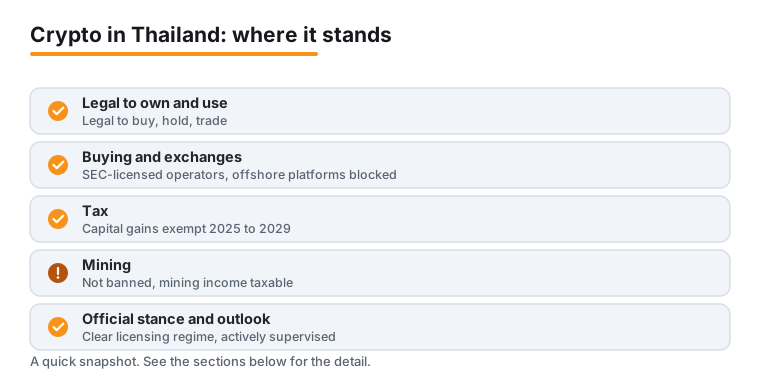
- Legal: Legal to hold and trade, not legal tender; use as payment restricted
- Tax: Capital gains from licensed exchanges exempt 2025 to 2029; mining taxed as income
- Buying: Via SEC-licensed exchanges with KYC, funded in Thai baht
Thailand is one of Southeast Asia's most actively regulated cryptocurrency markets. Buying, selling and holding crypto is legal, but it sits inside a defined licensing regime rather than a free market. Two authorities matter most: the Securities and Exchange Commission of Thailand (SEC), which licenses and supervises digital asset businesses, and the Bank of Thailand (BOT), the central bank, which guards payments, monetary policy and financial stability. The headline rules are easy to state. You can trade and hold crypto through SEC-licensed operators, but crypto is not legal tender and you generally cannot use it to pay for everyday goods and services, and dealing through unlicensed offshore platforms can carry penalties.
This guide explains the current legal status, who regulates what, how tax works, the licensing rules for exchanges, AML and KYC obligations, and the practical realities of buying and using crypto in Thailand as of 2026. Thai rules have changed repeatedly, so treat the specifics here as a starting point and confirm anything that affects your money with an official source. This article is general information as of 2026 and is not legal, tax or financial advice; verify the current position with the SEC and the Bank of Thailand. For background concepts, see our overview of crypto regulation.
On this page: Legal status · Who regulates it · Taxes · How to buy · Mining
Is Bitcoin and crypto legal in Thailand?
Yes. Buying, selling, holding and trading cryptocurrency is legal for both residents and foreigners in Thailand. Crypto is not banned, but it is also not legal tender. The legal foundation is the Emergency Decree on Digital Asset Businesses B.E. 2561, commonly called the Royal Decree on Digital Asset Business, which came into force on 14 May 2018 and created a formal category of "digital assets" covering cryptocurrencies and digital tokens.
The most important distinction for newcomers is between holding crypto as an asset and spending it as money. Investing in and trading crypto through SEC-licensed platforms is permitted. Using crypto as a means of payment for goods and services is restricted: on 18 March 2022 the SEC issued Notification No. 5/2565, effective from 1 April 2022, which prohibits licensed digital asset operators from facilitating the use of crypto as a means of payment, citing volatility, financial-stability and consumer-protection concerns shared with the Bank of Thailand and the Ministry of Finance. So in practice crypto in Thailand behaves more like a regulated investment asset than like cash.
Authorities have also tightened the perimeter against unlicensed operators. Royal Decree amendments that took effect on 13 April 2025 introduced an extraterritorial licensing requirement, meaning offshore platforms that target Thai users can be required to obtain a Thai license, and unauthorized platforms can be blocked. The takeaway is that crypto activity is legal when it runs through properly licensed channels.
Who regulates crypto in Thailand?
Two bodies share responsibility, with the SEC as the primary day-to-day regulator of crypto businesses.
- Securities and Exchange Commission of Thailand (SEC): the SEC licenses and supervises digital asset businesses, sets investor-protection and conduct rules, approves which tokens may be listed, enforces against unlicensed operators, and runs the digital asset regulatory sandbox. Its official site is sec.or.th.
- Bank of Thailand (BOT): the central bank oversees payments, monetary stability and how regulated financial institutions engage with digital assets. The BOT prohibits financial institutions from directly running digital asset businesses, leads policy on Thai-baht stablecoins and a central bank digital currency, and has run programmable-payment and stablecoin sandboxes. Its official digital asset page is at bot.or.th.
The Ministry of Finance and the Revenue Department are also relevant: the Ministry of Finance proposes tax and market-structure policy, and the Revenue Department administers tax on digital asset activity. Anti-money-laundering oversight sits with the Anti-Money Laundering Office (AMLO).
Key laws and frameworks
Thailand's crypto framework is built around licensing, disclosure, anti-money-laundering controls and a regulatory sandbox. The core pieces include:
- Royal Decree on Digital Asset Businesses B.E. 2561 (2018): the primary law defining "digital assets" (cryptocurrencies and digital tokens) and requiring exchanges, brokers and dealers to be licensed and supervised by the SEC.
- 2025 Royal Decree amendments (effective 13 April 2025): the Emergency Decree on Digital Asset Businesses (No. 2) B.E. 2568 added Section 26/1, which extends Thai licensing to operators outside Thailand that serve people inside Thailand. Seven criteria can trigger it, including Thai-language content, a .th or .ไทย domain, accepting Thai baht or payment from Thai bank or e-money accounts, requiring Thai law or Thai courts for disputes, paying for search engine optimisation aimed at Thai users, and keeping an office or staff in Thailand. A parallel decree on technology crime gave the Ministry of Digital Economy and Society power to order access to unlicensed platforms blocked, which it used against five offshore exchanges from 28 June 2025.
- SEC notifications: the SEC issues detailed rules, including the 2022 notification restricting the use of digital assets as a means of payment, and rules governing token listings, custody and conduct.
- Bank of Thailand notifications: govern how financial institutions may engage with digital assets and set the direction on stablecoins and a CBDC.
- Anti-money-laundering law: licensed operators are reporting entities subject to KYC and suspicious-transaction reporting obligations enforced by AMLO.
Because the rules are actively evolving, always check the SEC and BOT for the latest licensing lists and notifications before acting. For a general primer, see how crypto regulation works.
Licensing and registration of exchanges (VASPs)
The lawful way to operate or use a crypto exchange in Thailand is through an operator licensed by the SEC. Under the Royal Decree, the SEC licenses several categories of digital asset business, which include digital asset exchanges, brokers and dealers, and which have been expanded over time to cover fund managers, advisers and custodial wallet providers within the regulatory sandbox framework.
Key points for users and operators:
- Use licensed operators: the SEC publishes lists of approved digital asset operators on sec.or.th. Trading through an unlicensed or blocked offshore platform can expose you to legal risk and offers little recourse if something goes wrong.
- Offshore platforms are in scope: since the April 2025 amendments, foreign platforms that target Thai users (for example through Thai-language services, Thai baht support, local marketing or references to Thai law) can be required to be licensed.
- Enforcement is active: on 29 May 2025 the SEC named five unlicensed platforms serving Thai users, Bybit, OKX, CoinEx, XT.com and 1000X, and filed complaints with the Economic Crime Suppression Division, after which the Ministry of Digital Economy and Society blocked access from 28 June 2025. Enforcement also reaches licensed firms: on 23 July 2026 the SEC filed a criminal complaint against Bitkub Online, Thailand's largest exchange, and two former directors, alleging false reports that concealed a May 2021 hack of about 1.7 billion baht in customer assets.
- Standards apply: licensed operators must meet operational, custody, capital, AML and investor-protection requirements.
Before signing up, confirm a platform's license status directly with the SEC and review fees, withdrawal terms and security features.
Crypto taxation in Thailand
Crypto can create tax obligations in Thailand, and the treatment depends on the type of activity and the rules in force at the time. The headline 2025 development is a temporary exemption on capital gains.
- Five-year capital-gains exemption (2025 to 2029): Thailand introduced a personal income tax exemption on capital gains from the sale or exchange of digital assets, applying from 1 January 2025 through 31 December 2029, provided the transactions are carried out through SEC-licensed exchanges, brokers or dealers. It was formalized through Ministerial Regulation No. 399 (B.E. 2568), published in the Royal Gazette on 5 September 2025.
- Scope is limited to qualifying gains: the exemption applies to individuals only, and covers the gain, meaning sale price less acquisition cost and direct fees, on disposals made through an SEC-licensed Thai exchange, broker or dealer. Companies trading digital assets do not qualify. Trades on unlicensed platforms, DeFi and decentralised exchange swaps, peer-to-peer and wallet-to-wallet sales outside licensed operators, derivatives, and lending or interest income all fall outside it. Mining and staking rewards are not mentioned in Ministerial Regulation No. 399 and their treatment is unconfirmed pending Revenue Department guidance.
- Exemption is not the same as no reporting: gains may still need to be identified, calculated and reflected when filing a Thai tax return.
Tax rules here have shifted in recent years and the exemption is time-limited. Where crypto income is not exempt, it is taxed at Thailand's progressive personal income tax rates, which run from nil on the first 150,000 baht of net income to 35 per cent on income above 5,000,000 baht, and a 15 per cent withholding obligation applies under Section 50(2)(f) of the Revenue Code outside trades carried out through SEC-approved exchanges. Confirm the current position with the Thai Revenue Department or a qualified tax professional, and see our general guide to crypto taxes. This is not tax advice.
AML and KYC rules
Licensed digital asset operators in Thailand are subject to anti-money-laundering and counter-terrorism-financing obligations overseen by the Anti-Money Laundering Office (AMLO), in addition to SEC conduct rules.
In practice this means:
- Identity verification: expect to provide government ID when opening an account. Foreigners are typically asked for passport and home-country documentation. Accounts are tied to verified identities, so crypto trading through licensed channels is not anonymous.
- Ongoing monitoring: operators must monitor transactions and file suspicious-transaction reports.
- Crypto-to-cash services: exchange-style cash services and ATMs are expected to sit within the same regulated, KYC-bound framework, so do not assume any crypto-for-cash channel is anonymous.
- Tourist conversion scheme: the TouristDigiPay sandbox requires KYC and customer due diligence in line with AMLO criteria, caps spending at 50,000 baht a month at small general merchants and 500,000 baht a month at merchants with card terminals, and lets tourists withdraw money only on closing the account rather than as cash against a top-up balance.
Treat any platform that does not ask for identity verification as a red flag for being unlicensed.
Buying and using crypto in practice
A typical, compliant path to buying crypto in Thailand looks like this:
- 1. Choose a licensed platform. Confirm the exchange or broker holds a current SEC license by checking the SEC's published operator list.
- 2. Open and verify an account. Complete KYC with identity documents. Foreigners should be ready to provide passport and any additional documents requested.
- 3. Fund your account. Licensed exchanges typically support Thai baht deposits through local banking channels, subject to limits and checks.
- 4. Place your order. Buy Bitcoin or another listed asset, reviewing fees and spreads first. The SEC influences which tokens may be listed, so the menu can be narrower than on offshore venues. USDC and USDT were added to the approved list in 2025.
- 5. Secure your holdings. Use two-factor authentication and strong passwords, and consider self-custody for larger amounts. Always double-check wallet addresses before sending.
On using crypto day to day: you generally cannot pay merchants directly in crypto, because the 2022 SEC rules restrict crypto as a means of payment. The 2025 TouristDigiPay sandbox lets foreign visitors convert digital assets into Thai baht held in a regulated e-money wallet for spending, but even there tourists cannot pay merchants directly in crypto; everything routes through licensed operators and regulated e-money. Avoid unlicensed offshore platforms and informal peer-to-peer deals, which can carry legal risk and offer little protection.
Bitcoin mining in Thailand
There is no outright ban on Bitcoin mining in Thailand, but miners face two main constraints: electricity economics and tax treatment. Thailand's grid is not among the cheapest in the region, and tropical heat raises cooling costs, so profitability depends heavily on power pricing and hardware efficiency. Interest in renewable-powered mining, particularly solar, has grown as a way to lower running costs.
On tax, mining is generally treated as an income-generating activity rather than as exempt investment trading. That means mining rewards can be taxable income and likely fall outside the 2025 to 2029 capital-gains exemption, which is aimed at gains from selling digital assets through licensed operators. Anyone planning an operation should also weigh business registration, hardware import duties, electricity-supply rules and local requirements. Confirm the current position with the Revenue Department or a tax professional before scaling up.
Recent developments (2025 to 2026)
Thailand's direction has been toward integrating crypto into a supervised perimeter rather than retreating from it. Notable recent steps include:
- Approved stablecoins (March 2025): the SEC added USD Coin (USDC) and Tether (USDT) to its list of permitted cryptocurrencies for digital asset transactions.
- Tax incentive (effective 1 January 2025): the five-year personal income tax exemption on capital gains from digital asset sales through licensed operators, running to 31 December 2029.
- Tighter perimeter (effective 13 April 2025): Royal Decree amendments adding extraterritorial licensing for offshore platforms and stronger powers against unlicensed and peer-to-peer services, followed by enforcement actions blocking several unlicensed international platforms.
- TouristDigiPay (launched 18 August 2025): a regulated sandbox letting foreign tourists convert digital assets into Thai baht held in e-money wallets for spending, with KYC, spending limits and no direct cash withdrawals. Operator applications ran from 25 September to 26 December 2025. Merchants are paid in Thai baht, not crypto.
- Programmable payment and stablecoin work: the Bank of Thailand has run sandboxes for programmable payments and Thai-baht stablecoins, and the government advanced a tokenized government investment token initiative (the G-Token) in 2025. The Cabinet approved the G-Token plan on 13 May 2025, the SEC rules came into force on 21 July 2025, and the initial issuance was framed as around 5 billion baht, with retail access reported from as little as 100 baht.
- Digital assets in derivatives (10 February 2026): the Cabinet approved a Ministry of Finance proposal to expand the permissible reference assets under the derivatives framework so that cryptocurrencies (and carbon credits) can be used as underlying assets in Thailand's regulated futures and derivatives market. The SEC then consulted on letting an already licensed digital asset business apply for a derivatives licence directly, instead of setting up a separate company, with the consultation running from 22 April to 20 May 2026. It has given the third quarter of 2026 as its target for issuing the crypto futures rules and opening licence applications. The amendment to the Derivatives Act B.E. 2546 itself has not been enacted, and contract specifications still have to be agreed with the Thailand Futures Exchange.
Because this area moves quickly, treat any specific date or detail as something to re-verify with the SEC and BOT.
Consumer risks and protection
Regulation reduces some operational risk but does not remove market or fraud risk. The main risks for crypto users in Thailand fall into a few buckets:
- Market risk: crypto prices are volatile and assets can fall sharply. Licensing does not change that. Only commit money you can afford to lose.
- Unlicensed and blocked services: using offshore platforms that are not licensed in Thailand, or informal peer-to-peer services, can expose you to legal risk and leaves little recourse if funds are lost. Some major international platforms have been blocked for operating without authorization.
- Fraud and security: scams, phishing, fake investment schemes and exchange failures remain common across the industry. Thailand's 2025 measures specifically target online financial crime and unauthorized platforms.
- Regulatory change: rules on payments, tax and licensing have shifted before and the tax exemption is time-limited. What is allowed or tax-favored today may differ later.
Protection comes mainly from sticking to SEC-licensed operators, keeping records, using strong security, and verifying claims against official sources. This is general information, not financial advice.
Official sources and how to verify
For anything that affects your money, rely on primary, official sources rather than third-party summaries. The most important are:
- Securities and Exchange Commission of Thailand (SEC): licensing of digital asset businesses, approved operator lists, token rules and enforcement notices. See SEC Thailand and its digital asset business pages.
- Bank of Thailand (BOT): payments policy, stablecoins, financial-institution rules and CBDC work. See the Bank of Thailand digital asset page.
- Thai Revenue Department: the authority on crypto tax, including the scope and conditions of the 2025 to 2029 exemption.
To verify a platform before using it, check that it appears on the SEC's licensed operator list. To verify a tax position, consult the Revenue Department or a qualified Thai tax professional. For our broader coverage, see the regulation hub. This article is general information as of 2026 and is not legal, tax or financial advice; always confirm the current rules with the SEC and the Bank of Thailand.
Status as of August 2026: what has and has not changed
Nothing in the basic legal position changed between the last review of this page on 30 June 2026 and the start of August 2026. The Emergency Decree on Digital Asset Businesses B.E. 2561 still governs, crypto is still not legal tender, the 2022 restriction on paying for goods and services with digital assets still applies, and the personal income tax exemption on gains realised through licensed operators still runs to 31 December 2029. What moved was the machinery being built on top of that base.
- SEC criminal complaint against Bitkub, 23 July 2026. The SEC filed a complaint with the Economic Crime Suppression Division against Bitkub Online, Thailand's largest crypto exchange, and two former directors, Sakolkorn Sakavee and Thaweesap Rawan. The allegation is that daily net capital reports filed between May and October 2021 gave false information and concealed a hack of about 1.7 billion baht, roughly 50 million US dollars, across 16 digital assets. Bitkub replaced the stolen assets by the end of October 2021. The case now sits with police and prosecutors, who decide whether it goes to court. See CoinDesk, 27 July 2026.
- Travel Rule consultation closed 10 July 2026. The SEC's second public consultation on a draft notification that would apply FATF Recommendation 16 to Thai digital asset operators opened on 26 June 2026 and closed on 10 July 2026. It had not been issued as a final notification when this page was updated. See Silk Legal and Hoonsmart, 26 June 2026.
- Crypto ETF and crypto futures rules still pending. The SEC has given the third quarter of 2026, meaning July to September, as its target for issuing the crypto ETF rules and for opening crypto futures licence applications. Neither had been published as final rules as of 3 August 2026. See Thansettakij, 8 April 2026 and eFin, 20 May 2026.
- Scale of the licensed market. In May 2026 the SEC said it supervised 24 licensed digital asset businesses across six categories, holding more than 1 billion US dollars in customer assets. See InfoQuest, 21 May 2026.
What is coming next, and roughly when
Thailand already has crypto legislation, so the useful question is what is being added and on what timetable. Four measures are in the pipeline as of August 2026. None of them is law yet.
| Measure | Stage | What it would mean in practice | Expected timing |
|---|---|---|---|
| Crypto exchange traded funds | Draft rules. Approved in principle by the Capital Market Supervisory Board in February 2026, public consultation comments due 11 May 2026. | Passive single-asset spot ETFs on Bitcoin and Ether only, listed in Thailand, each averaging at least 80 per cent net exposure to its coin over the fiscal year, classified in risk spectrum 8 or above, and custodied by a Thai licensed digital asset custodian. Retail buyers get regulated exposure without holding coins. | SEC target is the third quarter of 2026. Not final as of 3 August 2026. See Chandler MHM, 17 April 2026. |
| Crypto futures and options on TFEX | Cabinet approved the Ministry of Finance proposal on 10 February 2026. The amendment to the Derivatives Act B.E. 2546 has not been enacted, and the SEC still has to write the supporting rules and agree contract specifications with the exchange. | Cryptocurrencies and approved digital tokens, plus carbon credits and renewable energy certificates, could serve as reference assets for regulated futures and options. Gives onshore hedging and leveraged exposure. | SEC target is the third quarter of 2026 for the rules and for opening licence applications. No launch date for actual contracts has been stated. See Mahanakorn Partners, 25 March 2026. |
| Travel Rule for digital asset transfers | Draft SEC notification. Principles consulted on March to April 2026, draft notification consulted on from 26 June to 10 July 2026. | Operators would have to collect and pass on sender and recipient details with every transfer, check the receiving operator, keep records for at least five years with the first two immediately retrievable, and verify that a customer controls a self-hosted wallet before allowing a transfer to it. | No in-force date has been stated. It remains at draft stage. See Silk Legal. |
| Thai baht stablecoin framework | Announced. Bank of Thailand Governor Vitai Ratanakorn said in late June 2026 that the design study had reached its final stage and a public hearing would follow. | A stablecoin pegged one to one to the baht and fully reserve backed, aimed at payments and settlement rather than speculation, restricted to settlement between regulated financial institutions in the first phase before any retail use is considered. | Public hearing before the end of 2026, formal rules expected 2026 to early 2027. See The Crypto Times, 29 June 2026 and Thailand Business News, 30 June 2026. |
One point worth being clear about. None of this touches the payment restriction. Every proposal above concerns investment products, transfer reporting or settlement infrastructure. There is no measure in the pipeline that would let you pay a Thai merchant directly in Bitcoin.
Crypto tax in Thailand: the actual rates
The five year exemption is the headline, but it is narrow, and the rates that apply outside it are published. Where crypto income is not exempt it is taxed as ordinary assessable income at Thailand's progressive personal income tax rates.
| Net taxable income (baht) | Personal income tax rate |
|---|---|
| 0 to 150,000 | Exempt |
| 150,001 to 300,000 | 5 per cent |
| 300,001 to 500,000 | 10 per cent |
| 500,001 to 750,000 | 15 per cent |
| 750,001 to 1,000,000 | 20 per cent |
| 1,000,001 to 2,000,000 | 25 per cent |
| 2,000,001 to 5,000,000 | 30 per cent |
| Over 5,000,000 | 35 per cent |
Rates as published by PwC Worldwide Tax Summaries, reviewed 2 February 2026. Note that the Revenue Department's own English language summary page still shows an older bracket structure with a top threshold of 4,000,000 baht, so use the current published brackets and confirm with the Revenue Department directly.
- Withholding tax: 15 per cent. Section 50(2)(f) of the Revenue Code requires a payer to withhold 15 per cent where cryptocurrency or digital assets are paid as income, and Section 40(4)(h) and (i) classify benefits from holding or transferring digital assets as assessable income. Where the transaction is carried out through an SEC-approved digital asset exchange, the payer does not have to deduct withholding tax. See Global Legal Insights, 21 October 2025 and Juslaws.
- VAT: exempt on licensed venues. Transfers of cryptocurrency and digital tokens through SEC-supervised exchanges, brokers and dealers are exempt from VAT under Royal Decree No. 788, gazetted 24 September 2024, applying from 1 January 2024 with no end date. It replaced Royal Decree No. 744, which covered only licensed exchanges and expired on 31 December 2023. Thailand's statutory VAT rate is 10 per cent but has been reduced to 7 per cent, a reduction currently legislated to run to 30 September 2026. See HLB Thailand and Forvis Mazars Thailand.
- Cost basis and losses. Gains are calculated using either first in first out or moving average cost. A loss on digital asset trading can be offset against profits in the same tax year only where the trading was done through an SEC-approved exchange. See Juslaws.
This is general information, not tax advice. Confirm your own position with the Thai Revenue Department or a qualified Thai tax professional.
Frequently asked questions
Is cryptocurrency legal in Thailand?
Yes. Buying, holding, selling and trading crypto is legal through SEC-licensed operators under the Royal Decree on Digital Asset Businesses B.E. 2561 (2018). However, crypto is not legal tender, and using it to pay for everyday goods and services is restricted under 2022 SEC rules. Dealing through unlicensed offshore or peer-to-peer platforms can carry legal risk.
Who regulates crypto in Thailand?
Two bodies share responsibility. The Securities and Exchange Commission of Thailand (SEC) licenses and supervises digital asset businesses such as exchanges, brokers and dealers and sets investor-protection rules. The Bank of Thailand (BOT), the central bank, oversees payments, financial-institution involvement, and policy on stablecoins and a central bank digital currency. The Revenue Department handles tax and AMLO handles anti-money-laundering oversight.
Do I have to pay tax on crypto in Thailand?
It depends on the activity and the rules in force. Thailand introduced a five-year personal income tax exemption on capital gains from selling digital assets through SEC-licensed operators, running from 1 January 2025 to 31 December 2029. Other income, such as from mining, staking or airdrops, may be taxable and may fall outside that exemption. The exemption does not necessarily remove reporting requirements. We do not state specific rates here; confirm your situation with the Thai Revenue Department or a qualified tax professional. This is not tax advice.
Can I spend Bitcoin in shops in Thailand?
Generally no. The SEC has restricted the use of digital assets as a means of payment for goods and services since 2022. The 2025 TouristDigiPay sandbox lets foreign visitors convert crypto into Thai baht held in a regulated e-money wallet for spending, but even then tourists cannot pay merchants directly in crypto, and conversion runs through licensed operators with KYC and spending limits.
Do foreign crypto exchanges need a Thai license?
They can. Royal Decree amendments effective 13 April 2025 introduced an extraterritorial licensing requirement, so offshore platforms that target Thai users (for example through Thai-language services, Thai baht support, local marketing or references to Thai law) can be required to obtain an SEC license. In 2025 several large international platforms were found to be operating without authorization and were blocked. Always check a platform's status on the SEC's licensed operator list before using it.
How can I verify Thailand's crypto rules myself?
Use the official regulators. Check the Securities and Exchange Commission of Thailand at sec.or.th for licensing, approved operator lists and digital asset rules, the Bank of Thailand at bot.or.th for payments and stablecoin policy, and the Thai Revenue Department for tax questions. This guide is general information as of 2026 and is not legal advice, so confirm anything that affects your money with these official sources or a qualified professional.
What is Thailand's G-Token?
The G-Token is a tokenized government investment instrument that Thailand's Ministry of Finance advanced in 2025 as a digital way to raise funds from the public, broadly similar to a government bond but issued as a digital token. The Cabinet approved the plan on 13 May 2025 and the SEC rules came into force on 21 July 2025. The initial issuance was framed at around 5 billion baht, with retail participation reported from as little as 100 baht. It is a government fundraising and investment instrument, not a general-purpose payment coin, and crypto still cannot be used as legal tender for everyday purchases in Thailand.
Can crypto be used in futures or derivatives in Thailand?
It is moving in that direction. On 10 February 2026 the Cabinet approved a Ministry of Finance proposal to expand the permissible reference assets under Thailand's derivatives framework so that cryptocurrencies (and carbon credits) can serve as underlying assets in regulated futures and derivatives. The SEC said it would follow up with further rulemaking, including changes to derivatives business licenses so digital asset operators can offer crypto-linked contracts. Because implementation depends on that follow-up work and can take several months, confirm the current status and product availability with the SEC before relying on it.
Has anything changed in Thailand's crypto rules since mid-2026?
The legal basics have not changed. The Emergency Decree on Digital Asset Businesses B.E. 2561 still governs, crypto is still not legal tender, the 2022 payment restriction still applies, and the personal income tax exemption still runs to 31 December 2029. Two dated things happened in July 2026: the SEC's public consultation on a draft Travel Rule notification closed on 10 July 2026, and on 23 July 2026 the SEC filed a criminal complaint against Bitkub Online and two former directors over reports that allegedly concealed a 2021 hack. The crypto ETF and crypto futures rules were still pending as of 3 August 2026.
When will Thailand have crypto ETFs and Bitcoin futures?
The SEC has given the third quarter of 2026, meaning July to September, as its target for both. The crypto ETF framework went through public consultation with comments due 11 May 2026 and would allow passive single-asset spot ETFs on Bitcoin and Ether only, custodied through a Thai licensed digital asset custodian. For futures, the Cabinet approved the underlying policy on 10 February 2026 but the amendment to the Derivatives Act has not been enacted, and the SEC still has to finalise rules and agree contract specifications with the Thailand Futures Exchange. Neither was final as of 3 August 2026, so treat any launch date as a target rather than a commitment.
What tax rate do I pay if my crypto gain is not exempt?
Thailand's progressive personal income tax rates apply. Net income up to 150,000 baht is exempt, then 5 per cent to 300,000, 10 per cent to 500,000, 15 per cent to 750,000, 20 per cent to 1,000,000, 25 per cent to 2,000,000, 30 per cent to 5,000,000, and 35 per cent above 5,000,000 baht. Section 50(2)(f) of the Revenue Code also imposes a 15 per cent withholding obligation on digital asset income, though the payer does not have to deduct it where the transaction goes through an SEC-approved exchange. This is general information, not tax advice.
Which crypto transactions does the 2025 to 2029 tax exemption not cover?
Ministerial Regulation No. 399, published in the Royal Gazette on 5 September 2025, exempts individuals on the gain from selling crypto or digital tokens through an SEC-licensed Thai exchange, broker or dealer. It does not cover companies, trades on unlicensed platforms, DeFi and decentralised exchange swaps, peer-to-peer or wallet-to-wallet sales outside licensed operators, derivatives, or lending and interest income. Mining and staking rewards are not mentioned in the regulation and their treatment is unconfirmed pending Revenue Department guidance.
Is Thailand launching a baht stablecoin?
It is being designed, not launched. Bank of Thailand Governor Vitai Ratanakorn said in late June 2026 that the study on a Thai baht stablecoin design had reached its final stage, with a public hearing due before the end of 2026 and formal rules expected between 2026 and early 2027. The design is a one to one baht peg, fully reserve backed, aimed at payments and settlement rather than speculation, and restricted to settlement between regulated financial institutions in the first phase. Sources differ on whether issuance would sit with the central bank or with licensed private issuers, so that detail is not settled.
Do I have to prove I own my own wallet to withdraw from a Thai exchange?
Not yet, but it is proposed. The SEC's draft Travel Rule notification, consulted on from 26 June to 10 July 2026, would require operators to verify that a customer owns or controls a self-hosted wallet before allowing a transfer to it, and to collect and transmit sender and recipient information on every transfer, keeping records for at least five years with the first two years immediately retrievable. The draft had not been issued as a final notification as of 3 August 2026.
Facts reviewed: 3 August 2026. Page updated: 3 August 2026.