Crypto, Sanctions & Geopolitics
Economic sanctions are one of the most powerful tools governments use to apply pressure without firing a shot. Cryptocurrency, by design, moves value across borders without asking permission from any bank or government. Put those two facts together and you get one of the most contested questions in finance and foreign policy: can digital assets help people and states slip past sanctions, and what are regulators doing about it?
This guide explains how crypto and sanctions intersect in practical terms. It covers the mechanics of modern sanctions, why crypto raises evasion concerns, what compliance looks like for exchanges and ordinary users, and how the whole issue is reshaping geopolitics in 2026. The aim is to give you an accurate mental model rather than hype. Because rules differ by country and change frequently, treat everything here as general background and verify specifics against official sources before acting.
This article is educational only and is not financial, legal, or tax advice. Sanctions law is complex and the penalties for getting it wrong are severe. Consult a qualified professional and the relevant authority in your jurisdiction before relying on any of it.
Crypto & sanctions
Sanctions are restrictions imposed by one or more governments (or a bloc such as the European Union or United Nations) to influence the behaviour of a country, organisation, or individual. They range from comprehensive embargoes that cut off almost all trade with a nation, to targeted measures aimed at specific people, companies, vessels, or even individual wallet addresses. In the United States, the primary enforcer is the Treasury's Office of Foreign Assets Control (OFAC), which maintains the Specially Designated Nationals and Blocked Persons (SDN) list. The EU, the UK, and other jurisdictions run parallel regimes that overlap but are not identical.
Traditional sanctions work largely by leaning on the banking system. Because most cross-border payments ultimately settle through correspondent banks and networks tied to the U.S. dollar, a designated entity can be effectively cut off from global finance. Banks that ignore the rules risk losing access to those same networks, so compliance is near-universal.
Cryptocurrency complicates this picture. Public blockchains such as Bitcoin and Ethereum let anyone hold and transfer value using software, without a bank acting as gatekeeper. In theory, that means a sanctioned party could send and receive funds that never touch a regulated intermediary. This is why the same question keeps resurfacing: do sanctions still bite when value can move peer-to-peer?
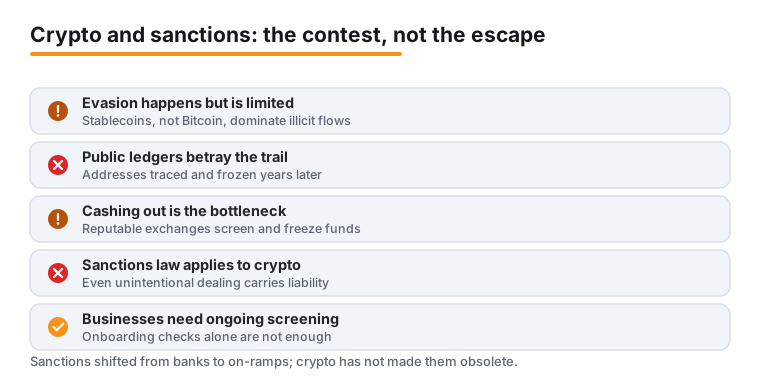
The honest answer is nuanced. Crypto removes one chokepoint (the bank) but introduces a different exposure. Most blockchains are transparent ledgers where every transaction is permanently visible. Once an address is linked to a sanctioned actor, its history can be traced, and the practical problem becomes converting crypto into usable goods or local currency. Sanctions have not disappeared in the crypto era; they have shifted from the banking layer toward the on-ramps and off-ramps where digital assets meet the regulated economy.
Evasion concerns
The fear that crypto undermines crypto sanctions is not theoretical. Blockchain analytics firms track meaningful flows tied to sanctioned states and entities, and the figures have grown sharply. According to Chainalysis's 2026 Crypto Crime Report, illicit cryptocurrency activity reached an estimated record level in 2025, with sanctions-related flows making up a large share, and stablecoins accounting for the overwhelming majority of illicit volume. These are estimates from on-chain analysis rather than audited accounts, so treat the precise numbers with caution, but the direction of travel is clear.
Several patterns drive the concern:
- State-level actors. Russia, Iran, and North Korea are repeatedly named in public reporting. Russian-linked entities have experimented with ruble-backed stablecoins and intermediary exchanges to keep trade flowing; Iranian state and military-linked networks have moved substantial value on-chain; and North Korea has financed itself partly through large-scale crypto theft, including some of the biggest exchange hacks on record.
- Stablecoins over Bitcoin. Contrary to early assumptions, much sanctions-related activity now uses dollar-pegged stablecoins rather than volatile assets like Bitcoin, because a stable unit of account is more practical for trade.
- Mixers and obfuscation. Tools that pool and shuffle funds to break the on-chain trail, along with chain-hopping and privacy coins, are used to obscure origins.
- Peer-to-peer and informal networks. Over-the-counter brokers and informal value-transfer systems can bridge crypto to cash with limited oversight.
There are real limits to evasion, however. Public ledgers are a forensic goldmine: analysts can cluster addresses, follow funds across hops, and flag tainted coins years later. The genuine bottleneck is cashing out, since reputable exchanges screen against sanctions lists and freeze flagged funds. Large-scale, sustained evasion typically requires either compromised intermediaries or jurisdictions willing to look the other way, neither of which is risk-free for the actors involved.
Compliance
For any business that touches crypto, sanctions compliance is not optional. OFAC has made clear that U.S. sanctions apply to transactions involving virtual currency exactly as they do to traditional money, and the same principle holds under other major regimes. Exchanges, custodians, brokers, payment processors, and many DeFi front-ends are expected to keep designated persons and jurisdictions out of their systems.
OFAC's published guidance for the virtual currency industry describes a risk-based programme generally built on five pillars:
- Management commitment with genuine board-level ownership and resourcing.
- Risk assessment documenting exposure by customer type, geography, and product.
- Internal controls such as customer due diligence, sanctions-list screening, blockchain analytics, and geolocation checks.
- Testing and auditing through independent review.
- Training so staff understand their obligations.
Two points trip people up. First, screening cannot be limited to matching names against a published list. Sanctions lists are non-exhaustive, addresses can be newly created, and risk can emerge mid-relationship, so ongoing monitoring matters as much as onboarding checks. Second, many jurisdictions apply rules like the Financial Action Task Force (FATF) Travel Rule, which requires originator and beneficiary information to accompany transfers above set thresholds.
The table below contrasts the two transaction layers, in general terms.
| Aspect | Regulated on-ramp/off-ramp | Peer-to-peer / self-custody |
|---|---|---|
| Identity checks | KYC and sanctions screening required | None by default |
| Ability to freeze funds | Yes, flagged funds can be blocked | No central party to freeze |
| Traceability | High; tied to verified identity | Pseudonymous but still on a public ledger |
| Practical for cashing out | Yes | Difficult at scale without an intermediary |
For individual users, the takeaways are simpler but no less important. Do not knowingly transact with sanctioned persons, entities, or jurisdictions; understand that interacting with a flagged address or service can expose you to legal risk even unintentionally; and remember that on-chain transactions are permanent and public. If you are unsure whether an activity is permitted, check official sources and seek professional advice rather than guessing.
Geopolitical impact
Beyond individual compliance, crypto is changing the strategic calculus around sanctions themselves. Policymakers increasingly treat digital assets as part of the financial battlefield rather than a fringe concern.
On one side, sanctioned governments view crypto as a potential pressure-release valve. The appeal is obvious: a payment rail that does not depend on the dollar or on banks they cannot access. In practice, the relief is partial. Volatility, the difficulty of converting large sums into goods, and the transparency of public ledgers all blunt the strategy. Crypto can ease friction at the margins, but it has not let any heavily sanctioned economy escape pressure wholesale.
On the other side, sanctioning authorities have grown far more sophisticated. Rather than treating crypto as ungovernable, agencies now combine blockchain analytics with designations that target specific wallet addresses, mixing services, stablecoin issuers, and the exchanges that serve sanctioned actors. The U.S., the EU, and the UK increasingly coordinate these moves, and recent EU sanctions packages have extended explicitly to crypto-related entities.
The legal boundaries are still being drawn. A notable 2025 episode involved the mixing service Tornado Cash: after a U.S. appeals court found that OFAC had exceeded its authority by sanctioning the protocol's immutable smart contracts, Treasury removed Tornado Cash from the SDN list in March 2025. This did not signal a retreat from crypto enforcement. Individual developers continued to face criminal proceedings, and authorities reaffirmed that sanctions law applies to digital assets. The case mainly clarified that autonomous, unowned software is a different legal object than a person or company, a distinction regulators are still working through.
The broader geopolitical themes to watch are: the growing role of dollar-pegged stablecoins in cross-border flows and the leverage their issuers may hand to U.S. authorities; deeper international coordination on enforcement; and an ongoing tug-of-war between privacy technology and the transparency that enforcement depends on. None of this points to crypto rendering sanctions obsolete. The more accurate picture is an escalating contest in which both evasion techniques and enforcement tools keep advancing.
Frequently asked questions
Can cryptocurrency be used to evade sanctions?
It can be attempted, and public reporting documents meaningful flows linked to sanctioned states and entities. But evasion is harder than it looks. Public blockchains are transparent, so transactions can be traced long after the fact, and the real bottleneck is converting crypto into usable funds, since reputable exchanges screen against sanctions lists. Crypto can reduce friction at the margins, but it has not allowed heavily sanctioned economies to escape pressure wholesale.
Do sanctions laws actually apply to crypto?
Yes. OFAC and other major authorities have stated that sanctions apply to transactions involving virtual currency just as they do to traditional money. Exchanges, custodians, and many other crypto businesses are expected to block dealings with designated persons and jurisdictions. Individuals can also face liability for transacting with sanctioned parties, even unintentionally. Always verify the rules in your own jurisdiction with official sources.
What is the SDN list, and why does it matter for crypto?
The Specially Designated Nationals and Blocked Persons (SDN) list is maintained by the U.S. Treasury's OFAC and names individuals, entities, and even specific wallet addresses that U.S. persons are generally prohibited from dealing with. For crypto, OFAC has at times added blockchain addresses directly to the list. Because the list is non-exhaustive and changes often, compliance requires ongoing screening rather than a one-time check.
Was Tornado Cash unsanctioned, and what does that mean?
Treasury removed the Tornado Cash mixing protocol from the SDN list in March 2025, after a U.S. appeals court found OFAC had overstepped by sanctioning immutable, unowned smart contracts. This was a narrow legal point about what kind of thing can be sanctioned, not a sign that crypto enforcement is easing. Individual developers still faced criminal proceedings, and authorities reaffirmed that sanctions law applies to digital assets.
Is holding Bitcoin a safe way to protect money in a sanctioned country?
It is sometimes presented that way, but the reality is mixed and this is not financial advice. Self-custodied crypto sits outside the banking system, which is the appeal, yet it carries serious drawbacks: high price volatility, the risk of irreversible mistakes, difficulty cashing out where local off-ramps are restricted, and potential legal exposure. Anyone considering it should weigh these risks carefully and understand the laws that apply to them.
Last updated: 2026-06.