Home › Crypto Regulation › Belize
Bitcoin & Cryptocurrency Regulation in Belize
Quick answer — Belize, 2026
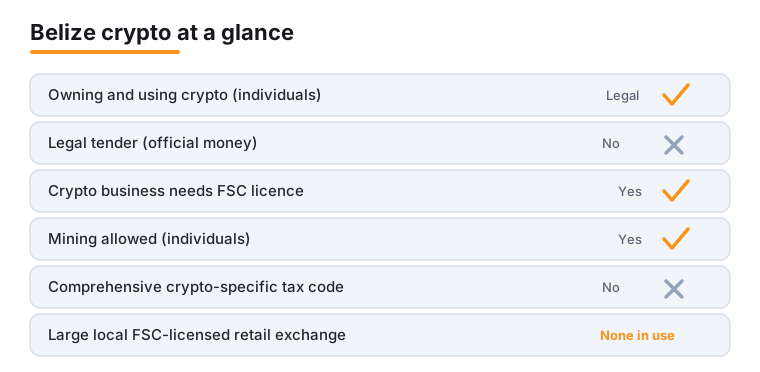
- Owning and trading is legal for individuals; crypto is not legal tender, and running a crypto business in or from Belize needs an FSC licence.
- Tax: no crypto-specific code, and being low-tax does not mean tax-free; confirm with the Belize Tax Service.
- Buying: residents mostly use international exchanges and peer-to-peer, with KYC and bank scrutiny on transfers.
Belize, the small English-speaking nation on the Caribbean coast of Central America, has long been known as an offshore financial services and tourism hub. As of 2026 it has a formal, if still evolving, framework for digital assets. Owning and using Bitcoin and other cryptocurrencies as a private individual is permitted, but carrying on a crypto business "in or from within" Belize is tightly controlled and requires a licence from the country's financial regulator, the Financial Services Commission.
This guide explains the current legal status of crypto in Belize, who regulates it, the key laws, how licensing and tax work, and the practical realities around buying, mining and consumer protection. It is general information as of 2026 and is not legal, tax or financial advice; the rules are changing quickly, so verify any specific point with the Financial Services Commission, the Central Bank of Belize, or a qualified Belizean professional before acting. For broader background see our guide to crypto regulation and the country regulation hub.
On this page: Legal status · Who regulates it · Taxes · How to buy · Mining
Legal status of Bitcoin and crypto in Belize
Holding and using cryptocurrency is legal for individuals in Belize. There is no law banning residents from buying, owning, selling or holding Bitcoin and other digital assets, and there is no prohibition on using a self-custody wallet.
Two distinctions are central:
- Crypto is not legal tender. The official currency remains the Belize dollar (BZD), pegged to the US dollar. Merchants are not required to accept crypto, and it has no status as official money.
- Personal use and running a crypto business are treated very differently. A private individual transacting for their own account faces few restrictions, but anyone operating an exchange, custodian, broker or similar digital-asset service "in or from within" Belize must be licensed. Operating such a business without authorisation is prohibited and can carry criminal penalties.
In short: you can own and use crypto, but you cannot offer crypto services to the public in or from Belize without a licence.
Who regulates crypto in Belize
Two official bodies matter:
- The Financial Services Commission (FSC) is the lead regulator for non-bank financial services, including digital-asset business and the licensing of virtual-asset providers. Some older material refers to the International Financial Services Commission (IFSC), an earlier name for the same regulatory function. The FSC's official site is belizefsc.org.bz.
- The Central Bank of Belize manages monetary policy, supervises banks and oversees the payment system. It has cautioned that cryptocurrencies are not legal tender and are not guaranteed or supervised the way bank deposits are. Its official site is centralbank.org.bz.
For digital-asset licensing, tax-transparency reporting and AML supervision, the FSC is the body you will deal with directly.
Key laws and frameworks
Belize's digital-asset regime rests on a few building blocks. Belize is not an EU member, so EU rules such as MiCA do not apply; the framework is domestic:
- Financial Services Commission Act, 2023 (Act No. 8 of 2023). Gazetted on 15 April 2023, this Act prohibits conducting business involving virtual assets, defined to include cryptocurrencies, stablecoins, NFTs and certain in-game currencies, without a licence. It covers activities such as negotiation, brokerage, exchange, transfer and management of virtual assets, with criminal sanctions for breaches under section 81.
- Financial Services Commission (Digital Asset Services Licensing) Regulations, 2025 (SI No. 162 of 2025). Published in late December 2025 and effective around 30 December 2025, these set out the detailed licensing regime for digital-asset services. They are described as transitional and are expected to be superseded by primary legislation.
- Financial Services Commission (Amendment) Act, 2026 (Act No. 8 of 2026). Assented on 13 May 2026 and gazetted on 14 May 2026, this Act amends section 81 of the Financial Services Commission Act, 2023 and nothing else. It inserts section 81(3A), allowing the Commission to grant a special licence for the listed digital-asset activities; section 81(3B), requiring the Commission to be guided by the IOSCO Policy Recommendations for Crypto and Digital Assets Markets Final Report of 16 November 2023 and the FATF standards; and section 81(3D)(b), which requires any special licence to be converted into a full Part VI licence no later than 31 December 2027. It also repeals section 81(5), (6) and (7). Section 3 provides that the Act comes into force on a date appointed by the Minister by Order published in the Gazette, and no such Order appears among Statutory Instruments No. 1 to No. 36 of 2026 or among the FSC gazette notices. Because regulation 12 of SI No. 162 of 2025 expires the 2025 regulations only on that entry into force, the 2025 regulations still apply. A companion Money Laundering and Terrorism (Prevention) (Amendment) Act, 2026 (Act No. 7 of 2026) was also brought forward alongside it. Confirm the current commencement status with the FSC.
The fees in force are set in the Schedule to SI No. 162 of 2025: an application fee of USD 5,000 and a licence fee of USD 15,000. Regulation 8(1) caps a licence at a period not exceeding one year, and regulation 8(2) states that it is of a temporary nature only and gives rise to no legitimate expectation of renewal, continuation or conversion into any licence under a subsequent enactment. Always check the FSC's current rules rather than older summaries.
Licensing and registration of exchanges and VASPs
Under the 2023 Act and the 2025 regulations, any person or entity that carries on, or holds itself out as carrying on, digital-asset services in or from within Belize must be licensed by the FSC. Licensable activities typically include:
- exchanging crypto for fiat currency, and swapping one digital asset for another;
- transferring digital assets on behalf of others;
- holding, safekeeping or administering client assets (custody);
- participating in or providing financial services related to the issuance or offering of digital assets.
The regime has extraterritorial reach: a Belize-incorporated or registered entity providing such services to clients abroad can still be caught. The FSC evaluates applications and may impose conditions, restrictions or limitations, and applicants are expected to meet AML/CFT, governance and operational standards.
The pause was statutory rather than discretionary. Section 81(3) of the 2023 Act barred the Commission from issuing any licence for trading virtual assets, operating as a wallet service provider, or the other listed activities on or before 31 December 2025, and the FSC set this out in Public Notice FSC/2/PN/012 of 25 May 2023. SI No. 162 of 2025 was gazetted on 30 December 2025, the day before the bar lapsed. There is a limited exemption for purely technical, software or infrastructure providers that do not take custody, exercise control, or transact on behalf of others, but the FSC retains discretion to bring such entities within scope if they present material risk. If a provider claims to be Belize-licensed, verify it directly with the FSC.
Crypto and Bitcoin tax in Belize
Belize does not have a comprehensive, crypto-specific tax code, and the way a given transaction is treated depends on the facts and on general tax rules administered by the Belize Tax Service. The general rates are published and they are these: income tax at a flat 25 percent on annual earnings above BZ$26,000; business tax charged on gross receipts rather than profit once receipts pass BZ$75,000, at 1.75 percent for other trade or business, 3 percent on rental and real property income, 6 percent for professions and vocations, 15 percent for financial institutions and 19 percent for telecommunications; and General Sales Tax at 12.5 percent. Neither BELTRAIDE's nor the Chamber of Commerce's published schedule lists a capital gains tax, so a private disposal has no obvious head of charge, while crypto activity carried on as a trade falls under business tax on gross receipts whether or not it is profitable. Verify your own position with the Belize Tax Service.
A few general points apply:
- Belize has historically been positioned as a low-tax, offshore-friendly jurisdiction, but that does not mean crypto activity is automatically tax-free. Income earned through crypto-related business activity, or in the course of a trade, can fall within existing tax rules.
- The distinction between casual personal investing and carrying on a business can affect how proceeds are characterised, a common grey area worldwide.
- Tax residency and source-of-income rules matter. Belize operates on broadly territorial principles, and residency typically turns on physical presence in the country, so non-residents and residents can be treated very differently.
For background on how crypto is taxed generally, see our crypto tax guide. Confirm your own obligations with the Belize Tax Service and a qualified tax adviser; this is not tax advice.
AML, KYC and international reporting
Anti-money-laundering and counter-terrorist-financing (AML/CFT) compliance is the backbone of Belize's digital-asset rules.
- Licensed providers must maintain AML/CFT frameworks, including customer identification and verification (KYC), record-keeping, transaction monitoring, sanctions screening and reporting of suspicious activity, consistent with Belize's national AML/CFT regime.
- Operational and cybersecurity safeguards are expected, and licensees must report material incidents to the FSC.
- Crypto-Asset Reporting Framework (CARF). In November 2023 Belize joined a group of jurisdictions committing to implement the OECD's CARF, which provides for the automatic exchange of crypto-account information between tax authorities. Belize appears in the list of jurisdictions making the joint statement of 10 November 2023, in which signatories said they intend to work towards swiftly transposing the CARF into domestic law and activating exchange agreements in time for exchanges to commence by 2027, subject to national legislative procedures. No Belize implementing Act or statutory instrument for the CARF has been published. The mechanism currently appears only in Schedule IV of the draft Digital Assets Bill, 2026, which would amend the Mutual Administrative Assistance in Tax Matters Act, and that draft leaves the CARF first reportable period to be specified later by Ministerial Order in the Gazette. This means crypto activity is set to become more visible to tax administrations over time, which is particularly relevant for non-residents and offshore structures.
For individuals, the practical effect is that any compliant platform you use will ask for identity documents and may query source of funds, especially on larger transfers.
Buying and using crypto in practice
There is no large domestic, FSC-licensed retail exchange that most Belizeans use; in practice people typically access crypto through international platforms and peer-to-peer methods. Key points:
- Using a foreign exchange as a customer is generally a personal matter. The licensing requirement targets firms providing services from within Belize, not individuals using overseas services for themselves.
- Banking the on- and off-ramps can be the hard part. Local banks may be cautious about crypto-related transfers; expect identity checks, source-of-funds questions and possible delays when moving between fiat and crypto.
- Any Belize-based service must be licensed. If a provider claims to operate from Belize, confirm it holds current FSC authorisation. Unlicensed operators are not permitted and offer no regulatory protection.
- Bitcoin ATMs are scarce. Belize has a very small physical crypto-ATM footprint, fees and spreads are high, and machines should not be assumed available outside the main centres.
Practical safeguards apply everywhere: use reputable platforms, enable two-factor authentication, beware of offers that look too good to be true, and remember that protections covering regulated banks generally do not extend to crypto.
How to buy Bitcoin in Belize
A typical, lawful route for an individual looks like this:
- Choose a reputable platform. Most users rely on established international exchanges. If a provider claims to be Belize-based, verify its FSC authorisation first.
- Complete identity verification (KYC). Expect to submit ID and possibly proof of address and source of funds, in line with AML requirements.
- Fund your account. Funding options can be limited; bank transfers or cards may work on some platforms, and peer-to-peer trading is a common alternative. Local banks may scrutinise crypto-linked transfers.
- Buy and then secure your crypto. Consider moving holdings you intend to keep into a wallet you control rather than leaving large balances on an exchange.
- Keep records. Save transaction histories for potential tax and compliance purposes.
Compare fees, supported funding methods and withdrawal options before committing, and start small while you learn how a platform works.
Bitcoin mining in Belize
There is no specific law banning cryptocurrency mining in Belize, and it is generally treated as a permissible activity for individuals. The bigger constraints are practical and economic rather than legal:
- Electricity cost and supply. Mining is power-hungry, and grid capacity, reliability and tariffs are decisive. Belize's tropical climate also adds cooling costs.
- Renewable potential. Belize has solar resources and existing hydroelectric generation, and there is interest in pairing mining with renewable energy. In reality, viability depends on securing affordable, dependable power and on grid-connection arrangements.
- Business and licensing considerations. Mining for your own account differs from operating a commercial mining or hosting business, which may bring company-registration, tax, import and energy-permitting obligations and could intersect with the digital-asset rules depending on structure.
Anyone planning a sizeable operation should get advice on energy supply agreements, import duties on hardware, and the relevant business and tax requirements before committing capital.
Recent developments (2025 to 2026)
Belize moved decisively from an open-ended licensing pause toward a structured regime:
- Late 2025: the FSC published the Financial Services Commission (Digital Asset Services Licensing) Regulations, 2025 (SI No. 162 of 2025), effective around 30 December 2025, ending the previous freeze on new virtual-asset licences and setting out detailed licensing requirements.
- November 2025: the Financial Services Commission (Amendment) Bill was introduced in the National Assembly, with government signalling that Belize is open to responsible innovation and high-quality investment, aiming to place the digital-asset regime on permanent statutory footing.
- 2026: the framework was taken forward as the Financial Services Commission (Amendment) Act, 2026 (Act No. 8 of 2026), with a companion Money Laundering and Terrorism (Prevention) (Amendment) Act, 2026; the transitional 2025 regulations are set to expire once the Amendment Act commences.
- Ongoing: work continues toward implementing the OECD Crypto-Asset Reporting Framework (CARF), to which Belize committed in 2023; Belize sits in the second wave, with data collection generally expected from 1 January 2027 and first exchanges in 2028.
The direction of travel is greater legal clarity for compliant businesses alongside stricter standards. Because details are still settling, treat the transitional regulations as a moving target and confirm current status with the FSC.
Consumer risks and protection
The main risks for crypto users in Belize are familiar ones, sharpened by a thin local market:
- Scams and fraud, including fake "licensed" platforms and high-yield schemes. The FSC periodically issues warning notices about unauthorised operators; check those notices before trusting a provider.
- Limited safety net. Belizean consumer-protection and deposit-guarantee schemes generally do not cover crypto. If a platform fails or you are defrauded, recourse may be limited.
- Volatility and custody risk. Crypto prices can swing sharply, and self-custody makes you solely responsible for keys and backups; lost keys mean lost funds.
- Liquidity and cash-out limits, given the small number of local on- and off-ramps.
Protect yourself by using reputable services, verifying any "Belize-licensed" claim with the FSC, securing your holdings, keeping records, and only committing money you can afford to lose.
Official sources and how to verify
This guide is general information as of 2026 and is not legal advice; always verify your situation with the named official regulator, the Financial Services Commission, before acting. Primary sources to consult:
- Financial Services Commission of Belize: the lead regulator for digital-asset licensing, AML supervision and public warning notices.
- FSC: Digital Asset Services Licensing Regulations, 2025 (SI No. 162 of 2025): the official page and PDF of the licensing regulations.
- National Assembly: Financial Services Commission Act, 2023 (Act No. 8 of 2023): the primary legislation that requires a licence for virtual-asset business.
- Central Bank of Belize: monetary authority and source on legal-tender status and the payment system.
For context elsewhere on this site, see our crypto regulation guide and the regulation hub. Because Belize's framework is transitional and being amended, check these official pages for the latest position rather than relying on third-party summaries.
What is changing in Belize, August 2026
Two crypto Acts passed in May 2026 and neither has been commenced. On 28 July 2026 the Financial Services Commission put a third and much larger law out for public comment. This is the pipeline as it stands.
| Instrument | Stage | Key date | What it does |
|---|---|---|---|
| Financial Services Commission Act, 2023 (Act No. 8 of 2023) | In force | Assented and gazetted 15 April 2023 | Section 81(1) prohibits unlicensed virtual-asset business in or from within Belize; section 66 makes contravention an offence |
| Digital Asset Services Licensing Regulations, 2025 (SI No. 162 of 2025) | In force, and still the operative rules | Gazetted 30 December 2025 | Licences of up to one year, USD 5,000 application fee, USD 15,000 licence fee, applications via the FSC LicenSys system |
| Money Laundering and Terrorism (Prevention) (Amendment) Act, 2026 (Act No. 7 of 2026) | Passed, awaiting commencement Order | Assented 13 May 2026, gazetted 14 May 2026 | Makes digital asset service providers financial institutions under the AML Act and names the FSC as their supervisor |
| Financial Services Commission (Amendment) Act, 2026 (Act No. 8 of 2026) | Passed, awaiting commencement Order | Assented 13 May 2026, gazetted 14 May 2026 | Creates a special licence and requires conversion to a full Part VI licence by 31 December 2027 |
| Digital Assets Bill, 2026 | Consultation draft | Published 28 July 2026, comments close 8 September 2026 | Would replace licensing with registration and recognition, regulate stablecoins, and add a statutory tax concession |
Both 2026 Acts close with the same clause: the Act comes into force on a date appointed by the Minister by Order published in the Gazette. No such Order appears among Statutory Instruments No. 1 to No. 36 of 2026 published by the National Assembly, nor among the FSC gazette notices. That matters directly, because regulation 12 of SI No. 162 of 2025 expires the 2025 regulations only on the entry into force of the Amendment Act. Until a commencement Order is published, the 2025 regulations remain the rules that apply. Regulation 13(1) then preserves any licence already in force until its own expiry date.
What the Financial Services Commission (Amendment) Act, 2026 actually does. It amends section 81 and nothing else:
- Inserts section 81(3A), under which the Commission may, notwithstanding the section 81(3) bar, issue a special licence for the listed digital-asset activities. As drafted the power is expressed as exercisable "prior to the 31st day of December 2025", a date already past when the Act was assented in May 2026.
- Inserts section 81(3B), requiring the Commission to be guided by the IOSCO Policy Recommendations for Crypto and Digital Assets Markets Final Report of 16 November 2023 and the FATF international standards.
- Inserts section 81(3D)(b), making every special licence subject to conversion into a licence under Part VI by such time as may be prescribed and in any event not later than 31 December 2027.
- Repeals section 81(5), (6) and (7), which had required firms operating before the 2023 Act to notify the Commission within one month and cease within three, with a fine of up to 100,000 dollars for failure to notify.
What the Money Laundering and Terrorism (Prevention) (Amendment) Act, 2026 does, when commenced. Its long title states that it amends Chapter 104 to satisfy the requirements of the Financial Action Task Force Recommendation with respect to digital assets and digital asset service providers.
- Adds digital asset service providers to the definition of financial institution, and inserts definitions of Digital Asset, Digital Asset Services and Digital Asset Service Provider covering exchange, brokerage, negotiation, transfer, safekeeping, custody, management, administration and digital wallet services.
- Extends the correspondent banking regime in section 15 to correspondent digital asset service relationships, and bars entering or continuing such relationships with shell digital asset service providers.
- Adds digital asset activity as new paragraph 34 of Schedule I, and inserts new item 33 in Schedule III naming the Financial Services Commission as its supervisory authority.
- Amends section 81(1) of the Financial Services Commission Act so that offering to conduct the listed activities, not only conducting them, falls within the prohibition.
The Digital Assets Bill, 2026: what is proposed and by when
On 28 July 2026 the FSC opened public consultation on a draft Digital Assets Bill, 2026, running to clause 60 with four schedules. The consultation paper invites comment from industry participants, professional associations, financial institutions, technology providers, investors, consumers and other interested persons. Comments close on 8 September 2026 and go to [email protected] using the FSC comment sheet. The draft has a blank gazette date, and Schedule I Part 2 and Schedule III are both marked as content pending from the competent authorities, to be completed before commencement, so no enactment date exists yet.
The main things the draft would change:
- Registration and recognition replace licensing. Firms would register with the FSC, or be recognised where they already hold a foreign registration. The Central Bank of Belize is among the defined supervisory authorities.
- Territorial reach is spelled out. Clause 3A(1) catches a person incorporated, registered or formed in Belize, or maintaining a place of business there, irrespective of where clients are resident; anyone actively marketing or soliciting into Belize; and anyone providing services to a Belize resident otherwise than at that person's exclusive initiative.
- Penalties are set on the face of the Act. Clause 4(5) makes unregistered issuance or service provision an offence, liable on indictment to a fine not exceeding five hundred thousand dollars or imprisonment not exceeding five years or both for an individual, and a fine not exceeding one million dollars for a body corporate.
- Stablecoins get par-value reserve rules. Clause 36(7) requires an issuer referencing one or more official currencies to maintain at all times reserve assets of a value not less than the aggregate par value of the stablecoins outstanding, unencumbered. Clause 36(8) gives holders a direct and enforceable right to redeem at par in the reference currency within the prescribed period. Clause 36(9) requires reserves to be segregated and protected from creditors, and clause 36(11) bars stablecoins whose value is maintained solely by an algorithm without reserves.
- Marketing claims are policed. Clause 24 bars representing a digital asset in a way likely to create the impression that it is legal tender, is issued by Belize or a foreign government, or is guaranteed, endorsed or approved by the Government of Belize or any other foreign government.
- Fees scale with size. Clause 56(3) sets four annual renewal tiers. A Standard Tier below $200 million in client assets or receipts pays a flat fee. An Enhanced Tier pays 0.02 percent with a $100,000 minimum, a Major Tier 0.015 percent with a $400,000 minimum, and a Systemically Important Tier 0.01 percent subject to a $1,000,000 maximum. Clause 56(5) gives reduced minimums for the first three years after registration.
- AML thresholds tighten. Schedule IV would amend the Money Laundering and Terrorism (Prevention) Act to trigger customer due diligence, in the absence of a business relationship, on any digital asset transaction equal to or above five hundred dollars in Belize currency, including several transactions that appear to be linked.
Belize crypto tax: the rates that actually apply, and the deal being proposed
Belize has no crypto-specific tax code and the Belize Tax Service has published no ruling on how an individual crypto disposal is characterised. That does not mean there are no numbers. The general heads apply, and Belize publishes them.
| Tax | Rate | Threshold |
|---|---|---|
| Income tax | 25 percent flat | Annual earnings above BZ$26,000, with relief bands between BZ$26,001 and BZ$29,000 |
| Business tax, charged on gross receipts rather than profit | Varies by category. Other trade or business 1.75 percent, rental and real property income 3 percent, professions and vocations 6 percent, financial institutions 15 percent, telecommunications 19 percent | Annual receipts above BZ$75,000 |
| General Sales Tax | 12.5 percent | Registration required above BZ$75,000 annual turnover |
Rates as published by BELTRAIDE and the Belize Chamber of Commerce and Industry. Neither published schedule lists a capital gains tax. The practical consequence for a private holder is that a gain on selling crypto has no obvious head of charge, while crypto activity carried on as a trade falls under business tax on gross receipts, which is charged whether or not the activity is profitable.
Part V of the draft Digital Assets Bill, 2026 would put a statutory tax deal on the table for registered firms, not for individuals:
- Clause 42(1) would exempt a qualifying registrant from all Belize tax on profits, income and gains from its digital asset business, on distributions to its owners, on payments on its debt instruments, on the issuance, transfer, redemption or cancellation of digital assets, and on proprietary trading gains whether realised or unrealised. "Belize tax" is defined to include income tax, corporate tax, business tax, capital gains tax, withholding tax, stamp duty, any other tax on profits or gains, and any tax in the nature of estate or inheritance tax.
- The initial tax concession period is up to ten years, commencing on the date of registration. Clause 48(5) allows no more than two renewal periods, each up to ten years, with the aggregate capped at thirty years.
- Clause 43(2) excludes activities that are not digital asset services, income from real property located in Belize, employment income of the registrant's employees, and goods and services tax, customs duties and other indirect taxes.
- Conditions include maintaining registration, not being a constituent entity of a multinational enterprise group, and meeting economic substance requirements under clause 52.
- Clause 43(4) states that nothing in Part V affects a registrant's obligation to comply with Crypto-Asset Reporting Framework requirements under the Mutual Administrative Assistance in Tax Matters Act, including reporting all relevant transactions with reportable users regardless of their tax residence.
Frequently asked questions
Is cryptocurrency legal in Belize?
Yes. Individuals can legally hold, buy, sell and use cryptocurrency in Belize, and it is not banned. However, crypto is not legal tender, and operating a crypto business such as an exchange or custodian in or from within Belize requires a licence from the Financial Services Commission. Operating without a licence is prohibited and can carry criminal penalties.
Who regulates crypto in Belize?
The Financial Services Commission (FSC), sometimes referred to by its earlier name the International Financial Services Commission (IFSC), is the main regulator for digital-asset business and licensing. The Central Bank of Belize oversees monetary policy and the payment system and has cautioned that crypto is not legal tender or a guaranteed deposit.
What law governs crypto businesses in Belize?
The Financial Services Commission Act, 2023 (Act No. 8 of 2023) prohibits virtual-asset business without a licence. The detailed licensing regime is set out in the Financial Services Commission (Digital Asset Services Licensing) Regulations, 2025 (SI No. 162 of 2025), effective at the end of December 2025, with the Financial Services Commission (Amendment) Act, 2026 (Act No. 8 of 2026) taking the framework forward onto a permanent footing. Confirm current status with the FSC.
Do I pay tax on crypto in Belize?
There is no comprehensive crypto-specific tax code, and treatment depends on your situation and on general tax rules administered by the Belize Tax Service. Being a low-tax jurisdiction does not make crypto automatically tax-free, and Belize has committed to international tax-transparency standards including the OECD Crypto-Asset Reporting Framework. Confirm your obligations with a qualified Belizean tax adviser; this is not tax advice.
Can I mine Bitcoin in Belize?
There is no specific ban on mining, so it is generally permissible for individuals. The real constraints are the cost and reliability of electricity and the climate's cooling demands. Larger commercial operations may face additional business, tax, import and energy requirements and could intersect with the digital-asset licensing rules, so seek professional advice.
Where can I buy Bitcoin in Belize?
Most people use established international exchanges or peer-to-peer trades, since there is no large FSC-licensed domestic exchange in common use. Expect identity verification (KYC) and possible scrutiny of bank transfers. If a provider claims to operate from Belize, verify it holds current FSC authorisation before using it.
Did the Belize crypto licensing freeze end?
Yes. The Financial Services Commission Act, 2023 paused new virtual-asset licences until 31 December 2025. The Financial Services Commission (Digital Asset Services Licensing) Regulations, 2025 (SI No. 162 of 2025) then took effect on 30 December 2025, setting out the licensing regime for digital-asset services in or from within Belize. Those regulations are transitional and are set to expire once the Financial Services Commission (Amendment) Act, 2026 commences.
Will my crypto in Belize be reported to tax authorities under CARF?
Over time, yes, for accounts held with reporting providers. Belize committed to the OECD Crypto-Asset Reporting Framework (CARF) in 2023 and is grouped in the second wave of jurisdictions, with data collection generally expected to begin from 1 January 2027 and the first automatic exchanges of information between tax authorities following in 2028. This is particularly relevant for non-residents and offshore structures. Confirm your own reporting position with a qualified adviser.
Is there a new crypto law in Belize in 2026?
Two were passed and one is in draft. The Financial Services Commission (Amendment) Act, 2026 (Act No. 8 of 2026) and the Money Laundering and Terrorism (Prevention) (Amendment) Act, 2026 (Act No. 7 of 2026) were both assented on 13 May 2026 and gazetted on 14 May 2026, but both commence only on a date the Minister appoints by Order published in the Gazette, and no such Order has been published. Separately, the FSC published a draft Digital Assets Bill, 2026 for consultation on 28 July 2026. Until a commencement Order appears, the rules that actually apply are the Financial Services Commission Act, 2023 and the Digital Asset Services Licensing Regulations, 2025.
When will the Digital Assets Bill, 2026 become law?
No date has been published. The consultation closes on 8 September 2026, comments go to [email protected], and the draft still has a blank gazette date with Schedule I Part 2 and Schedule III marked as content pending from the competent authorities, to be completed before commencement. The only fixed date in the legislation already passed is 31 December 2027, by which section 81(3D)(b) of the Financial Services Commission (Amendment) Act, 2026 requires any special licence to have been converted into a full Part VI licence.
What does a Belize crypto licence cost right now?
Under the Schedule to SI No. 162 of 2025 the application fee is USD 5,000 and the licence fee is USD 15,000. Applications are made through the FSC online system LicenSys. Regulation 8 caps the licence at a period not exceeding one year and states that it is of a temporary nature only and gives rise to no legitimate expectation of renewal, continuation or conversion into any licence or authorisation under a subsequent enactment.
Does the Belize licensing requirement catch an offshore company with only foreign clients?
Yes. Regulation 3(2) of SI No. 162 of 2025 states that a person incorporated or registered under the laws of Belize and providing digital asset services outside Belize is deemed to be providing those services from within Belize. Regulation 3(3) carves out purely ancillary technical, software, infrastructure or support providers that never take custody, exercise control, or otherwise deal in digital assets on behalf of another person, but regulation 3(4) lets the Commission apply the Regulations to them anyway where it considers the activities give rise to material regulatory, consumer protection or financial crime risk.
What tax would I pay on crypto in Belize?
There is no crypto-specific tax and no published Belize Tax Service ruling on individual disposals, so the general heads apply. Income tax is a flat 25 percent on annual earnings above BZ$26,000. Business tax is charged on gross receipts rather than profit once receipts pass BZ$75,000, at 1.75 percent for other trade or business, 3 percent on rental and real property income, 6 percent for professions and vocations, 15 percent for financial institutions and 19 percent for telecommunications. General Sales Tax is 12.5 percent. Neither BELTRAIDE's nor the Chamber of Commerce's published schedule lists a capital gains tax. Confirm your own position with the Belize Tax Service and a qualified adviser.
Would the proposed tax concession apply to me as an individual holder?
No. Part V of the draft Digital Assets Bill, 2026 would exempt only a registered digital asset issuer or service provider holding a tax concession certificate from the Director General of Tax Administration, and only while that certificate is in force. The initial period is up to ten years from the date of registration, and clause 48(5) allows no more than two renewals of up to ten years each, capped at thirty years in aggregate. Conditions include economic substance in Belize under clause 52, not being a constituent entity of a multinational enterprise group, and continued tax transparency reporting.
What penalties does the draft Digital Assets Bill propose?
Clause 4(5) of the consultation draft makes it an offence to service a digital asset in or from within Belize in breach of the Act, to issue digital assets or provide digital asset services without being registered or recognised, or to continue after suspension or revocation. On indictment an individual would face a fine not exceeding five hundred thousand dollars or imprisonment for up to five years, or both. A body corporate would face a fine not exceeding one million dollars.
Facts reviewed: 8 August 2026. Page updated: 8 August 2026.
Related guides
More countries in the region
Practical guides