Home › Crypto Regulation › Kiribati
Bitcoin & Cryptocurrency Regulation in Kiribati
Quick answer — Kiribati, 2026
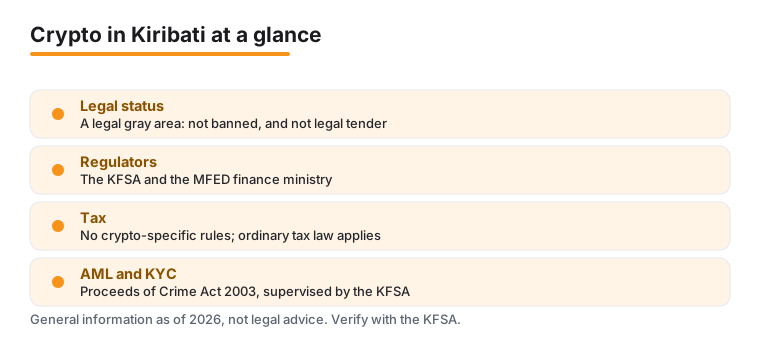
- Legal: Not banned, not legal tender, no dedicated crypto law
- Tax: No crypto-specific guidance, ordinary tax law may apply
- Buying: No licensed local exchange, use international platforms or P2P
Kiribati is one of the world's smallest and most remote economies: a spread of low-lying atolls in the central Pacific, home to roughly 130,000 people, that uses the Australian dollar as its everyday legal tender. As of 2026 there is no dedicated Bitcoin or cryptocurrency law in Kiribati. Owning, buying, and using crypto is not prohibited, but it also sits outside any purpose-built licensing or consumer-protection regime for digital assets. Instead, crypto-related activity is touched by general rules: the country's anti-money-laundering framework, prudential oversight of licensed financial institutions, and ordinary tax and commercial law.
Kiribati's financial sector is now supervised by a dedicated independent regulator, the Kiribati Financial Supervisory Authority (KFSA), which was created in 2021 and sits under the Ministry of Finance and Economic Development (MFED). This page explains what the current setup practically means for residents and visitors thinking about digital assets, covering legal status, the regulators, key laws, exchanges, tax, AML and KYC, mining, recent developments, and consumer risk. This is general information as of 2026 and is NOT legal, tax, or financial advice; you should verify the current position with the Kiribati Financial Supervisory Authority or a qualified local professional before acting. For broader context see our guide to crypto regulation.
On this page: Legal status · Who regulates it · Taxes · How to buy · Mining
Is Bitcoin and crypto legal in Kiribati?
There is no law in Kiribati that bans Bitcoin or other cryptocurrencies, and there is no law that grants them legal-tender status either. Crypto occupies a legal gray area: you are generally free to hold and transact in digital assets as a private individual, but you cannot expect the protections that come with a regulated, licensed crypto market.
A few points follow from this:
- Not legal tender. The only official money in Kiribati is the Australian dollar. No business is obliged to accept Bitcoin, and crypto carries no government guarantee.
- No crypto-specific licence. There is no local registration scheme purpose-built for exchanges, brokers, or wallet providers, and the financial regulator's public materials do not yet reference virtual assets.
- General law still applies. Anti-money-laundering, fraud, tax, consumer, and financial-supervision rules can reach crypto-related conduct even without a dedicated statute.
Because the gap is regulatory rather than prohibitive, the main risks are practical: limited recourse if something goes wrong, and uncertainty about how authorities would treat a novel situation. Treat any strong claim that Kiribati has formally adopted or banned crypto with caution and check the primary source.
The regulators: who oversees finance in Kiribati
Kiribati's financial oversight is shared across a small number of bodies, none of which currently runs a crypto-specific regime:
- Kiribati Financial Supervisory Authority (KFSA). This is the independent regulator responsible for licensing and supervising financial institutions in and from Kiribati, including the commercial bank, the Kiribati Provident Fund, the Development Bank of Kiribati, and non-bank institutions such as insurers and credit unions. Its published functions cover licensing and registration, supervision and compliance, consumer protection, and anti-money-laundering. See the Kiribati Financial Supervisory Authority.
- Ministry of Finance and Economic Development (MFED). The core economic ministry, which houses the Taxation division, customs, statistics, and financial supervision support. See the Ministry of Finance and Economic Development.
- Banking sector. Kiribati has historically operated without its own central bank. Because it uses the Australian dollar, currency matters are anchored to that currency, and day-to-day banking is dominated by the ANZ-affiliated bank operating locally.
There is no single dedicated "crypto regulator" in Kiribati. If you have a question about a digital-asset activity, the KFSA is the natural first point of contact, since it now holds the country's financial-supervision and AML mandate.
Key laws and frameworks
Kiribati has not enacted a standalone digital-assets framework, so the relevant law is the general financial-supervision, financial-integrity, and commercial regime. The most directly applicable instruments are:
- Financial Supervisory Authority (Kiribati) Act 2021 and the Financial Institutions Act 2021, which together established the KFSA and set the licensing and supervision framework for banks and other financial institutions.
- Proceeds of Crime Act (No. 8 of 2003), which underpins the financial-crime framework and supports customer due diligence, record-keeping, and suspicious-transaction reporting by reporting entities.
- Tax legislation including the Income Tax Act and the Value Added Tax Act 2013, which govern ordinary income, business, and consumption taxes.
Crypto itself is not named in these laws, but their general duties can apply where digital-asset activity intersects with a licensed institution, with fiat payments, or with taxable income. Compliance pressure from international standards, in particular the Financial Action Task Force (FATF) expectations for virtual-asset activity, reaches Kiribati only indirectly. Kiribati is not a member of the Asia/Pacific Group on Money Laundering, the FATF-style regional body for the Asia-Pacific, and it does not appear anywhere in the APG Global Fifth Round Mutual Evaluation Schedule, which allocates member assessments through to the 2033 plenary. No scheduled external review will press Kiribati to register or license virtual-asset service providers this decade. There is no EU MiCA-style regulation here; Kiribati is a Pacific nation and not subject to EU frameworks.
Licensing and registration of exchanges and VASPs
There is no licensed domestic cryptocurrency exchange in Kiribati, and no dedicated local licensing or registration regime that a virtual-asset service provider (VASP) must meet to serve residents. The KFSA's licensing mandate is framed around traditional financial institutions (banks, the provident fund, the development bank, insurers, and credit unions); its public materials do not yet describe a crypto-exchange or VASP licence.
In practice this means:
- People who buy crypto generally use international platforms or peer-to-peer arrangements rather than a Kiribati-licensed exchange.
- Any provider serving Kiribati users typically relies on its own home-jurisdiction licensing and KYC rather than a Kiribati permit.
- If you are setting up a crypto-related business locally, you should ask the KFSA directly whether and how any activity would be treated under the Financial Institutions Act, rather than assuming it is unregulated.
Because this area is undeveloped and could change, confirm the current registration position with the regulator before launching or relying on any service.
Crypto and Bitcoin tax in Kiribati
Kiribati does not publish crypto-specific tax guidance, so there is no rate, threshold or valuation rule for digital assets as such. One published rate does reach crypto activity indirectly: the Ministry of Finance and Economic Development states that a 30 percent international withholding tax applies to payments to non-residents for services, interest, royalties or other income sourced in Kiribati, under sections 90, 117 and 121 of the Income Tax Act, and the obligation to withhold and remit falls on the person making the payment. What can be said is general: income, business profits, and gains are dealt with under Kiribati's ordinary tax law, administered by the Taxation division within MFED. There is no public statement exempting crypto from those principles.
That leaves several open questions a taxpayer should resolve with a professional rather than assume:
- Whether a given activity (occasional investing, frequent trading, accepting crypto in business, or being paid in crypto) is treated as a capital matter, ordinary income, or business turnover.
- How the value of a crypto transaction is measured in Australian dollars at the relevant time.
- What records are needed to substantiate cost, proceeds, and the nature of each transaction.
The safe approach is to keep detailed records of every transaction, including dates, amounts, AUD values, counterparties, and purpose, and to seek advice from the Kiribati tax authority or a qualified accountant. Do not rely on tax outcomes copied from larger countries; they may not match Kiribati's law. For general background see our crypto tax guide. This is general information, not tax advice.
AML, KYC, and financial-crime rules
Anti-money-laundering and counter-terrorist-financing (AML/CFT) is the area of Kiribati law most likely to touch crypto in practice. The framework rests on the Proceeds of Crime Act (No. 8 of 2003), which supports customer due diligence, record-keeping, and suspicious-transaction reporting, and on the KFSA, whose published functions include anti-money-laundering supervision of the institutions it licenses.
Kiribati is not a member of the Asia/Pacific Group on Money Laundering (APG), the FATF-style body for the Asia-Pacific region. The APG's published member list covers 43 jurisdictions and includes neighbours such as Tuvalu, Niue and Nauru, but not Kiribati. International FATF standards now expect jurisdictions to bring virtual-asset activity within AML/CFT controls, which over time can shape how Kiribati treats crypto even before any dedicated statute.
For an ordinary user, the practical effect is felt at the banking layer: a bank handling fiat linked to digital-asset trading is expected to apply KYC and may scrutinise or report unusual transactions. Reputable offshore exchanges also impose their own KYC, requiring identity and address documents. Expect larger inbound or outbound transfers to attract compliance checks at the cash-in or cash-out stage.
Buying and using crypto in practice
There is no officially sanctioned local route to buy crypto in Kiribati, so people rely on international platforms or peer-to-peer arrangements, which introduces the usual frictions of a small, remote market.
Key practical constraints:
- Banking access. Card and bank-transfer funding depends on what the local bank and international card networks allow. Some banks restrict or scrutinise crypto-related payments, so access can be inconsistent.
- Identity verification. Reputable global exchanges require KYC documents and may not support a Kiribati address, phone number, or document set, which can block or delay onboarding.
- Foreign-exchange and transfer limits. Because the economy runs on the Australian dollar through a narrow banking channel, moving larger sums can attract compliance review.
- Peer-to-peer trades. Direct trades with another person carry counterparty and fraud risk and offer little recourse if a deal goes wrong; use escrow features and extra caution.
If you use an offshore platform, prefer well-established providers with clear security and compliance practices, confirm they actually support customers in Kiribati before sending funds, and consider moving holdings to a wallet you control with recovery phrases stored securely offline. In practice residents who buy crypto tend to open accounts on large global exchanges such as Binance, Coinbase, or Kraken and complete those platforms' own identity checks, because there is no Kiribati-licensed exchange to use instead. There is also no public evidence of operating Bitcoin ATMs in Kiribati; residents generally cash in or out through online exchanges or peer-to-peer trades.
Bitcoin mining in Kiribati
Bitcoin mining is not specifically prohibited in Kiribati, but it is poorly suited to local conditions and there is no public, large-scale mining industry. The obstacles are structural rather than legal:
- Electricity. Power is generated on a small scale, often diesel-dependent on the main islands, with limited capacity. Industrial-scale mining needs cheap, abundant, reliable electricity that Kiribati does not currently have.
- Climate and cooling. A hot, humid tropical environment raises cooling costs and hardware stress.
- Connectivity and logistics. Remote location, dependence on limited international links, and the cost of importing and maintaining specialised hardware all weigh against mining economically.
Solar potential is real in principle, but as of 2026 there is no evidence of a commercial renewable-powered mining operation in Kiribati, and national energy priorities are basic electrification and climate resilience. Anyone considering mining should check electricity supply terms, import duties on equipment, business-registration requirements, and tax treatment before committing.
Remittances and everyday use
Money sent home by relatives working abroad, including seafarers, is an important income source for many I-Kiribati households. In theory, Bitcoin and stablecoins can move value across borders quickly and, depending on the network and fees, more cheaply than some traditional channels. In practice, several frictions limit crypto remittances in Kiribati today:
- The last mile. The value still has to be converted into spendable Australian dollars, and there are few easy on/off-ramps locally, which usually pushes people back toward peer-to-peer trades or offshore exchanges.
- Volatility. A purely Bitcoin transfer can change in value between sending and cashing out; stablecoins reduce but do not remove this risk.
- Connectivity and literacy. Reliable internet and familiarity with wallets and security are uneven, raising the chance of user error or loss.
- Compliance. Larger inbound transfers can still trigger bank AML checks at the cash-out stage.
Crypto can be a useful supplement for some senders and recipients, but for most households established remittance operators and bank channels remain the practical default. Compare total cost, speed, and reliability for your specific corridor before relying on crypto.
Recent developments and outlook
The most significant recent change is institutional rather than crypto-specific: the creation of the Kiribati Financial Supervisory Authority under the Financial Supervisory Authority (Kiribati) Act 2021 and the Financial Institutions Act 2021. For the first time Kiribati has a dedicated, independent financial regulator with explicit licensing, supervision, consumer-protection, and AML mandates. While its public materials do not yet mention virtual assets, this is the body most likely to take up any future digital-asset regulation.
Kiribati's actual near-term financial-sector work is documented and dated. The IMF's Pacific Financial Technical Assistance Centre runs a Kiribati programme to build bank supervision, with a mission on the development of prudential standards and returns scheduled for 13 to 17 July 2026 and a public financial management assignment to develop financial regulations scheduled for 29 July to 10 August 2026. Digital assets appear nowhere in that programme. Any future change is more likely to arrive through banking-sector practice and donor-funded reform than through FATF pressure, because Kiribati is outside the APG and has no mutual evaluation scheduled. The live regional workstream Kiribati has joined is the World Bank financed Pacific Strengthening Correspondent Banking Relationships Project, effective 18 April 2025 and running to 2030. Because a jurisdiction this small can adopt or import new rules with little public notice, watch the KFSA and MFED channels for updates, and verify any claimed development before acting on it.
Rechecked in August 2026, the KFSA's public materials still show no reference to cryptocurrency, virtual assets, or virtual-asset service providers. The only legal instruments the KFSA publishes are four documents: the Financial Supervisory Authority of Kiribati Act 2021, the Kiribati Financial Institutions Act 2021, and a commencement notice for each. Its stated services remain licensing and registration, supervision and compliance, consumer protection, and anti-money-laundering, and it publishes neither a register of licensed institutions nor a public warning list. In other words, the position described on this page has not changed: there is still no dedicated crypto statute, licence, or crypto-specific tax rule in Kiribati that we can verify from a primary source.
Consumer risks and protection
The defining feature of crypto in Kiribati is the absence of a tailored framework, which cuts both ways: there is no ban, but also no licensed local exchange and no regulator yet dedicated to digital assets. The general consumer-protection mandate of the KFSA applies to the financial institutions it licenses, not to offshore crypto platforms.
Main risks:
- Regulatory uncertainty. The legal and tax treatment of specific crypto activities is not spelled out and could change.
- Limited recourse. If an offshore platform fails or you are defrauded, local remedies are minimal and cross-border enforcement is hard.
- Access and liquidity. A dominant single bank, narrow connectivity, and a small market make buying, selling, and cashing out harder than in larger economies.
- Volatility and scams. Price swings and fraud are global crypto risks that hit small, less-served markets especially hard.
If you choose to participate, conventional risk principles apply with extra force: never invest money you cannot afford to lose, be wary of leverage and of schemes promising guaranteed returns, use reputable platforms with strong security, and keep good records for tax. This is general information, not financial advice.
Official sources and how to verify
Because crypto policy in a small jurisdiction can change with little notice, always confirm the current position against primary sources rather than third-party summaries. The most authoritative starting points are:
- Kiribati Financial Supervisory Authority (KFSA) for licensing, supervision, consumer protection, and AML questions.
- Ministry of Finance and Economic Development (MFED) for taxation, customs, and broader fiscal policy.
- Asia/Pacific Group on Money Laundering (APG) for the regional AML/CFT standards applied across the Asia-Pacific. Note that Kiribati is not an APG member, so it is not assessed by the APG and does not appear in the APG's Global Fifth Round mutual evaluation schedule.
For wider context, see our overviews of crypto regulation and crypto rules by country. This article is for general information only as of 2026 and is not legal, tax, or financial advice. Always confirm the current position with the named official regulator, the Kiribati Financial Supervisory Authority, or a qualified local professional before acting.
What is changing in Kiribati, and when
Nothing in Kiribati's law names cryptocurrency, and nothing on the government's published schedule for 2026 or 2027 does either. The Ministry of Finance and Economic Development's own Kiribati Economic Outlook 2026 projects about 3.2 percent growth and about 3.5 percent inflation for the year and does not mention digital assets anywhere. What is moving is the machinery around crypto: the tax code, the public finance framework and bank supervision, which the KFSA is still building five years after it was created. Every item below is confirmed from a government or IMF document.
| Instrument or workstream | Stage in August 2026 | Timing | What it means in practice |
|---|---|---|---|
| Value Added Tax Amendment Act 2025 | Listed in the 2025 gazette instruments; implementation guidance delivered | Gazetted 2025; PFTAC guidance to the Kiribati Tax Division February to April 2026 | Affects registered businesses, not private holders. VAT attaches to a supply, not to how the customer pays, so a business that accepts crypto still accounts for VAT on the underlying supply. The gazetted copy is a scanned image, so no rate change can be confirmed and none is claimed here. |
| Public Finance Management Act | Enacted; being implemented | Internal audit implementation mission February to April 2026; financial regulations assignment scheduled 29 July to 10 August 2026 | Governs government financial management. No effect on holders or exchanges. It matters as evidence of where scarce legislative capacity is going. See the PFTAC June 2026 newsletter. |
| New Income Tax Act | Referred to in the approved budget as being implemented; no gazette entry, formal title, number or commencement date published | Revenue effect budgeted from 2026 | Income tax is the head of law under which any crypto gain or trading profit would be assessed. The 2026 Recurrent Budget books personal income tax at AUD 26,000,000 for 2026 against AUD 17,963,424 revised for 2025, and attributes part of the growth to this Act. Treat the Act itself as unverified until it appears in the gazette. |
| KFSA prudential standards and returns for banks | Drafting work commissioned with IMF assistance; nothing published, no public consultation | Mission scheduled 13 to 17 July 2026; no outcome published | The first substantive rulebook the KFSA is expected to issue, and the published scope covers licensed banks. Exchanges, brokers and wallet providers are not in it. |
| Accession analysis, Convention on Mutual Administrative Assistance in Tax Matters | Analysis only; Kiribati has not acceded | Remote assignment 1 May to 30 October 2026 | The most consequential item on the horizon for holders. The Convention is the legal basis for cross-border exchange of taxpayer information, so accession would be the route by which offshore exchange data could one day reach the Kiribati Tax Division. Nothing changes today. |
| Pacific Strengthening Correspondent Banking Relationships Project | In force | Effective 18 April 2025, running to 2030 | Protects the bank channel that makes buying and cashing out possible at all. Kiribati is one of the participating countries. |
Read together, the pipeline says something useful: Kiribati is spending its scarce legislative and supervisory capacity on tax collection, public finance and basic bank supervision. A dedicated digital-asset regime is not queued behind those, it is absent from the programme.
Kiribati sits outside the FATF regional system, so VASP rules are not being forced on it
The usual reason a small jurisdiction suddenly writes virtual-asset rules is an upcoming FATF-style mutual evaluation. That pressure does not currently apply to Kiribati, and the reason is specific rather than speculative.
- The Asia/Pacific Group on Money Laundering publishes its member list, and Kiribati is not on it. Neighbours including Tuvalu, Niue and Nauru, which the APG lists under its official name Naoero, are members. Kiribati is not.
- The APG Global Fifth Round Mutual Evaluation Schedule allocates member jurisdictions to plenaries from 2026 through to 2033. Tuvalu, Nauru and Niue are all placed in the 2033 plenary. Kiribati does not appear in the schedule at any point.
- The FATF standard on virtual assets, Recommendation 15, is what obliges countries to register or license virtual-asset service providers. In practice it bites when a mutual evaluation scores a jurisdiction against it. No such evaluation of Kiribati is scheduled.
The reasonable conclusion is that a VASP registration regime in Kiribati is unlikely this decade unless the government chooses to build one for domestic reasons. Domestic anti-money-laundering duties continue to rest on the Proceeds of Crime Act (No. 8 of 2003) and on the KFSA's supervision of the institutions it licenses. The KFSA's published services include the power to investigate unlicensed financial business and to handle complaints, but it publishes no register of licensed institutions and no public warning list, and its entire published legal library is four documents.
The tax figures Kiribati actually publishes
Kiribati publishes very little tax detail online. The Kiribati Tax Division site carries filing deadlines and forms but no rate schedule, and the returns on its income tax page are still the 2023 versions. Two published figures do reach crypto activity, both indirectly.
- 30 percent international withholding tax. The Ministry of Finance and Economic Development states that this applies to payments to non-residents for services, interest, royalties or other income sourced in Kiribati, citing sections 90, 117 and 121 of the Income Tax Act. The duty to withhold and remit falls on the person or entity making the payment, not on the recipient, and non-compliance can bring penalties, interest or disallowance of deductions. A Kiribati business paying an offshore platform, developer or service provider should establish its position before remitting.
- Filing deadlines. The due date for VAT returns is 15 days after the end of each quarter. Monthly withholding taxes, including PAYE, are due 21 days after the end of each month.
There is no published income tax band, company tax rate, capital gains treatment, threshold or valuation rule for digital assets, and none of the 2025 or 2026 gazette instruments creates one. Several third-party sites assert that Kiribati adopted a crypto tax framework in 2026 that classifies crypto as property. No primary source supports that, and it should not be relied on.
One related instrument is worth knowing about if you are importing hardware: the Ministry of Finance's taxation division lists The Import Levy (Amendment) Regulation 2025 among its publications. Anyone costing imported mining or node equipment should check the current levy position against that regulation rather than assume.
The bank channel, not the law, is what limits buying and cashing out
Kiribati's constraint on crypto is operational rather than legal. Correspondent banking relationships, the links that let a local bank move money internationally, have fallen sharply across the region. The World Bank states that since 2011 the Pacific has seen a 60 per cent drop in these relationships, double the world average. Kiribati is a participant in the response.
- The Pacific Islands Forum Secretariat's 2025 annual report, published 31 March 2026, states that the Pacific Strengthening Correspondent Banking Relationships Project was approved by the World Bank in August 2024, became effective on 18 April 2025, and has an implementation period of six years through to 2030.
- The same report says the project currently covers seven countries, namely Kiribati, Fiji, the Republic of the Marshall Islands, Samoa, Tonga, Tuvalu and Vanuatu, with other Pacific Island Countries including Solomon Islands and Papua New Guinea expected to join, and carries total financing of USD 68 million in IDA grants and credits. The World Bank's own feature counts the participants differently, so treat the exact roster as a point on which the two sources disagree.
- Procurement of the firm to run a Pacific Payments Mechanism feasibility study reached shortlist stage, with five of fourteen interested firms invited to submit detailed proposals, and country coordinators for Kiribati and six other countries were still being recruited as at the report date.
Neither document mentions virtual assets or crypto. The relevance is indirect and real: whether you can fund an offshore exchange account from Tarawa, or receive a cash-out into a local account, depends on the commercial bank keeping working correspondent links. ANZ (Kiribati) Ltd is the bank whose financial statements appear in the 2026 Kiribati gazette instruments. If that channel narrows, no change in crypto law would compensate.
Frequently asked questions
Is Bitcoin legal in Kiribati?
Bitcoin is not banned in Kiribati, but it is also not legal tender and there is no dedicated crypto law. You can generally hold and use crypto as a private individual, but without a local crypto-licensing regime or crypto-specific consumer protection, so the main risks are practical rather than a prohibition. Verify the current position with the Kiribati Financial Supervisory Authority before acting.
Who regulates crypto in Kiribati?
There is no dedicated crypto regulator. Kiribati's financial sector is supervised by the Kiribati Financial Supervisory Authority (KFSA), an independent body created under the Financial Supervisory Authority (Kiribati) Act 2021 and the Financial Institutions Act 2021, which handles licensing, supervision, consumer protection, and AML. It does not yet operate a crypto-specific regime, so it is the natural first point of contact for digital-asset questions. The Ministry of Finance and Economic Development oversees tax.
Do crypto exchanges need a licence in Kiribati?
There is no dedicated VASP or crypto-exchange licence in Kiribati, and no licensed domestic exchange. The KFSA's licensing framework is built around traditional financial institutions, and its public materials do not yet describe a crypto licence. If you plan a crypto-related business, ask the KFSA directly how the activity would be treated under the Financial Institutions Act rather than assuming it is unregulated.
How is cryptocurrency taxed in Kiribati?
There is no published crypto-specific tax guidance, and we do not state rates or thresholds because none is verified for digital assets. Crypto income, gains, or business activity would generally be considered under ordinary tax law administered by the MFED Taxation division. Keep full records and consult the tax authority or a qualified accountant; this is general information, not tax advice.
Where can I buy Bitcoin in Kiribati?
There is no licensed local exchange, so people typically use established international platforms or peer-to-peer trades. Confirm a platform actually supports Kiribati residents before funding, expect KYC and possible banking friction, and treat peer-to-peer deals with caution because they carry higher fraud risk and little recourse. There is also no public evidence of Bitcoin ATMs operating in Kiribati.
What are the AML and KYC rules for crypto in Kiribati?
AML/CFT rests on the Proceeds of Crime Act (No. 8 of 2003) and on the KFSA's anti-money-laundering supervision of licensed institutions, with Kiribati engaged through the Asia/Pacific Group on Money Laundering. There is no crypto-specific AML statute yet, but banks apply KYC and can scrutinise or report crypto-linked fiat transactions, and reputable offshore exchanges impose their own identity checks. Larger transfers can attract compliance review at the cash-in or cash-out stage.
Is Bitcoin legal tender in Kiribati?
No. The only official money in Kiribati is the Australian dollar, which the country uses as its everyday legal tender. Bitcoin has not been adopted as legal tender, no business is required to accept it, and it carries no government guarantee. Any claim that Kiribati has made Bitcoin official currency should be treated with caution and checked against a primary source.
Which exchanges can I use to buy crypto in Kiribati?
There is no Kiribati-licensed exchange, so residents typically use large international platforms such as Binance, Coinbase, or Kraken and complete each platform's own KYC identity checks. Confirm the platform actually supports Kiribati residents and your document set before funding an account, and expect possible banking friction because the local market runs through a narrow banking channel. Peer-to-peer trades are also used but carry higher fraud risk and little recourse.
Is Kiribati assessed by the FATF or the Asia/Pacific Group on Money Laundering?
No. The APG publishes its member list and Kiribati is not on it, although neighbours including Tuvalu, Niue and Nauru are. Kiribati also does not appear anywhere in the APG Global Fifth Round Mutual Evaluation Schedule, which allocates member assessments through to the 2033 plenary. Because the FATF standard on virtual assets usually bites a jurisdiction through a mutual evaluation, there is no scheduled external process pushing Kiribati to license or register crypto businesses.
Is a crypto law coming in Kiribati, and roughly when?
Nothing crypto-specific is drafted, tabled or announced as of August 2026. The financial-sector work that is funded and dated concerns banks: the IMF's Pacific Financial Technical Assistance Centre scheduled a Kiribati mission for 13 to 17 July 2026 to develop prudential standards and returns, and the target milestone is that the KFSA issues prudential regulations for banks. No outcome has been published. That work does not cover exchanges, brokers or wallet providers. Treat any claim that Kiribati has adopted a 2026 crypto framework as unsourced until you can see it in the Kiribati gazette.
What tax applies if I pay an overseas crypto platform or service provider from Kiribati?
Check the international withholding tax first. The Ministry of Finance and Economic Development publishes that a 30 percent withholding tax applies to payments to non-residents for services, interest, royalties or other income sourced in Kiribati, under sections 90, 117 and 121 of the Income Tax Act, and that the person or entity making the payment must withhold and remit it. Non-compliance can bring penalties, interest or disallowance of deductions. Whether a particular payment to an offshore platform falls within that is a question for the Kiribati Tax Division or a qualified adviser, because no crypto-specific guidance exists.
Why is it hard to move money in and out of Kiribati for crypto?
Because of correspondent banking, not crypto rules. The World Bank states that since 2011 the Pacific has seen a 60 per cent drop in correspondent banking relationships, double the world average. Kiribati is one of the countries in the Pacific Strengthening Correspondent Banking Relationships Project, which the Pacific Islands Forum Secretariat reports was approved by the World Bank in August 2024, became effective on 18 April 2025 and runs to 2030 with USD 68 million in IDA grants and credits. A feasibility study for a regional Pacific Payments Mechanism was at shortlist stage as at March 2026. Whether you can fund an offshore exchange account or receive a cash-out depends on that channel staying open.
Facts reviewed: 13 August 2026. Page updated: 13 August 2026.