Home › Crypto Regulation › New Zealand
Bitcoin & Cryptocurrency Regulation in New Zealand
Quick answer — New Zealand, 2026
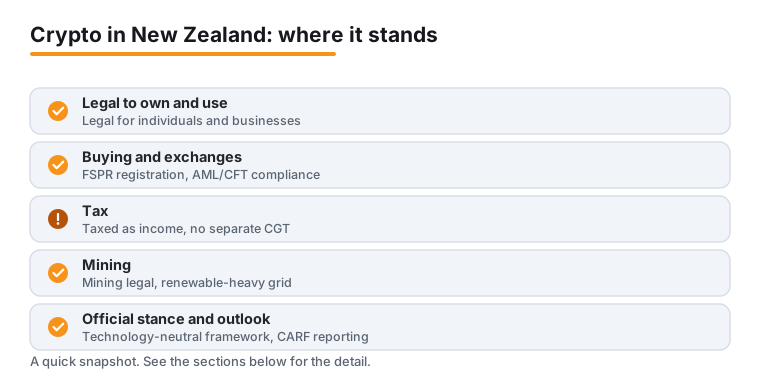
- Legal: Legal to own and trade, treated as property, not legal tender
- Tax: No capital gains tax; disposals and earnings taxed as income
- Buying: Via FSPR-registered exchanges with KYC
New Zealand is a stable, English-speaking market where owning, buying, selling and using Bitcoin and other cryptocurrencies is legal. Rather than passing a single dedicated "crypto law", New Zealand has largely applied its existing financial-markets, anti-money-laundering and tax rules to digital assets. That approach is technology-neutral: how a token is treated depends on what it actually does, not what it is called. The result is a workable, if sometimes complex, framework overseen by several agencies working in parallel, principally the Financial Markets Authority (FMA), the Department of Internal Affairs (DIA) and Inland Revenue (IRD).
What stands out in 2025 and 2026 is a clear move toward tighter tax transparency. New Zealand has adopted the OECD's Crypto-Asset Reporting Framework (CARF) into law, and from 1 April 2026 reporting crypto-asset service providers must collect and report customer transaction data to Inland Revenue. This guide explains the current legal status of crypto in New Zealand, who the regulators are, the key laws, how exchanges register, how crypto is taxed, the AML/KYC rules, buying and using crypto in practice, mining, recent developments, consumer risks, and how to verify everything with official sources. This is general information as of 2026 and is not legal, tax or financial advice; always confirm specifics with the named official regulators or a licensed adviser before acting. For broader context see our overview of crypto regulation.
On this page: Legal status · Who regulates it · Taxes · How to buy · Mining
Is Bitcoin and crypto legal in New Zealand?
Yes. Buying, holding, selling and using Bitcoin and other crypto assets is legal in New Zealand for both individuals and businesses. There is no ban on personal ownership or trading, and the country hosts registered exchanges, brokers and ATM operators. New Zealand courts have recognised cryptoassets as a form of property: the High Court decision in Ruscoe v Cryptopia Ltd (2020) confirmed that cryptoassets are property capable of being held on trust, which matters for disputes, insolvency and tax.
Crypto is not legal tender, however. The New Zealand dollar remains the only legal tender, so no merchant is obliged to accept Bitcoin as payment. The Reserve Bank of New Zealand has noted that cryptocurrencies are not legal tender and does not directly regulate them, though it monitors their impact on the financial system and has researched the idea of a central bank digital currency. Businesses may choose to accept crypto, but that is a commercial decision rather than a legal entitlement.
Because crypto is legal but regulated, the practical question for most people is not whether they can use it, but which obligations apply: chiefly identity verification when dealing with a registered provider, and tax reporting when they sell, swap or earn crypto.
Who regulates crypto in New Zealand?
No single agency owns crypto. Oversight is shared under existing laws:
- Financial Markets Authority (FMA). The conduct regulator for financial products and services. Where a crypto offering behaves like a regulated financial product or service, the FMA's disclosure, fair-dealing and licensing rules can apply. The FMA also publishes scam warnings and maintains alerts about unregistered operators. See FMA: crypto-asset service providers.
- Department of Internal Affairs (DIA). The lead anti-money-laundering supervisor for most virtual asset service providers (VASPs) such as exchanges, brokers and custodial wallet providers. See DIA: AML/CFT and Virtual Asset Service Providers.
- Inland Revenue (IRD). Sets and enforces the tax treatment of cryptoassets and administers the new CARF reporting regime. See Inland Revenue: cryptoassets.
- Reserve Bank of New Zealand (RBNZ). Watches financial-stability implications and is the central bank, but does not directly regulate cryptocurrencies as such.
- Commerce Commission. General consumer-protection and fair-trading matters can also be relevant.
This multi-agency model means the relevant regulator depends entirely on the activity. For a general primer, see our guide to crypto regulation.
Key laws and frameworks
New Zealand does not have one consolidated "crypto act". Several existing statutes apply depending on what a business or person is doing:
- Financial Markets Conduct Act 2013 (FMC Act). Governs the offer of financial products and the provision of financial services. Crypto offerings that amount to a regulated financial product can fall within its disclosure, fair-dealing and licensing requirements, administered by the FMA.
- Anti-Money Laundering and Countering Financing of Terrorism Act 2009 (AML/CFT Act). Although it does not name crypto specifically, most exchanges and VASPs fall within its definition of a financial institution and must run an AML/CFT programme, supervised mainly by the DIA.
- Financial Service Providers (Registration and Dispute Resolution) Act 2008 (FSP Act). Requires financial service providers operating in or from New Zealand to register on the Financial Service Providers Register (FSPR) and, where they serve retail clients, to join a dispute-resolution scheme.
- Income Tax Act 2007 and Tax Administration Act 1994. Provide the basis on which cryptoasset income is taxed.
- The Taxation (Annual Rates and the OECD Crypto-Asset Reporting Framework) measures enacted in 2025. These brought the OECD's CARF into New Zealand law, with reporting obligations on crypto-asset service providers taking effect from 1 April 2026.
This patchwork is technology-neutral by design. Because it relies on interpreting general rules, the exact treatment of a given token or service can be uncertain and evolving; confirm the current position with the FMA, DIA and IRD rather than relying on a fixed snapshot.
Registration and licensing of exchanges and VASPs
New Zealand does not issue a single, bespoke "crypto exchange licence". Instead, a crypto business must satisfy the general financial-services regime:
- FSPR registration. Most virtual asset service providers, including exchanges, brokers and custodial wallet providers, must register on the Financial Service Providers Register under the FSP Act before offering services. Those serving retail clients must also belong to an approved dispute-resolution scheme.
- AML/CFT compliance. Registered VASPs become reporting entities under the AML/CFT Act and must, before launching, appoint a compliance officer, conduct a risk assessment, write and maintain an AML/CFT programme, carry out customer due diligence, monitor and report suspicious activities, and file annual reports. The DIA supervises most of them.
- FMA conduct rules. If the service involves a regulated financial product, additional FMA licensing or disclosure obligations under the FMC Act may apply.
A set of AML/CFT amendment regulations was rolled out in stages, with a further stage taking effect on 1 June 2025, and supervisors signalled a broadly educative and constructive approach to the new requirements at the outset. Foreign exchanges can serve New Zealand customers, but offering financial services in or from New Zealand generally triggers the same registration and AML/CFT expectations. Always confirm a provider's status on the FSPR and check the FMA's warnings list before depositing funds.
Crypto and Bitcoin tax in New Zealand
Inland Revenue treats cryptoassets as a form of property, not as currency, and New Zealand has no separate capital gains tax regime. Tax depends on what you do with the asset and your intention, not on the token's name.
Key principles to be aware of:
- Disposals can be taxable. Profits made when you sell or swap cryptoassets are commonly treated as income where the asset was acquired with the purpose of disposal, where you are trading, or where it is part of a profit-making scheme. Using crypto to pay for goods or services counts as a disposal too.
- Earned crypto is income. Receiving crypto from mining, staking, certain airdrops, lending or yield, or being paid a salary in crypto is generally taxable at the time received, valued in New Zealand dollars.
- Rates. Because gains are taxed as income, they fall under New Zealand's progressive individual income-tax rates rather than a flat crypto rate. Since 1 April 2025 the rates have been 10.5 percent on income up to $15,600, 17.5 percent to $53,500, 30 percent to $78,100, 33 percent to $180,000, and 39 percent above that.
- Records and filing. Keep dates, NZD values, amounts, counterparties and the purpose of each transaction, and report taxable cryptoasset income in your income tax return.
See our general explainer on crypto taxes for background. Tax outcomes hinge on whether you are an investor, a trader or a business, and on rules that can change, so do not rely on a specific rate or threshold from any article. Confirm your position with Inland Revenue's guidance on taxing cryptoasset income or a chartered accountant. This section is general information, not tax advice.
AML, KYC and the Travel Rule
Anti-money-laundering and counter-terrorism-financing rules are the obligations most people encounter directly. Under the AML/CFT Act 2009, exchanges and other VASPs must verify customer identity (KYC) before providing services, monitor transactions, and report suspicious activity and certain large transactions to the authorities. This is why a registered exchange asks for your ID, proof of address and sometimes source-of-funds information during sign-up.
- Customer due diligence. Expect identity verification at onboarding, with enhanced checks for higher-risk customers or larger transactions.
- Travel Rule. In-scope providers are expected to apply the international Travel Rule, which requires originator and beneficiary information to accompany qualifying crypto transfers between institutions.
- Supervision. Since 1 July 2026 the DIA has been New Zealand's sole AML/CFT supervisor for all reporting entities, including every crypto business. It already supervised most VASPs, with the FMA covering a few depending on the services offered, and it publishes guidance for VASPs on meeting these obligations.
For users, the practical effect is that reputable New Zealand-facing platforms will not let you trade anonymously at scale. Treating KYC as a sign of a compliant, regulated provider, rather than an inconvenience, is generally the safer approach.
Buying and using crypto in practice
A careful, typical path to buying Bitcoin in New Zealand looks like this:
- 1. Choose a provider. Pick a reputable exchange or broker that serves New Zealand residents and is registered on the FSPR and supervised for AML/CFT. New Zealand-based services and larger global exchanges are both used; compare fees, security, supported payment methods and reputation.
- 2. Create and verify your account. Complete identity verification (KYC) by submitting your ID and details, a legal AML/CFT requirement. Enable two-factor authentication, preferably via an authenticator app rather than SMS.
- 3. Deposit funds. Fund the account by bank transfer or card, allowing for any bank limits or anti-scam friction.
- 4. Place an order. Buy Bitcoin with a market or limit order, and start small while you learn the interface.
- 5. Secure your holdings. For meaningful amounts, consider withdrawing to a wallet you control. A hardware (cold) wallet with an offline backup of your recovery phrase offers strong protection; never store the phrase online or share it.
- 6. Keep records. Save transaction details and NZD values for tax time, especially given the reporting requirements now coming into force.
Crypto can also be used for cross-border transfers, which matters for New Zealand's significant Pacific remittance flows, and Bitcoin ATMs have operated in cities such as Auckland, Wellington and Christchurch, though fees are usually higher than on exchanges and identity checks can apply. The government proposed banning crypto ATMs in 2025 but decided on 9 July 2026 not to proceed, preferring targeted controls, so the machines remain legal and operating. Crypto is not legal tender, so accepting it for payment is always at a merchant's discretion. Stay alert to scams throughout: fake apps, unsolicited "investment advisers", guaranteed-return schemes and requests to move funds urgently are all warning signs.
Bitcoin mining in New Zealand
Bitcoin mining is legal in New Zealand. There is no specific prohibition, so the main considerations are commercial, tax and energy-related rather than questions of legality.
- Energy mix. New Zealand generates a high share of its electricity from renewable sources, particularly hydro, geothermal and wind, giving mining a relatively low-carbon profile compared with fossil-fuel-heavy grids. Even so, electricity is a real cost and grid demand is a genuine consideration.
- Profitability. Mining economics depend on power prices, hardware efficiency, network difficulty and the Bitcoin price. Small-scale home mining is rarely profitable after costs; serious mining tends to be an industrial activity tied to cheap, ideally renewable, power.
- Tax and business obligations. Mining rewards are generally treated as income when received, valued in NZD, and running an operation as a business brings its own record-keeping and tax treatment. Confirm specifics with Inland Revenue.
- Local and environmental factors. Larger operations should consider resource consent, noise, cooling and community impacts depending on site and scale.
In practice, the renewable-heavy grid is the headline attraction for miners, balanced against electricity costs and the need to operate transparently and pay tax on rewards.
Recent developments (2025 to 2026)
New Zealand is tightening transparency rather than banning activity. The headline change is tax reporting:
- CARF adoption. The OECD's Crypto-Asset Reporting Framework was brought into New Zealand law in 2025. From 1 April 2026, reporting crypto-asset service providers (including exchanges, brokers and trading platforms operating as a business) must collect detailed user and transaction information and report it to Inland Revenue annually. The first reporting period runs 1 April 2026 to 31 March 2027, with the first report due by 30 June 2027.
- Greater IRD visibility. Through CARF, Inland Revenue will also receive information from other tax authorities about New Zealand tax residents who use overseas platforms. Inland Revenue has publicly stated it identified around 355,000 unique crypto-asset users in New Zealand making roughly 57 million transactions worth about 36 billion dollars, with roughly 80 percent of transactions occurring on overseas platforms, and it has urged investors to get tax compliant. CARF does not create new taxes; it enforces existing obligations more effectively.
- AML/CFT updates. Staged AML/CFT amendment regulations continued through 2025, and two Acts then received Royal Assent on 18 May 2026: the Anti-Money Laundering and Countering Financing of Terrorism Amendment Act 2026, in force from 19 May 2026, and the Anti-Money Laundering and Countering Financing of Terrorism (Supervisor, Levy, and Other Matters) Amendment Act 2026, whose key provisions took effect on 1 July 2026 and made the DIA the single AML/CFT supervisor.
- Proposed crypto ATM ban and cash controls. In July 2025, Associate Justice Minister Nicole McKee announced an in-principle decision to ban crypto ATMs as part of a wider AML/CFT overhaul, alongside a proposed 5,000 dollar cap on international cash transfers and enhanced powers for the Financial Intelligence Unit to request information from banks and crypto exchanges. On 9 July 2026 Cabinet decided not to proceed with the ban, agreeing that a blanket ban was not the right response at this time. Crypto ATMs remain legal and operating. The government will instead take regulation-making powers in the AML/CFT (Omnibus) Amendment Bill to restrict cash transactions for virtual assets, which could include maximum thresholds and, if clear evidence of harm emerges in New Zealand, prohibiting cash payments for high-risk virtual assets.
- NZDD stablecoin designation. On 11 March 2026, under the Financial Markets Conduct (ECDD Holdings Limited Stablecoin) Designation Notice 2026, the FMA declared the New Zealand dollar denominated NZDD stablecoin not to be a financial product under the FMC Act, treating it in substance as a payment mechanism rather than a debt security. Issuing it remains a financial service subject to the Act's fair-dealing rules. See FMA: NZDD stablecoin designation notice 2026.
- FMA innovation and scam focus. The FMA has run a regulatory sandbox pilot allowing firms to test innovative products under supervision, and has continued issuing warnings about crypto investment scams, fake platforms and recovery scams.
Because this area is evolving quickly, treat dates, thresholds and requirements as moving targets and verify the current position with the official sources below.
Consumer risks and protection
Key risks. Beyond Bitcoin's well-known price volatility, the main risks for New Zealand users are scams and fraud, platform failure or insolvency, loss or theft of private keys, irreversible transactions, and the tax and record-keeping burden of active trading. Crypto is not covered by deposit-style protections that apply to bank accounts, so platform failure or lost keys can mean total loss. Self-custody removes counterparty risk but shifts full responsibility for security onto you.
Protection and where to complain. The FMA publishes scam warnings and an alerts list, and registered providers serving retail clients must belong to a dispute-resolution scheme. Verify a provider on the FSPR and check the FMA's warnings before depositing funds. Regulators have repeatedly flagged crypto ATMs and unsolicited "investment adviser" contact as common scam channels, so treat any urgent instruction to send crypto or deposit cash as a major red flag.
Is it a good investment? That depends entirely on your goals, time horizon and risk tolerance, and no honest guide can promise returns. Only consider money you can afford to lose. This is general information, not financial advice; consider a licensed financial adviser and the FMA's investor resources before investing.
Official sources and how to verify
This guide is general information as of 2026 and is not legal, tax or financial advice; readers should verify their situation with the named official regulators or a licensed adviser before acting. Because the rules are technology-neutral and evolving, the official sources are the authoritative reference:
- Financial Markets Authority (conduct, crypto-asset service providers, scam warnings): fma.govt.nz
- Department of Internal Affairs (AML/CFT supervision of VASPs): dia.govt.nz
- Inland Revenue (cryptoasset tax and CARF reporting): ird.govt.nz
To verify a provider, search the Financial Service Providers Register and the FMA's warnings and alerts. For the tax position, start with Inland Revenue's cryptoassets pages and the CARF guidance, and consult a chartered accountant for your circumstances. For more background, see our broader regulation hub and our crypto regulation explainer. Rules change; this article is informational only and is not legal, tax or financial advice.
What is changing: August 2026 update
Three things moved between the end of June 2026 and early August 2026. One of them reverses what this page previously described as likely.
- New Zealand now has one AML supervisor, not three. The Anti-Money Laundering and Countering Financing of Terrorism (Supervisor, Levy, and Other Matters) Amendment Act 2026 received Royal Assent on 18 May 2026, and from 1 July 2026 the Department of Internal Affairs became the sole AML/CFT supervisor for all reporting entities. For crypto businesses the shift is narrower than it sounds, because the DIA already supervised most virtual asset service providers, with the Financial Markets Authority covering a few depending on the services offered. The DIA also gained new powers to make codes of practice, rules and notices, new investigation powers, and the ability to issue censures, and it expects to start collecting an industry levy from mid-2027 subject to Cabinet approval. See the Ministry of Justice record of AML/CFT legislative changes and the ministerial release of 12 May 2026.
- The crypto ATM ban was dropped. On 9 July 2026 Associate Justice Minister Nicole McKee announced that Cabinet had considered the evidence and agreed a blanket ban was not the right response at this time, reversing the in-principle decision of July 2025. The government will instead take regulation-making powers allowing restrictions on cash transactions for virtual assets, which could include maximum transaction thresholds and, if clear evidence of harm emerges in New Zealand, prohibiting cash payments for high-risk virtual assets. Crypto ATMs remain legal and operating. See Crypto ATMs to get guardrails, not the guillotine.
- CARF reporting is live, and Inland Revenue is already writing to people. Reporting obligations began on 1 April 2026. On 20 April 2026 Inland Revenue said a first batch of letters had been sent to people it knows have traded on one or more crypto-asset exchanges, giving them the chance to correct their tax position by filing an IR3 return. See Crypto investors urged to get tax compliant.
The underlying position is unchanged: crypto is legal, it is treated as property rather than legal tender, and New Zealand still has no single dedicated crypto statute.
New Zealand crypto legislation: what is in force and what is coming
New Zealand's next crypto-relevant law is the Anti-Money Laundering and Countering Financing of Terrorism (Omnibus) Amendment Bill, the third and final phase of the government's AML/CFT reform programme. It carries the virtual asset cash provisions that replaced the dropped ATM ban. Timing is tight: the minister said on 9 July 2026 that the bill would be introduced later that month, but Parliament rises on 24 September 2026 and is dissolved on 1 October 2026 ahead of the general election on 7 November 2026, so it cannot be enacted before the election.
| Measure | Stage | Timing | What it means in practice |
|---|---|---|---|
| AML/CFT Amendment Act 2026 | In force | From 19 May 2026 | More proportionate, risk-based obligations for reporting entities. Address verification dropped for standard simple low-risk transactions. Exchange onboarding still requires ID. |
| AML/CFT (Supervisor, Levy, and Other Matters) Amendment Act 2026 | In force | Key provisions from 1 July 2026 | The DIA becomes the single AML/CFT supervisor. An industry levy is expected from mid-2027, subject to Cabinet approval. |
| CARF reporting obligations | In force | From 1 April 2026 | Exchanges and brokers collect and report user and transaction data to Inland Revenue, keep records for seven years, register in myIR from March 2027, and file the first report by 30 June 2027. |
| AML/CFT (Omnibus) Amendment Bill | Cabinet agreed, introduction signalled for July 2026 but not confirmed | Cannot be enacted before the November 2026 election | Regulation-making power to restrict cash transactions for virtual assets, including possible maximum thresholds. Also billed as wider regulatory relief and FATF implementation. |
| Blanket crypto ATM ban | Dropped | Cabinet decided against it 9 July 2026 | Machines stay legal. Any controls will come later through regulations, not a prohibition. |
| FMA virtual assets work programme | Announced only | Multi-year, announced May 2026 | Work on tokenisation and market infrastructure. Not law, and nothing changes until something is published. |
What you actually pay: crypto tax rates and GST
New Zealand has no capital gains tax and no separate crypto tax rate. Where a disposal or crypto earnings are taxable, the profit is added to your other income and taxed at the ordinary individual rates below, which have applied since 1 April 2025.
| Taxable income (NZD) | Rate |
|---|---|
| $0 to $15,600 | 10.5% |
| $15,601 to $53,500 | 17.5% |
| $53,501 to $78,100 | 30% |
| $78,101 to $180,000 | 33% |
| $180,001 and over | 39% |
Two further points from Inland Revenue that often catch people out. Cryptoassets are not subject to GST when they are bought or sold, although GST implications can arise where crypto is received as payment in a business. And cryptoassets are not financial arrangements, they are excepted financial arrangements. Taxable cryptoasset income is returned in an IR3 individual income tax return. See Inland Revenue on cryptoassets and the current individual income tax rates.
Frequently asked questions
Is Bitcoin legal in New Zealand?
Yes. Owning, buying, selling and using Bitcoin and other crypto assets is legal in New Zealand, and the courts have recognised cryptoassets as property (Ruscoe v Cryptopia Ltd). However, crypto is not legal tender, so no business is required to accept it as payment.
Who regulates cryptocurrency in New Zealand?
Several agencies share oversight under existing laws. The Financial Markets Authority (FMA) regulates crypto activities that amount to financial products or services and issues scam warnings; the Department of Internal Affairs (DIA) supervises anti-money-laundering compliance for exchanges and other virtual asset service providers; providers generally register on the Financial Service Providers Register (FSPR); and Inland Revenue (IRD) handles tax. There is no single dedicated crypto statute.
Do I have to pay tax on crypto in New Zealand?
Generally yes. Inland Revenue treats cryptoassets as property, and there is no separate capital gains tax. Profits from selling, swapping or spending crypto are often taxed as income (for example where you bought to resell or are trading), and crypto earned from mining, staking, lending or as payment is taxable when received. Gains are added to your other income and taxed at New Zealand's progressive rates, which since 1 April 2025 have been 10.5 percent up to $15,600, 17.5 percent to $53,500, 30 percent to $78,100, 33 percent to $180,000 and 39 percent above that. Confirm your situation with the IRD or a tax professional. This is not tax advice.
What is CARF and how does it affect me from 2026?
CARF is the OECD's Crypto-Asset Reporting Framework, adopted into New Zealand law in 2025. From 1 April 2026, reporting crypto-asset service providers such as exchanges and brokers must collect customer and transaction data and report it to Inland Revenue, and the IRD will also receive data on New Zealand residents using overseas platforms. CARF does not create new taxes; it makes existing tax obligations far easier for the IRD to enforce, so accurate record-keeping matters more than ever.
Do crypto exchanges need a licence in New Zealand?
There is no single bespoke crypto licence. Most exchanges and virtual asset service providers must register on the Financial Service Providers Register, comply with the AML/CFT Act 2009 under the supervision of the Department of Internal Affairs (including identity verification and the Travel Rule), and join a dispute-resolution scheme if they serve retail clients. Additional FMA obligations apply if the service involves a regulated financial product. Check a provider on the FSPR and the FMA warnings list before using it.
Are crypto ATMs banned in New Zealand?
No. Cabinet decided on 9 July 2026 not to proceed with the proposed ban. In July 2025 the government announced an in-principle decision to ban crypto ATMs as part of a wider anti-money-laundering overhaul, alongside a proposed 5,000 dollar cap on international cash transfers and stronger information-gathering powers for the Financial Intelligence Unit. Cabinet then decided on 9 July 2026 not to ban them, agreeing that a blanket ban was not the right response at this time. Crypto ATMs are legal and operating in New Zealand, and the government will instead take regulation-making powers in the AML/CFT (Omnibus) Amendment Bill so it can restrict cash transactions for virtual assets later if needed.
How is the NZDD stablecoin treated by the regulator?
On 11 March 2026 the Financial Markets Authority issued a designation notice declaring the New Zealand dollar denominated NZDD stablecoin not to be a financial product under the Financial Markets Conduct Act, treating it in substance as a payment mechanism rather than a debt security. Issuing it is still a financial service and remains subject to the Act's fair-dealing provisions. This applies to that specific token and does not mean all stablecoins are treated the same way.
Is this guide legal or tax advice?
No. This is general information as of 2026, not legal, tax or financial advice. New Zealand's crypto rules are spread across several laws and are evolving, so you should verify your situation with the official regulators (the FMA, the DIA and Inland Revenue) or a licensed adviser before acting.
Who supervises crypto exchanges in New Zealand now?
The Department of Internal Affairs. From 1 July 2026 the DIA became New Zealand's sole AML/CFT supervisor under the Anti-Money Laundering and Countering Financing of Terrorism (Supervisor, Levy, and Other Matters) Amendment Act 2026, which received Royal Assent on 18 May 2026 and replaced a three-supervisor model shared with the Financial Markets Authority and the Reserve Bank. For crypto specifically the change is modest, because the DIA already supervised most virtual asset service providers, with the FMA covering a few depending on the services offered. The DIA also gained new powers to make codes of practice, rules and notices, new investigation powers and the ability to issue censures, and an industry levy to fund supervision is expected from mid-2027, subject to Cabinet approval. The FMA still regulates conduct where a crypto offering amounts to a regulated financial product, and Inland Revenue still handles tax.
What crypto legislation is New Zealand working on next, and when will it pass?
The Anti-Money Laundering and Countering Financing of Terrorism (Omnibus) Amendment Bill, the third and final phase of the government's AML/CFT reform programme. It is to include regulation-making powers letting the government restrict cash transactions for virtual assets, including possible maximum transaction thresholds, and the Ministry of Justice describes it more broadly as regulatory relief and implementation of Financial Action Task Force standards. The government said on 9 July 2026 that the bill would be introduced later that month, although introduction had not been confirmed from a parliamentary record as at early August 2026. Because Parliament rises on 24 September 2026 and is dissolved on 1 October 2026 ahead of the general election on 7 November 2026, it cannot be enacted before the election.
Do I pay GST on buying or selling crypto in New Zealand?
No. Inland Revenue states that cryptoassets are not subject to GST when they are bought or sold. GST implications can still arise where a business receives cryptoassets as payment for goods or services. Income tax is the relevant tax for most holders and traders, and taxable cryptoasset income is reported in an IR3 individual income tax return.
Facts reviewed: 5 August 2026. Page updated: 5 August 2026.