Home › Crypto Regulation › Tuvalu
Bitcoin & Cryptocurrency Regulation in Tuvalu
Quick answer — Tuvalu, 2026
- Legal: Legal but unregulated, not legal tender; no crypto specific law or ban
- Tax: No capital gains tax and no crypto specific guidance; income rules may still apply
- Buying: No domestic exchange, use international platforms or P2P; banking on and off ramps are the bottleneck
Tuvalu is one of the world's smallest and most remote nations: a Pacific archipelago of roughly 11,000 people, with no stock exchange, no independent central bank, and an economy that runs largely on cash, remittances and revenue from licensing its .tv internet domain. For everyday money it uses the Australian dollar, supplemented by its own Tuvaluan coins. Against this backdrop, cryptocurrency in Tuvalu is best understood as legal but almost entirely unregulated: there is no law banning Bitcoin, but there is also no dedicated crypto statute, no licensing regime for exchanges, and no specialist markets regulator to oversee the sector.
This guide explains, in plain terms and as accurately as the public record allows, how Bitcoin and crypto fit into Tuvalu today. It covers legal status, who the relevant authorities are, the general laws that apply, taxation, anti-money-laundering expectations, and the practical realities of buying, using and cashing out crypto in a lightly banked country. Because Tuvalu has very little crypto-specific law, much of the picture is shaped by general financial rules, banking constraints and global platforms rather than local statutes. This article is general information as of 2026 and is not legal, tax, or financial advice. Always verify the current position with Tuvaluan government authorities and the National Bank of Tuvalu, or a qualified professional, before acting. For wider context see our guide to crypto regulation.
On this page: Legal status · Who regulates it · Taxes · How to buy · Mining
Is Bitcoin and crypto legal in Tuvalu?
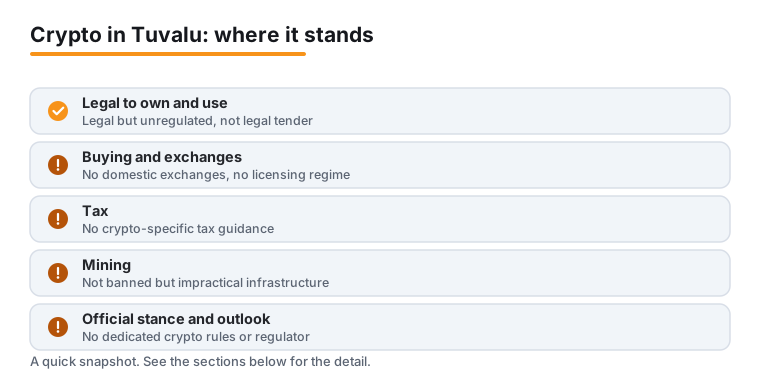
There is no public record of Tuvalu banning Bitcoin or other cryptocurrencies, and no statute that makes simply owning or using crypto illegal. In practical terms, holding Bitcoin, receiving it from family abroad, or trading it on an overseas exchange is not prohibited. At the same time, crypto is not legal tender in Tuvalu. The country's money is the Australian dollar, used at parity alongside Tuvalu's own coins, and no law gives Bitcoin or any token official monetary status.
The accurate way to describe the position is "legal but unregulated." This is common among very small economies. It means there are no crypto-specific consumer protections, no licensing regime for exchanges operating from within Tuvalu, and very little official guidance. Anyone using crypto in Tuvalu is therefore largely relying on global platforms and their own diligence. General laws, such as those addressing fraud, theft and money laundering, can still apply to crypto-related conduct. Because the legal landscape can change, confirm the current status with official Tuvaluan sources before treating crypto as freely usable.
Who regulates crypto in Tuvalu?
Tuvalu has no central bank and no monetary authority of its own, and no specialist financial-markets or securities regulator. This is the single most important fact for understanding crypto oversight in the country: there is no agency with a dedicated mandate over digital assets.
The principal financial institution is the National Bank of Tuvalu (NBT), a wholly government-owned bank and effectively the sole provider of banking services in the country. The NBT takes deposits, lends, handles foreign exchange and performs some treasury-style functions for the government, such as holding government accounts and foreign assets. Critically, the NBT is a bank, not a regulator. It does not license exchanges, supervise virtual-asset businesses, or issue binding crypto rules. Broader financial and economic policy sits with the Ministry of Finance and the wider government rather than with any independent supervisor. You can reach the bank through the National Bank of Tuvalu website.
Key laws and frameworks
Tuvalu does not have a dedicated cryptocurrency, virtual-asset or VASP (virtual-asset service provider) law, and its official legislation database does not list any such act. There is no published framework for stablecoins, token issuance or exchange licensing, and no local equivalent of regimes such as the EU's MiCA. Tuvalu is not an EU member, so MiCA and other EU rules do not apply to it.
Where rules do bite, they are general ones. The country's primary tax statute is the Income Tax Act 1992 (2022 Revised Edition, CAP 26.16), and the banking sector is only lightly supervised in practice. The full body of Tuvaluan law is published on the official Tuvalu Legislation portal, which is the authoritative place to check whether any new crypto-specific act has been enacted. Note a common point of confusion: a widely reported bill recognising crypto as personal property, introduced in September 2024, was United Kingdom legislation, not a Tuvaluan law. Do not assume Tuvalu has adopted any equivalent statute; confirm directly on the official legislation portal.
Licensing and registration of exchanges
Tuvalu has no domestic cryptocurrency exchange and no licensing or registration regime for crypto businesses. There is no Tuvaluan VASP licence, no register of virtual-asset firms, and no local authority that approves exchanges to operate. This is a genuine absence rather than a hidden requirement: the public record shows no framework at all.
For residents, the practical consequence is that buying or selling crypto means using international platforms governed by the rules of their own jurisdictions, not Tuvalu's. For anyone considering basing a crypto business in Tuvalu, the lack of a licensing regime is not the same as a green light: general company, tax and anti-money-laundering obligations can still apply, and the absence of a clear legal framework creates regulatory uncertainty. Anyone weighing this should take qualified local legal advice and confirm requirements with the Ministry of Finance before proceeding.
Crypto and Bitcoin tax in Tuvalu
Tuvalu's tax system is small and centres on income tax, import duties, and various fees. A notable feature is that Tuvalu does not levy a capital-gains tax, and the corporate income tax rate is a flat 30 percent on net profits under the Income Tax Act 1992. There is, however, no published, crypto-specific tax guidance, so the treatment of Bitcoin gains, trading profits, or crypto received as payment is not clearly defined in public sources.
The absence of a capital-gains tax does not automatically mean all crypto activity is tax-free. Depending on the facts, crypto could fall within existing income or business tax provisions, for example where someone is carrying on a trading or mining business rather than holding occasionally. Because this is genuinely uncertain, we deliberately avoid quoting crypto-specific rates or thresholds that are not reliably documented. If you live, work or transact in Tuvalu, consult the relevant Tuvaluan revenue or finance officials, or a qualified tax adviser. For general concepts see our crypto taxes guide. Nothing here is tax advice.
AML and KYC rules
Tuvalu is building, rather than fully operating, an anti-money-laundering and counter-terrorist-financing (AML/CFT) regime. It became a full member of the Asia/Pacific Group on Money Laundering (APG) in July 2023, having been an observer since 2014, and has committed to strengthening its legal and institutional frameworks, including criminalising money laundering and establishing confiscation measures. Implementation is ongoing under a multi-year policy reform programme.
In practice the system is still maturing. Tuvalu has established an Anti-Money-Laundering Coordination Committee and a Transaction Tracking Unit within the Tuvalu Police Force for reporting suspicious transactions, but it does not yet have a fully developed, standalone financial intelligence unit, and banking supervision is limited. There are no crypto-specific AML/KYC rules published for Tuvalu. The KYC checks most users actually encounter come from the international exchanges they use, which apply their own identity-verification standards regardless of Tuvalu's domestic framework.
Buying and using crypto in practice
Because Tuvalu has no domestic exchange, buying or selling crypto means using international platforms, and the real constraints are infrastructural rather than legal.
- Banking access is the main bottleneck. The National Bank of Tuvalu has faced correspondent-banking difficulties, including the loss of relationships with Australian institutions, which can make moving Australian dollars internationally slow, costly or limited. It maintains some overseas links, but the on-ramp and off-ramp remain the hardest steps.
- Card and payment coverage is thin. Limited access to international debit and credit cards and online payment rails can make funding an exchange account difficult. Tuvalu only gained its first ATMs in April 2025, and that system launched with prepaid cards; Tuvalu-issued debit and credit cards were still described as planned rather than in service.
- KYC and eligibility vary by platform. Global exchanges decide which countries they serve and may not fully support Tuvaluan customers, documents, or address and phone verification. Confirm a platform accepts Tuvalu before sending any money.
- Peer-to-peer and self-custody fill the gap. Where bank rails are difficult, some users rely on peer-to-peer trades or receive crypto directly from contacts abroad and hold it in a personal wallet.
Everyday commerce in Tuvalu runs on cash in Australian dollars, so plan any crypto access digitally and, crucially, work out how you would convert back to spendable cash before you buy.
Bitcoin mining in Tuvalu
Bitcoin mining is not specifically prohibited in Tuvalu, but it faces steep practical hurdles, and there is no mining-specific legal framework, incentive scheme or restriction on the books.
- Power supply. Electricity on small Pacific islands is limited and historically reliant on imported diesel, with growing but still constrained solar capacity. Running mining hardware continuously would compete with essential domestic needs and be costly.
- Connectivity. Reliable, low-latency internet is limited, undermining the stable connectivity competitive mining requires.
- Hardware and logistics. Importing, cooling and maintaining specialised rigs in a hot, humid, remote environment is difficult and expensive.
- Climate and policy context. As a nation on the front line of climate change, Tuvalu has strong reasons to prioritise sustainable energy, which sits awkwardly with energy-intensive proof-of-work mining.
In short, there is no clear legal barrier, but the economics and infrastructure make meaningful mining impractical today. Anyone considering it should investigate energy costs, import rules and any applicable business or environmental requirements with local authorities first.
Recent developments (2025 to 2026)
The most concrete recent developments are in basic financial and connectivity infrastructure, not crypto law. In April 2025 the National Bank of Tuvalu opened the country's first ATMs, unveiling five machines and 30 point-of-sale terminals on Funafuti, described by the government as a significant milestone and the nation's first electronic banking infrastructure. The roll-out was an AU$3 million project, begun in 2021, delivered with Fiji-based Pacific Technologies Limited and the Tuvalu Telecommunications Corporation, and it launched on prepaid cards. This matters for crypto because the lack of digital and card-based payment rails has long been a key barrier to using exchanges.
Connectivity also improved sharply in 2025. Tuvalu's first submarine fibre link, the Tuvalu Vaka Cable, was officially activated on 24 October 2025, and a Starlink service reached the islands during 2025, together giving the country far more capacity and lower latency than before. Better connectivity does not change the legal position on crypto, but it removes one long-standing practical obstacle to using online platforms.
On the regulatory side, the trajectory is toward better AML/CFT compliance following Tuvalu's 2023 APG membership, rather than toward a dedicated crypto regime. As of 2026 there is no public indication that Tuvalu is drafting a comprehensive cryptocurrency or virtual-asset law. The country has shown broad openness to digitalisation, notably through its high-profile "Digital Nation" initiative aimed at preserving statehood and cultural records against climate change. That programme includes a stated goal of a blockchain-based digital identity system and a national digital ledger for records such as births, deaths and marriages, but it is about national identity and record-keeping, not a rulebook for trading crypto. Treat the position here as a snapshot and check the official sources for changes.
Consumer risks and protection
The biggest risks for crypto users in Tuvalu are structural. Because there is no crypto-specific regulation and no local regulator, there are essentially no domestic consumer protections, no complaints body, and no local recourse if an overseas platform fails, freezes funds, or turns out to be fraudulent. Limited banking and payment infrastructure makes both buying and cashing out difficult, and the small, remote market leaves users dependent on global services with no local backstop.
Layered on top are the universal risks of crypto everywhere: price volatility, scams and phishing, lost or stolen private keys, and exchange or platform failure. Sensible precautions apply with extra force here: use only reputable, well-established platforms; never invest money you cannot afford to lose; enable strong, unique passwords and two-factor authentication; and if you self-custody, keep secure offline backups of your recovery phrase. Liquidity is a particular concern, since being able to buy is not the same as being able to sell and withdraw to spendable Australian dollars when you need to.
Official sources and how to verify
Because Tuvalu's crypto position is sparse and evolving, verify any important detail against primary sources rather than secondary summaries. The most relevant starting points are:
- The Tuvalu Legislation portal, the official database of Tuvaluan acts and regulations, where any new crypto, financial-services or tax law would appear.
- The National Bank of Tuvalu, for banking, foreign-exchange and account-access questions.
- The Asia/Pacific Group on Money Laundering, for Tuvalu's AML/CFT status and progress.
- The Library of Congress Guide to Law Online: Tuvalu, a useful index to Tuvaluan legal and government resources.
For broader context on how different countries treat digital assets, see our overview of crypto regulation by country. This article is general information as of 2026 and is not legal, tax, or financial advice; always confirm the current rules with the Tuvaluan authorities named above or a qualified professional before acting.
Frequently asked questions
Is cryptocurrency legal in Tuvalu?
Yes, in the sense that there is no known law banning it, so owning and using Bitcoin or other crypto is not prohibited. However, crypto is not legal tender (the Australian dollar is the country's money), and there is essentially no crypto-specific regulation. The status is best described as legal but unregulated. Confirm the current position with official Tuvaluan sources before relying on it.
Who regulates crypto in Tuvalu?
No one, specifically. Tuvalu has no central bank, no monetary authority, and no dedicated financial-markets or virtual-asset regulator. The National Bank of Tuvalu is a government-owned commercial bank, not a regulator, and broader policy sits with the Ministry of Finance. There is no agency that licenses or supervises crypto businesses in Tuvalu.
Does Tuvalu tax Bitcoin or crypto gains?
Tuvalu does not have a capital-gains tax, and there is no published crypto-specific tax guidance. That does not automatically make all crypto activity tax-free, because gains from a trading or business activity could fall under the Income Tax Act 1992. Because the treatment is uncertain, speak with Tuvaluan revenue officials or a qualified tax adviser. This is not tax advice.
Are crypto exchanges licensed in Tuvalu?
No. Tuvalu has no domestic exchange and no licensing or registration regime for crypto businesses, no VASP licence, and no register of virtual-asset firms. Residents who buy or sell crypto do so through international platforms governed by other jurisdictions' rules, not Tuvalu's.
How can I buy Bitcoin from Tuvalu?
Since there is no local exchange, residents typically use international platforms, peer-to-peer trades, or receive crypto directly from contacts abroad. The hardest part is usually the fiat on-ramp and cashing out, because of limited card access and the National Bank of Tuvalu's correspondent-banking constraints. Tuvalu only gained its first ATMs in 2025. Confirm a platform supports Tuvalu before sending any funds.
What are the AML and KYC rules for crypto in Tuvalu?
There are no crypto-specific AML or KYC rules published for Tuvalu. The country joined the Asia/Pacific Group on Money Laundering as a full member in 2023 and is still building its AML/CFT framework, including a police Transaction Tracking Unit, but it does not yet have a fully developed standalone financial intelligence unit. In practice, the identity checks users encounter come from the international exchanges they use.
Is Tuvalu's "Digital Nation" project a crypto or Bitcoin scheme?
No. Tuvalu's Digital Nation initiative is aimed at preserving the country's statehood, culture and records against climate change, including a 3D digital twin of its islands. It has a stated goal of a blockchain-based digital identity system and a national digital ledger for records such as births, deaths and marriages, but that is about identity and record-keeping, not a cryptocurrency or a plan to regulate crypto trading. It does not give Bitcoin any legal-tender or official monetary status in Tuvalu.
Did new internet cables and ATMs make it easier to use crypto in Tuvalu?
They removed practical obstacles rather than legal ones. In April 2025 the National Bank of Tuvalu launched the country's first ATMs and point-of-sale terminals, initially on prepaid cards, and in 2025 Tuvalu activated its first submarine fibre link, the Tuvalu Vaka Cable, alongside Starlink service. Better connectivity and card infrastructure can make reaching online platforms easier, but the fiat on-ramp and cashing out to Australian dollars remain the hardest steps, and none of this changed Tuvalu's legal position on crypto.
Facts reviewed: 30 June 2026. Page updated: 3 August 2026.