Home › Crypto Regulation › Uruguay
Bitcoin & Cryptocurrency Regulation in Uruguay
Quick answer — Uruguay, 2026
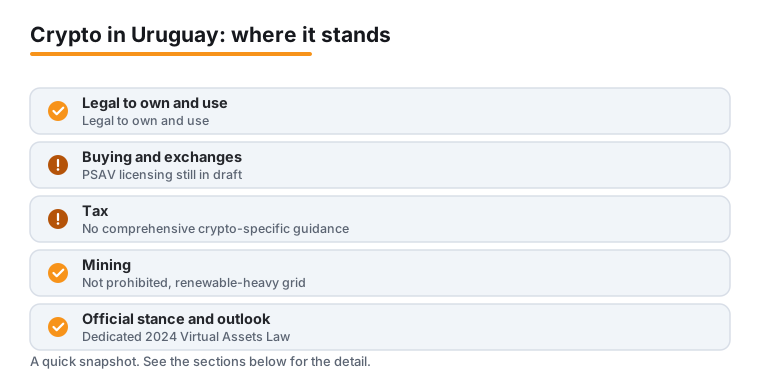
- Legal: Legal to own and use, not legal tender; regulated under 2024 Virtual Assets Law
- Tax: Territorial system, no crypto specific rules; gains assessed under existing IRPF or IRAE categories
- Buying: Via exchanges with KYC; no hard currency controls, peso and US dollars usable
Uruguay has become one of Latin America's more structured jurisdictions for digital assets. After treating cryptocurrency as a legal grey area for years, the country enacted a dedicated virtual-asset law in 2024 (Ley N. 20.345) and put crypto businesses under the supervision of its central bank. The framework is built around consumer protection, anti-money-laundering controls and alignment with international standards, rather than an outright ban or, at the other extreme, adopting Bitcoin as official money.
This guide explains how Uruguay treats Bitcoin and other cryptocurrencies in 2026: whether they are legal, who regulates them, how they are taxed, how exchanges must register, and the practical realities around buying, mining and consumer protection. It is written for residents, newcomers and visitors who want an accurate picture. This is general information as of 2026, NOT legal, tax or financial advice; always verify the current rules with Uruguay's named official regulators, the Banco Central del Uruguay (BCU) and the Direccion General Impositiva (DGI), or a qualified local professional before acting. For broader context see our overview of crypto regulation.
On this page: Legal status · Who regulates it · Taxes · How to buy · Mining
Is Bitcoin and crypto legal in Uruguay?
Yes. Owning, buying, selling and holding Bitcoin and other cryptocurrencies is legal in Uruguay. There is no prohibition on individuals using crypto, and the country has moved to regulate the sector rather than restrict it.
The crucial distinction is between legal and legal tender. Uruguay does not recognise Bitcoin as legal tender, so no merchant or creditor is obliged to accept it, and the Uruguayan peso remains the only official currency. This sets Uruguay apart from El Salvador, the one Latin American country to have granted Bitcoin legal-tender status (and which later rolled back that mandate). In practical terms, crypto in Uruguay is treated as a legitimate asset and a regulated financial activity, not as money you can demand to pay taxes or bills with.
The regulator: Banco Central del Uruguay (BCU)
The main regulator is the Banco Central del Uruguay (BCU), acting through its Superintendencia de Servicios Financieros (SSF), the Superintendency of Financial Services. Law 20.345 amended the BCU's Charter to give the central bank express authority to regulate and supervise the sector.
The law and the BCU's draft rules create the figure of the Virtual Asset Service Provider (in Spanish, Proveedor de Servicios de Activos Virtuales, or PSAV), broadly equivalent to the international concept of a VASP. The draft regulation distinguishes between financial PSAVs (PSAVF), which exchange, transfer, hold in custody or administer virtual assets, and non-financial PSAVs (PSAVNF), which buy and sell non-financial virtual assets and face lighter requirements such as registration in a register kept by the SSF. The BCU's stated core principles are financial-consumer protection, anti-money-laundering compliance and alignment with international standards. Tax matters are handled separately by the Direccion General Impositiva (DGI). The official source is the Banco Central del Uruguay.
Key laws and frameworks
Uruguay's central piece of legislation is Law No. 20.345, the Virtual Assets Law (Ley de Activos Virtuales), sanctioned on 10 September 2024 and published in the official gazette on 27 September 2024. Rather than creating a wholly separate regime, it amended the Charter of the Banco Central del Uruguay and related rules to bring virtual assets into the regulated financial system.
Key features include:
- A defined regulator. The BCU, through the SSF, supervises the sector and the new PSAV category.
- Scope. The BCU supervises PSAVs whose services relate to virtual assets that, in its judgement, can be considered financial instruments; other providers face lighter registration. The law also created a category of decentralised-registry securities (valores de registro descentralizado) issued and transferred using distributed-ledger technology.
- Stablecoins. The BCU has indicated that fully fiat-backed stablecoins meeting set requirements may be treated as electronic money and issued under existing licences rather than as ordinary crypto.
- AML/CFT obligations. Providers must apply customer due diligence and anti-money-laundering and counter-terrorist-financing controls consistent with FATF (GAFI) standards.
You can consult the full text of the law at IMPO, Ley N. 20.345. Detailed implementing rules are still being finalised, so check the BCU's latest publications.
Licensing and registration of exchanges (PSAVs)
There is no ban on Uruguayan residents using cryptocurrency exchanges, and both international and regional platforms are accessible. What is changing is the regulatory perimeter for the businesses themselves. Under Law 20.345 and the BCU's draft regulation, providers that operate in or target Uruguay must be authorised by, or registered with, the BCU as PSAVs and must comply with AML/CFT obligations. The framework generally does not require foreign firms to be licensed unless they offer services to local users.
The BCU's Superintendency presented a comprehensive normative project on 21 August 2025 and, following public consultation, published a revised version on 16 March 2026 reflecting changes introduced by the National Budget Law. Reported features of the draft include:
- Prior authorisation. Financial PSAVs must obtain authorisation from the SSF before operating and disclose their structure, shareholders, governance, operations and systems; non-financial PSAVs face a lighter registration regime.
- Capital and guarantees. For PSAVs providing custody or administration of virtual assets, the March 2026 draft sets a minimum net worth of UI 1,000,000 (indexed units), a guarantee in favour of the BCU of not less than UI 600,000, and a demand deposit at the central bank of not less than UI 50,000. These figures are part of a draft under consultation and may change.
- Client-fund segregation. The draft requires PSAVs to keep their own funds separate from client funds, so that clients' virtual assets do not form part of the provider's estate in the event of insolvency or liquidation.
- Transition deadlines. The draft provides that PSAVs already operating when the rule takes effect will have until 31 December 2026 to file their authorisation request and may keep operating while it is processed. The general deadline to comply with the various provisions runs to 30 June 2027, with specific additional deadlines for certain operational aspects.
The public-consultation comment period for the March 2026 draft ran to 13 April 2026. Because these rules were still in draft and consultation as of 2026, exact obligations and dates can change. Anyone planning to operate must confirm the current requirements directly with the BCU and obtain local legal advice. See also our hub on crypto regulation by country.
Crypto taxation in Uruguay
Uruguay operates a territorial tax system administered by the Direccion General Impositiva (DGI): broadly, Uruguayan-source income is taxable while much foreign-source income falls outside the scope of personal income tax, which is one reason Uruguay is mentioned as a relocation destination. Recent budget legislation has been adjusting how some foreign income and capital gains are treated, so details are evolving.
The DGI has not, to date, issued comprehensive crypto-specific guidance, so gains and income from cryptocurrency are generally assessed under existing categories. In practice that can mean personal income tax (IRPF) on capital income for individuals, corporate income tax (IRAE) for businesses, and value-added tax (IVA) potentially relevant to certain commercial activities. For company accounting, crypto held as an intangible asset is generally valued at acquisition cost. How a given transaction is characterised, and whether it is Uruguayan- or foreign-source, can materially change the outcome.
Because treatment depends heavily on residency, the source of the income, the nature of the activity and rules that are being reformed, this article does not state specific crypto rates or thresholds. Confirm your position with the Direccion General Impositiva (DGI) or a qualified Uruguayan tax adviser. See our general guide to crypto taxes. This is not tax advice.
AML and KYC rules
Anti-money-laundering (AML) and counter-terrorist-financing (CFT) compliance is a core pillar of Uruguay's framework. Law 20.345 brings PSAVs squarely within the country's AML/CFT system, and the BCU has emphasised alignment with FATF (GAFI) international standards.
For service providers this means obligations such as customer due diligence (KYC), identification of beneficial owners, ongoing transaction monitoring, record-keeping and reporting of suspicious activity. As part of the framework, PSAVs are treated as regulated parties and must register with Uruguay's financial-intelligence unit, the Unidad de Informacion y Analisis Financiero (UIAF), which sits within the BCU, and report suspicious operations to it. For ordinary users, the practical effect is that reputable exchanges and providers will ask you to verify your identity (typically a government ID and sometimes proof of address) and may request information on the source of funds before you can trade or withdraw fiat. These checks are a legal requirement, not an optional step, and they are becoming more consistent as more providers seek BCU authorisation.
Buying and using crypto in practice
For most people in Uruguay, a regulated cryptocurrency exchange is the simplest route to buy and sell. A typical process looks like this:
- Choose a platform that is transparent about its regulatory status, security and fees, and that supports Uruguayan pesos or US dollars and local payment methods.
- Create and verify your account by completing identity verification (KYC).
- Deposit funds by bank transfer, card or another supported method, checking fees and processing times.
- Place an order and review the fee and final price before confirming.
- Secure your holdings. For anything beyond small or short-term amounts, consider moving coins to a wallet you control, ideally a hardware wallet, and safeguard your recovery phrase. Never share private keys or seed phrases.
Uruguay does not impose the kind of hard currency controls seen in some neighbouring countries; the peso floats and residents can legally hold and transact in US dollars, which makes on- and off-ramping relatively straightforward. Bitcoin ATM coverage exists but is limited, with machines reported in tourist and coastal areas; ATM fees are usually higher than exchange fees, so check the rate and supported assets before using one. Using Bitcoin or dollar-pegged stablecoins to send cross-border value is also legal and can be faster or cheaper than some bank corridors, though volatility, network fees and spreads can erode any savings.
Bitcoin mining in Uruguay
Bitcoin mining is not prohibited in Uruguay, and the country has a distinctive feature for miners: an electricity grid dominated by renewable generation. In 2024 Uruguay generated roughly 99 percent of its electricity from renewables, principally hydropower, wind and biomass, with solar growing. This clean-energy profile has led to Uruguay being highlighted as a potential location for lower-carbon mining.
However, a renewable grid does not mean cheap or unlimited industrial power. A cautionary example is Tether, which announced large mining and energy plans in Uruguay but saw operations disrupted in 2025 amid disputes over electricity costs and bills, illustrating that profitability hinges on negotiated power tariffs and grid access, not green branding. Prospective miners should also note that:
- Regulatory classification. The law's discussion of providers has at times referenced miners, so larger commercial operations should check whether any registration or compliance obligations apply under the virtual-asset framework.
- General business rules. Company formation, equipment import, electrical and environmental permits, and ordinary taxation all apply as they would to any industrial venture.
Confirm power tariffs and grid-connection terms with the national utility (UTE) and the relevant authorities before committing capital.
Recent developments (2025 to 2026)
The clear theme is incremental formalisation. After Law 20.345 took effect in late 2024, the BCU's Superintendency presented its main PSAV normative project on 21 August 2025 and opened it for public consultation. A revised draft was published on 16 March 2026 to reflect changes from the National Budget Law, with a consultation comment period running to 13 April 2026. The draft sets transition arrangements giving providers already operating until 31 December 2026 to file for authorisation while continuing to operate, with a general compliance deadline of 30 June 2027 and some specific operational deadlines beyond that.
In parallel, the private sector launched a Blockchain Chamber of Uruguay to engage with regulators, and commentators have described the period as one of regulatory maturation that aims to give legal certainty while keeping pace with innovation. The reasonable expectation for 2026 is continued, gradual integration of crypto into the regulated financial system, more registered providers and clearer compliance expectations, without Bitcoin becoming legal tender. Because the implementing rules were still in draft and consultation, the exact obligations and dates can still change; verify against the BCU's latest publications.
Consumer risks and protection
A clearer legal regime and central-bank supervision can reduce some counterparty and fraud risk when you use authorised providers, and Uruguay's stable institutions and open currency market make entering and exiting positions relatively straightforward. The BCU has publicly warned about the risks of virtual assets and has stressed consumer protection as a core principle of the new framework.
None of that changes the underlying nature of the asset. Cryptocurrencies are highly volatile, can lose substantial value quickly, are not covered by deposit-guarantee schemes, and carry technology and custody risks. Regulation reduces some risks but does not make crypto safe or guarantee returns. Until PSAV authorisation is fully in force, many providers are still in a transition phase, so do your own diligence: prefer transparent platforms, keep clear records, use strong security, and be alert to scams, including fake platforms and impersonation of well-known brands. This article does not make price predictions or recommend buying or selling, and it is not financial advice.
Official sources and how to verify
Crypto rules in Uruguay are evolving, so always confirm the current position against primary official sources rather than third-party summaries:
- Banco Central del Uruguay (BCU), the financial regulator supervising PSAVs through its Superintendency of Financial Services: www.bcu.gub.uy.
- Law No. 20.345 (Virtual Assets Law), official text in Uruguay's legal database: IMPO, Ley N. 20.345.
- Direccion General Impositiva (DGI), the tax authority, for tax questions: www.dgi.gub.uy.
- Uruguay XXI, the government investment-promotion agency, for official context on the regulatory landscape: Uruguay XXI.
This guide is general information as of 2026 and is NOT legal, tax or financial advice. Rules, draft regulations and deadlines can change; verify your situation with the BCU, the DGI or a qualified Uruguayan professional before acting. For more, see our crypto regulation guide.
Frequently asked questions
Is cryptocurrency legal in Uruguay?
Yes. Buying, holding, selling and using cryptocurrency is legal in Uruguay, and the country regulates crypto businesses through the Banco Central del Uruguay (BCU) under the 2024 Virtual Assets Law (Law No. 20.345). However, Bitcoin is not legal tender, so no one is obliged to accept it as payment; the Uruguayan peso remains the only official currency.
Who regulates crypto in Uruguay?
The Banco Central del Uruguay (BCU), through its Superintendency of Financial Services (SSF), is the main regulator. Law 20.345 created the Virtual Asset Service Provider category (PSAV), covering exchanges, custodians and similar businesses, which must be authorised by or registered with the BCU and apply anti-money-laundering controls. Tax matters are handled separately by the tax authority, the DGI. Verify current rules at www.bcu.gub.uy.
Do crypto exchanges need a licence in Uruguay?
Increasingly, yes. Under Law 20.345 and the BCU's draft regulation, financial Virtual Asset Service Providers (PSAVs) that operate in or target Uruguay must obtain prior authorisation from the Superintendency of Financial Services, while lighter-activity providers face registration. Under the March 2026 draft, providers already operating would have until 31 December 2026 to file for authorisation and could keep operating while it is processed, with a general compliance deadline of 30 June 2027. The detailed rules, including proposed capital and guarantee requirements, were still in draft and public consultation as of 2026, so confirm the current requirements with the BCU.
How is crypto taxed in Uruguay?
Uruguay uses a territorial tax system, and the DGI has not issued comprehensive crypto-specific rules, so crypto gains and income are generally assessed under existing categories such as IRPF (individuals) or IRAE (businesses). The treatment depends on your residency, the source of the income and the nature of the activity, and the rules are being adjusted through recent budget legislation. This article does not state specific rates; confirm your position with the DGI or a qualified Uruguayan tax adviser. This is not tax advice.
Can I mine Bitcoin in Uruguay?
Mining is not prohibited, and Uruguay's grid was roughly 99 percent renewable in 2024 (mainly hydro, wind and biomass), which appeals to lower-carbon mining. But a renewable grid does not mean cheap power: Tether's large 2023 mining plans were disrupted in 2025 over electricity-cost disputes. Profitability depends on negotiated tariffs, grid access and scale, and larger operations should check business, import, environmental and any virtual-asset compliance rules. Confirm specifics with the national utility (UTE) and the authorities.
When must crypto exchanges comply with Uruguay's new rules?
Under the Banco Central del Uruguay draft published on 16 March 2026, providers already operating when the rule takes effect would have until 31 December 2026 to file an authorisation request and could keep operating while it is reviewed. The general deadline to adapt to the various provisions runs to 30 June 2027, with some additional operational deadlines. The comment period for the draft ran to 13 April 2026. These dates come from a draft under consultation and can change, so confirm the current position with the BCU.
How much capital does a crypto custody business need in Uruguay?
The March 2026 BCU draft proposes, for PSAVs that provide custody or administration of virtual assets, a minimum net worth of UI 1,000,000 (indexed units), a guarantee in favour of the BCU of at least UI 600,000, and a demand deposit at the central bank of at least UI 50,000. Providers must also keep client funds separate from their own so client assets are protected in an insolvency. These figures are from a draft still under consultation and may change; verify with the BCU.
Do crypto firms in Uruguay register with an anti-money-laundering unit?
Yes. Beyond BCU authorisation, virtual-asset service providers are treated as regulated parties for anti-money-laundering purposes and must register with Uruguay's financial-intelligence unit, the Unidad de Informacion y Analisis Financiero (UIAF), which sits within the BCU, and report suspicious operations. This is in addition to their KYC and transaction-monitoring duties.
Is this article legal advice?
No. This is general information as of 2026 and is not legal, tax or financial advice. Uruguay's crypto framework is still being implemented, and draft regulations and deadlines can change. Always verify your situation with the named official regulators, the Banco Central del Uruguay (BCU) and the Direccion General Impositiva (DGI), or a qualified Uruguayan professional before acting.
Facts reviewed: 30 June 2026. Page updated: 3 August 2026.