Home › Crypto Regulation › Syria
Bitcoin & Cryptocurrency Regulation in Syria
Quick answer — Syria, 2026
- Legal: Legal grey area, neither legalized nor banned, not legal tender
- Tax: No clear crypto-specific tax; general tax may apply
- Buying: Global exchanges opened after sanctions relief, plus P2P and stablecoins
Syria is at an unusual turning point for digital assets. After the fall of the Assad government in December 2024, the United States and the European Union moved through 2025 to remove or suspend most of the sweeping sanctions that had isolated the country's financial system for decades. The U.S. Treasury terminated its Syria sanctions program and de-listed the Central Bank of Syria, and the EU Council lifted its economic restrictive measures. That relief reconnected Syria to the global financial system and, for the first time, allowed mainstream crypto platforms to serve Syrian users.
This guide explains what is actually known about cryptocurrency regulation in Syria as of 2026: the legal status, the bodies that oversee finance and anti-money-laundering, the laws that exist (and the dedicated crypto law that does not yet exist), exchange access, taxation, mining, recent developments, and the risks every user should weigh. Syria's legal framework is incomplete and changing quickly, so treat everything here as a general overview, not a definitive ruleset. This article is general information as of 2026 and is not legal, tax, or financial advice; verify any specific point with the Central Bank of Syria or a qualified local professional before acting. For broader context see our guide to crypto regulation.
On this page: Legal status · Who regulates it · Taxes · How to buy · Mining
Is Bitcoin and crypto legal in Syria?
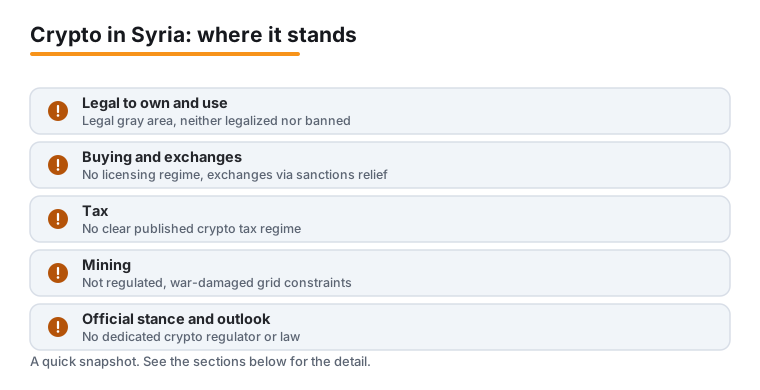
Cryptocurrency in Syria currently sits in a legal gray area. As of 2026 no Syrian law specifically legalizes Bitcoin or other digital assets, and none explicitly bans owning, buying, or transferring them. In practice individuals do hold and trade crypto, but without the clarity or consumer protection that a formal framework would provide.
A non-governmental think tank, the Syrian Center for Economic Research (SCER), published a proposal in early 2025 urging the transitional government to legalize Bitcoin, build a framework for trading and mining, and digitize the Syrian pound as a stablecoin backed by a mix of the U.S. dollar, gold, and Bitcoin. To be precise: this was a think-tank proposal, not law. Reporting indicates the transitional government has neither adopted nor prioritized it. The key takeaway is that the absence of a ban is not a green light, and the picture can change as new institutions take shape.
Who regulates crypto in Syria? The Central Bank and AML commission
Syria does not have a dedicated crypto regulator. Oversight of the financial system rests with two bodies that would shape any future digital-asset rules:
- The Central Bank of Syria (مصرف سورية المركزي) is the monetary authority. It issues currency, licenses and supervises banks and money-transfer businesses, and sets financial policy. Any future crypto framework would most likely be administered through the central bank. Its official website is cb.gov.sy.
- The Combating Money Laundering and Terrorism Financing Commission is an independent body with judicial capacity established within the Central Bank of Syria under Legislative Decree No. 59 of 2003, amended by Legislative Decree No. 33 of 2005. It is the country's financial intelligence unit, receiving and analyzing suspicious-transaction reports and conducting AML/CFT investigations. See the central bank's AML/CFT commission page.
Because these mandates predate digital assets, there is no Syrian authority that today licenses or registers a defined category of crypto businesses. If and when one is created, it would most plausibly be the central bank.
Key laws and frameworks that apply
There is no dedicated cryptocurrency statute in Syria. Instead, digital activity falls near the country's existing financial and anti-money-laundering rules, which were not written with virtual assets in mind:
- AML/CFT law based on Legislative Decree No. 59 of 2003 as amended by Decree No. 33 of 2005, which underpins customer identification, record-keeping, and suspicious-transaction reporting obligations for regulated financial institutions.
- Central banking and currency law, under which the Central Bank of Syria supervises licensed financial institutions and manages the national currency. In late 2025 the central bank announced a currency redenomination (removing two zeros from the pound, so 100 old pounds convert to 1 new pound) under Presidential Decree No. 293 of 2025, with the swap process beginning January 1, 2026. This is a fiat reform, not a crypto law.
Crucially, no Syrian framework yet defines or licenses "virtual asset service providers," so the SCER's crypto-and-mining proposal and the idea of a blockchain-backed digital pound remain proposals rather than enacted rules. Treat any claim of a specific Syrian "crypto law" with skepticism and verify it against the central bank.
Licensing and registration of exchanges and VASPs
Syria currently has no licensing or registration regime specifically for crypto exchanges, brokers, custodians, or other virtual asset service providers operating inside the country. Because AML obligations attach to licensed banks and money-transfer businesses rather than to a defined class of crypto firms, there is no domestic VASP authorization to apply for as of 2026.
In practice, Syrians who use crypto rely on global platforms that began accepting Syrian residents after sanctions relief, on peer-to-peer (P2P) trading, and on self-custody wallets. A business considering crypto activity inside Syria should assume the rules are unsettled, confirm its position directly with the Central Bank of Syria, and watch for any future registration requirements that a new framework could introduce. For how licensing works in more developed regimes, see our crypto regulation hub.
Crypto and Bitcoin taxation in Syria
Syria does not have a clear, published tax regime specific to cryptocurrency. There is no widely documented capital-gains tax on crypto profits, no defined VAT treatment for digital-asset transactions, and no crypto-specific reporting form. This follows directly from crypto's undefined legal status: there cannot be settled tax rules for an asset class the law has not yet defined.
That does not guarantee crypto activity is tax-free. General income and business tax principles could in theory reach gains or businesses that accept crypto, and rules may evolve as the new administration rebuilds its fiscal system. We deliberately do not quote any rates, thresholds, or filing deadlines for Syrian crypto, because none can be reliably verified. If you realize meaningful gains or run a crypto-accepting business, consult a qualified Syrian tax professional and confirm your obligations directly with the authorities. For general concepts see our crypto taxes guide. This section is informational only and is not tax advice.
AML and KYC rules
Syria's anti-money-laundering and counter-terrorist-financing obligations flow from Legislative Decree No. 59 of 2003 (as amended by Decree No. 33 of 2005) and are enforced by the Combating Money Laundering and Terrorism Financing Commission inside the Central Bank of Syria. Regulated financial institutions must verify customer identity (KYC), keep records, maintain internal compliance programs, and report suspicious transactions.
Two practical points matter for crypto users. First, these duties currently bind licensed banks and money-transfer businesses rather than a defined class of crypto firms, so domestic AML coverage of crypto is indirect. Second, Syria has been on the Financial Action Task Force (FATF) list of jurisdictions under increased monitoring (the "gray list") since 2010; in February 2026 the central bank governor signaled that a national AML strategy was being finalized. You can check Syria's status on the FATF country page for Syria. In practice, expect global exchanges serving Syrian users to apply strict identity verification and enhanced due diligence.
Buying and using crypto in practice
Until 2025 sanctions effectively cut Syrians off from mainstream international exchanges. That changed after the relief described below: in June 2025 Binance announced it had opened access to Syrian residents, reportedly offering more than 300 tokens and stablecoins, spot and futures trading, staking, and Syrian-pound trading pairs. Access on global platforms typically comes with stricter identity verification and, for newly reopened markets, additional onboarding review.
Alongside centralized exchanges, Syrians rely heavily on:
- Peer-to-peer (P2P) trading, where buyers and sellers match directly and settle via local cash or bank and mobile transfers. P2P has long been the backbone of crypto access in sanctioned or under-banked economies.
- Stablecoins such as USDT, used as a dollar proxy given the instability of the Syrian pound.
- Self-custody wallets, which avoid reliance on any single platform that could restrict service.
Practical cautions: confirm an exchange currently accepts Syrian residents, verify whether your payment method will process crypto transfers, and on P2P favor platforms with escrow and never release funds before escrow conditions are met. Crypto is also widely used for cross-border remittances into Syria, where value can move directly between wallets faster and with fewer intermediaries than legacy channels; recipients still need a reliable, usually P2P, way to convert to cash.
Bitcoin mining in Syria
Bitcoin mining is not specifically regulated in Syria, and there is no dedicated licensing scheme for it. The binding constraints are practical rather than legal. Mining is electricity-intensive, and Syria's power grid was severely damaged by years of war, with frequent outages and unreliable supply. That makes large-scale, grid-dependent mining difficult and costly.
The SCER proposal floated allowing entrepreneurs to mine Bitcoin under oversight using untapped energy resources, but that is a proposal, not a program. Where mining happens today it tends to depend on cheaper or self-generated power, and commentators point to solar as a more resilient off-grid option given Syria's sunlight. These are general efficiency observations, not a verified Syrian incentive or subsidy. Anyone considering mining should account for hardware import difficulties, power cost and reliability, and the chance that future rules impose registration, energy, or tax requirements.
Recent developments (2025 to 2026)
The defining change has been sanctions relief. On June 30, 2025 the U.S. President issued an Executive Order terminating the Syria sanctions program effective July 1, 2025; OFAC implemented it and removed Syrian financial institutions, including the Central Bank of Syria, from the Specially Designated Nationals (SDN) list. See the U.S. Treasury OFAC action of June 30, 2025. Sanctions remained on Assad-era figures and certain designated persons, so residual exposure persists.
In parallel, the EU Council adopted legal acts on May 28, 2025 lifting most economic restrictive measures on Syria and removing the Central Bank of Syria and other banks from its asset-freeze list, per the EU Council press release. Following this, Binance opened to Syrian users in June 2025. On the domestic side, the central bank pursued digital payments modernization (agreements with major card networks) and launched a fiat currency redenomination from January 1, 2026, and in early 2026 the central bank governor indicated a national AML strategy was nearing completion. None of these amounts to a dedicated crypto law, which still does not exist.
Consumer risks and protection
The defining feature of Syria's crypto landscape is uncertainty, and consumer protection is weak. The main risks:
- Regulatory risk. With no settled framework, restrictions, registration requirements, or taxes could appear and change quickly.
- Sanctions risk. Relief reopened access, but it can be conditional and reversible, and specific individuals and entities remain designated.
- Infrastructure risk. Unreliable electricity and internet and a fragile banking system complicate transacting and cashing out.
- Market and security risk. Price volatility, scams, fake apps, phishing, and the finality of crypto transactions can cause permanent losses.
There is no investor-compensation scheme in Syria to fall back on. A reasonable general principle, not advice, is to treat crypto as a high-risk holding: never commit money you cannot afford to lose, understand the difference between volatile assets and stablecoins, prioritize secure self-custody, start small, and double-check every address and counterparty.
Official sources and how to verify
Because Syrian rules are evolving and incomplete, always confirm specifics against primary sources rather than secondary commentary:
- Central Bank of Syria for monetary policy, banking supervision, and any future crypto framework: cb.gov.sy, and its AML/CFT commission page.
- U.S. Treasury OFAC for the current sanctions position: OFAC Syria action, June 30, 2025.
- EU Council for European measures: EU Council press release, May 28, 2025.
- FATF for Syria's AML monitoring status: FATF Syria country page.
For related explainers on this site, see our regulation by country index. This guide is general information as of 2026 and is not legal advice; verify your situation with the Central Bank of Syria and a qualified local professional.
Frequently asked questions
Is cryptocurrency legal in Syria in 2026?
It is in a legal gray area. As of 2026 no Syrian law specifically legalizes or bans cryptocurrency, so people buy, hold, and transfer it without a formal framework. A think tank (the Syrian Center for Economic Research) proposed legalizing Bitcoin in 2025, but that proposal has not been enacted into law. Verify the current position with the Central Bank of Syria before acting.
Which authority regulates crypto in Syria?
There is no dedicated crypto regulator yet. The Central Bank of Syria (cb.gov.sy) oversees the financial system and would most likely shape any future framework. The Combating Money Laundering and Terrorism Financing Commission, established inside the central bank under Legislative Decree No. 59 of 2003 (amended by Decree No. 33 of 2005), enforces AML and KYC rules that apply to licensed financial institutions rather than to a defined class of crypto businesses.
Can I use Binance or other exchanges from Syria?
Access improved after U.S. and EU sanctions relief in 2025. In June 2025 Binance announced it had opened to Syrian residents, reportedly with Syrian-pound trading and more than 300 tokens, spot and futures trading, and staking. Expect strict identity verification and enhanced due diligence. Availability and terms can change, so confirm directly with the platform that it currently serves Syrian residents.
Is there a crypto tax in Syria?
There is no clear, published crypto-specific tax regime in Syria, which follows from crypto's undefined legal status. That does not guarantee gains are tax-free, and rules may evolve. We do not quote any rates or thresholds for Syrian crypto because none can be reliably verified. Consult a qualified local tax professional. This is informational only and is not tax advice.
Did the lifting of sanctions make crypto legal in Syria?
No. The U.S. terminated its Syria sanctions program effective July 1, 2025 and the EU lifted most economic measures in May 2025, removing the Central Bank of Syria from sanctions lists. That reconnected Syria to the global financial system and let platforms like Binance serve Syrian users, but it did not create any Syrian crypto law. Some individuals and entities remain designated, and relief can be conditional.
Is Bitcoin mining allowed in Syria?
Mining is not specifically regulated, and there is no dedicated license for it. The real obstacles are practical: a war-damaged power grid, frequent outages, and hardware import difficulties make grid-dependent mining costly and unreliable. A 2025 think-tank proposal suggested allowing oversight-based mining, but it is not law. Future rules could add registration, energy, or tax requirements.
Does Syria have a central bank digital currency (CBDC) or digital pound?
No. Syria has not issued a central bank digital currency. The Syrian Center for Economic Research proposed in 2025 a digital pound stablecoin backed by a mix of the U.S. dollar, gold, and Bitcoin, but that is a think-tank idea the transitional government has not adopted. Separately, the Central Bank of Syria began a physical currency redenomination on January 1, 2026 that removes two zeros from the pound (100 old pounds equal 1 new pound); that is a paper-money reform, not a digital currency.
How does the January 2026 currency redenomination affect crypto users in Syria?
The redenomination is a fiat reform, not a crypto rule. The Central Bank of Syria began swapping old banknotes for new ones from January 1, 2026, converting 100 old pounds into 1 new pound. It does not change the legal status of cryptocurrency, which remains undefined. Many Syrians already use stablecoins such as USDT as a dollar proxy given the pound's instability, and that practice is unaffected by the note swap.
Facts reviewed: 30 June 2026. Page updated: 3 August 2026.