Home › Crypto Regulation › Slovenia
Bitcoin & Cryptocurrency Regulation in Slovenia
Quick answer — Slovenia, 2026
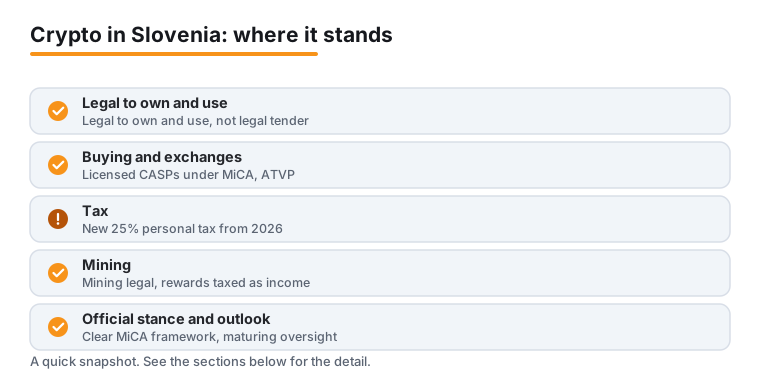
- Legal: Legal to own and trade, not legal tender; regulated under EU MiCA
- Tax: New personal crypto tax from 2026, flat 25 percent on disposal profits
- Buying: Via EU and international exchanges, SEPA and card, with KYC
Slovenia is one of Europe's more crypto-active countries, with high public familiarity with Bitcoin and digital assets, a cluster of blockchain businesses, and merchants that have experimented with crypto payments. Owning, buying, selling and using cryptocurrency is legal here. As a European Union member and a eurozone country, Slovenia applies the EU's harmonised Markets in Crypto-Assets Regulation (MiCA) alongside its own national implementing rules, supervised mainly by the Securities Market Agency (ATVP) and Banka Slovenije (the Bank of Slovenia).
This guide explains how Bitcoin and other crypto-assets are treated in Slovenia in 2026: their legal status, which authorities supervise the sector, the key laws, licensing of exchanges, taxation, anti-money-laundering rules, and practical notes on buying, using and mining crypto. The most consequential recent change is Slovenia's new personal crypto tax, adopted in 2025 and in force from 1 January 2026, so confirm the current details before relying on any summary. This article is general information as of 2026 and is NOT legal, tax or financial advice; verify the current rules with the named official Slovenian authorities (ATVP, Banka Slovenije and the Financial Administration, FURS) or a qualified professional before acting. For broader background, see our guide to crypto regulation and how crypto is taxed.
On this page: Legal status · Who regulates it · Taxes · How to buy · Mining
Is Bitcoin and crypto legal in Slovenia?
Yes. Buying, holding, selling and using Bitcoin and other crypto-assets is legal for individuals and businesses in Slovenia. There is no prohibition on private ownership or on transacting in crypto-assets.
What crypto is not is legal tender. Slovenia is part of the eurozone, so the euro is the only official currency, and no business is obliged to accept Bitcoin as payment. Merchants may choose to accept it voluntarily, and some do, but this is a private commercial arrangement rather than a legal entitlement.
Because Slovenia is in the European Union, the core rules are set at EU level and implemented nationally. The EU's MiCA regulation, which governs crypto-asset service providers and certain token issuers, applies in Slovenia, supplemented by domestic implementing legislation and the supervisory practice of ATVP and Banka Slovenije. Crypto businesses are also subject to EU and Slovenian anti-money-laundering rules, including customer identification and reporting.
Who regulates crypto in Slovenia?
Responsibility is shared among several authorities. There is no single, separate crypto regulator; instead, established financial and tax bodies apply EU and national rules.
- Securities Market Agency (Agencija za trg vrednostnih papirjev, ATVP) is the main competent authority under MiCA. It authorises and supervises crypto-asset service providers (CASPs) such as exchanges, custodians and brokers, and approves crypto-asset white papers. Official site: ATVP (a-tvp.si).
- Banka Slovenije (Bank of Slovenia) is a co-competent authority under MiCA, with particular responsibility for issuers of e-money tokens and asset-referenced tokens, and a central role in financial-stability and consumer-warning matters. Official site: Banka Slovenije (bsi.si).
- Financial Administration (Finančna uprava Republike Slovenije, FURS) is the tax authority responsible for crypto taxation, reporting and the registration of certain non-MiCA crypto-asset operators. Official site: FURS (fu.gov.si).
- Office for Money Laundering Prevention is Slovenia's financial intelligence unit, which receives suspicious-activity reports.
Because classification drives which rules apply, businesses building crypto products in Slovenia usually need tailored legal advice. You can confirm any provider's status or a regulator's current guidance directly on the official sites above. For more, see our overview of crypto regulation by country.
Key laws and frameworks
Slovenia does not treat crypto as a single, separately regulated asset class. Several frameworks apply depending on what a token does and who offers services around it. The main building blocks are EU regulations, national implementing legislation and EU anti-money-laundering law.
MiCA and national implementation
MiCA (Regulation (EU) 2023/1114) establishes EU-wide rules for crypto-asset service providers and for issuers of asset-referenced and e-money tokens. Its provisions for those token types applied from 30 June 2024, and the regime for service providers applied in full from 30 December 2024. Slovenia adopted national legislation, the Act Implementing the Regulation (EU) on Markets in Crypto-Assets, which designates ATVP and Banka Slovenije as the competent authorities for authorisations, white-paper approvals and supervision.
Other applicable rules
Tokens that behave like traditional financial instruments (for example, certain security tokens) can fall under existing securities law rather than MiCA, and stablecoins are governed by MiCA's specific token rules. EU anti-money-laundering directives, transposed into Slovenian law, impose customer due diligence and reporting on crypto businesses. Slovenia is also implementing the EU's DAC8 directive and the OECD Crypto-Asset Reporting Framework (CARF), which extend automatic exchange of tax information to crypto-assets reported by service providers.
Licensing and registration of exchanges (CASPs)
To provide crypto-asset services in Slovenia on a professional basis, a firm must be authorised as a crypto-asset service provider (CASP) under MiCA. Regulated activities include operating a trading platform, exchanging crypto for funds or other crypto, custody and administration of crypto-assets, brokering, transfer services, portfolio management and advice, among others.
- Authorisation. CASP applications are assessed by ATVP, which checks governance, capital, security and risk-management arrangements before granting authorisation. An authorised CASP can passport its services across the EU.
- Transition for existing VASPs. Firms that were already operating under the previous virtual-asset regime were given a short transition period to obtain full CASP authorisation. Slovenia set this transition to run only until 1 July 2025 (a six-month window from MiCA's full application on 30 December 2024), after which a provider generally needs to be properly authorised, or have a pending application, or stop serving Slovenian users. Slovenia did not apply the optional simplified authorisation route for legacy providers. Confirm any firm's current status with ATVP.
- Non-MiCA operators. Certain crypto-asset operators that fall outside MiCA may still need to register with FURS (for example via the eDavki system) for tax and reporting purposes.
There is no special licence required simply to buy crypto for your own account. Licensing obligations fall on the businesses providing the service.
Crypto and Bitcoin tax in Slovenia
Slovenia has historically been viewed as relatively benign for individual crypto holders, but that has now changed. Slovenia adopted a new personal crypto tax that took effect from 1 January 2026, and this is the single most important thing to verify before you transact.
The measure was proposed by the Ministry of Finance in April 2025, went through public consultation, was approved by the government in July 2025, and applies from 1 January 2026. Because the detailed wording, rate and mechanics can still be refined, you should confirm the rules actually in force with FURS before filing. Its key features are:
- What is taxed. Tax applies to the profit realised when crypto-assets are converted into fiat currency or used to pay for goods and services.
- Rate. A flat rate of 25% applies to net profit from such disposals. Confirm the current rate with FURS before filing.
- Exemptions. Crypto-to-crypto exchanges and transfers between a person's own wallets are generally not treated as taxable disposals.
- Cost-basis reset. Holdings are valued at their market price as of 1 January 2026, so gains accrued before that date are not retroactively taxed.
- Losses. Losses can generally be offset against profits, with carry-forward to later years as provided in the law.
- Reporting. Holders are expected to report active wallets held as of 1 January 2026 to FURS (the date 30 June 2026 has been cited for this initial wallet report), with an annual return filed after the tax year (by 31 March of the following year, so the first return would fall due 31 March 2027 for the 2026 tax year) and tax payable shortly after.
- Merchant reporting. Merchants that accept crypto payments above 500 euros are required to report those transactions.
Separately, individuals or entities trading or providing crypto services on a professional or business basis may be taxed under business-income or corporate rules instead, and VAT can apply to certain crypto-related services even though exchanging crypto for fiat is generally VAT-exempt across the EU. Treat the points above as orientation only. This is not tax advice. Check the current rules directly with FURS (fu.gov.si) or a Slovenian tax professional, and see our general crypto tax guide.
AML and KYC rules
Crypto-asset service providers in Slovenia are obliged entities under EU and national anti-money-laundering and counter-terrorist-financing rules. In practice this means:
- Identity verification (KYC). Regulated exchanges, brokers and ATM operators must verify customer identity, so expect to provide ID and sometimes proof of address and source of funds.
- Ongoing monitoring and reporting. Providers monitor transactions and report suspicious activity to the Office for Money Laundering Prevention, Slovenia's financial intelligence unit.
- Travel rule. Under the EU framework, originator and beneficiary information must accompany crypto transfers between providers, increasing the data attached to transactions.
- Tax information exchange. As DAC8 and CARF are implemented, crypto-asset service providers will report account and transaction information that is shared automatically with tax authorities across participating jurisdictions.
For users, the main consequence is that maintaining anonymity when using regulated platforms is not possible, and records of your activity are increasingly visible to authorities.
Buying and using crypto in practice
Residents of Slovenia can buy crypto through EU-based and international exchanges, brokers and apps, as well as through peer-to-peer arrangements and ATMs. Because Slovenia uses the euro and is in the EU single market, euro deposits via SEPA bank transfer and cards are widely supported.
A typical compliant path looks like this:
- Choose a provider. Pick a reputable exchange or broker that serves Slovenian and EU customers and holds, or is transitioning toward, MiCA CASP authorisation. Compare fees, supported assets, security and euro deposit options.
- Verify your identity. Complete KYC by submitting ID and any requested documents, as required under AML law.
- Fund your account. Deposit euros via SEPA transfer or card. SEPA transfers are usually cheaper for larger amounts.
- Place your order and secure your holdings. Buy your chosen asset, review the all-in cost including fees and spread, and for meaningful amounts consider withdrawing to a wallet you control, ideally a hardware wallet, safeguarding your recovery phrase.
- Keep records. Save confirmations and acquisition values; record the value of any holdings as of 1 January 2026, which is relevant under the new tax regime.
Slovenia also has a modest network of Bitcoin ATMs in larger towns. Operators apply KYC under AML rules and typically charge higher fees and wider spreads than online exchanges, so they suit small, occasional purchases rather than large amounts.
Bitcoin mining in Slovenia
Cryptocurrency mining is legal in Slovenia. There is no specific ban on running mining hardware, and individuals and companies may mine subject to the usual rules on electricity supply, business registration, environmental standards and taxation.
The practical constraints are largely economic rather than legal. Slovenia is not a low-cost-electricity jurisdiction, and European energy prices generally make large-scale proof-of-work mining challenging to run profitably compared with regions that have cheap or surplus power. Miners increasingly look to renewable or self-generated electricity to manage costs and reduce environmental impact, which also aligns with broader EU sustainability and energy-efficiency expectations.
From a tax and compliance standpoint, mining rewards are generally treated as income, and operating at scale can amount to a business activity with the corresponding registration, accounting and tax obligations. Anyone planning a meaningful mining operation should confirm the treatment of mined coins and equipment with FURS and factor energy contracts, grid rules and any local permitting into their planning.
Recent developments (2025-2026)
Slovenia's crypto environment is maturing rather than becoming restrictive. The direction of travel is toward greater oversight under MiCA, firmer AML enforcement, and clearer (and now heavier) personal taxation. The main developments to track are:
- New personal crypto tax from 2026. Slovenia adopted legislation in 2025 to tax profit on crypto disposals from 1 January 2026, with a 25% rate, a cost-basis reset to 1 January 2026 values, and initial wallet reporting due by 30 June 2026. Confirm the current rate, deadlines and mechanics with FURS.
- First EU sovereign digital bond. In July 2024 Slovenia issued the first digital (blockchain-based) sovereign bond by an EU member, a 30 million euro issue with a 3.65% coupon that matured in November 2024, settled on-chain in wholesale central bank money as part of the European Central Bank's settlement experimentation programme. This was a government finance experiment rather than a change to how retail crypto is treated, but it signals Slovenia's continued interest in tokenised finance.
- MiCA authorisation deadline passed. The transition window for existing virtual-asset firms to obtain full CASP authorisation closed on 1 July 2025, one of the shorter windows in the EU; firms that were not authorised (or did not have a pending application) by then had to stop serving Slovenian users. Check any platform's current status with ATVP.
- Tax transparency. Implementation of DAC8 and the OECD CARF brings automatic reporting and exchange of crypto account information among tax authorities.
Because the tax law in particular was finalised close to its start date, confirm the current rate, thresholds and reporting mechanics on the official FURS site before relying on any summary.
Tokenised finance and the state's own experiments
Beyond retail crypto, Slovenia has taken part in official experiments with blockchain-based (tokenised) finance. In July 2024 the Republic of Slovenia issued the first digital sovereign bond by an EU member state, a 30 million euro bond carrying a 3.65% coupon with a short maturity to November 2024. It was issued and settled on a distributed-ledger platform, with settlement in wholesale central bank money handled through the European Central Bank's programme for testing new settlement technologies.
This matters for context rather than for day-to-day users. It was a government funding and settlement experiment, not a product for retail investors and not a change to how personal crypto holdings are treated or taxed. It does, however, show that Slovenian authorities and the wider eurozone are actively trialling tokenised instruments, which over time may shape how regulated digital assets are issued and settled in the EU. For sources, see the government announcement at gov.si.
Consumer risks and protection
MiCA brings clearer rules for the platforms Slovenians use, including disclosure and consumer-protection requirements, which can reduce some operational and counterparty risks compared with the unregulated past. Banka Slovenije and Slovenia's Financial Stability Board have also issued consumer warnings about crypto-asset risks. Even so, the core risks remain:
- Market risk. Crypto prices are highly volatile, markets can become illiquid under stress, and assets can lose substantial value quickly. Only consider funds you can afford to lose.
- Provider and platform risk. Exchanges can fail, be hacked or restrict withdrawals; using authorised CASPs and self-custody for larger amounts reduces but does not remove this risk.
- Scams and fraud. Fake investment schemes, impersonation and phishing are common; treat unsolicited offers and guaranteed returns with extreme caution.
- Tax and compliance risk. The 2026 tax regime adds reporting obligations; failing to keep records or file correctly can lead to penalties.
We do not make price predictions or investment recommendations. If you are unsure, consider speaking with a qualified, independent adviser who understands both crypto and Slovenian rules.
Official sources and how to verify
Crypto law and tax change quickly in Slovenia, so always confirm specifics against primary official sources rather than third-party summaries. The authoritative starting points are:
- Securities Market Agency (ATVP) for MiCA authorisation, the status of crypto-asset service providers, and white-paper approvals.
- Banka Slovenije (Bank of Slovenia) for e-money and asset-referenced tokens, financial-stability matters and consumer warnings.
- Financial Administration (FURS) for crypto taxation, reporting deadlines and operator registration.
To verify a provider, check whether it is authorised or registered with ATVP (and listed on the relevant EU registers). To verify tax rules, rely on the current FURS guidance, since rates and deadlines can be refined. This article is for general information only and is not legal, tax or financial advice; always verify current rules with the official Slovenian authorities named above or a qualified professional.
Frequently asked questions
Is cryptocurrency legal in Slovenia?
Yes. Owning, buying, selling and using crypto is legal for individuals and businesses. However, crypto is not legal tender (the euro is), and no merchant is required to accept it. Crypto services are regulated under the EU's MiCA framework and national anti-money-laundering rules.
Who regulates crypto in Slovenia?
Several authorities share responsibility. The Securities Market Agency (ATVP) is the main competent authority under MiCA and authorises crypto-asset service providers; Banka Slovenije (the Bank of Slovenia) is a co-competent authority, especially for e-money and asset-referenced tokens; and the Financial Administration (FURS) handles crypto taxation. Suspicious-activity reporting goes to the Office for Money Laundering Prevention.
How is crypto taxed in Slovenia in 2026?
Slovenia introduced a new personal crypto tax that took effect from 1 January 2026. Individuals are taxed on profit when crypto is converted to fiat or spent, at a flat rate of 25%, while crypto-to-crypto swaps and transfers between your own wallets are generally not taxable. Holdings are reset to their 1 January 2026 value so historic gains are not taxed retroactively, and gains are self-reported to FURS (with the first annual return due 31 March 2027 for the 2026 tax year, and an initial wallet report due by 30 June 2026). Details and mechanics can still be refined, so confirm the current rate, deadlines and rules with FURS or a tax professional. This is not tax advice.
Was the 25% crypto tax actually in force in 2026?
Yes. The measure was proposed in April 2025, approved by the government in July 2025, and took effect from 1 January 2026. The reset to 1 January 2026 values means only gains made from that date count, and the first return is due 31 March 2027 for the 2026 tax year. Rates and deadlines can still be refined, so check the current FURS guidance for the status that applies to you before filing.
When did Slovenia's MiCA transition period for exchanges end?
Slovenia set a short transition window that closed on 1 July 2025, one of the shorter windows in the EU. Firms that were providing crypto services before MiCA applied in full (30 December 2024) could continue only until 1 July 2025, or until their CASP authorisation was granted or refused. After that, a provider must be authorised as a crypto-asset service provider (CASP) with ATVP to serve Slovenian users. You can check a provider's status with ATVP.
Did Slovenia issue a blockchain-based government bond?
Yes. In July 2024 Slovenia issued the first digital sovereign bond by an EU member state, a 30 million euro bond with a 3.65% coupon that matured in November 2024, settled on a distributed ledger in wholesale central bank money through a European Central Bank test programme. It was a government funding and settlement experiment, not a retail crypto product and not a change to how personal crypto is taxed.
Do crypto exchanges need a licence in Slovenia?
Yes. Firms providing crypto-asset services on a professional basis must be authorised as crypto-asset service providers (CASPs) under MiCA, with ATVP as the authorising authority. Existing virtual-asset firms were given a short transition period to obtain full authorisation, which ran until 1 July 2025 in Slovenia. There is no licence needed simply to buy crypto for your own account.
Can I mine Bitcoin in Slovenia?
Yes, mining is legal. The main constraints are economic: European electricity prices make large-scale mining hard to run profitably, so miners often use renewable or self-generated power. Mining rewards are generally treated as income, and operating at scale can be a taxable business activity, so check obligations with FURS.
Where can I verify the current rules?
Use the official sources: the Securities Market Agency (a-tvp.si) for MiCA and provider authorisation, Banka Slovenije (bsi.si) for token issuance and consumer warnings, and the Financial Administration FURS (fu.gov.si) for taxation. These primary sources are more reliable than third-party summaries, which can lag behind changes. This guide is general information as of 2026, not legal advice.
Facts reviewed: 30 June 2026. Page updated: 3 August 2026.