Home › Crypto Regulation › Montenegro
Bitcoin & Cryptocurrency Regulation in Montenegro
Quick answer — Montenegro, 2026
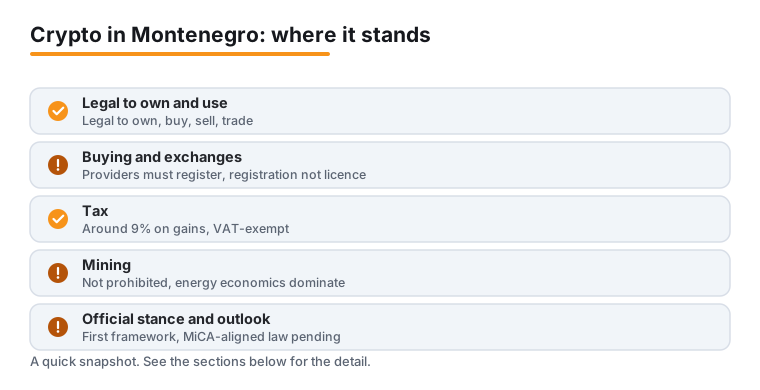
- Legal: Legal to own and trade, not legal tender; providers must register
- Tax: No crypto-specific tax rule; general rates apply, capital gains 15 percent, corporate tax 9 to 15 percent
- Buying: Via international exchanges in euros with KYC
Montenegro is a small Adriatic country that uses the euro as its currency, even though it is not a eurozone or European Union member, and it is an active EU candidate negotiating accession. That EU trajectory is the single most important thing to understand about crypto here: the rules are being rewritten to move toward the bloc's Markets in Crypto-Assets (MiCA) framework, but because Montenegro is not yet an EU member, MiCA does not apply directly. What is true today may change as new legislation lands.
Holding, buying, selling and using Bitcoin and other cryptocurrencies is legal in Montenegro, though crypto is not legal tender. In early 2025 the country took its first concrete regulatory step: amendments to the anti-money-laundering law brought crypto-asset services within scope and created a public register of providers supervised by the Capital Market Authority. There is still no standalone crypto-asset law, and none appears in the Government's work programme for 2026. Instead, crypto obligations were added to two further laws: the Law on Tax Administration (Official Gazette 160/2025, in force 30 December 2025, and again 104/2026, in force 18 July 2026) and the Law on Credit Institutions (Official Gazette 14/2026, in force 18 February 2026). This page explains the legal status, who regulates what, how tax may apply, and the practical realities of exchanges, AML rules, mining and using crypto, and points you to official sources.
This article is general information current as of 2026 and is not legal, tax or financial advice. Crypto rules in Montenegro are actively evolving; always verify current requirements with the named Montenegrin authorities, such as the Capital Market Authority and the Central Bank of Montenegro, or a qualified local professional before acting. See also our guide to crypto regulation.
On this page: Legal status · Who regulates it · Taxes · How to buy · Mining
Is Bitcoin and crypto legal in Montenegro?
Yes. Owning, buying, selling and trading Bitcoin and other cryptocurrencies is legal for individuals and businesses in Montenegro. There is no law banning private citizens from holding or transacting in digital assets, and the country has at times actively courted blockchain investment.
What crypto is not is legal tender. Montenegro's official medium of payment is the euro, which the country adopted unilaterally. No business is obliged to accept Bitcoin, and crypto does not have the status of money or a national currency. The Central Bank of Montenegro has long stressed that cryptocurrencies are not legal tender, are not issued or guaranteed by a central bank, and are held at the user's own risk.
The key nuance is regulatory maturity rather than legality. For years Montenegro had no dedicated crypto rules at all, and the European Commission flagged the unregulated market in its enlargement assessments. The policy response, beginning in 2025, has been to start building a framework rather than to restrict crypto. For background, see our crypto regulation explainer.
Who regulates crypto in Montenegro?
Responsibility is split across several public bodies rather than concentrated in one dedicated crypto regulator.
- Capital Market Authority (Komisija za tržište kapitala). Under the 2025 anti-money-laundering amendments, this securities and capital-markets regulator is tasked with maintaining the register of crypto-asset service providers and supervising entities that offer crypto services. It is the closest thing Montenegro has to a dedicated crypto supervisor today.
- Central Bank of Montenegro (CBCG). The central bank oversees banks, payment systems and financial stability, and is the authority that has repeatedly warned that crypto is not legal tender and carries significant risk. It does not license crypto exchanges, but it shapes how banks interact with the sector.
- Ministry of Finance. The ministry leads crypto policy and issued the August 2026 rulebook on reporting crypto-asset service users. No MiCA-aligned crypto law has been published in the Official Gazette and none appears in the Government 2026 work programme.
- Tax Administration (Uprava prihoda i carina). Responsible for assessing and collecting tax on crypto-related income and gains.
Because the framework is new and still developing, confirm which body governs a specific question directly with that authority. You can compare approaches in other countries via our regulation hub.
Key laws and frameworks
Montenegro does not yet have a single, comprehensive standalone cryptocurrency statute. Instead, the current rules sit inside its anti-money-laundering legislation, with a fuller regime in the pipeline.
- Anti-money-laundering amendments (2025). Montenegro's Parliament adopted amendments to the Law on the Prevention of Money Laundering and Terrorist Financing on 28 February 2025. The amendments were published in the Official Gazette and entered into force in March 2025. They introduced Montenegro's first regulatory definitions for crypto assets and crypto-asset services and created the obligation to register as a crypto-asset service provider.
- MiCA-aligned draft law (in progress). A working group to prepare the Working Draft of the Law on Crypto Assets was formed by the Financial Stability Council on 16 November 2022, coordinated by the Central Bank of Montenegro with the Ministry of Finance, the Capital Market Authority and the Insurance Supervision Agency, with World Bank technical assistance. No draft text has been published, and no such law appears in the Government's work programme for 2026. Because Montenegro is an EU candidate rather than a member, MiCA itself does not yet apply, but harmonisation is the clear policy direction.
- General financial, company and tax law. Until the dedicated regime is fully built out, existing tax, company and consumer-protection rules continue to apply to crypto activity.
Treat the framework as a moving target: timelines have shifted before, so rely on the enacted text rather than on summaries or announcements.
Licensing and registration of exchanges and providers
Under the 2025 amendments, providing crypto-asset services in Montenegro requires registration rather than a traditional licence. Entities must be entered in a register of crypto-asset service providers maintained by the Capital Market Authority, which is intended to be publicly accessible.
- What it covers. Reported in-scope services include custody and administration of crypto assets, operating a trading platform, exchanging crypto for fiat or other crypto, and executing orders, broadly mirroring the categories used in EU-style frameworks.
- Registration, not authorisation. Commentary describes the process as primarily a formal procedure rather than a substantive licensing assessment, at least under the current AML-based regime. The fee is EUR 5,000, payable when the application for entry in the register is filed, under Article 14 of the Capital Market Authority's fee price list in the consolidated text applying from 1 July 2026.
- Phased rollout. Article 145c of the amendments gave the supervisor nine months from entry into force to establish the register, a deadline of 20 December 2025. The Capital Market Authority's Rulebook was published in Official Gazette 146/2025 on 12 December 2025 and entered into force on 20 December 2025.
If you plan to operate a crypto business in or into Montenegro, verify the current registration steps, fees and any forthcoming licensing obligations directly with the Capital Market Authority, because the MiCA-aligned law in preparation may add fuller authorisation requirements.
Crypto and Bitcoin tax in Montenegro
Montenegro is generally regarded as a low-tax jurisdiction. As crypto-specific tax treatment has been introduced, several advisory sources report the following for 2025 onward. Because these figures come largely from professional and advisory summaries rather than a single consolidated official guidance page, treat them as a starting point and confirm with the Tax Administration.
- Gains taxed at around 9%. Montenegro has published no crypto-specific income tax rule, so the general rates apply. Capital gains tax for individuals is 15%, and capital gains are defined as arising from the sale of real estate, shares in a legal entity and securities; other categories of personal income are taxed at a proportional 15%. Entrepreneurial income is taxed at 0% up to EUR 8,400, 9% from EUR 8,400.01 to EUR 12,000 and 15% above EUR 12,000. Corporate income tax is progressive rather than a flat 9%: 9% on profit up to EUR 100,000, then EUR 9,000 plus 12% on profit above EUR 100,000, and EUR 177,000 plus 15% on profit above EUR 1,500,000. A municipal surtax of 13%, or 15% in Podgorica and Cetinje, applies on top of personal income tax.
- VAT exemption on crypto transactions. Buying and selling crypto itself is reported to be exempt from VAT. However, if you pay for ordinary goods or services with crypto, the standard 21% VAT applies to that underlying purchase as normal.
- Activity matters. Treatment can differ between occasional personal investment, frequent or professional trading, and income earned inside a company, and may differ for residents versus non-residents.
Keep full records of acquisitions and disposals. Confirm your exact obligations with the Montenegrin Tax Administration or a qualified local adviser before filing; this is not tax advice. For general concepts, see our crypto tax guide.
AML and KYC rules
Anti-money-laundering and counter-terrorist-financing (AML/CFT) rules are the backbone of Montenegro's current crypto framework, because the 2025 crypto provisions were introduced through the AML law itself.
- Providers are obliged entities. Registered crypto-asset service providers fall within Montenegro's AML/CFT regime, in line with international Financial Action Task Force (FATF) standards, including Recommendation 15 on virtual assets.
- Identity verification. Expect customer due diligence (Know Your Customer, or KYC): providers verify customer identity, monitor transactions, and report suspicious activity. Larger or unusual flows can trigger source-of-funds questions. The law requires customer due diligence on every occasional transaction that constitutes a crypto-asset transfer of EUR 1,000 or more. Separately, where a transfer above EUR 1,000 is sent to or received from a self-hosted address, the provider must take measures to assess whether that address is owned or controlled by its customer. These rules transpose Regulation (EU) 2023/1113, the EU crypto travel rule.
- Reform pressure. Reporting in late 2025 highlighted gaps and a crypto grey zone, and bodies such as MONEYVAL have pushed Montenegro to tighten oversight, which is part of why the broader law is being developed.
For everyday users this mainly means standard identity checks at exchanges and on- and off-ramps, much as elsewhere in Europe.
Buying and using crypto in practice
Residents of Montenegro can buy crypto much as people elsewhere in Europe do: through international centralised exchanges, peer-to-peer marketplaces, and over-the-counter arrangements. Because the country uses the euro, funding accounts and pricing assets in EUR is straightforward, and most major global platforms support euro deposits via card or bank transfer.
- Choose reputable, compliant platforms. Prioritise an exchange with a solid security record, transparent fees and clear regulatory standing. Many users rely on established international platforms while the domestic regime matures.
- Expect identity verification. KYC checks are standard. Have a government ID ready, and expect proof of address or source of funds for larger volumes.
- Secure your holdings. For anything beyond small amounts, consider a wallet you control, ideally a hardware wallet, and safeguard your recovery phrase. Enable two-factor authentication everywhere.
- Using crypto to pay. Merchants may accept crypto as a private commercial arrangement, but none are obliged to. Spending crypto can have tax consequences, and the underlying goods or services still attract normal VAT.
Keep transaction records for tax purposes and your own tracking.
Bitcoin mining in Montenegro
There is no specific law that singles out Bitcoin mining as illegal in Montenegro, and the activity is not prohibited. In practice it is governed by the same factors that shape any energy-intensive business: the cost and availability of electricity, environmental and grid regulations, and general business, tax and company law.
- Energy economics dominate. Mining profitability hinges on electricity prices and hardware efficiency. Montenegro has hydropower resources, but energy costs and grid rules can change, and large new loads typically require engagement with utilities and regulators.
- Environmental and sustainability pressure. As Montenegro moves toward EU standards, expect growing emphasis on energy efficiency and environmental impact.
- Standard business obligations apply. Commercial mining means registering a business, meeting tax obligations, and complying with permitting or zoning requirements. There is no recognised blanket crypto-mining tax holiday; any incentives would be those generally available to businesses or energy projects, and should be confirmed officially rather than assumed.
Small-scale or hobby mining differs from an industrial facility, but both should account for electricity costs, heat and noise, and local rules before committing capital.
Recent developments (2025 to 2026)
Montenegro's crypto policy moved faster in 2025 than in any prior year.
- February to March 2025. Parliament adopted the AML amendments that, for the first time, defined crypto assets and crypto-asset services and created the registration regime supervised by the Capital Market Authority. The register was set to be established within roughly nine months.
- Crypto tax treatment. A roughly 9% rate on crypto gains and a VAT exemption on crypto transactions were reported to apply from 2025, positioning Montenegro as a relatively low-tax option in the region.
- September 2025. The Prime Minister signalled that a fuller, MiCA-aligned law would be adopted. No draft text has since appeared in the Official Gazette, and in February 2026 the Capital Market Authority said Montenegro still has no digital assets law.
- December 2025. Investigative reporting (Balkan Insight, drawing on work prepared for BIRN Montenegro) described a crypto grey zone and argued that adoption was outpacing the country's capacity to supervise and enforce the rules.
- March 2026. Further reporting argued that Montenegro's crypto ambitions would need tougher rules and stronger oversight to succeed, keeping pressure on authorities to finalise the comprehensive law. On 18 July 2026 further amendments to the Law on Tax Administration (Official Gazette 104/2026) took effect, tying Montenegro's crypto tax reporting to Directive (EU) 2023/2226 (DAC8) and the Crypto-Asset Reporting Framework and pinning its definitions to Article 3(1)(5) and Article 3(1)(15) of Regulation (EU) 2023/1114 (MiCA).
Because the picture is still shifting, verify the latest status against official announcements before relying on any specific rule.
Consumer risks and protection
Montenegro's permissive but still-maturing framework means consumer protection lags behind more established markets, so caution matters.
- Limited local recourse. Because dedicated supervision is new and the comprehensive law is not yet in force, there may be little domestic recourse if a local service provider fails or behaves improperly. Favour established, well-regulated platforms.
- Not legal tender, not deposit-protected. The Central Bank of Montenegro stresses that crypto is not legal tender and is not backed by the state. Crypto holdings do not carry the protections that apply to bank deposits.
- Market and fraud risk. Crypto is highly volatile, can be illiquid under stress, and is a frequent target for scams. Beware of unrealistic return promises and unsolicited investment offers.
- Security hygiene. Use strong, unique passwords, two-factor authentication, and self-custody for larger holdings, and never share your recovery phrase.
None of this is a recommendation to buy or sell. Only consider amounts you can afford to lose, and consult a qualified adviser if you are unsure.
Official sources and how to verify
Crypto rules in Montenegro are evolving, so always check the latest position with the authorities themselves rather than relying on summaries.
- Capital Market Authority of Montenegro (Komisija za tržište kapitala), the supervisor maintaining the register of crypto-asset service providers: scmn.me.
- Central Bank of Montenegro (CBCG), for its position on crypto, payment systems and financial stability: cbcg.me.
- Tax Administration of Montenegro (Uprava prihoda i carina), for tax obligations: gov.me Tax Administration.
When a new crypto law or amendment is adopted, its authoritative text appears in Montenegro's Official Gazette (Službeni list Crne Gore). For comparisons with other jurisdictions, see our regulation overview. Remember that this page is general information current as of 2026 and is not legal advice; verify with the named regulators or a qualified professional before acting.
What is changing: Montenegro's crypto rules through 2026
Montenegro still has no single crypto-asset statute. What it has instead is crypto obligations bolted onto three existing laws, plus two rulebooks. Four of these six instruments landed after this page was first written, and the most recent was published on 7 August 2026.
| Instrument | Official Gazette | In force | What it added |
|---|---|---|---|
| Amendments to the Law on the Prevention of Money Laundering and Terrorist Financing | 24/2025 | 20 March 2025 | New chapter 3a on crypto-asset services, the provider register, and the EU crypto travel rule from Regulation (EU) 2023/1113 |
| Capital Market Authority Rulebook on the register and reputation assessment | 146/2025 | 20 December 2025 | Application form, required documents, good-repute test, refusal, deletion and suspension |
| Amendments to the Law on Tax Administration | 160/2025 | 30 December 2025 | Article 14h: reporting on crypto-asset service users and international exchange of that data |
| Amendments to the Law on Credit Institutions | 14/2026 | 18 February 2026 | Banks may issue asset-referenced tokens and provide crypto services; crypto exposure rules for banks |
| Amendments to the Law on Tax Administration | 104/2026 | 18 July 2026 | Re-bases crypto tax reporting on Directive (EU) 2023/2226 (DAC8), the Crypto-Asset Reporting Framework and MiCA definitions |
| Rulebook on reporting on users of crypto-asset services | 118/2026 | 15 August 2026 | The implementing act for the Article 14h reporting duty |
What is not on the calendar is a standalone crypto law. It does not appear in the Official Gazette, a search of the Government portal for kriptoimovina returns only the 2025 anti-money-laundering bill, and the Government's work programme for 2026 mentions crypto-assets only inside the entry for the credit institutions amendments.
Registering as a crypto-asset service provider: the real requirements
Registration is handled by the Capital Market Authority (Komisija za tržište kapitala) under its Rulebook adopted at the 159th session on 10 December 2025. Ten services are in scope: safekeeping and management of crypto-assets on behalf of a client, operating a trading platform, exchange of crypto for fiat, exchange of crypto for other crypto, execution of orders, placement, receiving and transmitting orders, advice, portfolio management and transfer services.
- Fee: EUR 5,000, payable when the application is filed, under Article 14 of the Authority's fee price list in the consolidated text applying from 1 July 2026.
- Documents (Article 4): a notarised declaration, proof of appointment of the AML authorised person and deputy, an extract from the Register of Beneficial Owners, a business plan setting out which crypto services will be offered and how they will be marketed, and information on all directors.
- Good repute (Article 7): notarised questionnaires and statements no older than one month, plus criminal and misdemeanour record extracts no older than three months, for directors, company members, governance and management body members and beneficial owners.
- Filing is physical. Article 8 requires the application and supporting documents to be submitted in paper form.
- The Authority can suspend you. Under Article 6 it may passivate a provider's status while it checks whether grounds for deletion exist, and during passivation the provider may not carry out any crypto-asset activity.
The register is public. As of August 2026 it contains one entry, Artenx d.o.o. Podgorica. It held none as late as 24 February 2026, when the Authority said there was significant interest but no formal application had been filed.
Crypto tax reporting: what changed between December 2025 and August 2026
The clearest crypto development in Montenegro is not a market law but a tax reporting duty. Amendments to the Law on Tax Administration adopted on 27 December 2025 added Article 14h, and further amendments in force since 18 July 2026 rewrote it around EU rules.
- A reporting crypto-asset service provider must collect and keep records on reportable crypto users, the services provided, orders and executed transactions with amounts and dates, income from the sale or acquisition of each reportable type of crypto-asset, and holdings at the end of the reporting period, and must apply enhanced verification.
- It must both register with the tax authority and be entered in the Capital Market Authority register.
- Filing is electronic, on a prescribed form, by 31 January of the year following the year in which the user was identified as reportable. Records must be kept for at least five years.
- The data are used for taxation and for exchange with competent authorities of EU member states and other jurisdictions. Income from the sale or acquisition of crypto-assets is exchanged within nine months of the end of the calendar year reported on.
- The July 2026 amendments replaced the Common Reporting Standard basis with Directive (EU) 2023/2226 (DAC8) and the Crypto-Asset Reporting Framework, and tied the definitions of crypto-asset and crypto-asset service provider to Article 3(1)(5) and Article 3(1)(15) of Regulation (EU) 2023/1114 (MiCA).
The implementing rulebook required by these amendments has now arrived. The Rulebook on the detailed manner of reporting on users of crypto-asset services was published in Official Gazette 118/2026 on 7 August 2026 and enters into force on 15 August 2026, well inside the one-year deadline that ran to 30 December 2026.
Banks and crypto after February 2026
The Law on Amendments to the Law on Credit Institutions, published 10 February 2026 and in force since 18 February 2026, is the first Montenegrin law to put crypto-assets inside prudential banking rules. Its text transposes Directive (EU) 2022/2556 on digital operational resilience, Regulation (EU) 2023/1114 (MiCA), Directive (EU) 2024/1619, Directive (EU) 2023/2864 and Directive (EU) 2024/2994.
- Banks may now issue asset-referenced tokens and provide crypto-asset services, and the e-money activity was extended to e-money tokens.
- Before taking on any crypto-asset exposure, a bank must run a prior assessment of that exposure and of the adequacy of its counterparty risk and market risk processes, and report those assessments to the Central Bank of Montenegro.
- For crypto-assets with no identified issuer, concentration risk is measured against exposure to crypto-assets with similar characteristics.
- Operational risk now expressly covers direct and indirect exposures to crypto-assets and to crypto-asset service providers, the supervisory review covers the bank's crypto risk management, and the Central Bank can order stress testing or scenario analysis on crypto exposures.
The practical catch is that every crypto permission in the law is expressed as subject to the regulations governing crypto-assets. Those regulations do not yet exist, so the permission sits on the statute book without an operative framework behind it.
Why there is still no dedicated crypto law
Work on a standalone framework started earlier than most summaries suggest and has not finished. On 16 November 2022 the Financial Stability Council, at its 61st meeting, formed a working group to prepare the Working Draft of the Law on Crypto Assets, coordinated by the Central Bank of Montenegro with the Ministry of Finance, the Capital Market Authority and the Insurance Supervision Agency, with World Bank technical assistance. No draft text has been published since, and that 2022 announcement is the only result the Central Bank's own site search for crypto returns.
Independent assessment points the same way. A February 2026 analysis by BIRN Montenegro concludes that the system is normatively correct but that Montenegro has laid the foundation without a specific digital asset law, without a criminal offence for unregistered provision of digital asset services and without specialised supervisory capacity. It records that the Financial Intelligence Unit has received no reports from crypto-asset service providers, because none were registered, that during 2024 it handled five crypto cases reaching it through suspicious transaction reports from commercial banks, and that BIRN documented a street-level dealer moving more than USD 17 million through a single account in one year.
The European Commission's Montenegro 2025 Report of 4 November 2025 notes that Parliament adopted the anti-money-laundering amendments in February 2025 and says some discrepancies with the acquis remain on the definition of terrorism financing, data protection and record retention periods, and sanctions. The report does not mention crypto-assets anywhere.
Frequently asked questions
Is cryptocurrency legal in Montenegro?
Yes. Buying, holding, selling and trading crypto is legal for individuals and businesses. Crypto is not legal tender, however, and no merchant is obliged to accept it. The Central Bank of Montenegro stresses that crypto is not state-backed and is held at the user's own risk.
Does Montenegro have a crypto law?
It has a first framework but not yet a single comprehensive statute. In early 2025 Montenegro amended its anti-money-laundering law to define crypto assets and services and to require crypto-asset service providers to register with the Capital Market Authority. No standalone crypto-asset law has been enacted or published in draft, and none appears in the Government's 2026 work programme. Crypto obligations were instead added to the Law on Tax Administration and the Law on Credit Institutions during 2025 and 2026.
Who regulates crypto exchanges in Montenegro?
The Capital Market Authority of Montenegro (Komisija za tržište kapitala) maintains the register of crypto-asset service providers and supervises them under the 2025 AML amendments. The Central Bank of Montenegro oversees banks and payments and warns about crypto risk, and the Ministry of Finance leads policy on the forthcoming law.
How is crypto taxed in Montenegro?
There is no published crypto-specific tax rule, so the general rates apply. Capital gains tax for individuals is 15% and covers real estate, shares in a legal entity and securities, with other categories of personal income taxed at a proportional 15%; entrepreneurial income is taxed at 0%, 9% and 15% by band; corporate income tax is progressive at 9%, 12% and 15% rather than a flat 9%. The standard VAT rate is 21%. These are not official consolidated figures, so confirm your exact obligations with the Montenegrin Tax Administration. This is not tax advice.
Does MiCA apply in Montenegro?
Not directly. Montenegro is an EU candidate, not a member, so the EU's Markets in Crypto-Assets (MiCA) regulation does not yet apply. However, the country is drafting legislation designed to align with MiCA as part of its EU accession path, and authorities aim to adopt it during 2026.
Can I use euros to buy Bitcoin in Montenegro?
Yes. Montenegro uses the euro, so funding accounts and pricing crypto in EUR is straightforward on most major international exchanges. Expect to complete identity verification (KYC) when you register and when buying larger amounts.
Do crypto providers in Montenegro have to do KYC checks?
Yes. Under the 2025 anti-money-laundering amendments, registered crypto-asset service providers are obliged entities and must verify customer identity. Reporting on the amendments indicates that KYC checks apply to every crypto transaction above 1,000 euros, along with transaction monitoring and suspicious-activity reporting.
Do I need to register to run a crypto business in Montenegro?
Yes. Providing crypto-asset services requires entry in the register of crypto-asset service providers maintained by the Capital Market Authority, introduced by the 2025 AML amendments. This is currently a registration step rather than a full licence, but the MiCA-aligned law in preparation may add fuller authorisation requirements, so confirm the current process with the Capital Market Authority.
How much does it cost to register a crypto business in Montenegro?
EUR 5,000, payable when the application for entry in the register of crypto-asset service providers is filed. The fee is set in Article 14 of the Capital Market Authority's fee price list. The application must be submitted in paper form, with a notarised declaration, proof of an appointed AML authorised person and deputy, an extract from the Register of Beneficial Owners, a business plan, information on all directors, and criminal and misdemeanour record extracts for directors, company members, management body members and beneficial owners.
How many crypto companies are registered in Montenegro?
One. As of August 2026 the Capital Market Authority's public register of crypto-asset service providers lists a single entry, Artenx d.o.o. Podgorica. The register was still empty on 24 February 2026, when the Authority said there was interest but no formal application had been submitted. BIRN Montenegro reported in February 2026 that the Financial Intelligence Unit had received no reports from crypto-asset service providers precisely because none were registered.
Will my crypto activity be reported to the tax authority in Montenegro?
If you use a Montenegrin reporting provider, yes. Article 14h of the Law on Tax Administration, in force since 30 December 2025 and rewritten with effect from 18 July 2026, requires reporting crypto-asset service providers to collect and file details of reportable users, transactions with amounts and dates, income from sales and acquisitions and end-of-period holdings. Filing is electronic by 31 January of the year following identification, records are kept at least five years, and the data can be exchanged with EU member states and other jurisdictions under Directive (EU) 2023/2226 and the Crypto-Asset Reporting Framework.
Can banks in Montenegro offer crypto services?
In principle yes, since 18 February 2026. The amended Law on Credit Institutions (Official Gazette 14/2026) added the issuance of asset-referenced tokens and the provision of crypto-asset services to the activities a credit institution may perform, and requires a bank to assess any crypto-asset exposure and report that assessment to the Central Bank of Montenegro before taking it on. However, the permission is expressed as subject to the regulations governing crypto-assets, and those regulations have not been enacted, so the activity is not yet operational.
What is the most recent crypto rule in Montenegro?
The Rulebook on the detailed manner of reporting on users of crypto-asset services, published in Official Gazette 118/2026 on 7 August 2026 and entering into force on 15 August 2026. It is the ministerial implementing act for the crypto reporting duty in Article 14h of the Law on Tax Administration, which had to be adopted within one year of 30 December 2025. Beyond it, no dedicated crypto law is scheduled: the Government's 2026 work programme mentions crypto-assets only in the entry for the credit institutions amendments.
Facts reviewed: 13 August 2026. Page updated: 13 August 2026.