Home › Crypto Regulation › Serbia
Bitcoin & Cryptocurrency Regulation in Serbia
Quick answer — Serbia, 2026
- Legal: Legal to own, trade and mine, not legal tender; regulated under Law on Digital Assets
- Tax: Capital gains taxed at 15%; long-term and reinvestment reliefs available
- Buying: Via licensed Serbian or international exchanges with KYC
Serbia has one of the more developed cryptocurrency legal frameworks in the Western Balkans. Digital assets are explicitly regulated rather than banned, taxed under defined rules, and supervised by two named authorities. This guide explains the current legal status of Bitcoin and crypto in Serbia, who regulates the sector, the key law, how exchanges are licensed, how crypto is taxed, the anti-money-laundering rules, and what users, miners and people sending remittances should know in 2026. It is general information as of 2026 and is not legal, tax or financial advice; laws change, so verify any specific point with the named official regulator, the National Bank of Serbia or the Securities Commission of the Republic of Serbia, before acting. For wider context see our overview of crypto regulation.
On this page: Legal status · Who regulates it · Taxes · How to buy · Mining
Is Bitcoin and crypto legal in Serbia?
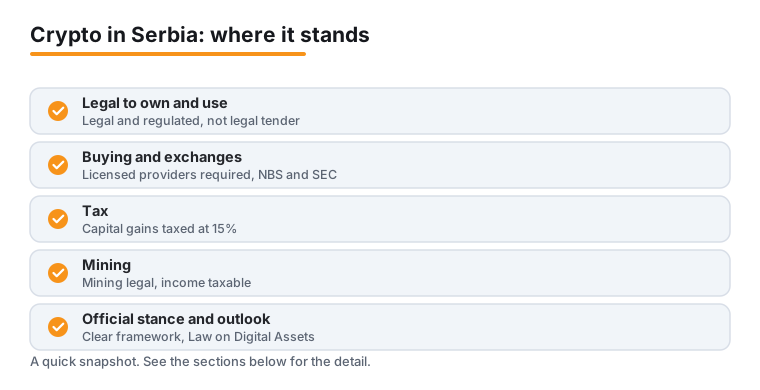
Yes. Owning, buying, selling, trading and mining cryptocurrency are legal in Serbia. The country regulated the sector through the Law on Digital Assets, published in the Official Gazette of the Republic of Serbia (No 153/2020) and applicable from 30 June 2021. Rather than treating crypto as forbidden, the law brings it into a defined legal category and sets out rules for the businesses that provide digital-asset services.
One important point: digital assets are not legal tender in Serbia. The National Bank of Serbia defines a virtual currency as a type of digital asset that is not issued or guaranteed by a central bank or public authority, is not necessarily tied to a legal tender, and does not have the legal status of money or currency. It can, however, be accepted as a means of exchange and can be bought, sold, exchanged, transferred and stored electronically. In practice this means merchants are not obliged to accept crypto, and you cannot demand to settle a debt in Bitcoin.
Who regulates crypto in Serbia
Serbia takes a two-regulator approach defined by the Law on Digital Assets, which splits oversight by the type of asset:
- National Bank of Serbia (NBS) supervises virtual currencies, such as Bitcoin and similar payment-type tokens, and licenses providers of virtual-currency services.
- Securities Commission of the Republic of Serbia (SEC) supervises digital tokens, which represent proprietary or investment-type rights and may have the characteristics of financial instruments. It also oversees the white papers issuers must publish.
Where a digital asset has the features of both a virtual currency and a digital token, the NBS and the SEC share jurisdiction. The Law on Digital Assets provides a one-stop process: if the same entity applies under both regulators, documentation is submitted once and the authorities exchange it between themselves. The NBS publishes official registers and warns that providing virtual-currency services without a licence is an unauthorised activity prohibited by law and a criminal offence under the Criminal Code.
Key laws and frameworks
The central piece of legislation is the Law on Digital Assets (Official Gazette of the Republic of Serbia No 153/2020), applicable since mid-2021. It is supplemented by secondary regulations issued by both the NBS and the SEC, by tax legislation, and by the Law on the Prevention of Money Laundering and the Financing of Terrorism. The law classifies digital assets into virtual currencies and digital tokens, and it governs issuance (including white papers), trading, custody and the licensing of service providers.
Serbia is an EU candidate country but is not an EU member, so the EU Markets in Crypto-Assets Regulation (MiCA) does not directly apply in Serbia in 2026. The broad expectation, given Serbia's accession path, is gradual alignment of its national framework toward EU standards over time. Anyone running a crypto business in Serbia should watch the NBS and SEC for amendments as that alignment progresses, and should not assume MiCA rights or passporting apply locally.
Licensing and registration of exchanges (DASPs)
Businesses that provide digital-asset services, often called digital-asset service providers (DASPs) or, internationally, virtual-asset service providers (VASPs), must be licensed before operating. This includes exchanges, brokers, custodial wallet providers and advisory services. Applications for virtual-currency services go to the NBS; applications for digital-token services with the characteristics of financial instruments go to the SEC. The Law on Digital Assets requires a decision on a licence application within 60 days of submission.
Licensing comes with minimum founding-capital requirements that scale with the range of services offered. Reported figures place the minimum capital broadly in the range of about EUR 20,000 to EUR 125,000 depending on the services, with a portion required to be paid in cash; because thresholds can change, confirm the current figures directly with the relevant regulator. Providers must also meet governance, security, record-keeping and compliance obligations, and follow the anti-money-laundering and know-your-customer rules described below. A notable structural rule is that financial institutions supervised by the NBS, such as banks, insurers and leasing providers, generally cannot themselves obtain licences to provide digital-asset services or hold crypto on their own account. The licensed market is still small: industry reporting in 2025 and 2026 indicates that two licensed crypto exchanges operate in Serbia, alongside other authorised providers, and the SEC has approved several white papers.
Crypto and Bitcoin tax in Serbia
Serbia taxes crypto, and the core rules are reasonably well defined. Gains realised when you sell or otherwise dispose of digital assets are generally treated as capital gains and taxed at a rate of 15% for both individuals and companies. The gain is the difference between the documented sale price and the documented acquisition price, so keep evidence of both. Note that a swap of one digital asset for another is also treated as a disposal and can trigger capital gains tax, not just cashing out to dinars. For individuals, a capital gains tax return is generally due within 120 days after the end of the quarter in which the gain (or loss) was realised, so track the quarter of each sale.
The law includes notable reliefs. Digital assets held continuously for at least ten years before transfer can be exempt from capital gains tax. In addition, a taxpayer who invests the proceeds of a sale into the share capital of a Serbian-resident company within 90 days can be exempt from 50% of the capital gains tax; investing later, within 12 months, can allow a refund of 50% of tax already paid. On indirect tax, the transfer of virtual currencies and the exchange of virtual currencies for fiat is generally exempt from value-added tax (without the right to deduct input VAT), although digital tokens that grant rights to goods or services may be treated differently.
Because rates, thresholds, qualifying periods and reliefs change and depend on your exact circumstances, do not rely on general figures. Keep complete records of every purchase, sale, swap and transfer, including dates, amounts, counterparties and the dinar value at the time, and confirm your position with the Serbian Tax Administration or a qualified accountant before filing. See our general guide to crypto taxes. This section is informational only and is not tax advice.
AML, KYC and the travel rule
Licensed providers must apply anti-money-laundering (AML) and know-your-customer (KYC) controls under Serbia's money-laundering and terrorist-financing prevention rules, alongside the digital-asset framework. Expect to verify your identity with an official document and, sometimes, proof of address, and expect transactions to be screened and suspicious activity reported.
Serbia also applies the international travel rule, which requires service providers to collect and share information about the originator and beneficiary of crypto transfers. In Serbia this obligation has been implemented strictly, with industry reporting indicating that travel-rule information is expected for transfers regardless of amount. The framework was further strengthened in 2025 with clearer AML, KYC and tax guidance. If you trade through a licensed Serbian provider, identity verification and transfer screening are a normal and mandatory part of the process.
Buying and using crypto in practice
Serbian residents can buy crypto through licensed domestic providers or through established international exchanges that accept Serbian customers. Because providers operating in Serbia must be authorised and follow AML/KYC rules, expect identity verification and transfer screening. Common routes include:
- Licensed Serbian exchanges and brokers are the most straightforward option, usually funded by bank transfer or card.
- International exchanges are widely used, but check that they serve Serbian users and support dinar (RSD) or euro funding.
- Peer-to-peer is possible but carries higher counterparty and fraud risk; favour escrow and reputable platforms.
A typical first purchase looks like this: choose a licensed or reputable provider; complete KYC with an ID document; fund the account in dinars or euros after checking fees and limits; place an order, considering buying gradually to smooth price swings; secure your holdings with two-factor authentication and, for long-term holdings, a wallet you control; and keep records for tax reporting. Remember that crypto carries none of the deposit guarantees or consumer protections that apply to bank accounts.
Bitcoin and crypto ATMs
Crypto ATMs (often called BTMs) operate in Serbia, mostly concentrated in Belgrade and a few other larger cities. They let you buy, and sometimes sell, Bitcoin and a handful of other coins using cash or a card, with the crypto sent to a wallet you control. Serbia's longest-running regulated exchange and wallet provider was also an early operator of crypto ATMs in the country.
Two practical points. First, machine availability changes frequently as operators add or remove units, so check a current ATM locator before travelling to one. Second, ATM operators are subject to the same licensing and AML/KYC expectations as other providers, so larger transactions typically require identity verification. Fees and spreads at ATMs are usually higher than on exchanges, which can be acceptable for speed and convenience but is worth comparing for larger amounts.
Bitcoin mining in Serbia
Bitcoin mining is legal in Serbia. There is no prohibition on running mining hardware, and mining income falls within the general tax framework, so miners should account for revenue and any realised gains and keep proper records.
The practical constraints are economic and energy-related rather than legal. Profitability depends heavily on electricity prices, hardware efficiency and the Bitcoin network's difficulty. Serbia has meaningful renewable potential, including hydroelectric capacity on its river network plus growing solar and wind resources, that some miners look to in order to lower costs. Anyone planning a sizeable operation should consider grid-connection rules, any permits for energy use, and noise and heat management, and should verify current commercial electricity tariffs and energy-sector requirements before committing capital.
Recent developments and outlook
The Law on Digital Assets has been in force since 2021, and the framework was reinforced through 2025 with strengthened AML and KYC duties and clearer tax guidance, including the 15% capital gains rate, the 120-day quarterly filing window for individuals, and the holding-period and reinvestment reliefs. The travel rule has been implemented strictly, with providers expected to share originator and beneficiary information for transfers regardless of amount. The licensed market remains small, with two licensed crypto exchanges reported as operating in Serbia. As an EU candidate, Serbia is widely expected to move its rules gradually toward EU standards such as MiCA over the coming years, which could tighten requirements for service providers while improving clarity for users; however, MiCA does not apply directly in Serbia in 2026.
Because the rules and tax details continue to evolve, treat this page as a starting point and confirm the current position with the National Bank of Serbia, the Securities Commission, the Tax Administration or a qualified professional before acting.
Consumer risks and protection
The main risks for Serbian users are familiar ones: market volatility, scams and phishing, exchange or wallet security failures, and the irreversibility of on-chain transactions. Crypto holdings do not benefit from the deposit-guarantee schemes or consumer protections that cover bank accounts, so losses from fraud, hacking or user error are often unrecoverable.
To reduce risk, use only licensed or reputable providers, enable strong security such as two-factor authentication and withdrawal controls, move long-term holdings to a wallet you control, be sceptical of anyone promising guaranteed returns, and invest only what you can afford to lose. The NBS treats unlicensed provision of virtual-currency services as a criminal offence, so checking whether a provider is licensed is a sensible first step. This is general information, not investment advice.
Official sources and how to verify
Always confirm the current law and any provider's status with the official authorities rather than relying on third-party summaries. The primary sources are:
- National Bank of Serbia, digital assets: nbs.rs digital assets page, which sets out the official definitions, the Law on Digital Assets (No 153/2020), and licensing of virtual-currency providers.
- NBS official registers: dataexchange.nbs.rs, where you can check licensed providers.
- Securities Commission of the Republic of Serbia: sec.gov.rs, which maintains the register of digital-token service providers and approved white papers.
For tax questions, consult the Serbian Tax Administration or a qualified Serbian accountant. For our own broader resources, see crypto regulation by country. This page is general information as of 2026 and is not legal, tax or financial advice; verify with the named regulators before acting.
Frequently asked questions
Is cryptocurrency legal in Serbia?
Yes. Buying, holding, selling, trading and mining crypto are legal and regulated under the Law on Digital Assets (Official Gazette No 153/2020), applicable since June 2021. However, crypto is not legal tender, so merchants are not required to accept it. This is general information, not legal advice; verify with the National Bank of Serbia.
Who regulates crypto in Serbia?
Two authorities share oversight under the Law on Digital Assets. The National Bank of Serbia supervises virtual currencies such as Bitcoin and licenses their service providers, while the Securities Commission of the Republic of Serbia supervises digital tokens that have the characteristics of financial instruments. Where an asset is both, the two bodies share jurisdiction.
How is crypto taxed in Serbia?
Gains from disposing of digital assets are generally treated as capital gains and taxed at 15% for both individuals and companies. Assets held continuously for at least ten years can be exempt, and reinvesting proceeds into a Serbian company's share capital within 90 days can give a 50% exemption. Swapping one crypto for another also counts as a disposal. For individuals, the capital gains tax return is generally due within 120 days after the end of the quarter of the sale. Transfers of virtual currencies are generally VAT-exempt. Rates and reliefs change, so confirm with the Tax Administration or an accountant. This is not tax advice.
Do crypto exchanges need a licence in Serbia?
Yes. Digital-asset service providers, including exchanges, brokers and custodial wallet providers, must be licensed before operating. Applications for virtual-currency services go to the National Bank of Serbia and applications for digital-token services to the Securities Commission, with a decision due within 60 days. Minimum capital requirements apply, and operating without a licence is a criminal offence.
What AML and KYC rules apply to crypto in Serbia?
Licensed providers must verify customer identity (KYC), screen transactions and report suspicious activity under Serbia's anti-money-laundering rules. Serbia also applies the international travel rule, requiring providers to collect and share originator and beneficiary information for crypto transfers, reportedly regardless of amount. These duties were strengthened in 2025.
Is Bitcoin mining allowed in Serbia?
Yes, mining is legal. The practical limits are electricity costs, hardware efficiency and network difficulty rather than the law, and mining income is taxable. Some miners look to Serbia's hydro, solar and wind resources to lower costs. Verify current electricity tariffs and any energy-sector requirements before scaling up.
When do I file a crypto tax return in Serbia?
For individuals, a capital gains tax return is generally due within 120 days after the end of the quarter in which you realised the gain or loss. Keep dated records of each sale and swap so you can identify the correct quarter. Deadlines and procedures can change, so confirm the current rules with the Serbian Tax Administration or a qualified accountant. This is general information, not tax advice.
Is swapping one crypto for another taxable in Serbia?
Yes. Exchanging one digital asset for another is generally treated as a disposal, so any gain can be subject to the 15% capital gains tax, not only when you cash out to dinars or euros. Keep the dinar value of both assets at the time of the swap. Confirm your position with the Tax Administration or an accountant, as details depend on your circumstances.
How many licensed crypto exchanges operate in Serbia?
As of 2026, industry reporting indicates two licensed crypto exchanges operate in Serbia under the Law on Digital Assets, alongside other authorised service providers. You can check whether a specific provider is licensed through the National Bank of Serbia registers before using it, since operating without a licence is a criminal offence.
Facts reviewed: 30 June 2026. Page updated: 3 August 2026.