Home › Crypto Regulation › Albania
Bitcoin & Cryptocurrency Regulation in Albania
Quick answer — Albania, 2026
- Legal: Legal to own and trade under Law 66/2020, not legal tender
- Tax: Capital gains taxed around 15%; mining and staking as income
- Buying: Few or no local licensed exchanges, use international platforms
Albania holds an unusual position in Europe's crypto landscape. It was one of the first countries on the continent to pass a dedicated law for digital assets, yet domestic licensing and everyday adoption have lagged well behind the ambition of that law. For residents, foreign investors, and the country's large diaspora, the headline is straightforward: owning, buying, and using cryptocurrencies such as Bitcoin is legal in Albania. The detail is where it gets complex, because supervision, licensing, and taxation are spread across several institutions and the framework is still maturing.
This guide explains the current state of cryptocurrency regulation in Albania, covering legal status, the regulators involved, the key laws, how exchanges are licensed, how tax and anti-money-laundering rules apply, and how people buy and use crypto in practice. It is general information as of 2026 and is not legal, tax, or financial advice; because the rules are evolving, always verify specifics with the named official regulators, the Albanian Financial Supervisory Authority and the Bank of Albania, or a qualified Albanian professional before acting. For wider context see our guide to crypto regulation and the country regulation hub.
On this page: Legal status · Who regulates it · Taxes · How to buy · Mining
Legal status of Bitcoin and crypto in Albania
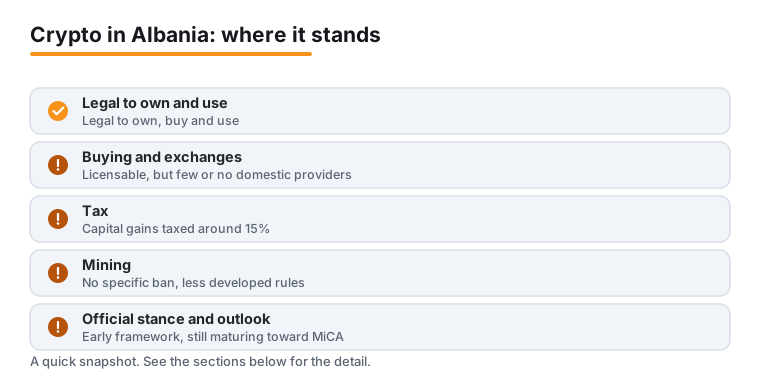
Crypto is legal in Albania. There is no prohibition on owning, buying, selling, or transferring Bitcoin and other crypto-assets, and individuals may legally hold coins in self-custody wallets and trade on international platforms. Albania is notable for having adopted a dedicated legal framework relatively early rather than leaving digital assets in a vacuum.
What crypto is not is legal tender. The Albanian lek (ALL) remains the only official currency, and crypto-assets are not money issued or guaranteed by the central bank. Merchants are under no obligation to accept crypto, and everyday acceptance for goods and services is rare in practice. So while holding and trading are lawful, treating Bitcoin as money for routine payments is uncommon and carries no consumer-protection guarantee if a transaction goes wrong.
The regulators: AFSA, Bank of Albania and AKSHI
Supervision of crypto in Albania is shared across more than one institution, which is important to understand before you rely on any single rule:
- Albanian Financial Supervisory Authority (AFSA / AMF) is the principal regulator for licensing and supervising crypto-asset and distributed-ledger-technology (DLT) service providers. Its official site is amf.gov.al.
- Bank of Albania is the central bank, responsible for monetary policy and financial stability and the issuer of public warnings about crypto risk. It has stated that it has not licensed any entity whose activity includes virtual currencies.
- National Agency for Information Society (AKSHI) works alongside AFSA under the DLT regime on technology-related authorisation, such as matters touching system audits and cybersecurity.
- General Directorate for the Prevention of Money Laundering (the Financial Intelligence Unit) handles anti-money-laundering and counter-terrorist-financing supervision and suspicious-transaction reporting.
This split matters: AFSA is the body to approach about licensing a crypto business, while the Bank of Albania's role is monetary stability and consumer warnings rather than licensing crypto firms.
Key laws and frameworks
The cornerstone of Albania's framework is Law No. 66/2020 "On Financial Markets Based on Distributed Ledger Technology", often called the DLT law, which entered into force on 1 September 2020. It was one of Europe's earliest comprehensive attempts to regulate the issuance, trading, and custody of digital tokens and virtual currencies, and it tasks AFSA with licensing and supervising the relevant service providers. You can read the official text on the regulator's site: Law No. 66/2020 (AFSA).
Implementing regulations followed, with AFSA's board approving bylaws on matters such as capital adequacy and the licensing of digital-token agents. On the tax side, Law No. 29/2023 "On Income Tax" took effect on 1 January 2024 and brought transactions in virtual assets and mining explicitly within the income tax regime (see the taxation section below).
The replacement for Law No. 66/2020 is already written and public. The draft law "Për tregjet e kripto-aseteve" (On Crypto-Asset Markets), led by the Ministry of Economy and Innovation and drafted by AFSA and the Bank of Albania, transposes Regulation (EU) 2023/1114 (MiCA) in full. It was published for public consultation on 27 November 2025, consultation closed on 30 January 2026, and the Council of Ministers regulatory acts department rated its final regulatory impact assessment 90 out of 100, "generally positive", on 13 May 2026 after four rounds of revision. Article 141 of the draft repeals Law No. 66/2020 and all its bylaws outright on the day the new law takes effect. The bill had not been adopted as of early August 2026, and because its commencement clause named 1 March 2026, a date that has already passed, a new entry into force date will have to be set. It remains a consultation text and can change before adoption.
Licensing and registration of exchanges and VASPs
Under Law No. 66/2020, providing certain crypto services in or from Albania requires a licence from AFSA. The law defines several licence categories, commonly summarised as: a digital-token agent licence; a DLT exchange (bourse) licence for platforms that facilitate trading between tokens, virtual currencies, and fiat; an innovative-service-provider licence (covering roles such as system auditors and technological assessors); a third-party portfolio custodian (custodian wallet) licence; and an automated collective investment undertaking licence using DLT.
In practice the framework has never been used. The government's explanatory memorandum for the replacement bill states that although the implementing bylaws were approved in 2022, AFSA has not received a single licence application under Law No. 66/2020, and consequently no entity is licensed to operate in DLT-based financial markets in Albania. The accompanying regulatory impact assessment describes the result as a legal deadlock in which firms that want to operate cannot effectively be licensed, and records that in some cases activity has been found being carried on without licence or authorisation. It also notes that AFSA received around 45 informal enquiries from interested firms between 2021 and 2025, but not one application to become a digital token agent, the gateway through which every other licence application had to pass. This gap between an early, detailed law and limited real-world implementation is a defining feature of Albania's situation. Anyone intending to operate a crypto business, or to confirm whether a given platform is locally authorised, should check directly with AFSA rather than assuming a platform is regulated in Albania.
Crypto taxation in Albania
Albania taxes crypto activity. The revised personal income tax law, Law No. 29/2023 "On Income Tax," took effect on 1 January 2024 and brought virtual assets explicitly into scope. Broadly, the system distinguishes two kinds of crypto income:
- Capital gains from selling or disposing of crypto-assets. The general capital gains rate for individuals in Albania is 15%. PwC's Albania tax summary, last reviewed 22 July 2026, records 15% on gains from the sale of shares and 15% on the capital gain realised on transfers of real estate, and does not address crypto at all. Albanian tax practitioners apply the same 15% to crypto disposals, with the taxable amount calculated as sale value less purchase value, net of fees. There is no separately published crypto rate and no crypto-specific guidance from the tax administration. Albanian tax practitioners note that a crypto-to-crypto swap is itself a taxable event, valued in lek (ALL) at the market price on the swap date.
- Active income such as mining and staking rewards, which is generally treated as ordinary income and taxed on the applicable progressive basis, while crypto income earned as a business is taxed under the corporate income rules.
One point worth noting is that, per Albanian tax practitioners, capital losses on crypto cannot be carried forward to future tax years; a loss realised in one year does not reduce a gain in a later year, though losses can offset gains within the same year. Individuals generally declare investment gains in the annual personal income tax return filed after the calendar year end. Because rates, allowances, the precise definition of a taxable event, and your residency status all affect the outcome, treat the figures above as indicative rather than definitive. Keep detailed records of every purchase, sale, and transfer (dates, amounts, counterparties, and lek values), and confirm your exact obligations with the Albanian tax authorities or a licensed Albanian accountant. See our general crypto tax guide for background. This is general information, not personal tax advice.
AML, KYC and source-of-funds rules
Crypto activity in Albania sits within the country's anti-money-laundering (AML) and counter-terrorist-financing (CFT) framework, supervised by the Financial Intelligence Unit. Licensed DLT service providers are obliged entities, meaning they must carry out customer due diligence, monitor transactions, and report suspicious activity. The Bank of Albania has explicitly flagged that unregulated virtual-currency activity can be exploited for money laundering and terrorist financing.
For ordinary users, this shows up as standard compliance steps on any reputable platform: identity verification (Know Your Customer, or KYC) using a passport or national ID; transaction monitoring; and requests for proof of source of funds on larger amounts. Expect these checks whether you use a locally licensed provider or, as is more common, a regulated international exchange. Cooperating with these requirements is normal and is part of how platforms stay compliant.
Buying and using crypto in practice
Because few providers are licensed domestically, most people in Albania acquire crypto through established international exchanges and regulated brokers rather than local platforms. Accounts are typically funded in lek or euros by bank transfer or card, after completing KYC verification. Albanian banks vary in how they treat transfers to and from crypto platforms, so some users encounter friction.
When choosing a venue, prioritise platforms with a strong security record, transparent fees, and a clear regulatory standing in their home jurisdiction. Be cautious with peer-to-peer trades and informal exchangers, which carry higher fraud and counterparty risk. Using an offshore or unlicensed service does not itself break Albanian law for an ordinary user, but it offers little recourse if the platform fails or freezes funds. For anything more than a small balance, withdrawing to a wallet you control, ideally a hardware wallet, reduces custody risk. Note that physical Bitcoin ATM coverage in Albania is very limited and inconsistent, so it is not something to rely on.
Bitcoin mining in Albania
There is no specific ban on cryptocurrency mining in Albania, and the country has a feature that periodically attracts interest: a high share of its electricity is generated from domestic hydropower, which is comparatively clean and, in wet years, relatively inexpensive. That has fuelled discussion about renewable-powered mining.
The practical picture is more cautious. Albania's grid is exposed to drought and to years when the country must import electricity, so power price and availability are not always favourable, and large new electrical loads can attract scrutiny. Miners must also account for income tax on rewards (treated as ordinary income under the 2024 income tax rules), AML obligations when converting to fiat through service providers, and standard business registration at commercial scale. The regulatory treatment of mining is less developed than the rules for exchanges and custody, so anyone planning a sizeable operation should clarify the energy, permitting, and tax position with the relevant authorities first.
Recent developments (2025 to 2026)
The clear direction of travel is gradual formalisation and alignment with Europe. As an EU candidate, Albania has strong incentives to harmonise with the EU's MiCA regulation, and reporting through 2025 and 2026 describes work on updated crypto-asset legislation inspired by MiCA. The draft sets out the dual oversight precisely. Article 93 names AFSA and the Bank of Albania as the competent authorities and divides their roles: the Bank of Albania authorises and prudentially supervises issuers of asset-referenced tokens and e-money tokens, while AFSA authorises and supervises crypto-asset service providers, oversees public offers and whitepapers, and polices market abuse. Under Article 20 the Bank of Albania has 60 working days from a complete application to assess it and prepare a draft decision. Article 48 permits a public offer of an e-money token only by an issuer licensed or authorised as a bank, a credit institution or an electronic money institution. Article 43 lets the Bank of Albania classify an asset-referenced token as significant when at least three of seven criteria are met, including more than 10 million holders, issuance value or reserve size above EUR 5 billion, and daily transaction counts and values. Unlike Law 66/2020, no information-technology authority is a competent authority under the draft, and decentralised finance is left out of scope.
Two caveats are important. First, the precise text, scope, and entry-into-force of any new law should be treated as evolving rather than final until officially adopted. Second, regulation on paper has so far outpaced market development, and the number of fully licensed domestic providers has remained small. Treat the environment as workable but still maturing, and check AFSA for the latest position before relying on any specific rule.
Consumer risks and protection
The Bank of Albania's public notice on the risks of virtual currencies is dated 13 July 2017 and has not been superseded. It states that the legal and regulatory framework in force does not stipulate the performance of such activity in Albania, that the Bank has not licensed any financial entity whose activity includes virtual currencies, and that companies involved in this activity in Albania are therefore not licensed and their activity is not subject to its regulatory and supervisory framework. Read it as a still-standing warning that predates Law No. 66/2020 rather than as current guidance on the new regime. The risks it highlights are familiar: high price volatility and the possibility of significant or total loss; the risk that crypto may not convert back to conventional currency; the absence of any deposit-insurance-style protection; potential misuse for money laundering or other illegal activity; and weak guarantees around data security on some platforms.
Because relatively few providers are licensed domestically, Albanian users largely rely on foreign services, which means leaning on protections from other jurisdictions rather than Albanian ones. Practical safeguards: only commit money you can afford to lose; use secure custody and never share private keys or seed phrases; be sceptical of schemes promising guaranteed returns; double-check wallet addresses before sending; and keep clear records for tax purposes. Consider speaking to a licensed Albanian financial professional before making significant decisions.
Official sources and how to verify
Crypto rules in Albania are evolving, so always confirm the current position with primary sources rather than relying solely on summaries. The most authoritative starting points are:
- Albanian Financial Supervisory Authority (AFSA / AMF), the licensing regulator for DLT and crypto-asset service providers: amf.gov.al.
- Law No. 66/2020 on Financial Markets Based on Distributed Ledger Technology, the official text hosted by AFSA: Law No. 66/2020 (PDF).
- Bank of Albania, for monetary policy, financial stability, and its public warning on virtual-currency risk: Bank of Albania virtual-currency risk notice.
For tax matters, consult the Albanian tax administration or a licensed accountant. This guide is general information as of 2026 and is not legal, tax, or financial advice; verify any specific obligation with the named official regulators before acting. You can also browse our country regulation hub for related guides.
August 2026 status: a drafted MiCA transposition bill, not yet adopted
Albania has no MiCA-style crypto law in force. What changed between mid-2025 and August 2026 is that the replacement stopped being an intention and became a published bill that has completed consultation and cleared its final impact assessment.
| Bill | Sponsor | Stage as of August 2026 | What it would do |
|---|---|---|---|
| "Për tregjet e kripto-aseteve" (On Crypto-Asset Markets) | Ministry of Economy and Innovation, drafted by AFSA and the Bank of Albania | Public consultation 27 November 2025 to 30 January 2026, now closed. Final regulatory impact assessment rated 90 out of 100, "generally positive", by the Council of Ministers regulatory acts department on 13 May 2026, after four rounds of revision. Not adopted. | Transposes Regulation (EU) 2023/1114 (MiCA) in full and repeals Law No. 66/2020 outright (Article 141) |
| "Për shkëmbimin automatik të informacionit mbi kripto-asetet" (Automatic Exchange of Information on Crypto-Assets) | Ministry of Finance | Draft published on the consultation portal, Albanian text dated 7 July 2026. Not adopted. | Transposes Article 8ad and Annex VI of Directive 2011/16/EU (DAC8), but its effects are deferred to the date Albania joins the EU |
On timing, the government's own final impact assessment sets the objective as securing, within 2026, full harmonisation of Albanian crypto-asset legislation with Regulation (EU) 2023/1114. Treat that as a target rather than a commitment. AFSA's general director told the parliamentary economy committee in October 2025 that the draft would be finalised within that year, and it was not. The consultation draft's own commencement clause, Article 142, sets entry into force at 1 March 2026, a date that passed while the bill was still in impact assessment, so a new commencement date has to be set before the law can take effect.
What the crypto-asset markets bill would actually require
The consultation text is public, so the obligations are already knowable rather than speculative. The figures and article numbers below come from the draft law and its explanatory memorandum as published for consultation. This is a consultation text and every figure below can change before adoption.
- Two regulators, split by function. Article 93 names AFSA and the Bank of Albania as the competent authorities. The Bank of Albania authorises and prudentially supervises issuers of asset-referenced tokens and e-money tokens; under Article 20 it has 60 working days from a complete application to assess it and prepare a draft decision, with further steps in Article 21 before the final decision. AFSA authorises and supervises crypto-asset service providers, oversees public offers and whitepapers, and polices market abuse. No information-technology authority is a competent authority, which is a change from the Law 66/2020 regime.
- Minimum capital for service providers. Annex IV sets three classes: EUR 50,000 for order execution, placing, transfers, reception and transmission of orders, advice and portfolio management; EUR 125,000 for custody and administration and for exchanging crypto against funds or against other crypto; EUR 150,000 for operating a crypto-asset trading platform. A provider must hold the higher of that figure or one quarter of the previous year's fixed overheads (Article 67), met through core tier 1 own funds, a qualifying insurance policy, or a combination.
- Stablecoin issuance restricted to regulated institutions. Article 48 allows a public offer or admission to trading of an e-money token only by an issuer licensed or authorised as a bank, a credit institution or an electronic money institution, with the whitepaper notified to the Bank of Albania at least 40 working days before the intended offer. An institution licensed in an EU state may do so through a Bank of Albania recognition procedure. Issuers of asset-referenced tokens must hold own funds of at least EUR 350,000, or 2 percent of average reserve assets, or one quarter of prior-year fixed overheads, whichever is highest (Article 35).
- A significance regime. The Bank of Albania can classify an asset-referenced token as significant when at least three of seven criteria in Article 43 are met, including more than 10 million holders, issuance value, market capitalisation or reserve size above EUR 5 billion, and daily transaction counts and values. Separately, Article 22 requires quarterly reporting to the Bank of Albania for any asset-referenced token with an issuance value above EUR 100,000,000.
- Retail protections. A 14 day right of withdrawal without fee or charge, and without giving reasons, for non-professional clients buying crypto-assets other than asset-referenced or e-money tokens (Article 13). Whitepapers must be notified to AFSA at least 20 working days before publication, and are not subject to prior approval (Article 8). Article 29 imposes fair, clear and not misleading standards on marketing communications.
- Direct applications, and a sandbox. Unlike Law 66/2020, which required applications to be routed through a licensed DLT agent, any interested firm could apply directly to the regulator. Article 139 has AFSA create and run a three-year regulatory sandbox for controlled testing of innovation.
- Repeal without grandfathering. Article 141 repeals Law No. 66/2020 and every bylaw made under it on the day the new law enters into force. There is no transitional licensing regime, which matters little in practice because no firm holds a licence under the old law. AFSA and the Bank of Albania then have one year to issue implementing regulations (Article 140).
- EU institutional powers are deferred. Article 121 makes the powers of the European Banking Authority, ESMA and the European Court of Justice applicable only from the date Albania joins the EU. Until then the Bank of Albania exercises them in relation to issuers of asset-referenced and e-money tokens.
Crypto tax reporting: a DAC8 bill exists, but its effects wait for EU accession
A second draft law, sponsored by the Ministry of Finance, transposes Article 8ad and Annex VI of Directive 2011/16/EU, the EU crypto tax reporting rules known as DAC8. The Albanian text published on the government consultation portal is dated 7 July 2026.
Read the commencement clause before anything else. Article 19 says the law enters into force 15 days after publication in the Official Gazette, but that its effects begin on the date of Albania's accession to the European Union, in accordance with the Accession Treaty. Article 9 then sets the first reporting year as the calendar year beginning 1 January of the year following the start of those effects. On the face of the draft, no report is filed before Albania is an EU member. Reporting is also aimed at users who are reportable persons resident in an EU Member State, not at Albanian residents generally.
What it would require once effective:
- Who collects it. The General Directorate of Taxation is the competent authority for receiving, processing and automatically exchanging the information, and maintains the register of crypto-asset operators.
- Who must report. Reporting crypto-asset service providers and crypto-asset operators, meaning any business carrying out exchange transactions in reportable crypto-assets for or on behalf of users.
- What is reported. Per user: name, address, jurisdictions of tax residence, tax identification numbers, and for individuals date and place of birth, with controlling persons of entities also captured. Per asset type: gross amounts, units and transaction counts for acquisitions and disposals against fiat and against other crypto, for retail payments, and for transfers in and out.
- Deadline. Annually, by 30 June of the year following the reporting period (Article 9).
- Thresholds and exclusions. Central bank digital currency and electronic money are excluded from reportable crypto-assets. A transfer used to pay for goods or services counts as a reportable retail payment transaction above USD 50,000 or the equivalent.
- If you do not respond. Where a user fails to provide the required self-certification, the provider must, after two reminders and not earlier than 60 days from the initial request, stop the user carrying out reportable transactions until the information is supplied (Article 11).
- Penalties on platforms. Under Article 17, fines of 700,000 to 1,000,000 lek for failing to report within the deadline, for registration breaches and for obstructing supervision; 300,000 to 700,000 lek for inaccurate, incomplete or untrue reporting and for due-diligence failures; 100,000 to 300,000 lek for not notifying changes to registration data. Records must be kept at least seven years (Article 12).
Note the dependency: this bill defines "crypto-asset" and "crypto-asset service provider" by reference to the legislation in force on crypto-asset markets, so in practice it presumes the MiCA transposition law is on the books.
Why this is moving now: EU accession Chapter 9
The driver is accession sequencing rather than domestic market demand. The government's impact assessment records that Albania opened Cluster 2 "Internal Market" of its EU accession negotiations in April 2025. That cluster contains Chapter 9 on financial services, where AFSA is the lead negotiating institution, and alignment with the EU digital finance framework including a crypto-asset law sits among the closing benchmarks.
The inter-institutional working group that produced the draft was set up by Prime Minister's Order No. 108 of 31 July 2025, tasked with transposing Regulation (EU) 2023/1114. Per the explanatory memorandum, the draft was written by AFSA and the Bank of Albania with contributions from the Ministry of Economy and Innovation, the Ministry of Finance, the Financial Intelligence Agency, the National Cyber Security Agency and AKSHI.
The European Commission's Albania 2025 Report, SWD(2025) 750 final, published 4 November 2025, corroborates the sequence and is blunt about where Albania stands. It assesses Albania as "between a moderate and a good level of preparation in the area of financial services", and records that "the AFSA has conducted a comparative analysis of the current legislation with the Market in Crypto-Assets Regulation (MiCA) and in July an inter-institutional working group to align with the EU acquis was set up". It also notes that the Bank of Albania and AFSA "have started the work on drafting relevant regulations on digital operational resilience" to align with the EU Digital Operational Resilience Act.
On enforcement capacity the same report is candid: it says financial investigation techniques need to be improved, "including on identification, analysis and preservation of digital evidence for cryptocurrency and virtual assets", and that seized and confiscated assets including virtual assets cannot be properly managed because "no state-owned digital wallet is available".
Frequently asked questions
Is cryptocurrency legal in Albania?
Yes. Owning, buying, selling, and transferring Bitcoin and other crypto-assets is legal in Albania, which has had a dedicated framework under Law No. 66/2020 since 2020. However, crypto is not legal tender, merchants are not required to accept it, and using it carries no consumer-protection guarantee. This is general information, not legal advice; verify with the official regulators.
Who regulates crypto in Albania?
Supervision is shared. The Albanian Financial Supervisory Authority (AFSA / AMF, at amf.gov.al) is the principal licensing regulator for DLT and crypto service providers. The Bank of Albania handles monetary stability and issues risk warnings, the National Agency for Information Society (AKSHI) is involved in technology authorisation, and the Financial Intelligence Unit supervises anti-money-laundering compliance.
What law governs crypto in Albania?
The core law is Law No. 66/2020 "On Financial Markets Based on Distributed Ledger Technology," in force since 1 September 2020. It sets out licensing categories supervised by AFSA. A revised income tax law effective 1 January 2024 brought virtual assets into the tax regime, and Albania is working toward updated, MiCA-inspired legislation as an EU candidate country.
Do I have to pay tax on crypto in Albania?
Generally yes. Since 1 January 2024, capital gains from disposing of crypto are taxable for individuals, with professional sources citing a flat rate around 15%, while mining and staking rewards are treated as ordinary income. Exact rates and rules can change and depend on your circumstances, so confirm with the Albanian tax administration or a licensed accountant. This is general information, not tax advice.
Are there licensed crypto exchanges in Albania?
Licensing is possible under Law No. 66/2020, which defines categories such as a DLT exchange licence and a custodian wallet licence issued by AFSA. In practice the domestic market has remained thin, with few or at times no fully licensed providers, so most residents use regulated international exchanges. Check directly with AFSA to confirm whether a specific platform is locally authorised.
Is there a new MiCA-style crypto law in Albania?
Albania, as an EU candidate, has signalled an intention to align with European standards, and reporting in 2025 and 2026 describes work on crypto-asset legislation inspired by the EU's MiCA regulation, with dual oversight by AFSA and the Bank of Albania. The exact scope and timeline should be treated as work in progress, so check AFSA for the current position before relying on it.
Can I carry crypto losses forward in Albania?
According to Albanian tax practitioners, no. Capital losses on crypto cannot be carried forward to reduce gains in a later tax year, although a loss can offset gains realised in the same calendar year. Because rules and interpretation can change, confirm your position with the Albanian tax administration or a licensed accountant. This is general information, not tax advice.
Is a crypto-to-crypto trade taxable in Albania?
Albanian tax practitioners describe a crypto-to-crypto swap as a taxable event, with the gain measured in lek (ALL) at the market value on the date of the swap, not only when you cash out to fiat. Keep records of each trade's date and lek value. Rates and definitions depend on your circumstances, so confirm with a licensed Albanian accountant. This is general information, not tax advice.
Which authority licenses a crypto business in Albania?
The Albanian Financial Supervisory Authority (AFSA / AMF, at amf.gov.al) is the licensing regulator for crypto-asset and distributed-ledger-technology service providers under Law No. 66/2020, working alongside the National Agency for Information Society (AKSHI) on technology matters. The Bank of Albania handles monetary stability and risk warnings rather than licensing crypto firms. Check directly with AFSA before relying on any platform's local status.
Has Albania adopted a MiCA-style crypto law yet?
No. As of early August 2026 the draft law "Për tregjet e kripto-aseteve" (On Crypto-Asset Markets) has completed public consultation, which ran from 27 November 2025 to 30 January 2026, and its final regulatory impact assessment was rated 90 out of 100 on 13 May 2026 by the Council of Ministers regulatory acts department. It has not been adopted. Law No. 66/2020 remains in force until the new law replaces it. The government's stated objective is full harmonisation with Regulation (EU) 2023/1114 within 2026, but that is a target, and an earlier commitment to finalise the draft during 2025 was not met.
How many crypto companies are licensed in Albania?
None. The government's explanatory memorandum for the new bill, dated November 2025, states that although the implementing bylaws were approved in 2022, AFSA has not received a single licence application under Law No. 66/2020, and that consequently no entity is licensed to operate in DLT-based financial markets. This is why Albanian residents rely on international platforms.
What capital would a crypto exchange need under the new Albanian law?
Annex IV of the consultation draft sets three tiers: EUR 50,000 for order execution, placing, transfers, reception and transmission of orders, advice and portfolio management; EUR 125,000 for custody and administration and for exchanging crypto against funds or other crypto; and EUR 150,000 for operating a crypto-asset trading platform. A provider must hold the higher of that figure or one quarter of the previous year's fixed overheads, met through core tier 1 own funds, a qualifying insurance policy, or both. These are consultation-stage figures and can change before adoption.
Will Albanian tax authorities be told about my crypto trades?
Not under current law, and not soon under the draft. A draft law transposing the EU's DAC8 rules is published on the government consultation portal, and it would require crypto-asset service providers to report each user's name, address, jurisdictions of tax residence, tax identification numbers and per-asset totals to the General Directorate of Taxation by 30 June each year. However, Article 19 of that draft states that its effects begin only on the date Albania joins the European Union, and its reporting is aimed at users resident in EU Member States. It has not been adopted, and on its own terms no report would be filed before accession.
Would the new law replace Law No. 66/2020?
Yes. Article 141 of the consultation draft repeals Law No. 66/2020 and every bylaw issued under it on the day the new law enters into force. There is no grandfathering clause, which has little practical effect because no firm holds a licence under the old law. AFSA and the Bank of Albania would then have one year from entry into force to issue implementing regulations under Article 140, and AFSA would run a three-year regulatory sandbox under Article 139.
Facts reviewed: 4 August 2026. Page updated: 4 August 2026.