Home › Crypto Regulation › Bosnia and Herzegovina
Bitcoin & Cryptocurrency Regulation in Bosnia and Herzegovina
Quick answer — Bosnia and Herzegovina, 2026
- Legal: Legal to own and trade, not legal tender
- Tax: Not uniform, varies by entity, no single crypto rule
- Buying: Via international exchanges, P2P and a few ATMs
Bosnia and Herzegovina (BiH) sits in an unusual middle ground when it comes to digital assets. Cryptocurrencies such as Bitcoin are not banned, and individuals are free to buy, hold, trade and use them, but they are also not recognised as legal tender or as an official currency. There is no single nationwide crypto statute. Instead, oversight is fragmented across the state level and the country's two entities, the Federation of Bosnia and Herzegovina and Republika Srpska, plus the Brcko District, each of which has moved at its own pace.
This guide explains, in plain terms, where crypto stands in BiH as of 2026: whether it is legal, who regulates it, how exchanges register, how it is taxed, and what buying, mining and using crypto looks like in practice. It draws on the position of the Central Bank of Bosnia and Herzegovina, the Republika Srpska Securities Commission and BiH's 2024 anti-money-laundering framework. This is general information as of 2026 and is not legal, tax or financial advice; because the rules are still evolving and differ between entities, always verify the current position with the named official regulators and a qualified local professional before acting. For broader context see our guide to crypto regulation.
On this page: Legal status · Who regulates it · Taxes · How to buy · Mining
Is Bitcoin and crypto legal in Bosnia and Herzegovina?
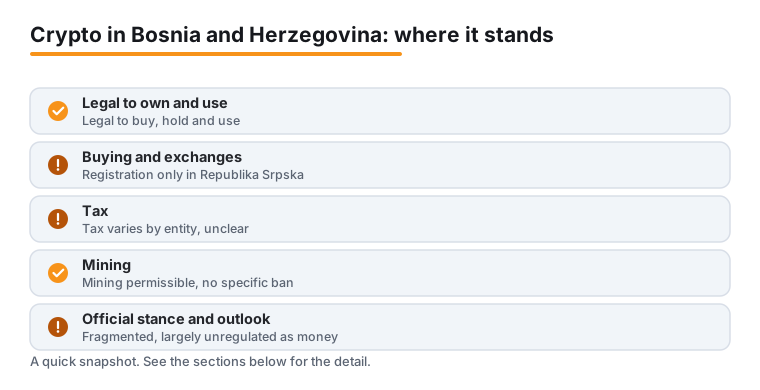
Yes, owning and using Bitcoin and other cryptocurrencies is legal in Bosnia and Herzegovina. There is no law prohibiting residents from buying, selling, holding or transferring crypto, and there are no reports of penalties for ordinary personal use. Possession and peer-to-peer trade are permitted across the whole country.
What crypto is not, however, is legal tender. The Central Bank of Bosnia and Herzegovina (CBBH) recognises only the convertible mark (BAM, also written KM) as official currency. The convertible mark operates under a currency-board arrangement and is pegged to the euro at a fixed rate of 1 EUR = 1.95583 BAM. The central bank has stated that cryptocurrencies do not have legal-tender status and has cautioned the public about price volatility and fraud risk.
The key consequence is that you can legally use crypto, but you do so without the statutory consumer protections that apply to bank deposits or to the national currency. Because BiH has a decentralised constitutional structure, the regulatory detail can vary depending on which entity you are in, as the next sections explain.
Who regulates crypto in Bosnia and Herzegovina?
There is no single crypto regulator. Responsibility is split across the state level and the two entities, which is the single most important thing to understand about the country.
- Central Bank of Bosnia and Herzegovina (CBBH). The state monetary authority. It issues and protects the convertible mark and has made clear that crypto-assets are not legal tender and are not regulated as money. It does not license crypto as currency.
- Republika Srpska Securities Commission (Komisija za hartije od vrijednosti Republike Srpske). The entity-level securities regulator that supervises virtual-currency service providers in Republika Srpska and maintains the public register of those providers. It is the only standing crypto-services regulator in the country.
- Financial Intelligence Department (within SIPA). The state-level financial intelligence unit. Under the 2024 anti-money-laundering law it receives suspicious-activity reports from obligors, and virtual currency service providers are listed as obligors in Article 5(1)(m). The state law does not set up a register or a licence for crypto firms, so the only public register in the country remains the record kept by the Republika Srpska Securities Commission.
- Tax authorities. Tax administration sits at entity level (and in the Brcko District), so the treatment of crypto gains and crypto businesses can differ across BiH.
You can verify the central bank's role at the Central Bank of Bosnia and Herzegovina and the entity securities regulator at the Republika Srpska Securities Commission.
Key crypto laws and frameworks
BiH does not have a comprehensive, EU-style crypto law. Regulation is spread across several layers.
State-level AML and CFT law (2024)
The most significant nationwide development is the anti-money-laundering and counter-terrorism-financing framework adopted at the state level in February 2024. It defines what a virtual currency is, introduces the concept of a virtual asset service provider, and brings activities such as exchange, custody and transfers within the scope of financial-crime rules. It applies across all BiH jurisdictions and is designed to meet Financial Action Task Force (FATF) recommendations, broadly aligning with the approach of the EU's anti-money-laundering directives.
Republika Srpska securities rules
Republika Srpska has moved further than the Federation. Through amendments to its Law on the Securities Market (around 2022, with further changes recognising virtual assets), the entity gave certain crypto-assets a defined legal character as digital records of value that can be exchanged, and placed supervision under the Republika Srpska Securities Commission.
Federation of Bosnia and Herzegovina
The Federation has historically had less specific crypto legislation, leaving more activity in a grey zone. The Federation still has no crypto law in force, but a text now exists. On 30 July 2026 the Federal Ministry of Finance opened a public consultation on a pre-draft Law on Providers of Services Related to Virtual Assets, alongside a pre-draft Law on the Capital Market. Comments are due by 1 September 2026, and the ministry states the package is intended to enter the legislative procedure during September. Article 2 of the pre-draft says it partially aligns with EU Regulation 2023/1114 (MiCA). Article 17 sets minimum paid-in founding capital at 100,000 KM in cash, about 51,100 euro, and Article 13 gives the Federation Securities Commission 60 days to decide on a complete licence application. A pre-draft is the earliest formal stage, so the figures can change and no adoption date has been set.
Relationship to EU rules (MiCA)
BiH is an EU candidate country but is not a member, and it has not adopted the EU's Markets in Crypto-Assets (MiCA) regulation. You cannot obtain a MiCA licence in BiH. Some service providers market the country as a lower-cost jurisdiction outside the MiCA regime, but that also means weaker harmonised consumer protection compared with the EU.
Licensing and registration of crypto exchanges and VASPs
If you want to run a crypto business in BiH, the practical entry point is Republika Srpska. It is currently the only part of the country with a standing licensing or registration regime specifically for virtual-currency services.
- Local company required. An operator generally needs to establish a local company in Republika Srpska, typically a limited liability company (d.o.o.), to provide crypto services there. Reporting indicates the statutory minimum share capital for such a company is BAM 1,000 (about 500 euro), paid in before registration.
- Registration with the Securities Commission. Providers of services related to virtual currencies are expected to register with the Republika Srpska Securities Commission, which maintains a public register of those providers. The 30 day step comes from the law itself, not from provider marketing. The Law on the Securities Market requires a provider of virtual currency services to notify the Commission within 30 days of incorporation, and Article 260(3) is blunt: a person who is not entered in the Commission record may not provide virtual currency services. Under the implementing rulebook the provider must also open a special purpose bank account, and money held there is not the provider's property and cannot be used to settle claims of its creditors.
- State-level AML registration. Separately, VASPs fall under the 2024 state AML framework, which brings obligations such as customer due diligence, recordkeeping and suspicious-activity reporting.
- Federation status. The Federation has no licensing regime in force, so there is currently nothing to apply for there. The pre-draft Law on Providers of Services Related to Virtual Assets went out for public consultation on 30 July 2026 with comments due 1 September 2026. Under that text, a provider seated in Republika Srpska or the Brcko District could serve Federation customers only through an organisational part licensed by the Federation Commission, and firms operating online into the Federation would be caught as well.
Because the regime is entity-specific and still developing, anyone setting up a crypto business should take qualified local legal advice and confirm current requirements directly with the regulator. You can check the public register and registration rules via the Republika Srpska Securities Commission.
Crypto taxation in Bosnia and Herzegovina
Crypto tax treatment is not uniform, and public sources disagree on the specifics, so this section sets out the general picture rather than firm figures for every case.
- Corporate income tax. The headline corporate income tax rate is 10% in both the Federation of BiH and Republika Srpska, which is one reason BiH is sometimes promoted to crypto businesses.
- Personal gains. Neither entity has a crypto-specific tax rule, so the general income tax laws are the starting point. In Republika Srpska, the Law on Income Tax (Official Gazette of RS Nos. 60/15 through 114/25) taxes personal earnings at 8%, income from self-employment at 10%, and capital gains and several other listed categories at 13%, with a capital gain defined in Article 36 as the positive difference between the sale price and the acquisition value. In the Federation, the Law on Income Tax (Official Gazette of FBiH Nos. 10/08 through 65/13) applies a single 10% rate across five listed income categories. Neither law mentions virtual currencies, and no tax authority in BiH has published crypto guidance we could locate, so whether a private crypto disposal falls into a taxable category is unsettled and the answer can differ by entity.
- General principles apply. Both entity income tax laws predate these activities and neither mentions staking, lending, DeFi, NFTs or mining rewards. Classification is therefore decided case by case, and a trading business is taxed on profit under corporate rules rather than under the personal categories above.
Keep detailed records of acquisitions, disposals and any income, and confirm your exact obligations with the relevant entity tax authority or a qualified local tax adviser. For general background see our guide to crypto taxes. Nothing here is tax advice.
AML and KYC rules
Anti-money-laundering rules are the most clearly developed part of BiH's crypto framework. The state-level law adopted in February 2024 brings virtual asset service providers into the financial-crime system and broadly tracks FATF standards.
In practice this means crypto service providers operating in BiH are expected to:
- Verify customers. Identity verification (KYC) and customer due diligence apply, with checks triggered at defined thresholds. The threshold is set in the law. Article 19(5)(c) of the Law on the Prevention of Money Laundering and Financing of Terrorist Activities (Official Gazette of BiH No. 13/24) requires a virtual currency service provider to carry out customer due diligence on occasional transactions exceeding 1,000 KM, about 511 euro at the fixed peg. The general thresholds in Article 12 are higher, at 30,000 KM for a transaction and 2,000 KM for an occasional transfer of funds.
- Report suspicious activity. Suspicious-activity reports are filed with the Financial Intelligence Department, reportedly within a tight window and with no minimum monetary threshold for what must be reported.
- Keep records. Providers must retain transaction and customer records for the periods set by the AML law.
- Apply the travel rule over time. Alignment with the FATF travel rule, which requires originator and beneficiary information to accompany transfers, has been signalled as part of proposed Federation licensing.
For ordinary users, the day-to-day effect is that reputable platforms and ATMs will ask for identification, especially above small thresholds. BiH's progress on these standards can be tracked through the FATF country page for Bosnia and Herzegovina.
Buying and using crypto in practice
Residents of BiH have several ways to acquire and use crypto. The right choice depends on how much you are buying, how quickly you need it and how comfortable you are managing custody and compliance.
- International exchanges. Many global crypto exchanges accept BiH users. You typically register, complete identity verification, deposit funds and trade. Funding directly in convertible marks is not always available, so check supported deposit methods and fees.
- Peer-to-peer (P2P) marketplaces. P2P platforms match buyers and sellers and support local payment methods. They offer flexibility but require care to avoid scams; use escrow features and trade only with reputable counterparties.
- Bitcoin ATMs. A small number of crypto ATMs have operated in BiH, historically in larger urban areas such as Sarajevo and in towns within Republika Srpska such as Banja Luka. The network is small and machines come and go, so check a current locator before relying on one. Fees are usually high and identity checks may apply.
- Using crypto for payments and remittances. A large diaspora makes remittances important to BiH households, and crypto is sometimes used to move value across borders. Recipients can convert to convertible marks through an exchange or P2P trade. Weigh volatility, conversion costs and the availability of local on and off ramps before assuming it is cheaper than traditional channels.
Whichever route you choose, verify the platform's reputation, enable two-factor authentication, understand the total fees, move significant holdings to a wallet you control, and keep records for tax purposes. Be alert to investment scams and guaranteed-return schemes, which target newer users.
Bitcoin mining in Bosnia and Herzegovina
Bitcoin mining is not prohibited in Bosnia and Herzegovina. There is no specific law banning the activity, so mining is generally treated as a permissible business or hobby, subject to the same obligations as any other economic activity, including electricity contracts, business registration where relevant, and tax on any resulting income.
The main considerations are energy and economics rather than legality:
- Electricity cost and supply. Profitability is driven largely by power prices and hardware efficiency. Confirm tariffs and whether your connection and contract permit high, continuous loads.
- Energy mix. BiH has substantial hydroelectric capacity and potential for solar and wind, which is why renewable or green mining is sometimes discussed for the region. Using cleaner or surplus energy can lower costs and impact, but it does not change the legal position.
- Grid and environmental rules. Large operations can attract scrutiny over grid impact and emissions, and energy policy can shift, so larger miners should seek local advice before committing capital.
Anyone mining at scale should treat it as a regulated business and verify current electricity, environmental and tax obligations with the relevant authorities.
Recent developments (2024 to 2026)
The direction of travel in BiH is toward more structure, though it remains fragmented.
- State AML law (February 2024). The headline change was the state-level anti-money-laundering and counter-terrorism-financing framework that defined virtual currencies and VASPs and brought them into the financial-crime system across the whole country.
- Republika Srpska registration regime. The Securities Commission continues to operate the country's only standing registration regime for virtual-currency service providers, with a public register of registered providers.
- MONEYVAL assessment (2024). The Council of Europe's anti-money-laundering body MONEYVAL assessed BiH in 2024 and advised the country to harmonise the control of virtual assets across all jurisdictions and strengthen enforcement. That follow-up produced a concrete result. At its June 2026 plenary the FATF added Bosnia and Herzegovina to its list of jurisdictions under increased monitoring, commonly called the grey list, after BiH made a high level political commitment to work with the FATF and MONEYVAL. The FATF records progress since the mutual evaluation report was adopted in December 2024, including an overarching AML and CFT strategy, guidance for obliged entities, and better sharing and use of financial intelligence. The action plan covers understanding of money laundering and terrorist financing risks, supervision of designated non-financial businesses and professions, beneficial ownership information, proportionate and dissuasive sanctions, money laundering investigations and prosecutions, and terrorist financing cases. No item is virtual asset specific, but grey listing usually means more source of funds questions for BiH customers at foreign banks and exchanges. This external pressure is one of the main drivers pushing the Federation and the state level toward clearer rules.
- Federation virtual asset law in public consultation (July 2026). On 30 July 2026 the Federal Ministry of Finance published a pre-draft Law on Providers of Services Related to Virtual Assets, with comments due 1 September 2026 and the package intended to enter the legislative procedure in September. It would create the first licensing regime in the Federation, supervised by the Federation Securities Commission, with 100,000 KM minimum founding capital, mandatory KYC, the travel rule, segregated client accounts, professional indemnity insurance, a user reserve fund, and fines of 15,000 KM to 200,000 KM for firms and 5,000 KM to 50,000 KM for responsible individuals. It would take effect eight days after publication in the Official Gazette of the Federation, with implementing rules due within six months.
- Partial MiCA alignment is now on the table. BiH is an EU candidate and is not covered by MiCA, so no MiCA licence can be issued here and the EU transition deadlines do not apply. The Federation pre-draft published in July 2026 is the first BiH text to move toward it: Article 2 states that it partially aligns with Regulation (EU) 2023/1114 and with Directives 2013/36/EU and (EU) 2019/1937, and Article 17(3) lets the Commission set higher capital and own funds requirements applying MiCA standards.
The likely path is toward clearer, more harmonised rules over time, partly driven by FATF expectations and BiH's EU candidate status, but for now crypto remains legal yet largely unregulated as money.
Consumer risks and protection
The defining feature of crypto in Bosnia and Herzegovina is regulatory uncertainty, and that translates directly into risk for individuals.
- Limited legal protection. Because crypto is not regulated as money and there is no comprehensive investor-protection regime, you generally bear the full risk of loss, fraud or platform failure. The central bank has explicitly warned about volatility and fraud.
- Legal grey areas. The absence of a unified regime means the treatment of specific activities, products and taxes can be unclear or inconsistent across the Federation, Republika Srpska and the Brcko District.
- Custody and security. Self-custody puts you in control but makes you responsible for safeguarding keys; using a third party introduces counterparty risk.
- Banking friction. Crypto-related businesses may face limited or cautious banking access.
- Changing rules. New legislation, including possible entity-level VASP licensing and closer alignment with international standards, could materially change obligations.
The sensible approach is to treat crypto as legal but largely unregulated: keep good records, use reputable services, only commit funds you can afford to lose, and verify the current position with official sources. This is general information, not financial advice, and we do not make price predictions. See also our regulation hub for other countries.
Official sources and how to verify
Crypto rules in BiH are evolving and differ between entities, so always confirm the current position with the official regulators rather than relying on summaries alone. This guide is general information as of 2026 and is not legal, tax or financial advice.
- Central Bank of Bosnia and Herzegovina (CBBH) for the legal-tender position of the convertible mark and the central bank's stance on crypto-assets.
- Republika Srpska Securities Commission for the registration regime and public register of virtual-currency service providers in Republika Srpska.
- FATF country page for Bosnia and Herzegovina for the AML and CFT standards BiH is working to meet.
For licensing, tax and any business activity, also consult the relevant entity tax authority and a qualified local lawyer or tax adviser, because requirements can differ between the Federation, Republika Srpska and the Brcko District and can change.
Status in August 2026: what actually changed
Two developments since the middle of 2026 change the practical picture, and neither is a ban.
- Bosnia and Herzegovina is now on the FATF grey list. At its June 2026 plenary the FATF placed the country under increased monitoring after BiH made a high level political commitment to work with the FATF and MONEYVAL. The FATF notes progress since the mutual evaluation report was adopted in December 2024, including an overarching AML and CFT strategy, guidance for financial institutions and other obliged entities, and better sharing and use of financial intelligence. The action plan covers deepening understanding of money laundering and terrorist financing risks, supervision of designated non-financial businesses and professions, timely availability of accurate beneficial ownership information, proportionate and dissuasive sanctions, more money laundering investigations and prosecutions, and pursuing terrorist financing cases. No item in the action plan is virtual asset specific. See Jurisdictions under Increased Monitoring, 19 June 2026.
- The Federation has published a crypto licensing law for consultation. On 30 July 2026 the Federal Ministry of Finance opened a public consultation on a pre-draft Law on Providers of Services Related to Virtual Assets and a pre-draft Law on the Capital Market. Comments go to the ministry by 1 September 2026, and a third text on the Securities Commission is described as being finalised. See the consultation notice and the draft documents.
What has not changed: crypto is still legal to buy, hold and sell, it is still not legal tender, there is still no single nationwide crypto statute, and Republika Srpska still runs the only crypto register in the country.
For a holder, the grey listing matters mainly as friction. Increased monitoring status typically means foreign banks and exchanges ask BiH customers more source of funds questions and take longer over onboarding. It is not a restriction on owning crypto.
The named laws that apply today
These are the instruments a reader can actually look up. Nothing else in BiH is crypto specific.
| Instrument | Level | Gazette reference | What it does for crypto |
|---|---|---|---|
| Law on the Prevention of Money Laundering and Financing of Terrorist Activities | State | Official Gazette of BiH No. 13/24 | Article 5(1)(m) makes a virtual currency service provider an AML obligor. Article 19(5)(c) sets customer due diligence on occasional transactions above 1,000 KM. General thresholds in Article 12 are 30,000 KM for a transaction and 2,000 KM for an occasional transfer. No state register or licence for crypto firms. Consolidated text |
| Law on the Securities Market, Articles 260, 260a and 260b | Republika Srpska | Official Gazette of RS Nos. 92/06 through 63/22 | Defines virtual currency and virtual currency service provider, requires notification of the Commission within 30 days of incorporation, bars unregistered persons from providing the services, and requires risk disclosure to users. Consolidated text |
| Rulebook on the Record of Virtual Currency Service Providers | Republika Srpska | Official Gazette of RS No. 04/23, published 17 January 2023 | How the record is kept and who gets on it, plus a special purpose bank account for client money that is shielded from the provider's creditors and usable only for buying and selling virtual currencies. Rulebook summary |
| Law on Income Tax | Republika Srpska | Official Gazette of RS Nos. 60/15 through 114/25 | 8% on personal earnings, 10% on income from self-employment, 13% on capital gains and several other listed categories. Does not mention virtual currencies. Consolidated text |
| Law on Income Tax | Federation of BiH | Official Gazette of FBiH Nos. 10/08 through 65/13 | Single 10% rate across five listed income categories. Does not mention virtual currencies. Consolidated text |
There is no crypto specific tax rule anywhere in BiH, no published tax authority guidance on staking, lending, DeFi, NFTs or mining rewards, and no crypto register in the Federation or the Brcko District.
What the Federation draft law would require
This is a pre-draft, the earliest formal stage, so figures can change before adoption. It is still the clearest signal available about what is coming and roughly when. The working version is on the Federal Ministry of Finance consultation page, and the ministry statement is here.
| Item | What the pre-draft says |
|---|---|
| Regulator | Securities Commission of the Federation of Bosnia and Herzegovina, which would issue the licence and supervise both this law and the state AML law |
| EU alignment | Article 2 states partial alignment with Regulation (EU) 2023/1114 and Directives 2013/36/EU and (EU) 2019/1937 |
| Minimum capital | Article 17: 100,000 KM paid in cash, about 51,100 euro at the fixed peg, with power for the Commission to set higher differentiated requirements using MiCA standards |
| Decision time | Article 13: 60 days from a complete application |
| Services covered | Custody and wallet services, operating a trading platform, exchange to and from legal tender, exchange between virtual currencies, transfers and order execution, and financial and advisory services around an offering. Article 6(2) excludes financial instruments regulated by securities law |
| Who is exempt | Article 7: natural persons dealing in virtual assets exclusively for their own private non-commercial needs, e-money, and banks and financial institutions already covered by securities, banking or payment rules |
| Compliance duties | KYC, the travel rule for originator and beneficiary data, segregated client accounts, professional indemnity insurance or a comparable guarantee, a separate user reserve fund on its own account, and key management controls requiring remaining user assets to sit in systems isolated from public networks or protected by advanced cryptographic methods |
| Ownership control | Article 18: Commission approval for a qualifying holding of 10% or more, and for crossing 20%, 30% and 50% of capital or voting rights |
| Penalties | Article 75: 15,000 KM to 200,000 KM for a legal person, 5,000 KM to 50,000 KM for the responsible individual, licence withdrawal and a permanent ban on repeat breach |
| Timing | Comments due 1 September 2026. The ministry intends the package to enter the legislative procedure during September. Article 78: in force on the eighth day after publication in the Official Gazette of the Federation. Article 77: Commission implementing acts within six months of entry into force |
Read plainly, this would end the Federation grey zone for businesses and leave private holders untouched. Nothing in the pre-draft creates a tax charge, a reporting duty for individuals, or a restriction on self-custody.
The Republika Srpska register: what it is and who is on it
It is worth being precise about this, because the country is sometimes marketed abroad as offering a cheap crypto licence. It does not.
In a notice dated 27 May 2026 addressed to users of virtual currency services, the Republika Srpska Securities Commission states that it does not issue authorisations to carry on the activity and that it instead keeps a record of providers. It supervises their compliance with anti money laundering law, and a person not entered in the record may not provide virtual currency services. See the Commission notices page.
The public record itself is short. As of August 2026 it lists three entries, all carrying 2023 reference numbers:
- Digital Asset Menagment d.o.o. Banja Luka, reference EPUVV-1/23
- Crypto Trading Management Servis d.o.o. Istocno Novo Sarajevo, reference EPUVV-4/23
- Adria Technology d.o.o. Banja Luka, reference EPUVV-5/23
The reference numbers run to 5 while only three entries are listed. You can check the current list at the register of virtual currency service providers.
For an ordinary user the practical takeaway is that almost nobody buys crypto in BiH through a domestically registered provider. Most people use international exchanges or peer to peer, which is legal, and in that case the counterparty is regulated somewhere else or not at all.
Frequently asked questions
Is cryptocurrency legal in Bosnia and Herzegovina?
Yes. Buying, holding, trading and using crypto is legal for individuals across the whole country, and there is no general ban. However, cryptocurrencies are not legal tender, the Central Bank of Bosnia and Herzegovina recognises only the convertible mark, and crypto is not regulated as money, so users do not get the protections that apply to bank deposits.
Who regulates crypto in Bosnia and Herzegovina?
Oversight is fragmented. The Central Bank of Bosnia and Herzegovina handles monetary matters and confirms that crypto is not legal tender. A state-level anti-money-laundering law adopted in February 2024 defines virtual currencies and VASPs and is administered through the Financial Intelligence Department. Republika Srpska supervises virtual-currency service providers through its Securities Commission, while the Federation has historically had fewer specific rules. BiH has not adopted the EU's MiCA regulation.
Do crypto exchanges need a licence in Bosnia and Herzegovina?
The only standing regime sits in Republika Srpska, where providers of virtual-currency services are expected to establish a local company and register with the Republika Srpska Securities Commission, which keeps a public register. Across the whole country, VASPs also fall under the 2024 state AML framework. The Federation does not yet have an equivalent standing licence, though entity-level licensing has been reported as proposed. Confirm current requirements with the regulator before relying on them.
How is crypto taxed in Bosnia and Herzegovina?
Tax treatment is not uniform and can differ between the Federation of BiH, Republika Srpska and the Brcko District, and public sources disagree on the specifics. The headline corporate income tax rate is 10% in both entities, but reported treatment of personal gains varies. Because of this divergence we do not state particular rates or thresholds here. Keep detailed records and confirm your exact obligations with the relevant tax authority or a qualified local tax adviser.
Is Bitcoin mining allowed in Bosnia and Herzegovina?
There is no specific prohibition on mining, so it is generally permissible. The main constraints are practical, chiefly electricity cost and supply, plus normal business and tax obligations on any income. Larger operations may face grid and environmental scrutiny, so check current rules locally before investing.
What does it take to register a crypto business in Republika Srpska?
The usual route is to incorporate a local company in Republika Srpska, typically a limited liability company (d.o.o.), and register it with the Republika Srpska Securities Commission, which keeps a public register of virtual-currency service providers. Legal-provider summaries describe a minimum share capital of BAM 1,000 (about 500 euro), notification of the Commission within 30 days of incorporation, and an anti-money-laundering documentation package that includes an appointed compliance or money-laundering reporting officer. The company also falls under the 2024 state anti-money-laundering law. Confirm exact current requirements with the Commission and a local lawyer before relying on them.
Did MONEYVAL review crypto rules in Bosnia and Herzegovina?
Yes. MONEYVAL, the Council of Europe's anti-money-laundering body, assessed Bosnia and Herzegovina in 2024 and advised the country to harmonise the control of virtual assets across its jurisdictions and strengthen enforcement. A follow-up in 2026 is expected to look for practical progress, and this external pressure is one of the reasons the Federation and state level are moving toward clearer crypto rules.
How can I verify the current crypto rules in Bosnia and Herzegovina?
Check the official regulators directly: the Central Bank of Bosnia and Herzegovina (cbbh.ba) for the legal-tender position, the Republika Srpska Securities Commission (secrs.gov.ba) for the register of virtual-currency service providers, and the FATF country page for AML standards. Because rules differ by entity and are evolving, also consult a qualified local lawyer or tax adviser. This guide is general information as of 2026, not legal advice.
Is Bosnia and Herzegovina on the FATF grey list?
Yes. At its June 2026 plenary the FATF added Bosnia and Herzegovina to its list of jurisdictions under increased monitoring, commonly called the grey list, after the country made a high level political commitment to work with the FATF and MONEYVAL. The agreed action plan covers understanding of money laundering and terrorist financing risks, supervision of designated non-financial businesses and professions, beneficial ownership information, proportionate and dissuasive sanctions, money laundering investigations and prosecutions, and terrorist financing cases. No item in it is virtual asset specific. For a crypto holder the practical effect is more source of funds questions and slower onboarding at foreign banks and exchanges, not any restriction on owning crypto.
Is the Federation of Bosnia and Herzegovina getting a crypto law?
A pre-draft exists and is in public consultation. On 30 July 2026 the Federal Ministry of Finance published a pre-draft Law on Providers of Services Related to Virtual Assets together with a pre-draft Law on the Capital Market, with comments due by 1 September 2026. The ministry says both are intended to enter the legislative procedure during September, and a third law on the Securities Commission is being finalised. Nothing has been adopted, no adoption date has been set, and the text can still change. If passed as drafted it would take effect eight days after publication in the Official Gazette of the Federation, with implementing rules due within six months.
How much capital would a crypto firm need under the Federation draft law?
Article 17 of the pre-draft sets minimum founding capital at 100,000 KM, about 51,100 euro at the fixed euro peg, and it must be paid in cash. The Commission would be able to set higher differentiated requirements by rulebook using MiCA standards. The pre-draft also requires professional indemnity insurance or a comparable guarantee, a separate user reserve fund held on its own account, and a licence decision within 60 days of a complete application. Because this is a pre-draft, the figure can still change before adoption.
How many crypto companies are actually registered in Republika Srpska?
Three, as of August 2026. The Republika Srpska Securities Commission register lists Digital Asset Menagment d.o.o. Banja Luka, Crypto Trading Management Servis d.o.o. Istocno Novo Sarajevo, and Adria Technology d.o.o. Banja Luka, all carrying 2023 reference numbers. The Commission stated in a notice dated 27 May 2026 that it does not issue authorisations to carry on the activity. It keeps a record and supervises anti-money-laundering compliance, and a person not entered in the record may not provide virtual currency services. Check the register directly before dealing with any firm that claims to be licensed in Republika Srpska.
What tax rate applies to a crypto gain in Bosnia and Herzegovina?
There is no crypto-specific tax rule, so the general income tax laws are the starting point and the answer differs by entity. In Republika Srpska, the Law on Income Tax charges 8% on personal earnings, 10% on income from self-employment and 13% on capital gains and several other listed categories, with a capital gain defined in Article 36 as the positive difference between sale price and acquisition value. In the Federation, the Law on Income Tax applies a single 10% rate across five listed income categories. Neither law mentions virtual currencies and no tax authority has published crypto guidance, so whether a private disposal is caught is unsettled. Keep records of every acquisition and disposal and confirm with the relevant entity tax authority or a local tax adviser.
Facts reviewed: 10 August 2026. Page updated: 10 August 2026.