Home › Crypto Regulation › Croatia
Bitcoin & Cryptocurrency Regulation in Croatia
Quick answer — Croatia, 2026
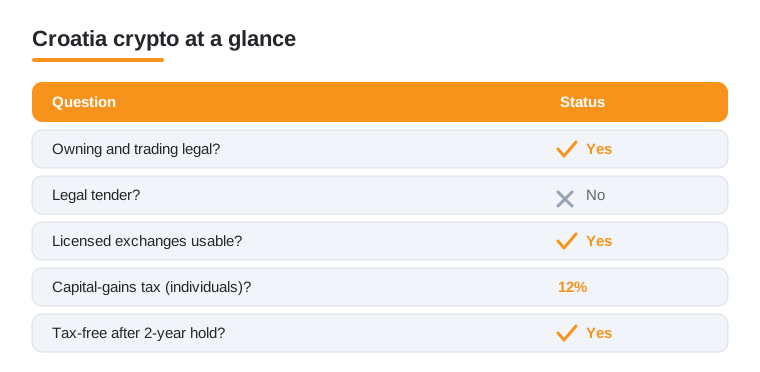
- Yes, owning and trading crypto is legal in Croatia, regulated under the EU's MiCA framework (not legal tender).
- Gains are generally taxed, reportedly at 12 percent, but no tax is due if you hold for more than two years.
- Residents buy euros-in via a HANFA-authorised or MiCA-licensed exchange after completing KYC, using SEPA transfer or card.
Cryptocurrency is legal in Croatia and is now formally regulated as part of the European Union's single rulebook for crypto-assets. Buying, holding, selling and trading Bitcoin and other crypto-assets is permitted for residents and visitors, and a regulated local industry of exchanges and service providers operates under supervision. As an EU member state, Croatia applies the EU's Markets in Crypto-Assets Regulation (MiCA), which has been directly applicable since 30 December 2024.
This page explains, in plain terms, how Bitcoin and crypto are treated in Croatia as of 2026: their legal status, who regulates the sector, the laws that apply, how exchanges are licensed, how crypto is taxed, the anti-money-laundering rules, and how to use crypto in practice. This is general information as of 2026 and is NOT legal, tax, or financial advice; always verify your own situation with the named official Croatian regulators or a qualified professional before acting. For wider context, see our overview of crypto regulation.
On this page: Legal status · Who regulates it · Taxes · How to buy · Mining
Is Bitcoin and crypto legal in Croatia?
Yes. Buying, holding, selling and trading Bitcoin and other crypto-assets is legal in Croatia. There is no ban on individuals owning or transacting in cryptocurrency, and the activity is openly served by licensed exchanges and other providers.
Crypto is not legal tender. The euro became Croatia's official currency on 1 January 2023, and no business is obliged to accept Bitcoin. Some merchants accept crypto voluntarily, usually through a payment processor that converts the amount to euros, but that is a commercial choice rather than a legal requirement.
As an EU member state, Croatia applies the bloc's harmonised crypto rules. The practical effect is that crypto is a legal but regulated asset class, with oversight focused on consumer protection, market integrity and anti-money-laundering controls rather than prohibition. See the broader regulation hub for how other countries compare.
Who regulates crypto in Croatia?
Two authorities share responsibility for crypto oversight in Croatia:
- The Croatian Financial Services Supervisory Agency (HANFA) is the competent authority that authorises and supervises crypto-asset service providers (CASPs), including exchanges, custodians, trading platforms and portfolio managers. HANFA maintains the official register of authorised providers.
- The Croatian National Bank (HNB) oversees issuers of asset-referenced tokens (ARTs) and electronic-money tokens (EMTs), the stablecoin-type instruments covered by MiCA.
HANFA has published consumer guidance making clear that, since MiCA became applicable, entities providing crypto-services and trading crypto-assets fall under its supervision. You can check the authorities directly via the HANFA and Croatian National Bank (HNB) websites.
Key crypto laws and frameworks in Croatia
Croatia's crypto rules are built on the EU's Markets in Crypto-Assets Regulation (MiCA), Regulation (EU) 2023/1114, which has been directly applicable across the EU, including Croatia, since 30 December 2024. MiCA creates a single rulebook for crypto-asset service providers and for issuers of certain tokens, replacing the earlier patchwork of national registrations.
To apply MiCA domestically, the Croatian Parliament adopted a national implementing law in July 2024 (the Act implementing Regulation (EU) 2023/1114), published in the official gazette, Narodne novine. That law designates HANFA as the competent authority for CASPs and tasks the HNB with supervising ART and EMT issuers.
Alongside MiCA, providers must comply with EU anti-money-laundering rules and the Transfer of Funds Regulation (the crypto travel rule), as well as Croatia's own anti-money-laundering legislation. The overall stance is cautious but open: compliance, transparency and consumer safeguards rather than prohibition.
Licensing and registration of exchanges (CASPs)
Firms that exchange crypto for fiat or for other crypto, operate trading platforms, or provide custody generally need authorisation as a crypto-asset service provider (CASP) from HANFA. Applications could be submitted from the start of 2025.
Typical authorisation requirements include:
- A Croatian legal entity with genuine local presence, including at least one director resident in the EU and effective on-site management.
- Fit-and-proper management with appropriate reputation and expertise, plus sound governance and internal controls.
- Minimum capital, custody safeguards, complaints handling and conflict-of-interest rules under MiCA.
- Full anti-money-laundering and know-your-customer procedures.
Transition for legacy providers: firms that were registered as Virtual Asset Service Providers (VASPs) before MiCA applied have until 1 July 2026 to obtain full CASP authorisation. After that deadline, providers without proper authorisation may have to stop offering services. Croatia granted its first full MiCA CASP licence in April 2026 to the Zagreb-based company Electrocoin, which became the first entry in HANFA's official Registry of Companies Authorised to Provide Crypto Asset Services. A Croatian CASP licence can also be passported across the other EU member states. Deadlines and requirements can change, so providers should confirm directly with HANFA.
Crypto and Bitcoin tax in Croatia
Crypto gains in Croatia are generally taxable. The following is a general guide only and not tax advice; confirm your obligations with the Croatian Tax Administration (Porezna uprava) or a qualified adviser.
- Capital gains for individuals: profit from selling or converting crypto to fiat is treated as income from capital. Article 70(4) of the Income Tax Act sets that rate at 12 percent, and the city surtax (prirez) was abolished from 1 January 2024, so the surtax that previously applied no longer does.
- Two-year holding exemption: Article 67(8) of the Income Tax Act exempts capital gains where financial assets are disposed of more than two years after acquisition. The Act does not mention crypto-assets anywhere, so the exemption reaches crypto through the practice of treating it as financial assets rather than through a crypto-specific rule.
- Crypto-to-crypto swaps: exchanging one crypto-asset for another is generally not treated as a taxable disposal. Tax is reported to arise only when crypto is converted to fiat (euros), at which point any gain may be taxable if the two-year holding condition is not met.
- Cost basis: the Income Tax Act (ZPDOH) requires the FIFO (first-in, first-out) method for calculating acquisition cost across multiple trades.
- Filing: crypto income is reported by the end of February for the previous year, using the JOPPD form through the ePorezna portal or in person. Late payment is reported to attract penalties.
- Businesses and miners: companies dealing in crypto, and mining carried out as a business, are generally taxed on profits as business income.
Because rates, thresholds and deadlines change with annual budgets and are sometimes reported inconsistently, treat any figure here as a starting point and confirm current rules with the Croatian Tax Administration (Porezna uprava). Keep detailed records of every purchase, sale, swap, fee and the euro value at the time. See also our general guide to crypto taxes.
AML and KYC rules
Anti-money-laundering (AML) and know-your-customer (KYC) controls are mandatory, not optional, for crypto service providers operating in or into Croatia. Providers must apply customer due diligence, including identity verification, ongoing transaction monitoring and suspicious-activity reporting, in line with EU AML rules and Croatia's national AML legislation.
Under the EU Transfer of Funds Regulation, the so-called crypto travel rule requires providers to collect and share originator and beneficiary information for crypto transfers, mirroring the rules that already apply to bank wires.
Tax transparency is tightening too: EU frameworks such as DAC8 and the OECD Crypto-Asset Reporting Framework (CARF) require platforms to collect and report user and transaction data to tax authorities, with information exchanged between member states. In practice this means a regulated provider will ask for ID and, sometimes, proof of address before you can trade or withdraw.
Buying and using crypto in practice
Buying crypto in Croatia is straightforward. Residents typically use a mix of locally authorised exchanges and brokers that accept euro deposits, large EU and international exchanges that hold or are seeking MiCA authorisation, and payment apps for small amounts.
A careful process looks like this:
- Choose a provider that is authorised under MiCA or listed in HANFA's register. Compare fees, supported assets and euro deposit options.
- Create and verify your account. Set a strong password, enable two-factor authentication, and complete KYC with your ID document.
- Deposit euros by SEPA bank transfer (usually cheaper) or card (usually faster).
- Buy your chosen asset and check the all-in fees before confirming.
- Secure your holdings. For more than small amounts, consider a wallet you control; a hardware wallet offers strong protection. Back up your recovery phrase offline and never share it.
- Keep records of each transaction and its euro value for tax reporting.
Bitcoin ATMs exist in Croatia, mainly around Zagreb, and let you buy with cash or card. Fees are generally higher than on an exchange and identity checks may apply, since ATM operators also have AML obligations.
Bitcoin mining in Croatia
Bitcoin mining is legal in Croatia and is shaped more by energy economics than by any crypto-specific law. There is no dedicated mining licence; miners who operate as a business must register accordingly, pay tax on profits, and meet ordinary requirements around electricity supply, equipment safety and any local permitting.
The main consideration is the cost and source of power. Croatia has notable renewable resources, including hydro, solar and wind, and access to renewable or off-peak power can improve both the economics and the environmental profile of mining. In practice, however, electricity prices across much of Europe are high compared with the cheapest global mining regions, which limits large-scale profitability for most operators.
If you are considering mining, treat it as a business: model your energy costs carefully, account for the taxation of mining income, and confirm any permitting or grid-connection requirements with local authorities and your electricity supplier.
Recent developments (2025-2026)
The past two years have brought Croatia from a light-touch VASP registration regime to a full MiCA framework:
- July 2024: Croatia adopted its national law implementing MiCA, naming HANFA and the HNB as the competent authorities.
- 30 December 2024: MiCA became directly applicable in Croatia, alongside the rest of the EU.
- From 1 January 2025: firms could begin submitting CASP authorisation applications to HANFA.
- April 2026: HANFA granted Croatia's first full MiCA CASP licence to the Zagreb-based company Electrocoin, which can now legally provide fiat-to-crypto and crypto-to-crypto exchange, custody and portfolio management.
- 1 July 2026: the end of the transitional period. Legacy VASPs registered before MiCA applied may keep providing their existing services until this date, but must hold a full CASP authorisation to continue past it; those without one have to stop.
The direction of travel is consolidation: a clearer split between authorised providers and those that exit the market, stronger disclosure, and continued emphasis on AML and tax transparency.
Consumer risks and protection
Regulation reduces some risks but cannot eliminate them. The main risks for crypto users in Croatia are the same as elsewhere: price volatility, the irreversibility of transactions, scams and phishing, exchange or custodian failure, and loss of private keys.
Practical protections:
- Prefer a HANFA-authorised or MiCA-licensed provider, which is subject to capital, governance and consumer-protection requirements. This does not remove market risk, but it reduces counterparty risk.
- Ignore unsolicited investment offers, fake support staff and anyone promising guaranteed returns. A legitimate provider will never ask for your recovery phrase or remote access to your device.
- Only invest money you can afford to lose, and be prepared for sharp price swings.
- Factor in tax and keep good records.
This page does not give investment advice or price predictions. If you are unsure, speak to an independent, qualified adviser who understands both crypto and Croatian tax rules.
Official sources and how to verify
Because the rules and tax treatment can change, treat any specific figure, deadline or requirement you read online, including on this page, as a starting point to be confirmed with the authorities themselves. The primary official sources are:
- Regulator (CASPs): Croatian Financial Services Supervisory Agency (HANFA), where you can check authorised providers and consumer notices.
- Central bank (token issuers): Croatian National Bank (HNB) MiCA page.
- Tax: Croatian Tax Administration (Porezna uprava).
This article is general information as of 2026 and is NOT legal, tax, or financial advice. Always verify your own situation with HANFA, the HNB, or the Croatian Tax Administration, or with a qualified Croatian professional, before acting.
What changed on 1 July 2026
The transitional period that let firms registered before MiCA keep operating in Croatia ended on 1 July 2026. The deadline is not merely administrative practice: Article 65 of the Croatian implementing act required any provider on the virtual asset service provider register kept under Article 9a of the Anti-Money Laundering Act to obtain authorisation by 1 July 2026 at the latest, in line with Article 143(3) of MiCA. From that date a company may lawfully provide crypto-asset services in Croatia only if it holds a crypto-asset service provider (CASP) authorisation from Hanfa and is entered in Hanfa's register, or is authorised in another EU member state. Hanfa set this out in its announcement of 3 July 2026.
In that announcement Hanfa said five of the seventeen firms previously registered as virtual asset service providers began the authorisation process in time and obtained a licence before the transitional period ended. The remaining firms had to inform clients that services had ceased and, where they held client funds and crypto-assets, return those assets in accordance with client instructions. Hanfa noted that these providers may apply for MiCA authorisation at any time. If you held an account with a Croatian provider that did not obtain a licence, the expected outcome is asset return, not continuity of service.
Enforcement followed within weeks. On 29 July 2026 Hanfa ordered Fima Plus d.o.o., based in Varaždin, to immediately cease the unauthorised provision of crypto-asset services, specifically the execution of orders for crypto-assets on behalf of clients and the provision of custody services, to return client assets, and to inform clients of the measures imposed and the arrangements for return. Hanfa's supervision covered 1 July 2025 to 23 January 2026. It found the company had received client funds into its own bank account and transferred them to a foreign trading platform, and had held clients' crypto-assets and funds in accounts opened in the company's own name.
The named Croatian laws and rulebooks
Croatia has a crypto-specific statute, and it has a name. It is the Zakon o provedbi Uredbe (EU) 2023/1114 o tržištima kriptoimovine, the Act on the implementation of Regulation (EU) 2023/1114 on markets in crypto-assets. It was passed by the Croatian Parliament on 12 July 2024, published in Narodne novine 85/2024 on 19 July 2024, and under Article 67 entered into force on the eighth day after publication. It does not rewrite MiCA, which applies directly. It designates the supervisors, provides in Article 54 for supervision fees payable to Hanfa and the Croatian National Bank, and sets the penalty regime.
On penalties, Article 58(1)(1) covers providing crypto-asset services in Croatia contrary to Article 59(1) of MiCA, with a fine for a legal person of up to EUR 5,000,000 that may not be less than 1 percent nor more than 5 percent of total net revenue. The same EUR 5,000,000 ceiling applies to offeror breaches under Article 57 and market abuse under Article 59. The ceilings are not uniform across the act: breaches of the asset-referenced token and e-money token rules under Articles 63 and 64 run up to 12.5 percent of total revenue.
Hanfa then built out the detail in nine ordinances published between June 2025 and January 2026, listed on its crypto-asset market regulation page.
| Instrument | Reference | What it covers |
|---|---|---|
| Zakon o provedbi Uredbe (EU) 2023/1114 o tržištima kriptoimovine | Narodne novine 85/2024, passed 12 July 2024 | Designates Hanfa for MiCA Titles II, V and VI (offers of crypto-assets other than asset-referenced and e-money tokens, service providers, market abuse) and the HNB for Titles III and IV (asset-referenced tokens, e-money tokens). Supervision fees and the penalty regime. |
| Pravilnik o izdavanju odobrenja za rad pružatelju usluga povezanih s kriptoimovinom | Narodne novine 95/2025, adopted 26 June 2025 | What a licence application must contain. Article 3(1) requires the form in the Annex to Commission Implementing Regulation (EU) 2025/306, plus documentation under this ordinance and Commission Delegated Regulation (EU) 2025/305. Also qualifying holdings and prior consent for board members. |
| Pravilnik o bonitetnim zahtjevima pružatelja usluga povezanih s kriptoimovinom | Narodne novine 153/2025 | Prudential requirements under Article 67 of MiCA, with companion ordinances in the same issue on supervisory reports and on the structure and content of financial statements. |
| Pravilnik o zaštiti imovine klijenata pružatelja usluga povezanih s kriptoimovinom | Narodne novine 157/2025 | Safeguarding of client assets, with a companion ordinance on the content of the provider's audit. |
| Pravilnik o provođenju tajnog nadzora and the complaints ordinance | Narodne novine 129/2025 | Hanfa's covert supervision of crypto-asset service provision, and the procedure for complaints against crypto-asset offerors and providers. |
| Pravilnik o kvalifikacijama i kadrovskim uvjetima te obrazovnom programu i ispitima | Narodne novine 10/2026 | Qualification and staffing conditions, the education programme and the examinations for crypto-asset service provider staff. |
| Zakon o sprječavanju pranja novca i financiranja terorizma | Narodne novine 108/17, 39/19, 151/22 | The general AML act, in force since 1 January 2018. Its Article 9a register of virtual asset service providers is the register the MiCA transitional regime was built on. |
The Croatian National Bank's own MiCA page confirms the EU timeline behind all of this: the Regulation entered into force on 29 June 2023, the e-money token and asset-referenced token provisions applied from 30 June 2024, and the crypto-asset services provisions from 30 December 2024.
Which firms actually hold a Croatian crypto licence
Hanfa publishes a Register of entities authorised to provide crypto-asset services. At the time of this check it listed four firms entered in the register:
- Bitblock d.o.o.
- DIGITAL ASSETS d.o.o. za posredovanje i usluge
- ELECTROCOIN d.o.o. za usluge
- WHITE TECH d.o.o. za usluge
A fifth company, IN KAPITAL d.o.o., was authorised on 17 June 2026 and is awaiting confirmation of registration in the Court Register before it is entered in the register. Hanfa's Board announcement of 17 June 2026 records the decisions granting authorisation to Bitblock d.o.o. and IN KAPITAL d.o.o. as crypto-asset service providers under MiCA. Four entered in the register plus one awaiting court registration is what makes up the five licensed firms Hanfa referred to on 3 July 2026.
Croatian residents are not limited to these firms. Hanfa also maintains a list of entities from other EU member states authorised to provide crypto-asset services. Under MiCA a licence granted in any member state can be passported, so most large European exchanges reach Croatian users through an authorisation held elsewhere in the EU rather than a Croatian one. Before depositing, check the provider against one of these Hanfa registers or the ESMA register.
What is coming next, and when
The change that reaches ordinary holders first is tax reporting, and it has already started. Croatia transposed DAC8, Council Directive (EU) 2023/2226, through the Zakon o izmjenama i dopunama Zakona o administrativnoj suradnji u području poreza published in Narodne novine 146/25 on 3 December 2025, with an implementing ordinance in Narodne novine 158/25 on 31 December 2025. Both appear among Croatia's communicated measures in the EUR-Lex national transposition record, ahead of the 31 December 2025 deadline shown there.
The directive provides that the first information is communicated for the relevant calendar year as from 1 January 2026, so 2026 is the first reporting period, and that tax authorities exchange the data within nine months following the end of the calendar year to which it relates. Reporting providers must collect and report, for each reportable user, name, address, residence for tax purposes, tax identification number and date and place of birth, together with per-asset aggregate acquisitions and disposals, crypto-to-crypto exchanges and transfers. That includes the aggregate value and number of units of transfers made to distributed ledger addresses not known to be associated with a virtual asset service provider or financial institution. In practice, a Croatian resident should assume the Tax Administration will see their 2026 activity at any licensed EU exchange.
Beyond the EU, the Croatian Tax Administration confirms that Croatia joined 47 other countries and jurisdictions in a joint statement on the OECD Crypto-Asset Reporting Framework on 10 November 2023. It describes this expressly as a political obligation and not a legal one, and points to the start of exchange in 2027 at global level. No Croatian implementing legislation for CARF was found.
The one clearly unfinished item is anti-money laundering. EUR-Lex records zero national transposition measures communicated by Croatia for Directive (EU) 2024/1640, against a deadline of 10 July 2025 shown for most member states. So amendments to the Croatian AML framework are still to come, and no published bill was found at the Ministry of Finance or Hanfa. The accompanying Regulation (EU) 2024/1624 was adopted on 31 May 2024 and is already in force, but under its Article 90 it applies only from 10 July 2027. It extends AML obligations directly to crypto-asset service providers, requires transactions with self-hosted addresses to be taken into account in risk assessment, requires providers to ensure their accounts are not used by nested exchanges, and sets a Union-wide limit on cash payments above EUR 10,000. For crypto users the threshold that matters is the EUR 1,000 occasional transaction level at which providers must apply customer due diligence. The EU Anti-Money Laundering Authority states that it and national supervisors will select and directly supervise some of the EU's most significant cross-border financial institutions from 2028.
No Croatian crypto-specific bill and no draft crypto tax measure were found in progress at the Ministry of Finance or in Hanfa's published material at the time of this check.
Frequently asked questions
Is cryptocurrency legal in Croatia?
Yes. It is legal to buy, hold, sell and trade Bitcoin and other crypto-assets in Croatia. Crypto is not legal tender, however, so no merchant is required to accept it. As an EU member state, Croatia regulates crypto under the EU's MiCA framework rather than banning it.
Who regulates crypto in Croatia?
The Croatian Financial Services Supervisory Agency (HANFA) is the competent authority that authorises and supervises crypto-asset service providers (CASPs) such as exchanges and custodians under MiCA. The Croatian National Bank (HNB) supervises issuers of asset-referenced tokens and e-money tokens.
Do exchanges need a licence in Croatia?
Yes. Exchanges and other crypto-asset service providers generally need a CASP authorisation from HANFA. Firms that were previously registered as Virtual Asset Service Providers have until 1 July 2026 to obtain full authorisation. Croatia granted its first MiCA CASP licence, to Electrocoin, in April 2026.
How is crypto taxed in Croatia?
Crypto profits for individuals are generally treated as income from capital, reportedly taxed at 12 percent, with the city surtax abolished from 2024. Reporting indicates no tax is due if you hold the asset for more than two years. Rates and rules change, so confirm with the Croatian Tax Administration (Porezna uprava) or a qualified tax adviser.
Are there KYC and AML rules for crypto in Croatia?
Yes. Crypto service providers must apply anti-money-laundering and know-your-customer checks, including identity verification, transaction monitoring and suspicious-activity reporting, in line with EU AML rules and the crypto travel rule. New EU tax-reporting standards (DAC8 and CARF) also require platforms to report user and transaction data to tax authorities.
Is Bitcoin mining allowed in Croatia?
Yes, mining is legal. There is no special mining licence, but if you mine as a business you must register, pay tax on profits, and meet normal electricity, safety and permitting requirements. Profitability depends heavily on energy costs, which are relatively high across much of Europe.
When do I have to report crypto gains in Croatia?
Crypto income for individuals is reported by the end of February for the previous year, using the JOPPD form through the ePorezna portal or in person. The Income Tax Act requires the FIFO (first-in, first-out) method to calculate acquisition cost. Rates and deadlines can change, so confirm with the Croatian Tax Administration (Porezna uprava) or a qualified adviser.
Is swapping one crypto for another taxed in Croatia?
Reporting indicates that exchanging one crypto-asset for another is generally not treated as a taxable disposal in Croatia. Tax is reported to arise when crypto is converted to euros or other fiat, and even then no tax is due if you held the asset for more than two years. Because tax treatment can change and is sometimes reported inconsistently, confirm your own situation with the Croatian Tax Administration or a qualified tax adviser.
What is the Croatian crypto law called?
Zakon o provedbi Uredbe (EU) 2023/1114 o tržištima kriptoimovine, the Act implementing Regulation (EU) 2023/1114 on markets in crypto-assets. It was passed by the Croatian Parliament on 12 July 2024, published in Narodne novine 85/2024 on 19 July 2024, and entered into force on the eighth day after publication. It designates Hanfa as supervisor for crypto-asset service providers, for offers of crypto-assets other than asset-referenced and e-money tokens, and for market abuse, and the Croatian National Bank for issuers of asset-referenced and e-money tokens.
What happened on 1 July 2026 in Croatia?
The MiCA transitional period ended. Article 65 of the Croatian implementing act required firms on the virtual asset service provider register to obtain authorisation by 1 July 2026 at the latest. Hanfa said on 3 July 2026 that five of the seventeen previously registered firms had obtained a licence in time and that the rest had to inform clients that services had ceased and return client funds and crypto-assets in accordance with client instructions. They may apply for authorisation again at any time.
Which crypto companies are licensed in Croatia?
Hanfa's register of entities authorised to provide crypto-asset services listed Bitblock d.o.o., DIGITAL ASSETS d.o.o., ELECTROCOIN d.o.o. and WHITE TECH d.o.o. A fifth firm, IN KAPITAL d.o.o., was authorised on 17 June 2026 and is awaiting confirmation of registration in the Court Register before entry in the register. Croatian users can also use providers authorised in other EU member states, which Hanfa publishes as a separate list.
Will the Croatian Tax Administration find out about my crypto?
Increasingly, yes. Croatia transposed DAC8 through an amending act published in Narodne novine 146/25 on 3 December 2025 and an ordinance in Narodne novine 158/25 on 31 December 2025. The first information is reported for the calendar year starting 1 January 2026, so 2026 is the first reporting period. Providers report user identity data and per-asset acquisitions, disposals, swaps and transfers, and tax authorities exchange it within nine months after the end of the calendar year. Croatia has also made a political commitment to the OECD CARF, with exchange starting in 2027 globally, though no Croatian CARF legislation was found.
What are the penalties for running a crypto business in Croatia without a licence?
Under Article 58 of the implementing act in Narodne novine 85/2024, a legal person providing crypto-asset services contrary to Article 59(1) of MiCA faces a fine of up to EUR 5,000,000, which may not be less than 1 percent nor more than 5 percent of total net revenue. Hanfa can also order a firm to cease immediately and return client assets, as it did on 29 July 2026 against Fima Plus d.o.o. of Varaždin.
Is anti-money laundering law in Croatia finished, or is more coming?
More is coming. The general act is the Zakon o sprječavanju pranja novca i financiranja terorizma, Narodne novine 108/17, 39/19 and 151/22, in force since 1 January 2018. At the time of this check, EUR-Lex recorded no Croatian transposition measures for Directive (EU) 2024/1640, against a deadline of 10 July 2025, so Croatian AML amendments are still outstanding. The accompanying EU AML Regulation is in force but only applies from 10 July 2027, and the EU AML Authority says direct supervision of major cross-border institutions begins in 2028.
Facts reviewed: 12 August 2026. Page updated: 12 August 2026.