Home › Crypto Regulation › North Macedonia
Bitcoin & Cryptocurrency Regulation in North Macedonia
Quick answer — North Macedonia, 2026
- Legal: Legal to own and use, not legal tender, no dedicated crypto law yet
- Tax: Personal income and capital gains taxed at flat 10 percent, no crypto-specific guidance
- Buying: Via international exchanges, P2P and Bitcoin ATMs with KYC
North Macedonia sits in a familiar position for the Western Balkans: cryptocurrency is not banned, but it has long operated in a legal grey zone without a single dedicated law. Residents can buy, hold, trade and use Bitcoin and other digital assets, yet none are recognised as legal tender or official currency. The Macedonian denar (MKD) remains the only legal tender. The first concrete rules arrived through anti-money-laundering legislation rather than a standalone crypto act, and the country, as an EU accession candidate, is gradually moving its financial rules toward European standards.
This page explains, in plain language, the current legal status of crypto in North Macedonia, who the regulators are, how tax and exchanges work in practice, and the outlook through 2026. It is general information as of 2026 and is not legal, tax or financial advice; the rules here are evolving quickly, so always verify the latest position with the named official Macedonian sources before acting. For wider context see our guide to crypto regulation and our country regulation hub.
On this page: Legal status · Who regulates it · Taxes · How to buy · Mining
Is Bitcoin and crypto legal in North Macedonia?
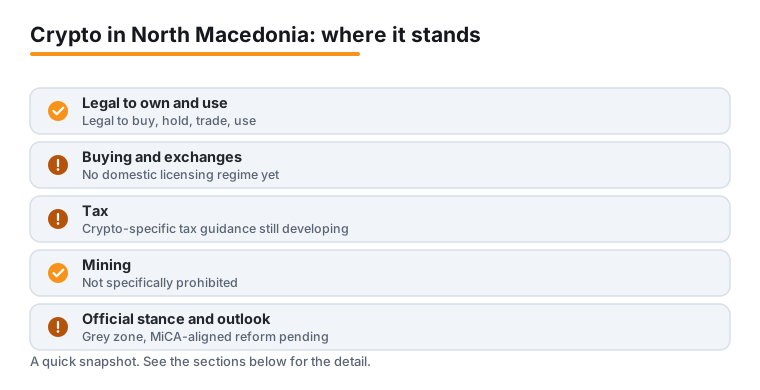
Yes, owning and using Bitcoin and other cryptocurrencies is legal in North Macedonia. No law prohibits individuals or businesses from buying, holding, trading or accepting digital assets. At the same time, no cryptocurrency is legal tender, and the Macedonian denar (MKD) remains the only official currency. Crypto is therefore best understood as a permitted but lightly regulated asset rather than a recognised form of money.
With no comprehensive crypto statute yet in force, activity falls under a patchwork of existing rules: anti-money-laundering law, general financial and consumer-protection principles, tax law and foreign-exchange rules. The practical takeaway is that you are free to participate but carry the responsibility for compliance, record-keeping and financial risk yourself, with no deposit-style protection scheme covering crypto holdings.
Who regulates crypto in North Macedonia?
There is no single dedicated crypto regulator. Instead, several authorities touch the sector under their existing mandates:
- National Bank of the Republic of North Macedonia (NBRNM) is the central bank and monetary authority. It supervises banks, payment service providers and exchange offices, and has publicly cautioned that crypto-assets are volatile, speculative and not issued or backed by the state. See National Bank of the Republic of North Macedonia.
- Financial Intelligence Office is the country's financial intelligence unit, an administrative body within the Ministry of Finance and a member of the Egmont Group. It oversees anti-money-laundering compliance and receives reports of suspicious transactions. See the Financial Intelligence Office.
- Securities and Exchange Commission of the Republic of North Macedonia regulates the securities market and would have a role where a token is structured like a regulated financial instrument. See the Securities and Exchange Commission.
- Public Revenue Office (UJP) administers taxes that may apply to crypto gains and income.
- Ministry of Finance leads policy and draft legislation, including any future crypto framework. See the Ministry of Finance.
Key laws and frameworks
North Macedonia does not yet have a single dedicated cryptocurrency law. The most important rules to date come through its anti-money-laundering and counter-terrorism-financing (AML/CTF) framework. The Law on Prevention of Money Laundering and Financing of Terrorism was amended in July 2022 to introduce the concept of "virtual assets" and to bring virtual-asset service providers within the scope of customer due diligence, identity verification and transaction monitoring, broadly tracking the EU AML directives and FATF standards.
Beyond AML, crypto activity is shaped by general tax law, foreign-exchange and capital-account rules administered by the central bank, securities law where a token behaves like a financial instrument, and ordinary consumer-protection and contract law. The EU's Markets in Crypto-Assets Regulation (MiCA) applies directly to EU and EEA states; it does not bind North Macedonia unless and until it is transposed into national law, though it is the model the country is widely reported to be following. Treat the legal framework as a work in progress and confirm specifics with the regulators above. For a primer on how these regimes fit together, see our crypto regulation guide.
Licensing and registration of exchanges and VASPs
As of 2026, North Macedonia has not yet introduced a comprehensive domestic licensing regime specifically for crypto exchanges and virtual-asset service providers (VASPs). The clearest obligations to date are the AML/CTF duties that apply to entities handling virtual assets: customer identification (KYC), ongoing monitoring and reporting of suspicious activity to the Financial Intelligence Office.
Because there is no local licensing framework yet, most platforms used by Macedonians are based abroad. The government and Ministry of Finance have signalled plans to introduce a dedicated licensing regime for exchanges and other VASPs, expected to be aligned with the EU's MiCA framework, with the first licences anticipated during 2026. These are proposals and draft measures rather than settled law, so the registration and licensing requirements that ultimately apply may differ. Anyone planning to operate a crypto business should verify the current status directly with the Ministry of Finance and the central bank before relying on any timeline.
Crypto and Bitcoin tax in North Macedonia
North Macedonia taxes personal income and capital gains under its Personal Income Tax framework. Since 1 January 2023 it has applied a flat 10 percent rate to most categories of personal income, including income from capital and capital gains, with the same 10 percent rate still in force in 2025 according to published tax summaries. In principle, a gain realised when you dispose of crypto, as well as crypto-related earnings such as mining or service income, can fall within the tax net rather than being automatically tax-free.
North Macedonia does not yet publish crypto-specific tax guidance, so there is no separate crypto tax rate or a stated allowance for digital assets. The general capital-gains rules provide context: for certain securities and investment-fund shares the taxable base is set at 90 percent of the realised gain, and a 0 percent rate can apply where those securities have been held for more than two years, but it is not confirmed that crypto is treated the same way as listed securities. Because of that uncertainty, do not assume any specific exemption applies to crypto without checking with the Public Revenue Office.
Dedicated crypto-specific tax guidance is still developing, and the precise treatment depends on facts such as whether you are an occasional investor or trading as a business. This page therefore avoids stating a definitive rate or threshold for your circumstances. Keep detailed records of every transaction (dates, amounts and denar values), distinguish personal investing from business activity, and confirm current rates and filing obligations with the Public Revenue Office or a qualified Macedonian tax adviser. For background on common approaches, see our guide to crypto taxes. This is general information, not tax advice.
AML and KYC rules
Anti-money-laundering and counter-terrorism-financing rules are the most developed part of North Macedonia's crypto regime. Under the Law on Prevention of Money Laundering and Financing of Terrorism and its amendments covering virtual assets, providers that deal in crypto are expected to identify and verify customers, apply risk-based due diligence, monitor transactions on an ongoing basis, and report suspicious activity to the Financial Intelligence Office, the country's financial intelligence unit.
In practice this means reputable exchanges and Bitcoin ATMs require government-issued identification before you can transact, and anonymous use is not the norm. North Macedonia's AML framework is periodically assessed by MONEYVAL, the Council of Europe's evaluation body, which influences the direction of reform. MONEYVAL carried out its most recent on-site mutual evaluation in autumn 2022 and published the resulting report in 2023; it noted at the time that entry requirements for virtual-asset service providers were still absent, which is one gap the planned licensing regime is meant to close. You can confirm current obligations with the Financial Intelligence Office.
Buying and using crypto in practice
There is no prohibition on buying crypto in North Macedonia, and residents commonly use a mix of international exchanges, peer-to-peer platforms and crypto ATMs. Because the country has not yet introduced a domestic licensing regime, most large platforms used by Macedonians are based abroad, which makes choosing a reputable, well-established provider especially important.
Expect identity verification (KYC) in practice: compliant platforms and local ATMs require proof of identity, and providers are subject to AML/CTF obligations. Funding typically happens via bank transfer or card in euros (EUR) or denar (MKD), subject to your bank's policies, which can include declining or flagging crypto payments. Foreign-exchange and cross-border capital rules administered by the central bank also apply when moving money in and out of the country, so larger transfers may attract bank questions. Prioritise platforms with strong security, transparent fees and clear withdrawal terms, and be cautious with unlicensed or anonymous services.
Bitcoin ATMs in North Macedonia
North Macedonia has a small number of Bitcoin ATMs, concentrated mainly in the capital, Skopje, including inside shopping centres. These machines let you buy popular crypto-assets with cash and, in some cases, sell crypto for cash, with supported assets typically including Bitcoin plus a handful of other major coins and stablecoins priced in euros or denar.
- ID is required. Expect to scan an identity document; anonymous use is not the norm under AML rules.
- Limits apply. Operators usually set per-transaction and daily caps; exceeding them may require extra verification.
- Fees are higher. ATM convenience generally comes with a wider spread than online exchanges, so compare costs for larger amounts.
- Have a wallet ready. You normally need your own wallet address (QR code) to receive purchased coins.
Availability and operators change over time, so verify a machine's current status and supported coins before relying on it.
Bitcoin mining in North Macedonia
Bitcoin mining is not specifically prohibited in North Macedonia, and individuals or businesses can in principle operate mining hardware. The decisive factors are practical and economic rather than any ban: electricity cost and availability, equipment expense, heat and noise, and the tax treatment of income produced.
Energy is the central consideration. The country's power mix and grid capacity, combined with periods of higher regional electricity prices, mean profitability is sensitive to tariffs and to whether you can access cheaper or renewable generation such as hydropower or solar. Larger operations also need to consider business registration, commercial electricity contracts and any environmental requirements for industrial energy use. Mining proceeds are likely treated as taxable income, so keep records, confirm obligations with the Public Revenue Office, and model electricity costs carefully before committing.
Recent developments and outlook for 2026
The defining trend is the move from an informal grey zone toward a structured, EU-aligned framework. North Macedonia is an EU accession candidate, and the government has signalled plans to introduce a dedicated licensing regime for crypto exchanges and VASPs, expected to be modelled on the EU's MiCA regulation, alongside stricter AML expectations consistent with FATF standards and clearer tax guidance. Reporting through 2025 and into 2026 points to draft measures and the first licences potentially arriving during 2026.
Importantly, these remain proposals and works in progress until formally enacted, and timelines for legislation in the region can slip. Until a dedicated law is in force, the existing AML/CTF framework, tax law, securities law and foreign-exchange rules continue to govern crypto activity. Treat reform announcements as evolving rather than settled, and check the Ministry of Finance and the central bank for the current position.
Consumer risks and protection
The headline risk in North Macedonia is regulatory uncertainty. With no comprehensive crypto law yet in force, users have limited formal recourse, and the rules can shift as the country drafts EU-aligned legislation. Crypto-assets are also highly volatile, can fall sharply, and are not covered by any state-backed deposit or investor protection scheme. Reliance on foreign platforms adds counterparty and custody risk, and converting between crypto and denar can involve friction and cautious banking attitudes.
The central bank has warned about the speculative nature of crypto-assets and the prevalence of fraud. Practical protection comes down to self-defence: use reputable, well-established providers; secure your assets with strong passwords, two-factor authentication and, for larger amounts, a hardware wallet you control; be sceptical of guaranteed-return schemes and unsolicited offers, which are common vehicles for scams; and keep detailed records. Treat crypto as high-risk capital you can afford to lose.
Official sources and how to verify
Because the framework is evolving, always confirm the current position with primary official sources rather than secondary summaries:
- National Bank of the Republic of North Macedonia for monetary policy, payment and foreign-exchange rules, and crypto risk warnings.
- Financial Intelligence Office for AML/CTF obligations and virtual-asset compliance.
- Securities and Exchange Commission of the Republic of North Macedonia for securities-law questions.
- Ministry of Finance for tax policy and forthcoming crypto legislation.
This article is general information as of 2026 and is not legal, tax or financial advice. Crypto rules in North Macedonia are changing, so before acting you should verify the latest position with the named official regulators above, in particular the National Bank of the Republic of North Macedonia, or consult a qualified Macedonian professional. See also our regulation hub for other countries.
Frequently asked questions
Is cryptocurrency legal in North Macedonia?
Yes. Buying, holding, trading and using crypto is legal, and there is no ban on it. However, no cryptocurrency is recognised as legal tender or official currency (the denar is the only legal tender), and the sector is not yet governed by a dedicated comprehensive law, so you participate at your own risk and responsibility.
Who regulates crypto in North Macedonia?
There is no single dedicated crypto regulator. The National Bank of the Republic of North Macedonia (the central bank) oversees monetary, payment and foreign-exchange matters and issues risk warnings; the Financial Intelligence Office handles anti-money-laundering supervision; the Securities and Exchange Commission covers securities-like tokens; and the Public Revenue Office administers tax. The Ministry of Finance leads any future crypto legislation.
Do I have to pay tax on crypto in North Macedonia?
Crypto gains and income can fall within North Macedonia's personal income and capital-gains tax framework, so they are not automatically tax-free. Personal income, including income from capital and capital gains, is taxed at a flat 10 percent rate that has applied since 1 January 2023 and remains in force in 2025. There is no crypto-specific guidance yet, so how crypto is classified in practice can depend on your circumstances; confirm current rates and filing obligations with the Public Revenue Office or a qualified tax adviser. This is general information, not tax advice.
When did North Macedonia start regulating virtual assets?
The first concrete rules came in July 2022, when the Law on Prevention of Money Laundering and Financing of Terrorism was amended to define "virtual assets" and place virtual-asset service providers under customer due diligence, identity verification and transaction-monitoring duties. There is still no single dedicated crypto law; a MiCA-aligned licensing regime has been signalled for 2026 but is not yet enacted.
Can I buy Bitcoin with cash at an ATM in North Macedonia?
Yes, a small number of Bitcoin ATMs operate, mainly in Skopje, and some let you buy with cash. Under the anti-money-laundering rules you should expect to show an identity document, and per-transaction and daily limits are common. ATM fees are usually higher than online exchanges, so compare costs for larger amounts, and check a machine's current status and supported coins before relying on it.
Do crypto exchanges need a licence in North Macedonia?
As of 2026 there is no comprehensive domestic licensing regime specifically for crypto exchanges and VASPs. The clearest obligations are the AML/CTF duties (KYC and suspicious-transaction reporting) under the money-laundering law. The government has signalled plans to introduce a MiCA-aligned licensing regime, with the first licences anticipated during 2026, but this remains a proposal until enacted. Verify the current status with the Ministry of Finance.
Will North Macedonia adopt EU-style crypto rules like MiCA?
As an EU accession candidate, North Macedonia is reported to be working toward legislation aligned with EU standards, including the MiCA framework, with signalled plans for exchange licensing and clearer tax guidance. These are proposals in progress; MiCA does not directly apply until transposed into national law, so treat timelines as evolving and verify status with official sources.
Is crypto mining allowed in North Macedonia?
Mining is not specifically banned, so it is generally permissible. The main constraints are practical, chiefly electricity cost and availability, plus the fact that mining income is likely taxable. Anyone planning a larger operation should account for energy contracts, business registration and local legal and tax advice.
Facts reviewed: 30 June 2026. Page updated: 3 August 2026.