Home › Crypto Regulation › Kosovo
Bitcoin and Cryptocurrency Regulation in Kosovo
Quick answer — Kosovo, 2026
- Legal: Legal to own and trade, not legal tender
- Tax: Gains taxed as capital gains at standard 10 percent rate
- Buying: International exchanges in practice; one CBK-licensed operator so far
Kosovo has moved in a short space of time from having almost no crypto rules to building a dedicated legal framework. For years, owning and trading Bitcoin was legal but largely unregulated, and the country drew headlines in 2022 when it banned crypto mining during an energy crisis. That picture changed when Kosovo adopted a specific Law on Crypto-Assets in late 2024 and the Central Bank followed with a licensing regulation in 2025. The headline for residents and the country's large diaspora is straightforward: owning, buying, and selling crypto-assets such as Bitcoin is legal in Kosovo, but it is not legal tender and the business side is now being brought under formal supervision.
This guide explains the current state of cryptocurrency regulation in Kosovo, covering legal status, the authorities involved, the key law and the new licensing regulation, how exchanges and crypto ATMs are treated, taxation, anti-money-laundering rules, mining, and how people buy and use crypto in practice. It is general information as of 2026 and is not legal, tax, or financial advice; because the framework is new and still being implemented, always verify specifics with the named official regulator, the Central Bank of the Republic of Kosovo, or a qualified Kosovo professional before acting. For wider context see our guide to crypto regulation and the country regulation hub.
On this page: Legal status · Who regulates it · Taxes · How to buy · Mining
Legal status of Bitcoin and crypto in Kosovo
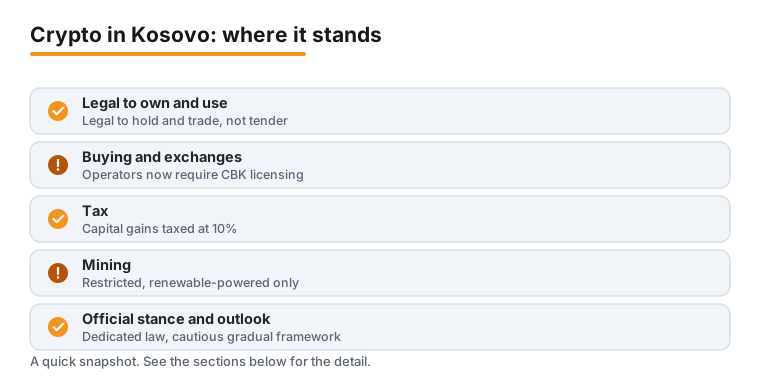
Crypto is legal to hold and trade in Kosovo. There is no prohibition on owning, buying, selling, or transferring Bitcoin and other crypto-assets, and individuals may keep coins in self-custody wallets and use international platforms. With the adoption of a dedicated Law on Crypto-Assets, the country has shifted from a legal vacuum toward a supervised framework, although the consumer-facing market is still small.
What crypto is not is legal tender. Kosovo uses the euro as its official currency, even though it is not a member of the eurozone, and crypto-assets are not money issued or guaranteed by the Central Bank. Merchants are under no obligation to accept crypto, and everyday acceptance for goods and services is rare. The Central Bank has also warned that virtual currencies are not regulated like bank money and that no institution in Kosovo guarantees the reimbursement of funds lost through them. So while holding and trading are lawful, treating Bitcoin as money carries no consumer-protection guarantee if something goes wrong.
The regulator: the Central Bank of Kosovo (CBK)
The principal authority for crypto in Kosovo is the Central Bank of the Republic of Kosovo (CBK), known in Albanian as Banka Qendrore e Republikes se Kosoves (BQK). The CBK is the sole authority responsible for licensing and supervising crypto-asset service operators, and it issues public warnings about the risks of virtual currencies. Its official site is bqk-kos.org.
Two other institutions share responsibility under the framework. The Tax Administration of Kosovo (TAK / ATK) handles the tax treatment of crypto income and gains, and the Financial Intelligence Unit (FIU) oversees anti-money-laundering and counter-terrorist-financing matters and suspicious-transaction reporting. In practice this means the CBK is the body to approach about licensing a crypto business, while tax and AML obligations are administered by the Tax Administration and the FIU respectively. The CBK has described its approach as cautious and gradual, consistent with European practice.
Key law and frameworks
The cornerstone of Kosovo's framework is Law No. 08/L-295 on Crypto-Assets, adopted by the Assembly of Kosovo on 22 November 2024. The law regulates the licensing, authorisation, and supervision of operators involved in the issuance, distribution, trading, and custody of crypto-assets, and it places these activities under the supervision of the Central Bank together with the Tax Administration and the Financial Intelligence Unit. Reporting describes the law as partially aligned with the European Union's Markets in Crypto-Assets regulation, Regulation (EU) 2023/1114, commonly known as MiCA.
Among its provisions, the law introduces licensing and authorisation requirements for operators, measures to prevent market abuse, explicit prohibitions on money laundering and the financing of terrorism, a white-paper requirement for the issuance of digital tokens, and restrictions on crypto-mining. Because Kosovo is an aspiring European Union member, the broad direction is alignment with EU standards over time. The exact wording and scope of specific provisions should be confirmed against the official text rather than summaries; the CBK is the authoritative source for the current framework.
Licensing and registration of exchanges and VASPs
The detail of how crypto businesses are licensed comes from the Regulation on the Licensing of Crypto-Asset Service Operators, adopted by the CBK board on 29 August 2025 under Law No. 08/L-295. The CBK is the sole authority for licensing crypto-asset service operators (often abbreviated CASO) to carry out two activities: the exchange of crypto-assets for cash, which expressly includes crypto ATMs, and the exchange of crypto-assets for other crypto-assets.
The requirements come from the regulation itself. Article 9 sets minimum capital of 125,000 euros, required both for licensing and for maintenance, paid in cash so as to be immediately available to absorb losses and accompanied by information on the source of the capital and a bank document certifying payment, plus an additional fund for initial expenses of at least 20% of that amount, which applies only to initial licence applications. Sources of capital must be legal and must not derive from debts or loans. Governance requirements include a board of at least three members, a majority of whom are independent and non-executive, with directors holding a relevant university degree, such as in economics or law, and at least three years of experience in the financial or banking sector, and at least one audit or risk-management committee. Significant shareholders, reported as those holding 10% or more, must have clean records with no convictions linked to money laundering, terrorist financing, or responsibility for a business bankruptcy. Operators must have an internal control and risk-management plan covering anti-money-laundering and counter-terrorist-financing measures, and significant shareholders must have clean records. Article 4 of the regulation provides that financial institutions and their subsidiaries are not permitted to engage in the provision of crypto-asset services unless regulated by the CBK. Anyone intending to operate, or wanting to confirm whether a platform is locally licensed, should check directly with the CBK rather than assume a service is authorised in Kosovo.
Implementation timeline and deadlines
The licensing regulation does not take effect the moment it is adopted. Article 23 sets entry into force at 90 days after approval by the CBK Board, and the CBK states that the regulation entered into force on 29 November 2025. From that date, Article 21 gave institutions subject to licensing 90 days to apply and to comply with the requirements, and the CBK fixed that deadline at 1 March 2026.
The transition window has closed. In a notice of 22 January 2026 the CBK confirmed that the regulation entered into force on 29 November 2025 and that 1 March 2026 was the final deadline by which all applicants had to have applied. After that date, the CBK stated, the provision of crypto-asset services without a CBK licence or in non-compliance with regulatory requirements will be considered a violation and will be addressed in accordance with the applicable legislation. One operator is now licensed: the CBK list of licensed and registered financial institutions dated 9 July 2026 records a single licensed crypto-asset service operator, CoinPrime SH.P.K. of Ferizaj. Because exact dates and procedural steps can shift during implementation, treat these timelines as indicative and confirm the current deadlines, application status, and any published list of licensed operators with the CBK before relying on them.
Crypto taxation in Kosovo
Kosovo taxes crypto activity through its general tax system rather than a separate crypto tax. The Tax Administration of Kosovo treats gains from financial activities, expressly including cryptocurrency trading and online digital trading platforms, as taxable capital gains. Capital gains are generally taxed at the standard rate of 10%, the same flat rate that applies to corporate income, with the taxable amount based on the difference between disposal value and acquisition cost.
For context on the wider system: personal income from employment is taxed on a progressive scale up to 10%, and the corporate income tax rate is 10%, with small businesses below an annual turnover threshold taxed on gross receipts instead. Crypto income earned as a business or as professional activity would generally fall under these income tax rules. Because the precise classification of a given transaction, your residency status, and record-keeping all affect the outcome, keep detailed records of every purchase, sale, and transfer, including dates, amounts, and euro values, and confirm your exact obligations with the Tax Administration of Kosovo or a licensed Kosovo accountant. See our general crypto tax guide for background. This is general information, not personal tax advice.
AML, KYC and source-of-funds rules
Crypto activity in Kosovo sits within the country's anti-money-laundering (AML) and counter-terrorist-financing (CFT) framework. Law No. 08/L-295 explicitly prohibits the use of crypto-assets for money laundering and terrorist financing, and the licensing regulation requires operators to maintain internal control and risk-management plans that include AML and CFT measures. Supervision of suspicious activity falls to the Financial Intelligence Unit, working alongside the Central Bank.
For ordinary users, this shows up as standard compliance steps on any reputable platform: identity verification (Know Your Customer, or KYC) using a passport or national ID; transaction monitoring; and requests for proof of source of funds on larger amounts. Expect these checks whether you use a future locally licensed operator or, as is more common today, a regulated international exchange. Kosovo has also worked with the Council of Europe on building capacity around the AML and CFT risks of crypto-assets. Cooperating with verification requirements is normal and is part of how compliant platforms operate.
Buying and using crypto in practice
Because domestic licensing only began in the 2025 to 2026 window, most people in Kosovo acquire crypto through established international exchanges and regulated brokers rather than local platforms. Accounts are typically funded in euros by bank transfer or card after completing KYC verification. Local banks vary in how they treat transfers to and from crypto platforms, so some users encounter friction, and peer-to-peer trading is common in the region.
When choosing a venue, prioritise platforms with a strong security record, transparent fees, and a clear regulatory standing in their home jurisdiction. Be cautious with informal exchangers and peer-to-peer trades, which carry higher fraud and counterparty risk. Using an offshore or unlicensed service does not by itself break Kosovo law for an ordinary user, but it offers little local recourse if the platform fails or freezes funds. For anything more than a small balance, withdrawing to a wallet you control, ideally a hardware wallet, reduces custody risk. As the new licensing regime takes hold, look for operators authorised by the CBK if you want a domestically supervised service.
Bitcoin ATMs in Kosovo
Crypto ATMs are directly addressed by the new framework. The CBK's licensing regulation treats the exchange of crypto-assets for cash, including via ATMs, as a licensed activity that may only be carried out by a licensed crypto-asset service operator. In other words, operating a Bitcoin ATM in Kosovo is not a free-for-all: it requires a CBK licence and falls under the same capital, governance, and AML requirements as other cash-exchange operators.
In practice, physical crypto ATM coverage in Kosovo has been limited and is being reshaped by the licensing rules, so availability may change as operators apply for or obtain licences. If you use a machine, expect identity verification and be mindful of fees, which on crypto ATMs are often higher than on online exchanges. To confirm whether a specific ATM operator is licensed, check with the CBK rather than relying on signage at the machine.
Crypto mining in Kosovo
Mining is the area where Kosovo has been most restrictive. In January 2022, facing its worst energy crisis in years after problems at a major power plant and a sharp rise in imported electricity costs, the government banned cryptocurrency mining across the territory as part of emergency energy measures, and authorities seized mining equipment in parts of the country. The ban was driven by the heavy electricity consumption of mining rigs at a time of acute shortage.
The newer Law on Crypto-Assets is reported to maintain restrictions on crypto-mining, with mining generally permitted only where it is powered by renewable energy. The combination of an energy-driven history of prohibition and a renewables condition in the law means mining is not something to assume is freely allowed. Anyone considering a mining operation in Kosovo should treat the energy, permitting, and legal position as restrictive and confirm the current rules directly with the relevant authorities, including the Central Bank, before committing.
Recent developments (2025 to 2026)
The clear direction of travel is formalisation. The two landmark steps are Law No. 08/L-295 on Crypto-Assets, adopted on 22 November 2024, and the CBK's Regulation on the Licensing of Crypto-Asset Service Operators, adopted on 29 August 2025 and becoming enforceable around the end of November 2025. Reporting notes that the regulation was developed on the basis of the law and the EU's MiCA regulation, and that the work was carried out in cooperation with the International Monetary Fund. One licence now appears on the register: the CBK list of licensed and registered financial institutions dated 9 July 2026 shows a single licensed crypto-asset service operator, CoinPrime SH.P.K., based in Ferizaj. The CBK has also approved a second crypto instrument, the Regulation on Information That Must Accompany Transfers of Funds and Crypto-Assets of 25 November 2025, which is not yet in force, and says it is continuing to draft further bylaws under the Law on Crypto-Assets.
Two caveats are important. First, the framework is new, so procedural details, deadlines, and the number of licensed operators are still settling, and the position should be treated as evolving until confirmed officially. Second, regulation on paper currently runs ahead of a still-small domestic market. Treat the environment as moving from informal toward supervised, and check the CBK for the latest position before relying on any specific rule.
Consumer risks and protection
The Central Bank of Kosovo has issued a public warning on the use of virtual currencies such as Bitcoin, stressing that they are not regulated in the way bank money is and that no institution in Kosovo guarantees the reimbursement of money lost through them. The risks it and other regulators highlight are familiar: high price volatility and the possibility of significant or total loss; the absence of any deposit-insurance-style protection; the risk that funds cannot be recovered if a platform fails or is fraudulent; and the potential misuse of crypto for money laundering or other illegal activity.
Because domestic licensing is only now taking hold, Kosovo users have largely relied on foreign services, which means leaning on protections from other jurisdictions rather than Kosovo ones. Practical safeguards: only commit money you can afford to lose; use secure custody and never share private keys or seed phrases; be sceptical of schemes promising guaranteed returns; double-check wallet addresses before sending; and keep clear records for tax purposes. Consider speaking to a licensed Kosovo financial or legal professional before making significant decisions.
Official sources and how to verify
Kosovo's crypto framework is new and still being implemented, so always confirm the current position with primary sources rather than relying solely on summaries. The most authoritative starting points are:
- Central Bank of the Republic of Kosovo (CBK / BQK), the licensing and supervisory authority for crypto-asset service operators, which also publishes warnings on virtual currencies: bqk-kos.org.
- Regulation on the Licensing of Crypto-Asset Service Operators, the official English-language text hosted by the CBK: CBK licensing regulation (PDF).
- Tax Administration of Kosovo (TAK / ATK), for the tax treatment of crypto gains and income: atk-ks.org, and its dedicated guidance on the tax treatment of cryptocurrencies.
- CBK official announcement of the framework, explaining the licensing regulation, its basis in Law No. 08/L-295 and MiCA, and the implementation timeline: CBK crypto-assets framework announcement.
For Law No. 08/L-295 on Crypto-Assets, consult the Official Gazette of the Republic of Kosovo or the CBK. This guide is general information as of 2026 and is not legal, tax, or financial advice; verify any specific obligation with the named official regulator before acting. You can also browse our country regulation hub for related guides.
Kosovo crypto regulation: what is true in August 2026
The licensing regime has stopped being a paper framework. The Central Bank's list of licensed and registered financial institutions dated 9 July 2026, the current version linked from the CBK's licensed financial institutions page, carries a heading "Crypto-asset service operator (CASO) Licensed" followed by a single entry: CoinPrime SH.P.K., based in Ferizaj. It sits in the register between the licensed currency exchange bureaux and the licensed insurers. It is the only crypto business on the CBK register.
The dates that used to be approximate are now fixed. In a notice of 22 January 2026 the CBK stated that the licensing regulation entered into force on 29 November 2025, that entities subject to licensing were required within 90 days, until 1 March 2026, to apply for a licence and fully align with the requirements, and that this was the final deadline by which all applicants had to have applied. After that deadline expired, the CBK said, the provision of crypto-asset services without a CBK licence or in non-compliance with regulatory requirements will be considered a violation and will be addressed in accordance with the applicable legislation.
| Step | Date | Status |
|---|---|---|
| Law No. 08/L-295 on Crypto-Assets published, Official Gazette 21/2024 | 22 November 2024 | In force |
| CBK Board approves the CASO licensing regulation | 29 August 2025 | Approved |
| CBK Board approves the regulation on information accompanying transfers of funds and crypto-assets | 25 November 2025 | Adopted, not yet in force |
| Licensing regulation enters into force, per the CBK | 29 November 2025 | In force |
| Final deadline to apply for a CASO licence | 1 March 2026 | Closed |
| CoinPrime SH.P.K. on the CBK register as a licensed CASO | List dated 9 July 2026 | Licensed |
What has not happened matters just as much. No second crypto law has been adopted: a search of the Official Gazette's register of laws in force for "kripto" returns exactly one act, Law No. 08/L-295. The CBK's own Crypto Assets regulations page still lists exactly one instrument, the regulation approved on 29 August 2025. Supervision sits with the Markets Supervision Department, which the CBK operationalised during 2025 to cover microfinance institutions, non-bank financial institutions, payment institutions, electronic money institutions and the crypto-assets sector (CBK Annual Report 2025). On 3 and 4 June 2026 the CBK hosted a high-level regional conference on crypto-assets and digital money in Prishtina with the IMF and regional central banks, which signals direction rather than any change in the law.
What the CBK licensing rules actually require
The requirements are set out in the official English text of the regulation, not in secondary reporting. The main obligations are:
- Scope. Two licensable activities only: exchanging crypto-assets for fiat money, including crypto ATMs, and vice versa, on a physical basis meaning an office, and exchanging crypto-assets for other crypto-assets. A licensed operator may only exchange crypto-assets that are permitted to be traded under European Union legislation.
- Capital (Article 9). 125,000 euros, required both for licensing and for maintenance, paid in cash so as to be immediately available to absorb losses, accompanied by information on the source of the capital and a bank document certifying payment, plus an additional fund for initial expenses of at least 20 percent of that amount, which applies only to initial licence applications. Sources of capital must be legal and must not derive from debts or loans.
- Governance (Article 10). A board of no less than three members, the majority of whom are independent non-executive directors, with members holding a university degree in economics, jurisprudence or another relevant field and three years of experience in the banking or financial sector. An audit committee must be chaired by a non-executive board member and include at least one external expert in accounting or auditing, and there must be a risk management committee, though the regulation adds that operators must have at least one committee exercising these functions unless the CBK requires otherwise. A main shareholder is anyone holding 10 percent or more of voting shares or capital interest.
- Establishment (Article 4). A registered office in Kosovo where at least part of the services is carried out. Financial institutions and their subsidiaries are not permitted to engage in the provision of crypto-asset services unless regulated by the CBK.
- Cash limits (Article 15). Transactions above 1,000 euros, whether carried out as a single transaction or several interconnected within 24 hours, must be carried out through transfer from a payment account. Operators wishing to be equipped with ATMs must also meet the CBK's cash operations licensing rules.
- Customer checks (Article 16). Identity must be verified before any occasional transaction of 1,000 euros or more, or the equivalent in foreign currency, with interconnected transactions on a single day treated as one.
- Bank access (Article 14). Licensed operators have the right to access bank account services for payments in an objective, non-discriminatory and proportionate manner. A bank that denies access must provide written justification within five working days of the decision, and that decision must be made available to the CBK immediately.
- Client assets (Article 13). Client crypto-assets and funds must not be used by the operator for its own account and must be held in separate and identifiable accounts. The article ends by stating that the CBK will issue a special regulation on this.
- Timetable for a decision (Article 6). The CBK confirms receipt in writing within five working days, considers whether the application is complete within 25 working days, and within 60 working days of a complete application adopts a reasoned decision to grant or refuse. The licence is granted for an indefinite period and is non-transferable.
- Penalties (Article 22). Violations are subject to corrective measures and administrative penalties under Article 67 of Law No. 03/L-209 on the Central Bank and Chapter VII of Law No. 08/L-295.
Kosovo's crypto travel rule: adopted, not yet in force
On 25 November 2025 the CBK Board approved the Regulation on Information That Must Accompany Transfers of Funds and Crypto-Assets, published by the CBK under its SEPA regulations. The CBK states in its Annual Report 2025 that it transposes EU Regulation 2023/1113 and fully implements the requirements of FATF Recommendation 16 on wire transfers.
Article 14 requires the initiator's crypto-asset service provider to ensure that a crypto-asset transfer is accompanied by the initiator's name, the initiator's distributed ledger address and crypto-asset account number, the initiator's address including the name of the place together with the personal number of the official identification document and the customer identification number, or alternatively the date and place of birth, and the current LEI where the relevant message format provides a field for it. Matching beneficiary details must travel with it. Article 1 frames the rules as applying where at least one of the payment service providers or crypto-asset service providers involved is licensed in Kosovo. Article 2 describes the crypto side of the scope more narrowly, as crypto-asset transfers executed through crypto-ATMs where the provider of the originator or the beneficiary is licensed in the country. The regulation cites Article 34 of Law No. 08/L-295 among its legal bases, and Article 31 repeals the funds-transfer regulation approved on 26 June 2024.
It is not yet in force. Article 32 sets entry into force at 10 days after the entry into force of three laws: Law No. 08/L-328 on Payment Services, Law No. 08/L-333 amending Law No. 05/L-096 on the Prevention of Money Laundering and Combating the Financing of Terrorism, and Law No. 08/L-304 on Banks. Of those, only the Law on Banks appears on the Official Gazette register of laws in force, published 27 January 2026 in Official Gazette 2/2026. Searching that register for 08/L-328 and for 08/L-333 returns no records. A separate payment services law, Law No. 10/L-026 on Payment Services, was published on 14 May 2026, but no published source states whether it satisfies the reference in Article 32, and no source states when the travel rule commences.
The AML statute that already applies is Law No. 05/L-096 on the Prevention of Money Laundering and Combating the Financing of Terrorism, published in Official Gazette No. 18 of 15 June 2016 and cited in the preamble of the regulation. Article 16 of the licensing regulation requires licensed operators to apply the AML and CFT legislation in force as it stands.
How the Tax Administration applies tax to crypto in practice
The Tax Administration of Kosovo's guidance on cryptocurrencies sets out the mechanics rather than just the rate:
- Trigger. Income from cryptocurrencies is taxed only when it is sold and a profit is made. Buying and holding is not subject to tax. Tax is paid on the capital gain, the positive difference between the selling price and the purchase price.
- Who pays. Every resident of Kosovo who earns income from selling cryptocurrency at a profit. Residence is determined under Law No. 08/L-257 on the Administration of Tax Procedures, which covers permanent, main or usual residence in Kosovo, staying at least 183 days within the tax year, or having the centre of vital interests in Kosovo, among other criteria.
- Cost base for mined coins. For taxpayers subject to real income tax, the purchase price of mined crypto is the real costs incurred during mining, including equipment, electricity, maintenance and other related expenses.
- Documentation. Purchase and mining expenses must be supported by proper documentation such as invoices, proof of payment or contracts. If they are not documented with valid evidence, the tax is calculated and paid on the full sale price, without deduction of expenses.
- Losses. Selling below the purchase price creates a capital loss. There is no tax liability on that transaction, but the loss may affect the calculation of taxes on other gains.
- Exemptions. The Tax Administration states that there are currently no tax exemptions in tax legislation for income from cryptocurrency trading.
- Companies. Profits of legal persons from selling cryptocurrency are treated as capital gains and taxed at the current corporate income tax rate, which the guidance gives as 10 percent. For natural persons the guidance says tax is calculated on the profit according to the applicable tax rate, without naming a separate figure.
The worked example the Tax Administration gives: buy for 300 euros, sell for 1,000 euros, capital gain of 700 euros, tax calculated on that 700.
Frequently asked questions
Is cryptocurrency legal in Kosovo?
Yes. Owning, buying, selling, and transferring Bitcoin and other crypto-assets is legal in Kosovo. Since late 2024 the country has had a dedicated Law on Crypto-Assets, with a Central Bank licensing regulation following in 2025. However, crypto is not legal tender, merchants are not required to accept it, and using it carries no consumer-protection guarantee. This is general information, not legal advice; verify with the Central Bank of Kosovo.
Who regulates crypto in Kosovo?
The Central Bank of the Republic of Kosovo (CBK / BQK, at bqk-kos.org) is the sole authority for licensing and supervising crypto-asset service operators. The Tax Administration of Kosovo handles the taxation of crypto gains and income, and the Financial Intelligence Unit oversees anti-money-laundering compliance and suspicious-transaction reporting.
What law governs crypto in Kosovo?
The core law is Law No. 08/L-295 on Crypto-Assets, adopted by the Assembly of Kosovo on 22 November 2024, which is reported to be partially aligned with the EU's MiCA regulation. The detailed licensing rules come from the CBK's Regulation on the Licensing of Crypto-Asset Service Operators, adopted on 29 August 2025. Confirm specifics with the CBK or the Official Gazette.
Do I have to pay tax on crypto in Kosovo?
Generally yes. The Tax Administration of Kosovo treats gains from cryptocurrency trading as taxable capital gains, taxed at the standard rate of 10%, which is also the corporate income tax rate. Personal income is taxed progressively up to 10%. Exact treatment depends on your circumstances, so confirm with the Tax Administration of Kosovo or a licensed accountant. This is general information, not tax advice.
Do crypto exchanges and Bitcoin ATMs need a licence in Kosovo?
Yes. Under the CBK's 2025 licensing regulation, operators that exchange crypto for cash, including crypto ATMs, or exchange crypto for other crypto, must be licensed by the Central Bank. The regulation requires minimum capital of 125,000 euros plus an additional fund of at least 20% for initial applications, a board of no less than three members with a majority of independent non-executive directors, audit and risk management committee functions, and AML and CFT controls. Financial institutions and their subsidiaries are not permitted to provide crypto-asset services unless regulated by the CBK. Check with the CBK to confirm whether a provider is licensed.
Is crypto mining allowed in Kosovo?
Mining has been restricted. Kosovo banned crypto mining in January 2022 during an energy crisis and seized equipment. The 2024 Law on Crypto-Assets is reported to maintain restrictions, generally permitting mining only where it is powered by renewable energy. Treat mining as restricted and confirm the current rules with the relevant Kosovo authorities, including the Central Bank, before proceeding.
When did the CBK licensing rules take effect and when was the application deadline?
The CBK adopted the Regulation on the Licensing of Crypto-Asset Service Operators on 29 August 2025. The CBK states that it entered into force on 29 November 2025, and the CBK set 1 March 2026 as the final deadline for applications. One licence appears on the register so far: CoinPrime SH.P.K. is listed as a licensed crypto-asset service operator on the CBK list of licensed and registered financial institutions dated 9 July 2026. Confirm the current status and any published list of licensed operators with the CBK.
Can I use crypto to pay for things in Kosovo?
There is no legal ban on agreeing to pay in crypto, but it is not legal tender. Kosovo uses the euro as its official currency, crypto-assets are not money issued or guaranteed by the Central Bank, and merchants are not required to accept them. Everyday acceptance by shops is rare, and using crypto as payment carries no consumer-protection guarantee if something goes wrong. This is general information, not financial advice.
Is there a CBK-licensed crypto company in Kosovo yet?
Yes, one. The Central Bank's list of licensed and registered financial institutions dated 9 July 2026 includes a heading for licensed crypto-asset service operators with a single entry, CoinPrime SH.P.K., based in Ferizaj. Anyone checking whether a provider is licensed should consult the current version of that list on the CBK website rather than relying on a company's own claims.
What was the deadline to apply for a Kosovo crypto licence, and what happens now that it has passed?
The CBK states that its licensing regulation entered into force on 29 November 2025, and in a notice of 22 January 2026 it confirmed that operators had until 1 March 2026 to apply. The CBK described that as the final deadline by which all applicants had to have applied, and said that after it expires, the provision of crypto-asset services without a CBK licence, or in non-compliance with regulatory requirements, will be considered a violation and addressed in accordance with the applicable legislation.
Does Kosovo have a crypto travel rule?
It has one on the books but not yet in force. The CBK Board approved the Regulation on Information That Must Accompany Transfers of Funds and Crypto-Assets on 25 November 2025, which the CBK says transposes EU Regulation 2023/1113 and fully implements FATF Recommendation 16. Its Article 32 delays entry into force until 10 days after three laws take effect: Law No. 08/L-328 on Payment Services, Law No. 08/L-333 amending the AML law, and Law No. 08/L-304 on Banks. Only the Law on Banks is on the Official Gazette register of laws in force, so no commencement date can be stated.
Do I pay tax in Kosovo if I only buy and hold crypto?
No. The Tax Administration of Kosovo states that income from cryptocurrencies is taxed only when it is sold and a profit is made, and that buying and holding cryptocurrency is not subject to tax. Tax is paid on the capital gain, the positive difference between the selling price and the purchase price. This is general information, not tax advice.
What happens if I cannot document what I paid for my crypto?
The Tax Administration states that expenses related to the purchase or mining of cryptocurrency must be supported by proper documentation such as invoices, proof of payment or contracts. If they are not documented with valid evidence, the tax is calculated and paid on the full sale price of the cryptocurrency, without deduction of expenses. Keeping records of every purchase, with dates and euro values, is what protects the deduction.
Can a Kosovo bank refuse to serve a licensed crypto operator?
Not without explaining itself. Article 14 of the CBK licensing regulation gives licensed crypto-asset service operators the right to access bank account services for payments in an objective, non-discriminatory and proportionate manner. If a bank denies access, it must provide the operator with a written justification within five working days of the decision, and that decision must be made available to the CBK immediately.
Which crypto services can be licensed in Kosovo?
Only two, for now. The CBK's 2025 regulation covers exchanging crypto-assets for fiat money, including crypto ATMs, and vice versa, on a physical basis meaning an office, and exchanging crypto-assets for other crypto-assets. The Tax Administration describes Law No. 08/L-295 as reaching a wider set of activities, including counselling, issuance, distribution, marketing and preservation of crypto-assets, but the CBK has not issued the bylaws that would license those, and states in its 2025 Annual Report that it continued drafting other bylaws for the implementation of the Law.
Facts reviewed: 13 August 2026. Page updated: 13 August 2026.