Home › Crypto Regulation › Isle of Man
Bitcoin and Cryptocurrency Regulation in Isle of Man
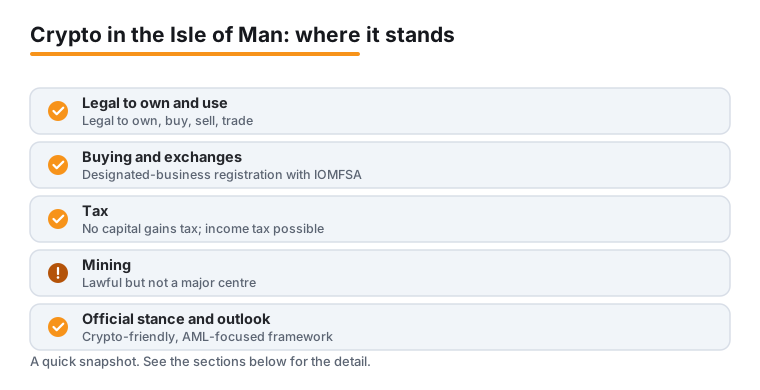
Quick answer — Isle of Man, 2026
- Legal: Legal to own and trade, not legal tender
- Tax: No capital gains or inheritance tax, trading income taxable
- Buying: Via IOMFSA-registered designated businesses or overseas exchanges
The Isle of Man is a self-governing British Crown Dependency in the Irish Sea with its own parliament (Tynwald), its own laws, and its own financial regulator. It is not part of the United Kingdom or the European Union, so it sets its own approach to crypto-assets. For more than a decade the Island has positioned itself as a crypto-friendly but anti-money-laundering-focused jurisdiction: rather than building a bespoke crypto licensing regime, it brought crypto businesses inside its existing anti-money-laundering (AML) framework and requires most of them to register with, and be overseen by, the Isle of Man Financial Services Authority (IOMFSA).
This page explains, in plain language, whether crypto is legal in the Isle of Man, who regulates it, the main laws and frameworks, how exchanges and virtual asset service providers (VASPs) register, how crypto is generally taxed, the AML and KYC rules, how to buy and use crypto in practice, plus mining, ATMs, recent developments, and consumer risks. This is general information as of 2026 and is NOT legal, tax, or financial advice. Crypto rules change and depend on your circumstances, so always verify the current position with the named official regulator, the IOMFSA, or a qualified Isle of Man professional before acting. See also our wider guides to crypto regulation and country regulation.
On this page: Legal status · Who regulates it · Taxes · How to buy · Mining
Legal status: is Bitcoin and crypto legal in the Isle of Man?
Yes. Owning, buying, selling, and trading Bitcoin and other crypto-assets is legal in the Isle of Man. There is no ban on individuals holding crypto, and the Island has actively welcomed crypto and blockchain businesses for years, provided they comply with the applicable registration and anti-money-laundering rules. It is a regulated, crypto-friendly jurisdiction rather than an unregulated free-for-all or a prohibition jurisdiction.
Legal is not the same as legal tender. The Isle of Man's legal tender is the Manx pound, which circulates alongside sterling at par; Bitcoin and other cryptocurrencies are not legal tender, so no business is obliged to accept them and any acceptance is a matter of private agreement. The Island's regulatory focus is on the businesses that provide crypto services to others, not on individuals simply holding or spending their own crypto.
Who regulates crypto in the Isle of Man (the regulator)
The primary regulator is the Isle of Man Financial Services Authority (IOMFSA), the Island's single statutory body for the regulation and supervision of financial services. For crypto specifically, the IOMFSA registers and oversees crypto businesses as "designated businesses" for AML and countering-the-financing-of-terrorism (CFT) purposes, publishes guidance on which token activities fall inside or outside its wider regulatory perimeter, and can take enforcement action against firms that breach the rules.
Other bodies play supporting roles. The Isle of Man Government's Cabinet Office and Treasury handle policy, tax, and international commitments such as crypto-asset tax reporting, and the Financial Intelligence Unit receives suspicious-activity reports. But for anyone dealing with a crypto exchange or service provider based on the Island, the IOMFSA is the authority that matters most. You can read the regulator's own material on the IOMFSA AML/CFT requirements and guidance pages and broader government information at gov.im.
Key laws and frameworks
The Isle of Man does not have a single standalone "crypto law." Instead, crypto activity is governed by a combination of AML-focused statutes and codes. The most important are:
- Designated Businesses (Registration and Oversight) Act 2015 (DBROA): the cornerstone for crypto. It requires businesses carrying on certain non-licensable activities, including convertible virtual currency businesses, to register with and be overseen by the IOMFSA for AML/CFT compliance.
- Proceeds of Crime Act 2008 (POCA): the primary AML statute, amended to bring virtual-currency businesses into the "regulated sector" and to underpin offences such as money laundering and failure to report suspicion.
- Anti-Money Laundering and Countering the Financing of Terrorism Code 2019 (the AML/CFT Code): the detailed rulebook that came into operation on 1 June 2019, setting out customer due diligence, risk assessment, monitoring, and reporting obligations for businesses in the regulated sector, including crypto firms.
- Travel Rule (Transfer of Virtual Assets) Code 2024: introduced in 2024 to implement the Financial Action Task Force (FATF) "travel rule," requiring information about the originator and beneficiary to accompany transfers of virtual assets.
Alongside these, the IOMFSA applies a substance-over-form approach to its wider regulatory perimeter: tokens with the characteristics of securities or electronic money can fall under financial-services regulation, while pure cryptocurrencies such as Bitcoin and Ether generally fall outside that perimeter and are dealt with through the designated-business AML regime. The Island has also committed to the OECD Crypto-Asset Reporting Framework (CARF) for tax-information exchange (see Recent developments).
Licensing and registration of exchanges and VASPs
The Isle of Man does not issue a dedicated "crypto exchange licence" in the way some jurisdictions do. Instead, the key requirement for most crypto businesses, including exchanges and other virtual asset service providers (VASPs), is to register as a designated business with the IOMFSA under the DBROA 2015, unless they already hold a financial-services licence for a regulated activity.
- What triggers registration: the law captures businesses that issue, transmit, transfer, provide safe custody or storage of, administer, manage, lend, buy, sell, exchange, or otherwise trade or intermediate convertible virtual currencies. This broadly covers exchanges, brokers, custodians, and similar VASPs.
- What registration involves: applicants are assessed and, once registered, are supervised by the IOMFSA for compliance with the AML/CFT Code. Firms must apply fit-and-proper standards to key people, maintain AML systems, and submit to oversight.
- What it does NOT involve: registration as a designated business is an AML oversight regime, not full prudential regulation. The IOMFSA itself stresses that this does not bring the protections that apply to fully licensed firms, so there are generally no capital or liquidity requirements and no conduct-of-business rules specific to consumers under this regime.
- Tokens that are securities or e-money: if a token or activity has the characteristics of a regulated investment, security, or electronic money, the business may instead need a financial-services licence under the Island's wider regulatory framework.
Because the boundary between a designated-business registration and full licensing depends on the specific tokens and activities, any business should confirm its own status directly with the IOMFSA before operating, and users should ask a platform whether and how it is registered.
Crypto and Bitcoin taxation in the Isle of Man
The Isle of Man is well known for a light personal-tax environment, and this extends to crypto, but the detail matters and depends on the facts.
- No capital gains tax: the Isle of Man does not levy a capital gains tax, so gains on crypto held as a personal investment are generally not taxed as capital gains.
- No inheritance tax: the Island has no inheritance or estate tax.
- Income tax can still apply: personal income tax exists, with a standard lower rate and a higher rate of 21 percent for 2026/27, unchanged from 2025/26. For 2026/27 the personal allowance is 17,000 pounds for a single person and 34,000 pounds for a jointly assessed couple, the first 6,500 pounds of taxable income above the allowance is taxed at the 10 percent standard rate (13,000 pounds for a jointly assessed couple) and the balance at 21 percent, and the elective annual tax cap is 220,000 pounds for an individual and 440,000 pounds for a jointly assessed couple. Crucially, profits from activity that amounts to a trade, for example frequent, business-like or professional trading, can be taxable as income rather than treated as a tax-free capital gain. Crypto received as employment income, or as business revenue, is also generally taxable.
- Companies: the standard rate of corporate income tax on most trading profits is 0 percent, though higher rates apply to specific activities such as banking and Isle of Man land and property income.
Rates, thresholds and the tax cap are set annually and are published in the Isle of Man Government's rates and allowances table, which currently runs to the 2026/27 year of assessment. None of the Assessor of Income Tax's published guidance notes or practice notes is crypto specific, so the trading versus investment question rests on general income tax principles. The distinction between investing (no capital gains tax) and trading (potentially taxable income) is fact-specific and important. For your actual position, check current guidance from the Isle of Man Government and our general crypto taxes guide, and speak to an Isle of Man-qualified tax adviser. This section is informational only and is not tax advice.
AML and KYC rules
Anti-money-laundering compliance is the heart of the Isle of Man's crypto regime. Crypto businesses in the regulated sector, whether licensed or registered as designated businesses, must comply with the AML/CFT Code 2019 and the Proceeds of Crime Act 2008. In practice this means:
- Identity verification (KYC): expect full identity checks when you open an account with a registered provider, plus source-of-funds or source-of-wealth checks for larger transactions.
- Customer due diligence and monitoring: providers must risk-assess customers, identify beneficial owners, carry out enhanced due diligence for higher-risk cases, and monitor transactions on an ongoing basis.
- Reporting: firms must appoint a money-laundering reporting officer and report suspicious activity; failure to report suspicion is itself an offence under POCA.
- The travel rule: under the Travel Rule (Transfer of Virtual Assets) Code 2024, originator and beneficiary information must accompany virtual-asset transfers, aligning the Island with FATF standards.
- Enforcement is real: the AML/CFT Code provides for significant civil penalties for non-compliance, and the IOMFSA actively supervises and can take action against firms.
For ordinary users, the practical effect is that you will need to verify your identity and may be asked for documents; this is a legal requirement, not an optional step.
Buying and using crypto in practice
For most people in the Isle of Man, buying crypto is done through online exchanges and brokers, including international platforms accessible from the Island. The Island is small, so the local crypto-business sector is specialised rather than mass-market. A typical, sensible path looks like this:
- Choose a reputable platform. If you use an Isle of Man-based provider, check whether it is registered as a designated business with the IOMFSA or otherwise licensed. If you use an overseas platform, make sure it accepts Isle of Man residents and is regulated in its home jurisdiction.
- Verify your identity by completing KYC with ID and any requested documents.
- Fund your account in pounds, typically by bank transfer or card, noting fees and limits.
- Place your order after reviewing the price, spread, and fees.
- Secure your holdings with two-factor authentication, and for larger or longer-term amounts consider a wallet you control, including a hardware wallet, with your recovery phrase backed up offline.
- Keep records of dates, amounts, and cost basis, which matters if your activity could be treated as trading for income-tax purposes.
There are no special exchange controls on ordinary crypto purchases. The constraints that matter are AML/KYC checks and choosing a trustworthy, properly regulated venue.
Bitcoin ATMs in the Isle of Man
The Isle of Man does not have a separate licensing category just for crypto ATMs. A business operating a Bitcoin ATM or cash-for-crypto kiosk would generally be carrying on a convertible-virtual-currency business and would therefore fall within the designated-business regime, meaning it should register with the IOMFSA and comply with the AML/CFT Code, including customer due diligence and the travel rule where relevant.
In practice the Island is small and the number of physical crypto machines is very limited, so availability can be sparse or change over time. Cash-based crypto kiosks also tend to carry higher fees and have been associated with elevated fraud risk in many jurisdictions. For most residents, a regulated online exchange is cheaper, easier, and offers a clearer compliance trail. If you do encounter a machine, treat any unregistered or anonymous cash operator with caution.
Bitcoin mining in the Isle of Man
There is no specific Isle of Man law that bans or licenses cryptocurrency mining, and operating mining hardware is generally lawful. The Island markets itself as a digital-economy hub with quality data-centre infrastructure and connectivity, and it has a growing share of renewable electricity in its supply mix.
That said, the Isle of Man is not a major proof-of-work mining centre. Its small size, electricity costs, and limited industrial space make large-scale mining less attractive than regions with cheap or surplus energy. Anyone considering mining should weigh electricity costs, hardware and cooling, noise and heat, planning and any business-registration considerations, and the tax treatment of mined coins, which may be treated as income when received and as business profits if mining is carried on commercially. The Island's policy emphasis has been on regulated crypto and blockchain businesses and on tax-information transparency rather than on attracting mining operations.
Recent developments (2024 to 2026)
Two developments define the current picture.
The 2024 consultation on crypto regulation. On 13 February 2024 the IOMFSA opened a public consultation and discussion paper on the future regulation of crypto-asset activities, exploring whether to move beyond the designated-business AML model toward fuller regulation. The consultation closed on 9 April 2024. According to the Authority's feedback statement, it received only 16 responses, the results were inconclusive, and the most frequently chosen "best" option was to maintain the existing approach. The IOMFSA decided to maintain the current approach under the DBROA 2015 for the time being while keeping the matter under review and monitoring international standards and developments in other jurisdictions. The Island introduced the travel rule through the Travel Rule (Transfer of Virtual Assets) Code 2024 (SD 2024/0137), which came into operation in October 2024 with a de minimis threshold of 1,000 euro. It was then amended by the Travel Rule (Transfer of Virtual Assets) (Amendment) Code 2026 (SD 2026/0047), in operation from 20 March 2026, which made the unhosted wallet requirement risk based, and travel rule breaches were brought inside the civil penalty regime by the AML/CFT (Civil Penalties) (Travel Rule) (Amendment) Regulations 2026 (SD 2026/0014) from the same date.
Tax-information transparency (CARF). The Isle of Man committed to the OECD's Crypto-Asset Reporting Framework and signed the related multilateral competent authority agreement in late 2024. Under this framework, the implementing legislation is now in force. The Income Tax (Crypto-Asset Reporting) Regulations 2025 (SD 2025/0229) were approved by Tynwald on 11 December 2025 and came into operation on 1 January 2026. The first reportable period runs from 1 January to 31 December 2026, first returns are due by 30 June 2027, and the first exchange by competent authorities is set for 30 September 2027. The practical direction of travel is greater reporting and transparency rather than dramatic changes to the underlying registration model. The next scheduled steps are dated: the MONEYVAL onsite phase from 28 September to 9 October 2026, re-issued AML/CFT sector guidance for VASPs targeted at Q1 2027, and a review of whether a broader prudential, conduct and market integrity framework for VASPs is needed, targeted at Q1 2029.
Innovation and supervision tools. The IOMFSA is a member of the Global Financial Innovation Network and runs an innovation hub on its website, along with a regulatory sandbox that lets financial-services products be tested in a controlled environment, both of which are relevant to crypto and blockchain firms seeking authorisation. The Authority has also worked with regtech providers on using technology, including AI-based tools, to support compliance-related interactions with the businesses it supervises. These are supervisory and engagement measures rather than new crypto rules.
Consumer risks and protection
It is important to understand the limits of protection. Because most Isle of Man crypto firms are registered as designated businesses for AML purposes rather than fully licensed, the IOMFSA has made clear that this regime does not provide the consumer protections, capital requirements, or conduct rules that apply to fully regulated financial services. Crypto activity is also generally outside any depositor or investor compensation scheme.
The main risks for crypto users in the Isle of Man are the same as elsewhere: sharp price volatility, scams and phishing, loss of access if you lose your keys, and counterparty risk if a platform fails. Sensible precautions include using only reputable providers and checking whether an Island-based firm is registered with the IOMFSA, being wary of guaranteed-return promises and unsolicited offers, never investing more than you can afford to lose, enabling two-factor authentication, considering self-custody for larger holdings, and keeping your own records. This is general information, not investment advice; we make no price predictions and past performance does not indicate future results. If you are unsure, consult a licensed adviser in the Isle of Man.
Official sources and how to verify
Because crypto rules in the Isle of Man are AML-focused and still evolving, always confirm the current position with the primary official sources rather than relying on summaries. The most authoritative starting points are:
- Isle of Man Financial Services Authority (IOMFSA) AML/CFT requirements and guidance for the designated-business regime, the AML/CFT Code, the travel rule, registers, and guidance on the regulatory perimeter for tokens.
- IOMFSA designated businesses overview for how virtual asset service providers register and are supervised under the Designated Businesses (Registration and Oversight) Act 2015.
- Isle of Man Government consultation: Regulation of Crypto-Asset Activities for the 2024 consultation, discussion paper, and feedback statement on the future of crypto regulation.
- Isle of Man Government: Crypto-Asset Reporting Framework (CARF) for the Island's crypto tax-reporting commitments and timeline.
- Isle of Man Government (gov.im) for tax, policy, and general guidance.
To check a platform, ask whether it is registered as a designated business with the IOMFSA or otherwise licensed before depositing funds. To reiterate: this page is general information as of 2026 and is NOT legal, tax, or financial advice, and you should confirm your specific situation with the IOMFSA or a qualified Isle of Man professional. For more context, see our crypto regulation guide.
Isle of Man crypto status update, August 2026
The core answer has not changed: crypto is legal to own and trade, there is no single crypto statute, and firms are registered for anti-money-laundering purposes rather than licensed. What has changed is the machinery around that core, and each change is a named instrument with a date.
- Tax reporting is live. The Income Tax (Crypto-Asset Reporting) Regulations 2025 (SD 2025/0229) were made on 10 November 2025, approved by Tynwald on 11 December 2025 and came into operation on 1 January 2026. The first reporting year is calendar year 2026.
- The travel rule was amended. The Travel Rule (Transfer of Virtual Assets) (Amendment) Code 2026 (SD 2026/0047), made on 13 February 2026, came into operation on 20 March 2026 and replaced the fixed unhosted wallet requirement in paragraph 7 with a risk based test.
- Travel rule breaches now carry civil penalties. The AML/CFT (Civil Penalties) (Travel Rule) (Amendment) Regulations 2026 (SD 2026/0014), made on 9 January 2026, brought contraventions of the Travel Rule Code 2024 inside the civil penalty regime. The IOMFSA confirmed both changes took effect from 20 March 2026 in its notice of 23 March 2026.
- The sector was formally risk assessed. The Virtual Assets and VASPs National Risk Assessment of April 2026 rates the sector's overall money laundering risk as Medium, and terrorist financing and proliferation financing risk as Very Low.
- An external inspection is imminent. The IOMFSA's bulletin of 29 July 2026 states that the onsite phase of the MONEYVAL mutual evaluation takes place from 28 September to 9 October 2026. Immediate Outcome 3 of that assessment covers supervision of financial institutions and virtual asset service providers (IOMFSA MONEYVAL FAQs).
A House of Keys general election is due on 24 September 2026 (Isle of Man elections), so any decision to move beyond the AML-only model falls to a new administration.
The Isle of Man crypto legislation pipeline and when it moves
Every item below has a published owner and target date. Unless stated otherwise they come from the Isle of Man National Action Plan dated July 2026. None of them creates a crypto licensing regime today.
| Measure | Stage and timing | What it means in practice |
|---|---|---|
| Financial Services (Miscellaneous Provisions) Bill 2026 | Completed its passage through the branches of Tynwald and entered the Royal Assent process, announced 15 July 2026. Still awaiting Royal Assent as at the IOMFSA bulletin of 29 July 2026. Commencement is by order made by the Authority, and none has been published. | Amends the Designated Businesses (Registration and Oversight) Act 2015 among other Acts. The IOMFSA describes the result as a new civil penalty regime in respect of individuals holding key positions within regulated firms and designated businesses. New Civil Penalty Regulations and guidance will be consulted on. |
| Re-issued AML/CFT sector guidance for VASPs | Target Q1 2027. Owner: FSA. | Will cover travel rule developments, stablecoin and unhosted wallet risk, exposure to foreign VASPs, and observed typologies. The current VASP sector guidance is Version 4, dated December 2024. |
| Deeper work on virtual asset risks and intelligence sharing | Target Q3 2027, rated High priority. Owner: Financial Intelligence Unit, with the AML/CFT Policy Office, FSA, Gambling Supervision Commission and FCARU. | More outreach to operators and professional services sectors on new typologies and technology risks. |
| Better cross-border virtual asset flow data | Target Q4 2028, rated Medium. Owner: FSA (lead), with the FIU, GSC, AML/CFT Policy Office and IOMFCP. | Flow data collection extended to VASPs and money transmission, including flows to and from unhosted wallets and foreign VASPs. |
| Controls over inactive VASPs | Target Q1 2029, rated Medium. Owner: FSA (lead), with the FIU. | Review of registration conditions, ongoing obligations and potential de-registration thresholds, aimed at the high number of registered but inactive entities. |
| Review of a broader VASP framework beyond AML | Target Q1 2029, marked longer term. Owners: FSA (lead), AML/CFT Policy Office, Treasury. | Would consider prudential, conduct and market integrity regulation in line with emerging international practice. The plan commits only to a review; nothing has been drafted and no crypto consultation is open. |
| MONEYVAL sixth round mutual evaluation | Onsite phase 28 September to 9 October 2026 per the IOMFSA bulletin of 29 July 2026. The overall process runs about 18 months (IOMFSA). | Immediate Outcome 3 rates supervision of financial institutions and virtual asset service providers. A weak rating would be the most likely reason for the Island to move faster than the dates above. |
CARF: what Isle of Man crypto firms report, and when it reaches your tax authority
The Isle of Man joined the November 2023 joint statement committing to implement the OECD Crypto-Asset Reporting Framework, and transposed it through the Income Tax (Crypto-Asset Reporting) Regulations 2025, made by the Treasury under section 104D of the Income Tax Act 1970 (Isle of Man Government CARF page). The Assessor of Income Tax set out the timetable in an industry advisory notice dated 18 December 2025.
| Date | Event |
|---|---|
| 1 January 2026 | First reportable period commences |
| 31 December 2026 | End of first reportable period |
| 1 January 2027 | Second reportable period commences; Reportable and Partner Jurisdictions list published for the first period |
| 30 June 2027 | First reportable period XML submissions due |
| 30 September 2027 | First exchange by competent authorities |
Returns are filed in XML using the OECD CARF schema through the Isle of Man Information Providers Service, and a provider with nothing to report must file a nil return. Penalties under the Regulations are:
- Up to 300 pounds per Reportable User to which a failure relates, and 300 pounds where the failure is the submission of the annual return itself.
- A daily default penalty of up to 60 pounds for each day a failure continues.
- For significant non-compliance, the higher of up to 10,000 pounds or double the penalty already charged.
- A criminal offence, punishable on summary conviction by a fine not exceeding level 3 on the standard scale, for a knowingly or recklessly false self-certification, or for failing to file a return within 6 months of the due date.
For an individual holder the effect is straightforward: an Isle of Man exchange, broker or custodian will ask for your country of tax residence and taxpayer identification number, and from September 2027 your account and transaction data will reach the tax authority where you live. CARF is a reporting standard, not a new tax, and it does not change the fact that the Isle of Man has no capital gains tax.
How large the Isle of Man crypto sector actually is
Virtual asset service providers have been inside the Island's AML framework since October 2018, when they were brought under the Designated Businesses (Registration and Oversight) Act 2015. The April 2026 national risk assessment key findings and the full assessment give the first published picture of the sector.
- As at December 2025, 19 VASPs were registered, of which 4 were active, employing around 100 staff between them.
- Their customers account for roughly 1.3 percent of customers across all FSA reporting sectors. Of those customers, 82.82 percent are resident in the UK and 98.31 percent are natural persons rather than entities.
- Typical services are exchange of virtual assets to fiat, exchange between virtual assets, custody and administration, and receipt or transmission of orders. There are no global exchanges registered on the Island; registered firms run broker, dealer or over the counter models.
- All active providers support Bitcoin; others also support ETH, SOL, TRX, LTC, XRP and DOGE, plus the stablecoins USDT and USDC. The assessment found no evidence of privacy coins or other anonymity enhancing services, no NFT services and no virtual asset issuance.
- 25 percent of registered VASPs permit, or intend to permit, transfers to unhosted wallets.
- The VASP sector filed 80 suspicious activity reports in 2025, 7.91 percent of the Island's total.
- Overall money laundering risk for the sector is rated Medium; terrorist financing and proliferation financing risk are each rated Very Low.
The practical reading for a resident is that the local sector is specialist and small, so most people will use an overseas platform. The assessment also notes that online gambling operators may accept virtual assets only under tightly controlled models that require conversion to fiat via regulated VASPs, with enhanced supervision applied.
Which crypto activities need a licence, not just registration
The IOMFSA sets the boundary in its Virtual Assets and the Regulatory Perimeter guidance, Version 2.0, last updated 19 March 2025 and produced with Digital Isle of Man. It names the licence classes, which a general description of a substance over form approach does not.
- Security tokens. If the token gives rights and obligations similar to an investment as defined in the Regulated Activities Order 2011 (Schedule 2, Part 1), such as shares, debentures, units in a collective investment scheme or derivatives, activity in it can require a Class 2 (Investment Business) licence under the Financial Services Act 2008, subject to exclusions and exemptions.
- E-money tokens. A token must meet all five listed characteristics to amount to e-money. Any issuer of e-money requires a Class 8 (Money Transmission Services) licence unless an exclusion or exemption applies.
- A plain crypto exchange. An exchange not handling tokenised securities falls outside the financial services perimeter but is still subject to registration and oversight under the Designated Businesses (Registration and Oversight) Act 2015 and to AML/CFT requirements.
- An exchange for tokenised securities. In general this is not possible on the Island. Such a market could only be run under a Class 6 (Crowdfunding Platform) licence, which carries investor limits and restrictions preventing real time, continuous or automated trading. The IOMFSA states that the Isle of Man does not currently have the legislative framework or regulatory systems in place to licence or supervise a securities exchange in compliance with the IOSCO Principles.
- Software developers. Developing software that lets others issue or exchange virtual assets, and licensing it to other entities, is neither a regulated activity nor designated business.
- Retailers. Merely making or receiving payments for goods or services in virtual assets requires neither a financial services licence nor registration as a designated business.
The VASP definition itself sits in Schedule 4 to the Proceeds of Crime Act 2008. Under section 7 of the 2015 Act it is an offence, subject to criminal or civil sanction, to provide or advertise as offering designated business services without first being registered with the Authority (IOMFSA). The Authority also warns consumers directly that if a firm is only registered with it for anti-money-laundering purposes, that does not mean it is a regulated firm (IOMFSA consumer awareness).
Frequently asked questions
Is Bitcoin legal in the Isle of Man?
Yes. Owning, buying, selling, and trading Bitcoin and other crypto-assets is legal in the Isle of Man, subject to AML registration and compliance rules for businesses. However, crypto is not legal tender; the Manx pound (alongside sterling) is the Island's legal tender, so no business is obliged to accept crypto as payment. This is general information, not legal advice.
Who regulates crypto in the Isle of Man?
The Isle of Man Financial Services Authority (IOMFSA) is the main regulator. It registers and supervises crypto businesses as "designated businesses" for anti-money-laundering purposes under the Designated Businesses (Registration and Oversight) Act 2015, and it publishes guidance on which token activities fall inside its wider regulatory perimeter. You can verify firms and read guidance on the IOMFSA website.
Do crypto exchanges need a licence in the Isle of Man?
Most do not need a bespoke crypto licence, but exchanges and other virtual asset service providers must register as designated businesses with the IOMFSA under the 2015 Act and comply with the AML/CFT Code, unless they already hold a financial-services licence. This is AML oversight, not full prudential regulation, so it does not carry the consumer protections of a fully licensed firm. Tokens that behave like securities or e-money may require a financial-services licence instead. Confirm a provider's status with the IOMFSA.
How is crypto taxed in the Isle of Man?
The Isle of Man has no capital gains tax and no inheritance tax, so gains on crypto held as a personal investment are generally not taxed as capital gains. However, income tax can apply: profits from frequent or professional trading can be taxed as income, and crypto received as employment or business income is generally taxable. Rates and the annual tax cap change, so confirm your position with the Isle of Man Government or a qualified Isle of Man tax adviser. This is not tax advice.
Did the Isle of Man change its crypto rules in 2024?
The IOMFSA consulted in 2024 on whether to introduce fuller crypto regulation, but after limited and inconclusive responses it decided to keep the existing designated-business approach under the 2015 Act for now while keeping it under review. In 2024 the Island also introduced the travel rule for virtual-asset transfers and moved toward FATF-aligned VASP terminology, and it committed to the OECD Crypto-Asset Reporting Framework for tax-information exchange.
Are crypto users in the Isle of Man protected by regulation?
Only to a limited degree. Because most Isle of Man crypto firms are registered as designated businesses for AML purposes rather than fully licensed, the IOMFSA has stressed that this regime does not provide the consumer protections, capital requirements, or conduct rules of fully regulated financial services, and crypto is generally outside compensation schemes. Regulation also cannot remove price volatility, scams, or key-loss risk. Use reputable, registered providers, secure your accounts, and never invest more than you can afford to lose.
Does the Isle of Man report crypto to tax authorities under CARF?
It is moving that way. The Isle of Man committed to the OECD Crypto-Asset Reporting Framework (CARF) and, subject to its own implementing legislation, crypto-asset service providers are expected to collect reportable customer and transaction information for periods from 2026, with international exchange of that information beginning in 2027. This is about tax-information transparency rather than a change to the underlying registration model. Confirm the current position on the Isle of Man Government CARF page.
Does the Isle of Man have a crypto sandbox or innovation support?
Yes. The Isle of Man Financial Services Authority is a member of the Global Financial Innovation Network and provides an innovation hub and a regulatory sandbox that allows financial-services products, including crypto and blockchain services, to be tested in a controlled environment. Firms exploring novel activity can use these channels to engage with the regulator. Check the IOMFSA website for current details on how to apply.
Does the Isle of Man have a crypto law in 2026?
There is no single crypto statute. Crypto firms register as designated businesses with the Isle of Man Financial Services Authority under the Designated Businesses (Registration and Oversight) Act 2015 and are overseen for anti-money-laundering compliance only. What does apply is specific and named: the AML/CFT Code 2019, the Travel Rule (Transfer of Virtual Assets) Code 2024 as amended in March 2026, the VASP definition in Schedule 4 to the Proceeds of Crime Act 2008, and the Income Tax (Crypto-Asset Reporting) Regulations 2025 for tax reporting. Under section 7 of the 2015 Act it is an offence, subject to criminal or civil sanction, to provide or advertise as offering designated business services without being registered.
Is the Isle of Man planning to properly license crypto firms?
Not yet, and not soon on current published plans. After its 2024 consultation the IOMFSA decided on 10 December 2024 to maintain the existing registration model for the time being and keep the matter under review. The National Action Plan dated July 2026 includes an action to review, at an appropriate time, whether a broader framework covering prudential, conduct and market integrity aspects is required for virtual asset service providers. It is marked longer term with a target of Q1 2029, led by the FSA with the AML/CFT Policy Office and Treasury. Nothing has been drafted, and no crypto consultation is currently open on the Isle of Man Government engagement hub.
When does Isle of Man crypto tax reporting start, and what are the penalties?
It has already started. The Income Tax (Crypto-Asset Reporting) Regulations 2025 (SD 2025/0229) came into operation on 1 January 2026, which is the start of the first reportable period. Returns for that period are due by 30 June 2027 and the first exchange by competent authorities is set for 30 September 2027. Penalties include up to 300 pounds per Reportable User to which a failure relates, 300 pounds where the failure is the return itself, a daily default penalty of up to 60 pounds, and for significant non-compliance the higher of up to 10,000 pounds or double the penalty already charged. A knowingly or recklessly false self-certification, or a return filed more than 6 months after the due date, is a criminal offence punishable by a fine up to level 3 on the standard scale.
Did the Isle of Man change its travel rule for crypto in 2026?
Yes. The Travel Rule (Transfer of Virtual Assets) (Amendment) Code 2026 (SD 2026/0047) came into operation on 20 March 2026. It substituted paragraph 7 of the 2024 Code so that a provider handling an unhosted wallet transfer may obtain the specified information from its own customer where it considers it appropriate, having assessed money laundering and terrorist financing risk by reference to the purpose and nature of the relationship and the transfer, the value and any linked transfers, transfer frequency and the duration of the relationship. Separately, the AML/CFT (Civil Penalties) (Travel Rule) (Amendment) Regulations 2026 brought travel rule contraventions inside the civil penalty regime from the same date. The 1,000 euro de minimis threshold is unchanged.
How many crypto firms are registered in the Isle of Man?
Nineteen virtual asset service providers were registered as at December 2025, of which four were active, according to the Virtual Assets and VASPs National Risk Assessment published in April 2026. Their customers account for roughly 1.3 percent of customers across all FSA reporting sectors, and 82.82 percent of those customers are resident in the UK. The assessment rates the sector's overall money laundering risk as Medium and its terrorist financing and proliferation financing risk as Very Low.
Is the Isle of Man being assessed by MONEYVAL, and does it affect crypto?
Yes. MONEYVAL, a permanent monitoring body of the Council of Europe, is conducting the Island's sixth round mutual evaluation. The IOMFSA's bulletin of 29 July 2026 states that the onsite phase runs from 28 September to 9 October 2026, following training visits that began in January 2026. Immediate Outcome 3 of the assessment covers supervision of financial institutions and virtual asset service providers. The overall process takes about 18 months and ends with a Mutual Evaluation Report discussed at the MONEYVAL Plenary.
What is the Isle of Man income tax rate on crypto trading profits for 2026/27?
There is no crypto specific rate. If your activity amounts to a trade, profits are taxed as income at the personal rates for 2026/27: a 10 percent standard rate on the first 6,500 pounds of taxable income above the personal allowance for a single person, or 13,000 pounds for a jointly assessed couple, and 21 percent on the balance. The personal allowance for 2026/27 is 17,000 pounds for a single person and 34,000 pounds for a jointly assessed couple, reduced by 1 pound for every 2 pounds of income above 100,000 pounds, or 200,000 pounds jointly assessed. An individual can elect the annual tax cap of 220,000 pounds, or 440,000 pounds jointly assessed. There is still no capital gains tax and no inheritance tax.
Facts reviewed: 13 August 2026. Page updated: 13 August 2026.