Home › Crypto Regulation › Sweden
Bitcoin & Cryptocurrency Regulation in Sweden
Quick answer — Sweden, 2026
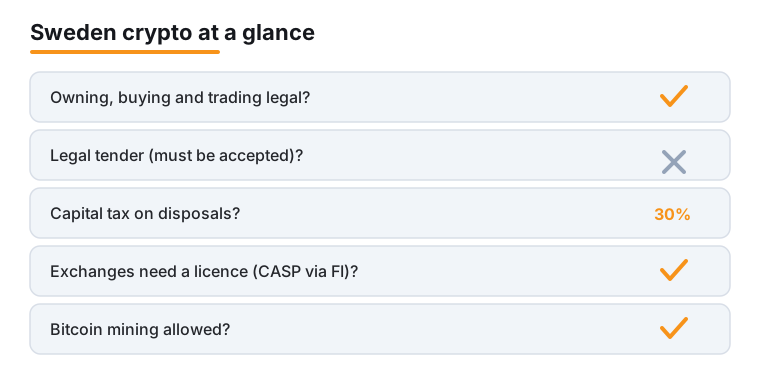
- Owning, buying, selling and trading crypto is legal in Sweden, but it is not legal tender.
- It is taxed: profits at the 30 percent capital rate, with the average cost basis method; mining and staking are taxed as income.
- Residents buy through an FI-authorised platform, verify with BankID, and fund via Swish, bank or SEPA transfer, or card.
Sweden is one of Europe's most digitally advanced economies, and its approach to Bitcoin and other crypto-assets reflects that: owning, buying, selling and trading crypto is legal, exchanges operate openly, and the rules now sit inside the European Union's harmonised framework rather than a purely national regime. Crypto is treated as a regulated asset, not as money or legal tender, and any business offering crypto services to Swedish customers must be authorised by the financial supervisor and follow anti-money-laundering obligations. This page explains how Sweden regulates crypto across legal status, supervision, the main laws and frameworks, exchange licensing, taxation, AML and KYC, everyday use, mining, recent developments, consumer protection, and how to verify everything with official sources.
This is general information as of 2026 for educational purposes only. It is not legal, tax or financial advice. Crypto rules and tax practice change frequently, so always confirm the current position directly with Sweden's Financial Supervisory Authority, Finansinspektionen, the Swedish Tax Agency, Skatteverket, or a qualified professional before acting. For broader background see our guide to crypto regulation.
On this page: Legal status · Who regulates it · Taxes · How to buy · Mining
Is Bitcoin and crypto legal in Sweden?
Yes. Buying, holding, selling and using Bitcoin and other crypto-assets is legal in Sweden for both individuals and businesses. There is no ban on owning crypto or on trading it through an authorised service provider.
What crypto is not is legal tender. The Swedish krona (SEK) is the only legal tender, and merchants are under no obligation to accept Bitcoin. Accepting crypto as payment is permitted but voluntary, and doing so can create tax and accounting consequences for both parties. In short, crypto is a legal, regulated asset class in Sweden, not a currency with mandatory acceptance.
Who regulates crypto in Sweden
The main regulator is Finansinspektionen (FI), the Swedish Financial Supervisory Authority. FI licenses and supervises crypto-asset service providers, enforces the EU framework, and oversees anti-money-laundering compliance. It has stated that authorisation from FI is required to provide crypto-asset services, with narrow exceptions for certain entities already subject to other financial regulation.
Sweden's central bank, Sveriges Riksbank, does not license private crypto firms. Its role concerns monetary policy and financial stability, and it has separately explored a state-backed digital krona, the e-krona. The e-krona is a central bank digital currency project and is entirely distinct from decentralised crypto-assets such as Bitcoin. The Swedish Tax Agency, Skatteverket, handles the taxation of crypto. You can read FI's own crypto guidance via the Finansinspektionen crypto-asset services page.
Key laws and frameworks
As an EU member state, Sweden's crypto rules are now anchored in the EU's Markets in Crypto-Assets Regulation (MiCA), which applies directly across the bloc. MiCA created a single, harmonised rulebook for issuing crypto-assets and for service providers such as exchanges, brokers and custodians. The provisions for crypto-asset service providers began applying on 30 December 2024, building on earlier rules for stablecoins (asset-referenced and e-money tokens) that applied from mid-2024.
Alongside MiCA, the following also apply:
- The Swedish Anti-Money Laundering Act (penningtvattslagen), implementing the EU AML framework, requiring customer due diligence, transaction monitoring and reporting of suspicious activity.
- Consumer protection and marketing rules, including MiCA's requirement that communications be fair, clear and not misleading.
- EU tax transparency measures, notably the DAC8 directive and the OECD Crypto-Asset Reporting Framework (CARF), under which providers report customer data to tax authorities.
- Data protection under the EU GDPR.
You can review the regulation itself through the ESMA Markets in Crypto-Assets Regulation page. Together these give Sweden a relatively clear, EU-aligned environment, but one with real compliance obligations.
Licensing and registration of exchanges
Under MiCA, a firm that offers crypto services in Sweden must hold authorisation as a Crypto-Asset Service Provider (CASP), from FI or from another EU supervisor passporting in. This is no longer conditional: the transitional period ended on 30 June 2026 and FI stated on 1 July 2026 that firms without authorisation should stop offering crypto services to consumers in the EU and wind down instead. This MiCA-based licence replaces the earlier national regime, under which crypto businesses registered with FI mainly for anti-money-laundering purposes.
Key features reported by FI and Swedish practitioners include:
- A CASP must have a registered office in Sweden and carry out at least part of its services there.
- Minimum own funds set by MiCA according to the class of services offered, plus FI's own charges: an application fee set case by case according to FI's assessed processing time, SEK 25,500 for the simplified notification route open to already regulated firms, and an ongoing supervision fee set in relation to the balance sheet total but at least SEK 150,000 per year.
- An ongoing annual supervisory fee (FI has indicated a minimum of around SEK 150,000), plus an application fee.
- FI aims to decide within 40 working days of a complete application, extendable by 20 working days if supplementary information is needed.
There is a transitional period for firms that were lawfully operating before 30 December 2024. Sweden chose a shorter national transitional period than the EU maximum: firms already operating under national law could continue but had to submit a MiCA authorisation application by 30 September 2025, and could keep operating while a timely application was assessed. That backstop has now passed. The transitional period ended on 30 June 2026, and FI confirmed on 1 July 2026 that firms without authorisation should not continue offering crypto services to consumers in the EU, must inform their customers how the services are affected and how they can handle their crypto-assets, and must wind down in an orderly way. One qualification applies in Sweden: under the transitional rule in Lag (2024:1159), a firm that applied before 1 October 2025 may continue until its application is finally decided. Treat the exact deadlines as something to confirm with FI, since national implementation and individual cases vary. Always check a provider's current authorisation status on FI's registers rather than relying on marketing claims.
Crypto and Bitcoin taxation in Sweden
Crypto is taxable in Sweden, and Skatteverket publishes detailed guidance on how to declare it. The treatment depends on what you do with the asset.
- Disposals (selling crypto, swapping one crypto for another, or spending crypto on goods and services) are treated as taxable events under the capital income rules. You calculate a gain or loss using the average cost basis method (genomsnittsmetoden).
- Profits are taxed at the flat capital income rate of 30 percent on the gain. If you make a loss, exactly 70 percent of it is deductible. Skatteverket states the rule without qualification: har du gjort en forlust ar den avdragsgill till 70 procent.
- Mining income is normally taxed as hobby income under income from employment, and only in exceptional cases as business income. Staking itself is not a taxable event, but staking rewards are taxable income at their market value when received and are entered at point 7.2 of the income tax return.
You should not declare unrealised changes in value on crypto you still hold; tax arises on disposal. Crypto is treated under the other-assets provisions in Chapter 52 of the Income Tax Act (Inkomstskattelagen). Individuals report disposals on form K4, section D (the section covering other assets such as cryptocurrencies) alongside the annual income tax return. Skatteverket requires an average cost basis calculated under the average method (genomsnittsmetoden); the 20 percent standard rule (schablonmetoden) may not be used for crypto. Taxable events include selling crypto, exchanging one crypto for another, exchanging crypto for fiat, paying for goods or services with crypto, lending out crypto and using crypto as a gambling stake. For the 2025 income year, Skatteverket's online declaration service opened on 17 March 2026 and the filing deadline was 4 May 2026; confirm the current year's dates with Skatteverket. Keeping complete records of every purchase, sale and transfer is essential, and reporting is becoming stricter as DAC8 and CARF take effect in 2026. See Skatteverket's official page, Skatteverket: Kryptovalutor, and our crypto taxes guide. Tax outcomes are individual; confirm current figures with Skatteverket or a Swedish tax adviser.
AML and KYC requirements
Since 30 December 2024, crypto-asset service providers are directly regulated for anti-money-laundering purposes under the Swedish AML framework. In practice this means a CASP must perform Know Your Customer (KYC) checks, carry out customer due diligence, monitor transactions and report suspicious activity to the authorities.
For ordinary users, expect to verify your identity with a government-issued ID, often through BankID, to be asked about the source of funds for larger transactions, and to keep your account details current, since outdated information can trigger delays or restrictions. FI named anti-money-laundering and fraud prevention among its supervisory priorities for 2025, with crypto firms identified as a sector facing heightened scrutiny. These obligations also limit the anonymity sometimes claimed for crypto, since regulated providers must identify their customers.
Buying and using crypto in practice
Swedes can buy crypto easily through domestic and international platforms. Local on-ramps are well developed: Swish payments, bank or SEPA transfers, debit and credit cards, and identity verification through BankID make funding and verifying an account straightforward.
A typical, compliant path looks like this:
- Choose an authorised platform. Pick an exchange or broker that is authorised or registered with FI and supports SEK; check fees, supported coins and security.
- Verify your identity. Expect KYC checks, usually completed quickly with BankID and an ID document.
- Deposit funds. Use Swish, a bank or SEPA transfer, or a card, depending on the platform.
- Place your order and, for larger holdings, consider moving crypto to a wallet you control (a hardware wallet for long-term storage) and safeguarding the recovery phrase.
- Keep records of every transaction for your tax return.
Crypto can also be used for cross-border transfers, where proponents point to speed and potential cost savings, but values can swing during a transfer, network fees vary, and both sending and receiving providers must still meet AML and KYC duties. Always verify a provider's current authorisation before depositing money, and stay alert to scams and impersonation.
Bitcoin mining in Sweden
Bitcoin mining is legal in Sweden, and the country has historically been attractive for it. A cold climate reduces cooling costs, and the electricity grid draws heavily on low-carbon sources such as hydropower and wind, which appeals to operators seeking a smaller carbon footprint. Northern Sweden in particular has hosted data-centre and mining operations.
The policy backdrop has shifted, however. Sweden previously offered a reduced energy-tax rate that benefited large data centres, including crypto miners, but that favourable treatment was removed in July 2023. The electricity tax for data centres rose from SEK 0.006 to SEK 0.36 per kilowatt hour, a large increase that raised operating costs for energy-intensive mining and prompted several operators to reconsider Sweden. There is no specific national crypto-mining licence; miners operate within Sweden's general rules for electricity use, energy taxation, environmental protection and business regulation, and EU-level discussions on the energy use and sustainability disclosures of crypto-assets are also relevant. Anyone considering mining should budget carefully for electricity and energy taxes, secure a suitable grid connection, and confirm the current tax and permitting position with the relevant authorities.
Recent developments (2025-2026)
The regulatory direction is one of consolidation rather than upheaval:
- MiCA is bedding in. CASP rules have applied since 30 December 2024, FI is processing authorisation applications, and the EU and EEA grandfathering period for pre-existing firms is set to close by 1 July 2026.
- Tax transparency is increasing. The DAC8 directive applies from 1 January 2026, and together with the OECD CARF framework it requires crypto providers to report customer transaction data to tax authorities such as Skatteverket automatically.
- AML enforcement is a priority. FI flagged crypto among its 2025 supervisory focus areas and has scrutinised exchanges' anti-money-laundering practices.
- The e-krona remains an exploratory central bank project at the Riksbank and is separate from private crypto markets.
The likely path is a more formal, more transparent market with clearer obligations for providers and clearer record-keeping expectations for users. Because these timelines can shift, verify current deadlines with FI and Skatteverket.
Consumer risks and protection
Using crypto in Sweden carries the usual risks of the asset class: high price volatility, irreversible transactions, the permanent loss of funds if private keys or passwords are lost, and exposure to fraud, phishing and fake investment schemes. Crucially, crypto sits outside the deposit-guarantee and investor-compensation schemes that protect bank deposits, so if a platform collapses or is hacked there is generally no safety net.
MiCA does add protections, including authorisation requirements for providers, governance and custody standards, and rules that marketing be fair, clear and not misleading. But these reduce rather than remove risk. A prudent approach is to invest only what you can afford to lose, use authorised providers you have checked on FI's registers, secure your own keys for larger holdings, and diversify rather than concentrating in a single volatile asset. For more, see our regulation hub. This is general information, not investment advice.
Official sources and how to verify
Because crypto rules and tax practice evolve, always confirm the current position with the responsible Swedish authorities rather than relying on third-party summaries:
- Finansinspektionen (FI), the Swedish Financial Supervisory Authority, for licensing, supervision and registers: fi.se crypto-asset services.
- Skatteverket, the Swedish Tax Agency, for tax treatment and how to declare: skatteverket.se: Kryptovalutor.
- ESMA, for the text and scope of MiCA at EU level: esma.europa.eu MiCA.
Before using any platform, check its current authorisation directly on FI's registers, and confirm your tax obligations with Skatteverket. This page is general information as of 2026 and is not legal, tax or financial advice; verify the current rules with Finansinspektionen and Skatteverket before acting.
What is changing: Sweden's crypto position in August 2026
Reviewed 3 August 2026. The biggest change since this page was last checked is that the MiCA transition in Sweden is finished. Finansinspektionen (FI) confirmed on 1 July 2026 that the transitional period ended on 30 June 2026. Firms that previously ran such a business but lack MiCA authorisation should not continue offering crypto services to consumers in the EU; they must instead wind down in an orderly way, inform their customers how the services are affected and explain how customers can handle their crypto-assets (Finansinspektionen, 1 July 2026). ESMA had issued the same call on 24 June 2026, adding that firms should stop taking on new customers.
In the same notice FI names Safello AB as the authorised Swedish provider and states that 77 companies hold authorisation in other EU countries and may serve Swedish consumers. Safello was authorised on 13 October 2025 for six crypto-asset services, covering transfers, custody and administration, execution of orders, reception and transmission of orders, exchange of crypto-assets for funds and exchange of crypto-assets for other crypto-assets. On 2 July 2026 FI rejected the application of Goobit AB, which operates BTCX. Goobit announced on 23 July 2026 that it had appealed, arguing the rejection does not rest on the objective and demonstrable grounds MiCA requires, and said FI had confirmed in writing that it may continue providing the services under the Swedish transitional provisions while the appeal is reviewed (Goobit press release, 23 July 2026). That continuation right comes from the transitional rule in Lag (2024:1159), which lets a firm that applied before 1 October 2025 operate until its application is finally decided.
On tax, the rates did not change but the visibility did. Two acts, SFS 2025:1377 and SFS 2025:1378, both issued on 27 November 2025, entered into force on 1 January 2026 and implement DAC8 and the OECD Crypto-Asset Reporting Framework. Providers must collect a tax residence self-certification and file one control statement per user per crypto-asset once a year, covering aggregated transactions rather than each trade. The first reporting year is 2026 and the filing deadline is 1 April 2027. Skatteverket states plainly that the reporting obligation does not introduce new rules for how the income is taxed.
One number that moved for miners: the general Swedish energy tax on electricity fell from 43.9 öre to 36.0 öre per kWh on 1 January 2026. There is no reduced rate to compare it against, because the energy tax reduction for data centres was abolished on 1 July 2023, since when no deduction or refund of energy tax has been available for them.
Swedish crypto legislation: adopted, in progress and rejected
Sweden has no standalone national crypto act beyond the supplementary MiCA law. What governs crypto here is a stack of EU instruments plus Swedish acts that plug them in. This is the current state of that stack and what is queued behind it.
| Measure | Stage | What it does | Timing |
|---|---|---|---|
| Lag (2024:1159) med kompletterande bestämmelser till EU:s förordning om marknader för kryptotillgångar | In force | Names FI as the MiCA competent authority, lets FI prohibit an offer to the public or the trading of a crypto-asset, and applies market abuse investigative powers to crypto-assets. Amends eight existing acts. | Decided by the Riksdag on 21 November 2024, issued 28 November 2024, in force 30 December 2024. Existing firms could operate until 30 September 2025, and if they applied before 1 October 2025, until the application is finally decided (SFS 2024:1159, Finance Committee report 2024/25:FiU12) |
| SFS 2025:1377 and SFS 2025:1378 (DAC8 and CARF) | In force | Tax residence due diligence by crypto providers, annual control statements to Skatteverket, and automatic exchange of those statements with other jurisdictions under Directive (EU) 2023/2226 | In force 1 January 2026; first report for 2026 due 1 April 2027; exchanges with other states at least annually, within nine months of year end |
| Ds EU:s penningtvättspaket (Fi2026/01654) | Draft, out for consultation | Proposes repealing the Money Laundering Act, the beneficial ownership register act and the act on the accounts and safe deposit box system, replacing them with new legislation including a new money laundering act and changed rules for Bolagsverket's register of beneficial owners | Published 6 July 2026, consultation responses due 30 October 2026, proposed entry into force 10 July 2027 (Ministry of Finance) |
| SOU 2026:10 Ökade möjligheter till tillgångsinriktad brottsbekämpning | Inquiry report, consultation closed | Implements Directive (EU) 2024/1260 on asset recovery and confiscation; examines a confiscation presumption or reversed burden of proof, and states that Asset Recovery Offices need access to information on loans, account balances and crypto-assets | Published 17 February 2026, sent out for consultation 3 March 2026 with responses due 3 June 2026; Sweden's transposition deadline for the directive is 23 November 2026 (Regeringskansliet) |
| Motion 2025/26:2612, bitcoin in the currency reserve and tax exemption for small crypto payments | Rejected | Would have had the Riksbank study and gradually add bitcoin to the currency reserve, and exempted small crypto payments from tax | Submitted 6 October 2025, rejected by the chamber on the recommendation of the Finance Committee and the Tax Committee (Riksdagen) |
| E-krona | Recommendation only | The Riksbank recommends the Riksdag and government appoint an inquiry into the legal changes an e-krona would need, and proposes it be set up once the digital euro regulation is finalised and the ECB has decided to issue one | Payments Report 2026, decided 3 March 2026 and published 12 March 2026. No decision to issue an e-krona and no inquiry appointed (Sveriges Riksbank) |
Read together, the direction is clear: no new Swedish rules on how crypto is taxed, but steadily more reporting, more information exchange between tax authorities, and stronger seizure powers. The next dated milestones are 30 October 2026 for anti-money laundering consultation responses, 23 November 2026 for the confiscation directive, 1 April 2027 for the first DAC8 filings, and a proposed 10 July 2027 for the anti-money laundering package.
Which crypto firms are licensed in Sweden, and how to check
Since 1 July 2026 the practical question is no longer whether a platform is registered but whether it is authorised. FI's advice is to check that the company holds MiCA authorisation in FI's or ESMA's register before you deposit, and FI adds that authorisation is not a guarantee that you cannot lose money (Finansinspektionen). An authorised firm can be based in any EU member state and passport into Sweden; FI puts the number authorised in other EU countries at 77.
What FI's process costs and takes, for anyone assessing whether a platform is likely to get through it:
- FI decides within 40 working days of a complete application, extendable by at most 20 working days if the application needs supplementing.
- The application fee depends on FI's assessed processing time under the fee ordinance (2001:911). Already regulated firms using the simplified notification route pay SEK 25,500, assessed within 20 working days of receipt.
- The ongoing supervision fee is set in relation to the size of the balance sheet total, but at least SEK 150,000 per year (FI, authorisation page, last reviewed 9 April 2025).
Two supervisory decisions affect what services you can still get. Crypto-assets that are asset-referenced tokens or e-money tokens not meeting MiCA requirements had to be withdrawn from trading, with a sell-only window that closed on 31 March 2025 (FI, 31 January 2025). Separately, FI said on 17 February 2026 that it intends to follow the European Banking Authority's opinion on crypto-asset service providers after 2 March 2026, which sets out three scenarios covering when a business may continue while awaiting a PSD2 authorisation and when the services must stop (FI).
Frequently asked questions
Is Bitcoin legal in Sweden?
Yes. Owning, buying, selling and using Bitcoin and other crypto-assets is legal in Sweden. However, crypto is not legal tender, so merchants are not required to accept it, and the Swedish krona remains the only legal tender.
Who regulates crypto in Sweden?
The main regulator is the Swedish Financial Supervisory Authority, Finansinspektionen (FI), which licenses and supervises crypto-asset service providers under the EU's MiCA regulation and enforces anti-money-laundering rules. The Swedish Tax Agency, Skatteverket, handles taxation, and the central bank, Sveriges Riksbank, focuses on monetary policy and the e-krona project rather than licensing private crypto firms.
Do crypto exchanges need a licence in Sweden?
Yes. Under MiCA, firms offering crypto services generally need authorisation from FI as a Crypto-Asset Service Provider (CASP), which requires a registered office in Sweden, minimum capital, and ongoing supervision. Pre-existing firms had a transitional period, but the EU and EEA grandfathering window is set to close by 1 July 2026. Confirm a provider's current status on FI's registers.
How is crypto taxed in Sweden?
Disposing of crypto (selling, swapping or spending it) is a taxable capital event. Profits are taxed at the flat capital rate of 30 percent, and around 70 percent of losses are typically deductible, using the average cost basis method. Income from mining, staking or being paid in crypto is generally taxed as income. Individuals usually report disposals on form K4, section D. Confirm current rules with Skatteverket.
What KYC and AML rules apply to crypto in Sweden?
Since 30 December 2024, crypto-asset service providers are directly subject to Swedish anti-money-laundering rules. They must verify customer identity (often via BankID), perform customer due diligence, monitor transactions and report suspicious activity. Expect to provide ID and, for larger transactions, information on the source of funds.
Is crypto protected like a bank deposit in Sweden?
No. Crypto is not covered by the deposit-guarantee or investor-compensation schemes that protect bank deposits. MiCA adds provider safeguards such as authorisation, custody and conduct standards, but if a platform fails or is hacked, or you lose your private keys, losses can be permanent. Only invest what you can afford to lose and use authorised providers.
When is the Swedish crypto tax deadline?
Crypto disposals are declared with the annual income tax return. For the 2025 income year, Skatteverket's online declaration service opened on 17 March 2026 and the filing deadline was 4 May 2026. Individuals report disposals on form K4, section D. Dates change each year, so confirm the current deadline with Skatteverket.
Why did Bitcoin mining slow down in Sweden?
Mining is still legal, but the economics changed. In July 2023 Sweden removed the reduced energy-tax rate that had benefited data centres, and the electricity tax rose from SEK 0.006 to SEK 0.36 per kilowatt hour. That increase raised operating costs sharply for energy-intensive mining and led several operators to scale back or move elsewhere. Sweden's cold climate and low-carbon grid remain attractive, but the tax change is a major cost factor.
Can I still use an unlicensed crypto exchange in Sweden in 2026?
No. The MiCA transitional period ended on 30 June 2026. Finansinspektionen stated on 1 July 2026 that firms without MiCA authorisation should not continue offering crypto services to consumers in the EU and must wind down in an orderly way, informing customers how the services are affected. Before depositing, check the firm in FI's or ESMA's register. FI also warns that authorisation is not a guarantee that you cannot lose money.
Which Swedish crypto companies actually hold a MiCA licence?
Safello AB is the authorised Swedish provider, licensed by Finansinspektionen on 13 October 2025 for six crypto-asset services covering transfers, custody and administration, execution of orders, reception and transmission of orders, exchange for funds and exchange for other crypto-assets. FI stated on 1 July 2026 that 77 companies hold authorisation in other EU countries and may serve Swedish consumers by passporting in. FI rejected the application of Goobit AB, which operates BTCX, on 2 July 2026; Goobit said on 23 July 2026 that it had appealed and that FI confirmed in writing it may continue providing the services under the Swedish transitional provisions while the appeal is reviewed.
Will Skatteverket see my crypto trades from 2026?
Yes, for trades on reporting platforms. Two acts, SFS 2025:1377 and SFS 2025:1378, entered into force on 1 January 2026 and implement DAC8 and the OECD CARF. Crypto-asset service providers must collect your tax residence and file a control statement once a year for each user covering their aggregated transactions in each crypto-asset. The first report covers 2026 and is due to Skatteverket by 1 April 2027, after which the data is exchanged with other tax authorities at least annually, within nine months of year end. Skatteverket states that this does not introduce new rules for how the income is taxed; you still declare it yourself on form K4, section D.
Is Sweden building a bitcoin reserve?
No. Motion 2025/26:2612, submitted on 6 October 2025 by Rickard Nordin of the Centre Party, proposed that the Riksbank study and gradually add bitcoin to Sweden's currency reserve and that small crypto payments be exempted from tax. The Finance Committee recommended rejection of the reserve proposal, the Tax Committee recommended rejection of the tax exemption, and the chamber rejected both. There is no Swedish strategic bitcoin reserve and no de minimis exemption for small crypto payments.
What crypto rules are coming to Sweden after 2026?
Three dated milestones. Sweden must transpose EU Directive 2024/1260 on asset recovery and confiscation by 23 November 2026; the inquiry report SOU 2026:10, published 17 February 2026, says Asset Recovery Offices need access to information on loans, account balances and crypto-assets. The first DAC8 control statements are due on 1 April 2027. And a Ministry of Finance memorandum published on 6 July 2026, out for consultation until 30 October 2026, proposes new legislation to adapt Swedish law to the EU anti-money laundering package, with a proposed entry into force of 10 July 2027.
Did the electricity tax that affects Swedish miners change?
Yes, it fell. The general energy tax on electricity dropped from 43.9 öre to 36.0 öre per kWh on 1 January 2026. There is no separate reduced rate for data centres to compare it with, because that reduction was abolished on 1 July 2023, since when no deduction or refund of energy tax has been available for them. Sites in certain northern municipalities may still qualify for the norrlandsavdrag.
Facts reviewed: 3 August 2026. Page updated: 3 August 2026.