Home › Crypto Regulation › Norway
Bitcoin & Cryptocurrency Regulation in Norway
Quick answer — Norway, 2026
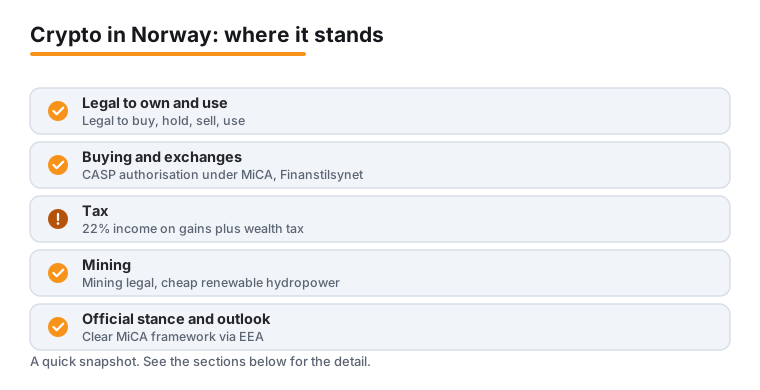
- Legal: Legal to own and trade, not legal tender; MiCA transposed via Crypto-Assets Act
- Tax: Gains taxed as capital income at 22%; crypto also included in annual wealth tax
- Buying: Via MiCA-authorised CASPs in Norway or passporting EEA firms, after KYC
Norway is one of Europe's most digitally advanced, high-trust economies, and its approach to Bitcoin and cryptocurrency reflects that: open to the technology, but firmly focused on consumer protection, anti-money-laundering controls, and tax transparency. Owning, trading, and using crypto is legal, but it is not legal tender. The Norwegian krone (NOK) remains the only official currency, and the central bank, Norges Bank, decided on 10 December 2025 that introducing a central bank digital currency is not currently warranted, and it published a final research report in the first quarter of 2026 while continuing to study the topic.
The biggest change in recent years is that Norway now has a dedicated crypto law. The Act on Crypto-Assets (in Norwegian, lov om kryptoeiendeler, often called the Crypto-Assets Act) entered into force on 1 July 2025 and implements the European Union's Markets in Crypto-Assets Regulation (MiCA) into Norwegian law through the European Economic Area (EEA) Agreement. This guide explains where Norway stands in 2026 on the legal status of crypto, who regulates it, how it is taxed, the rules for exchanges and service providers, mining, and what to weigh before investing. It is general information as of 2026 and is not legal, tax, or financial advice; always verify current details with the named official regulators, Finanstilsynet (the Financial Supervisory Authority of Norway) and Skatteetaten (the Norwegian Tax Administration), before acting. See also our overview of how crypto regulation works.
On this page: Legal status · Who regulates it · Taxes · How to buy · Mining
Is Bitcoin and crypto legal in Norway?
Yes. Buying, holding, selling, and using Bitcoin and other crypto-assets is legal in Norway. There is no ban on individuals owning digital assets or on businesses choosing to accept them.
However, crypto is not legal tender. The Norwegian krone (NOK) is the only official currency, and no merchant is obliged to accept Bitcoin as payment. For tax purposes, Norway's tax authority treats virtual assets as capital assets rather than as money. The central bank, Norges Bank, assessed a central bank digital currency (CBDC) and, on 10 December 2025, concluded that introducing one is not currently warranted, citing an efficient existing payment system; it continues to research the area and left the door open to reconsider if conditions change.
The practical effect is that ordinary users have wide freedom, while the heaviest obligations fall on the companies that operate as intermediaries: exchanges, custodians, brokers, advisers, and asset managers serving customers. These firms must now be authorised as crypto-asset service providers and must verify customer identities and comply with anti-money-laundering (AML) law.
Who regulates crypto in Norway?
The main regulator is Finanstilsynet, the Financial Supervisory Authority of Norway. Finanstilsynet has been appointed as the competent authority for MiCA in Norway and is responsible for authorising and supervising crypto-asset service providers, as well as for anti-money-laundering oversight of the sector. Its dedicated crypto pages are the primary place to check current rules and to confirm whether a given firm is authorised.
Two other public bodies matter for crypto users:
- Skatteetaten (the Norwegian Tax Administration) sets out how crypto is taxed and how you must declare holdings and transactions in your tax return.
- Norges Bank, the central bank, does not regulate individual crypto firms but monitors financial-stability risks from crypto-assets and conducts the CBDC research mentioned above.
You can read more general background in our guide to crypto regulation and on our regulation hub.
Key laws and frameworks
Norway is not an EU member, but it is part of the EEA, so it adopts much of the EU's financial rulebook. The central instrument for crypto is the EU's MiCA regulation (Regulation (EU) 2023/1114 on markets in crypto-assets), which Norway has transposed through its Act on Crypto-Assets (lov om kryptoeiendeler), in force since 1 July 2025, together with implementing regulations.
What MiCA covers in Norway:
- Authorisation and supervision of crypto-asset service providers (CASPs), including governance, custody, conduct, and market-abuse rules.
- Issuer rules for crypto-assets, including specific requirements for stablecoins and other asset-referenced or e-money tokens.
- An important carve-out: crypto-assets that qualify as financial instruments are not covered by MiCA and are instead regulated under existing securities legislation (the kind of rules that mirror the EU's MiFID II), so the classification of a token matters.
Alongside MiCA, transfers of crypto-assets are subject to information-sharing requirements (the EU funds-transfer or "travel rule" framework) designed to trace the originator and beneficiary of transfers. Because this is a young and evolving body of law, always check Finanstilsynet's current guidance rather than relying on older summaries.
Licensing and registration of exchanges and service providers
Before MiCA, Norwegian rules applied only to providers of exchange and custody services for virtual currencies, which since 2018 had to register with Finanstilsynet under the Anti-Money Laundering Act. MiCA goes much further: as a general rule, anyone offering crypto-asset services in the EEA (including custody, operating a trading platform, exchange, execution, placing, advice, or portfolio management) needs full authorisation as a CASP and must have a physical presence in the EEA.
Key transition points for 2026:
- Transition for existing providers. Firms that lawfully offered crypto services before 30 December 2024 were allowed to keep operating during a transition window while applying for full CASP authorisation. That window runs until 1 July 2026, or until the firm is granted or refused authorisation, whichever comes first; the arrangement was confirmed by a regulation adopted around 19 December 2025. From 1 July 2026, a firm without CASP authorisation can no longer legally serve customers in the EEA, so the licensing landscape is still actively changing.
- Authorisations are being granted. AK Jensen Norway AS became the first firm in Norway allowed to offer crypto-asset services under MiCA, with effect from 2 February 2026; because it is an investment firm, it can provide certain crypto services (order transmission and portfolio management) under MiCA Article 60 without a separate CASP authorisation. Full CASP authorisations for trading platforms followed in mid-2026: Tyr Markets AS was authorised on 18 May 2026, and Firi AS, the largest crypto exchange in the Nordics, was authorised on 22 May 2026, both to operate a crypto-asset trading platform under MiCA Article 63. Others are working through the process.
- EEA passporting. A firm authorised in Norway can, after notification, provide services across the EEA without a separate licence in each country, and firms authorised elsewhere in the EEA can serve Norwegian customers.
Because authorisations are being issued on a rolling basis and the transition rule has moved, verify a specific provider's current status directly with Finanstilsynet before using it.
Crypto and Bitcoin tax in Norway
Norway taxes crypto comprehensively. Skatteetaten treats virtual assets as capital assets, not as currency. There are two distinct layers, and the tax authority publishes official guidance on both:
- Income on gains. Norway does not have a separate capital-gains tax; instead, gains on crypto are taxed as capital income at the ordinary rate of 22 percent. When you sell, swap, or otherwise dispose of crypto, the taxable gain is the difference between the output value and your input value, adjusted for transaction costs. Losses are generally deductible. Mining and staking rewards are taxable income regardless of the protocol used, and related costs (such as hardware, electricity, and platform fees) may be deductible.
- Wealth tax. Norway levies an annual wealth tax. The market value of your crypto, assessed as at 1 January in the year after the income year, is included in your net wealth. For the 2026 income year, wealth tax applies to net assets above 1,900,000 NOK for individuals and 3,800,000 NOK for spouses assessed jointly, at a combined rate of 1.0 percent on the amount above the threshold (0.35 percent municipal plus 0.65 percent state), rising to 1.1 percent on net wealth above 21,500,000 NOK. Thresholds and rates change, so confirm the current figures with Skatteetaten.
You must declare crypto holdings and any gains or losses in your annual tax return, which must be filed and corrected within the deadlines Skatteetaten sets each year. Skatteetaten generally recommends the FIFO (first-in, first-out) method for cost basis. Keep detailed records of every transaction (dates, amounts, NOK value, and fees). This guide avoids quoting other fixed numbers because they change; see our general crypto tax overview and confirm specifics with Skatteetaten. This is not tax advice.
AML, KYC, and the travel rule
Anti-money-laundering compliance is central to Norway's crypto regime. Crypto-asset service providers must apply customer due diligence, verify customer identity, monitor transactions, and report suspicious activity, consistent with Norwegian and EEA anti-money-laundering law. Finanstilsynet supervises this compliance.
For users, this means:
- Identity verification (KYC). Expect to provide ID and, often, proof of address before you can trade, deposit, or withdraw on a regulated platform.
- Travel rule. Transfers of crypto-assets are subject to information-sharing requirements that accompany the transfer with details of the originator and beneficiary, in line with the EU funds-transfer framework.
- Bank scrutiny. Some Norwegian banks apply extra checks to crypto-related transfers for AML reasons. This is normal and is not a sign that crypto is illegal.
These obligations sit on the service providers, not on ordinary holders, but they shape the everyday experience of buying and moving crypto.
Buying and using crypto in practice
Norwegians can buy crypto through international and regional exchanges, brokers, and some banking or fintech apps. A typical, compliant path looks like this:
- Choose an authorised provider. Prefer platforms authorised as a CASP under MiCA (in Norway or elsewhere in the EEA under passporting) that support NOK and serve Norwegian residents. Authorisation signals oversight on custody, conduct, and AML; check the status with Finanstilsynet.
- Verify your identity. Complete KYC with your ID and any required documents.
- Fund your account. Many platforms support NOK deposits and withdrawals by bank transfer or card; compare fees and supported methods.
- Secure your holdings. Enable two-factor authentication, and for larger amounts consider a hardware (cold) wallet you control, with your recovery phrase backed up offline. Self-custody shifts security responsibility to you but reduces counterparty risk.
- Record everything. Log purchase dates, amounts, NOK values, and fees so you can meet Skatteetaten's reporting and wealth-tax requirements.
Crypto can in principle be used for cross-border transfers, but volatility, on-ramp and off-ramp fees, AML and travel-rule requirements, and the fact that converting crypto can be a taxable event mean it is not automatically cheaper or simpler than established services. Compare total cost case by case. This is not financial advice.
Bitcoin mining in Norway
Norway has been an attractive location for crypto mining and data centres because of its abundant, low-cost, and overwhelmingly renewable electricity (primarily hydropower) and a cold climate that aids cooling. This is the kernel of truth behind the "green mining" narrative often attached to Norway.
Mining itself is legal, but it is not free of obligations:
- Tax. Skatteetaten treats mining rewards as taxable income regardless of the consensus protocol used, while related costs such as hardware and electricity may be deductible.
- Energy-policy scrutiny. Norwegian authorities and local communities have debated whether energy-hungry crypto mining is the best use of clean power, especially where it competes with households and industry, and some local measures and changes to electricity-tax advantages have made large-scale mining less automatically favourable than before.
- Business and data-centre rules. Commercial miners face ordinary business registration and taxation, and larger operations may face registration, reporting, or zoning requirements as data centres.
Anyone planning a commercial operation should check current electricity pricing, local regulations, and tax treatment before committing.
Recent developments (2025-2026)
The pace of change has been rapid:
- 1 July 2025: Norway's Act on Crypto-Assets entered into force, transposing MiCA and appointing Finanstilsynet as the competent authority.
- 10 December 2025: Norges Bank decided that a digital krone (CBDC) is not currently warranted, pointing to Norway's efficient payment system, while keeping the option open for the future.
- 19 December 2025: a regulation confirmed the transition arrangement, letting firms that operated before 30 December 2024 continue until 1 July 2026 while they seek full CASP authorisation.
- 2 February 2026: AK Jensen Norway AS became the first firm cleared to offer crypto services under MiCA in Norway, as an investment firm using MiCA Article 60 rather than a standalone CASP licence.
- 18 and 22 May 2026: Tyr Markets AS and then Firi AS received full CASP authorisations under MiCA Article 63 to operate crypto-asset trading platforms; Firi is the largest crypto exchange in the Nordics. Three more followed: K33 Markets AS on 16 June 2026, and Bare Bitcoin AS and Norwegian Block Exchange AS in June 2026, taking the register to six Norwegian firms as of 3 August 2026. Firms authorised in any other EEA state can also serve Norwegian customers cross-border on a MiCA passport without a separate Norwegian licence.
- Throughout 2025-2026: Finanstilsynet has been implementing the detailed level-2 rules and ESMA guidelines under MiCA (covering matters such as how to classify a token and fit-and-proper assessments for issuers and CASPs).
Norway has also been tightening tax transparency for crypto, moving in step with broader European efforts on third-party reporting by crypto service providers. The authorised list changes as applications are decided, so check the firm in Finanstilsynet's CASP register and in ESMA's MiCA register before you deposit funds. Those two registers, not a platform's own marketing, decide whether it may legally serve you.
Consumer risks and protection
MiCA brings clearer rules and stronger consumer protection through authorisation, governance, custody, and market-abuse requirements. That is positive for legitimacy, but it does not remove market risk. Key risks to keep in mind:
- Volatility. Crypto prices can move sharply and assets can lose substantial value; only commit money you can afford to lose.
- Scams and fraudulent platforms. Verify a provider's authorisation status with Finanstilsynet before depositing funds, and be alert to phishing and impersonation.
- Tax complexity. The combination of a 22 percent income rate on gains and an annual wealth tax on holdings means crypto can create tax obligations even in years when you do not sell; accurate records are essential.
- Transition uncertainty. The transition window closed on 30 June 2026, so from 1 July 2026 a platform either holds an authorisation from Finanstilsynet, or is passported in from another EEA state, or cannot lawfully serve Norwegian customers. On 24 June 2026 Finanstilsynet told unauthorised providers to stop onboarding new customers and wind down in an orderly way.
Consider speaking with a licensed Norwegian financial or tax adviser before making significant investments. This content is informational only and is not legal, tax, or financial advice.
Official sources and how to verify
This guide reflects the situation as of 2026 and is general information, not legal advice. Always confirm the current rules, deadlines, and the authorisation status of any firm with the named official regulators before acting. The most authoritative starting points are:
- Finanstilsynet (the regulator): its dedicated crypto-assets and MiCA pages at Finanstilsynet, kryptoeiendeler (MiCA).
- Skatteetaten (the tax authority): its virtual-assets guidance at Skatteetaten, virtual assets and tax.
- ESMA (the EU body whose guidelines Norway applies through the EEA): its overview at ESMA, Markets in Crypto-Assets Regulation (MiCA).
For broader context on this site, see our crypto regulation guide, our crypto tax guide, and the regulation hub.
August 2026 status: the transition window has closed
The transitional rule in the Crypto-Assets Act let previously registered providers keep operating only until 30 June 2026. That window has closed. Since 1 July 2026 a platform must hold an authorisation from Finanstilsynet, or be passported into Norway from another EEA state, to serve Norwegian customers lawfully. In a statement published on 24 June 2026, Finanstilsynet told unauthorised providers to wind down immediately and in an orderly manner, stop onboarding new customers, limit services to what is strictly necessary for that wind-down, and communicate timelines clearly to customers. It told customers to check authorisation with Finanstilsynet or in ESMA's register.
| Firm | Authorised | Basis and services |
|---|---|---|
| AK Jensen Norway AS | 2 February 2026 | MiCA Article 60 notification by an existing investment firm: reception and transmission of orders, and portfolio management of crypto-assets |
| Tyr Markets AS | 18 May 2026 | MiCA Article 63: custody and administration, exchange for funds, exchange for other crypto-assets, transfer services |
| Firi AS | 22 May 2026 | MiCA Article 63. Finanstilsynet described it as the first crypto-asset service provider operating a trading platform to be authorised under Article 63 |
| K33 Markets AS | 16 June 2026 | MiCA Article 63: custody and administration, execution of orders, transfer services |
| Bare Bitcoin AS | June 2026 | MiCA Article 63. In the register, but Finanstilsynet published no news item, so the exact date is not confirmed by a primary source |
| Norwegian Block Exchange AS (NBX) | June 2026 | MiCA Article 63, announced on 30 June 2026 covering seven services including operating a trading platform and custody |
That is six Norwegian firms in the MiCA register as of 3 August 2026, against three named earlier on this page. The count comes from a third-party mirror of ESMA's CASP register synced on 3 August 2026, cross-checked against Finanstilsynet's own announcements and company filings. A MiCA authorisation granted in any EEA state also lets a firm serve Norwegian customers cross-border, so several large foreign exchanges operate here on a passport rather than a Norwegian licence. The Finanstilsynet CASP page sets out the processing timelines: 25 working days for the initial completeness check, then 40 working days to decide an Article 63 application, and 40 working days for an Article 60 notification once it is complete.
Your exchange now reports your holdings to Skatteetaten
Since 1 January 2026, crypto exchange and custody providers with a connection to Norway have a legal duty to collect information about their users and transactions and report it annually to Skatteetaten as third-party data. This is Norway's implementation of the OECD Crypto-Asset Reporting Framework, an agreement Norway signed on 27 November 2024.
- Legal basis: skatteforvaltningsloven section 7-12, with the detailed rules in skatteforvaltningsforskriften sections 7-12-1 to 7-12-9.
- Who reports: providers of exchange and custody services for crypto-assets with a connection to Norway.
- What is reported, per user: crypto-to-fiat exchanges, crypto-to-crypto exchanges, transfers for goods or services above USD 50,000, other transfers, and holdings, together with user identification and tax residency, amounts, unit counts and transaction numbers, and holdings values as at 1 January. See Skatteetaten's guidance for providers.
- First filing: 10 February 2027, covering calendar year 2026.
Skatteetaten said on 17 April 2026 that it will for the first time receive systematic information directly from crypto providers, that the risk of being discovered increases significantly for owners who hold crypto but do not report it, and that Norwegians reported crypto worth 34.7 billion kroner for the 2024 income year. Returns can be amended up to three years back, and those who correct before a control can avoid the additional tax charge. Reporting by your provider does not remove your own duty to declare wealth at year end and gains or losses on disposal.
What is coming next, and roughly when
| Measure | Stage | Timing | What it would mean |
|---|---|---|---|
| EU anti-money laundering package: Regulation (EU) 2024/1624 and the new EU-level supervisor | Norwegian consultation held, not adopted, and not yet incorporated into the EEA Agreement | Consultation ran 23 January to 30 April 2026. The EU rules enter into force on 1 January 2027. No Norwegian date set. | A rewritten Norwegian AML regime with directly applicable EU obligations on crypto firms. Until then hvitvaskingsloven, including the 2025 amendments implementing the crypto travel rule under Regulation (EU) 2023/1113, is the operative law. |
| Review of MiCA itself | European Commission targeted consultation, open now | Opened 20 May 2026, deadline extended to 30 September 2026. A Commission report under MiCA Articles 140 and 142 follows. | Any MiCA amendment would reach Norway through the EEA Agreement and the kryptoeiendelsloven. Scope, stablecoin rules and CASP obligations are all within the consultation. |
| Ban on establishing data centres for cryptocurrency | Requested by Stortinget. No bill or consultation found | Adopted 12 March 2026. No delivery deadline set. | Would affect new mining facilities only. The government has signalled a limited state planning rule rather than a general ban, citing the EEA Agreement. |
| Digital krone (CBDC) | Not proceeding for now | Norges Bank published its final Phase 5 reports in March 2026, following its December 2025 decision | No retail digital krone. Norges Bank concluded that introducing one is currently not warranted but may be in future, and continues work on tokenisation. No reassessment date has been given. |
Mining and data centres: what actually restricts you
Mining is legal in Norway and needs no crypto-specific licence, but three things matter more to a prospective operator than the tax treatment.
- Zoning. Borgarting lagmannsrett decided case LB-2024-139780 on 9 April 2025 that crypto mining does not qualify as industri under planning rules, because industry involves transforming physical inputs into marketable products. The state won and a planned facility in Hadsel in Nordland was refused. Projects sited on industrially zoned land are exposed to the same argument.
- Data centre registration. Data centre operators must register with Nkom under the Electronic Communications Act. Registration is a notification duty rather than an approval, so activity can start immediately. The threshold is 0.5 MW of subscribed electrical power, and the registration form asks for an estimate of the percentage of power consumption used for cryptocurrency mining. From 1 July 2026, FOR-2026-06-22-1320 also requires operators to keep current customer records including names, addresses and where the customer's equipment sits in the facility, to disclose that to the police or prosecuting authority where necessary, and to keep a representative in Norway.
- The proposed ban. On 12 March 2026 Stortinget asked the government to return with a proposal for a ban on establishing data centres for cryptocurrency, following Innst. 140 S (2025-2026) of 24 February 2026, backed by Labour, the Progress Party, the Conservatives, the Socialist Left, the Centre Party, Red and the Greens. A national concession scheme for data centres did not win a majority. In December 2025 the digitalisation minister said a general ban is difficult to justify under the EEA Agreement and that the government was examining a state planning rule imposing a temporary and limited ban on new power-intensive crypto data centres instead, and in a written answer of 12 January 2026 she said that work was targeted for early 2026. No bill or public consultation could be found as of 3 August 2026.
Frequently asked questions
Is cryptocurrency legal in Norway?
Yes. Buying, holding, selling, and using crypto is legal for individuals and businesses. However, it is not legal tender, so no one is required to accept it as payment. Since 1 July 2025, crypto-asset service providers must be authorised under Norway's Act on Crypto-Assets, which implements the EU's MiCA regulation, and are supervised by Finanstilsynet.
Who regulates crypto in Norway?
Finanstilsynet, the Financial Supervisory Authority of Norway, is the competent authority for crypto-asset service providers under MiCA and for anti-money-laundering supervision. Tax matters are handled by Skatteetaten, the Norwegian Tax Administration. You can verify a firm's authorisation status on Finanstilsynet's crypto-assets pages.
Does Norway follow the EU's MiCA rules?
Yes. Although Norway is not an EU member, it is part of the EEA and has transposed the EU's MiCA regulation through its Act on Crypto-Assets (lov om kryptoeiendeler), in force since 1 July 2025. A transition arrangement, extended in late 2025, has allowed previously registered providers to keep operating while they obtain full CASP authorisation, so check a provider's current status.
How is crypto taxed in Norway?
Skatteetaten treats crypto as a capital asset. Gains are taxed as capital income at the ordinary 22 percent rate, and losses are generally deductible; mining and staking rewards are taxable income. Crypto holdings are also included in Norway's annual wealth tax, valued at market price as at 1 January of the following year. You must declare holdings and transactions in your tax return. Confirm current rates and the wealth-tax threshold with Skatteetaten.
Do crypto exchanges need a licence in Norway?
Yes. Under MiCA and Norway's Act on Crypto-Assets, firms offering services such as custody, exchange, operating a trading platform, advice, or portfolio management generally need authorisation as a crypto-asset service provider (CASP) and must have a physical presence in the EEA. AK Jensen Norway AS was cleared to offer crypto services under MiCA from 2 February 2026 as an investment firm, and full trading-platform CASP authorisations followed in May 2026 for Tyr Markets AS and Firi AS. More are being processed during the transition, which runs until 1 July 2026.
Is Bitcoin mining allowed in Norway?
Yes, mining is legal, and Norway's cheap renewable hydropower and cold climate make it attractive for sustainable operations. However, mining rewards are taxable income, commercial miners face business registration and possible data-centre requirements, and authorities have debated the energy use of large-scale mining, with some electricity-tax advantages removed.
Where can Norwegians buy crypto legally?
Norwegian residents can use exchanges and brokers that are authorised as crypto-asset service providers under MiCA, either authorised in Norway or passporting in from elsewhere in the EEA. Firi AS, the largest crypto exchange in the Nordics, received full CASP authorisation from Finanstilsynet on 22 May 2026 and supports Norwegian customers. Before depositing funds, confirm a platform's authorisation status on Finanstilsynet's crypto-assets pages, since firms are still moving through the transition that ends on 1 July 2026.
Is Norway launching a digital krone?
Not for now. On 10 December 2025, Norges Bank decided that a central bank digital currency is not currently warranted, pointing to Norway's efficient and secure existing payment system, and it published a final research report in early 2026. The central bank said it may reconsider if conditions change, so a digital krone is paused rather than ruled out permanently. A CBDC would be separate from private crypto-assets such as Bitcoin.
Do I pay tax on crypto in Norway if I do not sell?
You can. Norway levies an annual wealth tax, so the market value of your crypto as at 1 January is added to your net wealth, and tax may apply if your total net assets exceed the threshold (1,700,000 NOK for individuals in 2025 and 2026) even in a year when you make no sales. Separately, gains from selling or swapping crypto are taxed as capital income at 22 percent, and mining or staking rewards are taxable when received. Confirm current thresholds and rates with Skatteetaten.
Is crypto legal in Norway in August 2026?
Yes. Buying, holding, selling and mining crypto are legal. The Norwegian krone remains the only official currency, so nobody is obliged to accept crypto as payment. What changed on 1 July 2026 is the platform side: the transitional rule under the Crypto-Assets Act ran only until 30 June 2026, so a service provider must now hold an authorisation from Finanstilsynet or be passported in from another EEA state.
Which crypto platforms are actually licensed in Norway right now?
Six Norwegian firms appeared in the MiCA register as of 3 August 2026: AK Jensen Norway AS (2 February 2026, under MiCA Article 60 as an investment firm), Tyr Markets AS (18 May 2026), Firi AS (22 May 2026), K33 Markets AS (16 June 2026), Bare Bitcoin AS (June 2026) and Norwegian Block Exchange AS (June 2026). Foreign exchanges authorised elsewhere in the EEA can also serve Norwegian customers on a MiCA passport. Check Finanstilsynet's CASP register and ESMA's MiCA register before depositing.
Does my exchange report my crypto to the Norwegian tax authority?
Yes, if it has a connection to Norway. Since 1 January 2026, exchange and custody providers must report user holdings and transactions to Skatteetaten as third-party data under skatteforvaltningsloven section 7-12. The first report covers calendar year 2026 and is due on 10 February 2027. This is Norway's implementation of the OECD Crypto-Asset Reporting Framework, which Norway signed up to on 27 November 2024. You still have to declare your holdings and disposals yourself.
Is Bitcoin mining banned in Norway?
No. Mining is legal and needs no crypto licence. On 12 March 2026 Stortinget asked the government to come back with a proposal for a ban on establishing data centres for cryptocurrency, but no bill or public consultation could be found as of 3 August 2026, and in December 2025 the responsible minister said a general ban is difficult to justify under the EEA Agreement. The bigger practical obstacles today are planning law, after Borgarting lagmannsrett ruled in April 2025 that crypto mining is not industri for zoning purposes, and access to grid capacity.
What crypto tax rate applies in Norway?
Gains on disposal, including crypto-to-crypto swaps and spending crypto, are taxed as general income at 22 percent, and losses are generally deductible. Holdings are also included in net wealth: for 2026 the wealth tax threshold is 1,900,000 NOK for individuals and 3,800,000 NOK for spouses assessed jointly, at a combined 1.0 percent above the threshold and 1.1 percent above 21,500,000 NOK.
Facts reviewed: 3 August 2026. Page updated: 3 August 2026.