Home › Crypto Regulation › Finland
Bitcoin & Cryptocurrency Regulation in Finland
Quick answer — Finland, 2026
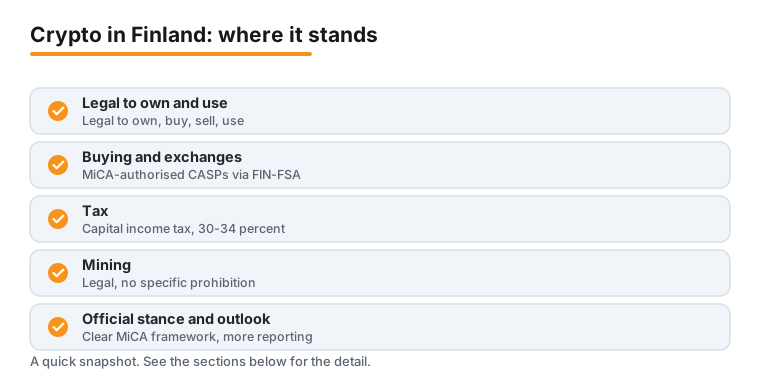
- Legal: Legal to own and use, not legal tender, regulated under MiCA
- Tax: Gains taxed as capital income, 30 percent up to 30,000 euros then 34 percent
- Buying: Via MiCA-authorised CASPs, SEPA or card, some Bitcoin ATMs
Finland treats Bitcoin and other crypto-assets as legal to own, buy, sell, hold and use, while tightly regulating the businesses that provide crypto services to the public. As a European Union and euro-area member state, Finland applies the EU's Markets in Crypto-Assets Regulation (MiCA) on top of its own anti-money-laundering and tax rules. The Financial Supervisory Authority (FIN-FSA, in Finnish Finanssivalvonta) authorises and supervises crypto-asset service providers, while the Finnish Tax Administration (Verohallinto, commonly called Vero) sets out how crypto is taxed. For 2026 the two biggest themes are the bedding-in of MiCA licensing after Finland's unusually short transition period, which ended on 30 June 2025, and the start of far broader tax-reporting obligations for platforms.
This guide explains Finland's current crypto legal status, who regulates the sector, the key laws, how exchanges are licensed, how crypto is taxed, the AML and KYC rules, and the practicalities of buying, using and mining crypto. The information here is general and current as of 2026; it is not legal, tax or financial advice, and you should verify any specific point with the named official regulator, the FIN-FSA, and with Vero or a qualified Finnish adviser before acting. See also our overview of crypto regulation and our country regulation hub.
On this page: Legal status · Who regulates it · Taxes · How to buy · Mining
Is Bitcoin and crypto legal in Finland?
Yes. Owning, buying, selling, holding and transferring Bitcoin and other crypto-assets is legal in Finland. There is no ban on individuals using cryptocurrency, and residents can freely hold crypto in self-custody wallets or with regulated providers.
What crypto is not is legal tender. The euro is Finland's official currency, and the FIN-FSA notes that crypto-assets are neither financial instruments nor a legal means of payment. No business is obliged to accept crypto, although merchants may choose to do so. The Bank of Finland (Suomen Pankki) has repeatedly described crypto-assets as high-risk and not real money. Because crypto is generally treated as property for tax purposes, selling or spending it can have tax consequences (see the taxation section).
While personal ownership is unrestricted, the provision of crypto services to the public is heavily regulated. Companies that exchange, hold, transfer or otherwise deal in crypto-assets for customers in Finland must be authorised, which is where MiCA and the FIN-FSA come in.
Who regulates crypto in Finland?
Crypto supervision in Finland is shared across a few authorities, each with a distinct role:
- Financial Supervisory Authority (FIN-FSA / Finanssivalvonta): the national competent authority that authorises and supervises crypto-asset service providers (CASPs) under MiCA, and previously ran the national registration regime for virtual-currency providers. Its official site is finanssivalvonta.fi.
- Finnish Tax Administration (Vero / Verohallinto): responsible for how crypto is taxed and reported. It publishes detailed guidance on virtual currencies at vero.fi.
- Bank of Finland (Suomen Pankki): the central bank and part of the Eurosystem. It does not license individual firms but contributes to financial-stability analysis and consumer warnings about crypto risk, and is involved in the wider European discussion on a possible digital euro.
For everyday users, the FIN-FSA is the authority to consult on whether a provider is allowed to operate, and Vero is the authority for tax questions. You can verify any of these via their official websites listed in the sources section below.
Key crypto laws and frameworks
Finland's crypto framework now rests primarily on the EU's Markets in Crypto-Assets Regulation (MiCA), which is directly applicable across all member states and creates a single rulebook for issuing crypto-assets and for licensing and supervising CASPs such as exchanges, brokers and custodians. MiCA's rules for crypto-asset service providers have applied since 30 December 2024.
Other relevant Finnish and EU instruments include:
- Act on Crypto-Asset Service Providers and Markets in Crypto-Assets (402/2024): the Finnish act implementing MiCA. It entered into force on 30 June 2024, with the provisions on crypto-asset service providers applying from 30 December 2024, and it expressly repealed the Act on Virtual Currency Providers (572/2019). Under its transitional provision, providers already registered with the FIN-FSA could continue under the repealed act only until 30 June 2025, or until they were granted authorisation under Article 59 of MiCA, whichever came first, and only if they had filed an application under Article 62 by 30 October 2024.
- Act on Preventing Money Laundering and Terrorist Financing (444/2017): Finland's main AML law, which made virtual-currency providers obliged entities and underpins customer due diligence and suspicious-transaction reporting.
- EU AML rules and the Transfer of Funds Regulation (the crypto travel rule): requiring information on the sender and recipient to accompany crypto transfers.
- Income Tax Act and Vero guidance on virtual currencies: the basis for crypto taxation (see below).
The Finnish act implementing MiCA is the Act on Crypto-Asset Service Providers and Markets in Crypto-Assets (402/2024), and the tax reporting act is the Act on the reporting obligation of reporting crypto-asset service providers in the field of taxation (1041/2025). Both are in force. The list of authorised firms does change, so check a provider's current status in the ESMA register or the FIN-FSA register before using it.
Licensing and registration of exchanges (CASPs)
Under MiCA, only firms that hold authorisation as a crypto-asset service provider may offer crypto services to customers in Finland. Authorisation is granted either by the FIN-FSA (for firms based in Finland) or by another EU or EEA regulator that then passports the authorisation into Finland after notifying the FIN-FSA of cross-border service provision. A single MiCA authorisation is valid across the whole EU.
Finland chose one of the shortest transitional periods in Europe. Existing virtual-currency providers registered under the 2019 Act could continue operating only until they obtained a CASP authorisation or until the national transition period ended on 30 June 2025, whichever came first. After that date, providers without authorisation may no longer offer crypto services in Finland.
The MiCA regime imposes substantive obligations on CASPs, including requirements on management competence and governance, minimum own funds, custody and safeguarding of client assets, information security, transparency and disclosures, and conduct-of-business and market-abuse rules. According to the FIN-FSA, in July 2025 Coinmotion became the first company authorised in Finland as a CASP under MiCA. Further authorisations followed during 2025, including Kvarn Capital, Tesseract and NorthCrypto (the latter granted in late November 2025), and the FIN-FSA has stated that it granted crypto-asset service provider authorisations to five companies during 2025. Before using any platform, check its current status in the FIN-FSA's official register, because the list of authorised firms changes over time.
Crypto and Bitcoin taxation in Finland
Crypto is taxable in Finland, and the Finnish Tax Administration (Vero) publishes detailed guidance on virtual currencies. The main principles are summarised below, but always confirm the current figures on vero.fi or with a tax adviser. This is general information, not tax advice. See also our broader guide to crypto taxes.
- Capital income rates: Gains from disposing of crypto are taxed as capital income. Finland taxes capital income at 30 percent up to EUR 30,000 of annual capital income, and at 34 percent on the portion above EUR 30,000.
- Taxable events: Disposing of crypto triggers tax. This includes selling crypto for euros or another fiat currency, swapping one crypto-asset for another, and using crypto to pay for goods or services. Simply buying and holding is not taxed until you dispose of the asset.
- Small-sales exemption: Per Vero, capital gains are not taxable if the combined selling prices of all assets you dispose of during the tax year do not exceed EUR 1,000. This threshold covers total sales proceeds, not net gains.
- Deemed acquisition cost: If you cannot establish the original purchase price, Vero allows a deemed acquisition cost of 20 percent of the sale price (or 40 percent for assets held at least ten years) to be deducted instead of the actual cost.
- Capital losses: A loss on disposing of crypto is a deductible capital loss. Per Vero, capital losses can be set against capital gains in the same year and, if not fully used, carried forward for the following five years. Note that the small-sales rule works both ways: if your total sales proceeds for the year stay at or below EUR 1,000, neither the gains nor the losses are counted.
- Mining versus staking: Income from proof-of-work mining is treated as earned income, taxed when the reward becomes available to you. Staking and lending rewards are generally treated as capital income or capital gains.
- Records: Keep documentation of dates, amounts, euro values and counterparties. Vero advises retaining records for several years.
Crypto-tax software is widely used in Finland, but treat any figures it produces as a starting point to verify against Vero's official guidance.
AML and KYC rules
Anti-money-laundering rules are central to Finland's crypto regime. Crypto-asset service providers are obliged entities under the Act on Preventing Money Laundering and Terrorist Financing (444/2017) and under the EU AML framework, which means they must apply customer due diligence and identify their customers (KYC), monitor and assess transactions, keep records, and report suspicious transactions to the Financial Intelligence Unit at the National Bureau of Investigation.
In practice this is why opening an account with a Finnish or EU exchange requires identity verification, and why larger or unusual transactions can prompt additional checks or source-of-funds questions. The EU crypto travel rule also requires information about the sender and recipient to accompany crypto transfers between providers.
Finland's AML rulebook is itself being replaced. On 4 June 2026 the Government gave bill HE 105/2026 vp to Parliament, proposing a wholly new Act on Preventing Money Laundering and Terrorist Financing to repeal Act 444/2017 and implement the EU anti-money-laundering package. Finlex records it as pending. It is intended to enter into force mainly on 10 July 2027, when the EU Anti-Money Laundering Regulation begins to apply. From that point customer and beneficial owner identification is governed by the directly applicable EU regulation, whose Article 79 prohibits anonymous accounts. The practical effect for ordinary users is straightforward: expect to verify your identity, and expect regulated providers to ask questions about larger transfers.
Buying and using crypto in practice
A typical path for a resident buying Bitcoin or other crypto in Finland looks like this:
- 1. Choose a provider. Pick a MiCA-authorised exchange, broker or app that serves Finland, and cross-check its authorisation in the FIN-FSA's official register. Finland has domestic providers as well as international platforms operating under MiCA.
- 2. Open and verify an account. Complete KYC by providing identity documents, as required by AML rules.
- 3. Fund your account. Deposit euros via SEPA bank transfer, card or another supported method.
- 4. Place an order. Buy Bitcoin or another asset, comparing fees and spreads first.
- 5. Decide on custody. Leave assets with the regulated provider, or withdraw to your own wallet (a hardware wallet is sensible for larger amounts) and safeguard your recovery phrase.
- 6. Keep records. Save transaction details, dates and euro values for tax reporting to Vero.
Cash buyers can use a Bitcoin ATM, such as machines operated by Bittimaatti, although fees and spreads are usually higher than online. Using crypto to pay for goods or services is allowed where a merchant accepts it, but remember that spending crypto is a taxable disposal. Mentioning any provider is not an endorsement; compare options and verify authorisation yourself.
Bitcoin mining in Finland
Bitcoin mining is legal in Finland. There is no specific prohibition on running mining hardware, but miners operate within the country's general legal, tax, energy and environmental frameworks.
Finland has features that appeal to miners. A cold climate reduces cooling costs, and the country generates a large share of its electricity from low-carbon sources including hydropower, wind and nuclear, which appeals to operators seeking a lower-carbon footprint. Some projects also reuse waste heat from data centres for district heating.
The main practical constraint is electricity. Nordic power prices can be volatile and, at times, high, and electricity is subject to tax, so proof-of-work mining economics depend heavily on local rates. For tax, mining rewards are treated as earned income, so record the euro value of rewards when received; disposing of the coins later can create a further capital gain or loss. Anyone mining at scale should also consider business registration, VAT, grid-connection and environmental compliance, and seek professional advice.
Recent developments (2025-2026)
Two changes dominate the current picture:
- MiCA fully in force. Finland's national transition period for virtual-currency providers ended on 30 June 2025, one of the shortest in the EU. Since then only FIN-FSA-authorised CASPs (or firms passporting an EU authorisation) may serve Finnish customers. The FIN-FSA reported that Coinmotion was the first company authorised in Finland as a CASP under MiCA in July 2025, and by the end of 2025 several more Finnish providers had been authorised, including Kvarn Capital, Tesseract and NorthCrypto.
- Expanded tax reporting from 2026. This is now law, not a signal. The Act on the reporting obligation of reporting crypto-asset service providers in the field of taxation (1041/2025) entered into force on 1 January 2026 and applies first to the calendar year beginning 1 January 2026. Crypto-asset operators must register with the Tax Administration before the end of the calendar year their first report covers, so by 31 December 2026, and the first annual return covering 2026 is due by the end of January 2027. This reflects the EU's DAC8 directive and the OECD Crypto-Asset Reporting Framework (CARF), under which providers collect detailed user and transaction data and tax authorities exchange it internationally. In practice, crypto activity is becoming far more visible to the Finnish tax authorities.
The dates ahead are already fixed. The European Commission's targeted consultation on reviewing MiCA closes on 30 September 2026. The first platform reports covering 2026 are due to Vero by the end of January 2027. The EU Anti-Money Laundering Regulation applies from 10 July 2027, the date on which the pending Finnish bill HE 105/2026 vp is intended to enter into force. A digital euro pilot is planned for the second half of 2027, with any first issuance no earlier than 2029 and only if the Regulation is adopted. There is no proposal in Finland to prohibit holding or using crypto-assets.
Consumer risks and protection
MiCA tightens the rules for providers, but the FIN-FSA stresses that it does not remove the risks of crypto. Important points for consumers:
- Not all activities are covered. MiCA does not require providers to assess whether a product is suitable for you, and crypto holdings are not covered by the Investors' Compensation Fund or deposit guarantee schemes.
- Volatility and loss. Crypto prices can fall sharply, and you can lose your entire investment. Lost private keys, hacks, scams and platform failures can all cause permanent loss.
- Use authorised providers. Dealing with a FIN-FSA-authorised CASP offers the strongest available protections. Be wary of unauthorised platforms, especially those promising guaranteed or unusually high returns.
The FIN-FSA and the Bank of Finland both publish consumer warnings about crypto-asset risk. As a general rule, invest only money you can afford to lose, secure your keys, and verify a provider's authorisation before transacting.
Official sources and how to verify
Because crypto rules and figures change, verify the current position directly with the official authorities rather than relying on third-party summaries. The primary Finnish sources are:
- FIN-FSA (Finanssivalvonta): crypto-asset activities, for authorisation rules, the register of authorised CASPs, and consumer warnings.
- Finnish Tax Administration (Vero): virtual currencies, for how crypto income and gains are taxed and reported.
- Bank of Finland (Suomen Pankki), for central-bank analysis, financial-stability commentary and the digital-euro discussion.
For background reading on this site, see our crypto regulation guide, our crypto taxes guide, and the regulation hub. This guide is general information current as of 2026 and is not legal advice; always confirm the details that apply to you with the FIN-FSA and Vero or a qualified professional.
Finland in August 2026: what is true right now
No Finnish national crypto law changed between the page's 30 June 2026 review and mid-August 2026. Two EU-level dates did land at or just after that review, and both matter to people in Finland.
- 1 July 2026: the EU-wide MiCA transitional period ended. On 23 June 2026 ESMA issued a public statement (ESMA75-113276571-1710) calling on unauthorised crypto-asset service providers to wind down their EU activities in an orderly manner. Such providers must immediately stop onboarding new EU clients, refrain from opening new client relationships or accounts, cease marketing and solicitation, and limit services to what is necessary to sell or transfer crypto-assets, reallocate assets or close positions.
- Finland was already past this point. As the FIN-FSA put it in its news release 13/2026 of 30 June 2026, unlike in Finland, in some other European countries it was permitted to provide crypto-asset services without authorisation until 30 June 2026. Finland's own six-month national transition closed a year earlier, on 30 June 2025. The exposure for Finnish residents is therefore not domestic: it is assets sitting on foreign platforms that relied on another member state's longer transition.
- 28 July 2026: the last ESMA guidelines began to apply. The FIN-FSA announced this in supervision release 15/2026 of 30 March 2026, stating that with these guidelines the European regulatory framework for crypto-asset service providers is complete, the European Supervisory Authorities having issued all standards and guidelines required under Title V of MiCA.
The FIN-FSA's advice to consumers is specific: check the ESMA register to see whether your provider is authorised, and if it is not, transfer the customer relationship to an authorised provider that serves Finland. Where an unauthorised provider is in a third country, using it from Finland is only possible on the client's own initiative, and even then the provider no longer has the right to market other services or new crypto-assets to that client.
One further Finnish change sits just before this window. In its June 2026 thematic review the FIN-FSA notes that chapter 6 a of the Consumer Protection Act (38/1978), which governs the pre-contractual information crypto-asset service providers must give consumers, was amended with effect from 19 June 2026, and that providers must take the new requirements into account.
What is changing, and when
Finland has no crypto-specific bill of its own in Parliament: none of the 129 government bills listed on Finlex for 2026 concerns crypto-assets. The pipeline that will change things for holders, exchanges, banks and taxpayers is a mix of one Finnish bill and several EU instruments with fixed dates.
| Date | What happens | Stage | What it means in practice |
|---|---|---|---|
| 30 September 2026 | European Commission targeted consultation on the review of MiCA closes | Consultation open | Opened 20 May 2026, deadline 23:59 CEST. Run under MiCA Articles 140 and 142. Feeds a Commission report that may, if warranted, come with a proposal to amend MiCA. Nothing changes for holders yet. |
| End of January 2027 | First annual returns from crypto-asset operators reach the Finnish Tax Administration, covering 2026 | In force | Under Act 1041/2025. Operators must register with Vero before the end of the calendar year the report covers, so by 31 December 2026. Disposals become visible to Vero without self-declaration. |
| 10 July 2027 | The EU Anti-Money Laundering Regulation applies, and the Finnish implementing act is intended to enter into force | Bill pending in Parliament | HE 105/2026 vp, given 4 June 2026 and recorded as pending, would replace Act 444/2017 entirely and amend 30 other acts. Anonymous accounts are prohibited under Article 79 of the EU regulation. |
| Second half of 2027 | Digital euro pilot begins, running 12 months | Regulation not yet adopted | Selected payment service providers, merchants and Eurosystem staff. Finland's OP Retail Customers plc is among the 36 providers selected. The ECB will only decide to issue once the Regulation is adopted. |
| 2029 | Earliest possible first issuance of a digital euro | Conditional | The ECB aims to be ready during 2029, assuming the Regulation is adopted in 2026. A digital euro is central bank money, not a crypto-asset, and would not change crypto taxation. |
The named laws and guidance that actually apply
Finland does not rely on a single crypto statute. These are the instruments by name and number, which is what to quote if you need to check a point with the regulator or a Finnish adviser.
| Instrument | Status | What it governs |
|---|---|---|
| Act on Crypto-Asset Service Providers and Markets in Crypto-Assets, 402/2024 | In force 30 June 2024; crypto-asset service provider provisions from 30 December 2024 | Finland's MiCA implementing act. Makes the FIN-FSA the competent authority, sets sanctions, and repeals the Act on Virtual Currency Providers (572/2019). Its transitional provision ran only to 30 June 2025. |
| Act on the reporting obligation of reporting crypto-asset service providers in the field of taxation, 1041/2025 | In force 1 January 2026, first applied to the calendar year starting 1 January 2026 | Implements Directive (EU) 2023/2226 (DAC8) and the OECD Crypto-Asset Reporting Framework. Platform due diligence and annual reporting of user exchange and transfer transactions to Vero. |
| Act on Preventing Money Laundering and Terrorist Financing, 444/2017 | In force, but proposed for repeal by HE 105/2026 vp with effect from 10 July 2027 | Makes crypto-asset service providers obliged entities: customer due diligence, monitoring, record keeping and suspicious transaction reporting. |
| Vero guidance Kryptovarojen verotus, VH/3057/00.01.00/2025 | Issued 18 December 2025, valid from 18 December 2025 until further notice; replaced VH/5083/00.01.00/2019 | The Tax Administration's detailed crypto guidance for individuals and companies. Sets out the 1,000 euro exemption on total annual sales proceeds, the deemed acquisition cost of 20 percent (40 percent when held at least ten years), and the FIFO ordering rule, citing the Supreme Administrative Court decision KHO 2024:123. |
| ESMA Guidelines ESMA35-24871704-2922 | Issued 28 January 2026, applicable from 28 July 2026 | Knowledge and competence criteria for staff who give information or advice on crypto-assets. The FIN-FSA has confirmed it will comply, under section 25 of Act 402/2024. |
On the rates themselves, nothing changed for 2026. Vero states that the tax rate for capital income up to 30,000 euros is 30 percent and 34 percent on income above that. Proof-of-work mining is earned income; staking rewards are capital income.
One point the page does not currently make, and which matters more than the rates: a loss is only deductible if it arises from a disposal. Vero's guidance states that because crypto-assets are property but not securities under the Income Tax Act, a loss of crypto-assets cannot be deducted as a loss comparable to a capital loss under section 50(3). If crypto-assets are lost through the bankruptcy of a crypto-asset service provider, through fraud, or through loss of the wallet, that loss is not deductible in income taxation at all.
What the FIN-FSA found when it reviewed crypto marketing
In supervision release 33/2026 of 4 June 2026 the FIN-FSA published its first thematic review of the sector, carried out mainly through a data collection in autumn 2025 covering the crypto-asset service providers then authorised in Finland. It found several shortcomings, both in marketing and in the pre-contractual information required by the Consumer Protection Act. An English translation of the report was added to the release on 4 August 2026.
- Risk disclosure was generic. Risk descriptions gave the impression that the same risks attach to all crypto-assets, rather than differing by asset, asset type or service.
- Information material to customers was often hard to find, and getting to grips with the risks required the customer to take the initiative.
- Marketing leaned heavily on how fast and easy the services were to start using, and on the firm being Finnish and supervised by the FIN-FSA.
- Some information given about crypto-assets contained clear errors, and the line between stated fact and image-building narrative was at times unclear.
- Website information did not bring out the differences between crypto-asset types, so a potential customer could not distinguish established crypto-assets from newer, less liquid ones such as meme coins.
- Not every firm surveyed had internal marketing guidance; one had no approval process at all for its social media channels; only one had defined competence requirements for the people carrying out marketing.
- Some firms gave a significant part of the required pre-contractual information, such as the risk statement, only in the terms of use, which were easy to skip when taking the service into use.
In an accompanying blog post of 17 June 2026, the supervisor made a further point worth reading twice: firms stressed heavily that they are supervised by the FIN-FSA, which can give a misleading impression that the investment risk is small. The FIN-FSA also states that consumer protection in the sector has been weak and that MiCA has not significantly improved it, because the marketing requirements remain fairly general. The same post records that the FIN-FSA granted crypto-asset service provider authorisations to five companies during 2025. Firms authorised elsewhere in the EU or EEA may passport into Finland, but when marketing in Finland they must still follow Finnish law on marketing and pre-contractual information.
Frequently asked questions
Is Bitcoin legal in Finland?
Yes. Buying, holding, selling and transferring Bitcoin and other crypto-assets is legal in Finland. However, crypto is not legal tender (the euro is), so no one is required to accept it as payment, and businesses that provide crypto services to the public must be authorised under the EU's MiCA regulation and supervised by the FIN-FSA.
Who regulates cryptocurrency in Finland?
The Financial Supervisory Authority (FIN-FSA, or Finanssivalvonta) is the competent authority that authorises and supervises crypto-asset service providers under MiCA. The Finnish Tax Administration (Vero / Verohallinto) handles crypto taxation, and the Bank of Finland (Suomen Pankki) contributes financial-stability analysis and consumer warnings. Always check a provider's current authorisation in the FIN-FSA's official register.
How is crypto taxed in Finland?
Gains from selling, swapping or spending crypto are taxed as capital income, at 30 percent up to EUR 30,000 of annual capital income and 34 percent above that. Per Vero, gains are not taxable if your total sales proceeds for the year do not exceed EUR 1,000. Mining is taxed as earned income, while staking and lending rewards are generally capital income. If you cannot prove your purchase price, Vero allows a deemed acquisition cost (20 percent, or 40 percent for assets held at least ten years). Confirm current rules with Vero.
Do crypto exchanges need a licence in Finland?
Yes. Under MiCA, only firms authorised as crypto-asset service providers may serve customers in Finland, either authorised by the FIN-FSA or passporting an authorisation from another EU or EEA regulator. Finland's national transition period for older virtual-currency providers ended on 30 June 2025, and Coinmotion was reported as the first MiCA-authorised CASP in Finland in July 2025. Verify any platform in the FIN-FSA register before using it.
What changes for crypto in Finland in 2026?
From tax year 2026, the Finnish Tax Administration will receive increasingly extensive information on crypto trading, reflecting the EU's DAC8 directive and the OECD Crypto-Asset Reporting Framework (CARF). Providers collect detailed user and transaction data, and tax authorities exchange it internationally. In short, crypto activity is becoming much more visible to the tax authorities, so accurate record-keeping is essential.
Are my crypto holdings protected if a provider fails in Finland?
Not in the way bank deposits are. The FIN-FSA warns that MiCA does not eliminate crypto risk: providers are not required to assess whether a product suits you, and crypto holdings are not covered by the Investors' Compensation Fund or deposit guarantee schemes. Using a FIN-FSA-authorised provider offers the strongest available protections, but you can still lose money through volatility, hacks, scams or platform failure. Verify with the FIN-FSA before transacting.
Can I deduct crypto losses in Finland?
Yes. A loss from selling or otherwise disposing of crypto is a deductible capital loss in Finland. Per Vero, capital losses can be set against your capital gains in the same tax year and, if not used up, carried forward for the following five years. The EUR 1,000 small-sales rule applies both ways, so if your total sales proceeds for the year are EUR 1,000 or less, neither gains nor losses are counted. Confirm the current rules with Vero.
Which crypto exchanges are licensed in Finland?
Coinmotion was the first company authorised by the FIN-FSA as a crypto-asset service provider under MiCA in July 2025, and by the end of 2025 further Finnish providers had been authorised, including Kvarn Capital, Tesseract and NorthCrypto. A firm authorised in another EU or EEA country can also serve Finnish customers by passporting its authorisation. The authorised list changes over time, so always check a provider's current status in the FIN-FSA's official register before using it.
Did anything change for crypto users in Finland on 1 July 2026?
Not in Finnish law, but yes in practice if you use a foreign platform. As the FIN-FSA put it, from 1 July 2026 it is not permitted to provide crypto-asset services without authorisation anywhere in the EU or EEA. Finland's own national transition had already closed on 30 June 2025, so Finnish-authorised providers were unaffected. The risk sits with platforms that had been operating from another member state under a longer transition and did not obtain authorisation. ESMA's statement of 23 June 2026 requires such firms to stop onboarding EU clients, cease marketing and solicitation, and limit activity to letting clients sell, transfer, reallocate or close positions. The FIN-FSA recommends checking the ESMA register and moving to an authorised provider if yours is not listed.
When do Finnish crypto platforms start reporting my trades to the Tax Administration?
Collection started on 1 January 2026 and the first reports arrive in January 2027. The Act on the reporting obligation of reporting crypto-asset service providers in the field of taxation (1041/2025) entered into force on 1 January 2026 and applies first to the 2026 calendar year. Crypto-asset operators must register with the Tax Administration before the end of the calendar year the report covers, so by 31 December 2026, and the return covering 2026 is due by the end of January 2027. This implements the EU DAC8 directive and the OECD Crypto-Asset Reporting Framework, so data is also exchanged between countries. It does not change what is taxable, only how much Vero already knows.
Is Finland planning a new crypto-specific law?
No. None of the 129 government bills listed on Finlex for 2026 concerns crypto-assets. The two pieces of legislation that affect crypto are not crypto laws as such: the tax reporting act 1041/2025, already in force, and government bill HE 105/2026 vp, which would replace Finland's anti-money-laundering act. The substantive crypto rulebook is MiCA, which is EU law applying directly in Finland alongside the Act on Crypto-Asset Service Providers and Markets in Crypto-Assets (402/2024). Any future change to MiCA itself would come out of the European Commission review whose consultation closes on 30 September 2026.
What changes for crypto in the EU anti-money-laundering rules in 2027?
From 10 July 2027 the EU Anti-Money Laundering Regulation applies directly in every member state, replacing national transposition for customer and beneficial owner identification. Article 79 of that regulation prohibits providing customers with anonymous accounts and anonymous safe-deposit boxes. Finland's implementing bill, HE 105/2026 vp, was given to Parliament on 4 June 2026 and is intended to enter into force mainly on the same date, enacting a new anti-money-laundering act and repealing the current Act 444/2017. For an ordinary holder the practical effect is that identity verification becomes uniform across EU platforms rather than varying by country.
Do the people selling me crypto have to be qualified?
Since 28 July 2026, yes. ESMA guidelines ESMA35-24871704-2922, issued on 28 January 2026, set criteria for the knowledge and competence of staff at crypto-asset service providers who give information about crypto-assets and services, with extra requirements for those giving advice. They also cover people who prepare, determine or publish that information without being in direct contact with a client. The FIN-FSA has confirmed it will comply with the guidelines, which connect to section 25 of Act 402/2024. This matters because the FIN-FSA's own June 2026 review found that only one of the firms it surveyed had defined competence requirements for the people carrying out marketing.
Can I deduct crypto lost in an exchange collapse or a scam in Finland?
No. Vero's guidance is explicit that because crypto-assets are property but not securities under the Income Tax Act, a loss of crypto-assets cannot be deducted as a loss comparable to a capital loss under section 50(3). If your crypto-assets are lost through the bankruptcy of a crypto-asset service provider, through fraud, or because you lost the wallet, that loss is not deductible in income taxation. This is different from a loss made on an actual disposal, which is a normal deductible capital loss.
Facts reviewed: 13 August 2026. Page updated: 13 August 2026.