Home › Crypto Regulation › Denmark
Bitcoin & Cryptocurrency Regulation in Denmark
Quick answer — Denmark, 2026
- Legal: Legal to own and trade under EU MiCA, not legal tender
- Tax: Gains taxed as personal income; rate can reach around 52 percent
- Buying: Via MiCA-authorised EU providers with KYC
Denmark treats cryptocurrency as legal to own, buy, sell and hold, but it is not recognised as legal tender and it operates inside one of the European Union's stricter supervisory cultures. As an EU member state, Denmark applies the bloc-wide Markets in Crypto-Assets Regulation (MiCA) alongside its own established rules on anti-money-laundering, consumer protection and taxation. The result is a market that is open to ordinary investors and businesses, yet closely watched by the Danish Financial Supervisory Authority (Finanstilsynet) and the Danish Tax Agency (Skattestyrelsen).
This guide explains where crypto stands in Denmark for 2026: whether it is legal, who regulates it, the key laws, how exchanges are licensed, how it is taxed, the AML and KYC rules, and the practical steps for buying and using Bitcoin. It is written for residents and visitors who want a clear, current picture without hype. This is general information as of 2026 and is not legal, tax or financial advice; Danish and EU rules change frequently, so verify any decision with the named official regulator, Finanstilsynet, or a qualified Danish professional before acting. For broader background see our overview of crypto regulation.
On this page: Legal status · Who regulates it · Taxes · How to buy · Mining
Is Bitcoin and crypto legal in Denmark?
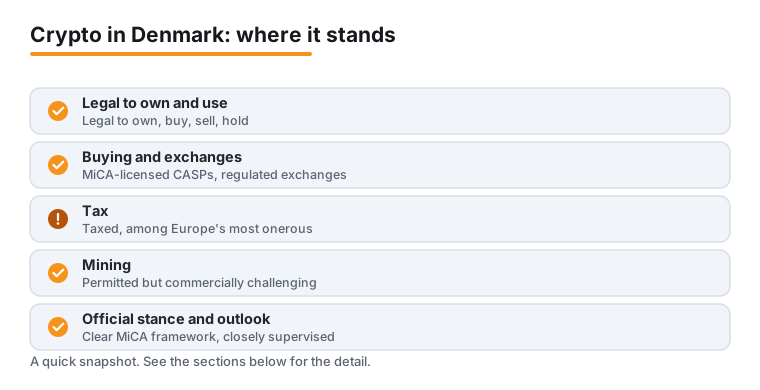
Yes. Buying, selling, holding and trading Bitcoin and other crypto-assets is legal for individuals and businesses in Denmark. There is no prohibition on owning digital assets, and Danish residents routinely use both domestic and international platforms to access the market.
What crypto is not is legal tender. The Danish krone (DKK) remains the only legal currency. The central bank, Danmarks Nationalbank, has consistently described crypto-assets as volatile and unsuitable as money, and has stressed that they are not covered by deposit guarantees or consumer-protection rules that apply to bank money. Merchants are free to accept Bitcoin voluntarily, but no one is obliged to take it as payment, and tax and accounting obligations still apply to such transactions.
In short, Denmark sits firmly in the legal-but-regulated camp shared by most of the EU. The freedom to participate comes with consumer-protection, anti-money-laundering and tax-reporting expectations that have grown more demanding over time.
Who regulates crypto in Denmark?
Three official bodies matter most:
- Finanstilsynet, the Danish Financial Supervisory Authority (Danish FSA). This is the lead financial regulator. It authorises and supervises crypto-asset service providers (CASPs) under MiCA and enforces anti-money-laundering rules in the financial sector. Its websites are finanstilsynet.dk and the English-language dfsa.dk.
- Skattestyrelsen, the Danish Tax Agency (part of Skat). It sets and enforces how crypto gains and income are taxed and reported.
- Danmarks Nationalbank, the central bank. It does not license crypto firms, but it issues analysis and consumer warnings on crypto risks and confirms that crypto is not legal tender.
Finanstilsynet is the practical point of contact for businesses seeking authorisation and for questions about whether a particular activity is regulated. Its published guidance also covers how it assesses when an offering is decentralised enough to fall outside parts of the rulebook.
Key laws and frameworks
The defining feature of Danish crypto regulation today is the EU's Markets in Crypto-Assets Regulation (MiCA). MiCA entered into force in 2023, and its rules for crypto-asset service providers and most tokens became applicable on 30 December 2024 (the rules for asset-referenced and e-money tokens applied earlier, from 30 June 2024). Because Denmark is an EU member, MiCA is directly applicable and forms the backbone of its framework, creating a single rulebook for exchanges, brokers, custodians and issuers across the bloc.
Alongside MiCA, Danish and EU anti-money-laundering law (implemented through Denmark's Anti-Money Laundering Act, the Hvidvaskloven) imposes customer due diligence and reporting duties. EU information-exchange and reporting rules increasingly require platforms to share customer data with tax authorities. Finanstilsynet maintains a dedicated MiCA section explaining the regime and reporting obligations; see Finanstilsynet's MiCA pages. Because this area is evolving, always confirm the current legal position against the official source rather than secondary summaries.
Licensing and registration of exchanges (CASPs)
Under MiCA, firms that professionally provide crypto services in or from Denmark must be authorised as a CASP by Finanstilsynet. Covered services typically include operating a trading platform, exchanging crypto for fiat or other crypto, custody and administration of crypto on behalf of clients, execution of orders, brokering, transfers, placement, and advice.
Authorisation generally requires a genuine operational presence in Denmark (local management and decision-making), minimum own-funds and governance arrangements set by MiCA, fit-and-proper checks on senior managers, a compliance function, and robust AML and CFT controls. Finanstilsynet has a reputation for applying these rules strictly, for example in how it evaluates claims of decentralisation.
Denmark applied the MiCA transitional window, which let providers already offering services before 30 December 2024 that applied for authorisation by that date keep operating for a period of up to 18 months, or until Finanstilsynet granted or refused the application. That window closed on 1 July 2026. Since then a provider serving Danish clients must already hold a crypto-asset service provider authorisation, and on 23 June 2026 ESMA told unauthorised providers to immediately stop onboarding new EU clients, cease marketing and wind down in an orderly way. Grandfathered providers are not yet fully licensed CASPs and cannot use MiCA's EU passport. Several platforms have already obtained MiCA authorisation through the Danish FSA, so the licensed market is taking shape. For consumers, the practical takeaway is to favour providers authorised in the EU.
Crypto and Bitcoin tax in Denmark
Denmark taxes crypto, and its treatment is widely regarded as one of the more onerous in Europe. Skattestyrelsen treats gains from crypto-assets as taxable, and individuals are generally expected to declare disposals such as selling crypto for kroner, swapping one token for another, or spending crypto. Income from activities like mining or staking can also be taxable. See also our general guide to crypto taxes.
Under the current rules, profits from disposing of crypto held by an individual are treated as personal income rather than as a lower flat-rate capital gain. Because personal income is taxed on a progressive scale, the rate depends on which band the gain falls in. From income year 2026 the tax ceiling on personal income is 44.57 percent, rising to 52.07 percent in the topskat band and 57.07 percent in the top-topskat band, in each case excluding labour market contribution and church tax. The 2026 thresholds are DKK 641,200 for mellemskat, DKK 777,900 for topskat and DKK 2,592,700 for top-topskat, measured after labour market contribution. Gains are calculated in Danish kroner, commonly using a first-in, first-out ordering of purchases. A well-known asymmetry applies to losses: under the current system a loss on one type of crypto can generally only be set against gains on the same type of asset, not freely against other income, which is one of the points the reform proposal below aims to change. Individual circumstances vary, so confirm the current figures and method with Skattestyrelsen or a Danish tax adviser before you file. The Danish tax year follows the calendar year, and crypto activity is reported through the annual tax assessment (arsopgorelse), with the personal filing deadline around 1 May and an extension to about 1 July available in many cases.
A few principles are worth understanding:
- Disposals are the usual trigger. Under the long-standing approach, simply holding crypto has not by itself created a tax bill; the taxable event arises when you dispose of the asset.
- Record-keeping matters. You are expected to keep accurate records of acquisition costs, dates and proceeds. Skattestyrelsen has increased its monitoring of digital-asset activity.
- Cross-border data sharing is expanding. In line with EU information-exchange rules, exchanges increasingly report customer transaction data to tax authorities, so under-reporting is risky. Denmark is implementing the EU DAC8 directive and the OECD Crypto-Asset Reporting Framework (CARF): crypto-asset service providers must carry out customer due diligence and report user and transaction data for activity from 1 January 2026, with the first reports to Skattestyrelsen due in early 2027 and onward exchange with other countries where users are tax resident.
A significant proposal has been under discussion that would move Denmark toward taxing crypto on a mark-to-market or inventory basis, potentially capturing unrealised gains. The proposal follows a recommendation from the Danish Tax Law Council (Skattelovradet) and, as reported, would tax gains at a rate of about 42 percent while allowing losses to offset gains more symmetrically across different crypto-assets. The reform has not been introduced as a bill and is not before the Folketing. What is settled law today is the existing speculation practice, under which gains are personal income and, following the Supreme Court judgment of 4 June 2025, losses are only a ligningsmaessigt fradrag with a tax value of about 26 percent, because personskatteloven section 3, subsection 2 sets out an exhaustive list of deductible losses that does not include them. Treat any specific number you see online with caution and verify the live position with Skat (Skattestyrelsen). This section is informational only and not tax advice.
AML and KYC rules
Crypto activity in Denmark sits inside the EU and Danish anti-money-laundering framework, enforced for the financial sector by Finanstilsynet under the Danish Anti-Money Laundering Act (Hvidvaskloven) and MiCA. In practice this means authorised CASPs and other obliged entities must:
- Verify customer identity (KYC): collect and check identity documents before providing services, and understand the source of funds where relevant.
- Monitor transactions for suspicious activity and apply enhanced checks to higher-risk situations.
- Report suspicious transactions to the Danish authorities, and keep records for the required retention periods.
For ordinary users this is why opening an account on a compliant platform involves identity verification, and why larger or unusual transactions can prompt additional questions. Fully anonymous use of regulated services is not available. EU rules also extend to information that must travel with crypto transfers between regulated providers.
Buying and using crypto in practice
Danish residents can buy crypto through international exchanges that serve the EU and through a growing set of platforms authorised under MiCA via the Danish FSA. Banks' willingness to support crypto-related transfers varies, so some users rely on SEPA euro transfers or payment cards. A typical, regulated path looks like this:
- 1. Choose a regulated platform. Prefer an exchange or broker authorised under MiCA in the EU that supports Danish customers and DKK or EUR funding.
- 2. Create and verify your account. Complete KYC by submitting identity documents; this is required under AML rules.
- 3. Deposit funds. Fund the account by bank transfer (SEPA), card, or another supported method, checking fees for each.
- 4. Place your order. Buy at the market price or set a limit order, and start small while you learn the interface.
- 5. Secure your holdings. Enable two-factor authentication and, for larger amounts, consider a personal or hardware wallet with the recovery phrase backed up offline.
- 6. Keep records. Save transaction details for tax reporting to Skattestyrelsen.
Merchants may accept crypto voluntarily, but it is not widely used for everyday payments, and every disposal can have tax consequences. Verify every address before sending, and be sceptical of platforms or advisers promising guaranteed returns, a common sign of fraud.
Bitcoin mining in Denmark
There is no specific ban on Bitcoin mining in Denmark, and operating mining hardware is legal. In practice, however, the country is not an obvious mining destination, and the main constraints are economic and environmental rather than a dedicated mining law.
The decisive factor is electricity. Denmark has relatively high consumer electricity prices, which makes energy-intensive proof-of-work mining hard to run profitably at small scale. The flip side is that Denmark is a leader in wind power and renewables, so operations that can secure low-cost or surplus renewable energy may find a more sustainable footing. Hardware efficiency and access to cheap power are the key profitability levers.
Anyone mining should also consider the surrounding obligations:
- Tax: Income or rewards from mining can be taxable; treatment depends on whether the activity is a hobby or a business, so check current guidance with Skattestyrelsen.
- Business and energy rules: Larger operations may face commercial, planning and electricity-market considerations.
- Environmental scrutiny: Denmark's strong climate focus means energy consumption attracts attention, reinforcing the case for renewable-powered, efficient setups.
In short, mining is permitted but commercially challenging for most, with sustainability and power costs the dominant concerns.
Recent developments (2025-2026)
Several threads define the current moment in Denmark:
- MiCA enforcement is now live. With the main rules applicable since 30 December 2024, Finanstilsynet is processing CASP authorisations, and licensed platforms have begun to appear. Denmark's grandfathering window for pre-existing providers runs until 1 July 2026, after which full authorisation is required to keep serving Danish customers.
- A possible overhaul of crypto taxation. Following a recommendation from the Danish Tax Law Council (Skattelovradet), Denmark has been considering taxing crypto on a mark-to-market or inventory basis, which could capture unrealised gains, apply a rate reported at about 42 percent, and allow more symmetrical loss offsets. This remains a proposal under parliamentary consideration as of 2026, not enacted law; watch the official sources for the final shape and timing.
- New crypto tax reporting rules. Under the EU DAC8 directive and the OECD CARF standard, Danish crypto-asset service providers must apply due diligence and report user and transaction data for activity from 1 January 2026, with the first reports due to Skattestyrelsen in early 2027 and information then exchanged with other countries. This markedly increases transparency for the tax authority.
- Expanding oversight. Alongside the new reporting rules, AML expectations under MiCA and the Hvidvaskloven continue to tighten.
Because these items are evolving, treat dates and figures as provisional and confirm them with the regulator before acting.
Consumer risks and protection
The Danish market is open but tightly supervised, and the main risks are familiar: price volatility, scams and phishing, platform or custodial failures, and an evolving tax regime. Crypto holdings are not covered by the deposit guarantee that protects bank balances, a point Danmarks Nationalbank and the Danish FSA have stressed repeatedly.
To reduce your exposure:
- Use authorised providers. A platform regulated under MiCA in the EU is subject to enforceable conduct, custody and disclosure standards and offers more recourse than an unregulated offshore venue. Regulation is not a guarantee against loss, but it materially improves oversight.
- Guard your keys and accounts. Enable two-factor authentication, beware of fake support and recovery-phrase phishing, and consider a hardware wallet for larger holdings.
- Be sceptical of promises. Guaranteed-return schemes, unsolicited investment tips and pressure tactics are classic fraud signals.
- Keep records. Good record-keeping protects you in a tax review and helps if a platform fails.
Only commit funds you can afford to lose, and treat crypto as a speculative, higher-risk part of any plan. This is informational only and not investment advice.
Official sources and how to verify
Because crypto rules in Denmark change and online summaries date quickly, confirm anything important against primary official sources before acting:
- Financial regulation and licensing: Finanstilsynet (Danish FSA) and its English site dfsa.dk, including the dedicated MiCA pages. To check whether a provider is supervised, use Finanstilsynet's company register at virksomhedsregister.finanstilsynet.dk.
- Taxation: Skat (Skattestyrelsen) for current crypto tax guidance, rates and reporting duties.
- Central bank analysis and consumer warnings: Danmarks Nationalbank.
For more context on our site, see how crypto regulation works and browse our wider country regulation guides. This article is general information as of 2026 and is not legal, tax or financial advice; verify your situation with the named official regulator, Finanstilsynet, or a qualified Danish professional.
What is changing: Denmark as of August 2026
The legal status of crypto in Denmark has not changed, but the date that mattered most to Danish users has now passed. The MiCA transitional window closed on 1 July 2026. Providers already offering services before 30 December 2024 that applied for authorisation by that date could keep trading for a period of up to 18 months, according to Finanstilsynet's own description of its practice. That period is over. A firm serving Danish clients today either holds a crypto-asset service provider authorisation or it should not be operating.
- 1 July 2026, end of the transitional period. On 23 June 2026 ESMA issued a public statement telling unauthorised providers to immediately stop onboarding new EU clients, cease marketing activities and solicitation, limit service to what is needed for clients to sell, transfer, reallocate or close positions, and communicate a wind-down timeline. ESMA also reminded clients of unauthorised providers that they "do not benefit from MiCA safeguards, including protections for client assets" (ESMA public statement, 23 June 2026).
- The deadline has real teeth. On 30 April 2026 Finanstilsynet refused Fuse Loyalty ApS an authorisation as a crypto-asset service provider, citing insufficient presence in Denmark and inadequate control over outsourced activities, and stated that the company must cease its activities from the date of the decision (Finanstilsynet).
- 1 January 2026, tax reporting went live. Crypto-asset service providers must report customer and transaction information for activity from 1 January 2026, with the first report to Skattestyrelsen due by 31 January 2027 (Skattestyrelsen).
- Income year 2026, the Danish rate structure changed. Personal income tax was restructured into mellemskat, topskat and top-topskat, which resets the ceiling that applies to crypto gains (Skatteministeriet rate tables).
- No crypto tax reform was enacted. The mark-to-market proposal recommended in October 2024 was postponed in December 2024 and has still not been introduced as a bill.
- 15 April 2026, Nationalbanken published fresh data. Its staff paper found that "Only 4 per cent of citizens in Denmark own crypto-assets, and the vast majority have holdings of less than DKK 10,000", and concluded that overall exposure "does not pose a significant risk to financial stability in Denmark" (Danmarks Nationalbank).
Which providers Finanstilsynet has actually authorised
Because the transitional period has ended, the practical question in Denmark is no longer whether a platform is allowed to operate for now, but whether it is on the register. Named Danish authorisations reported so far include Lunar, which said on 14 October 2025 that it was first in Scandinavia to receive a MiCA licence for crypto services, moving its Lunar Block platform from national registration with Finanstilsynet to the EU-wide MiCA framework (Lunar); GC Exchange A/S, the Danish entity of digital prime broker GCEX, reported on 15 December 2025 as having secured a full MiCA licence from the Danish Financial Supervisory Authority (Finance Magnates); and Northstake A/S, reported as authorised by Finanstilsynet in April 2026, alongside Penning ApS (Kaupr, 25 May 2026).
Treat any such list as a snapshot compiled from company announcements and trade press rather than from the register itself. ESMA's own advice is that clients using crypto-asset services in the EU should verify whether their provider is authorised under MiCA in the ESMA Register, and act promptly where it is not, including by transferring their crypto-assets to an authorised provider or to a self-hosted wallet. A provider that was fine to use in June 2026 on the strength of a pending application is not automatically fine now, as the Fuse Loyalty refusal of 30 April 2026 shows.
Denmark's crypto legislative pipeline and expected timing
Denmark has no standalone crypto act and none is in front of the Folketing. What is coming is one stalled domestic tax reform and one EU instrument with a fixed date.
| Measure | Stage on 3 August 2026 | Timing | What it would mean in practice |
|---|---|---|---|
| Lagerbeskatning (mark-to-market) of crypto-assets | Recommended by Skattelovradet on 23 October 2024. Bill announced, then postponed by tax minister Rasmus Stoklund on 23 December 2024. Not introduced in the Folketing. | The December 2024 notice deferred it to later in 2025. Beierholm reported on 19 December 2025 that a planned autumn 2025 adoption had been postponed again. No new introduction date has been published, and the council's own earliest effective date of 1 January 2026 has passed. | Annual tax on gains whether or not you sell, losses on one crypto-asset able to offset gains on another, and taxation as capital income. Until it passes, the current speculation practice continues unchanged. |
| Regulation (EU) 2024/1624 (AMLR) | Adopted, not yet applicable | Applies from 10 July 2027, and from 10 July 2029 for football clubs and agents | Crypto-asset service providers may not keep anonymous crypto-asset accounts, and cash payments for goods and services are limited to EUR 10,000. |
One market development sits alongside this rather than inside it. On 25 September 2025 Danske Bank announced that it had joined eight other European banks to launch a MiCAR-compliant euro-denominated stablecoin, through a new company established in the Netherlands that is seeking an e-money institution licence from the Dutch central bank, with the stablecoin expected to be first issued in the second half of 2026 (Danske Bank). This is a commercial project, not Danish legislation.
Sources: Skatteministeriet on the postponement, the Skattelovradet report of 23 October 2024, Beierholm, 19 December 2025, and the EUR-Lex summary of the AML regulation.
How Danish crypto tax actually works in 2026
There is still no crypto-specific tax statute in Denmark. Gains on crypto bought with resale in mind are taxed under the general speculation practice as personal income, and that is where the 2026 rate change matters.
- The ceiling on personal income. The personal tax reform was adopted by the Folketing on 16 May 2024 and applies from income year 2026. The tax ceiling on personal income, excluding labour market contribution and church tax, is 44.57 percent, 52.07 percent in the topskat band and 57.07 percent in the top-topskat band (Kromann Reumert). The 2026 rates and thresholds are bundskat 12.01 percent, mellemskat 7.5 percent from DKK 641,200, topskat 7.5 percent from DKK 777,900, top-topskat 5 percent from DKK 2,592,700, and a personal allowance of DKK 54,100 (Skatteministeriet). Skattestyrelsen states the thresholds are measured after labour market contribution (Skattestyrelsen).
- Losses are worth far less than gains. On 4 June 2025 the Danish Supreme Court held that speculation losses on crypto can only be deducted as a ligningsmaessigt fradrag with a tax value of about 26 percent, because personskatteloven section 3, subsection 2 sets out an exhaustive list of the types of loss that can be deducted from personal income and does not include them. The loss at issue in the case was DKK 338,791 (Kromann Reumert). Fixing this asymmetry is the main argument for the stalled reform.
- Gains and losses go in different boxes. Danish crypto tax guidance describes total gains as reported in rubrik 20, other personal income, and total losses separately in rubrik 58, and states that the two may not as a starting point be set off against each other (Danish crypto tax guidance).
- Records matter more from 2026. Skattestyrelsen will start receiving platform-level data for 2026 activity, so acquisition dates, cost and proceeds should be reconcilable to what your provider reports.
As at 19 December 2025, Danish advisers were still describing the position as unresolved, noting that it is uncertain how the rules will develop and that for now the previous practice for taxing cryptocurrency continues (Beierholm).
Frequently asked questions
Is cryptocurrency legal in Denmark?
Yes. Owning, buying, selling and trading Bitcoin and other crypto-assets is legal for individuals and businesses in Denmark. However, crypto is not legal tender, the Danish krone is the only legal currency, and activities are subject to EU rules (MiCA), anti-money-laundering requirements and taxation.
Who regulates crypto in Denmark?
The Danish Financial Supervisory Authority, Finanstilsynet (the Danish FSA), is the lead regulator and authorises crypto-asset service providers under the EU's MiCA framework. The Danish Tax Agency (Skattestyrelsen, part of Skat) handles tax, and the central bank, Danmarks Nationalbank, issues consumer warnings about crypto risks. You can verify supervised firms in Finanstilsynet's company register.
How is crypto taxed in Denmark?
Denmark taxes gains from crypto, generally when you dispose of an asset, and income from activities such as mining can also be taxable. Under the current rules, an individual's crypto gains are treated as personal income rather than a lower flat-rate capital gain, so the combined rate can reach roughly 52 percent, and losses on one type of crypto can generally only offset gains on the same type. A separate proposal to tax unrealised gains on a mark-to-market or inventory basis, at a rate reported at about 42 percent, has been under parliamentary consideration but is not settled law as of 2026. Confirm the current figures with Skattestyrelsen or a Danish tax adviser. This is not tax advice.
Do crypto exchanges need a licence in Denmark?
Yes. Under MiCA, firms providing crypto-asset services in or from Denmark must be authorised as a CASP by Finanstilsynet, which requires a local presence, governance and capital standards, fit-and-proper management, and AML and CFT controls. Providers active before 30 December 2024 that applied in time may operate under a grandfathering period until 1 July 2026 or until their application is decided.
What AML and KYC rules apply to crypto in Denmark?
Authorised providers must verify customer identity (KYC), monitor transactions, apply enhanced checks to higher-risk cases, and report suspicious activity under the Danish Anti-Money Laundering Act and MiCA. This is why compliant platforms require identity documents at sign-up and may ask about the source of funds; fully anonymous use of regulated services is not available.
Is Denmark taxing unrealised crypto gains?
Not yet. Denmark has debated a reform, based on a recommendation from the Danish Tax Law Council (Skattelovradet), that would tax crypto on a mark-to-market or inventory basis and could capture unrealised gains at a rate reported at about 42 percent, with more symmetrical loss offsets. As of 2026 this is a proposal under parliamentary consideration rather than enacted law, and details could change. Under the current rules, tax generally arises only when you dispose of an asset. Confirm the live position with Skattestyrelsen.
Will Danish exchanges report my crypto to the tax authority?
Yes. Under the EU DAC8 directive and the OECD Crypto-Asset Reporting Framework (CARF), crypto-asset service providers must carry out customer due diligence and report user and transaction data for activity from 1 January 2026. The first reports are due to Skattestyrelsen in early 2027, and the data is then exchanged with the tax authorities of other countries where users are tax resident. Keeping your own records helps you reconcile what is reported.
Where can I verify the official rules?
Use primary sources: Finanstilsynet (finanstilsynet.dk and the English dfsa.dk) for licensing and supervision and to check its company register, Skat (skat.dk) for tax, and Danmarks Nationalbank (nationalbanken.dk) for risk analysis. This guide is general information as of 2026, not legal advice, so confirm your situation with the named regulator or a qualified Danish professional.
What happened to crypto platforms in Denmark on 1 July 2026?
The MiCA transitional period ended across the European Union. Providers already offering services before 30 December 2024 that applied for authorisation by that date could keep operating for up to 18 months under Finanstilsynet's practice. From 1 July 2026 a provider serving Danish clients must hold a crypto-asset service provider authorisation. On 23 June 2026 ESMA told unauthorised providers to immediately stop onboarding new EU clients, cease marketing and solicitation, and limit service to what is needed for clients to sell, transfer, reallocate or close positions.
What is the maximum tax rate on crypto gains in Denmark in 2026?
Crypto speculation gains are taxed as personal income. From income year 2026 the tax ceiling on personal income is 44.57 percent, rising to 52.07 percent in the topskat band and 57.07 percent in the top-topskat band, in each case excluding labour market contribution and church tax. The 2026 thresholds are DKK 641,200 for mellemskat, DKK 777,900 for topskat and DKK 2,592,700 for top-topskat. There is no separate flat crypto rate.
Why is a crypto loss worth less than a crypto gain in Denmark?
Because of an asymmetry the Danish Supreme Court confirmed on 4 June 2025. Gains from speculative crypto trading are taxed as personal income, but losses cannot be deducted from personal income because personskatteloven section 3, subsection 2 sets out an exhaustive list of deductible loss types that does not include them. Losses are only a ligningsmaessigt fradrag, with a tax value of about 26 percent. Removing this asymmetry is the main argument behind the stalled mark-to-market reform.
Has Denmark passed the mark-to-market crypto tax yet?
No. Skattelovradet recommended it on 23 October 2024 and the Ministry of Taxation announced a bill, but the bill was postponed on 23 December 2024 and deferred to later in 2025. Danish advisers reported on 19 December 2025 that a planned adoption in autumn 2025 had been postponed again and that the previous practice continues. The council's own earliest effective date of 1 January 2026 passed without legislation, and no new introduction date has been published.
Will anonymous crypto accounts be banned in Denmark?
On regulated platforms, yes, from 10 July 2027. Regulation (EU) 2024/1624, the EU anti-money-laundering regulation, applies from that date and provides that credit institutions, financial institutions and crypto-asset service providers are not allowed to keep anonymous bank and payment accounts, passbooks, safe-deposit boxes or crypto-asset accounts. The same regulation limits cash payments for goods and services to EUR 10,000. In practice Danish platforms already require identity verification under hvidvaskloven.
How many Danes actually own crypto?
Danmarks Nationalbank published a staff paper on 15 April 2026 finding that only 4 per cent of citizens in Denmark own crypto-assets, and that the vast majority have holdings of less than DKK 10,000. The bank concluded that overall exposure among citizens in Denmark in 2025 remains limited and does not pose a significant risk to financial stability in Denmark.
Facts reviewed: 6 August 2026. Page updated: 6 August 2026.