Home › Crypto Regulation › Iceland
Bitcoin & Cryptocurrency Regulation in Iceland
Quick answer — Iceland, 2026
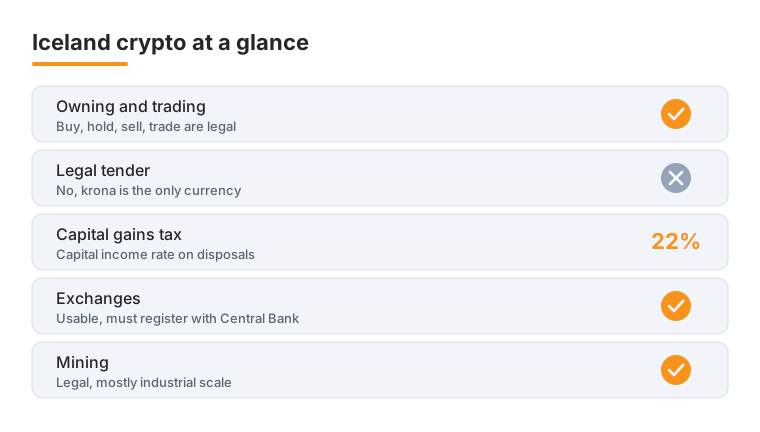
- Yes, buying, holding, and trading crypto is legal in Iceland, but it is not legal tender.
- It is taxed: disposals are generally capital income at 22 percent, and you must declare year-end holdings.
- Residents buy via EEA-regulated exchanges after ID/KYC checks; verify providers on the Central Bank register.
Iceland holds an unusual place in the crypto world: a small, highly digital, energy-rich Nordic country that became an early Bitcoin mining hub, yet sits outside the European Union. As a member of the European Economic Area (EEA), Iceland adopts most EU financial rules into domestic law, so the EU's Markets in Crypto-Assets Regulation (MiCA) and the bloc's anti-money-laundering regime increasingly govern how crypto-assets are treated. This page explains, in plain terms, how Bitcoin and other crypto-assets are regulated and taxed in Iceland as of 2026, covering the supervisor, service-provider registration and licensing, taxation, AML/KYC, buying and using crypto, mining, and the practical risks to weigh. For broader background, see our overview of crypto regulation.
This is general information current as of 2026 and is NOT legal, tax, or financial advice. Crypto rules in Iceland and across the EEA are evolving quickly, so verify anything that affects you directly with the Central Bank of Iceland (Sedlabanki Islands) and the Icelandic tax authority (Skatturinn), or with a qualified Icelandic professional, before acting.
On this page: Legal status · Who regulates it · Taxes · How to buy · Mining
Is Bitcoin and crypto legal in Iceland?
Yes. Buying, holding, selling, and trading Bitcoin and other crypto-assets is legal for individuals and businesses in Iceland. There is no general ban on owning crypto as a private asset.
What crypto is not is legal tender. The Icelandic krona (ISK) is the only official currency, no merchant is required to accept Bitcoin, and crypto is treated as a private asset rather than as money. Everyday use of crypto for payments remains limited.
Iceland's history with crypto was shaped by its post-2008 capital controls, which for years complicated moving money across borders. Those controls were progressively eased and largely lifted around 2017. Today there is no special outbound-currency restriction aimed at crypto, though standard anti-money-laundering reporting and tax rules still apply.
Who regulates crypto in Iceland?
The financial supervisor is the Central Bank of Iceland (Sedlabanki Islands). On 1 January 2020 the Central Bank absorbed the former Financial Supervisory Authority (Fjarmalaeftirlitid, or FME) under the Act on the Central Bank of Iceland No. 92/2019. As a result, supervision of crypto-asset service providers, banking, markets, and conduct now sits inside the Central Bank rather than in a separate FME agency. You may still see the older "FME" name in legacy documents and licences.
The Central Bank is the body that maintains the public register of supervised crypto-asset and virtual-asset service providers, enforces anti-money-laundering obligations, and acts as the national competent authority for the EU's MiCA framework as it is brought into Icelandic law through the EEA. Its official website is cb.is.
Crypto laws and frameworks in Iceland
Iceland does not have a single, standalone "crypto law." Instead, crypto-assets are governed by a combination of EEA-adopted EU rules, domestic anti-money-laundering legislation, and general financial-services and consumer law. The key elements are:
- MiCA (Markets in Crypto-Assets Regulation). MiCA applied in the EU from 30 December 2024. Iceland is an EEA EFTA state, so MiCA entered the EEA Agreement by Joint Committee Decision 041/2025, in force on 24 June 2025, and became Icelandic law through Act No. 101/2025 on markets in crypto-assets, in force from 1 January 2026. MiCA creates a harmonised licensing and conduct regime for service providers (exchanges, custodians, brokers) plus rules for asset-referenced and e-money tokens (stablecoins). EEA incorporation can lag the EU slightly, so the exact timing of national legislation and any grandfathering window are worth confirming with the Central Bank.
- Anti-money-laundering (AML/CFT) rules. Iceland follows Financial Action Task Force (FATF) standards and EU AML directives. Virtual-asset service providers operating in Iceland must register with the Central Bank and apply customer due diligence (KYC), ongoing monitoring, and suspicious-transaction reporting.
- VASP registration rules. Iceland introduced dedicated rules for virtual-asset service providers, including Central Bank Rules No. 151/2023 and No. 152/2023, requiring exchanges and custodial wallet providers to register before operating.
The practical takeaway: crypto is legal but supervised. Service providers face registration and compliance duties, while individual holders are mainly affected through tax reporting and the identity checks they meet when using exchanges.
Licensing and registration of exchanges and VASPs
Crypto-asset and virtual-asset service providers that are established in, or actively serve, Iceland are expected to be on the Central Bank's register and to comply with AML obligations. Under MiCA, providers also need the appropriate crypto-asset service authorisation as that regime takes full effect across the EEA.
Examples of Icelandic registered providers include Monerium ehf., which the Central Bank names as Monerium hf. and which it listed on 1 July 2026 among the firms without a MiCA crypto-asset service authorisation, though it continues as an e-money institution and issuer of e-money tokens under MiCA (it issued an early blockchain-based e-money licence and runs the euro-denominated EURe token), and IsMynt ehf., registered as a virtual-asset service provider. The transitional period ended on 1 July 2026. The Central Bank authorised Myntkaup ehf. on 25 June 2026 as a crypto-asset service provider, and on 1 July 2026 named IsMynt ehf., Orange Gateway ehf., Rafmyntasjóður Íslands ehf. and Monerium hf. as firms that held no MiCA authorisation on that date.
Because Iceland is in the EEA, many EU-based platforms can passport their MiCA-authorised services into Iceland, and a MiCA licence from any one EEA state can be passported across the bloc. Before depositing funds, confirm a platform is authorised to serve EEA/Icelandic customers and check the Central Bank's crypto-asset service providers register. Using a regulated provider gives you stronger protection than an unregistered one. See also our guidance on crypto regulation by country.
Crypto and Bitcoin tax in Iceland
Iceland taxes crypto. The tax authority, Skatturinn (Iceland Revenue and Customs), applies existing income and capital rules to crypto-assets rather than a dedicated crypto statute. In broad terms:
- Disposals are taxable. Selling crypto for krona or other fiat, and swapping one crypto for another, are treated as taxable events. Skatturinn treats a crypto-to-crypto swap as a disposal of the first asset followed by acquisition of the second.
- Capital income rate. Investment gains for individuals are generally taxed as capital income. The general capital income tax rate in Iceland is 22 percent, with a limited tax-free threshold (around ISK 300,000) that applies to certain interest, dividends, and gains on listed instruments. Treatment of crypto can differ from listed securities, so confirm your specific case.
- No long-term holding break. Iceland offers no reduced rate for long-held assets. Skatturinn states that how long the holder owned the crypto does not matter, and the whole gain is taxed in the year of disposal.
- Mining, staking, airdrops, and crypto received as payment are valued at the market price at the time of the transaction, and mined coins that were never reported on an earlier return carry a cost base of ISK 0 when later sold. Skatturinn's guidance covers mining, wages paid in crypto, sales, swaps and spending, but does not address staking, lending or decentralised finance. This kind of income is treated as ordinary personal income under Iceland's progressive brackets rather than at the flat 22 percent capital rate, so the effective rate on it can be higher; confirm your own case.
- Portfolio reporting. Iceland is notable in expecting taxpayers to declare not only realised gains but also the value of crypto holdings, typically at year-end. On the individual return this is entered under the other-assets section (section 4.4, Adrar eignir).
- Filing deadline. Individual tax returns are filed electronically through Skatturinn's portal, with the annual deadline falling in mid-March (the return for 2025 income was due in March 2026).
Rates, thresholds, and the precise treatment of swaps and rewards can change. Verify the current figures and your filing duties directly with Skatturinn or a qualified Icelandic tax adviser, and see our general guide to crypto taxes. This is not tax advice.
AML and KYC rules
Anti-money-laundering and counter-terrorist-financing (AML/CFT) rules are the part of Iceland's framework most people encounter directly. Iceland follows FATF standards and EU AML directives, and virtual-asset service providers must register with the Central Bank and run a compliance programme.
In practice this means:
- Identity verification. Exchanges and VASPs must verify your identity (passport or national ID, and often proof of address) before you can trade or withdraw.
- Monitoring and reporting. Providers must monitor transactions, keep records, and file suspicious-activity reports.
- Travel-rule style data. Information on the originator and beneficiary of transfers is collected in line with FATF and EU expectations.
These obligations sit on the service providers rather than on individual holders, but they shape the documentation you will be asked for and why some platforms decline certain transactions.
Buying and using crypto in practice
Icelanders can buy crypto through international exchanges that serve the EEA, through a small number of domestically registered providers, and through fintech apps with crypto features. A typical process looks like this:
- 1. Choose a regulated platform. Pick an exchange or app authorised to serve EEA/Icelandic customers and check the Central Bank register.
- 2. Complete identity verification. Provide ID and any required proof of address to satisfy KYC/AML checks.
- 3. Fund your account. Deposit krona or euros by bank transfer or card, subject to your bank's policies. Icelandic banks generally permit crypto-related transfers but may apply their own controls.
- 4. Place your order and review the fee and the actual price you pay.
- 5. Secure your crypto. For meaningful amounts, consider a wallet you control (a hardware wallet for long-term holdings) rather than leaving everything on an exchange.
- 6. Keep records of dates, amounts, and prices so you can report disposals and your year-end holdings correctly.
Using crypto for cross-border transfers is possible and can settle quickly, but volatility, on/off-ramp costs, AML checks, and the fact that a disposal can be taxable mean it is not always cheaper than mainstream EEA payment apps. Physical Bitcoin ATM coverage in Iceland is limited; most residents use online platforms. None of this is a recommendation to buy any specific asset.
Bitcoin mining in Iceland
Bitcoin mining is legal in Iceland, and the country became one of the world's best-known mining locations. The appeal is straightforward: electricity is almost entirely renewable, drawn mainly from hydropower with a substantial geothermal share, and the cold climate reduces cooling costs. Combined with a stable grid and established data-centre infrastructure, that drew large-scale miners during the 2017 to 2018 boom.
The picture has since matured:
- Energy is the constraint, not legality. Iceland's grid is relatively small and its renewable output is heavily committed across aluminium smelting, data centres, and other large users. Public debate questions how much scarce clean power should go to mining, and new large allocations are hard to secure.
- Low carbon footprint. Because the grid is overwhelmingly renewable, mining done in Iceland is far cleaner than fossil-powered mining elsewhere.
- Compliance and tax. A mining operation is still a business: it must address corporate registration, energy contracts, and tax, with mined coins generally taxed as income at their value when received, and AML duties where it sells or custodies coins.
For individuals, home mining of Bitcoin is uneconomic. Skatturinn taxes mined coins in the ordinary income brackets whether or not the mining amounts to a business, with costs deductible only where it is a business. Mining in Iceland today is primarily an industrial activity tied to securing an electricity supply.
Recent developments (2025 to 2026)
The dominant theme is the rollout of MiCA across the EEA. MiCA's core service-provider provisions applied in the EU from 30 December 2024 and in Iceland from 1 January 2026, and the Icelandic transitional phase ran until 1 July 2026: firms that were previously registered under national AML rules continue operating while they apply for full MiCA crypto-asset service authorisation, with the transition window running toward mid-2026.
For Iceland specifically, the main moving parts to watch are: the formal incorporation of MiCA and related EU acts into Icelandic law through the EEA process; the Central Bank's issuance of MiCA authorisations (still at an early stage); evolving AML obligations; and any updates from Skatturinn on how swaps, staking, and rewards are taxed. Iceland-based Monerium continues to operate a MiCA-relevant euro e-money token. Iceland's MiCA transitional period ended on 1 July 2026, and the Central Bank confirmed that from that date a registration under Act No. 140/2018 is no longer a basis for providing crypto-asset services.
Consumer risks and protection
The Central Bank of Iceland has repeatedly warned that crypto-assets carry significant risk and that holders of unregulated assets may have limited recourse. The main risks for users in Iceland are the universal ones: price volatility, exchange or custodian failure, scams and phishing, lost keys, and the irreversibility of on-chain transactions.
How to reduce your exposure:
- Use regulated providers. Favour platforms on the Central Bank register and, over time, those holding MiCA authorisation. MiCA adds disclosure, custody, and market-abuse protections, but it does not guarantee against loss.
- Understand what is and is not protected. Crypto holdings are generally not covered by deposit-guarantee schemes; assets on a failed platform may be hard to recover.
- Secure and record everything. Use strong security and self-custody for larger amounts, and keep transaction records for tax.
The Central Bank's consumer-facing material on crypto-assets and crowdfunding is a useful starting point before you invest.
Official sources and how to verify
Because crypto rules in Iceland are evolving with MiCA, confirm the current position in Act No. 101/2025 on markets in crypto-assets and in the Central Bank register of supervised entities. The most authoritative references are:
- Central Bank of Iceland (Sedlabanki Islands): the financial supervisor, including its crypto-asset service providers pages and register.
- Skatturinn (Iceland Revenue and Customs): the tax authority, for capital income rates, thresholds, and crypto reporting duties.
- ESMA: Markets in Crypto-Assets Regulation (MiCA): the EU-level framework that the EEA, including Iceland, is adopting.
To verify a specific provider, check whether it appears on the Central Bank's register and what authorisation it holds. To verify your tax position, use Skatturinn's official guidance or a licensed Icelandic adviser. Related reading on this site: crypto regulation, crypto taxes, and regulation by country.
Reminder: this page is general information current as of 2026 and is not legal, tax, or financial advice. Verify anything that affects you with the named official regulators before acting.
Iceland crypto status, August 2026
Iceland has a crypto statute with a name and a number. Act No. 101/2025 on markets in crypto-assets (Lög um markaði fyrir sýndareignir) was signed on 24 December 2025, published in Stjórnartíðindi on 29 December 2025 and entered into force on 1 January 2026. Article 1 gives Regulation (EU) 2023/1114 (MiCA) the force of law in Iceland with the adaptations resulting from EEA Joint Committee Decision No. 41/2025. Article 3 names Seðlabanki Íslands, the Central Bank of Iceland, as the competent authority, with supervision carried out by its financial supervision arm Fjármálaeftirlitið.
The 30 December 2024 date was the EU application date, not the Icelandic one. Iceland is an EEA EFTA state, so MiCA had to enter the EEA Agreement first. The Icelandic government's EEA acquis database records MiCA as incorporated by Joint Committee Decision 041/2025, in force across the EEA on 24 June 2025. The transitional provision of Act No. 101/2025 then reset MiCA's own clock for Iceland: where MiCA says 30 December 2024, Iceland reads 1 January 2026, and where it says 30 July 2024, Iceland reads 1 February 2026.
The transition is over. Firms holding a virtual asset service provider registration under the anti-money-laundering Act No. 140/2018 had until 1 July 2026 to obtain a full MiCA authorisation. The Central Bank confirmed on 1 July 2026 that from that date a registration under Act No. 140/2018 is no longer a legal basis for providing crypto-asset services in Iceland.
The Icelandic crypto rulebook now in force
| Instrument | What it does | Dates |
|---|---|---|
| Act No. 101/2025 on markets in crypto-assets | Gives MiCA force of law, names the Central Bank as competent authority, sets authorisation duties and administrative fines | Signed 24 December 2025, in force 1 January 2026 |
| Act No. 140/2018, new Article 57.a, inserted by Article 17 of Act No. 101/2025 | Gives Regulation (EU) 2023/1113, the travel rule for transfers of funds and crypto-assets, force of law | In force 1 January 2026 |
| Central Bank Rules No. 332/2026 | Incorporates 31 EU acts, 24 delegated and 7 implementing regulations, carrying the MiCA technical standards | Signed 31 March 2026, published 8 April 2026 |
| Ministerial Regulation No. 420/2026 | Implements Delegated Regulations (EU) 2024/1506 and 2024/1507 on classifying significant tokens and on intervention criteria | Published 30 April 2026, in force 1 May 2026 |
| Regulation No. 1520/2025 | Applies the OECD Crypto-Asset Reporting Framework: platforms collect user data and report to the tax authority | In force 1 January 2026, first reporting year 2026 |
Enforcement is not theoretical. Under Article 6 of Act No. 101/2025 Fjármálaeftirlitið may fine an individual up to ISK 105 million and a legal person up to ISK 750 million for most breaches, rising to ISK 750 million and ISK 2,240 million respectively for the market abuse provisions in MiCA Articles 89 to 92, or alternatively a share of annual turnover of up to 15 percent. Article 7 allows a ban on holding management positions of at least ten years where breaches of Articles 89 to 92 are repeated, and Article 14 ends the power to impose administrative sanctions seven years after the conduct.
Who can legally serve Icelandic customers after 1 July 2026
The Central Bank authorised Myntkaup ehf. on 25 June 2026 as a crypto-asset service provider for custody and administration of crypto-assets, exchange of crypto-assets for funds, exchange of crypto-assets for other crypto-assets and transfer services, the services in points (a), (c), (d) and (j) of MiCA Article 3(1)(16). Myntkaup had previously held only a registration under Act No. 140/2018. Current authorisations can be checked on the Central Bank register of supervised entities.
In its 1 July 2026 notice the Central Bank named four firms that had operated on an Act No. 140/2018 registration but did not hold a MiCA authorisation on that date: IsMynt ehf., Orange Gateway ehf., Rafmyntasjóður Íslands ehf. and Monerium hf. Monerium hf. continues in a different capacity, as an e-money institution and issuer of e-money tokens under MiCA. Firms without authorisation must stop all marketing, take on no new customers, and take the steps needed to conclude the activity, with nothing done that amounts to continuing licensed activity after the transitional period.
In a clarification issued on 10 July 2026 the Central Bank said the rules did not require the disposal of assets to be completed before 1 July 2026, and contain no instructions on how crypto-assets held in custody are delivered, converted or otherwise dealt with. A customer who believes a transfer was mishandled can take it to the complaints committee for goods and services purchases, kærunefnd vöru- og þjónustukaupa, or to the courts, while Neytendastofa supervises commercial practices.
ESMA made the same point EEA-wide. In a notice the Central Bank relayed on 24 June 2026, ESMA urged unauthorised providers to stop accepting new customers, halt marketing and inform existing clients, leaving only the minimum needed for clients to sell assets or close positions, and told consumers to check their provider in ESMA's public register.
What is coming next, and when
The next hard deadline is tax reporting. Regulation No. 1520/2025, made by the Ministry of Finance and Economic Affairs on 23 December 2025 under Article 92 of the Income Tax Act No. 90/2003, is based on the OECD Crypto-Asset Reporting Framework. It entered into force on 1 January 2026 and covers reporting for calendar year 2026 onward. Reporting providers must register with the tax authority no later than 30 days from starting reportable activity, carry out due diligence on users, and file before 20 January of the year following the year reported. The first Icelandic filing therefore falls due before 20 January 2027 for 2026 activity. Ríkisskattstjóri supervises, and failures can attract daily fines under Article 92 of Act No. 90/2003 and fines under Article 17 of the regulation. Iceland signed the CARF Multilateral Competent Authority Agreement on 11 March 2025, according to the OECD signatories list, status 3 March 2026, so the data is intended to be exchanged with partner jurisdictions.
One MiCA measure is drafted but not yet made. Consultation case S-114/2026, published on 2 July 2026, contains a draft regulation amending Regulation No. 420/2026 to implement Delegated Regulation (EU) 2024/1504 on the procedures for European Banking Authority fines and periodic penalty payments on issuers of significant asset-referenced and e-money tokens. Comments were open from 2 to 9 July 2026, none were received, and the consultation closed on 13 July 2026. The Ísland.is record for Regulation No. 420/2026 still lists no amending regulation.
The EU anti-money-laundering package is not yet Icelandic law. The government's EEA acquis database lists Regulation (EU) 2024/1624 as still under examination by Iceland, Liechtenstein and Norway for incorporation into the EEA Agreement, with no Joint Committee Decision and implementation not begun. Until that changes, Act No. 140/2018 remains the AML law that applies to crypto business in Iceland, alongside the travel rule in Regulation (EU) 2023/1113, which Article 17 of Act No. 101/2025 gave the force of law through a new Article 57.a of Act No. 140/2018.
Crypto tax in Iceland: what Skatturinn actually says
Skatturinn's crypto page states that there are no special statutory provisions on taxing cryptocurrency, so the general provisions of the tax acts apply: "Ekki er fyrir hendi sérstök lagaákvæði um skattlagningu rafmyntar". The specifics it then gives are concrete.
- For individuals outside business, a disposal is taxed as a gain on the sale of movable property under point 8 of section C of Article 7 of the Income Tax Act No. 90/2003, read with Article 16, and falls into capital income, taxed at 22 percent, the rate since 1 January 2018. Business income falls under section B of Article 7.
- Holding period is irrelevant: "skiptir ekki máli hve lengi skattaðili hefur átt rafmyntina".
- Taxable disposals include selling for money, swapping one crypto for another, and paying for goods or services with crypto. Moving crypto between your own wallets creates no tax liability.
- Cost base is the purchase price plus fees. Mined coins take their value at the time of acquisition, but if they were never reported on an earlier return the cost base is ISK 0.
- A loss on the sale of the same type of crypto in the same year may be set against gains on that type. Losses on a different coin may not. A lost or stolen private key is not deductible.
- Mining as a business is treated as commercial activity with deductible costs. Occasional or incidental mining is not a business and carries no cost deduction, but the income is taxed in the ordinary brackets either way.
- On the return, gains go on page three, section 3.9 "Annar söluhagnaður", field 522. Holdings go on page four, assets and debts at year end, section 4.4, field 15, at market value.
Skatturinn's guidance does not address staking, lending or decentralised finance, so no Icelandic rule for those should be treated as settled. Source: Skatturinn, Rafmynt.
Frequently asked questions
Is Bitcoin legal in Iceland?
Yes. Buying, holding, selling, and trading Bitcoin and other crypto-assets is legal for individuals and businesses in Iceland. Crypto is not legal tender, so the krona remains the only official currency and no one is obliged to accept crypto for payment. This is general information, not legal advice.
Who regulates crypto in Iceland?
The Central Bank of Iceland (Sedlabanki Islands) is the financial supervisor. It absorbed the former Financial Supervisory Authority (FME) on 1 January 2020 under Act No. 92/2019, and it now registers and oversees crypto-asset and virtual-asset service providers under AML rules and, as an EEA state, the EU's MiCA framework as it is adopted into Icelandic law. Its site is cb.is.
Does Iceland follow the EU's MiCA crypto rules?
Iceland is not in the EU but is in the European Economic Area, so it incorporates the EU's MiCA Regulation into domestic law. MiCA's core service-provider provisions applied in the EU from 30 December 2024 and in Iceland from 1 January 2026 under Act No. 101/2025, with the Icelandic transitional period for previously registered firms ending on 1 July 2026. EEA incorporation can lag slightly, so confirm the current status with the Central Bank of Iceland.
How is crypto taxed in Iceland?
Skatturinn (Iceland Revenue and Customs) treats crypto disposals, including crypto-to-crypto swaps, as taxable. Investment gains are generally taxed as capital income at Iceland's 22 percent rate, with no apparent reduction for long-held assets, and mining, staking, and airdrops are usually taxed as income at market value when received. Iceland also expects taxpayers to declare year-end holdings, not just realised gains. Confirm current figures with Skatturinn; this is not tax advice.
Do crypto exchanges need a licence to operate in Iceland?
Yes. Virtual-asset service providers must register with the Central Bank of Iceland under AML rules (including Rules No. 151/2023 and No. 152/2023), and under MiCA they need the appropriate crypto-asset service authorisation as that regime takes full effect across the EEA. A MiCA licence from any EEA state can be passported into Iceland. Check the Central Bank's register before using a platform.
Why is Iceland known for Bitcoin mining?
Iceland has abundant, almost entirely renewable electricity from hydropower and geothermal sources, a cold climate that cuts cooling costs, and established data-centre infrastructure, which made it a major mining hub. Mining is legal, but limited grid capacity now constrains how much further large-scale mining can grow, and mined coins are taxed as income when received.
Is crypto mining or staking income taxed the same as trading gains in Iceland?
Not necessarily. Selling or swapping crypto is generally taxed as capital income at the flat 22 percent rate. Crypto received from mining, staking, airdrops, or as payment is generally treated as ordinary personal income, valued at the time you receive it, and taxed under Iceland's progressive income brackets, which can produce a higher effective rate than 22 percent. A later sale of those coins can then create a separate capital gain or loss. Confirm the current treatment with Skatturinn; this is not tax advice.
When do I file crypto taxes in Iceland and where do holdings go on the return?
Individual tax returns in Iceland are filed electronically through Skatturinn's portal, with the annual deadline falling in mid-March (the return covering 2025 income was due in March 2026). Beyond reporting realised gains, Iceland expects you to declare the value of your crypto holdings at year-end, entered under the other-assets section of the return (section 4.4, Adrar eignir). Keep dated records of buys, sells, and swaps so you can complete both parts. Verify the current deadline and forms with Skatturinn; this is not tax advice.
Did MiCA apply in Iceland from 30 December 2024?
No. 30 December 2024 was the EU application date. Iceland is an EEA EFTA state, so MiCA first had to be incorporated into the EEA Agreement, which happened through Joint Committee Decision 041/2025, in force across the EEA on 24 June 2025. It became Icelandic law through Act No. 101/2025 on markets in crypto-assets, in force from 1 January 2026.
Which crypto firms are authorised in Iceland right now?
The Central Bank authorised Myntkaup ehf. on 25 June 2026 for custody and administration, crypto to funds exchange, crypto to crypto exchange and transfer services. On 1 July 2026 it named IsMynt ehf., Orange Gateway ehf., Rafmyntasjodur Islands ehf. and Monerium hf. as firms holding no MiCA authorisation. Check the Central Bank register of supervised entities for the current list, and the ESMA public register for firms authorised elsewhere in the EEA.
I had an account with IsMynt, Orange Gateway or Rafmyntasjodur Islands. What happens to it?
The Central Bank stated on 1 July 2026 that those three firms, plus Monerium hf., did not hold a MiCA authorisation on that date. Such firms must stop all marketing, take no new customers, and take the steps needed to conclude the activity. On 10 July 2026 the Central Bank clarified that the rules did not require the disposal of assets to be completed before 1 July 2026 and give no instructions on how custodied assets are delivered or converted. If you believe a transfer was mishandled you can complain to kaerunefnd voru- og thjonustukaupa or go to court. Monerium hf. continues as an e-money institution and issuer of e-money tokens.
When will Icelandic crypto platforms start reporting my account to the tax authority?
Regulation No. 1520/2025 applies the OECD Crypto-Asset Reporting Framework in Iceland from 1 January 2026, covering calendar year 2026 onward. Reporting providers must file before 20 January of the following year, so the first report on 2026 activity is due before 20 January 2027. Iceland signed the CARF multilateral competent authority agreement on 11 March 2025, so the data is intended to be exchanged with partner countries.
Where exactly do I put crypto on my Icelandic tax return?
Per Skatturinn, gains from disposals go on page three of the return, section 3.9 Annar soluhagnadur, field 522. Holdings go on page four, assets and debts at year end, section 4.4, field 15, at market value.
Is swapping one coin for another taxable in Iceland?
Yes. Skatturinn treats selling crypto for money, swapping one type of crypto for another, and paying for goods or services with crypto as disposals. Moving crypto between your own wallets creates no tax liability. Losses can only be set against gains on the same type of crypto sold in the same year, and a lost or stolen private key is not deductible.
How is staking taxed in Iceland?
Skatturinn's published crypto guidance does not address staking, lending or decentralised finance. It covers mining, wages paid in crypto, sales, swaps and spending. Treat any staking rule you read as unsettled and confirm your own case with Skatturinn.
What can the Icelandic supervisor do to an unlicensed crypto firm?
Under Article 6 of Act No. 101/2025, Fjarmalaeftirlitid can impose administrative fines of up to ISK 105 million on an individual and ISK 750 million on a legal person for most breaches, rising to ISK 750 million and ISK 2,240 million respectively for the market abuse provisions in MiCA Articles 89 to 92, or alternatively a share of annual turnover of up to 15 percent. Article 7 allows a ban on management positions of at least ten years for repeated breaches of those market abuse articles, and Article 14 ends the power to impose administrative sanctions seven years after the conduct.
Facts reviewed: 13 August 2026. Page updated: 13 August 2026.