Home › Crypto Regulation › Taiwan
Bitcoin & Cryptocurrency Regulation in Taiwan
Quick answer — Taiwan, 2026
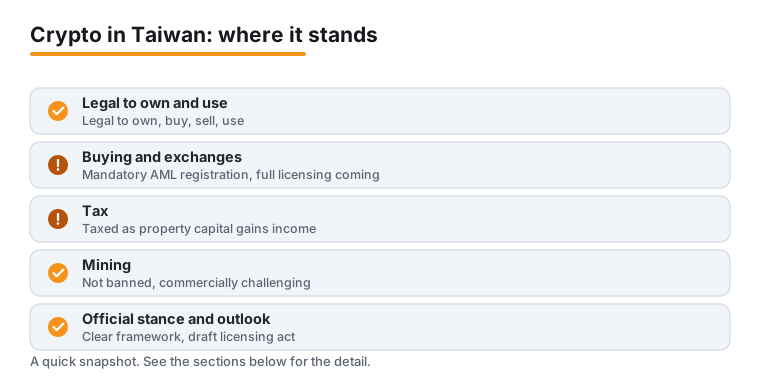
- Legal: Legal to own and trade, not legal tender; treated as speculative commodity
- Tax: No standalone crypto tax; gains reported as property income
- Buying: Via FSC AML-registered exchanges and OTC dealers, KYC and NTD transfer
Cryptocurrency is legal in Taiwan, and the territory has a large, active retail market, and the rules have just taken a major step forward. Until recently digital assets were governed through a patchwork of anti-money-laundering rules, securities law and tax guidance rather than a single dedicated statute. That patchwork is now being replaced by a dedicated law. On 30 June 2026 the Legislative Yuan passed the Virtual Asset Service Act at its third reading, a 56-article statute that names the Financial Supervisory Commission (FSC) as the sole regulator and moves the market from anti-money-laundering registration toward full licensing. Since 2025, virtual asset service providers (VASPs) such as exchanges have had to complete a mandatory anti-money-laundering registration with the FSC, and that registration continues while the new licensing regime is brought into effect. This page explains the current state of Taiwan crypto regulation as of 2026: whether Bitcoin is legal, who the regulators are, how exchanges must register and will be licensed, how crypto is taxed, the AML and KYC rules, and the practical realities of buying and using crypto. For a wider view, see our guide to crypto regulation and the main regulation hub.
This article is general information as of 2026, not legal, tax or financial advice. Taiwan's Virtual Asset Service Act was passed on 30 June 2026 but its effective date and detailed sub-rules are still being set, so always verify any specific rule with the Financial Supervisory Commission (FSC) or a qualified professional before acting.
On this page: Legal status · Who regulates it · Taxes · How to buy · Mining
Legal status: is Bitcoin and crypto legal in Taiwan?
Yes. Owning, buying, selling and using Bitcoin and other cryptocurrencies is legal for individuals in Taiwan. There is no ban on holding or trading digital assets, and a sizeable local market of registered exchanges and over-the-counter (OTC) dealers operates openly.
What crypto is not is legal tender. Taiwan's Central Bank and the FSC have consistently stated that Bitcoin and similar tokens are not currency; the official framing treats them as a highly speculative digital virtual commodity rather than money. In practice that means:
- You can legally hold and trade crypto, but no merchant is obliged to accept it, and it cannot be used to settle debts the way the New Taiwan dollar (NTD) can.
- Crypto sits outside the deposit-insurance and consumer-protection safety nets that cover bank accounts.
- Because gains can have tax consequences, you may need to declare profits as income (see the taxation section below).
Authorities have also restricted banks and card acquirers from facilitating some crypto purchases. Those measures shape how Taiwanese users fund their accounts but do not make personal ownership illegal.
Who regulates crypto in Taiwan?
The lead regulator for virtual assets is the Financial Supervisory Commission (FSC), Taiwan's integrated financial regulator. Within the FSC, the Securities and Futures Bureau (SFB) handles much of the day-to-day VASP supervision, including the anti-money-laundering registration regime and the list of registered providers.
Two other bodies share responsibility:
- The Central Bank of the Republic of China (Taiwan), or CBC, addresses currency, monetary and foreign-exchange matters. It must be consulted on stablecoin issuance under the draft licensing law.
- The Ministry of Finance and its National Taxation Bureaus handle the tax treatment of crypto gains.
Official sources: the Financial Supervisory Commission (FSC), the Securities and Futures Bureau VASP page, and the Central Bank of the Republic of China (Taiwan).
Key laws and frameworks
Taiwan's regime currently rests on three pillars, with a fourth (comprehensive licensing) on the way.
Anti-money-laundering law for VASPs
The Money Laundering Control Act was amended and promulgated on 31 July 2024. Its amended Article 6 requires any business or individual providing virtual asset services to complete AML registration with the competent authority (the FSC) before offering those services. Operating a VASP without the required registration can carry up to two years' imprisonment and a fine of up to NT$5 million.
VASP registration and AML/CFT regulations
On 26 November 2024 the FSC released the Regulations Governing AML Registration for VASPs and revised the related AML/CFT regulations. These categorise VASPs into types and impose KYC, transaction-monitoring, recordkeeping and internal-control obligations.
Securities law and token offerings
Tokens with the characteristics of an investment can be treated as securities under the Securities and Exchange Act. Taiwan has a dedicated security token offering (STO) framework with a lighter-touch tier for smaller raises and a regulatory-sandbox route for larger ones.
The Virtual Asset Service Act
The FSC announced a draft Virtual Asset Service Act for public consultation on 25 March 2025 and submitted it to the Executive Yuan for review in mid-2025. The Legislative Yuan then passed the Act at its third reading on 30 June 2026. It is a 56-article statute that names the FSC as the sole regulator for virtual assets and replaces the anti-money-laundering registration approach with a formal licensing regime for VASPs, along with a first framework for stablecoins. After the President signs the bill, the Executive Yuan sets the effective date, and the FSC still has to draft the secondary rules that put the law fully into operation. Because those sub-rules are being written through 2026 into 2027, verify the latest status and effective date with the FSC.
Licensing and registration of crypto exchanges (VASPs)
The single most important rule for crypto businesses in Taiwan today is mandatory AML registration. Under the timeline the FSC set, VASPs that had already filed an earlier AML declaration had to apply for AML registration by 31 March 2025 and complete it before 30 September 2025. New entrants must complete AML registration with the FSC before commencing operations, and offshore platforms targeting Taiwanese users are expected to establish a local company or branch and register as well.
The FSC and its Securities and Futures Bureau publish the list of registered VASPs. By around September 2025, nine enterprises had completed AML registration, including names such as BitoPro, XREX and KryptoGO. You can check current registration status on the SFB virtual asset services page. Registration is not a permanent pass: in November 2024 the FSC fined MaiCoin and BitoPro for shortcomings in customer due diligence, recordkeeping and suspicious-transaction reporting, showing that AML rules are actively enforced.
The Virtual Asset Service Act passed on 30 June 2026 adds a full licensing layer on top of AML registration: VASPs must obtain an FSC licence before operating, with requirements expected to include incorporation, minimum capital, operational guarantee bonds, fit-and-proper responsible persons, segregation of customer assets from the firm's own assets, and industry self-regulation. Existing firms that already completed AML registration are given a transition window, reported as roughly 12 months to apply for a licence and up to 21 months to obtain FSC approval, once the law takes effect. Operating without the required licence, or issuing a stablecoin without approval, can carry up to seven years' imprisonment and a fine of up to NT$100 million, with heavier penalties for market fraud or price manipulation. The exact requirements sit in secondary rules the FSC is still drafting, so confirm the current position with the FSC.
Crypto taxation in Taiwan
Taiwan does not yet have a standalone statute dedicated to crypto taxation, so gains are taxed under the existing income-tax framework. In a written report to the Legislative Yuan's Finance Committee in January 2025, the Ministry of Finance confirmed that individual profits from crypto trading should be reported as property (capital gains) income under Article 14, Paragraph 1, Item 7 of the Income Tax Act, calculated as proceeds minus cost and related expenses and then included in your annual consolidated income tax.
Practical points to understand:
- Crypto is not tax-free. Tax authorities have pursued unreported crypto income, collecting back taxes and penalties, so reporting matters.
- Treatment generally depends on whether a taxable disposal has occurred and on your individual circumstances; thresholds for domestic versus overseas income can differ.
- Because the rules are guidance-based rather than a dedicated crypto tax law, and because reforms are under discussion, treatment can change.
For a general primer see our crypto taxes guide, but confirm your specific position with the National Taxation Bureau or a Taiwan tax professional. This is not tax advice.
AML and KYC rules
Anti-money-laundering and know-your-customer obligations are now the backbone of crypto compliance in Taiwan. Registered VASPs must:
- Verify customer identity (KYC). Expect to provide government ID, proof of address and sometimes a selfie or video check before trading or withdrawing.
- Monitor and report. Platforms screen for suspicious activity, file suspicious-transaction and currency-threshold reports, and may ask about the source of funds for larger transactions.
- Keep records and maintain controls. Recordkeeping, internal controls and audit functions are required under the FSC's AML/CFT regulations.
For users, the upshot is that anonymous crypto activity through legitimate Taiwanese channels is effectively gone. Choosing a registered, compliant platform reduces the risk of frozen withdrawals and gives you better recourse if something goes wrong.
Buying and using crypto in practice
A typical, compliant route for a Taiwanese resident looks like this:
- 1. Choose a registered platform. Pick a domestic exchange or OTC dealer that has completed FSC AML registration, or a reputable international exchange that serves Taiwanese users. Verify status on the SFB list.
- 2. Complete KYC. Verify your identity with government ID and any required documents.
- 3. Fund your account. Bank transfers in New Taiwan dollars are the most common on-ramp. Card payments can be limited because of restrictions on acquirers handling crypto, so transfers from a verified bank account in your own name tend to be smoothest.
- 4. Place your order and review fees. Check the spread and fees before confirming.
- 5. Secure your holdings. Enable two-factor authentication; for long-term holdings consider a hardware or self-custody wallet you control.
- 6. Keep records. Save your buy/sell and transfer history for tax reporting.
Crypto ATMs exist in Taiwan but are a small, higher-fee channel; their operators are subject to the same AML and KYC expectations, so anonymous cash-for-crypto kiosks are not the norm. When using any new platform or wallet, start with a small test transfer.
Crypto mining in Taiwan
Bitcoin mining is not banned in Taiwan, but the island is not a natural fit for it. Taiwan is densely populated, imports most of its energy, and runs a tightly managed electricity grid that already serves a huge semiconductor and manufacturing sector. Industrial electricity demand and price are sensitive, which makes large-scale, energy-hungry mining commercially difficult compared with regions that have cheap surplus power.
There is interest in pairing blockchain compute with Taiwan's renewable-energy push (solar and offshore wind), but in practice renewables are aimed mainly at decarbonising the grid and supplying industry rather than at crypto mining. Anyone considering mining should check electricity tariffs, grid-connection and zoning rules, and business registration, and remember that mining income is taxable.
Recent developments (2025-2026)
The pace of change has been rapid:
- 2024: The Money Laundering Control Act amendment (31 July 2024) introduced mandatory AML registration for VASPs, and the FSC issued the VASP AML registration regulations on 26 November 2024.
- March 2025: The FSC published the draft Virtual Asset Service Act for public consultation (announced 25 March 2025, comments through late May 2025) and later submitted it to the Executive Yuan.
- By September 2025: The AML registration deadline took effect, with nine VASPs completing registration; in November 2024 the FSC fined MaiCoin and BitoPro for AML shortcomings.
- 30 June 2026: The Legislative Yuan passed the Virtual Asset Service Act at its third reading. The 56-article law names the FSC as sole regulator, requires VASPs to be licensed, and sets a first stablecoin framework. It was sent to the President for signing, after which the Executive Yuan sets the effective date.
- Stablecoins: Under the new Act, stablecoin issuance is restricted (reported as limited to banks) and issuers must hold 100 percent reserves at all times and obtain approval from both the FSC and the Central Bank. Reporting also noted the law treats stablecoins such as Tether (USDT) as a commodity rather than currency.
Because the FSC still has to draft the secondary rules that put the Act fully into operation, treat any specific licensing or stablecoin requirement as provisional and verify it against current FSC guidance.
Consumer risks and protection
The headline risks for Taiwanese users are price volatility, the absence of deposit-style protection, fraud and impersonation scams, and ongoing regulatory change. Custody risk also matters: assets left on an exchange depend on that platform's solvency and security. The draft Virtual Asset Service Act would strengthen protection by requiring segregation of customer assets, but those rules are not yet in force.
To protect yourself: use FSC-registered platforms, enable two-factor authentication, move long-term holdings to a wallet you control, never trust promises of guaranteed returns, and only commit money you can afford to lose. The FSC and police periodically warn about fraudulent OTC dealers and fake platforms; if a deal looks too good to be true, it usually is. None of this is financial advice.
Official sources and how to verify
Crypto rules in Taiwan are evolving, so always check the primary sources rather than relying on summaries:
- Financial Supervisory Commission (FSC) for the lead regulator's announcements, laws and press releases.
- Securities and Futures Bureau (SFB) virtual asset services page for the VASP AML registration rules and the list of registered providers.
- Central Bank of the Republic of China (Taiwan) for currency, foreign-exchange and stablecoin-related positions.
For tax questions, consult the Ministry of Finance and your local National Taxation Bureau. You can also explore our broader crypto regulation explainer and the regulation hub for context.
Reminder: this is general information as of 2026, not legal, tax or financial advice. The draft Virtual Asset Service Act is not yet law; verify current rules with the FSC and qualified professionals before acting.
Frequently asked questions
Is Bitcoin legal in Taiwan?
Yes. Buying, holding, selling and using Bitcoin is legal for individuals in Taiwan. However, Bitcoin is not legal tender; the Central Bank and the FSC classify crypto as a highly speculative digital virtual commodity rather than as currency, so no merchant is obliged to accept it.
Who regulates cryptocurrency in Taiwan?
The Financial Supervisory Commission (FSC) is the lead regulator, with its Securities and Futures Bureau (SFB) handling much of the VASP supervision. The Central Bank addresses currency and foreign-exchange issues, and the Ministry of Finance and its National Taxation Bureaus handle tax. Crypto service providers must complete AML registration with the FSC.
Do crypto exchanges need a licence in Taiwan?
Yes, going forward. Since 2025 exchanges have had to complete mandatory anti-money-laundering registration with the FSC under the amended Money Laundering Control Act. On 30 June 2026 the Legislative Yuan passed the Virtual Asset Service Act, which requires VASPs to obtain an FSC licence to operate. Existing AML-registered firms get a transition window (reported as about 12 months to apply and up to 21 months to be approved) once the law takes effect. Operating without the required licence can carry up to seven years' imprisonment and a fine up to NT$100 million. Verify current requirements with the FSC.
Do I have to pay tax on crypto in Taiwan?
Generally yes. Taiwan has no standalone crypto tax law, so the Ministry of Finance treats individual trading profits as property (capital gains) income under the Income Tax Act, declared in your annual consolidated income tax. Treatment depends on your circumstances, so confirm with the National Taxation Bureau or a tax professional. This is not tax advice.
Will Taiwan launch a regulated stablecoin?
There is now a legal framework for it. The Virtual Asset Service Act passed on 30 June 2026 sets Taiwan's first stablecoin rules: issuance is restricted (reported as limited to banks), issuers must hold 100 percent reserves at all times, and they need approval from both the FSC and the Central Bank. The precise process depends on secondary rules the FSC is still drafting, so verify the latest status with the FSC.
Did Taiwan pass a crypto law in 2026?
Yes. On 30 June 2026 the Legislative Yuan passed the Virtual Asset Service Act at its third reading. It is a 56-article statute that names the Financial Supervisory Commission (FSC) as the sole regulator for virtual assets, replaces the earlier anti-money-laundering registration approach with mandatory licensing for VASPs, and creates a first stablecoin framework. The bill went to the President for signing, and the Executive Yuan sets the effective date, so the detailed rules are still being finalised.
How do Taiwanese residents buy crypto?
Most buy through a domestic exchange or over-the-counter dealer that has completed FSC anti-money-laundering registration, such as BitoPro, XREX or KryptoGO, or through a reputable international exchange serving Taiwan. You complete identity verification (KYC), fund the account by New Taiwan dollar bank transfer from an account in your own name, then place your order. Card funding can be limited because of restrictions on acquirers handling crypto. Keep your buy and sell records for tax reporting.
Is crypto mining legal in Taiwan?
Mining is not banned, but Taiwan's limited land, imported energy and tightly managed grid make large-scale mining commercially challenging. Miners must consider electricity costs, grid-connection and zoning rules, business registration, and the fact that mining income is taxable.
Facts reviewed: 30 June 2026. Page updated: 3 August 2026.
Related guides
More countries in the region
Practical guides