Bitcoin & Cryptocurrency Regulation in Central African Republic
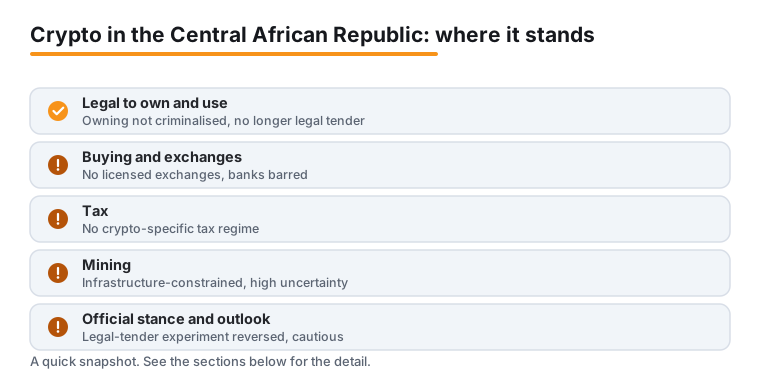
- Legal: Legal to own for individuals, no longer legal tender
- Tax: No clear crypto-specific tax rules
- Buying: No local licensed exchanges, use international or P2P via mobile money
The Central African Republic (CAR) holds a singular place in cryptocurrency history. In April 2022 it became the second country in the world, after El Salvador, to make Bitcoin legal tender. The experiment was short-lived: under pressure from the regional monetary union, CAR repealed the legal-tender provisions in March 2023. Today crypto sits in a cautious, partly defined legal space that is shaped far more by CAR's membership in the Central African Economic and Monetary Community (CEMAC) than by any standalone national framework. This guide explains where things actually stand for 2026: who regulates digital assets, the legal status of Bitcoin, how buying, taxation, mining and remittances fit in, and what residents and visitors should watch for.
This is general information current as of 2026 and is not legal, tax, or financial advice. Crypto rules in CAR and the wider CEMAC region remain evolving and partly unsettled. Always verify the current position with the official regulators named below, in particular the Bank of Central African States (BEAC), or a qualified local professional before acting. For broader context see our guide to crypto regulation and the country regulation hub.
Legal status of Bitcoin and crypto in 2026
For individuals, owning, holding and trading cryptocurrency is not criminalised in the Central African Republic. However, Bitcoin is no longer legal tender and enjoys no special legal status. The sequence of events matters:
- In April 2022, Parliament unanimously adopted a law making Bitcoin legal tender alongside the CFA franc and obliging businesses to accept it.
- In March 2023, the National Assembly amended that law, removing legal-tender status and replacing the obligation to accept crypto with a mere freedom to accept or refuse it.
So as of 2026, crypto exists in a grey zone. There is no comprehensive national regime that licenses exchanges or clearly defines how digital assets are taxed and protected, and there is no law forcing anyone to accept them. At the same time, individuals are not banned from buying or holding crypto. A critical distinction sits at the institutional level: while individuals are tolerated, the regional banking regulator prohibits banks and other supervised financial institutions from handling crypto-assets (see below). In practice you can use crypto at your own risk, but you cannot rely on it being recognised or protected the way regulated financial products are.
Who regulates crypto: BEAC, COBAC and COSUMAF
CAR does not set its own monetary policy alone. It shares the Central African CFA franc and a central bank with five neighbours (Cameroon, Chad, Republic of the Congo, Equatorial Guinea and Gabon) inside CEMAC. Three regional bodies carry most of the regulatory weight, alongside CAR's own government and Parliament for national legislation:
- BEAC (Banque des Etats de l'Afrique Centrale), the regional central bank, governs monetary affairs, the CFA franc and foreign-exchange policy for all six member states. The BEAC has consistently opposed embracing cryptocurrencies, citing risks to monetary sovereignty and to the union's foreign-exchange reserves.
- COBAC (Commission Bancaire de l'Afrique Centrale), the regional banking commission housed within BEAC, supervises banks, microfinance institutions and payment providers. COBAC issued the directive that bars these institutions from facilitating crypto transactions.
- COSUMAF (Commission de Surveillance du Marche Financier de l'Afrique Centrale), based in Libreville, Gabon, is the single financial-markets regulator for the CEMAC zone. Its financial-market regulation introduced concepts covering digital assets and Virtual Asset Service Providers (VASPs).
At the national level, CAR's Parliament passed the original 2022 crypto law and its 2023 amendment, and CAR ministries handle domestic implementation. But because the country is bound by CEMAC and BEAC rules, the regional position effectively constrains what CAR can do alone, which is precisely why the legal-tender experiment was rolled back.
Key laws and frameworks
Several distinct instruments shape the picture, and they pull in different directions:
- CAR Law No. 22.004 (2022), as amended in 2023: The original national law governed cryptocurrency, made Bitcoin legal tender and created a national electronic-transactions regulatory body. The 2023 amendment, agreed with BEAC to harmonise with the monetary union, stripped out the legal-tender status and the guaranteed-convertibility provisions.
- COBAC Decision D-2022/071 (May 2022): A regional banking directive prohibiting institutions supervised by COBAC (banks, microfinance institutions, payment service providers) across all six CEMAC states from holding, using, exchanging or converting crypto-assets, and requiring them to identify, monitor and report any crypto-linked transactions.
- COSUMAF financial-market regulation (Regulation No. 01/22/CEMAC/UMAC/COSUMAF): The regional financial-market rules that introduced definitions for blockchain, initial coin offerings, digital assets and VASPs, recognising digital-asset service providers as a category of market intermediary. Implementing detail has been slow to follow.
- CEMAC Regulation No. 01/24/CEMAC/UMAC/COBAC: A 2024 regional regulation on the single licensing of credit institutions. It is part of the broader banking framework and reflects the union's preference for tightly supervised, franc-based finance rather than open crypto markets.
Because some of these instruments overlap and detail is still emerging, treat any single summary as a starting point and confirm specifics with the regulators directly.
Licensing and registration of exchanges and VASPs
There is no mature, locally licensed crypto-exchange ecosystem in the Central African Republic. The regional VASP concept exists on paper through COSUMAF's financial-market regulation, which recognises digital-asset service providers as market intermediaries that should be accredited to operate. In practice, however, implementing rules and a functioning authorisation pipeline for crypto platforms have been slow to materialise across the CEMAC zone.
Compounding this, COBAC's 2022 directive bars supervised banks and payment institutions from facilitating crypto transactions, which removes a normal banking on-ramp that an exchange would otherwise rely on. The net effect for 2026 is that there is no clear, reliably operational path for a crypto exchange to be licensed and banked domestically, and most activity by residents happens on international platforms or peer-to-peer rather than through locally registered, supervised VASPs. Anyone considering offering crypto services in CAR should obtain current guidance directly from COSUMAF and BEAC before proceeding.
Crypto and Bitcoin taxation
There is no clear, publicly defined crypto-specific tax regime in the Central African Republic. The country has not issued detailed digital-asset tax guidance comparable to the capital-gains or income-tax rules some other nations apply, and the overall framework remains underdeveloped. The original 2022 law even contemplated paying tax contributions in crypto, but that envisioned arrangement did not produce a durable, codified crypto tax system after the 2023 amendment.
The absence of specific rules does not make crypto automatically tax-free. General tax principles can still apply depending on how an activity is characterised, for example whether gains resemble business income or whether crypto is received as payment for goods or services. We deliberately do not quote specific crypto tax rates or thresholds for CAR, because no reliably verified crypto-specific figures exist for 2026. If you trade, earn, mine or receive crypto in CAR, keep clear records of every transaction, assume reporting obligations may exist under general tax law, and consult a qualified local tax adviser. See our crypto tax overview for general principles. This is general information, not tax advice.
AML and KYC rules
CAR is part of the CEMAC anti-money-laundering and counter-terrorist-financing framework, and the region applies AML/CFT obligations to supervised financial institutions. COBAC's 2022 directive is itself partly an AML measure: even while prohibiting institutions from holding crypto-assets, it requires reporting institutions to identify and track crypto-linked transactions and to submit detailed monthly reports to the COBAC Secretariat General and the central bank.
For users, the practical implications are:
- Reputable international exchanges that any CAR resident might use will apply their own identity verification (KYC) and AML checks, so expect to provide valid identification.
- Domestic banks remain cautious about crypto-linked flows, partly because of these reporting duties, which can make funding and cashing out harder.
- Independent analyses have warned that CAR's crypto and land-tokenisation schemes have lacked basic safeguards, creating money-laundering and capture risks. That is a reason for extra caution, not reassurance.
Buying and using crypto in practice
With no established local exchange ecosystem, residents who buy crypto typically rely on international exchanges accessed online or on peer-to-peer (P2P) trading, settling in local currency or mobile money. A neutral, educational outline of the usual steps:
- Choose a reputable platform and confirm it currently serves CAR residents; availability can change without notice.
- Complete identity verification (KYC); have valid ID ready.
- Fund the account, often via mobile money or direct P2P settlement, since bank caution makes this the trickiest step.
- Place a small order first while you learn the platform.
- Move funds to a wallet you control, ideally a hardware wallet, rather than leaving them on an exchange.
- Secure everything: strong unique password, two-factor authentication, and a recovery phrase stored offline.
Other frictions shape day-to-day use: limited internet penetration and electricity in many areas restrict who can realistically access platforms, and because there is no local consumer-protection backstop tailored to crypto, treat any platform promising guaranteed returns or pressuring you to deposit quickly as a red flag.
Bitcoin mining
Mining in CAR is more aspiration than reality. Government messaging during the crypto experiment leaned on the idea of tapping natural resources and future energy capacity, but the on-the-ground constraints are significant:
- Electricity: Reliable, affordable power is limited, and large-scale mining depends on cheap, stable electricity.
- Infrastructure: Limited connectivity and difficult logistics for importing and maintaining hardware raise the barrier to entry.
- Policy uncertainty: Without a durable legal framework, miners face the risk that rules shift again, as they already have once.
There is genuine interest in renewable energy and more sustainable approaches, but for now prospective miners should treat CAR as a high-uncertainty, infrastructure-constrained environment and confirm the legal and tax position before committing capital.
Recent developments (2022 to 2026)
The headline arc is a reversal followed by troubled government-linked tokens:
- 2022: CAR makes Bitcoin legal tender (April), COBAC issues its prohibition directive (May), and the government launches Sango Coin, promising land, e-residency and investment perks. In August 2022, CAR's Constitutional Court strikes down provisions that would have allowed citizenship, residency or land to be acquired with crypto.
- 2023: Parliament repeals the legal-tender provisions (March) and harmonises the law with BEAC and the monetary-union framework (April).
- 2024: BEAC publicly reiterates its opposition to regulating or embracing crypto at the first CEMAC fintech forum, held in Douala from 29 to 31 January 2024, citing foreign-reserve concerns, and rebuffs fintech calls for a permissive licensing regime.
- 2025: A presidency-linked $CAR token launches on 9 February 2025 on the Solana chain via the Pump.fun platform, promoted through President Touadera's account. Its market value spiked, reportedly toward roughly 900 million dollars within hours, before collapsing by more than 80 percent amid doubts about the launch, including a promotional video that deepfake-detection tools flagged as possibly AI-generated. On 30 May 2025 Touadera signed a decree to tokenise more than 1,700 hectares of land, in an area west of Bossongo about 45 kilometres from Bangui, to be offered on Solana from June 2025, citing the mining code and the 2023 laws on tokenising natural resources.
- 2026: The $CAR token traded far below its 2025 peak, down by roughly 99 percent from its all-time high, and independent reports continued to describe the overall experiment as opaque and vulnerable to abuse. Reported public benefit from the token and land sales remained small and unclear.
Sango Coin itself underperformed badly, selling only a small fraction of its planned tokens. Neither Sango Coin nor the $CAR token should be treated as a stable or officially guaranteed instrument.
Consumer risks and protection
CAR offers little tailored consumer protection for crypto, so the burden of safety falls on the user. The main risks:
- Regulatory uncertainty: Rules have already reversed once and could change again, leaving users without reliable recourse.
- Scams and fraud: Be alert to offers promising quick or guaranteed returns, unsolicited messages, phishing, fake websites and pressure to act fast. Never share private keys, recovery phrases or passwords.
- Volatility: Crypto prices, and especially obscure local tokens, can swing dramatically.
- Custody and security: With limited local recourse, losing wallet access or falling for a scam can mean permanent loss.
- Government-linked tokens: Sango Coin and the $CAR token have shown poor transparency and severe volatility; do not confuse them with established assets like Bitcoin.
One genuine area of interest is remittances and reaching unbanked populations, where crypto and mobile money can in principle lower transfer costs. Those benefits depend on connectivity, liquidity, reliable on and off-ramps and trustworthy counterparties, all still works in progress in CAR. The realistic outlook for 2026 is continued caution: regional authorities remain wary and no clear licensing regime has materialised.
Official sources and how to verify
Because the rules are evolving and partly unsettled, always confirm the current position against primary, official sources rather than third-party summaries. The most authoritative starting points are the regional regulators that bind CAR:
- Banque des Etats de l'Afrique Centrale (BEAC), the regional central bank for CAR and the wider CEMAC zone, for monetary policy, foreign-exchange rules and crypto-related positions.
- COSUMAF, the CEMAC financial-market regulator, for the regional financial-market regulation and any digital-asset or VASP rules and market-intermediary accreditations.
- COBAC (Commission Bancaire de l'Afrique Centrale), the single CEMAC banking supervisor for CAR and its five neighbours, for the 2022 directive barring banks, microfinance institutions and payment providers from handling crypto-assets and for current banking-supervision rules.
- Wikipedia: Legality of cryptocurrency by country or territory, a useful cross-reference for tracking the CAR legal-tender repeal and the current regional status (verify its citations against the primary regulators above).
For national legislation, consult CAR government publications of Law No. 22.004 and its 2023 amendment, and seek qualified local legal or tax advice for your specific situation. Remember: this is general information current as of 2026 and not legal advice, and you should verify with the named regulators, especially BEAC, before acting. You can also browse our broader regulation hub.
Frequently asked questions
Is Bitcoin legal tender in the Central African Republic?
No. CAR adopted Bitcoin as legal tender in April 2022 but repealed that status in March 2023, after pressure from the CEMAC monetary union and BEAC. As of 2026, Bitcoin is not legal tender and businesses are not obliged to accept it, though individuals are not banned from owning or trading crypto.
Who regulates cryptocurrency in the Central African Republic?
Monetary authority sits with the Bank of Central African States (BEAC), the regional central bank for the CEMAC currency union that CAR belongs to. Within BEAC, COBAC supervises banks, and COSUMAF is the regional financial-market regulator. BEAC has taken a restrictive stance, and there is no clear, fully operational national or regional licensing regime for crypto exchanges. Verify current rules at beac.int.
Can banks in the Central African Republic handle crypto?
No. COBAC, the CEMAC banking commission, issued a 2022 directive prohibiting banks, microfinance institutions and payment providers from holding, using, exchanging or converting crypto-assets, and requiring them to report any crypto-linked transactions. This is one reason funding and cashing out through local banks is difficult.
Is crypto taxed in the Central African Republic?
There is no clear, publicly defined crypto-specific tax regime in CAR, and we do not quote specific rates because none are reliably verified for 2026. That does not guarantee crypto is tax-free, since general tax principles may apply depending on the activity. Keep detailed records and consult a qualified local tax adviser. This is not tax advice.
What happened to Sango Coin and the $CAR token?
Sango Coin was a 2022 government-linked project offering land, e-residency and investment perks for tokens, but it sold only a small fraction of planned tokens and had key features struck down by CAR's Constitutional Court. A separate presidency-linked $CAR token appeared in early 2025 with extreme volatility and governance concerns. Neither should be treated as a stable or officially guaranteed asset.
Is it safe to use crypto exchanges from the Central African Republic?
There is no local consumer-protection regime tailored to crypto, so use is at your own risk. Most residents rely on reputable international exchanges or peer-to-peer trading; confirm a platform currently serves CAR users, expect identity (KYC) checks, move funds to a wallet you control, and treat any promise of guaranteed returns as a red flag.
When did the $CAR token launch and what happened to it?
The presidency-linked $CAR token launched on 9 February 2025 on the Solana chain through the Pump.fun platform. Its value briefly spiked, reportedly toward around 900 million dollars within hours, then collapsed by more than 80 percent as doubts emerged, including a promotional video that deepfake-detection tools flagged as possibly AI-generated. By 2026 it traded far below its peak, down roughly 99 percent from its high. It is not a stable or officially guaranteed asset.
Is the Central African Republic tokenising land with crypto?
In 2025 the government moved to tokenise land using the $CAR token. On 30 May 2025 President Touadera signed a decree to tokenise more than 1,700 hectares in an area west of Bossongo, about 45 kilometres from Bangui, to be offered on Solana from June 2025, citing the mining code and 2023 laws on tokenising natural resources. Reported sales and public benefit have been small and unclear, and independent reports describe the scheme as opaque, so treat any offer with caution.
Last updated: 2026-06-30.