Home › Crypto Regulation › Cameroon
Bitcoin & Cryptocurrency Regulation in Cameroon
Quick answer — Cameroon, 2026
- Legal: Legal to own for individuals, banks barred, not legal tender
- Tax: No crypto-specific tax, general rules may apply
- Buying: Via P2P marketplaces using mobile money, no licensed local exchange
Cameroon is one of six countries in the Central African Economic and Monetary Community (CEMAC), so its rules for Bitcoin and other cryptocurrencies are shaped less by national statutes than by regional bodies: the central bank (BEAC), the regional banking supervisor (COBAC), and the regional financial-markets regulator (COSUMAF). The result is a genuinely mixed picture. Owning or trading crypto is not a crime for private individuals, regulated banks are formally barred from touching it, and a regional licensing category for crypto service providers exists on paper but has not produced any approved, operating providers as of 2026.
This page explains where things stand in 2026 for anyone in Cameroon who wants to understand the legal status of crypto, who the regulators are, the key laws, how exchanges and service providers are meant to be licensed, how tax and anti-money-laundering rules may apply, and the practical realities of buying and using crypto. It is general information as of 2026 and is NOT legal, tax, or financial advice. CEMAC rules are evolving quickly, so verify any specifics with the official regulators named below and a qualified local professional before acting. For wider context see our guide to crypto regulation and the regulation hub.
On this page: Legal status · Who regulates it · Taxes · How to buy · Mining
Is Bitcoin and crypto legal in Cameroon?
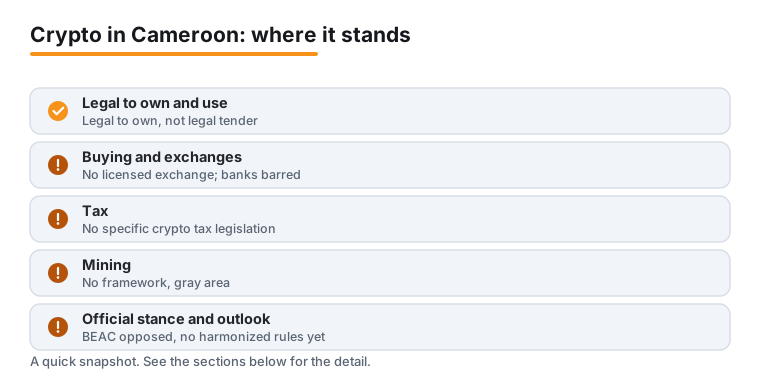
No Cameroonian or CEMAC law makes it a crime for a private individual to own, hold, or trade Bitcoin and other cryptocurrencies. At the same time, crypto is not legal tender and carries no official monetary status. The only legal tender in Cameroon is the Central African CFA franc (XAF), issued by the regional central bank, BEAC.
In practice crypto sits in a partly regulated, partly gray zone. Individuals generally can buy and sell digital assets, usually through peer-to-peer channels, but they do so without the deposit guarantees, dispute mechanisms, or supervision that apply to licensed banks. The single most consequential rule is aimed not at individuals but at financial institutions, which are barred from handling crypto. A separate regional regulation does create a licensing path for crypto service providers, but that path has not yet produced approved operators. Both points are explained in the sections below. Treat crypto as legal to own but largely unsupervised, and keep clear records of your transactions.
Who regulates crypto in Cameroon?
Oversight is primarily regional, shared across three CEMAC institutions plus Cameroon's national financial-intelligence unit:
- BEAC (Banque des Etats de l'Afrique Centrale / Bank of Central African States) is the central bank for the CEMAC zone. It defends the exclusive use of the CFA franc and has repeatedly opposed broadly legalizing or regulating cryptocurrencies, citing risks to monetary policy and to the region's foreign-exchange reserves. BEAC is instead pursuing a sovereign digital CFA franc.
- COBAC (Commission Bancaire de l'Afrique Centrale / Central African Banking Commission) supervises banks and other regulated institutions. Its 2022 decision bars those institutions from crypto activity.
- COSUMAF (Commission de Surveillance du Marche Financier de l'Afrique Centrale) is the CEMAC financial-markets regulator, based in Libreville, Gabon. Its General Regulation (Reglement General), adopted on 23 May 2023, introduced a legal category of digital-asset service provider, making COSUMAF the body that would, in principle, license crypto platforms.
- ANIF (Agence Nationale d'Investigation Financiere) is Cameroon's national financial-intelligence unit. It receives and analyzes suspicious-transaction reports, including any crypto-related flows, for money-laundering and terrorism-financing purposes.
Because authority is split, the two regulators can look like they point in opposite directions: COBAC keeps crypto out of the banking system, while COSUMAF created a licensing category for crypto businesses. Reconciling the two is one reason a harmonized regional framework is still being worked out.
Key laws and frameworks
There is no dedicated national Cameroonian crypto statute. The rules come from CEMAC-level instruments and ongoing harmonization work:
- COBAC Decision D-2022/071 of 6 May 2022 governs the holding, use, exchange, and conversion of cryptocurrencies and crypto-assets by institutions supervised by COBAC. It prohibits banks, microfinance institutions, and payment-service providers from subscribing to, holding, or facilitating crypto transactions, whether for their own account or for clients.
- COSUMAF General Regulation (Reglement General, adopted 23 May 2023 and in force the following day) introduced the concepts of digital assets and digital tokens and created the category of digital-asset service provider (in French, prestataire de services sur actifs numeriques, or PSAN). It followed the July 2022 CEMAC regulation reorganizing the regional financial market. Under its articles on market intermediaries and digital-asset services, providers such as custodians, exchanges, and trading platforms must be accredited by COSUMAF.
- Harmonized CEMAC crypto-asset framework (in progress). BEAC, COBAC, and COSUMAF, working with the International Monetary Fund, have held technical workshops (including in February 2026) to design a single harmonized crypto-asset framework. No draft has been published and no primary source gives a date. GABAC's account of the February 2026 seminar sets out no timetable, and BEAC Governor Yvon Sana Bangui gave no deadline when he restated the Heads of State mandate at a roundtable in Kigali on 11 March 2026. Verify the current status directly with the regulators rather than relying on news reports.
Because the field is evolving and the implementing rules for COSUMAF licensing were still incomplete, anyone relying on these frameworks should treat the detail as provisional and confirm it against the official sources.
Licensing and registration of exchanges and VASPs
On paper, CEMAC has a licensing route. The COSUMAF General Regulation of 23 May 2023 classifies a digital-asset service provider (PSAN) as a market intermediary, alongside brokerage firms and credit institutions, and requires COSUMAF accreditation before offering services such as custody of digital assets, exchange of digital assets for legal tender or other assets, operating a trading platform, or related order-handling, portfolio-management, and advisory services.
In practice, however, the implementing instruments that set out exactly how to obtain PSAN accreditation were still being developed, and COSUMAF has publicly cautioned investors about crypto-asset offers in the region. As of 2026 there is no widely recognized, COSUMAF-licensed crypto exchange operating from Cameroon. This means a business cannot assume it is lawfully offering crypto services simply because the category exists. Any provider planning to serve Cameroonian users should confirm the current accreditation rules and licensing status directly with COSUMAF and take local legal advice, particularly given the parallel COBAC ban that cuts licensed banks off from crypto.
Crypto and Bitcoin tax in Cameroon
Cameroon does have a dedicated provision. The Finance Law for the 2024 financial year, Law No. 2023/019 of 19 December 2023, added income derived from digital assets to article 35 of the General Tax Code, at point (e), as a category of income from movable capital, and inserted article 42 bis. The official explanatory memorandum describes the target as the interest paid on digital assets, which it calls crypto monnaie, together with the capital gains realised on their disposal. What is still not spelled out is the detail: mining income and crypto received as payment are not separately addressed, and article 42 bis leaves the taxing modalities to a ministerial text that has not been published.
The absence of an implementing ministerial text does not guarantee that nothing is owed. General income, business, and profit-tax principles could in principle be applied to crypto gains or earnings depending on the facts, and the way authorities interpret existing law can change as the market grows. A rate is in fact established. Article 35 (e) of the General Tax Code makes income derived from digital assets taxable as income from movable capital, article 70 (1) sets a discharging rate of 15 percent on that category, and article 71 adds 10 percent in additional council centimes, bringing it to 16.5 percent. What is missing is not the rate but the machinery: article 42 bis leaves the taxing modalities to a text of the Minister in charge of Finance that had still not been published as of August 2026. The sensible approach is to keep detailed records of every acquisition, disposal, and conversion to or from CFA francs, and to consult a licensed Cameroonian accountant or tax adviser. See our general crypto tax overview for background. This section is informational only and is not tax advice.
AML and KYC rules
Anti-money-laundering and counter-terrorist-financing (AML/CFT) oversight is handled at the national level by ANIF, Cameroon's financial-intelligence unit, within the wider CEMAC AML framework. ANIF receives and analyzes suspicious-transaction reports from reporting entities, and crypto-related activity that surfaces through banks, mobile-money operators, or investigations can be scrutinized through this lens.
The legal backbone is not crypto-specific. It rests on Cameroon's Law No. 2014/028 on the prevention and suppression of money laundering and terrorism financing, and on COBAC Regulation R-2015/01 on AML/CFT for CEMAC financial institutions. Under this framework, reporting entities must file a suspicious-transaction report with ANIF, and guidance commonly cited puts the deadline at within 48 hours of the suspicion arising. Cash transactions above a set threshold, commonly cited as 5 million CFA francs (XAF), trigger a cash-transaction report, and reporting entities are expected to keep transaction records for a number of years (often cited as ten). These obligations sit with regulated institutions rather than with individual crypto holders, but they shape how any crypto flow that touches a bank or a mobile-money account is treated. Confirm exact thresholds and deadlines against the current text of the law and COBAC rules before relying on them.
Because regulated banks are barred from crypto and no PSAN has been accredited, formal, supervised KYC at the point of a crypto trade is largely absent inside Cameroon itself. In day-to-day practice, the KYC that users actually encounter is the identity verification imposed by the offshore exchanges and peer-to-peer platforms they use, not a domestic licensing regime. If a harmonized CEMAC framework is adopted, expect it to bring formal registration, customer-identification, transaction-reporting, and monitoring obligations for crypto service providers in line with international (FATF) standards. Until then, complete any platform KYC honestly and keep your own records.
Buying and using crypto in practice
Because regulated banks generally cannot facilitate crypto and no domestic exchange is licensed, most people in Cameroon buy and sell through peer-to-peer (P2P) marketplaces and Africa-focused apps, settling in CFA francs. Mobile-money services such as MTN Mobile Money and Orange Money are the usual local payment leg, sometimes alongside bank transfers where a counterparty accepts them.
Typical routes include:
- Peer-to-peer marketplaces that match buyers and sellers and use escrow to hold crypto until payment is confirmed.
- Africa-focused exchanges and apps that support local payment methods and common assets such as Bitcoin, Ethereum, and stablecoins like USDT.
- Global brokers and exchanges, where accessible, though deposits and withdrawals for Cameroonian users can be constrained by the banking restrictions.
A safety-first checklist: use platforms with escrow and a track record and check counterparty ratings; verify quoted rates and fees against the wider market so you are not overpaying in a thin local market; complete platform KYC honestly and keep records of every trade for potential tax purposes; move long-term holdings into a wallet you control and protect your seed phrase offline; and stay alert to fake escrow and reversible-payment fraud, which are common in informal P2P trading. Naming a service is not an endorsement; availability and reliability change, so confirm current details before using any platform.
Bitcoin mining in Cameroon
There is no specific Cameroonian or CEMAC legal framework that authorizes, licenses, or prohibits cryptocurrency mining. Mining therefore falls into the same gray area as trading: neither formally permitted nor formally banned.
The bigger constraints are practical. Profitable mining depends on reliable, low-cost electricity, and parts of Cameroon experience grid-reliability challenges and load-shedding that raise cost and operational risk. Hardware import logistics, cooling in a tropical climate, and the difficulty of converting mined coins to CFA francs through banks (given the COBAC ban) all add friction. Cameroon does have meaningful hydropower potential that is sometimes cited as a theoretical advantage for energy-intensive computing, but turning that into viable, grid-friendly mining would need infrastructure, clear policy, and power arrangements that are not in place today. Anyone considering mining should evaluate electricity contracts, tax exposure, and the legal uncertainty carefully and get professional advice first.
Recent developments (2025-2026)
The most important trend is that BEAC has continued to resist broadly regulating private cryptocurrencies while advancing its own sovereign digital currency. BEAC reiterated its cautious stance at the first regional fintech forum in Douala (January 2024), with officials warning that buying crypto with foreign currency depletes the community's foreign-exchange reserves and weakens the CFA franc.
In 2025 and 2026, BEAC has pressed the case for a digital CFA franc and signalled a strict one-to-one parity approach for any CFA-pegged stablecoin, explicitly rejecting dollar-pegged stablecoins on monetary-sovereignty grounds. In May 2026, BEAC Governor Yvon Sana Bangui restated this position, saying the region would recognize only one parity, one CFA franc for one digital CFA franc, and warning that buying dollar-pegged stablecoins pulls on the region's foreign-exchange reserves and bypasses the central bank. From 23 to 27 February 2026 BEAC ran a strategic seminar in Yaounde with the IMF, attended by COBAC, COSUMAF, GABAC and the Financial Stability Board, on central bank digital currencies and the regulation of crypto-assets in CEMAC. GABAC described it as an important step towards stronger coordination among the regional regulators and announced no publication date. Because timelines have slipped before, treat any specific publication date as unconfirmed until it appears on the regulators' official channels. Watch BEAC and COSUMAF announcements, and verify claimed rule changes against primary sources rather than social media.
Consumer risks and protection
The defining issue for ordinary users in Cameroon is the gap in consumer protection. Crypto is largely outside the supervised financial system: there is no domestic licensed exchange to complain to, no deposit guarantee, and limited formal recourse if a platform fails, an account is frozen, or you are defrauded. Reliance on P2P and mobile money exposes users to counterparty failure, fake-escrow scams, and irreversible-payment fraud, and mistakes are often permanent.
There is also a specific scam risk: because a COSUMAF licensing category exists on paper, some promoters falsely claim to be approved or regulated to lend themselves credibility. COSUMAF has issued public alerts about crypto-asset offers in the region precisely because of this. Protect yourself by assuming no Cameroon-based provider is licensed unless you can confirm it directly with COSUMAF, only committing money you can afford to lose, using reputable platforms with strong security and two-factor authentication, and never sharing private keys or seed phrases. Crypto's inherent price volatility means losses are very possible even without fraud.
Official sources and how to verify
Because the framework is regional and changing, always confirm the current position with the primary regulators rather than secondhand summaries. The key official bodies and their sites are:
- BEAC - Bank of Central African States, the CEMAC central bank, for monetary policy, the digital CFA franc, and the regional crypto-framework work.
- COSUMAF - Commission de Surveillance du Marche Financier de l'Afrique Centrale, the financial-markets regulator, for the digital-asset service provider (PSAN) licensing category and investor alerts about crypto-asset offers.
- COBAC - Central African Banking Commission (hosted on the BEAC site, as COBAC is institutionally part of BEAC), the banking supervisor, for Decision D-2022/071 and the rules barring banks from crypto.
To verify a claim: check whether a provider is actually accredited by COSUMAF before trusting any licensing claim; confirm the status of the harmonized CEMAC crypto-asset framework on the BEAC and COSUMAF sites; and consult a licensed Cameroonian lawyer or tax adviser for your specific situation. This page is general information as of 2026 and is NOT legal, tax, or financial advice; verify with the official regulators named above before acting. For more, see our crypto regulation guide.
What is changing (August 2026)
Between the 30 June 2026 review and 3 August 2026, no new Cameroonian or CEMAC crypto instrument was adopted. Four things are nonetheless different from the picture given elsewhere on this page.
- There is a named crypto tax provision, and it has been there since 2024. Article 35 (e) of the General Tax Code lists income derived from digital assets among income taxable as income from movable capital, and article 42 bis leaves the taxing modalities to a text of the Minister in charge of Finance. That text had still not been published as of August 2026.
- A 3 percent tax on offshore digital platforms took effect on 1 January 2026 under Law No. 2025/012 of 17 December 2025, the Finance Law for the 2026 financial year. It does not mention crypto, but its wording can reach an offshore exchange.
- The regional framework still has no date. GABAC's own account of the BEAC and IMF seminar held in Yaounde from 23 to 27 February 2026 announces no timetable, and the BEAC governor set no deadline when he restated the mandate at Kigali on 11 March 2026.
- Cameroon remains under FATF increased monitoring, appearing on the grey list published after the plenary of 19 June 2026.
The crypto tax rule Cameroon already has: articles 35 and 42 bis
Cameroon wrote digital assets into its tax code with the Finance Law for the 2024 financial year, Law No. 2023/019 of 19 December 2023. Four provisions of the General Tax Code matter.
- What is taxable. Article 35 lists, at point (e), "les revenus tires des actifs numeriques", income derived from digital assets, as income from movable capital. The official explanatory memorandum to the bill is explicit about the target: interest paid on digital assets, which it glosses as "crypto monnaie" and "monnaie virtuelle", and the capital gains realised on their disposal. Its stated reason was that these revenues were escaping taxation altogether.
- The rate. Article 70 (1) applies a discharging rate of 15 percent to income from movable capital, and article 71 raises the tax calculated under article 70 by 10 percent for additional council centimes. That produces the effective 16.5 percent quoted by Cameroonian practitioners and by PwC, which lists income from digital assets among the categories taxed at that overall rate.
- Who withholds. Article 85 collects this tax by deduction at source, applied by the person who pays the income.
- Why it is not yet operational. Article 42 bis provides that the taxing modalities for income from digital assets are to be specified by a particular text of the Minister in charge of Finance. No such text could be found as of August 2026. A peer-to-peer trade between two individuals also has no obvious paying agent for article 85 to bite on.
The practical reading for a holder is narrow and specific: the legal hook exists, the rate is set, and the assessment and collection mechanics have been outstanding since 2024. That is a reason to keep records of every acquisition, disposal and conversion to or from CFA francs, not a reason to assume gains are untaxed. Confirm your own position with a licensed Cameroonian tax adviser.
The 2026 digital platform tax and what it means for offshore exchanges
Law No. 2025/012 of 17 December 2025, the Finance Law for 2026, created a "significant economic presence" test that treats a non-resident digital business as having a digital permanent establishment in Cameroon. It applies from 1 January 2026. The finance bill text published by the Directorate General of the Budget sets out the mechanics, at its sections 5b, 17c and 23a.
| Item | Rule |
|---|---|
| Threshold A | Gross remuneration invoiced for digital services to customers or users located in Cameroon exceeds FCFA 50,000,000 in a tax year |
| Threshold B | More than 1,000 users, customers or account holders located in Cameroon |
| Rate | 3 percent of total gross income generated in Cameroon, expressly a minimum tax that is final and discharging |
| Option | 30 percent on net profit, elected in writing before the tax year, irrevocable for five financial years, with transfer-pricing documentation |
| Filing | Monthly declaration of gross Cameroonian turnover, payment by the 15th of the following month, through a secure electronic portal |
| Location test | IP address, geolocation, SIM country code, billing address or Cameroonian bank details |
The law does not name crypto exchanges. The words digital asset, crypto, virtual asset and token do not appear in the text at all. What it does cover includes intermediation services for electronic marketplaces charging commission fees, and a catch-all for any other service provided or facilitated through an electronic network or digital application. On its face that language can reach an offshore trading platform earning fee, commission or spread income from Cameroonian users, though that reading is an inference from the drafted categories rather than anything the law states. Deloitte's summary of the same law notes that registration is electronic, filing is monthly, and non-compliance can lead to suspension of the service. Regfollower confirms the same two thresholds. Any platform in that position should take Cameroonian tax advice rather than assume the regime is aimed only at streaming and social media.
How many people use crypto in Cameroon, and what went wrong before
The most detailed public measurement of Cameroonian crypto use remains the government study on the development of cryptocurrency and Ponzi-type activities in Cameroon, presented in Yaounde on 24 August 2023 by Eric Pokem, deputy director for exchange and transfers at the Ministry of Finance directorate for financial and monetary cooperation, reported by Investir au Cameroun.
- Roughly 900,000 cryptocurrency users, or 6.76 percent of the active population, placing Cameroon 11th in Africa, in a ranking led by Nigeria with 22.33 million users.
- Field work covering 18 companies offering crypto services and 1,872 individual investors.
- Average investment per client around 1,600 dollars, roughly 800,000 FCFA, in a country where only 4.9 percent of the population has a monthly income above 500,000 FCFA.
- A little over 57 percent of users said they were aware of the risks they were taking, and users showed very little interest in the legal framework around these activities.
The study was carried out against a run of collapses. It names Mida, Mekit Invest, Chymal and Liyeplimal, the last operated by Global Investment Trading, whose members for that activity were estimated at 90,000 in 2021. Its recommendations were to ask COSUMAF to clarify the terms digital token and digital asset, to accelerate the digital-asset service provider status in concert with the other CEMAC regulators, to identify and immediately close firms mixing crypto with Ponzi structures, to set up a joint watch platform across the finance ministry, BEAC, COSUMAF, ANTIC and the posts and telecommunications ministry, and to study a central bank digital currency for the CEMAC zone.
Three years on, only the last of those has visibly advanced. The licensing status is still not operational, and as Investir au Cameroun reported in June 2025, Yellow Card, a pan-African crypto fintech licensed in Botswana, South Africa and Poland, has been unable to establish in Cameroon for want of an accreditation route. That gap is what keeps Cameroonian users on offshore platforms, informal peer-to-peer channels and providers operating without completed licensing.
Frequently asked questions
Is cryptocurrency legal in Cameroon in 2026?
Yes for individuals, in the sense that no law makes it a crime to own or trade crypto, but it is not legal tender and is largely unsupervised. A COBAC decision from May 2022 bars banks and other regulated financial institutions from handling crypto, which cuts the formal banking system off from digital assets even though personal ownership is not criminalized. Always confirm the current position with the official regulators.
Who regulates crypto in Cameroon?
Oversight is mainly regional. BEAC (the Bank of Central African States) sets monetary policy and opposes broadly regulating private crypto, favoring a digital CFA franc. COBAC (the Central African Banking Commission) supervises banks and bars them from crypto via Decision D-2022/071. COSUMAF (the CEMAC financial-markets regulator) created a licensing category for digital-asset service providers. ANIF is Cameroon's national financial-intelligence unit for money-laundering oversight.
Can a crypto exchange get licensed in Cameroon?
In principle yes: the COSUMAF General Regulation of 23 May 2023 created a digital-asset service provider (PSAN) category requiring COSUMAF accreditation for custody, exchange, and trading-platform services. In practice the detailed licensing rules were still being finalized, COSUMAF has warned investors about crypto-asset offers, and as of 2026 there is no widely recognized COSUMAF-licensed exchange operating from Cameroon. Verify any licensing claim directly with COSUMAF.
Do I have to pay tax on crypto in Cameroon?
There is a dedicated provision, but it is not yet operational. Article 35 (e) of the General Tax Code makes income derived from digital assets taxable as income from movable capital, taxed at 15 percent under article 70 (1), or 16.5 percent once article 71 adds the 10 percent additional council centimes. Article 42 bis leaves the assessment and collection modalities to a text of the Minister in charge of Finance which had not been published as of August 2026, and article 85 collects this category by deduction at source by the person paying the income, which has no obvious counterpart in a peer-to-peer trade. Keep detailed records and consult a licensed Cameroonian tax professional. This is general information, not tax advice.
How do people buy Bitcoin in Cameroon?
Most buying and selling happens through peer-to-peer marketplaces and Africa-focused crypto apps, with payment in CFA francs via mobile-money services such as MTN Mobile Money and Orange Money or by bank transfer where accepted. Because banks generally cannot facilitate crypto directly and no domestic exchange is licensed, P2P escrow trading is the common on-ramp. Use reputable platforms, verify rates and fees, and stay alert to fraud.
Is there a recent CEMAC crypto law on the way?
BEAC, COBAC, and COSUMAF, with support from the IMF, have been working on a harmonized regional crypto-asset framework and held a technical workshop in February 2026. Publication has been expected but repeatedly delayed, and as of 2026 it is not yet in force. BEAC is separately pushing a digital CFA franc and a strict one-to-one parity stance for CFA-pegged stablecoins. Confirm the status on the BEAC and COSUMAF official sites.
Are stablecoins like USDT allowed in Cameroon?
There is no national ban on individuals holding stablecoins, and USDT is widely used on P2P platforms in the region. At the regulatory level, though, BEAC has taken a firm line: it favors a digital CFA franc and, as restated by Governor Yvon Sana Bangui in May 2026, insists on a strict one-to-one CFA parity and rejects dollar-pegged stablecoins on monetary-sovereignty grounds, arguing they drain the region's foreign-exchange reserves. So dollar stablecoins face official resistance even though personal use is not criminalized.
What AML rules apply to money laundering and crypto in Cameroon?
AML/CFT sits under Cameroon's Law No. 2014/028 and COBAC Regulation R-2015/01, with ANIF as the national financial-intelligence unit that receives reports. Regulated institutions must file suspicious-transaction reports with ANIF (guidance commonly cites a 48-hour deadline), report large cash transactions above a threshold often cited as 5 million CFA francs, and retain records for a number of years. These duties fall on banks and other reporting entities rather than on individual holders, but they affect any crypto flow that touches the formal financial system. Verify current thresholds against the primary rules.
How much tax do I pay on crypto gains in Cameroon?
The rate set by law is 15 percent, rising to 16.5 percent once the 10 percent additional council centimes are added. Article 35 (e) of the General Tax Code lists income derived from digital assets as income from movable capital, article 70 (1) applies a discharging rate of 15 percent to that category, and article 71 adds the council centimes. In practice nothing is withheld on an ordinary peer-to-peer sale today, because article 42 bis leaves the taxing modalities to a ministerial text that had not been published as of August 2026, and article 85 collects this tax through the person who pays the income. Keep full records of every acquisition, disposal and conversion, and confirm your position with a licensed Cameroonian tax professional. This is general information, not tax advice.
Does Cameroon's new 3 percent digital tax apply to crypto exchanges?
The law does not say so directly. Law No. 2025/012 of 17 December 2025, the Finance Law for 2026, taxes non-resident digital businesses at a minimum 3 percent of gross Cameroonian income from 1 January 2026 once they cross either threshold: more than FCFA 50 million invoiced to customers or users in Cameroon, or more than 1,000 users, customers or account holders in Cameroon. The words crypto, digital asset, virtual asset and token do not appear anywhere in the text. However, the covered services include intermediation for electronic marketplaces charging commission fees, plus a catch-all for any service provided or facilitated through an electronic network or digital application. An offshore exchange earning fee or commission income from Cameroonian users could fall inside that wording and should take Cameroonian tax advice.
Is Cameroon on the FATF grey list?
Yes. Cameroon appears among the jurisdictions under increased monitoring on the list published after the FATF plenary of 19 June 2026. That is a country-level assessment of anti-money-laundering and counter-terrorist-financing weaknesses rather than a crypto-specific rule, but it is part of why banks, payment providers and offshore exchanges apply extra scrutiny to cross-border flows involving Cameroon. Check the FATF website directly for the position after the next plenary.
Is there any Cameroonian law that specifically mentions crypto?
Yes, in the tax code. Article 35 (e) of the General Tax Code makes income derived from digital assets taxable, and the official explanatory memorandum to the 2024 finance bill that introduced it refers explicitly to crypto monnaie and monnaie virtuelle. Article 42 bis then defers the taxing modalities to a ministerial text. Outside tax there is still no Cameroonian statute dealing with crypto: the operative rules are regional, namely the COBAC decision of 6 May 2022 barring supervised institutions from crypto and the COSUMAF General Regulation of 23 May 2023 creating a licensing category that has produced no accreditations.
Facts reviewed: 12 August 2026. Page updated: 12 August 2026.