Home › Crypto Regulation › Chad
Bitcoin & Cryptocurrency Regulation in Chad
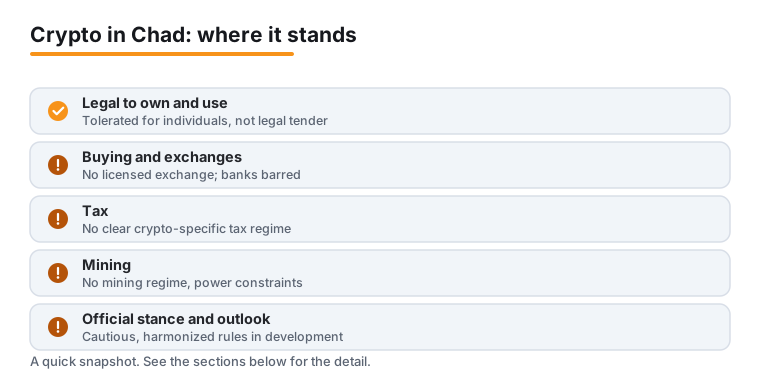
Quick answer — Chad, 2026
- Legal: Tolerated for individuals, restricted for banks, not legal tender, partly framed under CEMAC rules
- Tax: No clear crypto-specific tax; general rules may apply, treatment uncertain
- Buying: No domestic licensed exchange; use global exchanges or P2P
Chad is a member of the Economic and Monetary Community of Central Africa (CEMAC), a six-country bloc (Cameroon, Central African Republic, Chad, Equatorial Guinea, Gabon and the Republic of the Congo) that shares one currency, the Central African CFA franc (XAF), and one central bank, the Bank of Central African States (BEAC). Because monetary and financial-market rules are set regionally rather than purely in N'Djamena, Chad's treatment of Bitcoin and other crypto-assets is shaped mainly by CEMAC institutions: BEAC, the banking supervisor COBAC and the financial-market regulator COSUMAF. The headline position is cautious. Crypto is not legal tender and banks are barred from touching it, yet a regional financial-market general regulation adopted by COSUMAF in 2023 created a licensing route for digital-asset service providers, with key implementing rules still being finalised.
This page explains what that means in practice for anyone in Chad who wants to buy, hold, send or mine crypto, who the regulators are, and how the rules are evolving in 2025 and 2026. It is general information as of 2026 and is NOT legal, tax or financial advice. Crypto rules in the CEMAC zone are changing, so always verify the current position with BEAC and COSUMAF and a qualified local professional before acting. For broader context see our guide to crypto regulation and our country regulation hub.
On this page: Legal status · Who regulates it · Taxes · How to buy · Mining
Is Bitcoin and crypto legal in Chad?
There is no national Chadian law that criminalises a private individual for owning Bitcoin, and there is no law that recognises crypto as money. Bitcoin is not legal tender; the only legal tender in Chad is the Central African CFA franc (XAF). An individual who buys and holds crypto privately is generally not breaking a specific Chadian statute.
The key constraints are regional. A May 2022 directive from the Central African Banking Commission (COBAC) prohibits regulated banks, microfinance institutions and payment providers across the CEMAC zone from facilitating, holding, exchanging, converting or settling crypto transactions. Separately, BEAC has publicly opposed treating cryptocurrencies as a regional currency, citing risks to monetary sovereignty, foreign-exchange reserves and financial stability. So the honest summary is: tolerated for individuals, restricted for institutions, not recognised as currency, and partly framed but not yet fully regulated. BEAC said in May 2026 that publication of the future CEMAC crypto framework was expected during 2026, but no text has been published and no crypto item appeared on the agenda when the UMAC Ministerial Committee met in N'Djamena on 22 July 2026. Treat any specific claim as provisional and confirm it with the official sources listed at the foot of this page.
Who regulates crypto in Chad?
Chad does not regulate crypto through a single national agency. Authority is shared among CEMAC bodies and Chadian ministries:
- BEAC (Bank of Central African States): the regional central bank for CEMAC. It issues and manages the CFA franc, sets monetary policy, and has prioritised monetary sovereignty over private digital currencies.
- COBAC (Central African Banking Commission): the single banking supervisor for the six CEMAC states, institutionally part of BEAC and based in Libreville. Its May 2022 directive restricts regulated institutions from facilitating crypto transactions.
- COSUMAF (Commission de Surveillance du Marche Financier de l'Afrique Centrale): the regional financial-market regulator. Under its 2023 general regulation it is the body that licenses digital-asset service providers and is drafting the detailed implementing rules.
- GABAC: the CEMAC anti-money-laundering action group, which coordinates AML and counter-terrorist-financing standards across the region.
- Chadian national authorities: including the Ministry of Finance and Budget and tax and financial-intelligence bodies, which apply general financial-crime and tax rules.
Because these bodies operate at the regional level, the most authoritative starting points for Chad are BEAC and COSUMAF rather than a dedicated Chad-only crypto regulator.
Key laws and frameworks
Chad has no standalone national cryptocurrency act. The rules that matter come from CEMAC-wide instruments:
- The COSUMAF financial-market regulation (Regulation No. 01/22, adopted 21 July 2022). This text organised the CEMAC financial market and introduced the legal category of digital tokens, empowering COSUMAF over digital-asset activity. The detailed licensing framework for digital-asset service providers then came in COSUMAF's general regulation adopted on 23 May 2023 (see the licensing section below). Together these are a permissive, market-oriented step rather than a ban, but they left many operational rules to be filled in later.
- The COBAC directive of May 2022. This prohibits banks, microfinance institutions and payment providers from subscribing to, holding, exchanging, converting or settling crypto, requires them to monitor and report crypto-linked transactions, and confirms that only the CFA franc may be used for institutional CFA accounts.
The two instruments pull in different directions: COSUMAF opens a licensed market channel while COBAC closes the banking channel. The framework is therefore widely described as unfinished, because COSUMAF's general regulation and implementing instructions on token offerings, capital requirements, AML, cybersecurity and the precise conditions for digital-asset services were still being developed. Do not assume any specific provision is fully in force; verify with COSUMAF.
Licensing and registration of exchanges and VASPs
Under COSUMAF's general regulation adopted on 23 May 2023, anyone wishing to provide digital-asset services within the CEMAC zone must obtain authorisation (an agrement) from COSUMAF as a digital-asset service provider. Once licensed, such providers become financial-market intermediaries of CEMAC, on the same footing as brokerage firms, management companies, financial advisers and crowdfunding platforms.
The services covered include:
- custody of digital assets on behalf of third parties;
- buying and selling digital assets against legal-tender currency or other digital assets;
- operating a digital-asset trading platform;
- receiving and transmitting orders for third parties, portfolio management, advice and placement of tokens.
An application dossier is submitted to COSUMAF and, according to legal summaries of the CEMAC rules, is expected to include proof of the required minimum capital, audited financial statements, IT-security and data-protection policies, and a description of the digital-asset services to be offered. In practice, however, the detailed conditions, capital thresholds and application procedures depend on COSUMAF's implementing instructions, which have continued to be finalised, and no PSAN authorisation had been granted at the regional level. As a result, there is no established, openly operating, domestically licensed crypto exchange in Chad today. Any platform claiming to be CEMAC-licensed should be verified directly against COSUMAF's own records before you rely on it.
Crypto taxation in Chad
Chad has not published a crypto-specific tax regime. Chad's finance law for the 2026 financial year, adopted on 26 December 2025 and applying from 1 January 2026, restructured VAT and extended it to digital platforms but created no crypto-asset rate, allowance or threshold. Legal commentators describe the wider CEMAC zone as having no dedicated legislation on the taxation of virtual-currency transactions, so Chad is not an outlier here. General Chadian tax rules apply by default: personal income tax runs on a progressive scale from 0 percent on the first 800,000 XAF up to 30 percent above 12,000,000 XAF, capital gains for individuals are taxed at a flat 20 percent, and company profits are taxed at 35 percent with a minimum tax of 1.5 percent of turnover. No Chadian circular has been published saying which of these a crypto disposal falls into, so the unsettled question is classification rather than the rate.
Do not assume any specific tax outcome. Keep full records of your transactions (dates, amounts, counterparties and CFA-franc values), and confirm your obligations with a qualified Chadian tax adviser and the national tax authority before filing. For general background on how crypto can be taxed, see our crypto taxes guide, but treat it as context only and not as a statement of Chadian law.
AML and KYC rules
Anti-money-laundering (AML) and counter-terrorist-financing (CFT) obligations apply in Chad through the CEMAC framework and the regional action group GABAC, alongside Chad's own financial-intelligence and financial-crime rules. BEAC has explicitly cited money-laundering and terrorist-financing risks as a reason for its cautious stance on crypto.
The COBAC directive requires regulated institutions to identify, monitor and report crypto-linked transactions, which means banks are expected to flag rather than facilitate crypto flows. For licensed digital-asset service providers, AML and know-your-customer (KYC) standards are among the implementing rules COSUMAF has been developing under its 2023 general regulation. In practice this means reputable platforms serving the region will ask users for identity verification, and using crypto does not remove AML obligations. Be wary of any service that requires no identity checks at all.
Buying and using crypto in practice
Because local banks are steered away from crypto and no domestic licensed exchange is openly operating, Chadians who acquire crypto typically rely on:
- Global exchanges that accept users from the region, subject to each platform's own onboarding, identity-verification and country-availability rules; and
- Peer-to-peer (P2P) marketplaces, where buyers and sellers trade directly, often settling with mobile money or cash.
The following is a neutral description of how people in restricted markets typically proceed, not a recommendation, and you must ensure any activity complies with the rules that apply to you. Confirm a platform genuinely serves Chad before committing; complete identity verification on reputable services; fund and trade carefully, using built-in escrow and checking counterparty reputation on P2P; move coins you intend to keep into a wallet you control and back up recovery phrases offline; and retain records for tax and compliance. Converting back into CFA francs through official channels can be difficult, so factor in exit friction. Stay alert to fake platforms, impersonation, advance-fee scams and unrealistic rates, which are common in markets lacking formal infrastructure.
Bitcoin mining in Chad
Bitcoin mining is the energy-intensive process of validating transactions and minting new coins with specialised hardware. Two structural factors make large-scale mining difficult in Chad. First, electricity: Chad has one of the lowest electrification rates in the world, with limited grid coverage and frequent supply constraints, which is the opposite of the cheap, abundant, reliable power mining requires. Second, regulatory uncertainty: there is no Chad-specific licensing regime for mining, and selling mined coins back into the formal system would run into the same banking restrictions described above.
There is no public evidence of significant industrial mining in Chad. The country's solar potential could in theory support energy projects that mining might one day tap, but that remains speculative rather than an established industry. Anyone considering mining should treat the legal status as unsettled, check electricity rights and hardware-import rules, and seek local legal advice first.
Recent developments (2025 to 2026)
The most important recent trend is a coordinated push toward a single, harmonised CEMAC crypto-asset framework. BEAC used the region's first fintech forum, held in Douala from 29 to 31 January 2024, to reiterate its opposition to recognising cryptocurrencies, with its Director General of Operations stating that cryptocurrencies were not yet part of the central bank model and warning that buying crypto from abroad depletes foreign-exchange reserves. In February 2026, BEAC then held a capacity-building workshop with COBAC and COSUMAF, working with the International Monetary Fund, to prepare a sub-regional crypto-asset regulatory framework, with publication expected later in 2026. Regional authorities, including the AML body GABAC, have been coordinating on this work.
In parallel, BEAC has signalled a clear preference for a sovereign digital CFA franc over private tokens. Speaking at an international conference on crypto-assets in May 2026, BEAC Governor Yvon Sana Bangui said the zone would have only one parity of one CFA franc to one digital CFA franc, framing it as a matter of monetary sovereignty. BEAC has indicated it would permit only a stablecoin pegged one-for-one to the CFA franc and issued by the central bank, ruling out dollar-backed stablecoins across the zone to guard against what it calls digital dollarisation. The practical takeaway for Chad is that the cautious status quo still holds today, but clearer rules, whether more permissive or more restrictive, may follow. Watch announcements from BEAC and COSUMAF for changes.
Consumer risks and protection
Crypto users in Chad face several specific risks:
- Limited recourse. With the banking system largely closed to crypto and the licensing framework still being finalised, there is little formal consumer protection if a platform fails or a counterparty defrauds you.
- On- and off-ramp friction. Converting between CFA francs and crypto often depends on informal P2P channels, which carry counterparty and price-volatility risk.
- Fraud. Fake exchanges, impersonation, advance-fee scams, fake Bitcoin ATM advertisements and unrealistic returns are common where formal infrastructure is thin. COSUMAF has issued public alerts warning against unauthorised crypto-asset offers.
- Volatility and custody. Prices can swing sharply, and self-custody means you alone are responsible for your keys.
- Regulatory risk. The framework is evolving and rules could tighten.
Protect yourself by verifying any platform against official records, never investing money you cannot afford to lose, avoiding offers that sound too good to be true, and seeking qualified local advice. None of this is investment advice.
Official sources and how to verify
Because crypto rules in Chad are regional and changing, always confirm the current position directly with the official bodies rather than relying on third-party summaries:
- Bank of Central African States (BEAC): the regional central bank for CEMAC, including Chad; the authoritative source on monetary policy, the CFA franc and any digital-currency initiative.
- Central African Banking Commission (COBAC): the banking supervisor that issued the 2022 directive restricting banks from facilitating crypto.
- COSUMAF: the regional financial-market regulator responsible for licensing digital-asset service providers and for the implementing rules of its 2023 general regulation; it also publishes investor alerts about unauthorised crypto offers.
For Chad-specific tax and financial-crime questions, also consult the Chadian Ministry of Finance and the national tax authority. This page is general information as of 2026 and is NOT legal advice; verify the current rules with BEAC and COSUMAF and a qualified local professional before acting. See also our crypto regulation guide.
What is changing, and when
As of August 2026 Chad has no national crypto law and the CEMAC regional framework that would create one has not been published. BEAC said in May 2026 that publication of the future CEMAC crypto framework was expected during that year and called it a key step, quoting Governor Yvon Sana Bangui on the digital CFA franc: "Nous n'aurons qu'une seule parité : un franc CFA pour un franc CFA numérique" (FinancesAO, 12 May 2026).
The body that adopts CEMAC regulations is the UMAC Ministerial Committee. It held its second ordinary session of 2026 on 22 July 2026 in N'Djamena. The reported agenda covered the CEMAC economic and financial situation, foreign exchange reserves and exchange regulation, CEMAC-IMF cooperation, the central bank's 2026 revised budget, banking sector reform, payment services and banking mediation, COSUMAF's 2025 annual report and the GABAC file. No crypto-asset text was among the items, and ministers renewed their commitment to IMF cooperation (Alwihda Info, 23 July 2026; ATPE). The framework therefore remains pending, not imminent.
Two workstreams sit behind it. BEAC ran a five-day technical seminar in Yaoundé from 23 to 27 February 2026 with the IMF, the Financial Stability Board, COBAC, COSUMAF and GABAC, on central bank digital currencies and crypto-asset regulation, covering financial stability, financial inclusion, the legal framework and anti-money-laundering integrity (GABAC; FinDev Gateway, 26 March 2026). Separately, COSUMAF's priority actions set out blockchain proofs of concept, a guide for the public and professionals, and a dedicated fintech space on its website where operators can engage with the regulator (Droit, Médias et Finance).
| Item | Stage, August 2026 | Expected timing | What it would mean in Chad |
|---|---|---|---|
| CEMAC harmonised crypto-asset framework (BEAC with IMF) | Announced, no text published, not tabled at the 22 July 2026 UMAC session | Publication expected during 2026 per BEAC; no adoption date fixed | First crypto-specific rulebook applying in Chad, covering exchanges, custody and token issuance |
| Digital CFA franc | Announced, study stage | No launch or pilot date published | Central bank money at one-to-one parity, not a legalisation of Bitcoin or stablecoins |
| First COSUMAF PSAN licence | Applications under examination since July 2025; none publicly confirmed granted | No calendar communicated by COSUMAF | First lawful route for an exchange to serve Chadian customers under regional supervision |
| Chad national crypto or digital asset bill | None identified in parliament or the gazette | Not stated | Chad's recent digital legislating is telecoms, not crypto |
Chad's own recent digital law-making illustrates the point. Parliament adopted on 23 December 2025, by 65 votes in favour of the 67 cast, a law ratifying ordonnance n°011/PR/2025, which amends article 18 of loi n°013/PR/2014 on electronic communications. It modernises telecoms rules and says nothing about digital assets or electronic money (Walaw, 26 December 2025).
The named rules that already bind crypto activity in Chad
Chad has no crypto statute of its own. Named regional instruments do the work instead. Note that the COBAC prohibition is described in legal commentary as a decision of May 2022 but carries no instrument number in the sources located, and it does not appear on BEAC's published list of COBAC regulations (4M Legal and Tax; BEAC, COBAC regulations).
| Instrument | Date | What it does | Who it binds |
|---|---|---|---|
| COBAC decision barring regulated financial institutions from facilitating crypto transactions | May 2022, no instrument number located | Bars supervised financial institutions and their partners from facilitating any type of crypto-asset transaction | Banks, microfinance institutions, payment providers |
| COSUMAF Règlement Général | Adopted 23 May 2023, in force 24 May 2023 | Creates the PSAN status, reserves placement of digital tokens to licensed PSANs, and sets minimum fully paid-up share capital of 300,000,000 FCFA for market intermediaries, rising to 1,000,000,000 FCFA where acting as depositary of a collective investment scheme | Exchanges, custodians, brokers, token issuers |
| Règlement N°02/24/CEMAC/UMAC/CM | December 2024 | Replaces the anti-money-laundering regulation of 11 April 2016, runs to 186 articles against 166, defines actifs virtuels and prestataires de services d'actifs virtuels and brings them expressly into scope | Virtual asset service providers, banks, reporting entities |
| Instruction COSUMAF n°46-25, transmitted by lettre circulaire n°001-2026 of 19 February 2026 | 15 December 2025 | Requires prior COSUMAF approval of directors and senior managers of supervised entities including PSANs, on honourability and competence conditions, with a transition period that closed on 19 May 2026 | Founders, boards and senior management of digital asset firms |
The anti-money-laundering regulation replaced Règlement n°01/CEMAC/UMAC/CM of 11 April 2016 (CEMAC texts, Secrétariat Général du Gouvernement). GABAC ran dissemination seminars on the new text in N'Djamena from 17 to 21 November 2025 (GABAC). One caution on the citation: GABAC dates Règlement N°02/24 to 24 December 2024, while legal commentary dates it to 20 December 2024 and GABAC assigns that day to a separate text on targeted financial sanctions (Kalieu Elongo; text of Règlement N°02/24/CEMAC/UMAC/CM). The exact day should be checked against the gazette.
COSUMAF set out in July 2025 which businesses need a PSAN licence:
- Operators of cryptocurrency exchange platforms
- Digital asset custody providers
- Crypto payment service providers
- Trading platforms
- Digital asset brokers
- Token issuers, including ICOs and STOs
- Other digital asset investment service providers
At the same meeting, held on 25 July 2025 at COSUMAF's headquarters in Libreville, the regulator launched a census of digital asset service providers operating in CEMAC and said the first licence applications were already under examination, assessed on management competence and integrity, anti-money-laundering compliance, protection of client assets, data protection, information system security and risk controls (Droit, Médias et Finance, 29 July 2025). Yellow Card publicly began talks toward the first CEMAC PSAN licence in June 2025, and COSUMAF communicated no official calendar for the procedure (EcoMatin, 26 June 2025).
What Chad's tax code actually charges
Chad's finance law for the 2026 financial year was adopted on 26 December 2025 and applies from 1 January 2026. It restructured VAT, extended VAT collection and remittance to national and foreign digital platforms, introduced electronic invoicing obligations and tied VAT deductibility and refunds to the centralised e-Tax system. It contains no crypto-asset or digital-asset provision (Alwihda Info, 30 December 2025; VATabout, 2 March 2026).
So a Chadian taxpayer selling crypto falls back on the general tax code. These are the rates that exist:
| Tax | Rate | Source |
|---|---|---|
| Personal income tax on work income | 0 percent up to 800,000 XAF, then 10.5 percent to 6,000,000, 15 percent to 7,500,000, 20 percent to 9,000,000, 25 percent to 12,000,000, and 30 percent above 12,000,000 XAF | PwC Chad, last reviewed 12 August 2024 |
| Capital gains, individuals | 20 percent flat | PwC Chad, last reviewed 12 August 2024 |
| Corporate income tax | 35 percent | PwC Chad, last reviewed 12 August 2024 |
| Minimum corporate tax | 1.5 percent of turnover, filed and paid monthly for companies under the normal or simplified regime | PwC Chad, last reviewed 12 August 2024 |
| VAT | 17.5 percent standard, 9 percent reduced, 0 percent on exports and international transport | Chad finance law 2026, in force 1 January 2026 |
Rates confirmed at PwC Chad, personal income tax and PwC Chad, corporate income tax. Those summaries were last reviewed in August 2024 and so predate the 2026 finance law. No Chadian tax circular has been published applying any of these rates to a crypto disposal, so the open question is classification, capital gain against business profit, rather than the rate.
Chad-specific warnings and enforcement touchpoints
- In July 2025 the Ministère des Finances, du Budget, de l'Économie, du Plan et de la Coopération Internationale published a communiqué denying a fraudulent "Note d'information" circulating on social media that claimed to announce a state-backed cryptocurrency investment campaign. The ministry described it as "une tentative d'escroquerie organisée par des individus malintentionnés", warned citizens against sharing personal or financial data on unofficial channels such as WhatsApp, and said it communicates only through official press releases, its institutional website and certified accounts (Africa Press, 23 July 2025). This is the closest thing Chad has to an official consumer warning on crypto.
- GABAC held the launch seminar for its money laundering, terrorist financing and proliferation financing typologies study at the Hôtel de l'Amitié in N'Djamena from 10 to 14 November 2025, and ran dissemination seminars on the new CEMAC anti-money-laundering regulations at the same venue from 17 to 21 November 2025 (GABAC).
- Suspicious transaction reporting in Chad goes to the national financial intelligence agency (ANIF). Règlement N°02/24/CEMAC/UMAC/CM reinforces the ANIFs' role and carries severe administrative and criminal penalties (Règlement N°02/24/CEMAC/UMAC/CM).
- No crypto-specific COBAC regulation appears on BEAC's published list, where the most recent entry is Règlement N°01/CEMAC/UMAC/COBAC of 20 December 2024 on single approval of credit institutions (BEAC, COBAC regulations). BEAC's most recent published monetary policy decision is Decision No. 01/CPM/2026 of 29 June 2026 on benchmark rates, and no crypto instrument appears among its committee decisions (BEAC, Comité de Politique Monétaire).
Frequently asked questions
Is Bitcoin legal in Chad?
Owning Bitcoin is not specifically criminalised for individuals in Chad, but it is not legal tender and is not recognised as money. Only the Central African CFA franc is legal tender. A May 2022 COBAC directive bars banks and payment providers across the CEMAC zone from facilitating crypto, while a 2023 COSUMAF general regulation created a licensing route for digital-asset service providers whose detailed rules are still being finalised. The position is best described as tolerated for individuals but restricted institutionally. Verify the current rules with BEAC and COSUMAF before acting.
Who regulates cryptocurrency in Chad?
Chad regulates crypto through CEMAC bodies rather than a single national agency. The Bank of Central African States (BEAC) sets monetary policy and manages the CFA franc; the Central African Banking Commission (COBAC) supervises banks and issued the 2022 restriction; COSUMAF is the financial-market regulator that licenses digital-asset service providers; and GABAC coordinates anti-money-laundering standards. Chadian ministries apply general tax and financial-crime rules. A harmonised regional crypto framework has been in development since 2025.
Can a crypto exchange be licensed in Chad?
Under COSUMAF's general regulation adopted on 23 May 2023, a provider of digital-asset services in the CEMAC zone must obtain authorisation from COSUMAF and then operates as a CEMAC financial-market intermediary. Covered services include custody, buying and selling crypto, running trading platforms, order handling, portfolio management and advice. However, the detailed implementing rules were still being finalised through 2025, so no established domestically licensed exchange is openly operating in Chad yet. COSUMAF launched a census of digital asset service providers in July 2025 and said the first licence applications were already under examination, but no PSAN licence has been publicly confirmed as granted. Verify any licensing claim directly with COSUMAF.
Are there taxes on cryptocurrency in Chad?
Chad has not published a clear, crypto-specific tax regime, and we have not verified any particular rate or threshold for crypto gains. General income, business-profit or capital rules could in principle apply, but this is uncertain. Do not assume any specific treatment. Keep records of your transactions and confirm your obligations with a qualified Chadian tax adviser and the national tax authority. Our crypto taxes guide offers general background only, not Chadian law.
What AML and KYC rules apply to crypto in Chad?
AML and counter-terrorist-financing obligations apply through the CEMAC framework, the regional body GABAC and Chad's own financial-crime rules. BEAC has cited money-laundering and terrorism-financing risks as reasons for its caution. The COBAC directive requires banks to monitor and report crypto-linked transactions, and KYC standards are part of the implementing rules COSUMAF is developing for licensed providers. In practice, reputable platforms will require identity verification, and using crypto does not remove AML obligations.
Is a digital CFA franc coming to Chad?
BEAC has signalled a clear preference for a sovereign digital CFA franc over private tokens. At a May 2026 conference, BEAC Governor Yvon Sana Bangui said the zone would keep a single parity of one CFA franc to one digital CFA franc, and BEAC would permit only a central-bank stablecoin pegged one-for-one to the CFA franc, ruling out dollar-backed stablecoins across the zone. This is policy direction rather than a launched product. Watch BEAC's official channels for the latest. This is general information as of 2026, not legal or financial advice.
Has the CEMAC crypto framework changed in 2026?
The direction of travel is toward a single, harmonised CEMAC crypto-asset framework rather than a Chad-only law. In February 2026, BEAC held a capacity-building workshop with COBAC and COSUMAF, working with the International Monetary Fund, to prepare a sub-regional crypto-asset regulatory framework, with publication expected later in 2026. Until that text is published and in force, the earlier position holds: banks are restricted by the 2022 COBAC directive, while COSUMAF's 2023 general regulation provides a licensing route for digital-asset service providers. Verify the current status with BEAC and COSUMAF.
Does a crypto exchange in Chad have to hold minimum capital?
Under the CEMAC digital-asset rules, a provider must be authorised by COSUMAF, and legal summaries of the framework say the application dossier is expected to include proof of a required minimum capital, audited financial statements, IT-security and data-protection policies, and a description of the services offered. The exact capital thresholds sit in COSUMAF's implementing instructions, which have continued to be finalised, so confirm the current requirements directly with COSUMAF before relying on any figure.
Does the CEMAC anti-money-laundering regulation cover crypto?
Yes, since December 2024. Regulation No. 02/24/CEMAC/UMAC/CM replaced the regulation of 11 April 2016, runs to 186 articles against 166, and adds definitions of virtual assets and virtual asset service providers, expressly extending the anti-money-laundering perimeter to them. It requires customer and beneficial owner identification, record keeping and specific risk management measures for new technologies, and carries severe administrative and criminal penalties. Reporting goes to the national financial intelligence agency, ANIF. Sources differ on whether the regulation is dated 20 or 24 December 2024.
Which tax rates apply if I sell crypto in Chad?
There is no crypto-specific rule, so the general code applies. Personal income tax is progressive, from 0 percent on the first 800,000 XAF up to 30 percent above 12,000,000 XAF. Capital gains for individuals are taxed at a flat 20 percent, and company profits at 35 percent with a minimum tax of 1.5 percent of turnover. No Chadian circular states which of these a crypto disposal falls into, so classification is the unresolved point, not the rate.
Did Chad's 2026 finance law tax cryptocurrency?
No. The finance law for 2026, adopted 26 December 2025 and applying from 1 January 2026, restructured VAT into 17.5 percent standard, 9 percent reduced and 0 percent for exports and international transport, extended VAT collection to national and foreign digital platforms, and introduced electronic invoicing and mandatory use of the e-Tax system for deductions and refunds. It contains no crypto-asset provision.
Which crypto businesses need a COSUMAF licence?
COSUMAF listed seven categories in July 2025: exchange platform operators, digital asset custody providers, crypto payment service providers, trading platforms, digital asset brokers, token issuers including ICOs and STOs, and other digital asset investment service providers. Applications are assessed on management competence and integrity, anti-money-laundering compliance, protection of client assets, data protection, information system security and risk controls.
Do directors of a crypto firm need approval in the CEMAC zone?
Yes. COSUMAF Instruction No. 46-25 of 15 December 2025, transmitted by circular letter No. 001-2026 of 19 February 2026, requires prior approval of the board chair, board members, general manager, deputy general manager, general administrator and manager of supervised entities, explicitly including digital asset service providers. Candidates need a clean criminal record in every country of residence over the past ten years, a Master's degree in law, finance or economics or equivalent, and at least ten years of experience of which five on financial markets. The transition period for existing office holders closed on 19 May 2026.
Facts reviewed: 12 August 2026. Page updated: 12 August 2026.